IJEDR1802123
International Journal of Engineering Development and Research (
www.ijedr.org
)
666
Finite Element Method - Analysis Of Rotary Type
Vegetable Cleaner Machine
Anjali Meshram1 Dr. S. R. Ikhar2 Dr. A. V. Vanalkar3 1M.Tech. Student 2,3Associate Professor 1,2,3Department Of Mechanical Engineering
1,2,3K.D.K. College Of Engineering, Nagpur, Maharashtra, India.
_____________________________________________________________________________________________________ Abstract - Root vegetables and fruits should be cleaned before weighting and grading as in the harvesting process it leaves the soil and foreign materials stick to the vegetable surface. Soil and other foreign materials must be removed, especially for medium and heavy textured soils in which a pre-harvest irrigation is used to loosen the soil prior to hand harvesting. Washing of fruits and root vegetables is vital steps in any processing operation, which give attractive, polished and chemical free fruits and vegetables. At present time,washing of fruits and root vegetables is carried out manually which is very tedious and time consuming and expensive process. As we know that time and human power are the important concern,now a days in every field so there is a requirement as to be design and develop a vegetable cleaning machine which will reduce the required human effort and make their task easy. Main objective of this study is design and develop a vegetable cleaning machine, using CAD model and FEM-Analysis Techniques. In this study, the design calculations and CAD modeling and Finite Element Analysis of the vegetable cleaner machine is present to conclude the safe design.
Keywords - cleaning process, vegetable cleaning,CAD model.
_____________________________________________________________________________________________________ 1. Introduction
Root vegetables like potatos, sweet potatos, carrots, raddish, beet roots and similar vegetables need to be cleaned before transporting from field to the market. Washing of vegetables before selling it into the market, is an important primary process, which reduces the surface microbial load, while removing the field soil, dust and even residual pesticides and chemicals, thus leading to the value addition of the product at the farm level. In the practical form contamination of vegetables is generally due to unsanitary cultivation and marketing practices. The microorganisms and pesticides involved with the food if they remaine unsanitized, it can be harmful for a public health point of view, because they can lead to health hazard. At present there is no primary processing equipment like vegetable washers available in the market for small farmers or traders. Since washing of root vegetables before selling is a consumer’s requirement, an appropriate washer must be designed to reduce time and labor in cleaning of the root crop before subjecting it to sorting, grading and eventually selling in the market.Manual washing of root vegetables is a backbreaking job for everyone who does the work. Normally many Indian farmers follow a traditional method of cleaning the carrots, radish in which the roots are washed manually by hands and feet. So that there is need to design a rotary type vegetable cleaner for the utilisation of every farmer in India should be in affortable price.
Fig 1: Images of root vegetables 2.Design Calculations
1) Barrel dimensions Cleaning in 1 hour:
Total weight / total time = 2750 kg / 4 hours = 687.5 ≈ 690 kg/hour
[4min washing with 28 revolution per minute of barrel for single charge] Charge loading and unloading time approx = 6 min
Total time required for single charge = 6 + 4 = 10 min Hence,
60 /10 = 6 charge in 1 hour
IJEDR1802123
International Journal of Engineering Development and Research (
www.ijedr.org
)
667
Total barrel should be filled 1/6 for better cleaningConsidering the length of barrel = 1.47 m
π 4× d
2× l = 0.107 × 6
π 4× d
2× 1.47 = 0.107 × 6
d = 0.75 m
2) Torque calculation;
Considering total weight to be rotated is 150 Kg
150 × 9.81 = 1471.5 𝑁 𝑇 = 𝐹 × 𝑟
𝑇 = 1471.5 × 0.1 = 147.15 𝑁. 𝑚
3) Power calculation;
P=2πNT/60
P=(2×π×105×147.15)/60= 1618 watt
From the design calculations, following specifications are obtained.
690 Kg vegetables can be cleaned in 1 hour with 1.47 m length and 0.75 m diameter of barrel rotating at 28 revolutionper minute. From the design calculations performed in previous research structure supporting the whole system is safe.
3. CAD modeling of vegetable cleaner
Fig. 2 Detailing Drawing Of Vegetable Cleaner
In fig.2 Detailed CAD drawing of vegetable cleaner machine is given. With the correct diamensions, all parts are explain. This diagram shows the front view, top view and side view with the complete model.
IJEDR1802123
International Journal of Engineering Development and Research (
www.ijedr.org
)
668
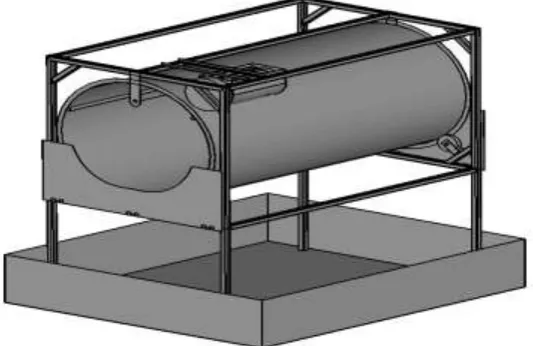
This is initial CAD model of the machine with the plane steel metal sheet. In which barrel, frame, and tank is provided with the motor.4. Finite Element Analysis
Maximum Displacement = 0.46 mm Fig. 4 FEA –MODEL
Maximum Displacement = 0.46 mm FIG. 5 FEA - MODEL
IJEDR1802123
International Journal of Engineering Development and Research (
www.ijedr.org
)
669
Maximum Stresses = 30.6 MPaFIG.6 FEA – MODE
Maximum Stresses = 30.6 MPa FIG.7 FEA- MODEL
In the given fig. 6 and 7 FEA – model of vegetable cleaner machine is shown in which the maximum stress pattern is shown that should be 30.6 MPa. Maximum stresses shows that barrel should be affected at this place. Blue pattern on the fig means that the design would be safe.
5. Results
From the Linear Static Analysis 0.46 mm maximum displacement and 30.6 MPa. Maximum stresses was obtained. The tabular format of machine can be explain in below table as
COMPONENT FRAME BARREL
MATERIAL SS304 SS304
YOUNGS MODULUS
210000 N/mm2 210000 N/mm2
POISSONS RATIO
0.29 0.29
DENSITY 7850 Kg/m3 7850 Kg/m3 YIELD STRESS 215 N/mm2 215 N/mm2
IJEDR1802123
International Journal of Engineering Development and Research (
www.ijedr.org
)
670
6. ConclusionThe paper involves the detailed design and analysis of vegetable cleaning machine. In the present study, designed and analysed of vegetable cleaner machine as per the company requirement. The FEM analysis of vegetable cleaning machine for validation of design is performed and the results obtained are shown in the safe zone as the stresses obtained are less and within the yield point stress of that material. Which means that given design is in the safe zone.
7. References
[1] An International Journal of Trend in Research and Development, ‘’Design, Development and Testing of Small Scale Mechanical Fruit Washer” by R. N. Kenghe ,A. P. Magar and K. R. Kenghe, Department of Agricultural Process Engineering, Mahatma Phule Krishi Vidyapeeth, Rahuri, India.
[2] IJRMET “Designing and Fabrication of Automatic Root Crop Washer” by Ravdeep Singh Ghuman, Rachit Khanna, Sidhant Singla, Preetpal Singh, Harvinder Singh , School of Mechanical Engineering, Chitkara University, Punjab, India.
[3] Design of a Small Scale Root Crop Washer by Michelle Choi, Isabella Han, Kourosh Mohtashami.
[4] Small–Scale Mechanical Carrot Washer for Research Sample Preparation by A. Moos, D. D. Steele, D. C. Kirkpatrick. [5] “Development of a manually operated root crop washer” Dawn C. P. Ambrose and S. J. K. Annamalai Central Institute of Agricultural Engineering, Regional Centre, Coimbatore-641 003, Tamil Nadu, India.
[6] Glob. Innov. Agric. Soc. Sci.,‘DEVELOPMENT AND PERFORMANCE EVALUATION OF CARROT WASHER’, GhulamSiddique, Abdul Aleem, GhulamHussain and Hafiz Ali Raza Agricultural Engineer AMRI Multan, Punjab Pakistan; https://www.scribd.com/document/343156177/Development-and-Performance-Evaluation-of-Carrot-washer#.
[7] Design Of A Vegetable Washer For The Foodsermce Industry By Toby J. Mendenhall, Tombossa D. Negusse, Stanley G. Solomon, Jr. And Randy R. Price Agricultural Engineering Department Oklahoma
State University Stillwater, Oklahoma
[8] International Journal of Agricultural Engineering, “Performance testing of stirrer type fruit washer” by A.P. Magar, M.D. Abuj, T.B. Bastewad and P.V. Adagale.