IJEDR1802149
International Journal of Engineering Development and Research (
www.ijedr.org
)
807
1Department of ECE, Punjabi University, Patiala, Punjab, India_____________________________________________________________________________________________________
Abstract— In digital circuits multiplier has important role in calculations. These are the main important blocks in many applications like digital signal processing, microprocessor and microcomputers. The time that required to doing calculation in multiplier is reduced by using Vedic multipliers. Vedic Mathematics is the fastest and low power multiplier. Vedic Mathematics have sixteen sutras but “Urdhva Tiryagbhyam” is mainly used .In this paper 16 bit Vedic multiplier is designed by using modified full adders which has used less number of slices and delay is reduced when compared to existing techniques of Vedic Multiplier. In this paper 16 bit Vedic Multiplier using modified full adder 2 has better performance in terms of delay, memory utilization and number of slices as compare to other modified full adders. Simulation and synthesis are carried on XILINX ISE 14.4 software.
Keyword – Vedic Multiplier, Full Adder using Multiplexer, Ripple Carry Adder, VLSI.
_____________________________________________________________________________________________________
I.INTRODUCTION
Vedic Mathematics is very simple and easy to understand. It improves the speed of calculation. The word ‘Vedic’ is obtained from the word ‘Veda’ and its meaning is “store house of all knowledge”. Vedic multiplier has applications in many fields like Microprocessors, Fourier transform, Communication and Digital Signal Processing. Ancient Vedic mathematics consists of 16 Sutras and they are related to different branches of mathematics like algebra, arithmetic and geometry. Vedic Multiplier mainly used “Urdhva Tiryagbhyam” (Vertically and Crosswise) which is used for both binary and decimal multiplication. This technique contains generation of partial products and then performs addition simultaneously. This method can be used for 2x2, 4x4……NxN bit multiplication. Vedic Multiplier reduces the power consumption and gives results in less time.
II.VEDIC MULTIPLIER
Vedic Multiplier is designed by using adders and multipliers. In this paper 16 bit Vedic multiplier is designed by using 4 full adders which are designed by using different methods. These modified full adders give different results.
1.
FULL ADDER USING HALF ADDERSIn this full adder it is design by using two half adders and an OR Gate. Inputs are ‘a’, ‘b’, ‘cin’ and outputs are ‘sum’ and ‘carry’.
Fig.1: Full Adder using Half Adders
2.
MODIFIEDFULLADDER1IJEDR1802149
International Journal of Engineering Development and Research (
www.ijedr.org
)
808
Fig.2: Modified Full Adder 13.
MODIFIEDFULLADDER2In this full adder two 4:1 multiplexer are used. Inputs for first multiplexer are ‘c’, ‘not c’, ‘not c’, ‘c’ and selection line are ‘a’ and ‘b’ and the output is ‘sum’. Whereas inputs for the second multiplexer are ‘0’,’c’,’c’,’1’ and selection line are ‘a’ and ‘b’ and the output is ‘carry’.
Fig.3: Modified Full Adder 2
4.
MODIFIED FULL ADDER 3In this full adder XOR Gate, XNOR Gate and 2:1 multiplexer is used. Inputs for XOR Gate are ‘a’ and ‘b’ and the intermediate output is ‘y’. Inputs for XNOR Gate are ‘a’ and ‘b’ and intermediate output is ‘z’. Inputs for first multiplexer are ‘y’ and ‘z’ and selection line is ‘cin’ and the output is ‘sum’. Inputs for the second multiplexer are ‘a’, ‘cin’ and the selection line is ‘y’ and the output is ‘carry’.
Fig.4: Modified Full Adder 3
By using AOI logic gate counts for various bit adders using full adders are as follows: 1. 4Bit Adder: It consists of 1 half adder and 3 full adders.
2. 6 Bit Adder: It consists of one 4 bit adder and 2 full adders. 3. 8 Bit Adder: It consists of one 6 bit adder and 2 full adders. 4. 12 Bit Adder: It consists of one 8 bit adder and 4 full adders. 5. 16 Bit Adder: It consists of one 12 bit adder and 4 full adders. 6. 24 Bit Adder: It consists of one 16 bit adder and 8 full adders.
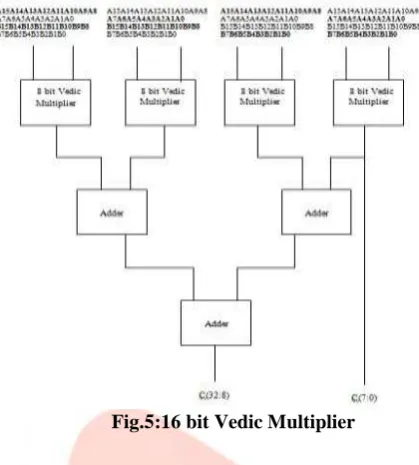
These adders are used to design 16 bit Vedic Multiplier.
III.PROPOSED METHODOLOGY
IJEDR1802149
International Journal of Engineering Development and Research (
www.ijedr.org
)
809
Fig.5:16 bit Vedic MultiplierIV.RESULTS
The proposed methodology is simulated and synthesized on Xilinx ISE 14.4 software.
Fig.6:Simulation Results of 16 bit Vedic Multiplier
The first input for 16 bit Vedic multiplier ‘a’ is “0000000000001111” and ‘b’ is “0000000000001111” and the output ‘c’ is “00000000000000000000000011100001”. Second input for ‘a’ is “0000000000000101” and ‘b’ is “0000000000000101” and the output ‘c’ is “00000000000000000000000000011001”. Third input for ‘a’ is “0011100000110101” and ‘b’ is “0000000000000011” and the output ‘c’ is “000000000000000010101000100111”.
IJEDR1802149
International Journal of Engineering Development and Research (
www.ijedr.org
)
810
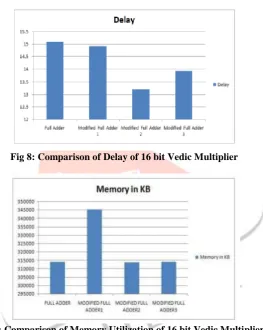
Fig 7: Comparison of Number of slices of 16 bit Vedic MultiplierFig 8: Comparison of Delay of 16 bit Vedic Multiplier
Fig 9: Comparison of Memory Utilization of 16 bit Vedic Multiplier
V.CONCLUSION
This paper presents the proposed architecture of Vedic multiplier by using different adders. In this paper modified full adders are used to design 16 bit Vedic multiplier which improves the performance of 8 bit Vedic multiplier by calculating delay and memory utilization. Modified full adder 2 has better performance in terms of delay, number of slices and memory utilization.
REFERENCES
[1]Manpreet Kaur,Amandeep Kaur “Review Paper on Vedic Multiplier by Using Different Methods” International Journal of Engineering Development and Research (IJEDR) Volume 6, Issue 2(June 2018).
[2]VijayaLakshmi “Performance Analysis For Vedic Multiplier Using Modified Full Adders” International Conference on Innovations in Power and Advanced Computing Technologies (iPACT) IEEE (2017).
[3]G. Challa Ram, D. Sudha Rani, Y. RamaLakshmanna, K.Bala Sindhuri “Area Efficient Modified Vedic Multiplier” 2016 International Conference On Circuit, Power And Computing Technologies, IEEE (March 2016).
[4]Paras Gulati,Harsh Yadav, Manoj Kumar Taleja “Implementation of an efficient Multiplier Using the Vedic Multiplication Algorithm” 2016 International Conference on Computing, Communication and Automation (ICCCA) IEEE (2016).
[5]M. Akila, C. Gowribala, S. Maflin Shaby “Implementation of High Speed Vedic Multiplier using Modified Adder’ 2016 International Conference on Communication and Signal Processing, IEEE(April 2016).