Enriching the Text Mining Capabilities by Transforming
the Text Mining Domain to Chess Game Domain to
Simulate Future Scenarios
Madeeh Al-Gedawy
Information and Decision Support Center Egyptian Cabinet
Osman Hegazy
Department of Information Systems Cairo University
ABSTRACT
Text mining depends on analyzing the text on different levels: words, sentences, paragraphs, articles and the whole corpus. However, following the fixed rules of analysis from the very start to the end proved to be poor in building trends and sequence analysis of respectful quality. Our point of view is that we need a more flexible approach to predict the writer's strategy; this strategy depends on 2 factors: 1) Information gained on each level. 2) Feedback information from a lower to a higher level in order to redirect the analysis assumptions to a more fruitful route. Such general stream of thinking indicates a possible resemblance with the use of Agile [16] technique in system analysis and design.
We are suggesting a technique relies on the adoption of a main strategy with possibility to reassess and act based on a closer feedback loops; such feature resembles to great extent the Chess game where we have a master plan and changeable tactics that depends on the feedback information gathered on every move. The paper presents this new methodology that enriches the results of text mining by using its output as parameters for a Chess game; the new domain has very rich historical records that help researchers in building future scenarios which is too hard to be accomplished within the text mining domain itself. This issue can largely affect the decision makers and researchers in politics and sociology. The reader may guess that some of the implementation is overlapped with classical simultaneous games or Chess Min-Max algorithm; which is not true[1].
Keywords
Frequency Analysis – Sentiment Analysis – Chess – CQL – Markov Processes – Heijden–PGN.
1. INTRODUCTION
This paper presents a new methodology that helps in illustrating different future scenarios that can occur as a chain reaction to the current social or political situations as depicted by analyzing newspapers as an online discourse. Scenarios detection and simulation is done through Chess board and Chess literature. The Chess board, pieces mapping, game fundamental development theme (sequence of pieces' moves) are all initialized through Text Mining and Markov processes. A huge database of Chess games - named 'Heijden database' [3] - is searched for similar game theme using a specific Chess language query named 'CQL' [4]. Each found game is an alternative scenario which must be taken into consideration.
The paper is organized as follows. First, in the following section the Text Mining techniques used to feed the Chess game parameters are discussed. Next, the newspapers' articles used in Text Mining analysis and the 'Heijden' Chess data source are described. The following section discusses the technique used to build Chess scenarios. The later section demonstrates a political case study in details. The final section gives a quick summary and conclusions.
2 TEXT MINING TECHNIQUES
Text Mining looks for hidden information and employs common algorithms from AI, machine learning and statistics. While data mining deals with structured numeric data, text mining deals with unstructured text. Text Mining is a bunch of statistical techniques to transform the text into numeric data which is much easier to analyze.
2.1 Levels of Text Mining Processing [5]
2.1.1 Word Level
Every word has some properties, the most important are: Homonymy: same form, different meanings Polysemy: same form, related meanings Synonymy
Hyponymy: hierarchical relation: breakfast, meal While parsing then text, removing words that do not carry information from a non-linguistic view. These words are called stopping words. For example, in English: a, about, above, alone, he, does, why. In Classic Arabic:
اذامل ،ًف ،ام ،لعفٌ ،الله ،يرلا ،وه And in Colloquial Arabic: فٌاش ،شهلعم ،ـمدنف اٌ ،ىللا
After parsing, beginning to stem every word, stemming means to correlate a word to its normalized form, because different forms are problematic because they have different spelling while their meanings are the same. For example, in English: learn-learns-learned-learning. In Arabic, رٍملات-رملتت-رٍملت. To solve the problem, stemming procedure is broken into
2.1.2 Sentence Level
While parsing, some words are noticed to appear sequentially a lot of times. This is called N-Gram which is defined as a sequence of consecutive words that appear in the indexed documents and it must have a threshold of frequencies. Example: ‘ةٍساٍس تاعلاطتسا’is an N-Gram of level 2.
If the application focus is sentence translation, it will take place here. Translation process may be stated as decoding the meaning of the source language text and them re-encoding the meaning in the target language text. Several approaches may be adopted here.
2.1.3 Document Level
This task aims to get a summarized version of the original document. Here there are two methods to use:
Knowledge-based (summary-generation): discover meaning and produce a text within length
constraints.
Selection-based (sentence-extraction): based of weighting model.
The summarization is based on weighting words; focus on word of greater weights. Words are weighed from 4 aspects:
Thematic: simply the word frequency Location: opening and closing words are given
greater weight than other words in the same sentence
Heading: the header of the document is weighted higher
Cue: sentences stamped with expressions like: hence, significant are given more weights
2.2Frequency Analysis
The tf-idfweight (term frequency of inverse document frequency) weight is often used in information retrieval and text mining. This weight is a statistical measure used to assess the importance of a word is to a document collection or corpus. The importance increases proportionally to the number of times a word appears in the document but is offset by the frequency of word in the corpus. System variations of tf-idf weighting are often used by search engines as a central tool in scoring and ranking.
One of the simplest classifications is calculated by adding the tf-idffor each search term; more sophisticated ranking functions are variations of this simple model. The simplest formula for tf-idf [6]:
𝑡𝑓 − 𝑖𝑑𝑓 =
#𝑜𝑓𝑜𝑐𝑐𝑢𝑟𝑟𝑒𝑛𝑐𝑒𝑠𝑜𝑓𝑡𝑒𝑟𝑚𝑡𝑖𝑛𝑡𝑖𝑠𝑑𝑜𝑐𝑢𝑚𝑒𝑛𝑡𝐷 ∗ log(# 𝑜𝑓𝑑𝑜𝑐𝑢𝑚𝑒𝑛𝑡𝑠𝑤𝑖𝑡 𝑚𝑒𝑛𝑡𝑖𝑜𝑛𝑜𝑓𝑡𝑒𝑟𝑚𝑡 𝑡𝑜𝑡𝑎𝑙 # 𝑜𝑓𝑑𝑜𝑐𝑢𝑚𝑒𝑛𝑡𝑠 )[15]
2.3Sentiment Analysis [7]:
Sentiment Analysis extracts emotions from text. Three types of analysis can be conducted here:
1. Polarization Analysis (positive – negative - neutral)
2. Subjectivity versus Objectivity Discourse [11] 3. Modes Analysis (angry – sarcastic – reverent –
skeptical – melancholic - etc)
For the polarization analysis conducted in this research, two dictionaries for Arabic positive and negative words have been built. The sentiment analysis is conducted per paragraph where Turney's method is applied. Turney's Method measures the Pointwise Mutual Information between every word in the paragraph and the words in the two dictionaries; this calculates the Sentiment Orientation (SO) for the word and then average SO for the whole paragraph is calculated. 𝑑SO(w) = log( hits(w NEAR {positive dictionary words} )hits({positive dictionary words}) / hits(w NEAR {negative dictionary words})hits ({negative dictionary words}) ) [9]
𝑆𝑂 𝑤
= (log 𝑖𝑡𝑠 𝑤𝑁𝑒𝑎𝑟 𝑝𝑜𝑠𝑖𝑡𝑖𝑣𝑒𝑑𝑖𝑐𝑡𝑖𝑜𝑛𝑎𝑟𝑦𝑤𝑜𝑟𝑑𝑠 𝑖𝑡𝑠 𝑝𝑜𝑠𝑖𝑡𝑖𝑣𝑒𝑑𝑖𝑐𝑡𝑖𝑜𝑛𝑎𝑟𝑦𝑤𝑜𝑟𝑑𝑠 log 𝑖𝑡𝑠 𝑤𝑁𝑒𝑎𝑟 𝑛𝑒𝑔𝑎𝑡𝑖𝑣𝑒𝑑𝑖𝑐𝑡𝑖𝑜𝑛𝑎𝑟𝑦𝑤𝑜𝑟𝑑𝑠 𝑖𝑡𝑠 𝑛𝑒𝑔𝑎𝑡𝑖𝑣𝑒𝑑𝑖𝑐𝑡𝑖𝑜𝑛𝑎𝑟𝑦𝑤𝑜𝑟𝑑𝑠 [9]
A negation rule is applied here. Every dictionary word found in the paragraph is allocated into a small context window (2 words before and 2 words after); if a negation word is found in these 4 words, the dictionary word is reversed from positive to negative and vice versa.
2.2Research done in using game theory for
enhancing text analytics
To great extent, this research is novel in mixing game theory and text analytics. Nevertheless, this research benefitted from some core ideas in game theory; especially: backward induction and applying Zermelo’s theorem in calculating the winning strategies.
3 DATA DESCRIPTION
3.1Articles used in Text Mining
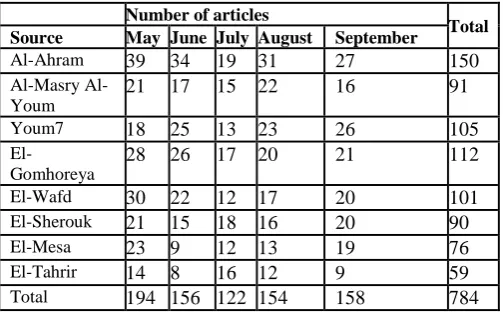
[image:2.595.292.544.567.723.2]This study depends on articles collected from May to September 2011 from eight newspapers' sites' articles. The articles that mention the Prime Minister Dr. EsamSharaf are the only ones get analyzed. The statistics of the articles mentioned Dr. Sharafis stated in the following table.
Table 1. Distribution of analyzed articles
Number of articles
Total Source May June July August September
Al-Ahram 39 34 19 31 27 150
Masry Al-Youm
21 17 15 22 16 91
Youm7 18 25 13 23 26 105
El-Gomhoreya
28 26 17 20 21 112
El-Wafd 30 22 12 17 20 101
El-Sherouk 21 15 18 16 20 90
El-Mesa 23 9 12 13 19 76
El-Tahrir 14 8 16 12 9 59
The articles acquisition is done through a desktop application that fetches those articles daily from the internet and stores them into the database then it does the text analytics upon the
[image:3.595.145.472.124.367.2]fetched filtered articles. A snapshot of the application is illustrated in the following figure.
Fig 1: Application used for articles acquisition
3.2'Heijden' Chess Database
The Heijden database is the largest collection of Chess games in the world; it contains 76132 games. It was created by Dr. Harold der Heijden. The games are written in a specific format designed for Chess games which stored as plain text; this format is named Portable Game Notation (PGN) [8]. A PGN file contains 2 types of notations:
1. Metadata a. Event b. Date c. White Player d. Black Player e. Result f. Moves Count g. Time Control 2. Game Moves
a. Pieces Moves b. Events
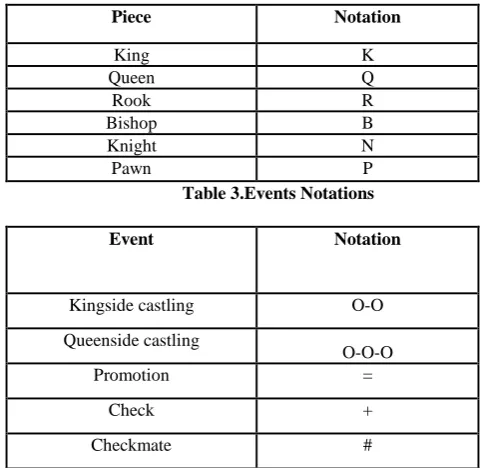
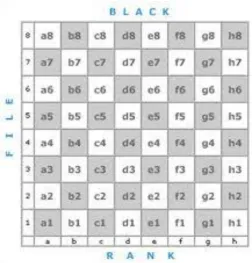
[image:3.595.307.549.419.653.2]The pieces (king – queen – rook –bishop – knight - pawn), events (castling – promotion – check - checkmate) and cells notations, moreover, an example of a PGN file are listed in the following tables.
Table 2.Pieces Notations
Piece Notation
King K
Queen Q
Rook R
Bishop B
Knight N
Pawn P
Table 3.Events Notations
Event Notation
Kingside castling O-O
Queenside castling
O-O-O
Promotion =
Check +
[image:3.595.86.195.479.594.2]Fig2:Squares Notations
Table 4. PGN game example
PGN game moves 1
. f4 d5 12.Nf2 Qd6
23.Ne6 Nxe6
34.g5hxg5 45.bxc4 bxc4 2.Nf3 Bg4 13.d3 c6
24.Bxe6+ Kb8
35.hxg5 Kd8
46.Kf5 c3
3.e3 Bxf3 14.e4 fxe4
25.Qc5 Nxf5
36.Kf2 Ne7
47.Ba4 Nh4 + 4.Qxf3 e6 15.dxe4
Nc7
26.Qxe7 Nxe7
37.Kf3 Ke8
48.Kxe5 Nf3+ 5.c4 Nf6 16.Be3
Bxe3
27.Rxf8 Rxf8
38.Be6 Kf8
49.Kf4 Nd2 6.cxd5
Nxd5
17.Qxe3 Nc8
28
. Rd7
Ng8
39.Kg4 c5 50.Ke3 Nc4+ 7.Bc4 Nc6 18.Rad1
Qe7
29.Rxg7 Nf6
40.b3 b5 51.Kd4 Nxa3
1/2-1/2 8.a3Bc5 19.Nd3
Nd6
30.Bf5 h6 41. Bd5 a5 9.Nc3
Nce7
20.Ba2 Rf8
31.g4 Rg8
42.g6 Kg7 10.Ne4
Bb6
21.Nc5 e5
32.Rxg8+ Nxg8
43.Bf7 Nxg6 11.O-O f5 .22f5
O-O-O
33.h4 Kc7
44.Be8 c4
4 EXPERIMENT: BUILDING CHESS
SCENARIOS
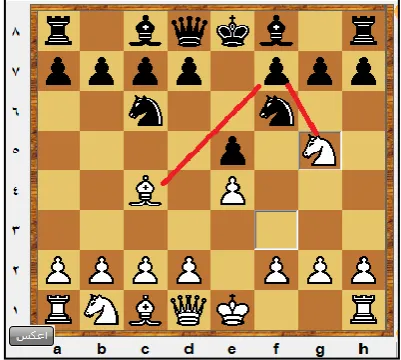
The case study game focuses on the future scenarios for the government and SCAF regarding their handling of the increasing pressures and demands in the current transitional phase. Three different scenarios are detected and demonstrated: The use of the military council of the government as a front receiving blame and criticism, SCAF tries to deal directly and oppressively with the demonstrators
and giving the government full power to reach a state of reassuring stability.
The pressures and demands on the government and SCAF are increasing rapidly. The origin of the problem is that despite the success of the revolution in the overthrow of Mubarak regime but the political forces did not agree on how to manage the transitional phase from the start, leading to conflict between rebels who are eager for a revolutionary government in performance (school of Jean-Jacques-Rousseau) and the transitional government and SCAF who tend to be very conservative in performance (school of Thomas Hobbes and David Hume) [2].
1. Game ObjectiveDetecting and illustrating different future scenarios that can occur as a chain reaction to the SCAF and government attitudes towards the various demands and pressures
2. Defining Players
a. Black: SCAF and Government
b. White: Instability stemmed from pressures and demands
60% of the games played in the Heijden database are won by the White, as the study simulates stress test upon SCAF and the government; the White was chosen to represent the pressures and demands.
3. Defining the pieces
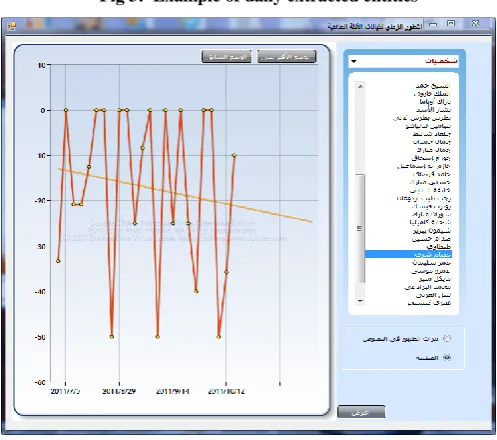
Fig 3: Example of daily extracted entities
Fig 4: Example of entities trend analysis
An entity impact is measured by multiplying the frequency by its polarity degree. The most frequent entities are ranked in a descending order according to their impacts. On the other hand, Chess pieces are ranked in a descending order according to their powers in literature. The pieces mapping is listed in the following table.
[image:5.595.317.532.592.743.2]Table 5. Pieces mapping
5. Game ThemeThe theme denotes the initial conditions of the game, the pieces moves sequences, the relations among them and specifying some events such as: castling, promotion or check. From the text mining analysis the story board of the game starts by a scene where the SCAF and the government are attacked by the demonstrators and the private media in the same time, which refers to a fork situation. All the scenarios must contain intensive private media moves (Knights) and aggressive attacks to the government (the Black queen) and may be the ministry of interiors also (the White rook). The scenario which implies the success of the government to eradicate instability must include collateral moves from the government's parties: ministry of interiors, prime minister, mature state media and tactical handling of the daily procedures. The theme initial conditions must yields the board illustrated in the next figure.
Fig 6: Initial board for all scenarios
a. The games that have similar theme are queried from the Heijden database using a special script named Chess Query Language (CQL) which was developed by Lewis Stiller and GadyCosteff. Using CQL the games that have specific Chess openings, initial conditions, certain moves, certain pieces on certain squares, pieces left and specific events are found. A simple example of a CQL query is provided below where games that contain a White move turn where the piece goes from and to specific squares [12]: (match:pgnheijden.pgn ;the name of the PGN file to look for studies:output result.pgn ;the name of the result file(position :wtm :movefrom .d4 moveto: .d3;) end position); end match
b. After using impact analysis to map the pieces, we use Markov chains [13] to filter games that have the same patterns of the pieces. Each piece makes a sequence of moves detected from the text mining analysis. Each piece has 5 states: current position, moving forward, moving backward, attacking, taken. Suppose that the text mining analysis depicts 6 snapshots, this means we have 6 states in sequence for each piece to be searched for in the database. For every snapshot, each piece is tagged with one of these five states. Only the games that match the pieces states sequences are initially picked. If the result set has more than 3 games; only the games that match a Markov process of the first order are chosen. The Markov Chain transition matrix [14] is built during the model creation for each piece by calculating the cells one by one using the CQL query language.
Piece White Black
Pawn Daily events
Bishop
Private Media State media Foreign
pressures Knight Demonstrations
and set-ins
Rook Remnants of
Mubarak regime
Ministry of interiors Presidential
candidates
The army Queen Political parties
and movements
Sharaf's government
[image:6.595.200.401.314.494.2]Table 6. Transition Matrix for the Bishop Curre
nt
Forwa rd
Backwa rd
Attacki ng
Take n
Current 0.24 0.29 0.09 0.34 0.04
Forward 0.4 0.19 0.1 0.22 0.09
Backwa rd
0.42 0.13 0.15 0.11 0.19
Attacki ng
0.34 0.21 0.1 0.05 0.3
Taken 0 0 0 0 1
If there were 4 moves depicted from the text mining, then the next probable move for the Bishop can be guessed using the Transition Matrix (P) by multiplying it to itself 5 times.
S5 = s4P; s4 = s3P; s3 = s2P; s2 = s1P; s1=[1,0,0,0,0]
5.
DISCUSSING
THE
GENERATED
CHESS SCENARIOS
Three scenarios have been found: a weak government used as a front to deal with the people and receive all their blames, an
SCAF that oppresses the demonstrators directly due to continuous pressure and an SCAF that gives the government which is up to the responsibility full power to manage. The 3 scenarios can be logically classifiedas:
The power given to the government is incomplete 1. Government is used as a front for the
actions of the Military Council 2. The military is facing directly the
demonstrators and protestors Full power given to the government
3.
SCAF gives the government -which is
up to the responsibility- full power
to manage
5.1 Scenario one - Government is used as a
front for the actions of the Military Council
Fig 7: scenario one board
5.1.2The
scenario
development
and
[image:7.595.221.431.334.597.2]explanation
Table 7. Scenario one development and explanation
Government is used as a front
Mov e ID
Black (future of Sharaf's government and SCAF)
White (instability and revolution failure)
Movemen t
Explanatio n
Movemen t
Explanatio n
1 Queen
moves one step forward
defending
2 Knight
moves one step forward
Pressure on the government
satisfaction
3 Queen
takes knight
Getting rid of the pressure by
oppression
4 Bishop
takes queen
Private media pressure leads to government'
s resignation 5 King flees
from the bishop
two variations
exist: Change in
SCAF attitude and
strategy that adjusts
the course of the revolution
(most probable) or hostile protestors and repeat Libya's pattern (total deviation
from the revolution
course)
5.2 Scenario two - SCAF oppresses the
demonstrators directly due to continuous
pressure
5.2.1 The scenario board
11 A simplified version of PGN file is provided in the
appendix
Fig8: scenario two board
5.2.2
The
scenario
development
and
explanation
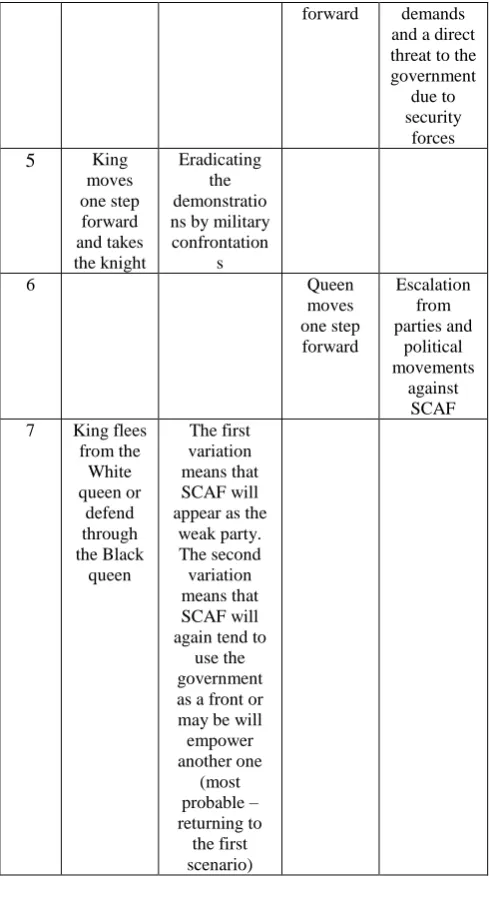
Table 8 . Scenario two development and explanation SCAF oppresses the demonstrators directly due to
continuous pressure Mov
e ID
Black (future of Sharaf's government and SCAF)
White (instability and revolution failure) Moveme
nt
Explanation Moveme nt
Explanatio n
1 Pawn
moves one step
forward
Procedures to lessen the
bondage between the private media
and foreign influence on one hand and
the demonstratio
ns on the other hand
2 Pawn
takes pawn
Daily events
3 Knight
moves one step
forward
Confronting the demonstratio
ns by using the state media and lessen the power of private media
4 Knight
moves one step
forward demands and a direct threat to the government
due to security
forces
5 King
moves one step forward and takes the knight
Eradicating the demonstratio ns by military
confrontation s
6 Queen
moves one step forward
Escalation from parties and
political movements
against SCAF 7 King flees
from the White queen or
defend through the Black
queen
The first variation means that SCAF will appear as the
weak party. The second variation means that SCAF will again tend to
use the government as a front or may be will empower another one
(most probable – returning to
the first scenario)
5.3 Scenario two - SCAF gives the
government which is up to the responsibility
full power to manage
5.3.1 The scenario board
22 A simplified version of PGN file is provided in the
[image:9.595.334.547.70.337.2]appendix
Fig 9: scenario three board
5.3.2
The
scenario
development
and
explanation
Table 9.Scenario three development and
explanation
SCAF gives the government which is up to the responsibility full power to manage
Mov e ID
Black (future of Sharaf's government and SCAF)
White (instability and revolution failure) Moveme
nt
Explanation Movement Explanati on
1 Pawn
moves one step forward
Procedures to lessen the
bondage between the
private media and
foreign influence on one hand and
the demonstratio
ns on the other hand
2 Pawn takes
pawn
Daily events
3 Knight
moves one step forward
Using state media to affect the citizens
4 Pawnmove
s one step forward
More daily events
5 Queen
moves one step
The government
[image:9.595.43.288.71.523.2]forward satisfy the people
6 Knightmov
es one step forward
Escalation upon the governmen t and police 7 Queen
sacrifices the rook
Change the minister of interior
8 Knight
takes rook
Ending the current security system 9 Queen
attacks rook
Issuing the political isolation law
10 Rook
moves towards the king Escalation from the remnants 11 Queen
attacks the king Decisive actions to eliminate expected instability
12 Knights
protects the king Foreign aid tries to support the instability 13 Knight
moves one step forward and checkmat e Cleverly use the media to show how the foreign aids tries to help the subversive parties – ending the state of instability
6. CONCLUSION AND WORK FUTURE
Chess simulation is successfully built to give three possible future scenarios that illustrate the results of SCAF and government's strategies of dealing with the pressures and increasing demands. The game parameters are fed from text mining analysis performed on 784 articles collected from eight different newspapers. The game parameters are the game theme which is searched in a famous Chess database named Heijden that contains 76132 games in specific format named PGN; the search query is done using a special script named CQL which enable the analysts to find specific game themes. Applying Markov Chain proved to be very useful in limiting the results and only choosing those which matches the sequence analysis of the pieces states which are: current position, moving forward, moving backward, attacking, and being taken. The case study demonstrate this new methodology unique capabilities to extend the text mining features to accurate predict and guess the future scenarios using the text mining output as parameters to feed Chess games due to havingricher data. The whole process is automated which gives the advantage of being subjective in analysis.
Nevertheless, this new methodology has two challenges: The number of variables in the political reality is greater than number of playing pieces.At certain times the speed of change events is too large while the game remains very rigid. For confronting these 2 issues, the author needs to investigate into a modified technique that using an alternative Chess game rules named: "Atomic Chess"; in Atomic Chess, the attacking and attacked pieces explode with the neighboring cells after the capturing. This technique seems to be keeping up with systems
with fast fluctuations.
7. REFERENCES
[1] Joseph Y. Halpern. (2008). "computer science and game theory," The New Palgrave Dictionary of Economics, 2nd Edition.
[2] Paul J. Magnarella. A review of Human Rights in Africa, University Press of America, 2000.
[3]76,132 endgame studies in a database. Retrieved from ChessVibes: http://www.chessvibes.com/reports/76132-endgame-studies-in-a-database, 2010.
[4] CQL Introduction. (n.d.). Retrieved from CQL Manual: http://rbnn.com/cql/
[5] Ronen Feldman and James Sanger, The Text Mining Handbook, Cambridge University.
[6] M. Ikonomakis, S. Kotsiantis, V. Tampakas, Text Classification Using Machine Learning Techniques, WSEAS Transactions on Computers, Issue 8, Volume 4, pages 966–974, 2005.
[7] AlekhAgarwal and Pushpak Bhattacharyya. Sentiment analysis: A new approach for effective use oflinguistic knowledge. In Proceedingsof ICON, 2005.
[8] rec.games.chess. (2002). Portable Game Notation Specification and Implementation Guide. Retrieved from http://folk.uio.no/andreio/docs/pgnspec.pdf
[9] Erik Cambria; Robert Speer, Catherine Havasi and Amir Hussain (2010)."SenticNet: a Publicly Available Semantic Resource for Opinion Mining". Proceedings of AAAI CSK.
[10]Srivastava, A., and Sahami.M. (2009).Text Mining: Classification, Clustering, and Applications. Boca Raton, FL: CRC Press.
[11] Bing Liu (2010). "Sentiment Analysis and Subjectivity".Handbook of Natural Language Processing, Second Edition.
[12]CQL example. Retrieved from:
http://www.xs4all.nl/~timkr/chess2/cql.htm
[13] er Levin, David.Markov chains and mixing times.pp. 16, 2009.
[14]Pankin, Mark D.."BASEBALL AS A MARKOV
CHAIN".Retrieved from:
http://www.pankin.com/markov/intro.htm.
[15] H.C. Wu, R.W.P. Luk, K.F. Wong, K.L. Kwok (2008). "Interpreting tf–idf term weights as making relevance decisions".ACM Transactions on Information Systems. [16]"TheState of Agile Development"(PDF). VersionOne,
Inc. 2008.
APPENDIX
Simplified version of first scenario PGN file
< Game Scenario_id="1 <"
< Move MoveNo="1" From="e2" To="e4 </ "
< Move MoveNo="1" From="e7" To="e5 </ "
< Move MoveNo="2" From="g1" To="f3 </ "
< Move MoveNo="2" From="b8" To="c6 </ "
< Move MoveNo="3" From="f1" To="c4" S </
< Move MoveNo="3" From="g8" To="f6 </ "
< Move MoveNo="4" From="f3" To="g5 </ "
< Move MoveNo="4" From="d8" To="e7 </ "
< Move MoveNo="5" From="g5" To="f7 </ "
< Move MoveNo="5" From="e7" To="f7 </ "
< Move MoveNo="6" From="c4" To="f7 </ "
< Move MoveNo="6" From="e8" To="f7 </ "
/< Game
>
Simplified version of second scenario PGN
file
< Game Scenario_id="2 <"
< Move MoveNo="1" From="e2" To="e4 </ "
< Move MoveNo="1" From="e7" To="e5 </ "
< Move MoveNo="2" From="g1" To="f3 </ "
< Move MoveNo="2" From="b8" To="c6 </ "
< Move MoveNo="3" From="f1" To="c4 </ "
< Move MoveNo="3" From="g8" To="f6 </ "
< Move MoveNo="4" From="f3" To="g5 </ "
< Move MoveNo="4" From="d7" To="d5 </ "
< Move MoveNo="5" From="e4" To="d5 </ "
< Move MoveNo="5" From="f6" To="d5 </ "
< Move MoveNo="6" From="g5" To="f7 </ "
< Move MoveNo="6" From="e8" To="f7 </ "
< Move MoveNo="7" From="d1" To="f3 </ "
</Game>
Simplified version of third scenario PGN
file:
Game Scenario_id="3"> <"
< Move MoveNo="1" From="e2" To="e4 </ "
< Move MoveNo="1" From="e7" To="e5 </ "
< Move MoveNo="2" From="g1" To="f3 </ "
< Move MoveNo="2" From="b8" To="c6 </ "
< Move MoveNo="3" From="f1" To="c4 </ "
< Move MoveNo="3" From="g8" To="f6 </ "
< Move MoveNo="4" From="f3" To="g5 </ "
< Move MoveNo="4" From="d7" To="d5 </ "
< Move MoveNo="5" From="e4" To="d5 </ "
< Move MoveNo="5" From="c6" To="d4 </ "
< Move MoveNo="6" From="d5" To="d6 </ "
< Move MoveNo="6" From="d8" To="d6 </ "
< Move MoveNo="7" From="g5" To="f7 </ "
< Move MoveNo="7" From="d6" To="c6 </ "
< Move MoveNo="8" From="f7" To="h8 </ "
< Move MoveNo="8" From="c6" To="g2 </ "
< Move MoveNo="9" From="h1" To="f1 </ "
< Move MoveNo="9" From="g2" To="e4 </ "
< Move MoveNo="10" From="c4" To="e2 </ "
< Move MoveNo="10" From="d4" To="f3 </ "