Adherence in Internet-based interventions
Silje C Wangberg Trine S Bergmo Jan-Are K Johnsen
Norwegian Centre for Telemedicine, University Hospital of North Norway, Tromsø, Norway
Correspondence: Silje C Wangberg Norwegian Centre for Telemedicine, University Hospital of North Norway, PO Box 35, N-9038 Tromsø, Norway Tel +47 77 75 40 00
Fax +47 77 75 40 98
Email [email protected]
Background: The Internet is a promising channel for delivering health-promoting interventions. A common problem for Internet-based interventions is low adherence. The current paper reports adherence rates from three different Internet-based trials with potential covariates.
Methods: Data on adherence and baseline characteristics of users were collected from three different Internet-based trials: one supporting diabetes self-management, one supporting smoking cessation, and one offering an online personal health record. Logging of web use was used as the measure of adherence in two of the trials, while logging of authentication SMS messages was used in the third.
Results: In all three trials, users dropped out at a high rate early in the intervention. The baseline variables that were related to use were self-effi cacy, having smoking friends, age, gender, and education. Tailored emails increased use for up to fi ve months into a one-year intervention.
Conclusion: Dropout from Internet-based trials is substantial, and attrition curves can be a valuable tool for more accurate pretrial estimates of sample size power. Automated follow-up of users via email seems likely to increase adherence and should be included in Internet-based interventions. Tailoring on baseline covariates to adherence such as self-effi cacy could make them even more effective.
Keywords: Internet-based interventions, adherence, attrition, tailoring, self-effi cacy
Background
The Internet is a promising channel for strengthening self-management skills. Web-based education and self-care programs improve patient knowledge and have shown to be effective in managing several chronic conditions and lifestyle changes. Favor-able outcomes have, for instance, been found in nutrition (Brug et al 1999), physical activity (Vandelanotte et al 2007), and smoking cessation (Strecher 1999; Walters et al 2006).
Reviews of Internet-based interventions can, however, present a rather confus-ing picture as the only common ground is the delivery medium. The interventions may range from posting pamphlets online, through dynamic combinations of text-based information and communicative features, such as forums or “ask an expert” or multimedia, to individually computer tailored content. The latter, personalizing the intervention based on user characteristics, is the component that has most consistently been shown to be effective (Brug et al 1999; Kreuter and Skinner 2000; Oenema et al 2001; Strecher 1999; Strecher et al 2006; Walters et al 2006; Johnson et al 2007; Vandelanotte et al 2007).
What all Internet-based interventions have in common is great potential for reach-ing people. In Norway, where the trials reported in the current study were conducted, 85% of the population has used the Internet during the last three months while 58% has used it for health purposes (Andreassen et al 2006; Statistics Norway 2007).
proportion of them never use the program, and many use it only once. Discontinued use has for instance been seen in studies of Internet-based interventions for panic disorder (Farvolden et al 2005), depression (Christensen et al 2004), weight loss (Vandelanotte et al 2007; Verheijden et al 2007), diabetes self-management (Glasgow et al 2003; Wangberg 2008), and smoking cessation (Feil et al 2003; Strecher et al 2005; Swartz et al 2006).
Since a dose-response relationship for the use of Internet-based interventions has been found (Eysenbach 2002; Cobb et al 2005; An et al 2006; Japuntich et al 2006; Graham et al 2007; Steele et al 2007), low adherence could underestimate the effi cacy of such interventions. In this respect it is impor-tant to differentiate the concept of retention of recruited users with which we are concerned from initial reach, a relevant factor to take into account when considering the effectiveness of these interventions (Green and Glasgow 2006).
While characteristics of those lost to follow-up assess-ment are routinely reported, fewer studies have looked directly at covariates of use. Knowledge about aspects that infl uence use may be a valuable aid in designing studies. Previous research has found that older people (Japuntich et al 2006; Verheijden et al 2007), users with higher self-effi cacy for target health behavior (Steele et al 2007), and women (Feil et al 2003; Glasgow et al 2007) have higher adherence to Internet-based interventions. A recent more general meta-analysis of patients’ adherence to prevention and treatment of a variety of acute and chronic conditions found that patients’ belief in the severity of their disease predicts adherence (DiMatteo et al 2007). Thus, we could also expect to see cor-relations between needs such as long-term illness, subjective health status, or poor self-effi cacy for self-management to be related to the use of Internet-based programs.
Eysenbach (2005) has called for more research on attri-tion from Internet-based intervenattri-tions. He argues for the need to develop models for discontinuation of eHealth applica-tions and dropouts in Internet-based trials. Christensen and Mackinnon (2006) found that there has been little debate about this issue despite the fact that attrition is a major prob-lem in the use and evaluation of Internet sites. In this paper, we will contribute to this debate by modeling attrition and assessing factors related to adherence. The main objectives are to report and model adherence curves from three different Internet-based trials, to investigate whether covariates to use exist and to analyze the need for tailoring. We hypothesize a substantial dropout early on in the interventions, and a slower decline in use thereafter. Further, we expect health status, age, gender, and self-effi cacy to be related to use.
Method
We used data from three Internet-based interventions: Study 1: an Internet-based diabetes self-care intervention; Study 2: an Internet-based smoking cessation intervention; and Study 3: an Internet-based personal health record. All study proto-cols were submitted to review by a regional ethics committee before any contact was made with participants.
Study 1: Internet-based diabetes
self-care intervention
Via an advertisement on the Norwegian Diabetes Associ-ation’s website, 90 persons signed up to participate in the trial. Inclusion criteria were 1) diagnosis of type 1 or type 2 diabetes, and 2) having access to the Internet. The baseline questionnaire had to be completed before access was given to the website directly thereafter. The intervention was tai-lored to the level of self-effi cacy, so that participants were randomized to receive intervention exclusively on that aspect of self-care (blood glucose monitoring; diet care; physical activity) with a) the lowest self-rated self-effi cacy or b) the highest self-rated self-effi cacy. The interventions consisted of several components derived mainly from social cognitive theory (Bandura 2004), which were intended to increase the performance of self-care such as peer modeling through vid-eos, information, and tools to monitor own target behavior. The users received no particular instructions as to how often they should log on to the site.
Adherence was assessed as the number of logins and time spent at the intervention website gathered through web logging per anonymous and unique user ID. The following assumptions were made in order to estimate the number of accesses and time spent there: if no activity was detected in a 15-minute period, the next onset of activity was coded as a new visit.
to have a good concurrent validity by being negatively related to self-effi cacy, r =−0.47, p ⬍ 0.001. For more details on this sub-study, please see Wangberg (2008).
Study 2: Internet-based smoking
cessation intervention
Participants were mainly recruited through media coverage of the project and snowball sampling, but the intervention's URL was also spread in various other ways. The participants were randomized into two groups: 1) A tailored group who had access to tailored content on the website and received tailored emails. The emails were received daily around their preset quit date, and thereafter more seldom throughout the year. 2) A control group who had access to exactly the same website, but without the tailored content and emails. Both groups received information about various aspects of smok-ing cessation and had access to the online community features such as the discussion forum and guest books. Because of continuous recruitment to the program, different samples were used for different analyses. By September 23, 2006 a total of 618 users had been registered in the Internet-based smoking cessation program, and could thus by the time of analysis potentially have used the intervention for a year. While the participants in the tailored group received emails requesting them to visit the site and tell us how they were doing at 3 weeks, 6 weeks, 3 months, 6 months, 9 months, and 12 months after their quit date, the control group received no instructions as to how often they should log on to the site.
A survival analysis was performed with the web-log data from the 618 fi rst user IDs in the data set, since we were unable to link the logins to registration date per user. If no activity was registered for a user during 40 minutes, they were automati-cally logged out. Data on self-effi cacy were gathered at base-line and after one month’s use of the site using the Smoking Self-Effi cacy Questionnaire (SEQ; Etter et al 2000).
Study 3: Internet-based personal
health record
Participants were recruited by mailing a four-page informa-tion pamphlet to all members (approximately 6500) of the Norwegian patient organization for people with thyroid dis-order. Information was also published in the organization's magazine and on their website. Volunteer participants were randomized during online registration and given individual usernames and passwords that would enable participants to log in on the project site to answer the baseline and later the one-month follow-up questionnaires. Emails distrib-uted after registration contained information about login
procedure at a separate web address (intervention group, n = 218), or contained a PDF fi le that could be printed and used as a paper-based health record (control group, n = 192). Login required an authenticating code sent by short message service (SMS) to the participant’s mobile phone, in addition to entering a username and a password at the intervention web-site.
The number of these SMS messages sent out per user was used as the main measure of adherence. In addition, the users were asked to self-report their number of logins.
The intervention was an Internet-based, nonspecifi c symptom monitoring tool that enabled users to register symptoms, rate these for “severity”, and monitor how they developed over time. Symptom development could be moni-tored through graphic illustrations, and users could choose to print a “report” of selected symptoms, for instance to use in consultations with health professionals. The users received no particular instructions as to how often they should log on.
Analyses
In Study 1 and 2, logging of web use, number of logins, and time spent at the site were used as a measure of adherence, while in the third study logging of authentication SMS mes-sages was used. Groups were compared using ANOVA. A survival analysis where survival (adherence) was defi ned as at least one login every month was performed with data from the 618 persons who had been registered for more than a year in Study 2. Functions for use were estimated through curve fi tting exponential and logarithmic functions to the data. These functions were chosen on the basis of the general shape of the attrition curves from previous research. A linear multiple regression was performed with baseline characteris-tics as predictors and number of logins to an Internet-based smoking cessation intervention as the dependent variable to assess which variables was related to adherence. Pearson’s correlation analysis was performed to assess relations between two continuous variables. All reported confi dence intervals (CI) are 95%, and all analyses were performed with SPSS 15.0 (SPSS, Inc., Chicago, IL, USA).
Results
Study 1: Internet-based diabetes
self-care intervention
intervention, 18 (28%) never accessed the site again; 13 (20%) logged in twice, while the remaining 33 (34%) logged in from 3 to 25 times during the six weeks. Login time per week can be seen in Figure 1. It appears that in general the participants spend time on the interventions when fi rst given access, and then do not return before one month post-assessment. Neither a logarithmic function (R2= 0.62, CI =⬍0.0001–0.81) nor
an exponential function fi ts the data signifi cantly (R2= 0.33,
CI =⬍0.0001–0.67). The correlation between number of logins and minutes spent at the site was r = 0.60 (0.41–0.73). A plot of proportion of users per week (not shown) also corresponded well with number of logins per week.
Those who had used the intervention site only once did not differ signifi cantly from those who had used the site more often on any baseline variables. This included which version of the intervention they were randomized to, type of diabetes, duration of diabetes, whether they used insulin or not, blood glucose variability (HbA1C), body mass index, self-manage-ment, self-effi cacy, value confl icts, intention, perceived social norms, gender, or age. The two factors that differed the most between the groups were perceived external barriers to dia-betes self-management and educational attainment. Perceived external barriers were on average higher among those who had logged in only once (M = 8.6, CI = 6.5–10.8) than for those who had logged in more than once (M = 5.8, CI = 4.3–7.2)
while education was on average lower among those who had logged in only once (M = 2.1, CI = 1.6–2.7) than for those who had logged in more than once (M = 2.8, CI = 2.5–3.1).
Study 2: Internet-based smoking
cessation intervention
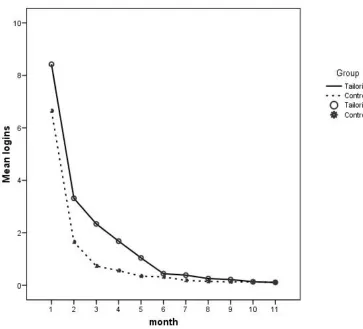
For the 2884 registered users of the Internet-based smok-ing cessation program from August 15, 2006 until October 23, 2007, the mean number of logins was 15 (12.7–17.2). Of these, 26 (0.9%) people dropped out of the intervention during the registration process, and were therefore registered with zero logins. The correlation between the number of logins and minutes spent at the site was r = 0.89 (0.89–0.90). Recruitment was continuous, so some of these users had used the site for a year, while others only for hours. The mean number of logins per month for the tailored group and the control group can be seen in Figure 2. The tailored group had more logins during the fi rst months (signifi cantly more in month 2, 3, 4, and 5) than the control group, who received no emails and no tailored content. But this difference disap-peared by month 10, when participants in both groups had logged in 0.13 times on average (0.06–0.21).
A survival analysis including the 618 persons who had been registered for more than a year showed that 19% (61) of the users were still adherent in the second month of the
y = -41.37Ln(x) + 89.36 R2= 0.62
0 0.2 0.4 0.6 0.8 1 1.2 1.4 1.6 1.8 2
0 0.2 0.4 0.6 0.8 1 1.2 1.4 1.6
Month
Mean
lo
gins
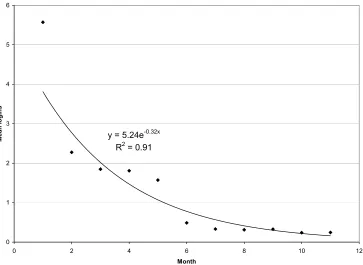
intervention, and 5 people (0.8%) made it to the end of the one-year intervention. Mean survival time for the tailored group was 1.7 (1.5–1.9) months compared with 1.3 (1.2–1.4) months for the control group. Plotting the reduction in the number of logins for this group did not show signifi -cant differences in fi t between an exponential (R2 = 0.91,
CI = 0.63–0.95) and a logarithmic (R2= 0.89, CI = 0.58–0.94)
function (Figure 3).
Correlations between baseline characteristics (age, gen-der, education, living alone, cigarettes per day, proportion of friends smoking, and self-effi cacy for smoking cessation) and use were assessed for 1895 users who had registered before February 27, 2007 (Table 1). The average effect sizes were small for all variables, but being older, being female, having a higher education, having few smoking friends, and a higher self-effi cacy for cessation were associated with more logins.
Study 3: Internet-based personal
health record
At the start of the trial, 410 people with thyroid disorders had signed up and completed the baseline questionnaire. Of these,
210 (51%) completed the one-month follow-up questionnaire. Only one signifi cant difference in baseline characteristics was found between responders and nonresponders. Nonresponders had a slightly higher mean expected number of uses of the Internet-based personal health record during the next year, 1.6 (1.5–1.8) compared with the responders, 1.3 (1.2–1.4). They were equally distributed across the intervention and control arm of the trial, across gender, education, age, income, self-effi cacy, illness perceptions, and subjective health.
trial can be seen. Neither a logarithmic function (R2= 0.06,
CI =⬍0.0001–0.37) nor an exponential function fi tted the data signifi cantly (R2= 0.22, CI =⬍0.0001–0.53).
Before the intervention, these persons were asked how much they thought they would be using the Internet-based personal health record. What they said they would do did not correlate with what they reported that they actually did, r = 0.048 (−0.24–0.33). Three (1%) participants did not answer. Ten (5%) said they would use it daily, 109 (50%) said they would use it every week, 79 (36%) monthly, while 17 (8%) reported they would use it more seldom.
Discussion
In all our three trials we found that many users never used the intervention, substantial proportions of the participants used the interventions only once, and few used the programs until the end of the interventions. This corresponds to previous research (Feil et al 2003; Glasgow et al 2003; Christensen et al 2004; Eysenbach 2005; Farvolden et al 2005; Strecher et al 2005; Swartz et al 2006; Vandelanotte et al 2007; Verheijden et al 2007). In a recent review of Internet-based interventions for physical activity, attrition rates at short-term follow-up (⬍3 months) ranged from 10% to 50% (Vandelanotte et al 2007). In our diabetes self-management trial, about half the participants used the intervention more than once, and in the smoking cessation trial, 19% were still using the program by
the second month, and only 0.8% used the program at least monthly throughout the one-year intervention.
High correlations were found between number of logins and time spent at the site in both the diabetes self-management and the smoking cessation intervention. The number of logins was also proportional to the number of users in the intervention at any given time. This suggests that these different indicators of adherence are relatively comparable. Since the number of logins was available for all three trials, we chose this variable for plotting attrition curves. Only the smoking cessation trial had power to estimate a signifi cant function. Both a logarithmic and an exponential function fi t the data well, essentially show-ing that use is reduced by 25% every month of the intervention. Although not signifi cant, the attrition appeared to be about twice as fast in the other two interventions.
y = 5.24e-0.32x R2= 0.91
0 1 2 3 4 5 6
0 2 4 6 8 10
Month
Mean
lo
gin
s
12
Figure 3 Mean logins per month for one-year users of the Internet-based smoking cessation program Opptur (N = 618).
Table 1 Regression with baseline characteristics as predictors and number of logins to an Internet-based smoking cessation interven-tion as the dependent variable (N = 1895)
Baseline characteristics B (95 CI) β
Age 0.5 (0.1–0.8) 0.08
Education −3.9 (−7.2–0.6) −0.06
Being female 13.8 (5.8–21.9) 0.09
Living alone 1.8 (−7.0–10.6) 0.01
One might have expected to fi nd differences between adherence to interventions for self-managing chronic dis-ease, which is a lifetime venture, versus quitting smoking, which might be considered a more time-limited project, albeit one that for the majority of quitters is started more than once. On the other hand, it may be argued that all health behaviors are in essence the same and that their maintenance may require conscious effort and support for a long time. Newsom and colleagues (2005) found in a large North American survey that health behaviors were largely independent of each other. Others would argue that even though the behaviors in question may differ, the process of changing them, and thus interventions to support them, have more similarities than differences (Strecher et al 2002; Jones et al 2003; Johnson et al 2007). Reviews of interventions based on common stages of change principles have, however, found limited overall evidence for effects (Bridle et al 2005; West 2005). Nevertheless, in this study, and in the previous Internet-based interventions reviewed, attrition curves seem similar. We therefore saw it as an interesting research question to pursue whether there were similarities in factors related to attrition over three different interventions too.
Surprisingly, we found no correlations between needs such as severity of illness, subjective health, illness
perceptions, current self-care, or number of cigarettes per day, and use of the interventions. This is in contrast to adher-ence research in other fi elds (DiMatteo et al 2007).
In the smoking cessation trial we found that higher self-effi cacy for quitting predicted higher use. Steele and col-leagues (2007) found that higher self-effi cacy for physical activity (but not for using the Internet) was related to greater program exposure. Higher self-effi cacy for changing the tar-get health behavior was not found to be signifi cantly related to use in the Internet-based diabetes self-management trial, but was found to be related to better intervention effects in a previous study (Wangberg 2008). Previous research has found that self-effi cacy is an important factor for engaging in and maintaining a host of health behaviors (AbuSabha and Achterberg 1997; Ockene et al 2000; Bandura 2004). Taken together this suggests that self-effi cacy is an important vari-able to take into account when tailoring an intervention.
The use of tailored emails and website content increased adherence up to fi ve months into the smoking cessation inter-vention, and emailed post-assessment reminders increased the use in the two other trials. This is in contrast with Tate and colleagues (2006), who found that the participants who received automated tailored messages had the lowest number of logins, while they found no difference between the access to an email counseling condition and a basic intervention y = -0.03Ln(x) + 0,05
R2= 0.22
0 0.02 0.04 0.06 0.08 0.1 0.12 0.14 0.16 0.18
0 0.5 1 1.5 2 2.5 3 3
Month of intervention
Mean
lo
gi
ns
.5
condition. Still, we believe that in most cases follow-up is likely to increase use by reminding the participant to visit the site. Mobile text messaging (SMS) could be an even more effective way of achieving this through its even greater ability to reach users regardless of time and location and without login procedures (Wangberg et al 2006).
There is reason to believe that tailoring these messages may have an independent effect. “Tailoring” is a wide-ranging concept, however. Dijkstra (2005) suggests that tailoring approaches can be classifi ed into three basic groups: 1) personalization, eg, greeting the user by fi rst name; 2) feedback, eg, giving the user information about how her level of physical activity compares with a norm group; and 3) adoption of content in relation to theory. This latter group in turn contains a variety of approaches, such as receiving feedback on current health behavior (Verheijden et al 2007), focusing on a specifi c behavior according to self-effi cacy (Wangberg 2008), or presenting information relevant to the participant’s stage of change (Johnson et al 2007). It is not always clear from reports what a specifi c tailored intervention actually does and which mechanisms are most effective. There is also some doubt about whether it is the actual tailoring or the perception of such that accounts for the observed effects (Webb et al 2005).
Future research should assess whether there is an additional effect of tailoring emails on adherence, and if so which kind of tailoring is most effective. It could also be useful to separate the adherence to interventions from adherence to the objec-tive of the intervention, eg, smoking cessation. Tomson and colleagues (2005) found that nonresponders to a quitline trial were even more likely to have quit smoking than the respond-ers, thus clearly showing that quitting an intervention does not necessarily mean having given up on behavior change. In fact, attrition could in some cases even be an indicator of success, suggesting that the intervention is no longer needed.
Limitations
As seen from the wide confi dence intervals, a key limitation of the data from our two smallest trials, as well as for several of the studies reviewed, is that they do not have adequate statistical power to enable assessment of subgroup differ-ences between users and nonusers, or relations between use and other variables.
Variance was increased in the study of the Internet-based personal health record by using a fi xed answering format (daily, weekly, monthly) for predicted use, while an open response format (number of times during last month) was used for actual use.
Conclusions
In Internet-based trials one should plan for the worst case scenario of losing half of the participants during the fi rst month of the intervention. Education and self-effi cacy seem to be factors that should be taken into account in the design of interventions in order to increase adherence. Furthermore, emails are likely to lead to more logins, at least during the first months of an Internet-based intervention. Whether tailoring these emails has an additional effect warrants further research.
Disclosure
The authors have not declared any competing interests. All three authors contributed to drafting and revising the manu-script. SCW came up with the idea for this paper, and was in addition involved in design, data collection and analysis in all three studies. JAKJ was also involved in design, data collection, and analysis in study 3.
Acknowledgments
The authors wish to thank the other members of the project groups who have contributed to designing and running each of the three interventions described. Study 1 and 2 were supported in part by EXTRA funds from the Norwegian Foundation for Health and Rehabilitation, and a doctoral fellowship from the Norwegian Research Council, Grant No. 167063/V50 to the fi rst author. Study 2 was supported in part by funds from the Norwegian Directorate of Health and Social Affairs. Study 3 was funded by Innovation Norway through the “Research and Innovation Foundation of Troms County” (FIFT), Grant No. 2006/006943.
References
AbuSabha R, Achterberg CD. 1997. Review of self-effi cacy and locus of
control for nutrition- and health-related behavior. J Am Diet Assoc,
97:1122–32.
An LC, Perry CL, Lein EB, et al. 2006. Strategies for increasing adherence to an online smoking cessation intervention for college students. Nicotine Tob Res, 8(1 Supp 1):7–12.
Andreassen HK, Wangberg SC, Wynn R, et al. 2006. [Health-related use
of the Internet in the Norwegian population]. Tidsskr Nor Laegeforen,
126:2950–52.
Bandura A. 2004. Health Promotion by Social Cognitive Means. Health
Educ Behav, 31:143–64.
Bridle C, Riemsma RP, Pattenden J, et al. 2005. Systematic review of the effectiveness of health behavior interventions based on the
transtheo-retical model. Psychol Health, 20:283–301.
Brug J, Campbell M, van Assema P. 1999. The application and impact of computer-generated personalized nutrition education: A review of the litterature. Patient Educ Counsel, 36:145–56.
Christensen H, Griffi ths KM, Korten AE, et al. 2004. A comparison of changes in anxiety and depression symptoms of spontaneous users
and trial participants of a cognitive behavior therapy website. J Med
Christensen H, Mackinnon A. 2006. The Law of Attrition Revisited. J Med Internet Res, 8:e20.
Cobb KN, Graham AL, Bock BC, et al. 2005. Initial evaluation of a
real-world Internet smoking cessation system. Nicotine Tob Res,
7:207–16.
Dijkstra A. 2005. Working mechanisms of computer-tailored health
educa-tion: evidence from smoking cessation. Health Educ Res, 20:527–39.
DiMatteo MR, Haskard KB, Williams SL. 2007. Health beliefs,
dis-ease severity, and patient adherence: a meta-analysis. Med Care,
45:521–8.
Etter J-F, Bergman MM, Humair J-P, et al. 2000. Development and valida-tion of a scale measuring self-effi cacy of current and former smokers. Addiction, 95:901–13.
Eysenbach G. 2002. Issues in evaluating health websites in an Internet-based
randomized controlled trial. J Med Internet Res, 4:e17.
Eysenbach G. 2005. The law of attrition. J Med Internet Res, 7:e11.
Farvolden P, Denisoff E, Selby P, et al. 2005. Usage and longitudinal effectiveness of a Web-based self-help cognitive behavioral therapy
program for panic disorder. J Med Internet Res, 7:e7.
Feil EG, Noell J, Lichtenstein E, et al. 2003. Evaluation of an Internet-based smoking cessation program: lessons learned from a pilot study. Nicotine Tob Res, 5:189–94.
Glasgow RE, Boles SM, McKay HG, et al. 2003. The D-Net diabetes self-management program: long-term implementation, outcomes, and
generalization results. Prev Med, 36:410–19.
Glasgow RE, Nelson CC, Kearney KA, et al. 2007. Reach, engagement, and retention in an Internet-based weight loss program in a multi-site
randomized controlled trial. J Med Internet Res, 9:e11.
Graham AL, Cobb KN, Raymond L, et al. 2007. Effectiveness of an
Internet-based worksite smoking cessation intervention at 12 months. J Occup
Environ Med, 49:821–8.
Green LW, Glasgow RE. 2006. Generalization, and applicability of research:
Issues in External Validation and Translation Methodology. Eval Health
Prof, 29:126–53.
Japuntich SJ, Zehner ME, Smith SS, et al. 2006. Smoking cessation via the Internet: A randomized clinical trial of an Internet intervention as
adjuvant treatment in a smoking cessation intervention. Nicotine Tob
Res, 8(1 supp 1):59–67.
Johnson SS, Paiva AL, Cummins CO, et al. 2007. Transtheoretical Model-based multiple behavior intervention for weight management:
Effective-ness on a population basis. Prev Med, Oct 23 [Epub ahead of print].
Jones H, Edwards L, Vallis TM, et al. 2003. Changes in diabetes self-care behaviors make a difference in glycemic control: The Diabetes Stages
of Change (DiSC) study. Diabetes Care, 26:732–7.
Kreuter MW, Skinner CS. 2000. Tailoring: what's in a name? Health Educ
Res, 15:1–4.
Newsom JT, McFarland BH, Kaplan MS, et al. 2005. The health conscious-ness myth: implications of the near independence of major health
behaviors in the North American population. Soc Sci Med, 60:433–7.
Ockene JK, Emmons KM, Mermelstein RJ, et al. 2000. Relapse
and maintenance issues for smoking cessation. Health Psychol,
19(1, Suppl 1):17–31.
Oenema A, Brug J, Lechner L. 2001. Web-based tailored nutrition education:
results of a randomized controlled trial. Health Educ Res, 16:647–60.
Statistics Norway. 2007. ICT in households, 2nd quarter of 2007 [online]. Accessed October 26, 2007. URL: http://www.ssb.no/english/sub-jects/10/03/ikthus_en/.
Steele RM, Mummerey WK, Dwyer T. 2007. Examination of program expo-sure across intervention delivery modes: face-to-face versus Internet. Int J Behav Nutr Phys Act, 4:7.
Strecher VJ. 1999. Computer-tailored smoking cessation materials: A review
and discussion. Patient Educ Couns, 36:107–17.
Strecher VJ, Shiffman S, West R. 2005. Randomized controlled trial of a web-based computer-tailored smoking cessation program as a
supple-ment to nicotine patch therapy. Addiction, 100:682–8.
Strecher VJ, Shiffman S, West R. 2006. Moderators and mediators of a Web-based computer-tailored smoking cessation program among nicotine
patch users. Nicotine Tob Res, 8(1 Supp 1):95–101.
Strecher VJ, Wang C, Derry H, et al. 2002. Tailored interventions for
multiple risk behaviors. Health Educ Res, 17:619–26.
Swartz LHG, Noell JW, Schroeder SW, et al. 2006. A randomised control study of a fully automated Internet based smoking cessation programme. Tob Control, 15:7–12.
Tate DF, Jackvony EH, Wing RR. 2006. A randomized trial comparing human e-mail counseling, computer-automated tailored counseling,
and no counseling in an Internet weight loss program. Arch Intern
Med, 166:1620–5.
Tomson T, Bjornstrom C, Gilljam H, et al. 2005. Are non-responders in
a quitline evaluation more likely to be smokers? BMC Public Health,
5:52.
Vandelanotte C, Spathonis KM, Eakin EG, et al. 2007. Website-delivered
physical activity interventions: A review of the literature. Am J Prev
Med, 33:54–64.
Verheijden M, Jans MP, Hildebrant VH, et al. 2007. Rates and determinants of repeated participation in a web-based behavior change program for
healthy body weight and healthy lifestyle. J Med Internet Res, 9:e1.
Walters ST, Wright JA, Shegog R. 2006. A review of computer and
Internet-based interventions for smoking behavior. Addict Behav, 31:264–77.
Wangberg SC. 2008. An Internet-based diabetes self-care intervention tailored to self-effi cacy. Health Educ Res, 23:170–9.
Wangberg SC, Arsand E, Andersson N. 2006. Diabetes education via mobile
text messaging. J Telemed Telecare, 12(S1):55–6.
Webb MS, Simmons VN, Brandon TH. 2005. Tailored interventions for motivating smoking cessation: Using placebo tailoring to examine
the infl uence of expectancies and personalization. Health Psychol,
24:179–88.
West R. 2005. Time for a change: putting the Transtheoretical (Stages of
Change) Model to rest. Addiction, 100:1036–9.
Williams GC, McGregor HA, Zeldman A, et al. 2004. Testing a self-deter-mination theory process model for promoting glycemic control through