IJEDR1703155
International Journal of Engineering Development and Research (www.ijedr.org)
1104
A Energy Efficient Routing Protocol for Under water
Wireless Sensor Network
1Achhran Choudhary, 2Parvinder Singh 1Research Scholar, 2Associate Professor
Rayat Institute of Engineering and Information Technology, Ropar
________________________________________________________________________________________________________
Abstract - Wireless Sensor Network is the most booming industries for research nowadays. Generally, the wireless sensing elements examine the incidents with allied sensing modules, the data procedure, and data computation and then it transmits the data to a desired destination on a radio interaction channel. WSNs is a kind of network that encompasses the spatially dispersed sensing elements that have been prepared with its sensing, computation, authentication and interaction sections for monitoring the acceptable occurrences like environmental info or milestone of objectives The wireless sensing elements generally or in normally mixed-up, then self so as to adapt with the interaction environment by communicating wirelessly, and creating spontaneously an Ad-hoc network, adapting dynamically in case of network failure and degradation, managing the movement of incorporating, and participating nodes of the network. UWSN is a scalable sensor network, which relies on localized sensing and coordinated networking among large numbers of low-cost sensors. In recent years, underwater wireless sensor network has emerged as a powerful technique in order to discover and exploit this harsh environment. In this paper, an efficient approach is proposed for Depth based Underwater Routing. The result analysis shows efficacy of proposed approach as it reduces the energy required for routing in underwater sensor network. In order to propose an Objective Function based on distance between nods, number of retransmissions and energy of each node. The simulation conclusion displays that performance and throughput of proposed approach that provides the effective and significant the energy efficiency with more network lifetime compared to protocols. It can be noted that the packet delivery ratio for the proposed approach is better as compared to the basic approach because the packet lost in the network reduces.
Keywords: WSN, UWSN, DBR.
________________________________________________________________________________________________________
I. INTRODUCTION
In WSN interaction system, there might be more than thousands sensing nodes they are allocated widely and in random order. Generally, WSNs contains a huge number of economical least powered and cost sensing nodes that are of tiny size and these all are capable of interaction over a wider coverage of interaction real-time uses like for environmental sensing, defense or military, livelihood cross-check and monitor, or surveillance systems. Basically sensing elements are equipped and charged by battery that cannot replaceable and also not-rechargeable manner after allocating again and again. But unfortunately sensor networks are structured, and built to last, till today. The wireless sensing elements generally or in normally mixed-up, then self so as to adapt with the interaction environment by communicating wirelessly, and creating spontaneously an Ad-hoc network, adapting dynamically in case of network failure and degradation, managing the movement of incorporating, and participating nodes of the network. And for accomplishing these all mentioned factors, energy plays a vital role. The energy efficiency of a considered network is required to be optimized as the routing operation of the network consumes a lot of energy and on the other hand the effective routing of the wireless network is also most significance. With the advancement in technology and growth of industries, many consider WSN as the basic requirement for setting up the industries. The sensors are fitted everywhere in the industry to fetch live data and to take accurate decisions. Wireless sensor networks are the sensors deployed in various monitoring environments which are controlled by a central receiving unit called Base Station. Base Station is responsible for the collection and processing of data collected from various different types of sensors. These sensors in the network are categorized as the heterogeneous and homogenous sensors. The sensors deployed in the network are either the same type of sensors or of different types depending on the application . In the various applications for military and police investigation Wireless sensor networks can be used. Lately, several developments within the hardware shrink correlative with less-cost production or advancement in wireless communications technologies that have created probably varied applications with the high numbers of sensors. In alternative cases of the ground, access space of objectives should be monitored which is dangerous, therefore an answer to tack together the sensors is to find them from craft network . While not locating the position, there's solely the way to grant adequate target coverage by sensors to use multiple sensors than the fastened variety. Higher detector density will enhance the likelihood of targeted coverage; distribution of the sensors is well within the targets proximity.
IJEDR1703155
International Journal of Engineering Development and Research (www.ijedr.org)
1105
encompasses the spatially dispersed sensing elements that have been prepared with its sensing, computation, authentication and interaction sections for monitoring the acceptable occurrences like environmental info or milestone of objectives. Generally, in current scenario - the sensing elements might be 30 or 40 approximately but in networking perspective it may possess nth authenticated sensing elements. The simulation characteristics or states of the communicating sensing elements might not be pre evaluated and of course it would not be determined previously. It needs sensing elements to be configured with robust self-configurable and systematic algorithms. In computer networking, hop is part of path between sources to destination. Data packets are travel through routers, bridges and gate ways while travelling between sources to destination. The hops count nothing but only intermediate devices that helps to travel the data among source and destination instead of flowing over single wire. The main advantages of DBR are as follows.1) It does not require full-dimensional location information.2) It can handle dynamic networks with good energy efficiency. 3) It takes advantage of multiple-sink network architecture without introducing extra cost.II. RELATED WORK
Ahmed, Tanveer [1] in this work, we propose an Optimized Depth Based Routing (ODBR) scheme which ensures uniform energy consumption amongst sensor nodes and hence maximizes network lifetime. We allocate more initial energy to nodes that have higher traffic load compared to the ones with less traffic load. The results show that this strategy helps to balance energy utilization amongst sensor nodes and improves lifetime of the network
Li, Chao, Yongjun Xu[2] In this paper, we adopt a cross-layer approach to propose a DBR aware MAC protocol called DBR-MAC, which smoothly integrates a handshaking-based MAC and a DBR protocol. It improves the throughput, energy, and time efficiency at the cost of fairness. A depth-based transmission scheduling scheme is introduced based on the depth information, angle information, and overheard one-hop neighboring nodes' transmissions to make key nodes have higher priority to access the channel than other nodes. DBR-MAC is a cross-layer scheme and its directional forwarding tries best to forward packets from source to the floating sink node by the least hops. Moreover, an adaptive depth-based backoff algorithm cuts down the backoff time for the nodes and prevents the congestions at key nodes. Extensive simulations show that the throughput, energy, and time efficiency of DBR-MAC outperform existing DBR-MAC protocols when applied in the data collection network.
Diao, Boyu, Yongjun[3] In this paper, we propose an innovative depth-based routing with network coding improving routing reliability while preserving the intrinsic distributed manner of DBR and introducing little time delay and energy cost. Moreover, a simple analytical performance model where ideal MAC is assumed is proposed to derive the analytical delivery ratio for our DBR-NC and DBR protocols. This analytical model is validated by simulation results. The extensive simulation results show that the proposed DBR-NC protocol outperforms (over 15%) the state of art DBR protocols in terms of packet delivery ratio. We also show that our DBR-NC will not introduce much extra delay and energy consumptions.
Liaqat, Tayyaba [4] In order to solve the problem of data routing in WSN, water-wave algorithm is used. Water Wave Optimization algorithm is depending on the shallow water wave models for explaining optimization issues. It is discussed as when a wave travels from deep water to shallow water, its wavelength is increasing and its wave height is decreasing and vice versa. In the proposed optimization algorithm, the solution space is comparable to the seabed area, and by using seabed depth, the fitness point can be calculated. As the fitness is higher, distance to the still water level is shorter. During the problem-solving process, we examine three types of operations on the waves: Propagation, Refraction, and Breaking. Based on the value of the fitness function optimized route isselected.
Ahmad, Ashfaq et al. [5] presented a novel routing approach relied on cluster. This proposed approach is very efficient in terms of energy. In order to overcome the issue of coverage hole and energy hole, density controlled uniform distribution has been introduced and it will help in fixing the optimum number of CHs in every round. The simulation of proposed technique is being done in MATLAB and an experiment result indicates that proposed technique outperforms than any other existing technique.
Jeong-Sam kim and Tae-Young Byun et al. [6] proposed a density based clustering approach (D-LEACH). A simulation result demonstrates that the proposed algorithm increase the lifetime of the network, decreases the energy, and performs better than LEACH protocol. This proposed algorithm based on the local density of the nodes, where each and every node checks its probability to join the cluster.
G. Sadashivappa et al. [7] proposed a novel scheme for energy enhancement in wireless sensor networks. The newly proposed strategy with sink mobility is compared with the ABC algorithm and the simulation results prove the efficacy of the proposed one in terms of average packet delay and the life time. These criteria are satisfied in the proposed algorithm. It is necessary for a WSN to have less delay in packet delivery and the average energy should be high. So this approach will be suited for real time applications where time delay plays a major role.
Uribe et al. in [8] solved the problem of lack of unfied simple analytical model based on Maxwell's Equations that can be ised as a design tool for Underwater Wireless Sensor Networks (UWSN). It is mentioned that UWSNs experience severe communication problems due to large acoustic or electromagnetic (EM) signal attenuation. The propagation of acoustic signals in submarine media is possible with very low frequency signal carriers only, therefore reduced bandwidth, low transmission rates, thus extending transmission duration and diminishing battery life. Requirements to increase transmission data rates for UWSN have made it attractive to explore the possibilities of higher frequency EM transmissions. Recent experiments show that huge EM signal losses are to be expected in the near field of the transmitting antenna, however experiencing little additional reductions thereafter.
Pandya et al. in [9] presented a low cost, small form factor CORAL testbed, which consists of piezotransducers, a microcontroller-based architecture and interface circuitry. They illustrated the operation of a prototype, show the performance in various environments, and explain its integration into a micronode for underwater WSNs.
IJEDR1703155
International Journal of Engineering Development and Research (www.ijedr.org)
1106
cluster head. They have defined a cluster head selection based on the condition of energy, distance and the maximum connectivity level between the nodes. As the cluster head will die, the next node will be selected from the neighbor list based on the criteria of maximum connectivity and the maximum energy constraint. The main objective of the work is to provide the higher throughput and to improve the network life.III. METHODOLOGY
A fitness function is derived which is a combination of all the above considered factors and the few other performance parameters of Underwater Wireless Sensor Network. The factors are:
Residual Energy of a node: Residual energy is the energy remaining in the node after the communication is processed. The energy is exhausted when a node transmits or receive the data in the network. Residual energy is
𝑅𝑒𝑠𝑖𝑑𝑢𝑎𝑙𝐸𝑛𝑒𝑟𝑔𝑦 = 𝑇𝑜𝑡𝑎𝑙𝐸𝑛𝑒𝑟𝑔𝑦 − 𝐸𝑛𝑒𝑟𝑔𝑦𝑢𝑠𝑒𝑑
Distance between the Nodes in the network: Distance is an important parameter in the network. The distance is directly proportional to the energy consumed from a node. The more the distance the more energy required to transfer data from source to destination. Distance is calculated using the Euclidean Formula which is given by:
𝐷𝑖𝑠𝑡𝑎𝑛𝑐𝑒 = √(𝑥1− 𝑥2)2+ (𝑦1− 𝑦2)2
Number of Retransmissions: While transferring of data from one node to the other node packets in the network are lost due to various reasons like collision of packets in the channel or the queue of a node. The number of retransmissions is due to packets lost in the network which are due to mainly two reasons, the first one is the queue length of the node and the second reason is the packet collision in the network. This parameter must be optimized in order to improve the performance of the system.
The fitness function considered in the research work is a combination of the above written parameters along with the numerical weight given to each parameter. The numerical values must be given according to the contribution of each parameter in the optimum result of the algorithm.
Fitness Function:
𝐹𝑖𝑡𝑛𝑒𝑠𝑠𝐹𝑢𝑛𝑐𝑡𝑖𝑜𝑛(𝐹𝑗) = ∑( 𝑤1∗ (1 − 𝑃𝐿𝑖) + 𝑤2∗ 𝐸𝑖+ 𝑤3∗ 𝑑𝑖,𝑗 𝑛
𝑖=1 Where, 𝑤1, 𝑤2, 𝑤3are the weights supplied to the algorithm,
i is the iteration which ranges from 1 to N (total number of nodes), 𝑃𝐿is the normalized Packet lost rate in the network
𝑑𝑖,𝑗is the distance between node 𝑖𝑎𝑛𝑑𝑗 and
𝐸𝑖is the residual energy of each node in the network. 𝐼𝑉.RESULTS
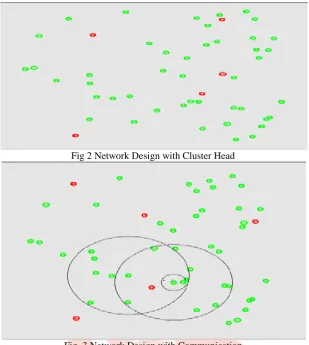
The proposed design is implemented using the network simulator ns-2.35. The network grid of size 1000*1000 is taken and 50 nodes are placed in the grid. Figure 1 and 2 shows the network animator output result of the proposed approach. Figure 3 shows the communication between nodes in the network.
IJEDR1703155
International Journal of Engineering Development and Research (www.ijedr.org)
1107
Fig 2 Network Design with Cluster HeadFig 3 Network Design with Communication
Figure 4 and 5 shows the simulation of the relative member information stored in the network by every node. In figure 5.4 the information of the neighbors is stored which lies within the range of the node. In figure 5.5 the path finding procedure for a node is shown which is comparable to the selection and finding of a path in the network.
The performance parameters for the comparison of basic and proposed approach are Residual Energy: It is given by
𝑅𝑒𝑠𝑖𝑑𝑢𝑎𝑙𝐸𝑛𝑒𝑟𝑔𝑦 = 𝐼𝑛𝑖𝑡𝑖𝑎𝑙𝐸𝑛𝑒𝑟𝑔𝑦 − 𝐸𝑛𝑒𝑟𝑔𝑦𝐶𝑜𝑛𝑠𝑢𝑚𝑒𝑑
Figure 6 shows the residual energy comparison between the basic and proposed approach. The residual energy in the proposed approach is higher than the basic approach.
Fig 6 Residual Energy Average End to End Delay:it is given by:
𝐷𝑒𝑙𝑎𝑦 = (𝑃𝑎𝑐𝑘𝑒𝑡 𝑟𝑒𝑐𝑒𝑖𝑣𝑒𝑑 𝑏𝑦 𝑟𝑒𝑐𝑒𝑖𝑣𝑒𝑟 𝑡𝑖𝑚𝑒 − 𝑔𝑒𝑛𝑒𝑟𝑎𝑡𝑒𝑑 𝑡𝑖𝑚𝑒)
Figure.7 shows the Average End to End delay comparison between the basic and proposed approach. The delay in the proposed approach reduces because of the reduction in number of retransmissions.
0 50 100 150
10 20 30 40 50
Re
sid
u
al
En
ergy
(J
)
Simulation Time
Residual Energy
Basic Approach
IJEDR1703155
International Journal of Engineering Development and Research (www.ijedr.org)
1108
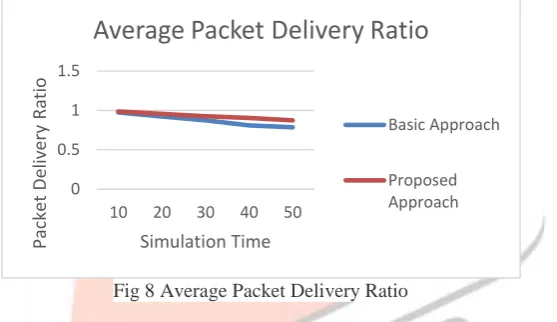
Fig 7 Average End to End DelayAverage Packet Delivery Ratio: It is defined as follows:
𝑃𝑎𝑐𝑘𝑒𝑡𝑑𝑒𝑙𝑖𝑣𝑒𝑟𝑦𝑟𝑎𝑡𝑖𝑜 = 𝑡𝑜𝑡𝑎𝑙𝑝𝑎𝑐𝑘𝑒𝑡𝑠𝑟𝑒𝑐𝑒𝑖𝑣𝑒𝑑 𝑡𝑜𝑡𝑎𝑙𝑝𝑎𝑐𝑘𝑒𝑡𝑠𝑔𝑒𝑛𝑒𝑟𝑎𝑡𝑒𝑑
Figure 5.8 shows the packet delivery ratio comparison between the basic and the proposed approach. The packet delivery ratio for the proposed approach is better compared to the basic approach because the packet lost in the network reduces.
Fig 8 Average Packet Delivery Ratio
V.CONCLUSION
Data routing in Underwater Wireless Sensor Network is an important aspect of research in recent years. In recent years, underwater wireless sensor network has emerged as a powerful technique in order to discover and exploit this harsh environment. Many new techniques have been implemented and their merits and demerits have been compared with the existing solutions. Different architectures for two-dimensional and three-dimensional underwater sensor networks are discussed, and the characteristics of the underwater channel are detailed. The main challenges for the development of efficient networking solutions posed by the underwater environment are detailed and a cross-layer approach to the integration of all communication functionalities is suggested. Furthermore, open research issues are discussed and possible solution approaches are outlined. In the proposed approach a water-wave algorithm based routing approach is proposed. In the present approach, firstly the optimization function is calculated based on the values of residual energy, number of retransmissions and the distance between the nodes. The results also shows that the proposed approach performs better as compared to the basic approach on the basis of residual energy, packet delivery ratio and average end to end delay. It is necessary for a WSN to have less delay in packet delivery and the average energy should be high. So this approach will be suited for real time applications where time delay plays a major role. In future various other machine learning algorithms must be used and their results must be compared with the existing approaches.
REFERENCES
[1] Guangzhong, Liu, and Li Zhibin. "Depth-based multi-hop routing protocol for underwater sensor network." In Industrial Mechatronics and Automation (ICIMA), 2010 2nd International Conference on, vol. 2, 2010, pp. 268-270.
[2] Wahid, A., Lee, S., Jeong, H.J. and Kim, D., 2011. Eedbr: Energy-efficient depth-based routing protocol for underwater wireless
sensor networks. Advanced Computer Science and Information Technology,vol.3, pp.223-234.
[3] Khizar, M., Wahid, A., Pervaiz, K., Sajid, M., Qasim, U., Khan, Z.A. and Javaid, N., 2016, July. Enhanced Energy Efficient Depth Based Routing Protocol for Underwater WSNs. In Innovative Mobile and Internet Services in Ubiquitous Computing (IMIS), 2016 10th International Conference on pp. 70-77.
[4] Ahmed, Tanveer, Maham Chaudhary, M. Kaleem, and Sajid Nazir. "Optimized depth-based routing protocol for underwater wireless sensor networks." In Open Source Systems & Technologies (ICOSST), 2016 International Conference on, 2016, pp. 147-150
[5] Ahmad, Ashfaq, K. Latif, N. Javaidl, Z. A. Khan, and Umar Qasim. "Density controlled divide-and-rule scheme for energy efficient routing in Wireless Sensor Networks." In Electrical and Computer Engineering (CCECE), 2013 26th Annual IEEE Canadian Conference on,vol.6, 2013, pp. 1-4.
0 1 2 3 4 5
10 20 30 40 50
En d to E n d De lay Simulation Time
Average End to End Delay
Basic Approach Proposed Approach 0 0.5 1 1.5
10 20 30 40 50
Pa cket Deli ve ry Rat io Simulation Time
Average Packet Delivery Ratio
Basic Approach
IJEDR1703155
International Journal of Engineering Development and Research (www.ijedr.org)
1109
[6] Kim, Jeong-Sam, and Tae-Young Byun. "A Density-Based Clustering Scheme for Wireless Sensor Networks." In Advanced Computer Science and Information Technology, 2011, pp. 267-276.[7] G. Sadashivappa and Jose, Deepa V "A novel scheme for energy enhancement in wireless sensor networks." In Computation of Power, Energy Information and Commuincation (ICCPEIC), 2015 International Conference on, pp. 0104-0109. IEEE, 2015. [8] Lanbo, L., Shengli, Z. and Jun‐Hong, C., 2008. Prospects and problems of wireless communication for underwater sensor networks. Wireless Communications and Mobile Computing, 8(8), vol. 4, pp.977-994.
[9] Cui, J.H., Kong, J., Gerla, M. and Zhou, S., 2006. The challenges of building mobile underwater wireless networks for aquatic applications. Network, IEEE, 20(3), pp.12-18.