IJEDR1702307
International Journal of Engineering Development and Research (www.ijedr.org)1974
The comparison of Energy Efficient in Wireless
Sensor Network using Various Clustering Methods
and Different Protocols
V.Perumal, Dr.K.Meenakshi Sundaram Ph.D Research Scholar, Associate professor,
Department of Computer Science, Erode Arts & Science College(Autonomous),
Erode, Tamilnadu, India.
________________________________________________________________________________________________________
Abstract - Wireless Sensor Network(WSN) need for most challenging task on various Clustering process in Energy consumption. The clustering process of data transmission in Inter and Intra clustering, Hierarchical clustering, Layered clustering and using various protocols are described. WSN have a large number of nodes of sensing, computing and transmit the data. There is a lot of existing system for WSN related to energy consumption, and sensor nodes. Furthermore, clustering is useful for reply based sensor network that require scalability to hundreds even large number of nodes. However clustering algorithm has lot of advantages and disadvantages compared on LEACH protocol have Energy saving, data aggregation and the first dead node occurrence to find in wireless sensor network.
Keywords: Sensor node, Cluster, Energy Saving, Dead node occurrence, WSN.
________________________________________________________________________________________________________
I.INTRODUCTION
Wireless Sensor Network is the collection of thousands of low-battery powered and low cost and sensor devices that are communicating to each other in order to perform collaborative task. In WSN each sensor node collects the information from its nearby environment within its range. The collected information is further processed in its processing model, and then sent to the Base station. Every sensor node duplicates its energy while transmitting, receiving and processing. As sensor nodes have non reachable and limited energy resources, it is very scarce resource and hence need to be managed carefully in order to extend the life time sensor network [1]. Sensor node can be used in numerous industrial, military and agricultural applications, such as transportations, traffic monitoring, environmental monitoring, smart offices, and battlefield[2].Since the sensor node is energy constrained and its valid communication distance is limited, it is infeasible for all the sensors to transmit data directly to the base station (or sink node). The sink mobility nowadays due to its varied applications in diverse fields that have need of surveillance and monitoring that become inevitable in our daily life. But the main drawback of such sensors are their resource constrained nature mainly in the power backup capabilities of sensor nodes and as a result a number of issues have emerged out of which energy efficiency is an important matter of concern [3].Main challenges of wireless sensor network faced by researcher is battery life .Battery life matter s a lot to keep node alive, where large capacity batteries cannot be deployed. Energy utilization is due to computational operation performed and data transmission reaction [4].To guarantee a good balanced distribution of the energy load between sensor nodes, clustering communication protocols have been designed and implemented.
Wireless Sensor Network
IJEDR1702001
International Journal of Engineering Development and Research (www.ijedr.org)1975
Clustering Progress:Clustering is a process to subdivide the sensing field of sensor network into the number of clusters. Clusters are organizational unit for WSNs. The dense nature of these set of connections requires the need for them to be broken down into clusters to simplify tasks such a communication.
Cluster Heads: Cluster heads are the organization leader of a cluster. They often are required to organized activities in the cluster. These tasks include but are not limited to data aggregation and organization the communication schedule of a cluster.
Base Station: The base station is at the upper level of the hierarchical WSN. It provides the Communication link between the sensor network and the end-user.
End User: The data in a sensor network can be used for a wide range of applications. Therefore, a particular application may build use of the network data over the internet, using a PDA or even a desktop computer. In a queried sensor network (where the required data is gathered from a query sent through the network). This query is generated by the end user.
Sensor Node: A sensor network consists of several detection station called sensor node. All sensor nodes are operational with a transducer, microcomputer, transceiver and power source. Transducer generates electrical signals on based physical effect and phenomena. The microcomputers processes and stored sensor output. Transceiver can be hard-wired or wireless, receives instructions from a central computer and transmit data to that computer. Power for every one sensor node is derived from the electric utility or from a battery. The main characteristics of a WSN include Power utilization constraints for nodes using batteries or energy harvesting. Ability to handle with node failures, Mobility of nodes, Communication failures, Heterogeneity of nodes, Scalability to great scale of network, such as uncomplicated sensing, data storage space, routing and data processing. Clusters are the organizational part for WSN [9].
Energy Consumption of the sensing device should be minimized and sensor nodes should be energy efficient since their limited energy resource determines their lifetime. To conserve power, wireless sensor nodes normally power off both the radio transmitter and the radio receiver when not in use. Communication between sensor nodes dissipates most of its energy depending on the distance between the sending and receiving sensor nodes. We use the 1st order radio frequency energy consumption model to describe the energy consumption for sensor nodes which incorporates both free-space and multi-path energy loss.
II. CLUSTERING TECHNIQUES
The clustering has been well received as an effective way to reduced energy consumption of a WSN. Clustering is designed as the process of choosing a set of wireless sensor nodes to be cluster heads for a given WSN. Therefore, data traffic generated at each sensor node can be sent via cluster heads to be the base station. Clustering is also used for data aggregation, where the cluster heads aggregate the information collected at the cluster member.
Intra clustering: Data collection by each node is the cluster is delivered directly to the CH in a single-hop manner if it is the coverage area of sensor node. The multi-hop packet transmission is used emerging from the sensor node is forwarded to one of the neighbors belonging to the same cluster which is close to the CH.
Inter clustering: Data aggregated at each cluster is delivered by the CHs directly to closet sink, if the sink is in coverage area. Otherwise, the aggregated packet is forwarded to the node that closet to the target sink[9].
Hierarchical clustering: The hierarchical clustering scheme produced for higher level and lower level. The higher level is formed by nodes that are responsible for aggregating and fusing the received data from sensor node in sensing area and then transmit it to a central processor; such nodes are called the cluster head. The lower level of the hierarchy is formed by the nodes that are responsible for detecting the required data from the sensing region and then sending it to the corresponding cluster head. Each cluster includes number of sensor nodes and one cluster head. Cluster head selection can be centralized performed by the base station [3].
Layered cluster: A layered structure is formed where cluster close to the base station are smaller than those which are farther from it. In this way of cluster to select high energy level of nodes and proper distribution as cluster heads three criteria are considered including residual energy, number of neighboring nodes neighborhood radius of the cluster[11].
III. ENERGY CONSUMPTION
Energy is the most crucial resources of wireless sensor network, particularly in this environments which is replacing for recharging a sensor’s batteries are impossible. Energy efficiency in WSNs is a hot research area where lot of methods to improve the energy efficiency is researched. There are different methods or techniques adopted to reduce the energy consumption or to effectively use the available energy to the maximum extent possible. Some of them are adopting different node deployment strategies, applying duty cycling concepts, including sensor nodes which can act as data collector and router, changing the role of nodes accordingly etc. each method will be appropriate for a specific application. According to the literature the majority of the energy is consumed for communication rather than that of processing and sensing. so the need of an energy efficient routing protocol is very important to extend the network lifetime. Some Effective Formula’s are used to calculated for the distance Energy metric given below
IJEDR1702001
International Journal of Engineering Development and Research (www.ijedr.org)1976
T(n)= 𝑝
1−𝑝(𝑟 𝑚𝑜𝑑𝑝1) , nϵG
n is given the no of node; p is a priority for probability of a node being selected cluster. r is the current round and G is the set of node that have not yet become head set. Members for the last 1/p rounds. Each node clustering the cluster head selection will generate round between 0, 1. If the number is a reduced amount of than the threshold T(n) the node will become a cluster head. The base station broadcasts a message to whole network and each node calculated as the distance to base station dbsbased on received
signal power. Each node calculated its CH radius with respect to its distance from the BS using. Rsize=Rmin1 +
𝑑𝐵𝑆−𝑑𝐵𝑆𝑚𝑖𝑛
𝑑𝐵𝑆𝑚𝑎𝑥−𝑑𝐵𝑆𝑚𝑖𝑛∗ 𝑠𝑝𝑒𝑒𝑑changr_rate Rminis the minimum cluster size and speed change rate is radius variation speed rate. They are protocol parameter .dBSmin is the distance of closet node to the main station and dBSmax is the distance of the furthest node
to the BS.
The messaging transmitting and receiving Energy is defined as transmission Energy denoted by ETelec andreceiving Energy
denoted by ERx.To transmit s bit packet length within distance d ,a node consumes on Energy ETx given by
ETx(s,d)=ETxelec(s)+ETxamp(s,d) =Eelec*s+Eamp*s*d2
To receive an s packet length within a distance d, a sensor node consumes an Energy ERxelec given by
ERx(s) =ERxelec(s)
=Eelec*s
The sensor nodes residual energy can be calculated during single frame /epoch as Eres(i)=Ei-Edisswhere
Ei is the sensor node energy for the current round and Ediss is energy dissipated in nth sensor node.
IV.COMPARISON OF VARIOUS ALGORITHMS
We consider Energy Saving Progress for the various clustering algorithm and routing protocols are used in wireless sensor network. Sensors are randomly deployed in a region with sink located at the center using MATLAB and NS2 Environment. Based on our research these methods (Layered, Hierarchical, Inter and Intra Clustering ,etc.,) or useful. Using 100 nodes, sensor nodes distributed dimension of 100m*100m , The energy cost of transmitter electronics Eelec-50NJ/bit ,The energy cost of transmit
amplifier Eamp-10PJ/bit, message size-4000 these are common for in my comparative study papered Simulation parameters with
results are discussed below.
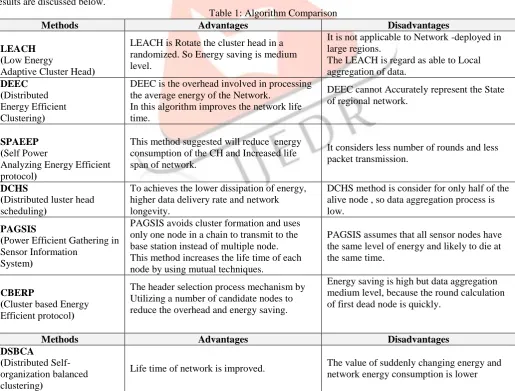
Table 1: Algorithm Comparison
Methods Advantages Disadvantages
LEACH (Low Energy
Adaptive Cluster Head)
LEACH is Rotate the cluster head in a randomized. So Energy saving is medium level.
It is not applicable to Network -deployed in large regions.
The LEACH is regard as able to Local aggregation of data.
DEEC (Distributed Energy Efficient Clustering)
DEEC is the overhead involved in processing the average energy of the Network.
In this algorithm improves the network life time.
DEEC cannot Accurately represent the State of regional network.
SPAEEP (Self Power
Analyzing Energy Efficient protocol)
This method suggested will reduce energy consumption of the CH and Increased life span of network.
It considers less number of rounds and less packet transmission.
DCHS
(Distributed luster head scheduling)
To achieves the lower dissipation of energy, higher data delivery rate and network longevity.
DCHS method is consider for only half of the alive node , so data aggregation process is low.
PAGSIS
(Power Efficient Gathering in Sensor Information
System)
PAGSIS avoids cluster formation and uses only one node in a chain to transmit to the base station instead of multiple node. This method increases the life time of each node by using mutual techniques.
PAGSIS assumes that all sensor nodes have the same level of energy and likely to die at the same time.
CBERP
(Cluster based Energy Efficient protocol)
The header selection process mechanism by Utilizing a number of candidate nodes to reduce the overhead and energy saving.
Energy saving is high but data aggregation medium level, because the round calculation of first dead node is quickly.
Methods Advantages Disadvantages
DSBCA (Distributed Self-organization balanced clustering)
IJEDR1702001
International Journal of Engineering Development and Research (www.ijedr.org)1977
GMLEECS(Geographical multi-layered Energy Efficient clustering Scheme)
Energy saving is high at the same time large
amount data’s are transfer. Only consider for Small scale of network.
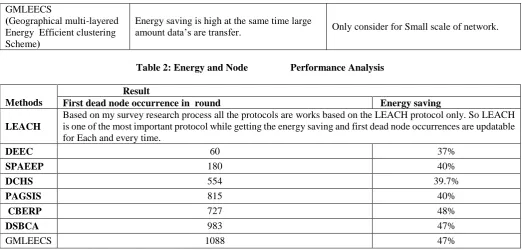
Table 2: Energy and Node Performance Analysis
Methods
Result
First dead node occurrence in round Energy saving
LEACH
Based on my survey research process all the protocols are works based on the LEACH protocol only. So LEACH is one of the most important protocol while getting the energy saving and first dead node occurrences are updatable for Each and every time.
DEEC 60 37%
SPAEEP 180 40%
DCHS 554 39.7%
PAGSIS 815 40%
CBERP 727 48%
DSBCA 983 47%
GMLEECS 1088 47%
We compare the above Table 2 is given results of GMLEECS (Geographical multi-layered Energy Efficient clustering Scheme) protocol’s performance is much better than for the percentage of energy saving is 47% at the same time first dead node occurrence round is 1088 in various methods.
V.CONCLUSION
Wireless sensor network is applicable for specific network especially energy saving process. In this paper analyzing large number of papers related to knowledge in Wireless Sensor Network using Energy Efficient Algorithm. The Energy Efficient algorithm is very helpful for the large data aggregation and energy saving. Increasing the application of WSN inspired many researchers to explore the energy consumption algorithm that implemented. Generally each and every approach has one main problem that is high energy saving due to the long distance from the cluster head node to the base station. In this paper we referred large number of protocol, but most of the protocols are compared based on LEACH protocol. According to GMLEECS (Geographical multi-layered Energy Efficient clustering Scheme) protocol’s performance is much better than the existing methods because the first dead node in rounds of GMLEECS algorithms delay than the existing methods, and also saving the network energy.
References
[1] Abdul Alim ,Md Abdul ,Yu cheng Wu & Wei Wang "A Fuzzy based clustering protocol for energy efficient Wireless sensor network"Advanced Materials Research vol-760, pp.685-690,2013.
[2] V.Perumal,Dr.K.Meenakshi Sundaram “An Enhanced Cluster based Multi-hop Routing Technique in Wireless Sensor NetworkUsing AODV Protocol”
[3] JenqShiou ,Tung-Hung Chiang , Min-Chieh Yu and Kuan-Wu Su"Energy Efficiency clustering Sceme For Prolonging the Lifetime of Wireless sensor network with Isolated nodes"vol-20,IEEE-2013.
[4] Kanikpunjani ,Dr.S.STyagi"Energy Efficient Routing protocols for Wireless sensor network "vol-2,IJERT-2013.
[5] Liao.Y, Qi.H.Li ,"Load-balanced clustering Algorithm in distributed Self Organizing for Wireless Sensor Network" vol-5,pp(1498-1506),IEEE-2013.
[6] Amira Ben Ammar,Ali DZIRI”Multi-hop LEACH based Cross layer Design for Large Scale WSN”pp(763-768),IEEE-2016. [7] N.G.Palan ,Dr.B.VBarbadekar , Dr.SuahsPati“Self Power Analysing Energy Efficient Protocol(SPAEEP):An Adaptive
approach” IEEE-2016.
[8] G.Kannan,T.SreeRenga raja "Energy Efficient Distributed cluster head Scheduling Scheme for two tiered Wireless sensor network" Egyptian Informatics Journal,pp(167-174) 2015.
[9] A santar pal sing , S.C Sharma "A Survey on cluster based routing protocols in WSN"ICACTA vol-45,pp(687-695),2015. [10] BehrangBarekatain,shahrzadDehghari"An Energy-Aware Routing protocol for WSN based on new combination of Genetic
Algorithm &K-means" Information Systems International conference pp(552-560),2016.
[11] SamanSiavoshi, YousefseifiKavian Mehdi Tarhani,HabibFalariRashvand "Geographical multi-layered energy-efficient clustering scheme for ad hoc distributed wireless sensor network"vol-6,pp(1-9),IET-2016.
[12] Ahemad .A Ababnesh, A Novel Energy –Aware clustering Algorithm for Wireless Sensor Networks”vol-7,pp(333-338) ,IJACSA-2016.
IJEDR1702001
International Journal of Engineering Development and Research (www.ijedr.org)1978
[14] SarayutPoolsanguan; Chakchai So-In; KanokmonRujirakul; KanokpornUdompongsuk “An enhanced cluster head selectioncriterion of LEACH in wireless sensor networks” 13th International Joint Conference on Computer Science and Software Engineering (JCSSE), ( 1 – 7),2016.