University of Pennsylvania
ScholarlyCommons
Publicly Accessible Penn Dissertations
1-1-2012
Secure Time-Aware Provenance for Distributed
Systems
Wenchao Zhou
University of Pennsylvania, [email protected]
Follow this and additional works at:http://repository.upenn.edu/edissertations Part of theComputer Sciences Commons
This paper is posted at ScholarlyCommons.http://repository.upenn.edu/edissertations/601
For more information, please [email protected]. Recommended Citation
Zhou, Wenchao, "Secure Time-Aware Provenance for Distributed Systems" (2012).Publicly Accessible Penn Dissertations. 601.
Secure Time-Aware Provenance for Distributed Systems
Abstract
Operators of distributed systems often find themselves needing to answer forensic questions, to perform a variety of managerial tasks including fault detection, system debugging, accountability enforcement, and attack analysis. In this dissertation, we present Secure Time-Aware Provenance (STAP), a novel approach that provides the fundamental functionality required to answer such forensic questions -- the capability to
"explain" the existence (or change) of a certain distributed system state at a given time in a potentially adversarial environment.
This dissertation makes the following contributions. First, we propose the STAP model, to explicitly represent time and state changes. The STAP model allows consistent and complete explanations of system state (and changes) in dynamic environments. Second, we show that it is both possible and practical to efficiently and scalably maintain and query provenance in a distributed fashion, where provenance maintenance and querying are modeled as recursive continuous queries over distributed relations. Third, we present security extensions that allow operators to reliably query provenance information in adversarial environments. Our extensions incorporate tamper-evident properties that guarantee eventual detection of compromised nodes that lie or falsely implicate correct nodes. Finally, the proposed research results in a proof-of-concept
prototype, which includes a declarative query language for specifying a range of useful provenance queries, an interactive exploration tool, and a distributed provenance engine for operators to conduct analysis of their distributed systems. We discuss the applicability of this tool in several use cases, including Internet routing, overlay routing, and cloud data processing.
Degree Type
Dissertation
Degree Name
Doctor of Philosophy (PhD)
Graduate Group
Computer and Information Science
First Advisor
Boon Thau Loo
Keywords
Byzantine faults, Distributed systems, Forensics, Provenance, Security
Subject Categories
SECURE TIME-AWARE PROVENANCE FOR
DISTRIBUTED SYSTEMS
Wenchao Zhou
A DISSERTATION in
Computer and Information Science
Presented to the Faculties of the University of Pennsylvania in Partial Fulfillment of the Requirements for the Degree of Doctor of Philosophy
2012
Boon Thau Loo
Assistant Professor, Computer and Information Science Supervisor of Dissertation
Jianbo Shi
Associate Professor, Computer and Information Science Graduate Group Chairperson
Dissertation Committee
Zachary G. Ives (Chair), Associate Professor, Computer and Information Science Val Tanner, Professor, Computer and Information Science
SECURE TIME-AWARE PROVENANCE FOR DISTRIBUTED SYSTEMS COPYRIGHT
Acknowledgments
This dissertation would not have been possible without the guidance, helps and support from my advisor, colleagues, friends and family. I apologize in advance for any omission I may have made below.
I am very fortunate to have the privilege to work with my excellent advisor Boon Thau Loo. When I applied for graduate schools in 2007, Boon just started at Penn and generously took me as his third advisee. Admitting three enthusiastic yet inexperienced applicants in the first tenure year is aggressive and inarguably risky. I am very grateful that Boon was willing to take the leap of faith and give me the opportunity to ever start my Ph.D. at Penn. In the following five years, I have been tremendously benefited from the guidance and encouragement that I received from Boon. He has been a role model for me and other fellow advisees, by perfectly illustrating focus, discipline and strive for perfection in his work. Apart from professional advices, Boon has been amazingly generous with time and at-tention on other topics, including presentation skills, strategies for job search and balancing between family and work. I have learned an innumerable amount from Boon, and I am deeply indebted to him for his constant and unconditional support throughout my years at Penn.
provenance-based view maintenance, which is the inception of my dissertation research on provenance. Andreas and I met in his outstanding seminar course “Distributed Systems and Social Networks” in Spring 2010. My final project “Secure Network Provenance” has since then evolved into a major portion of this dissertation. Margo kindly accepted the invitation to my dissertation committee, and gave invaluable feedback on earlier drafts of the dissertation. I am especially grateful that Margo read my dissertation thoroughly and attended the defense on the first day she re-covered from a surgery. Micah and I have collaborated since the ExSPAN project in 2009. His insightful ideas and warm encouragement were one significant con-tributing factor of the productive collaboration. I am fortunate to further continue this collaboration with him at Georgetown University. Val is a mathematician and theoretician who always has the most profound understanding of a problem. The theoretic foundation of my dissertation was greatly inspired by the discussion with him during the TaPP workshop in 2011. This dissertation would not have been the same without his comments.
My appreciation also goes to Jennifer Rexford and Jonathan Smith for their advices on my post-graduation career and their support for my job applications, and Insup Lee for chairing my WPE-II exam in 2009.
I have spent two great summer internships at Yahoo! Research in 2010 and Microsoft Research in 2011. I would like to thank my fantastic mentors Russell Sears and Adam Silberstein (at Yahoo! Research), and Badrish Chandramouli and Suman Nath (at Microsoft Research), for providing me the great opportunities at research labs and allowing me to enjoy the pleasant and fruitful summers.
Li and Suyog Mapara (for the TAP project), and William R. Marczak and Andrew Mao (for the A3 project). I would like to acknowledge them here, and thank them for their relentless efforts.
Also at Penn, I have had the fortune to meet many great friends who made my five years at Penn an enjoyable experience. Changbin Liu and I share the same advisor, and we came to Penn taking the same flight on the same day, and de-fended the dissertations on the same day (2 hours apart). Zhuowei Bao, Meng-meng Liu and I were classmates at high school, and what a pleasant reunion at Penn’s databases group! I also thank my other friends Adam Aviv, Wei Di, Harjot Gill, Dong Lin, Shivkumar Muthukumar, Santosh Nagarakatte, Lu Ren, Shaohui Wang, Jianzhou Zhao, and Zhuoyao Zhang for brightening my Ph.D. life.
Outside the computer science ecosystem, Xiaolei Su from the Harvard Medical School and Weiyuan Zhou from the Wharton Business School have been longtime friends of mine ever since high school. We accompanied each other and shared memorable moments along the journey.
ABSTRACT
SECURE TIME-AWARE PROVENANCE FOR DISTRIBUTED SYSTEMS
Wenchao Zhou Boon Thau Loo
Operators of distributed systems often find themselves needing to answer foren-sic questions, to perform a variety of managerial tasks including fault detection, system debugging, accountability enforcement, and attack analysis. In this dis-sertation, we presentSecure Time-Aware Provenance(STAP), a novel approach that provides the fundamental functionality required to answer such forensic questions – the capability to “explain” the existence (or change) of a certain distributed sys-tem state at a given time in a potentially adversarial environment.
Contents
1 Introduction 1
1.1 The Provenance Approach . . . 3
1.2 Research Challenges . . . 4
1.3 Contributions . . . 6
2 System Model 9 2.1 State Transition Systems . . . 9
2.2 Protocol as Derivation Rules . . . 12
2.3 Rule Execution Model . . . 13
2.4 Execution Traces . . . 15
2.5 Challenges and Requirements . . . 17
2.6 Summary . . . 18
3 Provenance Model 20 3.1 TAP Provenance Model . . . 20
3.2 Derivations and System Snapshots . . . 23
3.3 Correctness . . . 25
3.4 Summary . . . 27
4.1.1 Provenance as Relational Tables . . . 29
4.1.2 Example Tables . . . 32
4.2 Provenance Maintenance with Delta Rules . . . 32
4.2.1 Rule Generation for Provenance Maintenance . . . 33
4.2.2 Proactive and Reactive Maintenance . . . 35
4.3 Provenance Query Processing . . . 37
4.3.1 Recursive Query Plan . . . 38
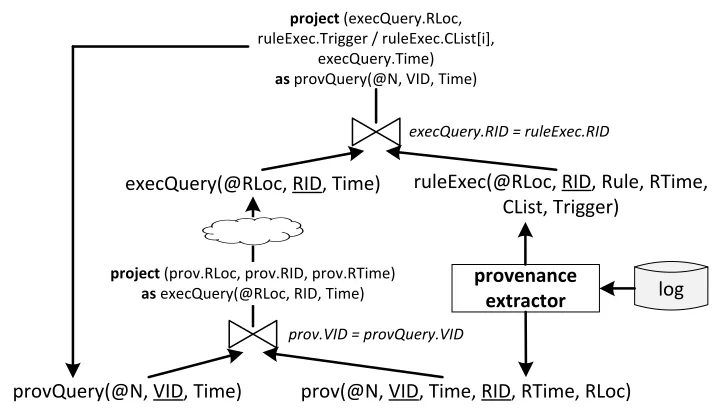
4.3.2 Reconstructing Provenance on Demand . . . 39
4.3.3 Distributed Recursive Query Formulation . . . 41
4.3.4 Query Customization . . . 44
4.4 Correctness . . . 46
4.5 Evaluation . . . 47
4.5.1 Performance of TAP Provenance . . . 48
4.5.2 Performance of Snapshot Provenance . . . 52
4.6 Summary . . . 58
5 Optimizations 59 5.1 Cost-based Optimizations . . . 60
5.1.1 Cost Model . . . 61
5.1.2 Applying the Cost Model . . . 63
5.1.3 Optimizations using the Cost Model . . . 65
5.2 Query Optimizations . . . 66
5.2.1 Query Results Caching . . . 66
5.2.2 Query Traversal Order . . . 67
5.2.3 Condensed Provenance . . . 69
5.3 Evaluation . . . 70
5.3.1 Cost-based Optimization . . . 71
5.4 Summary . . . 80
6 Secure Provenance 81 6.1 Threat Model and Assumptions . . . 82
6.1.1 Compromises . . . 83
6.1.2 Assumptions . . . 83
6.2 Approach Overview . . . 84
6.2.1 Approximate Provenance using Evidence . . . 84
6.2.2 Fundamental Limitations . . . 85
6.2.3 Definition: STAP . . . 87
6.3 Secure Maintenance and Querying . . . 88
6.3.1 Secure Logging for Provenance Maintenance . . . 88
6.3.2 Secure Provenance Querying . . . 90
6.3.3 Optimizations . . . 91
6.4 Correctness . . . 92
6.5 Evaluation . . . 94
6.5.1 Experimental Setup . . . 95
6.5.2 Example Queries . . . 96
6.5.3 Usability . . . 97
6.5.4 Network Traffic at Runtime . . . 98
6.5.5 Storage . . . 100
6.5.6 Computation . . . 101
6.5.7 Query Performance . . . 103
6.5.8 Scalability . . . 104
6.6 Summary . . . 105
7 Implementation: NETTRAILSSystem 107 7.1 Architecture Overview . . . 108
7.3 Interactive Exploration Tool . . . 111
7.4 Applications . . . 113
7.4.1 Application #1: Chord . . . 113
7.4.2 Application #2: Hadoop MapReduce . . . 114
7.4.3 Application #3: Quagga . . . 115
7.5 Limitations . . . 116
8 Related Work 117 8.1 Provenance . . . 117
8.2 Forensics in Distributed Systems . . . 120
8.3 Declarative Networking . . . 123
9 Summary 124 9.1 Future Directions . . . 125
9.1.1 Extensions to Thesis . . . 126
9.1.2 Looking Beyond . . . 127
A Correctness Proofs 129
List of Tables
4.1 An exampleprovrelation based on Figure 3.1. The table is horizontally
parti-tioned across all nodes, based on the location specifierLoc. . . 31
4.2 An exampleruleExecrelation that corresponds to theDERIVEvertices shown
in Figure 3.1. . . 31
4.3 Examplesend andrecvrelations that correspond to the SEND andRECEIVE
vertices in Figure 3.1. . . 32
4.4 User-defined functions for various queries . . . 45
5.1 Summary of the statistics used for cost-based optimizations. . . 62
5.2 Comparisons between estimated storage (obtained from the cost model) and
actual measured storage (in MB) for the path-vector protocol. . . 71
5.3 Comparisons between estimated average query latency (obtained from cost
model) and actual measured end-to-end latency (in seconds) for the path-vector
protocol. . . 72
5.4 Comparisons between estimated storage (obtained from the cost model) and
actual measured storage (in GB) for Hadoop MapReduce. . . 73
5.5 Comparisons between estimated average query latency (obtained from cost
model) and actual measured end-to-end latency (in seconds) for Hadoop
List of Figures
1.1 An example scenario based on network routing. . . 5
2.1 An example network, where the best path between nodecandachanged at timet2, due a change of the network topology. . . 15
2.2 An execution subtrace of the MINCOSTprogram that corresponds to scenario in Figure 2.1 and provides an explanation of +mincost(@c,a,4). . . 16
3.1 The TAP provenance graph for explaining the deletion ofmincost(@c,a,5). 23 3.2 The TAP provenance graph for explaining the deletion ofmincost(@c,a,5). The subgraph that supports the precondition that link(@b,c,3)existed at timet2is replaced by theEXISTvertex. . . 24
4.1 Logical query plan for recursive provenance queries. Underlined attributes are primary keys. . . 37
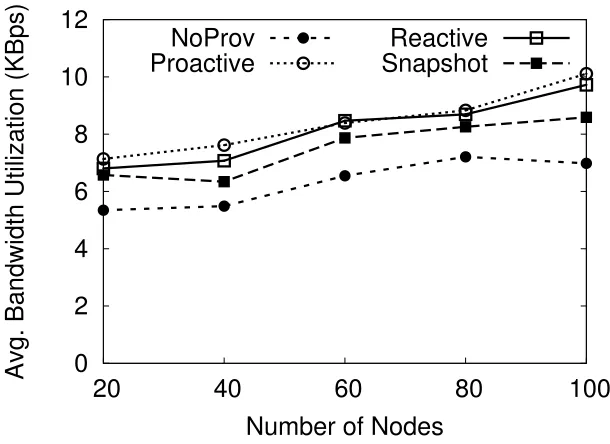
4.2 Average per-node bandwidth utilization (KBps). . . 49
4.3 Average per-node storage overhead (MB). . . 50
4.4 Query latencies (seconds) for various network sizes. . . 51
4.5 Average communication cost (MB) for MINCOST. . . 54
4.6 Average bandwidth cost (MBps) for MINCOSTunder churn. . . 55
4.7 Average bandwidth cost for PATHVECTORin testbed deployment. . . 56
4.8 Fixpoint times for PATHVECTORin testbed deployment. . . 57
5.1 Average bandwidth cost (KBps) with and without caching. . . 75
5.3 Average bandwidth cost (KBps) using different query traversal orders. . . 77
5.4 Cumulative distribution of query completion latencies using different query traversal orders. . . 78
5.5 Average bandwidth (KBps) for querying POLYNOMIALand BDD. . . 79
6.1 Example result (with simplified notations) of the Hadoop-Squirrel query. . . . 97
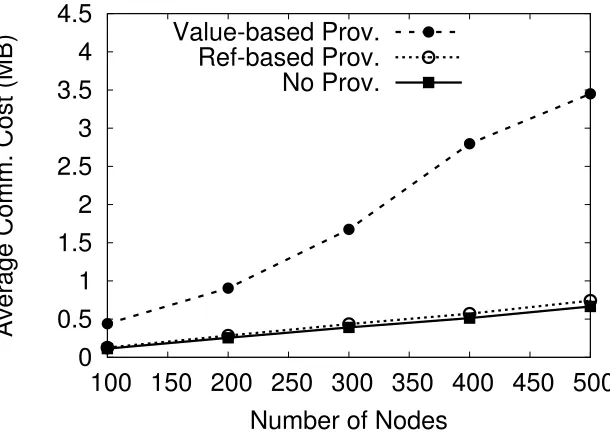
6.2 Normalized increase in traffic by NETTRAILS, compared to a baseline system (no provenance). . . 99
6.3 Per-node log growth in NETTRAILS, excluding checkpoints. . . 101
6.4 Additional CPU load for generating and verifying signatures, and for hashing. 102 6.5 Query cost: time elapsed (left bar) and data downloaded (right bar). . . 103
6.6 Scalability for Chord: total traffic (left) and log size (right). . . 104
7.1 The architecture of a single node. . . 108
7.2 A screenshot of the NETTRAILSsystem. . . 111
Chapter 1
Introduction
Distributed systems have rapidly evolved, from simple client/server applications in local area networks, to Internet-scale peer-to-peer networks and large-scale cloud platforms deployed on thousands of nodes across multiple administrative domains and geographical areas. Despite the ubiquity and criticality of these distributed systems, designing and deploying these systems remains challenging due to their ever-increasing scale and the complexity and unpredictability of system execu-tions. In both the design and deployment phases, designers/administrators of distributed systems often find themselves needing to answerforensicquestions, to understand why and how a system execution reaches a certain state. Such exam-ples include, but are not limited to, the following scenarios:
Chapter 1. Introduction
invariants and properties can be performed by compiling the answers to the corresponding forensic questions.
• System debugging. A detected system fault in a prototype implementation may indicate a subtle yet critical bug in the design or the implementation. The system designer would greatly benefit from knowing the execution trace that led to this unexpected state, and the ability to reconstruct it for debug-ging purposes.
• Access control. Upon receiving a request for accessing local resources, the operators may decide to grant or deny the access based on how the request was formulated – whether it was originated from an authorized user or whether an authority has endorsed the request.
• Accountability. In a system deployment that crosses multiple administra-tive domains, each of the participating parties may act to maximize its own benefit regardless the (potentially negative) impact on the global system (e.g., “hot-potato” routing in the interdomain routing systems). Forensic questions that are answered in a collective and secure fashion are useful to enforce ac-countability – the ability to hold the parties to be accountable to their opera-tions and outputs to the global system.
• Attack analysis - root cause analysis. Distributed systems are known to be vulnerable to malicious attacks. Given the symptoms (e.g., suspicious en-tries in the routing table), the operators must decide their root causes (e.g., intrusion by a malicious user) before they can take appropriate actions.
1.1. The Provenance Approach
Composing answers to forensic questions is not an easy task; in fact, the an-swers are often coupled with a particularcombinationof behaviors, both within the network and at different hosts, which can be hard to find. The key challenge is to inspect the data flows, dependencies, and updates to distributed (networked) nodes’ state — often in ways that are not predictable in advance. Existing domain-specific solutions [22, 51, 101] often work by recording some forensic data at each node, e.g., a list of past routing changes, which are then used to answer the admin-istrator’s questions on demand. However, tailoring the schema and the introspec-tion mechanisms to each new applicaintrospec-tion is cumbersome and inflexible. It would be preferable to have agenericsolution that can be applied to arbitrary distributed systems.
1.1
The Provenance Approach
The approach that we propose in this dissertation is to construct a distributed data structure called theprovenancethat, at a high level, tracks how data flows through the system. Data provenance itself is not a new concept — it has been extensively explored by the databases and the systems community, and has proven to be a useful and practical concept. It has been successfully applied to a variety of areas, including probabilistic databases [9, 85, 105], collaborative databases [33], file sys-tems [42, 72, 73], scientific workflow computation [10, 15, 23, 78, 100], and cloud computing [45]. It is primarily used to answer questions concerning how query or computation results are derived and which data sources they come from. The capa-bility of learning such information is essential to answer the cause-and-effect ques-tions, and, therefore, enables provenance to be a promising approach for forensics in distributed systems.
Chapter 1. Introduction
queries (“Why does a certain stateτexist?”), which explains the derivations of system state at query time, for fault detection, history queries (“Why didτ exist at a previous timet?”) for system debugging and accountability, dynamic queries (“Why and how didτ (dis)appear?”) for root cause analysis, and causal queries (“What state on other nodes was derived from τ?”), which explains which parts of the system have been affected, for attack analysis and system recovery.
1.2
Research Challenges
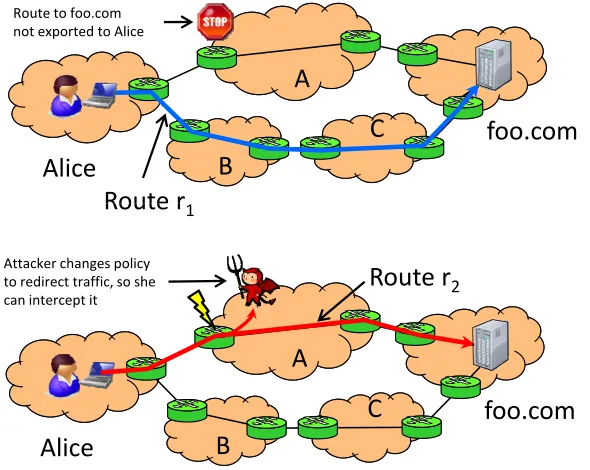
To support the full range of functionality required for enabling forensics in dis-tributed systems, there are a number of challenges that traditional data provenance cannot answer very well. To illustrate this, we consider a realistic scenario from to-day’s Internet routing systems (illustrated by Figure 1.1). A network operator Alice might want to investigate why her router1to the destinationfoo.comchanged to
router2 five minutes ago.
Surprisingly, this query cannot be easily answered by existing provenance sys-tems, because it requires a comprehensive solution for several challenges arisen in distributed systems: the query may ask for a state change and for state (such as route r1) that no longer exists; a route change during query processing could
re-sult in inconsistency in the query rere-sults; furthermore, if the change was brought about by an attacker who has “hijacked”r1, the attacker can try to cover his traces
by falsifying the provenance ofr2. To support forensic queries in this scenario,
• We must be able to capturehistoricalinformation about past states and inter-actions within the systems, not just about the current state. Only maintaining relationships among current state is not enough; historical provenance would require recording relationships among entries in event logs.
tran-1.2. Research Challenges
A
Route to foo.comnot exported to Alice
Alice
foo.com
A
C
B
Route r
Route
r
1A
Attacker changes policyto redirect traffic, so she
can intercept it
Route
r
2Alice
foo.com
A
C
B
Figure 1.1: An example scenario. In the unmodified system (top), network A’s policy does not allow cross traffic, so Alice can reachfoo.comonly through net-works B and C. If evil Eve can compromise A’s router (bottom), she can change this policy and thus gain the ability to listen to Alice’s traffic.
sient state. In reality, the state of a distributed system can be highly dynamic; there can even exist instabilities or oscillations, for instance, a typical Internet router can incur hundreds of updates per minute.
• We must takemessages and timinginto account, rather than simply looking at global sequences of events. In a distributed system, the local clocks of the different nodes can be slightly out of sync, messages take time to propagate from one node to another and are sometimes lost by the network, etc.
Chapter 1. Introduction
state derivations, or instead just record the inputs and use deterministic re-play to re-derive missing state.
• We must have the ability todistribute the storageof the provenance to keep communication costs down: for performance reasons, centrally archiving the system’s entire provenance is impractical. This means that we also need the ability todetect when nodes tamper with the provenance; otherwise, a com-promised node could cover its traces and avoid detection.
1.3
Contributions
Several prior work has proposed solutions that attack these research challenges in-dividually. For instance, PASS [72] and several scientific workflow systems [10, 78, 100] present solutions for historical provenance; Orchestra [33], PA-S3fs [73] and RAMP [45] discuss distributed provenance maintenance and querying for specific applications; and Sprov [42] enforces the integrity of chain-structured provenance. (Chapter 8 summarizes and discusses the related work in greater details.) This dissertation provides thefirst comprehensivesolution that addressesallthe research challenges presented in the previous section. We demonstrate thatit is both feasible and practical to develop a general-purpose provenance system for distributed systems, that
provides explanation for system behavior even in an untrusted and dynamic environment.
This dissertation proposes and develops the foundations of Secure Time-aware Provenance(STAP). STAP captures time, distribution, and dependencies of updates; it enables the administrator of a distributed system to pose “ad hoc” queries over the system’s prior states, communications patterns, event orderings, and more. In particular, the dissertation makes the following contributions:
1.3. Contributions
protocols, we prove that STAP provides a sound and complete representa-tion of the dependencies of events in a distributed system. Due to practical challenges in distributed systems (such as loosely synchronized clocks, node failures, and interactions via message passing), we rethink several of the key design decisions behind data provenance in the design of STAP.
2. Efficient distributed provenance maintenance. It is infeasible to maintain provenance in a centralized approach for large scale distributed systems, which may consist of thousands of nodes. To amortize the maintenance over-head, this dissertation explores a distributed storage model and the corre-sponding maintenance techniques [113], with the design goals that aim to minimize the impact to the existing concurrently running systems.
3. Recursive provenance query evaluation. As a distributed storage model is adopted, provenance queries have to be evaluated in a distributed re-cursive fashion. This dissertation presents a general querying framework that enables a large degree of customizations for various applications. We show that, based on a combination of recursive view maintenance and log-ging/deterministic replay, a recursive query can reconstruct the provenance of a system state/event that occurred at a specific time in the past [112, 113].
4. Performance optimization and tradeoffs. In addition, the dissertation ex-plores a related research question – how optimizations/tradeoffs can be ap-plied to improve the communication overhead and query response time. We present two alternative strategies for maintaining provenance: a proac-tivescheme in which provenance deltas are logged, and areactivescheme in which only nondeterministic events (such as incoming messages) are logged for reconstructing provenance on demand.
Chapter 1. Introduction
the optimal strategy for a given application depends on factors such as query frequency, system runtime, and the ratio of local vs. distributed derivations. To exploit these tradeoffs, we develop cost models [112] for both schemes, and we describe techniques for determining the optimal maintenance strat-egy at runtime.
5. Security guarantees in malicious environments. This dissertation further explores the question whether there exists an approach that can guarantee the correctness and completeness of provenance query results with the exis-tence of compromised nodes; if not, whether we can provide a weaker yet useful guarantee. This dissertation presents a solution [109] that guarantees progress on provenance queries – given a query issued at a correct node, either a correct and complete query result is returned or at least one compro-mised node is exposed.
6. Full-fledged implementation and evaluation. Finally, we present the NET -TRAILS system [111], a full-fledged TAP provenance engine. NETTRAILS uses a declarative networking [63] engine for maintaining and querying the provenance graph, which is coupled with a secure logging and replay sys-tem. NETTRAILS incrementally maintains and queries provenance in a workload-aware fashion, and it can provide meaningful guarantees despite network variability (such as instabilities or oscillations) and even in a mali-cious environment.
Chapter 2
System Model
Before we present the provenance model of STAP in Chapter 3, we first introduce a distributed system model (based on distributed Datalog) and some basic concepts that will be useful for our formal definitions. We also describe some key chal-lenges that STAP needs to address in order to support a range of network forensic capabilities.
2.1
State Transition Systems
We consider a system that consists of a set of nodesN = {N1, N2, ..., Nn} that are
connected by a network and can communicate by sending messages. Each node has a local clock, but the clocks are not necessarily synchronized. A node Ni is
eithercorrect, whereNiconforms to a prescribed protocolP(Ni); orfaulty, whereNi
can behave arbitrarily. A faulty node externally exhibits as a Byzantine fault [55]. We writeF to denote the set of faulty nodes.
Chapter 2. System Model
of faulty nodes, as faulty nodes can behave arbitrarily regardless of their states. We now give the syntactic definition of node state and messages.
Definition 1. (State) The state of a node Ni, H(Ni), is expressed as a set of tuples (typically with fixed schema), where each tuple τ ∈ H(Ni) represents a relational data
item that encodes information aboutNi’s current state.
We model user input as tuples that are inserted or deleted directly by users, and computations performed by the system asderivationsof new tuples from existing tuples. We say that a tuple is abase tuple if it was inserted directly by a user; oth-erwise, it is aderived tuple. As an illustrative example, consider a simple network routing system that computes pair-wise shortest paths among all nodes. The state of a nodeNi contains the local links to its neighbor (e.g.,link(S,D,C)for a direct
link between S and Dwith cost C), and its routing entries to various destinations
(e.g., cost(S,D,C) for a path from node S to D with cost C). Here, link tuples
are the base tuples directly imported from external sources, and cost tuples are
derived from these baselinktuples.
Definition 2. (Update)An update is either +τ or−τ, whereτ is a tuple that is being derived(+)or underived(−). We write4τ to denote an update of either type.
Definition 3. (Message) Each message m ∈ M is a triplet(src, dest, upd)where src denotes the sender,destdenotes the receiver, andupdis the message payload. The message
payload is either+τ or−τ, indicating an intended update of stateτ.
We additionally write txT ime(m) to denote the time m is sent from src, and
rxT ime(m) to denote the time m is received by dest. txT imeand rxT ime are
respec-tively defined accordingly to the local clocks ofsrcanddest.
2.1. State Transition Systems
a messages sent from Z to S that notifies the discovery of a new path from S to Dwith costC, and (S,S,-link(S,D,C))represents a withdraw of the direct link
between nodeSandD.
Based on the syntactic definition of system state, we next present the semantics of the state transition system. We define valid state transition as follows:
Definition 4. (Transition). Suppose S = {M,H} and S0 = {M0,H0}
, a valid state
transitionS →S0corresponds to one of the following scenarios:
1. H0 =H,M0 =M+{m}
, wherem = (src, src, upd): the user sends an external
input (which is not yet delivered) to nodesrc;
2. H0 =H,M0 =M+{m}, wherem= (src, dest, upd), src∈F: a faulty nodesrc
sends out a messagemto nodedest;
3. H0 =H,M0 =M − {m}: the messagemis lost during the transmission;
4. H0 = H,M0 = M − {m}, where m = (src, dest, upd), dest ∈ F: the messagem
is delivered to a faulty nodedest;
5. H0(dest) = H(dest) + ∆τ
,H0(N
i) = H(Ni)(forNi =6 dest),M0 =M − {m}+
{m01, m02, ..., m0o}, wherem= (src, dest,∆τ), mi0 = (src0i, dest0i,∆τi0), src0i =dest:
a correct nodedestreceives a messagem ∈ M, applies the modification to its local
state, and generates a set of new messages according to its execution logic described
by protocolP(Ni).
The first four scenarios in the definition are straightforward, where the nodes’ states remain unchanged during the transition. The transition in the last scenario largely relies on the semantics of the execution logicP(Ni), which remains
Chapter 2. System Model
2.2
Protocol as Derivation Rules
The execution logic of a given nodeNiis entailed by the prescribed protocolP(Ni),
which is encoded as a set of explicitderivation rules. This is the case, e.g., for sys-tems that are written in a declarative language such as Network Datalog (log) [63]. However, STAP is not specific to declarative systems written in ND-log, and can be applied to any legacy distributed systems whose dependencies between incoming and outgoing tuples can be modeled using derivation rules as described in Section 7.2.
As an illustrative example, we consider the simple MINCOST protocol for net-work routing, in which the nodes compute the lowest-cost path between each pair of nodes using the followingrules:
mc1 cost(@S,D,C) :- link(@S,D,C).
mc2 cost(@S,D,C) :- link(@Z,S,C1), mincost(@Z,D,C2), C=C1+C2.
mc3 mincost(@S,D,MIN<C>) :- cost(@S,D,C).
As in traditional Datalog, each NDlog rule has the formp :- q1, q2, ..., qn.,
which can be read informally as “pshould be derived whenever q1, q2,..., and qnall exist at the same time”. NDlog supports alocation specifierin each predicate,
which is written as an@symbol followed by the node on which the tuple resides.
For example, any cost tuples that are derived via rule mc1 should reside on the
same node as the corresponding link tuples, since both carry the same location
specifier.
In this program, the base tuplelink(@S,D,C)exists if nodeShas a direct link
to nodeDwith costC. The tuplecost(@S,D,C)is derived whenShas a (possibly
indirect) path to D with total cost C, which can either be a direct link (mc1) or a
path through another nodeZ(mc2). Rulemc3 aggregates all paths with the same
2.3. Rule Execution Model
base tuples. For instance, mincost tuples may be updated if the cost of a link
changes, since this can change the lowest-cost route.
2.3
Rule Execution Model
Next, we briefly describe the execution model for NDlog rules. The execution of a NDlog program consists of insertions and deletions of individual tuples; we refer to these as events. An event is essentially triggered by a node Ni receiving
a message m = (Ni0, Ni,∆τ), and applying the intended update carried by the
message. We defer the formal definition of event till the end of the section, after the rule execution model is presented. Causal dependencies can exist between events; for instance, the insertion of a derived tuple causally depends on the insertion of the tuple(s) from which it was derived. It is these causal dependencies that will be captured by STAP.
NDlog programs are executed usingpipelined semi-na¨ıveevaluation (PSN) [63]. PSN first requires rewriting each NDlog rule into delta rules (also known as the event-condition-action rule in active database [20]) of the formaction :- event, conditions. As an example, the generated delta rules for rulemc2in the MINCOST program are:
d1 +cost(@S,D,C) :- +link(@Z,S,C1), mincost(@Z,D,C2), C=C1+C2.
d2 -cost(@S,D,C) :- -link(@Z,S,C1), mincost(@Z,D,C2), C=C1+C2.
d3 +cost(@S,D,C) :- link(@Z,S,C1), +mincost(@Z,D,C2), C=C1+C2.
d4 -cost(@S,D,C) :- link(@Z,S,C1), -mincost(@Z,D,C2), C=C1+C2.
d1-d2andd3-d4are delta rules for thelinkandmincostpredicates, respectively.
Rulesd1andd3describe insertions (+), andd2and d4describe deletions (-). For
Chapter 2. System Model
For rules with aggregates (e.g. mc3), a similar set of insert/delete delta rules
can be generated. The main difference here is that the action would result in an update of an aggregate in the rule head.
Since derivations can involve tuples on remote nodes (such as the rule mc2
above), nodes must notify each other when they locally derive a tuple that could trigger a derivation on a remote node. This is done by sending a message that encodes the update. For instance, evaluating the delta rules of rulemc2 results in
sending messagem=(Z,S,+/-cost)to nodeZ. Messages can be reordered by the
network.
In PSN evaluation, when a node receives a message, it applies the update en-capsulated in the message and then determines whether any additional deriva-tions (or underivaderiva-tions) have been triggered by the rule evaluation. If so, the cor-responding updates are formulated as messages and sent to the corcor-responding destinations.
We model aneventas the application of one update and its corresponding delta rule evaluation. An event corresponds to one transition step in the system execu-tion. We formally define an event as follows:
Definition 5. (Event)An eventd@Ni = (e, r, t, c, e0)represents the fact that delta ruler was triggered by updateeand generated a set of updatese0at timet(relative toNi’s local
clock), given the preconditionc. The preconditioncis a set of tuples that existed onNi at
timetthat are used in the event.
Given an initial state S, we write S −−−→ Sd@Ni 0
to denote the transition from S to S0 ,
whereS0 is the resulting state after the application the eventd@N i.
2.4. Execution Traces
a
b
c
5
1 3
at time t2 > t1
a
b
c
5 3
at time t1
Figure 2.1: An example network, where the best path between node c and a
changed at timet2, due a change of the network topology.
nodes (Scenario 1 and 2), we writee, rand cas⊥; for message loss and messages delivered at faulty nodes (Scenario 3 and 4), we writer,cande0as⊥.
2.4
Execution Traces
The execution of an NDlog program can be characterized by the sequence of events that take place; we refer to this sequence as an execution trace. An execution trace can be used to explain a derivation that occurred during the execution – we can simply replay it and check which event triggered the derivation and which condi-tions held at that time. A full trace can recursively explain all derivacondi-tions; if we are only interested in some specific derivations (e.g., the ones queried by the network operator), a subtrace is generally sufficient.
Definition 6. (Trace): A traceE of a system execution is an ordered sequence of events d1@Ni1, d2@Ni2, ..., dm@Nim.
Definition 7. (Subtrace): A subtraceE0 ⊆ E of a trace E is a subsequence ofE, i.e., E0 consists of a subset of the events inE in the same order. In particular, we write E|Ni to
denote the subtrace that consists of all the events onNiinE.
Chapter 2. System Model +link(@b,a,1) +cost(@b,a,1) +mincost(@b,a,1) +co st(@ c,a,4) +mincost(@c,a,4) -mincost(@c,a,5) a b c mc2 mc3 mc3
t2@b t3@c Timeline
link(@b,c,3)
+link(@b,c,3) mc1
t0@b
……
……
Figure 2.2: An execution subtrace of the MINCOST program that corresponds to scenario in Figure 2.1 and provides an explanation of +mincost(@c,a,4). Rectangles indicate that a rule is fired, dashed arrows indicate local event triggering, solid arrows indicate cross-node messages, and shaded boxes indicate the conditions for events.
between nodecandain response to updated link information that claimed there
existed a shorter path between the two nodes. Figure 2.2 shows a part of the corre-sponding execution during which +mincost(c,a,4)is derived. The explanation
for this event consists of the following trace (event tuples are denoted inbold):
• At timet2@b, node bdiscovered a new link to node aand thus inserted the
base tuple+link(@b,a,1).
• Rulemc1was triggered by+link(@b,a,1), resulting in+cost(@b,a,1).
• Rulemc3was used to derive+mincost(@b,a,1)from+cost(@b,a,1).
• Rulemc2(specifically its delta ruled3) was triggered by+mincost(@b,c,1).
The condition was satisfied by the existing tuple link(@b,c,3) that had
been derived at time t0; the resulting update +cost(@c,a,4) was then
shipped to nodec.
• At time t3@c, node c received +cost(@c,a,4) from node b and derived
+mincost(@c,a,4) using rule mc3, which then replaced the higher-cost
2.5. Challenges and Requirements
Note that the ordering of edges (arrows) in Figure 2.2 reflects dependencies, in the form of ahappens-beforerelationship. For example,+link(@b,c,1)happens before +cost(@b,a,1)as a result of executing rulemc1.
2.5
Challenges and Requirements
The aim of STAP is to provide an explanation for the derivation of any network state. For example, in Figure 2.2, a network operator may issue a query asking for the explanation of-mincost(@c,a,5)at a particular timet3at nodec. STAP’s
ex-planations should provide the entire chain of events, leading from+link(@b,c,3)
at timet3. To illustrate why this is a challenging problem, we consider the
follow-ing realities in any distributed systems:
• Continuous processing. Distributed systems run continuously: nodes con-stantly process new information and update their state in response to local events and incoming messages from other nodes. Thus, a given tuple might have existed at time tx but not at time ty, or it might have existed at both
times, but for different reasons. STAP should store enough information to return the correct explanation for a given time.
• Updates. Sometimes it is important to understand not only why a certain tuple exists, but also why it has appeared or changed. For example, to un-derstand the route update presented in Figure 2.1, one would not only need to understand the derivation of the latest route, but also explain why the pre-vious route was replaced by the current one. Prior distributed provenance engines [113] are unable to deal with recording explanations that evolve over time, let alone provide an explanation that causally links-mincost(@c,a,5)
Chapter 2. System Model
• Lack of synchrony. There is no “global” time that could be used to order events. For instance, whencreceived the message in Figure 2.2, its local clock
might show an earlier time than b’s clock when it sent the message! Also,
since information takes time to propagate from node to node, there may not be a single, globally consistent explanation: if a tuple is obtained through a long chain of derivations from tuples on other nodes, some of the underlying tuples may have already changed or disappeared. Hence, STAP must capture time and dependencies at a logical level, based on rule execution and tuple instances.
• Network effects. Messages can be delayed and reordered. For instance, if
link(a,b,1) is added and withdrawn within a short period of time, mincost(@c,a,4)would subsequently also be derived and deleted in quick
succession, increasing the likelihood that the insert and subsequent delete messages are reordered in the network. The explanations of
+mincost(@c,a,4)or-mincost(@c,a,4)should still be accurate in the
pres-ence of such message orderings. Message delays further complicate this, since reordering can separately happen to the actual network derivations and to the corresponding provenance metadata.
2.6
Summary
2.6. Summary
Chapter 3
Provenance Model
We use the system model described in the previous chapter as a basis for formalizing STAP. In this chapter, we present a (slightly) simplified version of STAP, calledTime-aware Provenance(TAP), that assumes a trusted environment. We defer the discussion of STAP’s security enhancement for untrusted environments to Chapter 6.
Given a distributed system, TAP is used to provide an explanation as to why a given tuple τ or update event is located on node Ni at timet. Tuple τ can be
viewed as amaterialization pointthat applies a sequence of the update events onτ. Intuitively, the answer for a provenance query on the existence ofτ on nodeNi at
timetcan be formulated as a sequence of query results for the update events (up to timet) onτ. Hence, we focus our discussion on the provenance of update events.
3.1
TAP Provenance Model
TAP encodes the provenance for a traceE in a graphG(E) = (V, E)in which each vertex v ∈ V represents an event in E, and each edge (v1, v2) ∈ E represents a
3.1. TAP Provenance Model
• INSERT(t,n, τ)andDELETE(t,n, τ): Tupleτ was inserted (deleted) on nodenat
timet.
• DERIVE(t,n, R, τ) and UNDERIVE(t,n, R, τ): Tuple τ was derived (underived)
via ruleRon nodenat timet.
• SEND(t,n,4τ,n0)and RECEIVE(t,n0,4τ,n): An update4τ was sent (received)
on nodenat timetto (from) noden0.
The last two vertices are needed because a derivation on one node can involve tuples on another; the corresponding messages are represented explicitly inG. The vertices are generated and connected according to the following rules:
• When a base tuple is inserted, anINSERTvertex is added.
• If a nodeNi derives a tupleτ via ruler, a DERIVEvertex is added, which has
incoming edges from all ofr’s preconditions, as well as from the triggering event, i.e., theINSERTthat causedrto fire. TheDERIVEvertex is then connected to a newINSERTvertex (ifτ is local toNi) or a new SENDvertex (ifτ is sent to
another node).
• When a message is received from another node, a RECEIVE vertex is added, with an incoming edge from the corresponding SEND vertex. This vertex is then connected to a newINSERTvertex.
• Whenever anINSERTvertex is added for a tupleτ that already has at least one derivation, an incoming edge is added toτ’s most recentINSERTvertex (recall that tuples can have more than one derivation).
• When a tuple τ1 replaces another tupleτ2 due to a primary-key or
aggrega-tion constraint, anupdate edge is added fromτ1’sINSERTvertex toτ2’sDELETE
Chapter 3. Provenance Model
The guidelines for deletions and underivations are analogous. Note that the graph is acyclic because edges are always added between an existing vertex and a new vertex, but never between two existing vertices. It is also monotonic because, as the execution continues, new vertices and edges are added but never removed.
Given the instantiated provenance graphG(E), the provenanceG(4τ,E)of an update event4τ on node Ni at timet is simply the subtree ofG(E)that is rooted
at the correspondingINSERT(t, Ni, τ)(orDELETE(t, Ni, τ)) vertex.
WhenG(4τ,E)includes aDERIVEvertex for some ruleα:-α1, α2, . . . , αk, it
in-cludes the provenance ofeachαi, not just the provenance of the tuple (say,α1) that
triggered the rule. This is helpful when the provenance is used to explain the exis-tenceofτ, sinceαis a (direct or indirect) precondition forτ and eachαi is equally
responsible forα’s existence. However, when provenance is used to explain a state change, i.e., the appearance or disappearance ofτ, only the provenance of the trig-gering tuple (hereα1) is relevant; the others merely clutter the graph. Because of
this, TAP can optionally replace each subtree for a non-triggeringαi with a single
EXIST vertex and a snapshotsummarizing the current state at a particular node, as
it was computed by applying all events up to the current time. State snapshots are discussed in more detail in Section 3.2.
Example: MINCOST Routing. Let us revisit our running example from the
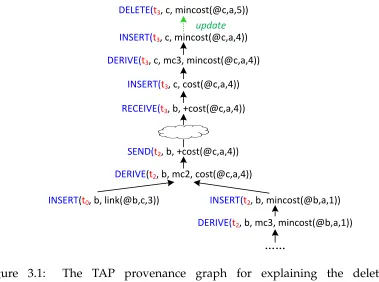
pre-vious sections. Figure 3.1 shows a piece of the TAP graph that explains the dele-tion of the tuplemincost(@c,a,5)on nodecat timet3that resulted from the new
link a-c that was inserted at time t0. Specifically, the edge at the DELETE vertex
of mincost(@c,a,5) (indicated by a dotted line) corresponds to an aggregation
constraint — that is, the minimal cost changed because a lower-cost path to nodea
became available. The updated lowest cost (cost(@c,a,4)) was derived on node b at time t2 (and subsequently sent to node c) because a) a link b-c with cost
3.2. Derivations and System Snapshots
DELETE(t3, c, mincost(@c,a,5))
INSERT(t3, c, cost(@c,a,4))
update
INSERT(t3, c, mincost(@c,a,4))
INSERT(t2, b, mincost(@b,a,1))
INSERT(t0, b, link(@b,c,3))
……
SEND(t2, b, +cost(@c,a,4))
RECEIVE(t3, b, +cost(@c,a,4))
DERIVE(t2, b, mc2, cost(@c,a,4))
DERIVE(t2, b, mc3, mincost(@b,a,1))
DERIVE(t3, c, mc3, mincost(@c,a,4))
Figure 3.1: The TAP provenance graph for explaining the deletion of
mincost(@c,a,5).
mincost(@b,a,1)was newly derived att2 via rulemc3. The latter derivation was
caused by the insertion of the base tuplelink(@b,a,1), which corresponds to the
addition of the new link.
Note that the additional time dimension on the provenance graph enables an-other use of provenance: querying theeffectsof an update event. For example, if we want to determine how the insertion of the new linka-bhas affected the system,
we can simply locate the corresponding INSERT vertex in the graph and traverse the edges in the reverse direction.
3.2
Derivations and System Snapshots
Consider a delta rule of the form∆τ:-∆τ1, τ2, . . . , τk. Since TAP is used to explain
Chapter 3. Provenance Model
DELETE(t3, c, mincost(@c,a,5))
INSERT(t3, c, cost(@c,a,4)) update
INSERT(t3, c, mincost(@c,a,4))
INSERT(t2, b, mincost(@b,a,1))
INSERT(t0, b, link(@b,c,3))
…… SEND(t2, b, +cost(@c,a,4))
RECEIVE(t3, b, +cost(@c,a,4))
EXIST(t2, b, link(@b,c,3))
DERIVE(t2, b, mc2, cost(@c,a,4))
DERIVE(t2, b, mc3, mincost(@b,a,1))
DERIVE(t3, c, mc3, mincost(@c,a,4))
Figure 3.2: The TAP provenance graph for explaining the deletion of
mincost(@c,a,5). The subgraph that supports the precondition that
link(@b,c,3)existed at timet2 is replaced by theEXISTvertex.
provenance of the triggering tuple ∆τ1 is relevant. Instead of storing full
prove-nance information of all preconditions, we introduce a new vertex that provides a compact representation of per-node state at a given time:
• EXIST(t, n, τ): State of tupleτ at a particular noden at its local time tn. This
vertex includes all vertices{INSERT(t, n, τ)|t ≤ tn} ∪ {DELETE(t, n, τ)|t ≤ tn}.
To retrieve the snapshot value of τ at time t, one can simply replay the se-quence of insertions and deletions, canceling out deleted insertions accord-ing to standard bag semantics.
In Figure 3.2, mincost(@c,a,4) is derived from rule mc2. The DERIVE vertex for
mincost(@c,a,4) at time t2 includes the INSERT vertex for the triggering event
3.3. Correctness
3.3
Correctness
Given the provenanceG(4τ,E)of an update event 4τ, Gshould be “consistent” with the trace representation of the executionE. We sayG(4τ,E)is correct if it is possible to extract a subtrace fromGthat has the properties ofvalidity, soundness, completeness, and minimality. We first describe our subtrace extraction algorithm, followed by the correctness properties themselves.
Subtrace extraction. Given G(4τ,E), the original subtrace can be obtained by running an algorithm A (presented in Algorithm 1) based on topological sort. Briefly,Aconverts each vertex in the provenance graph to an event and then uses a topological ordering to assemble the events into a trace – in other words, if two vertices v1, v2 ∈ V correspond to events e1, e2 and are connected by edges in E,
thene1 will appear in the trace beforee2. This is possible as the provenance graph
is acyclic (see Lemma 1).
In particular, Line 19 - 32 implements the construction of one individual event, where the information of a rule evaluation (such as the triggering event, condi-tions, and action) is extracted from the corresponding vertices inG(4τ,E).
Correctness of subtrace. The extracted subtrace A(∆τ,E) must satisfy the fol-lowing four properties (Theorems and proofs for all four properties are included in Appendix A):
Property 1. (Validity)A(∆τ,E)is valid, that is, given the initial stateS0, for any event
di@Ni = (ei, ri, ti, ci, e0i) ∈ A(∆τ,E), (a) there exists dj@Nj = (ej, rj, tj, cj, e0j) that
precedesdi@Ni inA(∆τ,E), ei ∈ e0j, and (b) for allτk ∈ ci, τk ∈ Si−1, where S0
d1@N1
−−−−→
S1...Si−2
di−1@Ni−1
−−−−−−→ Si−1. (Recall from Definition 5 that S
dk@Nk −−−−→ S0
indicates a state
transition from stateSto stateS0 by applying eventd
Chapter 3. Provenance Model
Algorithm 1Extracting subtraces from provenance 1: procExtractT race(G= (V, E))
2: // calculate the out-degree of all vertices inG 3: for∀e= (v, v0)∈Edodegree(v)←degree(v) + 1
4: // generate the subtrace based on topological sort
5: N odeT oP rocess=V
6: whileN odeT oP rocess6=φdo
7: selectv∈N odeT oP rocess :degree(v) = 0,and6 ∃v0 ∈N odeT oP rocessthat is located on the same node has a larger timestamp
8: N odeT oP rocess.remove(v)
9: iftypeof(v) =INSERT or DELETEthen
10: f ind e= (v0, v)∈E, degree(v0)←degree(v0)−1
11: end if
12: iftypeof(v) =SEND or RECVthen
13: f ind e= (v0, v)∈E, degree(v0)←degree(v0)−1
14: end if
15: iftypeof(v) =EXISTthen
16: f ind e= (v0, v)∈E, degree(v0)←degree(v0)−1
17: end if
18: iftypeof(v) =DERIVE or UNDERIVEthen
19: f ind e= (v, v0)∈E,output←v0 20: for∀e= (v0, v)∈Edo
21: iftypeof(v0) =INSERT or DELETEthen
22: trigger=v0//v0is the triggering event
23: else
24: condition.add(v0)//v0is a EXIST vertex for one of the conditions
25: end if
26: degree(v0)←degree(v0)−1
27: end for
28: ruleN ame←v.ruleN ame, time←v.time
29: event←(trigger, ruleN ame, time, condition, output)
30: trace.push f ront(event)
31: end if
32: end while
33: returntrace
3.4. Summary
Property 2. (Soundness)A(∆τ,E)is sound, that is,A(∆τ,E)is a subtrace of someE0 that is equivalent toE (written asE0 ∼ E). We say two tracesE andE0 are
equivalent, if for all nodesNi,E|Ni =E0|Ni.
Intuitively, soundness means that A(∆τ,E)must preserve the all happens-before relationships among events in the original execution trace obtained from running the NDlog program. Ideally, we would like A(∆τ,E) to be a subtrace of E, but without synchronized clocks, we cannot always order concurrent events on differ-ent nodes. However, for practical purposes E and E0
are indistinguishable: each node observes the same sequence of events in the same order.
Property 3. (Completeness)A(∆τ,E)is complete, that is, it ends with the event∆τ. Intuitively, completeness means that A(∆τ,E) must include all events necessary to reproduce τ. Note that the validity property already requires that any event that is needed for ∆τ be included in A(∆τ,E); hence, we can simply verify the completeness property of a valid trace by checking whether it ends with∆τ.
Property 4. (Minimality)A(∆τ,E)is minimal, that is, no validE0⊂ A(∆τ,E)
is sound
and complete.
Intuitively, minimality means that A(∆τ,E) should not contain any events that are not necessary to reproduce ∆τ. If this property were omitted,A(∆τ,E)could trivially output the complete traceE.
3.4
Summary
Chapter 3. Provenance Model
Chapter 4
Maintenance and Querying
In this chapter, we explore the generic data management challenges posed by the distribution, querying, and maintenance of provenance in large-scale distributed systems. Such scale has presented a unique challenge to provenance data man-agement: Network applications in Internet domains usually involve thousands of nodes; moreover, provenance computations are required to co-exist with existing network protocols. Bandwidth efficiency and minimal impact on convergence time are of significant importance.
4.1
Storage Model
This section defines the storage model used by NETTRAILS to store and main-tain provenance in distributed systems. NETTRAILS’s graph-based data model is amenable to storage using a distributed relational database, and is sufficiently gen-eral to be used as a basis for generating other provenance representations.
4.1.1
Provenance as Relational Tables
Chapter 4. Maintenance and Querying
provenance tables – calledprov, ruleExec, send, and recv – that are
incremen-tally updated as the derivation rules that model the protocols are executed. These tables store TAP’s provenance graph in a distributed fashion.
Tuple instances: The provtable maintains information about each tuple
(includ-ing both current tuples and tuples that existed in the past) as well as the specific rule that triggered its derivation. Entryprov(@N,VID,Time,RLoc,RID)indicates
that the tuple on nodeNwith unique identifierVIDwas derived at time Timeby a
rule execution on nodeRLoc that is uniquely identified byRID. IfNand RLoc are
different, the tuple was sent from RLoc toN, and this communication is recorded
in additionalrecvandsendentries (see below).VIDis generated based on a
cryp-tographic hash of the contents of the tuple and the time of its derivation; similarly,
RIDis a hash of the rule identifier, node location, andVIDof the derived tuple. For
base tuples,RIDis set tonull, since they are not derived by any rule.
In order to correctly generate the above entries, NDlog programs undergo an automatic rewrite process to include theRIDandRLocinformation with each tuple
derivation. This process ensures that the appropriateproventry will be generated
on the node to which the derivation is sent.
Rule execution instances: TheruleExectable maintains information about each
execution of a rule (not just about each rule). EntryruleExec(@RLoc,RID,Rule, ExecTime,Event,CList)indicates the execution of aRuleonRLocatExecTime,
triggered by an eventEvent(i.e., a tuple that changed, appeared, or disappeared)
while the preconditions inCListwere holding.
Message transmissions: The send and recv tables maintain information about
message exchanges.send(@Sender,VID,STime,RID)andrecv(@Receiver,VID, RTime,Sender,STime)refer to the rule execution identified by RID that affected
4.1. Storage Model
+/- Loc VID Time RLoc RID Derivation
+ b V ID1 t0 null null +link(@b,c,3)
+ b V ID2 t2 null null +link(@b,a,1)
+ b V ID3 t2 b RID1 +mincost(@b,a,1)
+ c V ID4 t3 b RID2 +cost(@c,a,4)
+ c V ID5 t3 c RID3 +mincost(@c,a,4)
− c V ID6 t3 c RID3 -mincost(@c,a,5)
Table 4.1: An exampleprovrelation based on Figure 3.1. The table is horizontally
partitioned across all nodes, based on the location specifierLoc. The last column is
not stored in the table; it is included here to show the derivation that corresponds to each entry. The first column indicates an insertion (+) or a deletion (−).
+/- RLoc RID Rule ExecTime Event CList Derivation
+ b RID1 mc3 t2 V ID2 null +mincost(@b,a,1)
+ b RID2 mc2 t2 V ID2 (V ID1) +cost(@c,a,4)
+ c RID3 mc3 t3 V ID4 null +mincost(@c,a,4)
Table 4.2: An exampleruleExec relation that corresponds to the DERIVE vertices shown in Figure 3.1. The last column shows the derivation rule that was executed in each instance.
to be sent,sendandrecventries are generated at the sender and receiver,
respec-tively, and are timestamped using nodes’ local clocks. To handle clock skew, the receiver stores the sender’s timestamp at message transmission; this timestamp is included in each message along with the (un)derived tuple. This information is used during query processing to correctly match upsendandrecventries.
Given the distributed nature of provenance storage, these tables are naturally partitioned based on their first attributes, and distributed among the nodes. For instance, prov entries are co-located with the tuples to which the update events
were applied, and ruleExecentries are located on the nodes on which the rule
Chapter 4. Maintenance and Querying
Sender VID STime RID Derivation
b V ID4 t2 RID2 +cost(@c,a,4)
Receiver VID RTime Sender STime Derivation
c V ID4 t3 b t2 +cost(@c,a,4)
Table 4.3: Example send and recv relations that correspond to the SEND and
RECEIVEvertices in Figure 3.1.
4.1.2
Example Tables
Tables 4.1, 4.2, and 4.3 show the entries for the tables above, based on the exam-ple provenance tree shown in Figure 3.1. The vertices defined by our provenance model (Section 3.1) are encoded in the above provenance tables as follows: INSERT
and DELETE vertices are respectively represented as tuple insertions (+prov) and
deletions (-prov). Likewise, DERIVE and UNDERIVE are stored as+ruleExec and -ruleExec. Edges betweenINSERT/DERIVEandDELETE /UNDERIVE pairs are rep-resented by theRID and VID pairings in each prov entry. recv and send entries
correspond to the RECV and SEND vertices. For each tuple uniquely identified by its primary key, each EXIST vertex consists of all updates (i.e., +prov and -prov)
ordered by their timestamps.
4.2
Provenance Maintenance with Delta Rules
The TAP graph can be captured via the evaluation of delta rules (see Section 2.3) of the form action :- event, conditions. In a delta rule of the form
4p :- p1, . . . ,4pi, . . . , pn, theevent(in this case,4pi) is represented as anINSERTor
DELETE vertex, theconditions(the otherpk) are represented as a sequence ofINSERT
(or DELETE) vertices that support the existence ofpk (EXIST vertex), and the action
4.2. Provenance Maintenance with Delta Rules
When a delta rule 4p :- p1, . . . ,4pi, . . . , pn is fired at time t, NETTRAILS
per-forms the following steps:
• Generate a +ruleExec or -ruleExec tuple with timestamp t to represent the rule execution, and maintain pointers to the triggering event 4pi and
preconditionsp1, . . . , pn(excludingpi).
• Generate a+provor-provtuple with timestamptto represent the insertion or deletion event4p, and to maintain a pointer to the generated+/-ruleExec
tuple.
• If the generated event4p needs to be sent to another node, generate a pair of send and recv tuples at the sender and the receiver, respectively, with
timestamps that correspond to nodes’ local clocks.
• Finally, if the generated event 4presults in a violation of a primary-key or aggregation constraint (e.g., the newly-generated tuple displaces another), generate an additional+provor-provtuple to represent the deletion caused
by4p. This corresponds to the update edge from Section 4.1.
4.2.1
Rule Generation for Provenance Maintenance
To perform the provenance maintenance described in the previous section, we leverage the distributed querying processing capability of the declarative network-ing engine. GivenanyNDlog program, additional NDlog provenance maintenance rules are automatically generated. Algorithm 2 shows the basic approach towards generating provenance maintenance rules. The algorithm takes as input an NDlog delta ruleRof the form:
+/-h(@H1,...,Hk) :- +/-t0(@X,P01,...,P0k0),t1(@X,P
1
1,...,P1k1),...,
Chapter 4. Maintenance and Querying
Algorithm 2Generation of Provenance Maintenance Rules 1: procP rovenanceRewrite(R)
2: RS← {}
3: R=±h(@H1, ..., Hk): -±t0(@X, P10, ..., Pk00), t1(@X, P
1
1, ..., Pk11), ..., tn(@X, P1n, ..., Ponn), c1, ..., cp.
4: RS.add(eHT emp(@RLoc, H1, ..., Ho, RID, Rule, ExecT ime, Event, CList): -t0(@X, P10, ..., Pk00), t1(@X, P
1
1, ..., Pk11), ..., tn(@X, P
n
1, ..., Pknn), c1, ..., cp, RLoc=X, Rule=rid,
P ID0=f sha1(t0+X+P10+...+Pk01), ...
P IDn=f sha1(tn+X+P1n+...+Pknn), Event=P ID0
CList=f append(P ID1, ..., P IDn),
RID=f sha1(R+RLoc+Event+CList).)
5: RS.add(ruleExec(@RLoc, RID, Rule, ExecT ime, Event, CList):
-eHT emp(@RLoc, H1, ...Ho, RID, Rule, ExecT ime, Event, CList).)
6: RS.add(eH(@H1, ..., Ho, RID, RLoc, ExecT ime):
-eHT emp(@RLoc, H1, ...Ho, RID, Rule, ExecT ime, Event, CList).)
7: RS.add(±h(@H1, ..., Ho): -eH(@H1, ...Ho, RLoc, RID, RecvT ime).)
8: RS.add(prov(@H1, V ID, RecvT ime, RLoc, RID):
-eH(@H1, ...Ho, RLoc, RID, RecvT ime), V ID=f sha1(h+H1+...+Ho).)
9: returnRS
where the rule body consists of one trigger eventt0, n predicates+/-t1, t2,. . . ,tn
and pconstraints (or assignments)c1, c2,. . . ,cp. The derived rule head+/-h
con-sists of k attributes which are generated from executing the rule body. Here, we assume that all body predicates are executed at locationX(since the rule has been localized). We further consider the case in which the rule head locationH1 is at a
different location fromX (and hence the derivation is sent across the network).
The output of running the algorithm is the rule setRS, which is used for prove-nance mainteprove-nance and executing the original derivation. The first rule generates the local eventeHTemp(line 4) which contains all information required for creating
the local ruleExec entry (line 5) corresponding to the meta-data for rule
execu-tion, sending the event message eH to the target node H1 (line 6) to create the
4.2. Provenance Maintenance with Delta Rules
that the only additional attribute shipped with each messageeHis the (RID,RLoc, ExecTime) fields necessary to reconstruct the provenance information.
The generation ofsendandrecvtuples is performed by the underlying
trans-mission module, which, upon sending and receiving the packets, simply deserial-izes the packets and records the related fields. Note also that upon receiving theeH
tuple, the transmission model replacesExecTimefield withRecvTime, which
indi-cates the time when the tuple is received. This is necessary for reconstructing the provenance information by tracing from theproventry back to the corresponding recventry.
Recent work by Amsterdamer et al [2] has shown that provenance models should be extended to take into account the individual values within tuples to handle aggregation in general. It is worth mentioning that Algorithm 2 can be ex-tended to support general aggregations, where Line 4 needs to be updated to treat aggregation rules as a special case, in which the individual tuples in the relations of the rule body need to be taken into account.
4.2.2
Proactive and Reactive Maintenance
To answer provenance queries about past tuples or updates, the TAP model con-tains a temporal dimension. This could in principle be implemented by keeping a full copy of the provenance whenever it changes. However, this would require an enormous amount of storage, particularly for long-running distributed systems with many updates. Moreover, keeping full copies of the provenance is unnec-essary because TAP provenance is monotonic: the provenance of historic updates and tuples (which eventually make up a major portion of a provenance graph) is immutable.
re-Chapter 4. Maintenance and Querying
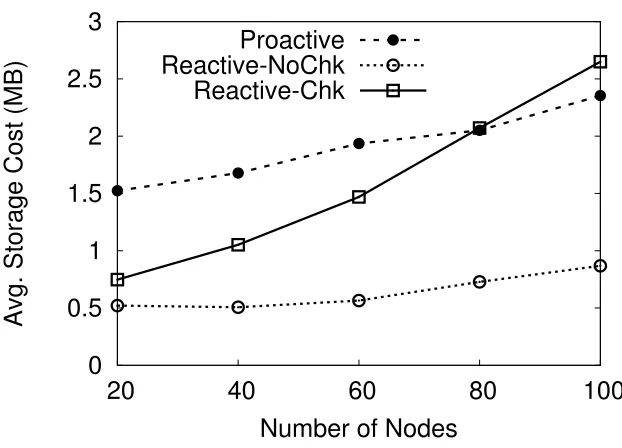
construct the full provenance graph. NETTRAILS can store these deltas in the fol-lowing two different ways:
• Explicit deltas (proactive). In this approach, all of the +prov, -prov, +ruleExec and -ruleExec entries are stored explicitly in a temporally
or-dered log that is indexed by time. Compared to keeping each version of the provenance, the storage cost is considerably lower; however, the full prove-nance information must be reconstructed from the deltas before a query can be answered. To permit fast reconstruction ofEXISTvertices during query ex-ecution (see Section 4.3), NETTRAILS maintains reverse-time ordered point-ers between all +provand -proventries that correspond to the same tuple.
For instance, in Table 4.1, the prov entry with VID4 (+mincost(@c,a,4))
points to the entry withVID5 (-mincost(@c,a,5)) which in turn points to
another entry for+mincost(@c,a,5).
The idea of keeping deltas between adjacent versions and reconstructing a specific version by merging deltas is known as a classic approach to perform efficient versioning. It has been extensively studied and adopted in many application domains, include transaction logs in database systems [30, 70], revision control systems [43, 102], and log-structure file systems [89, 93]. Sev-eral variants, such as forward deltas and reverse deltas [102], have been pro-posed to tailor the system performance for different system settings or re-quirements. We expect that similar treatment is applicable to the proactive provenance maintenance as well.
• Per-node input logs (reactive). In this approach, NETTRAILSmaintains only the non-deterministic inputs (recventries for incoming messages, as well as