DESIGN AND STRUCTURAL ANALYSIS OF A QUAD
BIKE CHASSIS
Rushikesh Deshmukh
1, R N Patil
2 1M.Tech. Scholar,
2Professor & Head, Department of Mechanical Engineering,
B V D U, College of Engineering, Pune, (India)
ABSTRACT
This paper introduces a new design for the quad bike chassis which is expected to show better performance with
lesser deformations as compared to the conventional designs of quad bikes. Along with these factors driver
comfort, improved aesthetics and affordable price are added advantages to the list. The chassis has been
designed keeping in mind all the above mentioned parameters in CATIA V5 R19 software. The material
selection has been done through extensive market research and the most appropriate material has been selected
which its AISI 1018. Once the material is selected the design is tested for its strength in the form of front and
rear impact tests in ANSYS 14.5 workbench. The results of the impact tests show that the deformations produced
are within limits and the chassis is structurally stable.
Keywords: Chassis, FEA, Strength, Quad Bike
I. INTRODUCTION
A chassis is the actual frame or structure of an automobile. The chassis serves as a framework for supporting the body and different sub-systems of the automobile and is also responsible for its protection. It also provides better seating area and ergonomics to the driver [1]. A Quad bike is one which is supposed to function in any type of terrain and hence it is similar to any other All-Terrain Vehicle. It is mainly designed for off road usage which requires a strong chassis which should not deform under any circumstances. The chassis of conventional ATV’s occupy more space leading increase in number of members resulting into higher values of weight and vehicle space. This increased weight lessens the overall performance of the ATV. Therefore it is imperative to design a chassis which has reduced weight and occupies less space. Considering these factors this paper presents a chassis with minimum possible weight and optimized space, leading to improved power to weight ratios. The proposed design is later analyzed for front and rear impact tests in ANSYS 14.5 workbench.
II DESIGN METHODOLOGY
2.1 Frame Design
and stress values. Also, the chassis is designed such that the roll center of the vehicle is kept at minimum possible distance from ground [3].
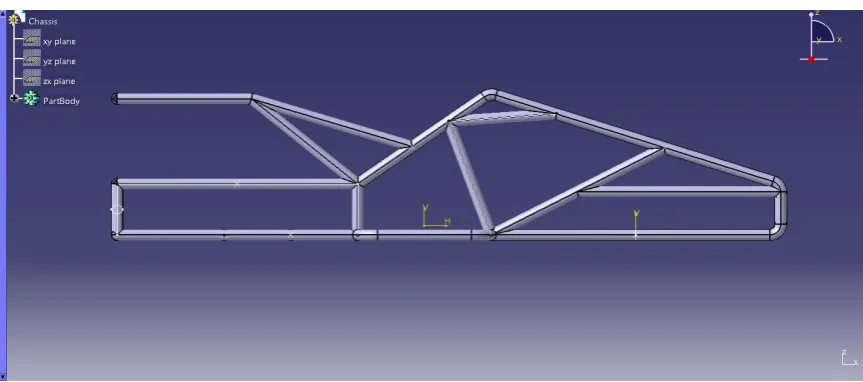
Fig 1- Design of Quad Bike chassis prepared using CATIA V5 software
Fig 2- Side view of quad bike chassis
2.2 Material Selection
Selecting the chassis material is also an important phase of frame designing. The biggest challenge during material selection is reducing the cost without compromising with the strength requirements. Thus material selection was focused on parameters like lightweight, cost effectiveness, shock absorbing ability, weld ability, life of the material and lastly its recycling ability. The properties which must be concentrated on are density, Young’s modulus, Poisson’s ratio, tensile and yield strength of the material [4]. The market research showed three materials to be appropriate for the quad bike design. These materials along with their properties have been listed below in Table 1.
i) AISI 1018 ii) AISI 1010
Table 1 Probable Materials and Important Properties
Property
Density (g/cc)
Yield Strength (MPa)
Carbon
content Cost (Rs./m) Total points Material
AISI 1018 7.87 370 0.18 190 8.33
AISI 1010 7.87 305 0.10 180 7.87
4130 Chromoly 7.85 460 0.30 450 6.82
The strength and rigidity of the chassis hugely depends over the physical properties of the material along with its cross-section and dimensions [4]. The circular cross section is preferred over the square cross section since it provides better bending stress values along with reduced weight which an added advantage is contributing towards vehicle performance. After considering all the factors like cost, weight, availability etc. of the material the most appropriate material full filling the requirements of a quad bike is found to be AISI 1018 based on weighted-point method as shown in Table 1. The dimensions of the pipe are as follows:-
Outer diameter= 25 mm Wall thickness= 4mm
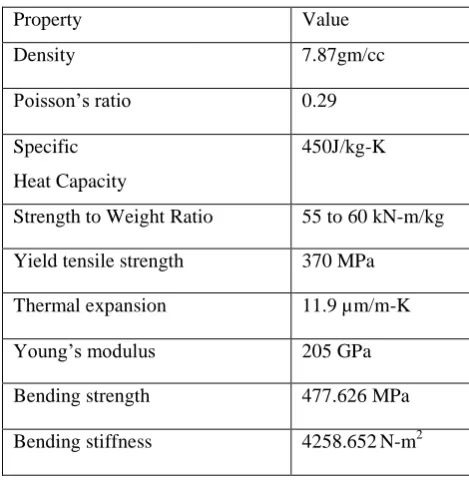
Its physical properties are listed below in Table 2.
The material selected is the most suitable for the quad bike chassis with the following properties.
Table 2 Material Properties of AISI 1018
Property Value
Density 7.87gm/cc
Poisson’s ratio 0.29
Specific Heat Capacity
450J/kg-K
Strength to Weight Ratio 55 to 60 kN-m/kg Yield tensile strength 370 MPa
Thermal expansion 11.9 µm/m-K
Young’s modulus 205 GPa
Bending strength 477.626 MPa
Bending stiffness 4258.652N-m2
2.3 Structural Analysis
types of jerks and loads. The frame should be able to withstand the impact, torsion, roll over conditions and provide utmost safety to the driver without undergoing much deformation.
In order to check the stress, strain and displacement of the roll cage model prepared following tests will be performed on the chassis by using ANSYS software [5] :
1) Frontal impact test 2) Rear side impact test
2.3.1 Methodology Adapted:
Creation of cad model of chassis
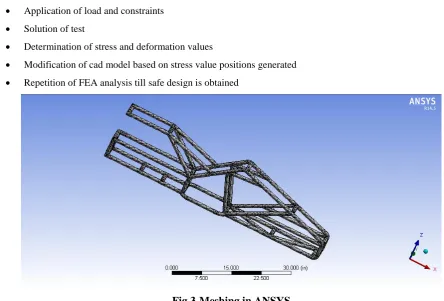
Generation of mesh using 1-d and 2-d elements as shown in Fig 3.
Modification of mesh quality considering “convergence of nodes”
Application of load and constraints
Solution of test
Determination of stress and deformation values
Modification of cad model based on stress value positions generated
Repetition of FEA analysis till safe design is obtained
Fig 3-Meshing in ANSYS
III. EXPERIMENTATION
3.1 Front Impact Test
3.1.1 Load Calculations
The mass of the vehicle is 300kg. The vehicle frame subjected to impact analysis is assumed to be hitting a static wall with a velocity of 60 kmph. Thus considering the proposed weight of the vehicle and driver the impact load can be calculated based on G-force of magnitude 4 since the maximum amount of force which human body can bear without failure is 9G:
Initial velocity u=60 kmph=16.67m/s [3]
F= 300*4*10 F = 12000N
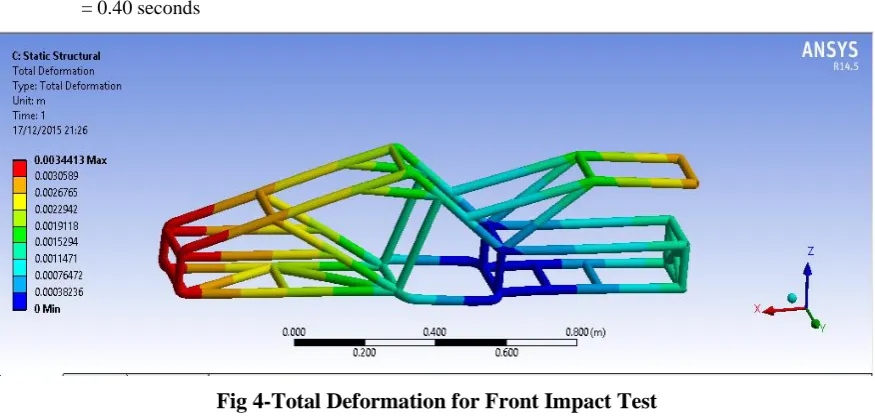
Hence a gross load of 12kN [1] is applied at the front corners constraining the rear members as shown in the Fig.4.
Impulse time= weight of vehicle*(velocity/impact load) = 300*(16.67/12000)
= 0.40 seconds
Fig 4-Total Deformation for Front Impact Test
3.2 Rear Impact Test
This test is basically done to check the strength of the designed chassis for an impact from the rear side. This test is useful in determining the deformations in the rear side. This helps us in providing extra safety on the rear if required as the complete transmission system of the vehicle is positioned on the rear part. The following figure shows total deformation of the design on the rear side for a force of 4G from the rear side.
Fig 5-Total Deformation for Rear Impact Test
IV. RESULTS
V. CONCLUSION
The paper introduces new design for quad bike chassis which is expected to show better performance and aesthetics when
compared to conventional designs. The design is further tested for loading conditions like front impact and rear impact tests
using ANSYS software tools. The results show that the proposed design has reduced values of stress and deformation which
assure the safety of the chassis.
REFERENCES
[1] Denish S. Mevawala , Mahesh P. Sharma, Devendra A. Patel, Darshan A. Kapadia, Stress Analysis Of Roll Cage For An All Terrain Vehicle IOSR Journal of Mechanical and Civil Engineering (IOSR-JMCE) e-ISSN: 2278-1684, p-ISSN: 2320-334X
[2] Srijan Manish, Jitendra Kumar Rajak, Vishnu Kant Tiwari, Rakesh, Quad bike design and simulation: a pre-manufacturing methodology,International Journal of Advanced Research in Engineering and Technology (IJARET), ISSN 0976 –6480(Print), ISSN 0976 – 6499(Online) Volume 5, Issue 6, June (2014), pp. 68-76 © IAEME
[3] Khelan Chaudhari, Amogh Joshi, Ranjit Kunte, Kushal Nair, Design And Development Of Roll Cage For An All-Terrain Vehicle, PP 49-53 ISSN : 2319 – 3182, Volume-2, Issue-4, 2013International Journal on Theoretical and Applied Research in Mechanical Engineering (IJTARME).
[4] Amrit Om Nayak, S.Kalaivanan, D.Manikandan, G.Ramkumar, T.Manoj, M.A.Kannan, Complete Design And Finite Element Analysis Of An All Terrain Vehicle, International Journal of Mechanical and Industrial Engineering (IJMIE), ISSN No. 2231 –6477, Volume-1, Issue-3, 2012
[5] Deep Shrivastava , Designing of All Terrain Vehicle (ATV) , Mechanical Department of Oriental Institute of Science and Technology Bhopal, International Journal of Scientific and Research Publications, Volume 4, Issue 12, December 2014 1 ISSN 2250-3153
[6] Shaik Khajamoinuddin,B.Balaji , Modal And Static Analysis Of A Standard All Terrain Vehicle Chassis, 2014, IJEDR
[7] D.Nagarjuna, Junaid Mohammed Farooq, A.S.N.Saiteja, P.Siddhartha Sri Teja, Optimization of Chassis of an All Terrain Vehicle, International Journal of Innovative Technology and Exploring Engineering (IJITEE) ISSN: 2278-3075, Volume-2, Issue-2, January 2013.