ScholarlyCommons
Publicly Accessible Penn Dissertations
1979
The Dysfunctional Attitude Scale: A Validation
Study
Arlene Nancy Weissman
University of PennsylvaniaFollow this and additional works at:
http://repository.upenn.edu/edissertations
Part of the
Psychoanalysis and Psychotherapy Commons
, and the
Psychology Commons
This paper is posted at ScholarlyCommons.http://repository.upenn.edu/edissertations/1182
For more information, please [email protected].
Recommended Citation
Weissman, Arlene Nancy, "The Dysfunctional Attitude Scale: A Validation Study" (1979).Publicly Accessible Penn Dissertations. 1182.
Degree Type
Dissertation
Degree Name
Doctor of Philosophy (PhD)
Graduate Group
Education
First Advisor
Andrew R. Baggaley
Subject Categories
WEISSMAN, ARLENE NANCY
THE DYSFUNCTIONAL ATTITUDE SCALE: »
VALI DATION STUDYo
UN IV E RS I TY OF PENNSYLVANIA, P H . D . , 1 9 7 9
COPR. 1 9 7 9 WEISSMAN, ARLENE NANCY
Unj\ersiN; Microfilms
International 3 0 0 N. 2 E 6 B R O A D . A N N A R B O R . M l 481 06
©
1379
ARLENE NANCY WEISSMAN
ALL RIGHTS RESERVED
In all cases this material has been filmed in the best possible
way from the available copy. Problems encountered with this
document have been identified here with a check mark
.
1. Glossy photographs _ _ _ _ _ _
2. Colored illustrations_ _ _ _ _ ,
3. Photographs with dark background _ _ _ _ _ _
4. Illustrations are poor copy _ _ _ _ _ _
5. Print shows through as there is text on both sides of page _ _ _ _ _ _
6.
Indistinct, broken or small print on several
pages ^
throughout
7.
Tightly bound copy with print lost in spine _ _ _ _ _ _
8» Computer printout pages with indistinct print _ _ _ _ _ _
9. Page(s)
lacking when material received, and not available
from school or author _ _ _ _
10. Page(s) ^_ _ _ _ _ _ seem to be missing in numbering only as text
fol1ows
11. Poor carbon copy _ _ _ _ _ _
12. Not original copy, several pages with blurred
type
_
13. Appendix pages are poor copy _ _ _ _ _
14. Original copy with light type _ _ _ _ _
15. Curling and wrinkled pages _ _ _ _ _ _
A VALIDATION STUDY
by
ARLENE NANCY 'WEISSMAN
A DISSERTATION
IN
EDUCATION
Presented to the Faculty of the Graduate School of Arts and Sciences of the University of Pennsylvania in Partial
Fulfillment of the Requirements for the Degree of
DOCTOR OF PHILOSOPHY
1979
Approved:
Andrew R. Baggaley, Chai
Accepted:
Dean of the Graduate Jpttiool
The dissertation that follows is the product of several
years and many persons’ efforts. Neither space nor language
allows an adequate accounting of all who made significant
contributions to my development and to the completion of this
study. I would like to express my sincere thanks to Dr. Aaron
T. Beck whose early and continuous interest and support provided
the basis for this dissertation. The assistance and suggestions
of Dr. Andrew Baggaley, Dr. Arthur Dole, and Dr. Daniel Wagner,
who served on my committee, are also acknowledged. The
frustrations of data collection were eased greatly by Drs.
Edward Craighead, Marylou Ginsberg, Steven Gulkus, Constance
Hammen, John Rush, Maria Watkins and Shelley Weber who provided
valuable assistance. A special thanks is extended to Ms. Lynn
Schreiber, who assisted in the scoring of the data as well as to
Ms. Patti Sierota and Ms. Nancy Wagner who typed the final
manuscript. I would be remiss if I failed to acknowledge the
support and encouragement afforded me by my family and friends.
Finally this dissertation is dedicated to the memory of
Julia E. Grossman, my grandmother, who provided a constant
source of encouragement and taught me that it is always necessary
to do what is right and to do it well.
Page
LIST OF TABLES ... vi
LIST OF FIGURES ... viii
I. I N T R O D U C T I O N ... 1
Statement of the Problem... 1
The Cognitive View of Emotions ... 3
The Evaluation of the Concept of Depression ... 9
Definition of Depression ... 16
Beck's Cognitive Theory of Depression ... 17
The Concept of Schemas ... 23
Empirical Findings ... *... 29
Review of Existing M e a s u r e s ... 37
Purpose of the R e s e a r c h ... 45
Research Hypotheses ... 47
II. CONSTRUCTION OF THE DYSFUNCTIONAL ATTITUDE S C A L E ... 48
Test F o r m a t ... 48
Initial Item Selection ... 50
Refinement cf the S c a l e ... 56
III. THE VALIDATION OF THE DYSFUNCTIONAL ATTITUDE SCALE ... 73
M e t h o d o l o g y ... 73
P r o c e d u r e s ... 85
Psychometric Properties of DAS-A and DAS-B ... 92
IV. RESULTS AND D I S C U S S I O N ... 100
Equating of DAS-A and DAS-B Scores ... 100
Descriptive Statistics ... 101
iv
Page
IV. RESULTS AND DISCUSSION (cont.)
Relationship to Demographic Information... 103
Reliability of the DAS-A and DAS-B... 106
Validity of the D A S ...Ill V. FINAL COMMENTS... 134
Evaluation of the Dysfunctional Attitude Scale... 134
Questions Raised by the Data... 137
Implications for Beck's Position... 140
Potential Value of the D AS... 141
VI. SUMMARY... 143
APPENDIX A ... 146
APPENDIX B ... 150
APPENDIX C ... 154
APPENDIX D ... 156
APPENDIX E ... 164
APPENDIX F ... 171
INDEX...178
REFERENCES... 183
Page
1. Unrotated Factor Matrix: 100 Item D A S ... 58
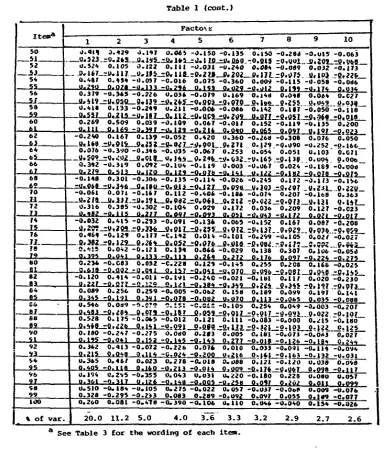
2. Rotated Orthogonal-Factor Matrix: 100 Item DAS ... 60
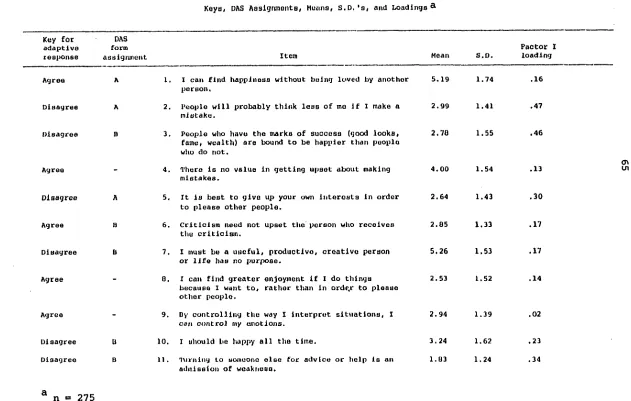
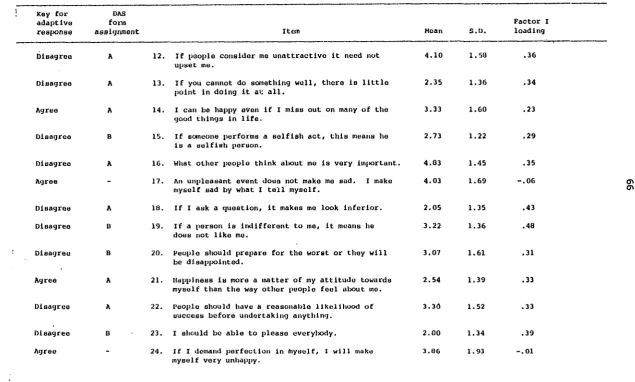
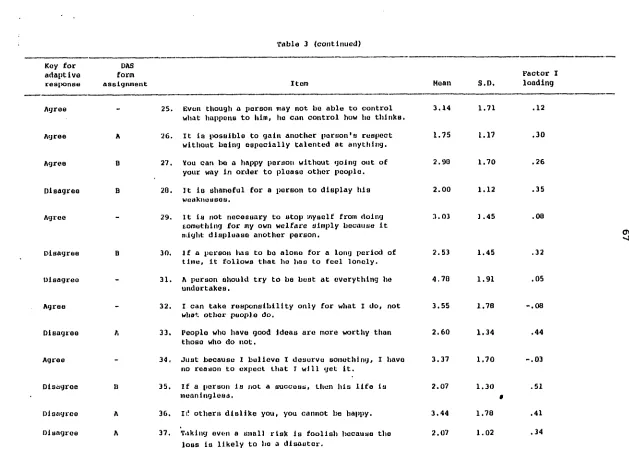
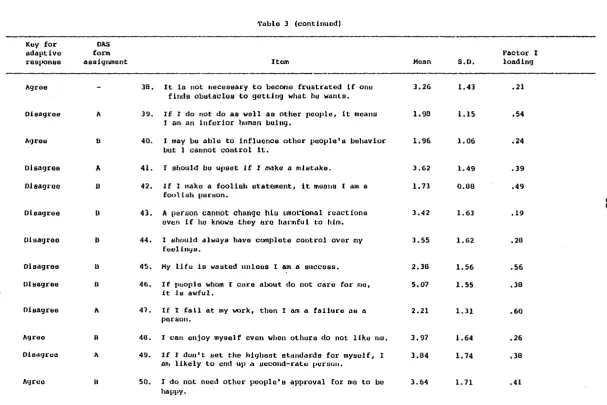
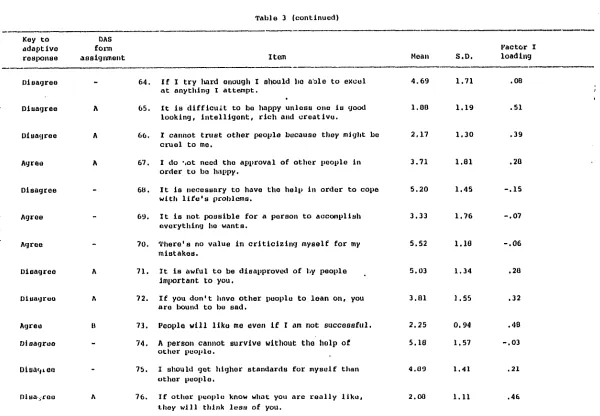
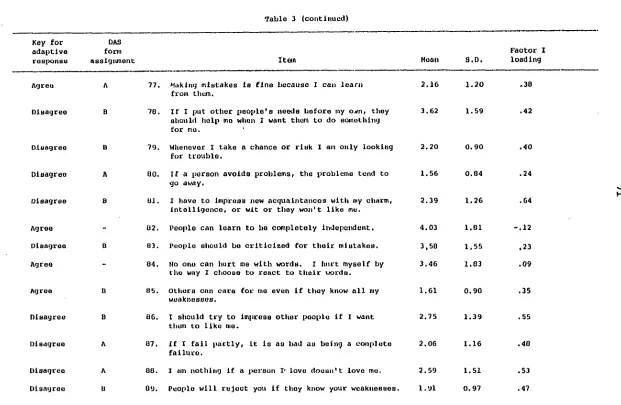
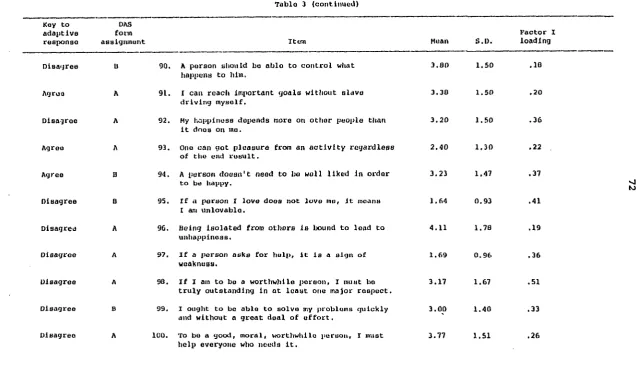
3. 100-Item Form of the Dysfunctional Attitude Scale: Keys, 65
DAS Assignments, Means, S.D.'s, and Loadings ... 65
4. Demographic Characteristics of the Sample ... 8 6
5. Clinically Relevant Background Characteristics of the
S a m p l e ... 8 8
6. Descriptive Statistics for the Assessment Variables ... 102
7. Means and S.D.'s on the Assessment Instruments by S e x ... 105
8. Item Statistics for Each Form of the DAS Under Varying
Conditions ... 108
9. Intercorrelations among the Assessment Variables ... 112
10. Partial Correlations of DAS Responses with M o o d ... 116
11. BDI and DAS Scores at Pre- and Posttesting as a Function
of Psychopathological Classification ... 117
12. Distortion Scores for Males and Females by Changes in
Depression Level ... 120
13. Depression Scores for Males and Females by Changes in
Dysfunctional Attitude Endorsement ... 121
14. Cross-Lagged and Other Correlations Between Depressogenic
Attitudes and A f f e c t ... 124
15. First-Order Partial Correlations Between Attitudes and
Affect for Cross-Lagged Relationships ... ... 126
vi
Page
16. First-Order Partial Correlations for Depressed and
Nondepressed Groups ... 129
17. DAS Scores by Levels of Depression as Measured by
the BDI: One-Way A N O V A ... 131
18. DAS Scores by Levels of Depression as Measured by
the POMS D-Scale: One-Way A N O V A ... 133
Page
1. The 100 DAS Items Plotted as a Function of the
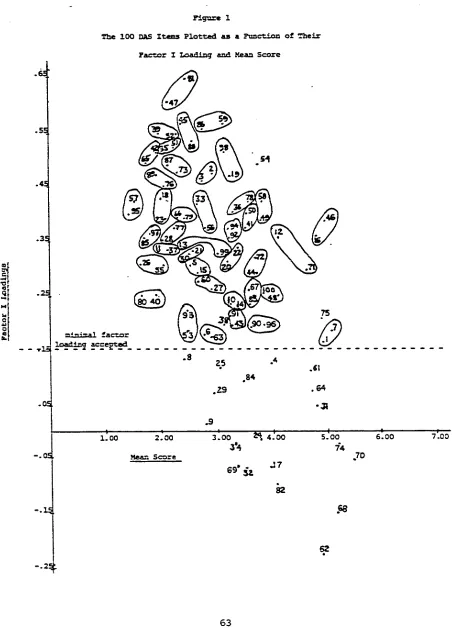
Factor I Loading and Mean S c o r e ... 5 3
2. Design of the R e s e a r c h ... 9 1
3. Cross-Lagged Panel Correlation Paradigm ... 9 9
viii
Introduction
Statement of the Problem
The subject of depression has puzzled and mystified people and,
in general, has been an area of controversy for over 2 , 0 0 0 years.
Yet in spite of the numerous theoretical papers regarding its
etiology and psychopathology, there is a dearth of systematic
studies aimed at testing hypotheses generated by the various
theories. One reason for this may be that the earlier views,
such as Freud's formulation of an internalized struggle between
superego and ego, are too remote from observables in clinical
material to be reduced to operational terms for testing.
During the last decade and a half, Beck (1967) has attempted
to stipulate certain characteristics that appear to be at the
core of the depressive constellation and which are also testable.
In the early 1960's, Beck (1961, 1963, 1964, 1967) conducted a
series of studies of clinical depression which led to the
development of a cognitive formulation of depressive symtomatology
and an approach to the treatment of depression that dealt pri
marily with cognitive factors. He postulated a "cognitive triad,"
consisting of a negative conception of the self, of the external
world, and of the future as central to the depressive constellation.
This view has received some support from a series of systematic
investigations (Beck & Hurvich, 1959; Beck, 1961; Beck & Ward,
1961). Recently, Beck (1970, 1972, 1974, 1976) has theorized that
emotions in general may follow from the meanings attributed to
events and that emotional disturbances result when events are
given distorted interpretations. He hypothesized further that
many forms of psychopathology — such as anxiety, phobias,
obsessions, as well as depression — may be associated with
characteristic cognitive distortions and that these disturbances
will respond to therapy aimed at the correction of these
distortions. A depressed person, then, may be helped by changing
his errors in thinking, i.e., his dysfunctional attitudes, rather
than by concentrating on his depressed mood.
While conducting research with Aaron T. Beck, I realized that
the lack of an objective method to quantify the relative presence
or absence of these cognitive distortions was a basic limitation
affecting efforts to test empirically the hypotheses inherent in
this type of therapy. If reliable and valid means for measurement
were available, a number of additional avenues for research dealing
with the formal thought processes in depression would be opened.
The primary purpose, therefore, of this study was to design a
written instrument aimed at identifying the common assumptions
underlying the typical idiosyncratic cognitions of depressed
individuals, as espoused within Beck's approach. A
level goal of this research was to determine the relationship
between these attitudes and depressive tendency.
The Cognitive View of Emotions
Within the clinical realm, analysis of phenomena from a
cognitive information-based perspective is not new (cf. Kelly,
1955; Rotter, Chance, & Phares, 1972); yet recent years have
witnessed increasing emphasis on refining and operationalizing
a "cognitive learning" approach (e.g., Bandura, 1969; Estes,
1971; Staats, 1972). In addition, a rapidly accumulating
body of evidence and considerable speculation suggest that
this convergence toward a cognitive-behavioral perspective
holds substantial clinical promise (Bergin, 1970; D'Zurilla &
Goldfried, 1971; Goldfried, Decenteceo & Weinberg, 1974;
Lazarus, 1967, 1971, 1976; Mahoney, 1974; Meichenbaum, 1972;
Ullman, 1970). Arieti (1968), a psychoanalyst, has called
cognition the "Cinderella" of the field of psychiatry. He
emphasized that "a great deal of human life has to do with
conceptual constructs. It is impossible to understand the
human being without such important cognitive constructs as
the self-image, self-esteem, self-identity, identification,
hope, or projection of the self into the future" (p. 1637).
Until recently, researchers and therapists have regarded
of one another. According to Singer (1973), however, the intimate
relation between affect and cognition is rooted in the infant's
early efforts at accommodating to its novel and everchanging
environment. He assumes, with Tomkins (1962), and Izard (1971),
that environmental novelty activates the interest affect, which
in turn sustains efforts at exploration and accommodation. Mastery
or successful accommodation reduces excitement and activates joy,
whereas a complex mass of unassimilable material may produce
startle, distress, or fear. Thus, affective and cognitive processes
are intertwined from the very beginning of life. As man interacts
further with his environment, an elaborate set of cognitive functions
emerge which enable him to achieve greater control over his feelings,
actions, and environments. Ma n 1s ability to appraise, to interpret,
and to ascribe evaluative labels to his behavior and/or his feelings
gives, in large measure, meaning to his affective-behavioral states.
Rensberger (1977), reporting for the New York Times, summarizes
the cognitive position as follows:
"Freud got it the wrong way around, some psychiatrists are now asserting. Emotional disorders do not cause people to think in bizarre, illogical patterns
typical of mental illness. Rather, it is illogical
or otherwise defective thinking patterns that cause
emotional or behavioral problems." (p. A21)
Just as Freud's momentous discovery consisted of revealing the
unconscious processes in a person's affective life, the
affective-unconscious, so now we must go below the surface and reveal the
unconscious processes in a person's cognitive life, what we may call
the cognitive-unconscious (Weiner, 1975). Fairly conclusive
evidence is now available that a person's attitude toward any
object can be seen as a function of his beliefs about the object
and the evaluative aspects of those beliefs (Fishbein,
1967)-Several contemporary theories treat emotion in essentially this
same way; i.e., as response or as a complex of responses determined
by cognitive processes. These recent theories seem to have stemmed
from pervasive ideas about human nature which can be traced through
Aristotle, Thomas Aquinas, Diderot, Kant, and other philosophers
such as Epictetus, who in the first century A.D. wrote in The
Enchiridion, "Men are disturbed not by things, but by the view
which they take of them." The major ideas inherent in these
approaches are: (1) Man is first and foremost a rational being;
(2) Rationality is basically good, emotionality basically bad;
(3) Reason (cognitive processes) should be used as a control and
as a substitute for emotion (Izard, 1577).
The classic theory in the field of emotions is the formulation
of William James (1884), that " ... bodily changes follow directly
the perception of the exciting fact, and our feelings of the same
changes as they occur i£ the emotion." In this assertion James
(1884) avoids assuming that cognition intervenes between the object
stimulus and the bodily response. But this stimulus-response
perception of object to bodily state to feeling of bodily state,
•h'th the perception of the object and the awareness of the
feeling involve cognitive states and assessments. Perception is
never direct but always interpreted in terms of one's prior
learning, beliefs, language, and assessments. Even sensation may
be modified by cognitions. The theory, therefore, presents more
than a behavioral stimulus and a behavioral response and is really
a "covert cognitive" theory of emotions (Shibles, 1974).
George A. Kelly (1955) thought of emotion as behavior that is
either loosely defined or not a word-bound construction. His
theory postulates that each individual has available a number of
personal constructs for cognizing and perceiving events. The
foundations of Kelly's theory are summarized by the statement
that "A person's processes are psychologically channelized by
the ways in which he anticipates events" (Kelly, 1955). This
personal construct psychology emphasizes the individuality of
a person's system of construing events. The salience of a
C O x i S u T U C t dimension in a person's system is determined by its
utility in anticipating behavior or events and thus it has a
direct association with behavioral prediction. How we "feel"
may be the other side of how we "know."
Ellis (1962) theorizes that emotions and self-evaluative
thoughts are virtually one and the same thing. Emotion is not
the opposite of thinking. Rather it is partially comprised of
thinking or reason. What we call "emotion" seems to include
mainly: (1) A certain kind of forceful thinking — a kind
strongly slanted or biased by previous perceptions or experiences;
(2) Intense bodily responses, such as feelings of pleasure or
nausea; (3) Tendencies toward positive or negative action in
regard to the events that seem to cause the strong thinking and
its emotional concomitants (Ellis & Harper, 1975). Emotions
differ from feelings in involving more cognition. For Ellis,
without cognition or self-talk there would be few emotions,
since emotion implies reason.
Arnold (1960, 1968), in support of Ellis, characterizes
an emotion as a felt tendency toward an object
(behavioral-motoric component) judged suitable or unsuitable (cognitive
component), and reinforced by specific bodily changes
according to the type of affect (physiological-bodily component).
The emotion proper is the nonrational attraction or repulsion
that follows upon the appraisal of something as good or bad
for the perceiver. Ellis and Arnold's views are consistent
with social-psychological definitions of attitude. Attitude
also is considered a tendency to evaluate an object or symbol
in a certain way (Katz & Stotland, 1959), with an affective as
well as a predispositional response or behavioral component
(Lott, 1973). Specifically, Ellis maintains that certain
irrational beliefs produce various forms of emotional upset- As
seen from a social-leaming viewpoint, these irrational views
take on the status of a persistent and well-learned set with
which certain individuals approach life situations. As suggested
by Dollard and Miller (1950), our early social learning experiences
teach us to label situations in varying ways. Emotional re
activity may result at times from the label attached to certain
events, not the situation that is labeled.
The patient's private world has not been regarded as a useful
area of inquiry to the behaviorists (Watson, 1914; Skinner, 1971).
This is because thoughts, feelings, and ideas that are accessible
only to the person experiencing them are not valid data for these
theorists; only behavior that can be directly observed by an
independent outsider is used in explanation. However, research
in behavior therapy techniques has highlighted the fact that
environmental events per se, although important, are not of
primary importance; rather what the client says to himself
about those events influences his behavior (e.g.. Mahoney,
1974; Meichenbaum, 1974; Steiner, 19/0). Recently, it. has
been hypothesized that, in humans, conditioning does not occur
automatically and is in fact cognitively mediated (Bandura,
1974; Brewer, 1974) . To account for behavior solely in terms
of external rewards and punishments overlooks the fact that
human beings can be rewarded and punished by their own thinking,
"even when this thinking is largely divorced from outside rein
forcements and penalties” (Ellis, 1962). Lazarus, Averill, and
Opton (1970) expanded this view by stating, "The individual —
cognitively filters stimulus information, and the resulting
appraisal determines whether the situation is evaluated as
relevant, threatening, frustrating, etc." They add that
cognitive processes "create the emotional response" and shape
it into recognizable affect. This recent development of
cognitive theories within the ranks of behavior therapy has
to be classified as one of the more intriguing developments
in contemporary clinical psychology. Adler (1964) summarizes
this cognitive approach to emotions when he said:
"In a word, I am convinced that a person1s behavior springs from his ideas ... It is very obvious that we are influenced not by
'facts' but by our interpretation of facts ... Everyone possesses an 'idea' about him self and the problems of life - a life-pattern, a law or movement - that keeps fast held of him without his understanding it. without his being able to give any account
of it." (pp. 19, 26-27)
The Evaluation of the Concept of Depression
As a distinct and distressing state in man, depression was
known at least as early as 1500 years before Christ. In the
Old Testament's Book of Job we have what is essentially a
self-reporting inventory of a classical clinical depression. Conse
quently, we have a condition that has prevailed at least since
to this day no agreement exists as to diagnosis, epidemiology,
classification, causes or effectix 3 therapies for this "illness"
(Fieve, 1971).
The condition that today we label "depression" has been
described by a number of ancient writers under the classification
of "melancholia." In 400 B.C. Hippocrates rendered the first
clinical description of melancholia when he observed depression
in women and labeled it hysteria because he felt its source was
the uterus ("hyster" in Greek). Later this bleak mood became
known as melancholia after the black bile secreted by the gall
bladder, thought to be the provoker of sadness. Opposed to
melancholia were excitements, designated by the term "mania,"
and explained by the influence of yellow bile. Two centuries
later, the Greek writer Aretaeus ascribed melancholia to
flatulence or anger, grief and dejection. He linked some
depression to manic states and noted that logical thought
processes were not impaired in depression (Becker, 1574).
Furthermore, the cardinal signs and symptoms used today in
diagnosing depression were found in most of these ancient
descriptions: disturbed mood, castigations,
self-debasing behavior, wish to die, physical and vegetative
symptoms, and delusions of having committed unpardonable
sins (Beck, 1967). The field did not advance beyond this
19th century phenomenology until Kraepelin (1913) presented
the first schematic classification of all psychiatric illnesses.
Despite his narrow focus on prognosis as the essential criterion
for categorization, Kraepelin's (1913) attempt proved to be most
successful.
In the early part of this century, Freud and his co-workers
emphasized the significance of psychodynamics in personality d e
velopment and in the expression of psychopathologicai symptoms.
Enlarging on an insight of his disciple, Karl Abraham, Freud
(1917) in his classic paper, Mourning and Melancholia, played
an extraordinary significant role in contributing to the psycho
dynamic understanding of depression. He considered depressive
illness not only from the point of view of a reaction to life
situations but also from the standpoint of the intrapersonal
or intrapsychic events that constituted this reaction. Freud
assumed that a particular behavior has its roots in the uncon
scious and that any irrationalities observed on the conscious
level are only manifestations of the underlying unconscious
drives. In general, according to this psychoanalytical
orientation, depression represented the introjection of hostility
resulting from the loss of an ambivalently loved object (Abraham,
1911; Freud, 1917) or a reaction to separation from a significant
object of attachment (Spitz, 1942; Klein, 1945; Robertson &
More recent reformulations of the original psychoanalytical
model have concentrated on object loss and its consequence on the
ego. Bibring (1953) emphasized a loss of self-esteem as the
crucial element in depression. His views contrasted with those
of the earlier psychoanalytic theorists in that he placed more
emphasis on ego psychology (conscious response to events) than
on unconscious conflicts between ego and superego (Mendels, 1970).
According to Bibring (1953), the basic mechanism of depression is
" __ the ego's shocking awareness of its helplessness in regard
to its aspirations" (p. 39). Depression supervenes when the ego
is cognizant of its goal and simultaneously aware of its helpless
ness to attain it. The ego suffers a narcissistic injury and
collapse in self-esteem. Depression then appears when one cannot
live up to one's ego ideals.
The ego-psychological approach is carried to its fullest
implications in Beck's (1967) cognitive model of depression, which
emphasizes another intrapersonal component of depression. The
vicissitudes of self-esteem in depressive illness are considered
from a perspective that conceptualizes depression in a new and
provocative way (Mendelson, 1975). Generally, the thought dis
order that depressed patients manifest has been considered to
be a consequence of a basic disturbance in mood. However, Beck
(1967) has suggested that it is a primary disturbance in thinking
that causes the development of the disturbed mood state. He
proposed "that the typical depressive affects are evoked by the
erroneous conceptualizations." An altered style of cognition,
characterized by negative expectations, is said to be the basis
of depressive mood states. Beck thus sees these intrapersonal
distorted cognitions as playing an etiological role in what has
been generally thought of as an affective disorder.
"This notion of the primacy of affect over cognition in psychopathology presents an interesting paradox: for normal subjects, the conceptualization of
a situation determines the affective state, but in psychopathology, the affective state determines the cognition.
On the basis of clinical observations and subsequent research, this author has postulated that in abnormal condirions such as depression and anxiety the direction of the reaction is from cognition to affect, just as it is in
normal responses (Beck, 1963). The difference
between normal and abnormal reactions lies in the degree of correspondence between the con ceptualization and the veridical stimulus
configuration. In psychopathological states
perseverative faulty conceptualization leads to excessive or inappropriate affective
disturbance." (Beck, 1971)
Leaming-theory approaches to the analysis of depression were
hinted at by Skinner (1953) when he described depression as a
general weakening of the response repertoire of an organism, a
weakening presumably brought about by extinctions. In general,
the behaviorist views depression as a set of maladaptive
behavioral responses which are elicited by uncontrollable
aversive stimuli or by loss of reinforcement, and additionally
Seligman, 1974; Ferster, 1965; Lazarus, 1968). However, it was
not until Seligman and his associates (Seligman & Maier, 1967;
Seligman, Maier & Geer, 1968) began their experimental work,
connecting the powerless aspects of dependency and depression,
that the leaming-theory approach gained impetus. They showed
that dogs receiving a large number of inescapable electric
shocks ultimately learned to become passive and accept the
electric shock in apparent helplessness. These animals, once
having learned that their behavior was useless in one experimental
situation, gave up without exploring alternatives in a new
experimental situation where their behavior could have had an
effect. Seligman's model may be useful in conceptualizing the
type of affect-cognition-action sequence that leads to what a
numbe.r of other theorists (e.g., Bibring, 1968; Beck, 1967)
have recognized as symptoms of depression, i.e., feelings of
hopelessness or helplessness. Learned helplessness is net only
a stimulus-specific behavioral state; it may well represent an
induced trait, the expectation that one's efforts are generally
futile. After drawing a number of parallels between the charac
teristics of "learned helplessness" and depression, Seligman (1968)
suggested that successful therapy occurs when the patient believes
that his responses produce gratification, that he is an effective
human being.
Attempts at reconciling these diverse theoretical positions
have been sporadic and incomplete. Psychodynamic explanations
of psychopathology weight early experience factors more heavily,
whereas behavioral explanations stress current situational
determinants more heavily. Cognitive approaches to psycho
pathology, however, may prove to be useful integrators of these
disparities. A greater emphasis on the individual's descriptions
of internal events can lead to a more complete view of human
psychopathology and the mechanisms of behavioral change. By
using introspective data, the cognitive theorist has access to
the patient's thoughts, ideas, attitudes, dreams, and daydreams.
These ideational productions provide the cognitive theorist with
the raw materials with which he can form concepts and models
(Beck, 1970). It is important, however, for the therapist to
distinguish among symptom, technique, and underlying attitudes.
For example, the symptom may be affective, such as crying spells,
sadness, loss of gratification, loss of sense of humor, apathy.
The therapeutic approach may be behavioral, for example, mobilizing
the patient into more activity and positively reinforcing certain
types of activity. The underlying attitude, however, is the
component that needs to be changed ultimately if the totality
of the depression, for example, is to be influenced. Thus, the
Definition of Depression
Despite the fact that research dealing with depression has
increased quantitatively, investigations into the causes of this
condition continue to remain unsolved. A major reason for this
slow progress stems from the fact that the term "depression" is
used in many ways: T o describe a normal mood state (e.g.,
grief); a symptom (e.g., sadness that is seen in many psychiatric
disorders); a syndrome (characterized by dejection, hopelessness,
psychomotor retardation, etc.); a disease; an illness; or any
combination of these. Furthermore, different schools of thought
use dissimilar dialects, thereby hindering communication to an
even greater extent. Friedman (1974) , in an attempt to present
a schematic way of viewing "depression" has proposed that the
term be employed in three ways: A s an affect, as a clinical
state, and as a character style. Within this framework, the
concentration of this paper is on depression as defined by the
first two classifications of this tripartite division:
1. To refer to a basic feeling of sadness which is a part of
the fabric of life and which is noted in states of grief and periods
of disappointment (i.e., the affect of depression), and,
2. To refer to a complex of symptoms, including the affect
of depression, but also other affects such as anxiety or guilt,
and motivational, vegetative, and cognitive disturbances (i.e.,
the clinical depressive state).
In previous studies by Beck (1961, 1963, 1964, 1967), depression
has been defined in this way, as a psychopathological dimension
rather than as a discrete nosological entity. This concept of
depression should be distinguished from the use of the term to
designate specific diagnostic categories, such as "neurotic
depressive reaction" or "manic depressive reaction," which are
frequently considered to have a specific onset, course, prognosis,
and etiology. As a psychopathological dimension, depression may
be observed in association with other psychopathological states
such as "schizophrenic reaction" or "anxiety reaction," as well
as in cases receiving a primary diagnosis of depression (Loeb,
Beck, & Diggory, 1971). Viewed in this way, depression is
identifiable in many diverse types of patients.
Beck's Cognitive Theory of Depression
A promising strategy in the exploration of both psychopathology
and normal functioning is the study of an individual's cognitions —
the person's manner of perceiving, construing, anticipating and
evaluating events, behaviors and their consequences (Kelly, 1955;
Mischel, 1973; Mahoney, 1974). While cognitive theories have been
postulated (Ellis, 1962; Lazarus, Averill, & Opton, 1970;
Meichenbaum, 1976), these theorists attempt to account for the
development of emotional responses and affective disturbance in
general. The most precise delineation of a theory focusing upon
in the writing of Beck (1963, 1964, 1967, 1974, 1976). In contrast
to many historical and popular views, Beck's (1967) thesis is that,
"The affective response is determined by the way an individual
structures his experience." Rejecting the notion that man is
governed by powerful unconscious forces over which he frequently
has little control. Beck locates the basic problem of emotional
disturbances in man's misconceptions about himself, his irrational
beliefs and faulty assumptions about reality. Depressive affect
and behaviors are considered secondary manifestations of depressed
cognitions; depression is seen as a thought disorder.
Although Arnold (1960), experimental psychologists such as
Richard Lazarus (1966), and clinicians such as Albert Ellis (1962),
have clearly marked the association between thinking and emotion,
they have not delineated the particular kinds of appraisals that
lead to specific emotions. In fact, the vast literature in
personality and social psychology hardly touches on the question
of what ideational content in response to a noxious stimulus or
a threat produces sadness, anxiety, or anger. Granting that the
initial appraisal may be a global "bad for me," Beck (1976)
claims that the individual's unique interpretation of the noxious
stimulus determines his emotional response. Beck's theory
delineates the idiosyncratic content of cognitions relevant to
specific clinical syndromes, whereas Ellis offers a more general
hypothesis about the predominance of irrational self-talk as a
reflection of neurotic behavior and thinking.
By analyzing recorded interview materials of depressed and
nondepressed patients in psychotherapy. Beck (1963, 1964) found
that depressed patients tended to distort their experiences in
an idiosyncratic way; that is, they misinterpreted specific
irrelevant events in terms of personal failure, deprivation,
or rejection, or they tended to greatly exaggerate or over
generalize events that bore any semblance of negative infor
mation about themselves. From this, Beck theorized that
"certain cognitive schemas become prepotent during depression,
dominate the thought processes and lead to cognitive distortions"
(Beck, 1964). Furthermore, Beck believes these cognitions (i.e.,
any mental activity that has verbal content) to be automatic
and involuntary and to seem plausible to the patient. The
meaning that an individual attaches to an object or a
situation affects how he feels. In other words, the depressed
person feels sad and lonely, for example, because he erroneously
thinks he is inadequate and deserted. His thinking may appear
as highly irrational, but it makes sense within the patient's
conceptual framework. The relationship between cognition and
affect or emotion is based largely on prior learning and
association. One's irrationality leads to one's emotional
the character, Don Juan:
"The world is such and such or so-and-so only because we tell ourselves that that is the way it is ... You talk to yourself. You're not
unique at that. Everyone of us does that.
We carry on internal talk — In fact we
maintain our world with our internal
talk." (Casteneda, 1972)
Beck (1967) assigns primary etiological importance to an
altered style of cognition characterized b y three negative
views: of the self, of the environment, and of the future.
This negative "cognitive triad" presumably results in and
accounts for other manifestations of depression — such as
a lack of motivation, low activity level, dysphoria, etc.
In this view, depressives' cognitions lead to the misinter
pretation of experiences and subsequently to other responses
that are logical consequences of such misinterpretations.
Maladaptive behaviors are emitted which are consistent with
the cognitions of the depressives who are thus locked into
an internally consistent, self-fulfilling cycle.
The three cognitive constructions referred to as the
"cognitive triad" are:
1. The view of self. The depressed patient's cognitive
schemas that relate to self-assessment consist of seeing himself
as deficient, inadequate, or unworthy. He will often attribute
his unpleasant feelings and experiences to some kind of physical,
mental, or moral defect within himself. He will then consider
himself worthless because of his presumed defects and will
"reject" himself.
2. The view of the world. The depressed person tends to
see his world as making exorbitant demands on him and as
presenting obstacles that cannot be surmounted. He interprets
his interactions with his environment in terms of defeat and
failure, deprivation, or disparagement.
3. The view of the future. The depressed person's negative
cognitive patterns relating to the future become evident in his
view that his current difficulties or suffering will continue
indefinitely. Thus, he anticipates unremitting hardship,
continued frustration, and never-ending deprivation. Such
schemas essentially amount to a pervasive, hopeless attitude.
The hallmark of the cognitive triad is that the negative
evaluations comprise unrealistic, distorted, and illogical ways
of thinking, which do not correspond to reality. It is as though
the depressed individual has been b o m with eyes that see only
with great distortions but give the illusion of seeing sharply
and clearly. These distorted and illogical ways of thinking are
manifested in the depressed person's tendencies to make extrava
gant use of the following proccoooo: Itiaggeration or misinter
pretation of events; the making of extreme, absolute judgments
incident; focusing on one particular detail out of context and
ignoring the more salient features of a situation; drawing
inferences in the absence of, or even contrary to evidence;
and extracting personally relevant meanings from unpleasant
situations.
This view represents a radical departure from psychodynamic
theories of affective disorders in that it emphasizes the role
that disturbances in thinking play in determining emotional
states (Beck, 1971). The cognitive approach to depression and
psychopathology does not assume that a well-adjusted individual
necessarily thinks logically and solves problems correctly
(Beck, 1967). What is assumed is that, to understand and
correct maladaptive behavior, the idiosyncratic meaning that
people ascribe to their experiences must be uncovered (Kovacs
& Beck, 1978). These cognitions are termed "idiosyncratic" because
they reflect a faulty appraisal, ranging from a mild distortion
to a complete misinterpretation, and because they fall into a
pattern that is peculiar to a particular psychopathological
state. The focus of therapy is on altering or removing those
idiosyncratic evaluations that are dysfunctional or maladaptive,
with the expectation that the remaining symptoms and behaviors
characteristic of depression will be alleviated. An important
factor in treatment when trying to change misconceptions is the
emphasis on insight, a cognitive process consisting of identifying
thoughts, feelings, and wishes and making psychological connections
among them (Beck, 1976).
The Concept of Schemas
How does an individual form the concepts that predispose him to
depression? Early in life, a child develops many attitudes about
himself and his surroundings- Some of these concepts are realistic
and facilitate healthy adjustments, while others deviate from
reality and make the individual vulnerable to possible psycho
logical disorders. These relatively abstract and generalizable
rules regarding certain regularities in the relationships among
events are called "schemas." According to Beck (1964) schemas
are conceived as relatively stable cognitive structures (in
contrast to a cognitive process, which is transient), which
channel thought processes, irrespective of whether or not these
are stimulated by the immediate environmental situation. When
a particular set of stimuli impinge on the individual, a schema
relevant to these stimuli is activated. The schema abstracts
and molds the raw data into thoughts or cognitions. Once
established, the schemas serve as a guide to behavior and as
a framework that influences the way in which relevant new
information will be assimilated. Beck (1967, p. 288) said, "It
affective response. If the schema is concerned with self
depreciation, a feeling of sadness will be associated with
i t An analogous relationship between the content of the
schema and the corresponding feeling holds for the other
affects." Eventually, a single association may call up an
entirely negative (or positive) experience response. Beck
(1971) has described this process as follows:
"These schemas may remain latent for many years but, activated under certain stress ful conditions, supersede more realistic
concepts. The indiscriminate and repetitive
application of these idiosyncratic schemas leads to a continual affective arousal. The 'snowballing' phenomena observed in these conditions can be understood in terms of a feedback model. The affective responses to the cognitive distortions are in turn processed by the idiosyncratic cognitive systems and lead to further
idiosyncratic cognitions. Thus, a
continuous cycling of cognition affect -cognition is established."
When viewed in this sense, "schema" certainly constitute a Kantian
notion: We sense the world in terms of our categories. There is
no sensation without cognition and no cognition without sensation.
One might also say there is no emotion without cognition and
sensation because, in the assessment view, emotion comprises
both.
The process of "constructing" involves: first, hypothesis
generation; second, testing of these hypotheses; third, feedback
from these tests; and finally, reformulation or adjustment of the
original hypotheses. The individual must conceptualize the
world in a structural framework, however primitive it ma y be,
before he can react to it and within it. This acceptance of
an internal unit (a cognition, a plan, a mediator, a schema)
as what is learned provides a different orientation to the
field.
In depression, specific idiosyncratic schemas assume a
dominant role in directing the thought processes. Though the
schemas may be latent during the nondepressed period, they
are activated by particular kinds of circumstances and become
progressively more potent as the depression develops. Circum
stances are not expected to produce a depression unless the
person in question is particularly sensitive to the situation
because of his specific predepressive constellation. Whereas
the average person might experience such a trauma and still be
able to maintain interest in other aspects of his life, the
depression-prone person experiences such a constriction of
his cognitive field that he experiences negative ideas about
every aspect of his life. The phenomenology of normal and
pathological moods may overlap considerably. Most moods
entail poorer discrimination between subjective and objective
reality. But in normal moods the individual has greater
recognition that changed perceptions are temporary effects of the
mood. Moreover, qualitative and quantitative aspects of the mood
are more appropriate to the mood-eliciting events. Events that
are incompatible with the mood are perceived and responded to more
realistically, which may lead to a shift or termination of the mood.
By contrast, pathological moods are less appropriate to reality in
relation to all of the factors (Becker, 1974). In psychopathological
conditions, the reaction to the stimulus situation is determined to
a much greater extent by internal processes which distort the stimulus
situation. The increased frequency and degree of cognitive dis
tortions as the depression develops may be attributed to the
progressive dominance of the idiosyncratic schemas. Normally,
the cognition resulting from the interaction of the schema with
the stimuli is expected to be a reasonably accurate (veridical)
representation of reality (Piaget, 1947). However, as these
idiosyncratic schemas become more active, they are capable of
being evoked by stimuli that are less congruent with them. Now,
instead of a schema's being selected to "fit” the external details,
the details are selectively extracted and molded to "fit" the
schema. The result is inevitably a distortion of reality.
When the idiosyncratic schemas are especially active as in
severe depressions, particular items congruent with the depressive
schemas are selected from the stored material. These items then
form part of the typical depressive sequences of associations and
ruminations. According to Beck (1971) :
"The model for affect instigation is based on certain assumptions. First, irrespective of the veridical properties of a stimulus
situation, an individual's reaction to the situation depends upon his appraisal (or conceptualization) of the situation.
Crucial properties of the stimulus are its connotations, meanings, and significance for the perceiver.
Second, the cognitive content or meaning is chained to a particular affect. As the cognitive content changes, the affect changes in consonance with it. Affect-pro ducing ideation may occur in response to a
specific external stimulus or may occur in a sequence of associations in the ‘stream
of consciousness.' The affect is congruent
with the cognitions.
During the course of a person's
development, a particular cognitive content may establish a pathway to a specific affect. Some of these cognition-affect chains appear to be universal. Others are idiosyncratic for a particular society or a specific individual."
A cycle is formed wherein each negative judgment reinforces the
negative self-concept, which in turn facilitates a negative
interpretation of subsequent experiences. In the terminology
of formal logic, the schema equals the major premise; the
external event equals the minor premise; the cognition equals
the conclusion, the affect follows from the conclusion. If
this major premise is invalid, then the conclusion will be
invalid, even though the logical operations may be flawless.
By observing a recurrent erroneous conclusion, then, one can
infer the content of the idiosyncratic schema. Thus, schemas
and to others- To understand a depressed individual then, we need
to get inside his conceptual system and see the world through his
eyes. Beck (1976) gives the following example:
"An instructor, in a casual way, told two students (Miss A and Miss B ) , who were carrying on a side conversation in his seminar, 'If you have anything to say, share it with the rest of us or else be
quiet.' Miss A responded angrily that she had
simply been trying to clarify a point." (p. 43)
In this example, the major premise (schema or attitude) when stated
as a rule is: "All corrections by a person in authority are
criticisms." The minor premise (external event) is: "The teacher
is correcting me." Miss A concludes, "Therefore, the teacher is
criticizing me." Eer emotional response was anger. Miss A
doesn't actually state the initial premise to herself; however, it
is already a part of her cognitive organization. Whether or not
she has a concrete thought about the situation, she is aware of
the conclusion.
The depressed patient also shows certain patterns of illogical
thought. These systematic "errors" of thinking, which lead to
distortions of reality, can be categorized according to the ways
in which they deviate from logical or realistic thinking. These
illogical processes, typical of depressed individuals within
Beck's (1967) approach, include:
1. Arbitrary inference: The process of drawing a conclusion
when there is no evidence to support the conclusion or when the
evidence is contrary to the conclusion.
2. Selective abstraction; The process of focusing on a detail
taken out of context, ignoring other more salient features of the
situation, and conceptualizing the whole experience on the basis
of this element.
3. Overgeneralization: The pattern of drawing a general
conclusion on the basis of a single incident.
4. Magnification or minimization; Errors in evaluation that
are so gross as to constitute distortion.
5. Personalization: The patient's proclivity to relate external
events to himself when there is no basis for making such a connection.
6 . Dichotomous Reasoning: overly rigid and simplified perception
of events as good or bad, right or wrong, etc.
Empirical Findings
Unfortunately, evidence- in support of B eck5 s formulations
has been largely anecdotal or indirect (Beck, 1967; 1970; 1971).
However, some studies have explored the experimental manipulation
of other variables relevant to depression. Loeb, Feshbach, Beck,
& Wolf (1964) randomly assigned a group of depressed and non
depressed patients (determined by scores on the Beck Depression
Inventory) to an experimentally-induced superior and inferior
performance condition. Prior to and immediately following the
experimental task, the patients rated their own moods. Results
showed that the psychiatric patients in the superior performance
perceived others as happier than did patients in the inferior
performance group. Depressed patients were more sensitive to
task performance than nondepressed patients in estimating how
they would do in a future task. The depressed patients also
showed greater changes in self-ratings of their mood with task
performance.
In a subsequent study by Loeb, Beck, £ Diggory (1S71), depressed
patients (determined by a dual criterion, score on the Beck
Depression Inventory and an independent psychiatric rating) were
found to be significantly more pessimistic about their performance
than were a matched control group of nondepressed patients. However,
the depressed patients performed as well as the control group. On a
second task in this manipulation, the previous experience of
"success" (defined by sorting 20 cards in any of seven trials)
or "failure" had different effects on the actual performance of
the two groups: Success improved the performance of the depressed
group, whereas failure improved the performance of the nondepressed
group. Friedman (1964) also demonstrated that, when given cognitive
tasks to perform, even the most regressed depressed patients do as
well as nondepressed controls, despite their severe feelings of
incapacity. He interprets this finding as being in accord with
Bibring's (1953) theoretical conception of depression as an ego
phenomenon, involving lowered self-esteem and subjective feelings
of helplessness and hopelessness.
Hammen and Krantz (1976) reported the results of a study
comparing the changes in self-ratings of depressed and non
depressed females as a function of feedback on a performance
task. The depressed subjects (determined by scores on two
measures of depressed mood) were found to evaluate their
personal qualities significantly more negatively than the
nondepressed subjects. In response to an experimental
manipulation (i.e., positive feedback about their performance,
negative feedback, or no feedback), the depressed subjects
typically demonstrated strongly negative reactions to failure
as compared with the neutral condition. The depressed subjects
became more pessimistic in the prediction of their future
performance following the negative feedback.
Hammen and Glass (1975) found that inducing depressed
college students to increased participation in enjoying
(reinforcing) activities did not necessarily reduce their
depression. Rather, the relation between mood and reinforce
ment may depend to an important extent on cognitive factors,
because the data suggested that depressed subjects who
increased their activities tended to evaluate them more
negatively than other subjects. This finding seems contrary
to that of Lewinsohn and his colleagues (Lewinsohn, 1974;
Lewinsohn & Graf, 1973; Lewinsohn & Libet, 1972), who
positive reinforcement. It is, however, in agreement with Beck
(1963), who believes that depressed mood and its attendant
cognitions result in reductions in reinforcing activities rather
than the reverse association.
Velten (1968) used a group of statements designed to be
"depressing" and controlled for the subjects' pretreatment mood
level and suggestibility. He found that depressed mood in female
college students was induced by the depressing statements.
Weintraub, Segal, & Beck (1974) also found a time-specific
relationship between cognition and moo d , i.e., male under
graduates who thought more negatively felt more "depressed."
They further stated that "the negative attitudinal set, rather
than depressed affect, m ay be the primary factor in depression."
This result is also in agreement with Hammen and Krantz's (1976)
finding that depressed persons tend to systematically select
dysfunctional cognitions that maintain if not enhance depression
and
hopelessness-These research findings suggest new approaches for treating
depression and new ways in which the depressed person can learn
to help himself. As a result of these studies, some psycho
therapists are now concerned with the kinds of statements that
people make to themselves or with which they "think." One such
new approach, based on Beck's assumptions, is called
"cognitive-behavioral therapy;" it suggests that the individual's problems
are derived largely from certain distortions of reality based on
erroneous premises and assumptions. These incorrect conceptions
have originated in defective learning during the individual's
cognitive development. Man can learn erroneous, self-defeating
notions, and he is capable of unlearning or correcting them as
well. Regardless of the origin of these notions, the formula
for treating them is simple: The therapist helps the patient
to unravel his distortions in thinking and to learn alternative,
more realistic ways to formulate his experiences.
Of particular significance to this basic question of how
undesirable affect can be served from cognition is the
widely-known work of Schachter and his colleagues. Schachter's (1964,
1966) research supports the contention that the emotional content
of a reaction can be modified or eliminated if the cognitions
related to the emotional reaction are changed. Such a contention
presupposes that emotional experiences always include cognitive
aspects. Three propositions constitute the essence of Schachter's
(1971) approach:
1. Given a state of physiological arousal for which an
individual has no immediate explanation, he will "label" this
state and describe his feelings in terms of the cognitions
available to him ...
2. Given a state of physiological arousal for which an
evaluative needs will arise and the individual is unlikely to
label his feelings in terms of [any] alternative cognitions
available ...
3. Given the same cognitive circumstances, the individual
will react emotionally or describe his feelings as emotions only
to the extent that he experiences a state of physiological
arousal.
In other words, both physiological arousal and cognitive
evaluation are necessary, but neither is a sufficient condition
for the production of emotional states (Mandler, 1975). This
two-factor theory of emotions, although not fully explaining
the link between negative cognitions and depressive affect,
suggests that affective experience is a joint product of
cognitive labeling and physiological arousal.
In an early experiment, Schachter and Singer (1962) injected
students with adrenaline and asked them to report their experiences.
Seventy-one percent reported having certain physical sensations,
the rest described "as-if" emotions; e.g., "I feel as if I were
afraid." The researchers found that the cognition that one has
and the kind of linguistic labeling that one does determines
which emotion is experienced. Subjects who were aware that the
cause of their arousal was adrenaline reported no emotions. The
same physiological arousal may be experienced as joy or as anger
(or as any other emotion), depending on the cognitions available
in the situation. The data suggest that if a state of physiological
arousal is induced, and if the individual has no immediate expla
nation for it, he will then label his state in terms of the environ
mental-cognitive information available at the time. Conversely,
if the state of physiological arousal is completely explained in
terms of antecedents, such as an injection, then the individual
will not use other environmental-cognitive information to label
his internal state (rdandler, 1975). The conclusion is that an
emotion is neither a physiological event determined by factors
under the skin nor is it determined by environmental events
impinging upon the person. Rather, it is the result of a
complex evaluation of internal and external pieces of information
and is particularly affected by a person's attributions of the
causality, intent, and extent of these factors.
The relative independence of physiological and cognitive factors
demonstrated by these experiments is somewhat overshadowed by the
necessary artificiality of the experimental situation, as physio
logical arousal is rarely artificially induced, but, instead,
caused by environmental events. Schachter's thesis can be
applied to a depressed state as follows: If a person suffers
a loss, he will become emotionally aroused and will scan his
environment for cues. Then, when he notices that he has suffered
this loss, he will interpret the loss as the cause of the dysphoria.