5239 IJSTR©2020
Analysis Of Napier Bone Usage In Multiplication
Learning In Primary School
Agung Prabowo, Agus Sugandha, Agustini Tripena, Slamet Riyadi, Sukono
Abstract— These instructions give you guidelines for preparing papers for IJSTR JOURNALS. Use this document as a template if you are using Microsoft Word 6.0 or later. Otherwise, use this document as an instruction set. The electronic file of your paper will be formatted further at IJSTR. Define all symbols used in the abstract. Do not cite references in the abstract. Do not delete the blank line immediately above the abstract; it sets the footnote at the bottom of this column. Students have considered mathematics as difficult subject for a long time. One of the materials in mathematics that causes difficulties to students is multiplication. Teacher should introduce a method of learning that employs game, re-creative, creating comfort, to increasing student interest and motivates students. The solutions that have been proved to be able to solve the problem is Napier bone method. The purpose of this research is to know whether there is influence of using Napier bones on the 4th grade elementary school student math achievements. The sample of this study was the students at three schools in the district of Kalibagor, Banyumas Regency. They were the 4th grade students of Pekaja 1, 2, and 3 state elementary schools, that consisted of 19, 30, and 15 students respectively. The teaching learning processes were conducted four times that spent 70 minutes each. The research is a pre and post test research that is carried out by giving pre-test and post-test in the beginning and in the end of the learning period. Qualitative information was gained through questionnaires in the end of learning period. To know whether or not there was an improvement of students achievements, the result of the pre-test and post-test are compared statistically through paired test using degree of significant level α = 0,05. The conclusion is that there was an improvement of student achievements in two sites, i.e. SDN 1 and 3 Pekaja. Different result is gained by the 4th grade students of SDN 2 Pekaja.
Index Terms— achievements, math, multiplication, motivation, Napier bones, paired t test, primary school.
—————————— ——————————
1 INTRODUCTION
Students in general, including elementary students, has considered mathematics as difficult subject for a long time. Many students feel frightened and discouraged while joining the mathematics classes [9,10]. The mathematical uneasiness may appear in the form of feeling worried and frightened of the mathematical problems and mathematics subject [3] that results in the low motivation and low achievements of mathematics score. Mathematical uneasiness can be detected through physical signs such as traumatic feeling, the reluctance to do mathematics problems, and mathematics assignments. Students refusal to solve mathematical problems in front of the class can be indicated through physical symptoms such as irregularity of heart beat, psychosomatics problems (slight stomach upset), excessive sweat, trembling, or getting weaker [3].
To encourage the students, teacher should introduce a method of learning that employs game, re-creative, creating comfort, increasing student interest and motivates students in learning math [7,8,9,10]. When the mathematical uneasiness comes to the students, the re-creational learning that is most of the time makes use of real objects such as tangram, Russian Farmer multiplication mode [1], and Napier bones becomes the hands on activities [3,5,6].One of the materials in mathematics that causes difficulties to students is multiplication [5,6]. Various strategies have been developed to be able to easily teach mathematics such as jarimatika, Sakamoto method, kumon mathematics, etc. However, most of the methods are only accessible through courses with payment and take a relative long time.In any level of education, multiplication is taught using downward calculation method. Before the method is introduced to the 4th grade students of elementary school, they should master addition and have kept in their memory the multiplication from 1 to 10. Addition is introduced to students of the 1st grade, in the 2nd grade the students learn the addition of number more than 10 and they also started to learn subtraction. In the 3rd grade students starts learning the multiplication of two figures that results in less than 100. The basic ability above will be useful when students learn multiplication of more complex unit numbers. The formal method that are usually given in the class are downward (vertical) calculation and long form (horizontal) calculation.Many problems arise with downward model multiplication. Some of them are (1) students forget the result of unit numbers multiplication, (2) students forget of the concept of addition by saving, and (3) students do not move one number value in every continuation multiplication. When one of those problems is faced by a student, it means that the student has not mastered the concept of vertical multiplication and it is almost always that the result of the multiplication is ————————————————
Agung Prabowo, Department of Mathematics, Faculty of Mathematics and Natural Sciences, Universitas Jenderal Soedirman, Purwokerto, Central Java, Indonesia, 53123, PH (+62) 82115636571, E-mail: [email protected]; agung.prabowo@unsoed,ac.id
Agus Sugandha, Department of Mathematics, Faculty of Mathematics and Natural Sciences, Universitas Jenderal Soedirman, Purwokerto, Central Java, Indonesia, 53123, PH (+62) 81542935467, E-mail: [email protected]
Agustini Tripena, Department of Mathematics, Faculty of Mathematics and Natural Sciences, Universitas Jenderal Soedirman, Purwokerto, Central Java, Indonesia, 53123, PH (+62) 82138951252, E-mail: [email protected].
Slamet Riyadi, Department of English Education, Faculty of Cultural Sciences, Universitas Jenderal Soedirman, Purwokerto, Central Java, Indonesia, 53123, PH (+62) 82242132365, E-mail: [email protected]
5240 incorrect. The problems were also experienced by students of
three elementary schools in Pekaja village, district of Kalibagor, Banyumas Regency. The results of the interviews with the math teachers of grade IV of the three elementary schools revealed that there were still many students that could not solve the problem of vertical multiplication. Commonly, students got mistake in the multiplication of tens with unit. One of the solutions that have been proved to be able to solve the problem of vertical multiplication is Napier bone method and gelosia method. Napier bone is formed in the shape of cylinder that consists of the bone of 0, the bone of 1, etc. up to 9 each bone is separated. Each bone contain the result of multiplication from 0 to 9 with numbers on the bones, for example bone 4 will contains the result of multiplication 0 and 4, 1 and 4, 2 and 4, etc. up to the result of multiplication of 9 and 4. In this way, the numbers on bone 4 are 00, 04, 08, 12, 16, 20, 24, 28, 32, 36, and 40. Napier bones can also be used to memorize the results of the multiplications of unit numbers from 1 x 1 up to 10 x 10. By learning though Napier bones the students who have not mastered the multiplication of 1 to 10 will be able to get guidance to master it.Besides, the Napier bone can also be used to introduce the concept of vertical (stacking down) multiplication to students. Multiplication using Napier bone will give a different atmosphere to the students because they are not trained only on cognitive skills but also psychomotoric skills. This is because the students are required to do multiplication using real object that force them to actively use their hands and other body parts (hands-on activity). Even according to Kusumah [3], the use of Napier bone is also able to grow the positive response to mathematics among students [5,6].Based on the above finding and theoretical study, the purpose of the research is to examine whether or not using Napier bone is able to improve students capacity in solving multiplication problem.
2
RESEARCH
METHODOLOGY
The samples of the study were the students of 4th grade in three elementary schools. They were the students of SDN 1, 2 and 3 Pekaja. The total respondents were 68 students, but there were only 64 students available when the research was carried out. From the 64 respondents, there were 19 students of the 4th grade of SDN 1 Pekaja, 30 students of SDN 2 Pekaja, and 15 students of SDN 3. The samples were selected through purposive random sampling.The method of the research is by material presentation by the researcher that was assisted by university students that previously got specific training. The steps of the research are presented through figure 1. Each student was completed with 1 set of Napier bones that consists of 33 pieces and also the module. Each session was videotaped.
Fig 1. Methodology or the steps of this research
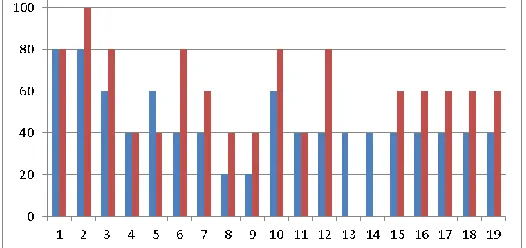
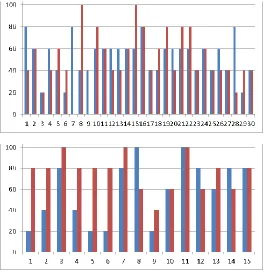
In the pre-test students were faced with 5 multiplication problems that had to be finished within 10 minutes. Then it was continued with the learning process within 70 minutes. The teaching learning process were carried out 4 times within a week, they were on Tuesday, Thursday, Friday, and Saturday (7th, 9th, 10th and 11th of August 2019, at 08.20-09.30).In the last meeting all of the students got post-test, five of them were interviewed on their response to the use of Napier bones in the learning of mathematics. Out of the five students, 2 students represented high achievers, 2 students represented low achievers, and 1 students represented average achievers.Since the research was carried out in August, we add an extra activity, i.e. mathematics quiz contest using Napier bones. Each of the three schools sent a group that consisted of 3 students. The contest was held on Wednesday, 15th August 2018. The 1st position was SDN 3 Pekaja, and the 2nd and the 3rd were SDN 2 and 1 Pekaja.The sample of the study that consisted of only 15-30 students for each class was categorized into small data that the hypothesis testing used t test, paired t-test or the test of means difference for related sample. In that test the data was gained of one sample that is related, which means that two data will be gained from one sample, they were the pre-test and post-test result. The data of the pre-test and post-test that were completed with graph (Figure 2) were presented in the enclosure. Paired t-test fits for research that compares pre and post or comparing means of pretest and means of post-test postes of one sample. Pre and post research describes that respondents knowledge would be measured of their competence before and after the treatment. Then the scores of the respondents before and after the treatment were compared by comparing the means of the pre-test and the post-test. Since there were three classes used in this research, there were three conclusions gained. Then there was an analysis on whether there was improvement of the ability of the students on multiplication using Napier bones.
Meeting 1
Introduction, the distribution of module and Napier bones, pre-test and the learning of multiplication of
unit numbers using Napier bones.
Meeting 2
The learning of multiplication of unit numbers with tens using Napier bones
Meeting 3
The learning of multiplication of tens with unit numbers using Napier bones
Meeting 4
The learning of multiplication of tens with tens using Napier bones, post-test and questionnaire
5241 IJSTR©2020
Fig 2. The pre-test and post-test score of each class (from above: SDN 1, 2, and 3 Pekaja)
3 RESULT
The data analysis were done to each class using statistical instruments such as means, standard deviation, modes, skewness, and kurtosis (Table 1). The measurements were used to determine the normality of the data of the research. As a parametric statistic measurement, paired t-test required that the data were normally distributed.
3.1 Calculation of Pre-test Data Normality of 4th Grade SDN 1 Pekaja
Measurement of data normality was conducted through Kolmogorov-Smirnov test with the null hypothesis of the data following the normal distribution. The calculation used the formula given by Holander and Wolfe [2], page 530 – 531 and 740.
i i
i
X Z P X Y P X F0
(1)
i n imaks M
D
,...., 2 , 1
iF
X
in
i
X
F
n
i
maks
0 01
,
(2)
The pre-test scores results in X1, X2, ..., X19 as shown in Table 2. The data was sequenced in increasing order. From
Table 2 it was found that the pre-test data had μ = 45.26 and σ = 15.68. The result of the calculation using equation (1) and (2) was given on Table 3.
From the Table A.38 page 740 [2], for n = 4, it was gained that
dtabel = 0.493 with α = 0.20 and dtabel= 0.565 with α = 0.10. As a
result, the value of D = 0.3264 result in α > 0.20. It means that under the degree of meaningfulness α = 0.05, H0 was
accepted because 0.20 > 0.05. This means that the data of the pre-test score followed the normal distribution.
3.2 Normality Test of Post-test Score of the 4th Grade SDN 1 Pekaja
The data of post-test scores resulted in X1, X2, ..., X19 as shown in Table 4. Based on Table 2, the data of pre-test had
mean μ = 55.79 and standard deviation σ = 25.61. The calculation using equation (1) and (2) results in Table 3.
From Table A.38 page 740 [2], for n = 5 it was gained dtabel = 0.447 with α = 0.20 and dtabel = 0.509 with α = 0.10. Therefore, the value of D = 0.2289 had α > 0.20. It means that under the meaningfulness α = 0.05, H0 was accepted since 0.20 > 0.05. It means that the data of the post-test score followed the normal distribution.
3.3 The Test of the Impact of using Napier Bones in Improving Student Achievement of the 4th Grade
Student of SDN 1 Pekaja
After the assumption of normality distribution was fulfilled by the two group of data (pre-test and post-test scores), hypothesis testing was conducted. The proposed hypothesis was as follows:
H0 : there is no improvement of students achievements of the 4th grade students of SDN 1 Pekaja before and after the learning process using Napier bones.
H1 : there is improvement of students achievements of the 4th grade students of SDN 1 Pekaja before and after the learning process using Napier bones.
Statistically, the hypothesis of the research above could be formulated as:
H0 :
1
2TABLE 1
THE MEASUREMENTS OF THE POST-TEST SCORE OF
EACH CLASS
TABLE 2
5242
H1 : 1 2 with
scores test -pre of means the : 1 scores test -post of means the : 2
The hypothesis testing was carried out by comparing the means of pre-test and the means of post-test [4] using equation (3): n s d t d count / (3) where test value -post and test value -pre between s difference the of means the : d d sd: thestandar deviation of
samples the of numbers the : n
From the data collected, it was found that the means differences and the standard deviation of the means differences is
53 10 19 200 19 20 20 20 0 21 ... .
n d ... d d
d n
94 24 90 621 18 84 5 200 11 1 19 19 53 10 200 11 1 2 1 2 2 . . . , . , n n d d s n i i id
Using equation (3), it was found that
n s d t d count / . . . . . / . . / . . 84 1 72 5 53 10 36 4 94 24 53 10 19 94 24 53
10
The value of ttabel using the degree of freedom dk = n – 1 = 19 – 1 = 18 and significance level α = 0.05 was ttabel = 1.734. Since tcount = 1.84 > ttabel = 1.734, so H0 was rejected. Therefore, the gained data supported the conclusion that there was an improvement of student achievements after they experienced learning using Napier Bones.
Using the same procedure the following was the summary of the results of the 4th grade of SDN 2 Pekaja, and the 4th grade of SDN 3 Pekaja. The testing included the testing of data normality and hypothesis testing, in relation to whether or not there was an improvement of student achievements. The result of normality testing was summarized on Table 4.
Then, there was a test to determine whether the use of Napier bones improve student achievements or not (Table 5). The test made use of t distribution with equation (3). If the tcount
> ttable, the H0 is rejected, it means that there was an
improvement of student achievement after they learned using Napier Bones.
4 DISCUSSION
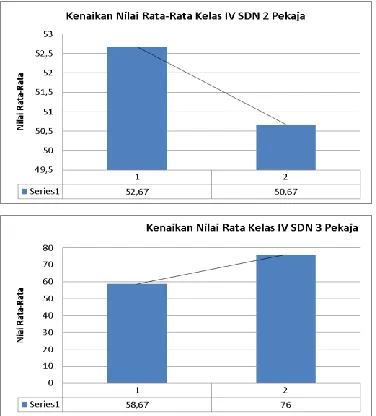
Test of hypothesis of the research that was carried out using paired t test or the test of the difference of related samples. It showed a result that there was an improvement of student achievement after they join learning using Napier Bones. The test was conducted on the degree of significant α = 0.05. The improvement of the achievement occurred to the 4th grade students of SDN 1 and 3 Pekaja. In contrary, the data of the 4th grade students of SDN 2 Pekaja, showed that the students achievements got worse. Figure 3 supported the conclusion above.
TABLE 4
DATA OF POST-TEST SCORE DATA NORMALITY TESTING
OF 4THGRADE STUDENTS OF SDN 1, 2 AND 3 PEKAJA
TABLE 3
THE CALCULATION OF KOLMOGOROV-SMIRNOV TEST
USING THE DATA OF POST-TEST SCORETABLE 5
5243 IJSTR©2020
Fig 3. The Improvement of Means of 4th Grade Students of SDN 1, 2 and 3 Pekaja
The means of the pre-test gained by the three schools consecutively were 45.26, 52.67 and 58.67. The three means did not show big differences that they could be categorized into the same level. This fact guided the researcher to the prediction that there would be an improvement of student achievement after they learned using Napier bones.The increase of the means before and after the treatment occurred to the 4th grade SDN 1 and 3 Pekaja, the increase were 10.53 or 23.27% and 17.33 or 29.54% respectively. Even though the increase of the means was not sharp quantitatively, the statistics showed the improvement of student achievements. Good achievements were shown by the 4th grade students of SDN 3 Pekaja that yielded post-test means score above 75. The result of the 4th grade students of SDN 2 Pekaja showed the opposite fact. Statistically there was no improvement of student achievement, even there was a decrease of means by 2 or 3.80%. The fact was out of expectation since when the teaching learning process was on the 4th grade students of SDN 2 Pekaja were the most enthusiastic. One of the causes was because they were the most in number. Besides, their pre-test means was the higher. Strong prediction on the cause out of expectation result was when the students were doing their post-test they lost their concentration.In collecting qualitative information, questionnaires that consist of 3 questions each were distributed to 5 students of each class.
Relating to the method of using Napier Bones the students said that it was fun to have it in learning mathematics. A most all the respondents said that Napier bones was really helpful in understanding the concept of multiplication. Some of their responses were as follows: “Ya; iya; tulang Napier sangat mudah untuk perkalian; mudah sekali; gampang; ya, menggunakan tulang Napier sangat mudah dimengerti; iya... dengan Tulang Napier itu lebih gampang; lebih mudah menggunakan tulang Napier daripada menggunakan tangan; dan mudah, karena tulang Napier mudah dimengerti” (Yes; yes; Napier bones are very easy to multiply; very easy; easy; yes; using Napier bones is very easy to understand; yes… with Napier Bone it's easier; it's easier to use Napier's bones than to use your hands; and easy, because Napier's bones are easy to understand). But, there was a respondent who said that he did not know.
The research was also completed with the module of learning so that it facilitated the students in understanding the material. All students who were asked to give responses said that the module really helped them in understanding multiplication using Napier bones. The charts provided in the module made them easy to do multiplication problems correctly. Picture 4 showed students work.
Fig 4. Example of Students' Work
There was no problem related to the research site, since the three schools gave their support for this research. The students also kept enthusiastic in joining the whole program that took four sessions. Only a slight problem when conducting the pre-test and post-test since there were four students out of 68 who could not join the test.Relating to the second question, all respondents stated that learning multiplication using Napier bones was easier and more comfortable. Even though, all respondents agree with the statement that the learning was more comfortable and easier. In answering the third question one of the rests of the students said that he found difficulties in using the Napier bones. Finding that contained suggestion was that the teaching learning activity had to be made more varied by adding other activities such as game, puzzle, and quiz of mathematics. This means that people no more viewed mathematics as disastrous subject, it becomes a full of strategy creativity and challenging subject.The good point is that the need of follow up action of this research activity by involving ore parties. However there are improvements that should be done in the implementation of this method. Some suggestions were given to the implementation of the program such as using other equipment like tangram and tusuk sate (satay’s pricker).The instrument of collecting data designed for the research is considered to be sufficient to measure the variables used. To get a more accurate and solid information, in the end of the research interviews were conducted to some of the respondents. Relating to the material that has been given, there was pre-test that was different from the post pre-test, but still in the same level of difficulty. It was to gain information on whether or not there was an improvement of student achievement and student mastery to a certain concept.
5 CONCLUSSION
AND
SUGGERSTION
5244
also able to foster students' motivation in learning mathematics that it can be followed up and implemented in schools.Suggestions that can be given is that this program can be used as an extra-curricular program of mathematics. This suggestion was based on some certain considerations (1) using Napier bones is not officially included in the curriculum of mathematics, (2) the questions tested in school examinations and national examination never be related to matter on using Napier bones, (3) the process of multiplication using Napier bones spent much time, and (4) mathematics teaching tends to focus on formal mathematics that support to abstracting and idealising.
REFERENCES
[1] Z. Amir, “Mengungkap Seni Bermatematika dalam Pembelajaran,”Suska Journal of Mathematics Education, vol. 1, no. 1, pp. 60-76, 2015.
[2] M. Holander and D. A. Wolfe, Nonparametric Statistical Methods. New York: John Wiley & Sons Inc, pp. 530–531 and 740, 1999.
[3] Y. S. Kusumah, “Pembelajaran Matematika Rekreasional Melalui Eksplorasi, Penemuan, Permainan dan Hands-on Activity dalam Meningkatkan Kemampuan Matematis Siswa,” Keynote Speakers on Seminar Nasional Matematika, Universitas Muhammadiyyah Jakarta, pp. 1-15, 2015.
[4] H. Riwidikdo, Statistik Kesehatan. Yogyakarta: Penerbit Mitra Cendekia Press, pp. 35-36, 2017.
[5] T. Yuriana and Suwardi, “The use of Napier Bones Props to Enhance Learning Ahievement on Grade 5 Math Multiplication,” Madurrisa Jurnal Kajian Pendidikan Islam, vol. 10, no. 2, pp. 188-205, 2018.
[6] M. H. Firdaus and s. Andayani, “Adapting the Concept of Napier’s Bones to Teach Multiplication for Elementary Students,” Proc. International Seminar and The Fourth National Conference on Mathematics Education, pp. 1-7, 2011.
[7] L. K. Ng, “Mathematics Anxiety in Secondary School,”
Proc. of the 35th Annual Conference of the Mathematics Education Research Group of Australasia, pp. 570-577, 2012.
[8] A. Shishigu, “Mathematics Anxiety and Prevention
Strategy: An Attemp to Support Students and Strengthen Mathematics Education,” Mathematics Education Trends and Research, vol. 2018, No. 1, pp1-11, 2018.
[9] G. B. Guita and D. A. Tan, “Mathematics Anxiety and Students’ Academic Achievement in a Reciprocal Learning Environment,” International Journal of English and Education, Vol. 7. Issu3 3, pp. 112-124, July 2018.