Archives • 2014 • vol.3 • 216
-
221
COMPARATIVE PHYTOCHEMICAL ANALYSIS OF MORINGA OLEIFERA
AND MORINGA PEREGRINA
Shaikha Awad Al Ameri, Fatima Yaaqoub Al Shaibani, Abdul Jaleel Cheruth*, Adil Ismail Al-Awad, Mohammed A. Salem Al-Yafei, Kandhan Karthishwaran, Shyam S. Kurup
Department of Aridland Agriculture, College of Food and Agriculture, United Arab Emirates University, United Arab Emirates
Abstract
Moringa peregrina and Moringa oleifera are used in folk medicine and grows widely in the tropical and
subtropical regions of Africa and India. The objectives of this investigation were to determine the phytochemical composition and nutritive contents of Moringa peregrina and Moringa oleifera extracts from the leaves and fruits. The powdered plant samples were examined separately for their phytochemical constituents like total phenol content, micro and macro elements using appropriate methods. They were also subjected to proximate analysis such as ash content, dry matter and crude protein. All the elements content were determined by using ICP AES. According to the nutritional values obtained, the phytochemical and proximate analysis results showed the high percentage in M. oleifera. There was no significant difference in dry matter content between two species. The ash content, total phenol content, protein, macro elements (Ca, K, Mg, Na, P) and micro elements (Cu, Co, Fe, Mn, Zn) were higher in M. oleifera when compared to M. peregrina. The extracts from both plants showed the presence of active phytochemicals may provide substantial basis for the use of these plants in ethaomedicine. Their nutritional properties in different parts may provide incentive for proper evaluation of these plants as dietary food as well as medicinal agents essential for human health. Further studies are required to ascertain this conclusion, which are underway in our lab.
Keywords: Phytochemicals, Moringa peregrina, Moringa oleifera, proximate analysis
_______________________________________ http://pharmacologyonline.silae.it
Introduction
Throughout the world, plants have been a rich source of nutrients and antioxidants as they contain lot of bioactive molecules and compounds. Out of the bioactive molecules, most of them are as produced as chemical defense against stresses or infections. Native plants usage in traditional as well as modern medicine is gaining a lot of attention now a days, and the recent studies showed that a number of plant products and herb extracts exert potent antioxidant actions (1). Moringa species are one of the most useful trees in the tropics and subtropics of Asia and Africa, with multiple uses.
Moringa peregrina is native to the region extending
from the DeadSea to Southern Arabia and northern Somalia (2). In the past, M. peregrina was both an indigenous and a cultivated tree in Sudan (3). M.
peregrina leave is an excellent source of protein,
minerals and essential amino acids (4). These species are the most widely cultivated of the Moringaceae family and was utilized by the ancient Egyptians, southern Arabia and northern Somalia.
M. Oleifera and M. peregrina are the best known
and utilized species (5). Traditionally, almost all parts of Moringa flower, fruits and roots are edible, and have long been consumed as vegetable and used to treat many diseases such as abdominal tumors, hysteria, scurvy, paralytic attacks, helminthic bladder, prostate troubles, sores and skin infections (6).
Drumstick (Moringa oleifera, Family: Moringaceae) is a native Indian medicinal plant that grows widely in the tropics and subtropics of Asia and Africa. M.
oleifera was used as a nutritional supplement and
remained popular among the lower socio-economic class (7). It has been reported as the significant sources of vitamins (A, B, C, E, riboflavin, nicotinic acid, folic acid, pyridoxine, ascorbic acid, and beta carotene), iron, calcium and alpha tocopherol (8).
M. oleifera has been investigated for its fast growth,
high nutritional attributes, and utilization as a livestock fodder crop. It can be grown as a crop on marginal lands with high temperatures and low water availability, where cultivation of other agricultural crops is difficult (9). The leaves are highly nutritious, which contain more vitamin A than carrots, more calcium than milk, more iron than spinach, more vitamin C than oranges and more potassium than bananas and more protein than milk and eggs (10). The leaves of M. oleifera extract also exhibited strong anticancer potential (10). The hydro-ethanolic extract of M. oleifera
leaves prophylactically and therapeutically protects against acetaminopheninduced hepatotoxicity in experimental rats through their antioxidant nature (11).
Many native fruits and Vegetables are the cheapest and most available sources of important nutrients, supplying the body with minerals salts, vitamins and certain hormone precursors, protein, energy and essential amino acids (12). Hence, proximate and nutrient analysis of wild edible plants plays a crucial role in assessing their nutritional significance (13). Until now a full depiction of the extract the leaves and fruit of M. peregrine has not been reported. Moreover, the use of different methods of phytochemical and proximate analysis has not been studied. Hence in this study we aimed to compare the phytochemical and proximate composition of M.
peregrina with cultivated species of M. oleifera plant
parts.
Materials and Methods Plant Material
The fully matured fruits and leaves of Moringa
peregrina and Moringa oleifera samples were
collected from Al-Foah Experimental Station of College of Food and Agriculture, UAEU. The plants were identified and authenticated at UAEU. The fresh plant leaves were washed thoroughly and carefully with distilled water and air dried for 7 days.
Preparation of extracts
The parts of plants were dried in the shade and powdered so that all the material could passed through a mesh not larger than 0.5 mm. The powdered materials of each plant species (1000 g) were soaked in 3L of methanol (Sigma-Aldrich, USA) for 1 day, and the steps were repeated twice, followed by Soxhlet extraction by using methanol for 72 hrs. At the end of extraction, it was passed through Whatman filter paper No.1 (Whatman Ltd., England). The extract was concentrated to dryness under vacuum on rotary evaporator at 40°C then
stored at 4°C for further use (1).
Total Phenol
Quantification of total phenolic content in ethanolic plant extract was carried out according to the method of Slinkard & Singleton (14) with slight modification (14a). The ethanolic plant extract powder will be dissolved in 25% ethanol (v/v) to obtain concentration of 0.5% (w/v). The solution (0.5 _______________________________________
mL) was added to 100 µL of Folin–Ciocalteu reagent (two-fold diluted with de-ionized water) and mixed thoroughly. After 3 min, 1.5 mL of 2% sodium carbonate solution was added. The reaction mixture was mixed thoroughly and placed in the dark for 40 min and the absorbance was read at 760 nm. The total phenolic content was calculated from the standard curve of tannic acid (0–0.1 mg/mL) and expressed as mg tannic acid per gram of dry ethanolic plant extract after blank substraction. Blank was prepared in the same manner, except that distilled water was used instead of Folin– Ciocalteu reagent.
Dry matter
This was determined by the standard methods of the Association of Official Analytical Chemists (15). 1g of sample was weighed into a clean dried porcelain evaporating dish. This was placed on an oven and the temperature maintained at 105°C for
6 hrs. The evaporating dish was cooled in a desiccator to room temperature then reweighed and recorded. Weight of moisture was calculated by subtracting the weight of dried sample from the fresh as follows:
%dry matter = fresh weight-dried weight/weight of fresh sample x 100/1
Ash content
The percentage composition of ash was estimated by the furnace method. 20g of the sample was weighed into a preheated and weighed porcelain crucible. The crucible was inserted into a furnace and regulated to a temperature of 630°C and
heated for 3hrs. The set up was then allowed to cool to room temperature and weighed again. Percentage composition of ash was then obtained as follows:
%Ash = (weight of crucible + ash –weight of crucible)/weight of sample x100/1
Protein
Total nitrogen contents of samples was determined using an Elemental Analyzer (Vario MICRO Cube, Elementar Analysensysteme GmbH, Donaustraße, Germany), by mean of ignition of 50 mg samples. Sulfanilamide, the manufacturer recommended calibration standard, was run to compute the daily factor. The amount of Crude protein was estimated by multiplying the sample.
percent nitrogen content by a factor 6.25
%Protein = % Nitrogen × 6.25
Microelements and Macroelements
Samples were prepared accurately by weighing 0.5 grams of sample into the microwave digestion vessels and 10 ml of concentrated nitric acid (HNO3) and 2 ml hydrochloric acid (HCL) were added (Method 3015A, US Environmental Protection Agency, 2008). The vessels were capped and place in the microwave digestion system. The analysis was conducted using ICP-OES - Agilent Technologies, 710.
Results and Discussion
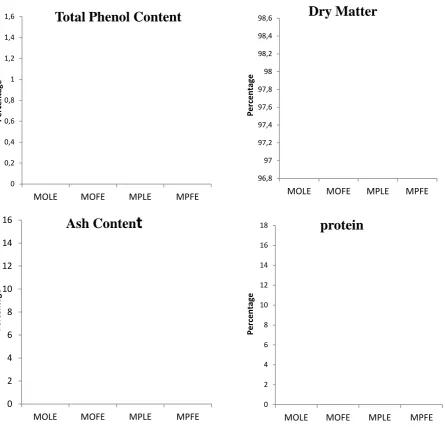
As shown in Figure 1 the amount of total phenol is higher in M. oleifera fruit extract (MOFE) and is 1.474 when compared to M. Oleifera leaf extract (MOLE),
M. peregrina fruit extract (MPFE) and M. peregrina
leaf extract (MPLE). The dry matter seems to be approximately equal. The proximate analysis showed the dry content of MOLE to be 98.275 and 97.46 in MOLF and more when compared to MPLE content 98.4 and 97.76 in MPFE. The results of physico-chemical analysis of plant ash are given in Figure 1. The Ash content is higher in leaf rather than fruit in both samples. Percentage of loss on drying was highest in MOLE followed by MPLE, MOFE and MPFE. All the samples were found alkaline in pH. Ash content is generally taken to be a measure of the mineral content of the original food (16). Natural food products should have a general ash content of about 5% while processed food can have ash content ranging over 10%. This study shows that Moringa species have acceptable levels of ash content as natural food products. According to A.O.A.C (15), mineral contents are usually needed in small proportions. This is because high ash content signifies low food quality while low ash content signifies high food quality.
The protein content in M. oleifera was higher than
M. peregrina. The crude protein of MOLE was 13.69
and MOFE 16.88 respectively with MPLE content of 8.22 and MPFE of 12.07. The high level protein content M. oleifera is a further confirmation of its use as vegetable. Protein which would serve as enzymatic catalyst, mediate cell responses, control growth and cell differentiation (17). For most of the studies the protein content are considered as the main determinants of food type and less is known about elemental composition of various wild edible species (18). The recommended dietary allowance (RDA) for protein is 56g for individual weighing 70kg _______________________________________
and 46g for adult weighing 50kg, children may consume 2kg/day (19).
The micronutrient and macronutrients analysis of the Moringa species showed variation among different elements. As shown in table 1, the content of microelements in both species and nutritional significance of elements were high when compared with the standard recommended dietary allowance. According to the nutritional value obtained the presence of macro elements (Ca, K, Mg, Na, P) and micro elements (Cu, Co, Fe, Mn, Zn) in MPFE, MPLE shows higher amount when compared to MPFE and MPLE. Especially in M. oleifera reveals the Ca, Co is higher in leaves and K, Cu is higher in fruit. Copper is a very powerful pro-oxidant and catalyzes the oxidation of unsaturated fats and oils as well as ascorbic acid. The copper content of MOLE is 4.441 and 5.695 in MOFE which is higher than 2.040 and 3.288 respectively for MPLE and MPFE. The zinc content of MOLE was 26.65 and 19.20 mg/kg in MOFE. The Recommended Dietary Allowance (RDA) for zinc is 13mg/kg.
Increased contents of flavonoids may help in providing oxidative stress protection by contributing along with other antioxidant vitamins, and enzyme to the total antioxidative defense system of the human body. Many studies have attributed that antioxidant properties are due to the presence of flavonoids (20). Moisture content determination is one of the most fundamental and important analytical procedure. According to Yisa et al. (21) high moisture content increases perishability as the fruits are more susceptible to microbial infections. This result indicated low shelf life of the fresh plant hence extended storage would lead to spoilage due to susceptibility to microbial attack. This supports the practice of storage in dry form by users. Moisture content is among the most vital and mostly used measurement in the processing, preservation and storage of food (16).
Sodium and potassium are important intracellular and extracellular cations respectively. Sodium is involved in the regulation of plasma volume, acid-base balance, nerve and muscle contraction (22). Zinc is required for the proper functioning of the reproductive system was found to be present in the high amount in M. oleifera when compare to M.
peregrine (23). Low sodium diet has been reported
to be beneficial in the prevention of high blood pressure and high potassium has been reported to have a protective effect against excessive sodium intake (24). Calcium is good for growth and maintenance of bones, teeth and muscles (25).
Copper is a very powerful pro-oxidant and catalyzes the oxidation of unsaturated fats and oils as well as ascorbic acid. The content of copper was very high in
Moringa species. Copper is very vital in diet because
it is involved in the proper usage of iron (Fe) and especially for the synthesis of cytochrome oxidase, which contains both iron (Fe) and copper (Cu). Excess copper can lead to jaundice (Wilson’s disease) (26). Zinc is essential in the activation of certain enzymes. These include dehydrogenase, alkaline phosphatase and carboxypeptidase. Zinc containing organic compounds is employed as astringent and anti-fungal agents. It aids wound healing and metabolism of nucleic acid and insulin. Zinc in excess causes anemia and if deficient in the body can lead to dermatitis.
The iron content of MOLE was 483.58 and 211.51 mg/kg in MPLE. According to Bolt et al. (27), the recommended daily requirement of iron for man is 6 – 40mg/kg. Iron is very important in the formation of haemoglobin in red blood cells and deficiency of iron leads to anaemia.
Energy and nutrient values of medicinal plant samples are mainly used to translate medicinal samples intakes as intakes of food components. Thus, the use of Moringa species leaves and fruits in our diet could help boasting in blood level especially in anemic conditions (28).
Phytochemical properties are the high levels of phenolic compounds found in plants, as antioxidants which are considered to be beneficial to human health. Our findings showed that leaves of Moringa species are very rich in nutrients and chemical substances which offer great potential for food and pharmaceutical companies. This study proved the edible wild plants as rich sources of dietary supplements and they contain essential nutrients like protein, mineral, moisture and ash needed by the human body (and animals) for proper growth and maintenance. Because it is frequently prescribed by non-professionals and taken concomitantly with conventional medicine, it poses a potential risk for herb drug interactions.The result highlighted significance of wild edible plant as a cheap source of nutrient for the rural poor.
Nutritional values of wild plant foods are of considerable significance, as they help to pinpoint traditional food resources of tribals. Due to lack of awareness and negative approach towards the wild food plants, it is important to create community awareness to accept wild food plants as useful as the cultivated ones. It may be concluded that promotion _______________________________________
of consumption and processing of these plant species, to various products, may help to improve the diet and alleviate nutrient deficiencies. Its conservation is therefore very important for further studies on its medicinal and other benefits. Lastly, more information on the phytochemical analysis of the plants with medicinal importance to determine their relevance as raw materials for drug manufacture should be made. In addition, further studies are needed to determine, isolate and characterize the structure of the bioactive compounds from the leaves and fruit of Moringa species which are underway in our lab.
Author Contributions: SAA & FYS conducted the experiment as part of their Senior Project under the supervision of AJC at College of Food and Agriculture, UAEU. AIA assisted in lab works. KK assisted in preparation of manuscript. MASY & SSK assisted in overall planning of experiment and manuscript review.
References
1. Karthishwaran K, Mirunalini S. Assessment of the antioxidant potential of Pergularia daemia (Forsk.) extract in vitro and in vivo experiments on hamster buccal pouch carcinogenesis. Asian Pacific Journal of Tropical Disease 2012; 2(1): S509–S516.
2. Dehshahri S, Wink M, Afsharypuor S, Asghari G, Mohagheghzadeh A. Antioxidant activity of methanolic leaf extract of Moringa peregrina (Forssk.) Fiori. Research in pharmaceutical sciences 2012;7(2):111.
3. Jahn SA, Musnad HA, Heinz B. The tree that purifies water: cultivating multipurpose Moringaceae in the Sudan. Unasylva 1986;38:23-28.
4. Osman HE, Abohassan AA. Morphological and analytical characterization of Moringa peregrina population in Western Saudi Arabia. Int. J. Theor. Appl. Sci. 2012;4:174-184.
5. Lalas S, Gortzi O, Athanasiadis V, Tasknis J, Chinoil I. Determination of antimicrobial activity and resistance to oxidation of Moringa peregrina seed oil. Molecules 2012;17: 2330–2334.
6. Rahman IM, Barua S, Begum ZN, Rahman AM, Hasegawa H. Physicochemical properties of Moringa oleifera Lam. Seed oil of the indigenous cultivar. Journal Food Lipids 2009;16:540–553.
7. Mbikay M. Therapeutic potential of Moringa oleifera leaves in chronic hyperglycemia and dyslipidemia: a review. Frontiers in Pharmacology 2012;3:1-12.
8. Melo V, Vargas N, Quirino T, Calvo CMC. Moringa oleifera L.–An underutilized tree with macronutrients for human health. Emir. J. Food Agric. 2013;25(10):785-789.
9. Nouman W, Basra SMA, Siddiqui MT, Yasmeen A, Gull T, Alcayde MACA. Potential of Moringa oleifera L. as livestock fodder crop: a review. Turk. J. Agric. For. 2014;38:1–14.
10. Sreelatha S, Jeyachitra A, Padma PR. Antiproliferation and induction of apoptosis by Moringa oleifera leaf extract on human cancer cells. Food Chemistry and Toxicology 2011;49(6):1270-1275.
Mohd MM, Arulselvan P. Therapeutic potential of Moringa
oleifera extracts against acetaminophen-induced hepatotoxicity in rats. Pharm Biol 2013;51(3):279–88. 12. Amaechi NC. Nutritive and anti-nutritive evaluation of
wonderful kola (Buccholzia coricea) seeds. Pak. J. Nutr. 2009;8:1120-1122.
13. Pandey M, Abidi AB, Singh S, Singh, RP. J Human Eco. 2006;19(2):155-156.
14. Slinkard KW, Singleton VL. Phenol content oil grape skins and the loss of ability to make anthocyanins by mutation. Vitis 1984; 23:175-178.
14a. Maqsood S, Benjakul S. Effect of kiam (Cotylelobium
lanceolatum Craib) wood extract on the
haemoglobin-mediated lipid oxidation of washed asian sea bass mince. Food and Bioprocess Technology, 2013; 6(1): 61-72. 15. A.O.A.C. Official Methods of Analysis, Association of
Analytical Chemists. 15th ed., Washington D. C. USA. 1990;1121-1180.
16. Onwuka GI. Food Analysis and Instrumentation; Theory and Practice. Naphthalic prints, Surulere, Lagos, Nigeria. 2005;219- 230.
17. Whimey EN, Rolfes SR. Understanding Nutrition, 10th Edn. Thomson/Wadsworth Publishing Company, Belmont, C.A. 2005;pp:132-137.
18. Anonymous. Council of Scientific and Industrial Research. 1970-1988:1-12.
19. Jones MM, Johnson DO, Netlerville JT, Wood JI, Joesten MD. Chemistry and Society.5th ed., Saunders College Publishers USA, 1985:521- 577.
20. Harborne JB, Williams CA. Advances in flavonoid research since 1992. Phytochemistry 2000;55:481- 504.
21. Yisa J, Egila JN, Darlinton AO. Chemical Composition of
Annona senegalensis from Nupe land, Nigeria. African J of
Biotech. 2010;9(26):4106-4109.
22. Akpanyung EO. Proximate and mineral composition of bouillon cubes produced in Nigeria. Pakistan Journal of Nutrition 2005;4(5):327-329.
23. Hambidge M. Human zinc deficiency. Journal of Nutrtion 2006;130:1344S-1349S.
24. Lichtenstein AH, Appel LJ, Brands M. Carnethon M, Daniels S, Franch HA, Franklin B, Kris-Etherton P, Harris WS, Howard B, Karanja N, Lefevre M, Rudel L, Sacks F, Van Horn L, Winston M, Wylie-Rosett J. Summary of American heart association diet and lifestyle recommendations revision. Arteriosclerosis, Thrombosis and Vascular Biology 2006;26:2186-2191.
25. Turan M, Kordis S, Zeyin H, Dursan A, Sezen Y. Macro and micro minerals content in some wild edible leaves consumed in eastern Anatolia. Tailors and Francis 2003;pp: 129-130.
26. Stoker SH. Environmental Chemistry: air and water pollution. 2nd ed., Wiley Interscience Publishers, USA 1976;2- 29.
27. Bolt GH, Bruggenwert WG. Solid Chemistry, basic elements. Elsevier Scientific Publishing Co., New York. . 1978;145. 28. Brahma J, Singh B, Prethy, Gajurel P. Nutritional analysis of
some selected wild edible species consumed by the bodos tribes of Kokrajhar district, BTC, ASSAM. Asian J Pharm Clin Res 2014;7(3):34-37.
29. Sample digestion methods, 2008 Sample digestion methods: Microwave assisted digestion of aqueous samples and extracts (Method 3015A), 2008. EPA Test Methods On-line (SW-846). www.epa.gov/epawaste/hazard/testmeth-ods/sw846/pdfs/ 3015a.pdf
_______________________________________ http://pharmacologyonline.silae.it
0 0,2 0,4 0,6 0,8 1 1,2 1,4 1,6
MOLE MOFE MPLE MPFE
Pe
rc
en
ta
ge
Total Phenol Content
96,8 97 97,2 97,4 97,6 97,8 98 98,2 98,4 98,6
MOLE MOFE MPLE MPFE
Pe
rc
en
ta
ge
Dry Matter
0 2 4 6 8 10 12 14 16
MOLE MOFE MPLE MPFE
Pe
rc
en
ta
ge
Ash Conten
t
0 2 4 6 8 10 12 14 16 18
MOLE MOFE MPLE MPFE
Pe
rc
en
ta
ge
protein
Figure 1. Pytochemical and Proximate composition of Moringa species. MOFE- M. oleifera fruit extract, MOLE - M. Oleifera leaf extract, MPFE - M. peregrina fruit extract MPLE - M. peregrina leaf extract.
Sample ID Macroelements (%) mg/Kg (ppm) Ca K Mg Na S P Microelements (%) mg/Kg (ppm) Cu Co Fe Mn Zn
MOLE 3.341 0.955 0.762 0.273 0.452 0.208 4.441 0.684 483.58 53.79 26.65
MOFE 0.283 2.047 0.263 0.052 0.723 0.390 5.695 <0.003 77.13 12.44 19.20
MPLE 1.640 0.809 1.193 0.463 1.119 0.231 2.040 <0.003 211.51 25.00 11.74
MPFE 0.296 1.520 0.303 0.067 0.694 0.254 3.288 <0.003 58.02 8.68 18.25