(Received 10 January 2019/Accepted 8 April 2019)
Doppler-broadening of the Hαemission spectra from hydrogen reflected at surfaces of palladium and tung-sten sheet metal surfaces held at clamp holders were presented in this study. The reflected hydrogen atoms were observed with velocity components produced by the back scatterings of H+3, H+2 and H+ion incident regions. Pal-ladium exhibited higher spectrum emission intensities than tungsten for both clamp structures. Modification of the clamp structure should produce cooler surface condition due to direct contact of metal surface to the substrate holder thus having H atoms adsorbed more on the palladium sheet.
c
2019 The Japan Society of Plasma Science and Nuclear Fusion Research
Keywords: hydrogen reflection, Doppler-broadening mechanism, palladium, tungsten DOI: 10.1585/pfr.14.3401098
1. Introduction
Hydrogen plasma interaction on metal wall surfaces causes surface permeation or erosion and plasma impu-rity emission in which investigating and analyzing these phenomena are significant in the advancement of fusion research and device development. The phenomena must be studied before fusion devices will be put into opera-tion with the long life-time. It is consequently of interest to examine and understand the underlying mechanisms of hydrogen isotope permeation and particle release during plasma-surface interactions [1, 2]. Permeation of hydro-gen through metallic materials like palladium is of vital concern to control transport and mass separation of hydro-gen isotopes in the system. Palladium (Pd), in compari-son to tungsten (W), has a strong absorbance of hydrogen molecules and can show unique behavior in a hydrogen plasma environment due to the nature of rapid hydrogen isotope transport [3]. Thus, a comparative study in hydro-gen reflection between Pd and W has been made using a small plasma exposure device [4].
The material temperature is an important parameter that determines the hydrogen transport in the bulk media, while it also affects the amount of hydrogen atoms ad-sorbed on the surface. Thus, the impact due to the target surface cooling for palladium and tungsten during plasma exposure in a magnetized hydrogen plasma is presented in this paper. With two different target design structures, the data on velocity distribution functions of hydrogen atoms reflected at metal surfaces will be discussed.
author’s e-mail: [email protected]
∗)This article is based on the presentation at the 27th International Toki Conference (ITC27) & the 13th Asia Pacific Plasma Theory Conference (APPTC2018).
2. Experimental Methods
The plasma bombardment experimental device setup is shown in Fig. 1. This apparatus irradiated palladium (Pd) and tungsten (W) metal sheets by a linear magnetized hy-drogen plasma. These metal materials are 0.1 mm thick, 24 mm wide and 25 mm long in size. An 18.7 mT mag-netic field is produced by three pancake coils. Each coil current input is 5 A and connected in parallel around the device to create linear magnetic-force lines that extended the electrons from the tungsten filament cathode to the tar-get substrate holder. The embedded circuit diagram for the filament region indicates two DC power supplies, in series connection, are used to extract electrons from the filament and generate the hydrogen gas discharge. Both power sup-plies are maintained with discharge current ofI2 =1.0 A and 70 V for bothV1andV2for applied potentials. Hydro-gen gas pressure is set at 1.2 Pa. These conditions Hydro-generate a hydrogen cylindrical-shaped magnetized plasma with a diameter isΦ=15 mm. A viewing port of BK7 (borosoli-cate glass) is fitted with an ICF70 flange for the alignment of the substrate holder and hydrogen reflection measure-ment.
The floating potential, Vf, was approximately−8 V
Fig. 1 Hydrogen bombardment device with embedded circuit diagram for the filament discharge region.
c
2019 The Japan Society of Plasma
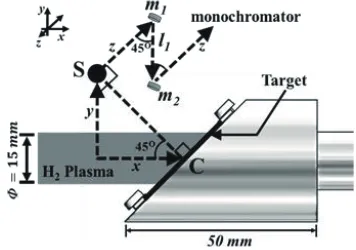
Fig. 2 Plasma diagnostic observation area from the metal sheet.
and−12 V with respect to the chamber wall that was fixed at the anode potential for Pd and W, respectively. Negative bias voltages were applied to the substrate holder starting from−100 V at an increment of−100 V to−600 V max-imum through a DC power supply. The −600 V is the maximum limit for the current device configuration. The molecular and atomic spectra at the vicinity of the bom-barded metal sheets of Pd and W were observed through a 0.23Å wavelength resolution Czerny-turner monochro-mator. The wavelength used for Hα observation was set around 656.28 nm to monitor the atomic emissions. A continuously cooled CCD detector, S7034-1007S of Hamamatsu Photonics, with 60 seconds integration time recorded the output spectra.
Figure 2 illustrates the observation area for the plasma diagnostic for the hydrogen emission spectra. Ions in the hydrogen plasma, bombarded the center of the metal sheet target positioned at a 45-degree angle. The locationCis denoted as the center of the metal substrate holder. This center is aligned with the epicenter of the view port through a guide laser. The substrate target holder position is ad-justed in thex-axis right direction through the manipula-tor by 9 mm from the center,C. The spotS, indicated by a filled circle, is the observation of interest to detect and investigate the Doppler-broadening due to the velocity dis-tribution of hydrogen reflection at the tungsten and palla-dium metal sheets. By setting the line of sight outside of the plasma column, all lines emissions from molecules di-rectly excited by plasma electrons are excluded in the spec-trum [4]. The first mirror, m1, is perpendicular through thez-axis of the spot. It is moveable at they-axis direc-tion wherel1 = 9 mm. A second mirror, m2, is placed below and not moveable. Bothm1 andm2 are angled at 45 degrees. The light from the plasma is guided to the monochromator through m1 and m2 mirrors outside the chamber. The adjustments on the manipulator and posi-tioning of m1 are made to observe the emission spectra outside the plasma boundary. This mirror is set to ob-serve perpendicularly the area of interest. TheS region is perpendicular from the metal surface and approximately 12.7 mm in measurement.
An endpoint fixture structure and a ring clamp
struc-Fig. 3 (a) Endpoint and (b) Modified Clamp.
ture were utilized to hold the metal sheet target in position of the water-cooled target holder (Fig. 3 (a) and Fig. 3 (b)). In the endpoint fixture structure or the endpoint clamp, small rectangular stainless-steel washers press the metal target to the water-cooled body by the screws. The second structure of modified clamp press the peripheral part of the metal target evenly with the ring fixture to realize a better heat transfer from the thin metal target to the surface of the water-cooled target holder (Fig. 3 (b)). A continuous water flow at the backside of the holder was maintained to avoid excessive heating of the target, as temperature exceeded 1100 K during a hydrogen plasma bombardment onto the target maintained with the structure of Fig. 3 (a) [5]. Mean-while, the surface temperature of the target mounted by the modified clamp cannot be evaluated as the tempera-ture was below 800 K, which was the detection limit for the infrared radiation thermometer. Effect on the Doppler-broadening of the hydrogen plasma on tungsten and pal-ladium sheet metal targets are investigated between these two target holder structures.
3. Experimental Results
(a)
(b)
Fig. 4 Doppler-broadening spectrum, in (a) linear and (b) semi-logarithmic scale, of the magnetized hydrogen plasma on palladium target under an endpoint clamp. The spectrum broadens with increasing negative bias voltages.
potential up to−600 V, the spectrum displays enlarged red and blue wings corresponding to the incident kinetic ener-gies of hydrogen ions. In addition, the ion species reflected are H+, H+2, and H+3 can be observed (Fig. 4 (a)). How-ever, to exhibit a clearer view of the reflected ions, a semi-logarithmic graph is displayed (Fig. 4 (b)). Ion species present in the plasma are H+, H+2, and H+3 with the frac-tion composifrac-tion changed due to particle recycling process at the target surface.
The regions of the incident ions can be separated into three according to the general equation of wavelength shift,
Δλ, calculated by the following equation.
Δλ=λα
c
2eEb
M . (1)
0.74 nm. The cut-offenergies of atoms formed by the re-flections of H+2 ions, and those of H+3 ions determine the wavelength range from 0.43 nm to 0.52 nm as the part con-stituted by reflections of H+and H+2. The dissociative exci-tation of the background H2molecules produce light emis-sion forming the sharp central peak withΔλ <0.5 nm.
Figure 4 (b) shows the wavelength spectrum of light emissions from hydrogen atoms H+, H+2, and H+3 reflec-tions at Pd surface for the corresponding wavelength range. Intensities are normalized at the central peak. At the high-est bias voltage of−600 V, the Doppler-broadening shoul-der extended outward up to 0.7 nm, close to the value cor-responding to 600 eV kinetic energy proton, due to excita-tion collisions with hydrogen molecules.
Figures 5 (a) and (b) exhibits the palladium’s hydro-gen emission spectrum taken with the modified clamp at normalized intensity shown in linear and semi-logarithmic scale, respectively. From floating potential to−600 V bias voltage, a widening of spectrum is seen due to promi-nent presence of H2 molecules dissociative excitation at increasing negative bias voltage (Fig. 5 (a)). The blue and red wing regions of the palladium target using the modified clamp demonstrates minute difference.
From equation 1, velocity distribution regions of H+3, H+2, and H+are seen in Fig. 5 (b). Similar cut-offenergies atEb =−600 V and expansion of the Doppler-broadening
shoulder up toΔλ=0.7 nm is present.
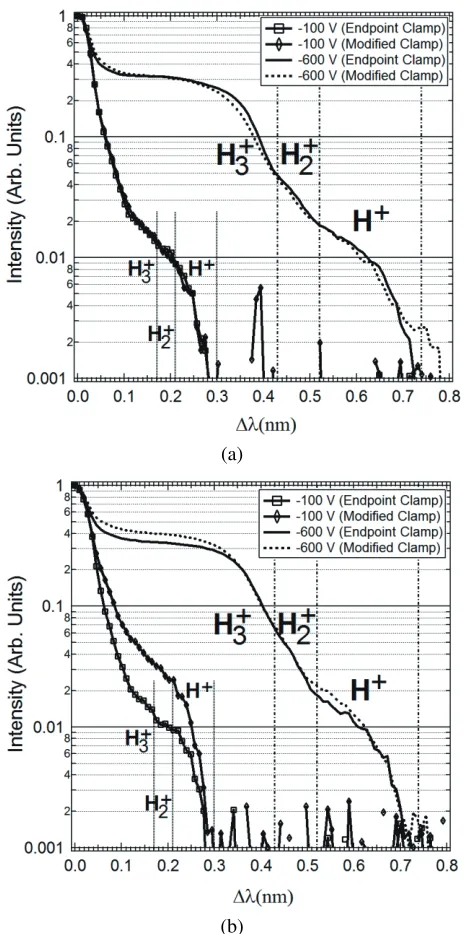
Hydrogen ion reflection from tungsten and palla-dium metal sheets with both manifold clamps are seen in Figs. 6 (a) and (b). Velocity distributions of the ion reflec-tion is separated by bias voltages of Eb = −100 V and
Eb = −600 V. From Eq. 1, at Eb = −100 V, the
wave-length shift for H+3, H+2, and H+ are |Δλ| ≤ 0.17 nm, 0.17 nm≤ |Δλ| ≤ 0.21 nm, and|Δλ| ≥ 0.30 nm, respec-tively. On using either the endpoint or modified clamp, there is no remarkable change on the velocity distributions H+2 and H+ regions on tungsten surface. There is mini-mal change to no significant change in the H+3 region for
Eb =−600 V andEb =−100 V, respectively, on tungsten
surface when using either of the two clamps.
On the other hand, Fig. 6 (b) displays the comparison of the effect of both endpoint and modified clamps on the hydrogen reflection on the surface of the palladium metal sheet with bias voltagesEb =−100 V andEb =−600 V.
AtEb =−100 V, there is a prominent gap region wherein
there is an observed lower emission spectrum on the end-point clamp region relative to the modified clamp. Palla-dium with bias voltageEb=−600 V also exhibited higher
(a)
(b)
Fig. 5 Doppler-broadening spectrum, in (a) linear and (b) semi-logarithmic scale, of the magnetized hydrogen plasma on palladium target under the modified clamp. The spectrum broadens with increasing negative bias voltages.
reflection distribution when endpoint clamp was used. Pal-ladium show some enhanced signal on the H+and H+3 in-cident ion region when using a modified clamp. Modified clamp’s impact on the emission spectra for palladium may indicate that the surface temperature on the metal sheets during bombardment also changed due to the full periph-eral clamping of the second manifold. Placing a modified clamp, instead of an endpoint clamp, over the palladium metal created a direct contact with the surface backside cooling water. On the other hand, the endpoint clamp, were there is less cooling contact of the metal target, may cre-ate a mechanism where there are more adsorb molecules on the surface which may result to lesser hydrogen proton reflection. When using the infrared radiation thermometer,
(a)
(b)
Fig. 6 Doppler-broadening spectrum (a) Tungsten and (b) Pal-ladium in both endpoint and modified clamp. The spec-tral graph of−100 V and 600 V negative bias voltage are compared with each other using both clamps.
temperature was not completely detected for the modified clamp due to the 800 K detection limit for the infrared ra-diation thermometer.
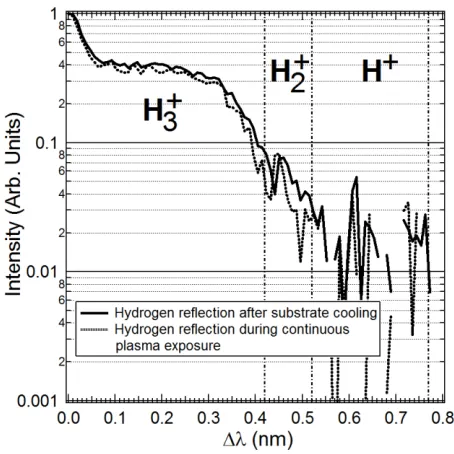
Fig. 7 Hydrogen reflection on palladium after substrate cool-ing and exposure to continuous plasma under modified clamp.
condition of the metal surface target.
4. Conclusions
The endpoint and modified clamp effect on the hydro-gen reflection mechanism for both tungsten and palladium were discussed. Reflection characteristics were
recogniz-This phenomenon was observed at different bias voltages also.
Meanwhile, hydrogen velocity distributions for palla-dium surface showed a difference between emission spec-trum for both manifolds. Modified clamp provided higher velocity distributions relative to the endpoint clamp at dif-ferent bias voltages. It is suggested that better cooling was present through direct contact of the metal substrate on the substrate holder. This mechanism may provide less adsorbed hydrogen molecules and have higher Doppler-broadening distribution of emission spectra relative to us-ing an endpoint clamp.
It is also interesting to relate results to thermocouple data diagnostic to measure the surface temperature since current setup do not contain aforementioned mechanism.