67
Development of Kiln-Drying
Schedules for Two Lesser-Known
Timber Species in Ghana
Bernard Effah1,*, Jonny Osei Kofi2
1
Department of Interior Architecture and Furniture Production. Kumasi Polytechnic, Post Office Box 854, Kumasi-Ashanti, Ghana-West Africa
2
Department of Wood Science and Technology, Kwame Nkrumah University of Science and Technology, Kumasi. Ghana-West Africa
*Corresponding email: [email protected]
Abstract
Cola nitida and Funtumia elastica are two lesser- known species in Ghana that are not used for commercial timber purposes. The objective of this study was to develop kiln-drying schedules for Cola nitida and Funtumia elastica as the basis for determining the potential uses that may encourage the utilization and promotion of these lesser known species. The drying schedules were determined using the quick drying test method developed by Terazawa (1965). Three trees each per species were used in the study. The drying schedules comformed to those of Sterculia rhinopetala and Alstonia boonei. Checks in the early stages of drying were less severe in both Cola nitida and Funtumia elastica samples (Class 3). There were no honeycombing (Class 1) in both Cola nitida
and Funtumia elastica species. There was no deformation (Class 1) in both Cola nitida
and Funtumia elastica species. Experimental dry kiln schedules for lumber of thickness up to 38 mm corresponding to two Madison schedules were proposed: Cola nitida (T10-C4) and Funtumia elastica (T10 – D4).
68
1. INTRODUCTION
Although there are many tree species in the world especially in the tropics, Ghana has considerable wealth in tropical hardwood timber resources. Forest product exports represent about 12% of total export of goods [1]. Before the ban on round logs export in 1994, about 55-65% of the wood exported from Ghana was in the form of round logs and 32-47% in green lumber [2]. The Ghanaian government’s policy was aimed at encouraging the production of added value timber products and the export of kiln-dried sawn timber and other machined wood products [3].
There are nearly seven hundred different tree species in Ghana [4]. Approximately 420 of these tree species attain timber size and therefore are of potential economic value [5]. Almost 126 of them occur in sufficient volumes to be considered exploitable as raw material base for the timber industry [6]. However, about 90% of the country’s wood exports are covered by 10 species [7], and only 4 species contribute roughly 60% of the total production [8].
Historically, most dealers in the Ghana wood industry have relied mainly on a traditional knowledge based on experience of use of the various species but with little or no information on their properties. Most of the species are also not being put to wider utilization because of inadequate data on the physical and technological properties that relates to the utilization of the species. One such important data is the drying properties of the species. For many lesser-utilized species, there does not appear to be any published record of a recommended kiln schedule [9], among them are Cola nitida and Funtumia elastica. For many end-uses and secondary manufacturing processes, lumber should be dried to avoid undesirable defects such as excessive shrinkage, warping, splitting and checking, stain and decay caused by fungal attack. Kiln schedules for drying the wood species chosen for the study have so far not been developed. Since drying improves wood quality and maximum value-addition, the target for the wood industry-kiln-drying, should be encouraged. It is, therefore, important that the susceptibility of the wood species to drying defects (splits, checks, collapse, honey comb, etc), which are related to its interaction with moisture, be studied to provide important information on the ability of particular species at particular moisture contents to be utilized for specific purposes [1]. Measurements of these physical and technological properties relevant to the drying of wood are also aimed at developing appropriate drying schedules for specific end-uses.
69
There is, therefore, the need to draw up satisfactory drying schedules for the numerous lesser-known species that may (soon) be exploited [1]. This means that suitable processing of Cola nitida and Funtumia elastica which are lesser-known to the timber industry are essential for the production of high quality products for national and international markets. It has, therefore, become imperative to adopt systematic and scientific techniques to develop drying schedules for Cola nitida and Funtumia elastica
species to promote their utilization. This in turn may be followed by an evaluation of their utilization potential, marketability and performance, so as to serve as suitable substitutes for the fast-diminishing traditional market species in Ghana.
There is also very little information about the variability in timber properties with respect to drying, including how strongly they are correlated [10]. The variability of wood properties further complicates drying. Each species has different properties, and even within species, variability in drying rate and sensitivity to drying defects impose limitations on the development of standard drying procedures [12]. It is important that
Cola nitida and Funtumia elastica to be subjected to these tests.
Proper utilization of a particular wood species must be based on both basic properties and processing properties. Drying properties are a set of the most important processing properties. A proper drying process will be the main key to efficiently utilize and ensure high quality wood products [13]. The purpose of the study was to determine the drying behavior of Cola nitida and Funtumia elastica species as means to propose kiln-drying schedules to dry them.
2. MATERIALS AND METHODS
2.1 Materials
2.1.1 Species Used and their Origin
Three matured logs each of Cola nitida and Funtumia elastica species were procured from Siana in the Asunafo South district of the Brong Ahafo region within the southwestern part of Ghana to provide wood for the determination of drying schedules of the species. The logs were obtained from a cocoa farm in the same locality within the open forest of the area. The species were selected because of their availability in the forest, their commercial bye products of cola nuts and natural rubber respectively, whiles their timber resource are left unutilized.
2.1.2 Conversion and Sampling
70
Funtumia elastica trees. Although the standard breast height for cutting timber is 1.3 meters, these two species were cut at lower levels because of the unbuttressed nature of their bases so as not to waste the wood. From each log, a section (billet) of 50 cm long was removed from the butt, the middle and the top portions of the clear bole. The sections were further sawn through and through to get flat sawn boards (planks). Two 5-cm thick flat grain boards for kiln schedule determination tests were sawn 10 cm away from left and right of the bark of the sections.
2.2 Methods
2.21 Kiln Schedule Determination and Susceptibility to Drying Defects
The flat-sawn boards of length 50 cm from both left and right sides of each axial section (billet) of the species were chosen for this test because those parts had more moisture (sapwood). The method used in this experiment was the quick drying test at 100 developed by Terazawa (1965) [14] as described by Ofori and Brentuo (2010b) [15] and Ofori and Appiah (1998) [1]. All the chosen boards which were in green condition were planed, trimmed and crosscut to specific sizes of 2 cm x 10 cm x 20 cm in thickness, width and length respectively. From every axial section (B.M.T), 12 defect-free specimens were selected for the study totaling 36 specimens for each tree. On one face of each sample, the widest growth ring and the widest rays were marked off. Both face edges of each sample were marked for end checking observation. The test was run in a set of six samples. The initial weight, length, width and thickness of the test specimens were measured and placed edge-wise in an oven at 103 ± 2oC until oven-dry condition was reached. During the first eight hours, the test specimens were weighed and critically observed for drying defects, ie, end and surface-check occurrences every hour.
Afterwards, two observations and measurements were made on the 24th and 30th hours on the second day and on the 48th hour on the third day. During the drying and monitoring processes, checks occurred, movements of maximum check and check closing occurred were observed and their corresponding moisture contents noted. A scale of 1 to 8 was used to evaluate initial checks and deformation, while another from 1 to 6 was used to evaluate honeycombing. The condition of maximum checking was compared with the checking criteria set by Terazawa (1965) [14] and the specimens were then awarded a corresponding checking classification.
71
along its freshly sawn face were measured with a micrometer screw gauge. The difference between the two measurements on each sample was recorded as the cross-sectional spool-like deformation and the mean value determined. From each section, two rounds of drying tests were conducted. Initial and final temperatures as well as the wet bulb depression for the drying process of each species were set based on the highest scale of defects.
3. RESULTS AND DISCUSSION
3.1 Results of Susceptibility to Drying Defects
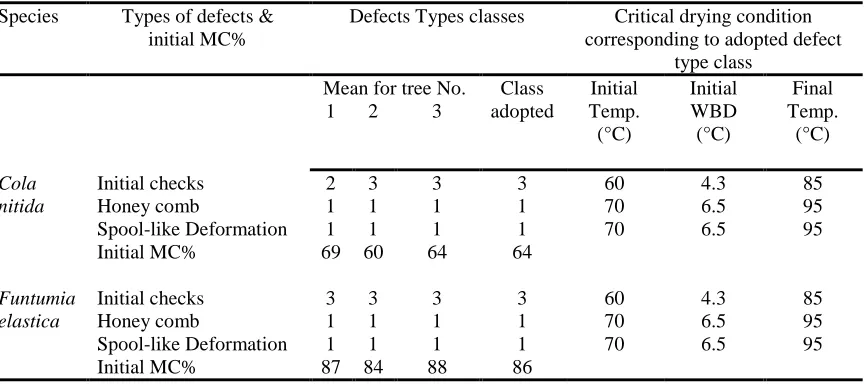
The result of the 100oC – test is shown in Table 1. Visual observations made with respect to seasoning defects included checking and splitting, collapse and twisting. Table 1 shows the results of the types of defects (checking, honey comb and cross-sectional spool-like deformation) and classes of drying defects obtained for the two species.
Table 1: Summary of the types and classes of drying defects and their critical drying conditions for Cola nitida and Funtumia elastica
Species Types of defects &
initial MC%
Defects Types classes Critical drying condition
corresponding to adopted defect type class
Mean for tree No. Class
adopted
Initial Temp. (°C)
Initial WBD (°C)
Final Temp.
(°C)
1 2 3
Cola nitida
Initial checks 2 3 3 3 60 4.3 85
Honey comb 1 1 1 1 70 6.5 95
Spool-like Deformation 1 1 1 1 70 6.5 95
Initial MC% 69 60 64 64
Funtumia elastica
Initial checks 3 3 3 3 60 4.3 85
Honey comb 1 1 1 1 70 6.5 95
Spool-like Deformation 1 1 1 1 70 6.5 95
Initial MC% 87 84 88 86
Checks in the early stage of drying were less severe in both Cola nitida (Bese) and Funtumia elastica (Funtum) samples (Class 3). Initial checking in the samples is strictly related to initial relative humidity but less related to initial temperature. Moderately higher initial dry bulb temperature of 60oC for both Cola nitida and Funtumia elastic, and a larger wet bulb depression of 4.3oC for both species are critical to the drying of the species to prevent them from severe splitting in the early stages of drying.
72
WBD of 6.5oC may be used. There was no spool-like deformation (Class 1) in both Cola nitida and Funtumia elastica species. Spool-like deformation is related to the initial and final temperatures and less so, to the initial relative humidity, but not to the final relative humidity. A higher initial dry bulb temperature of 70oC and a higher WBD of 6.5oC may be employed for drying both Cola nitida and Funtumia elastica.
3.2 Proposed Experimental Kiln Drying Schedules for Cola Nitida and Funtumia Elastica
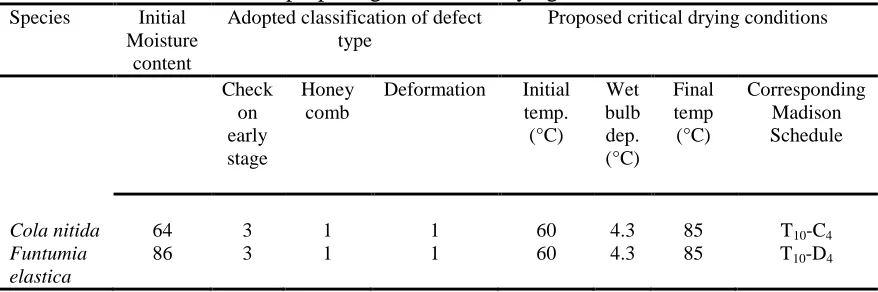
A kiln drying schedule is a series of temperatures and relative humidities that are applied at various stages of drying. Table 1shows the type and class of drying defects obtained from the two species. Using the adopted classes for each drying defect (initial check, honey comb and deformation), three possible drying conditions (initial temperatures, initial wet bulb depression and final temperatures) were obtained from the table of Terazawa (1965) [14]. The drying condition is inferred from the most severe grade of defects so it would be the mildest one and more safely. Table 2 is a summary of the initial moisture content and adopted classifications of defect types used in proposing the drying conditions.
Table 2: Summary of initial moisture content and adopted classification of defect types used in proposing the critical drying conditions
Species Initial
Moisture content
Adopted classification of defect type
Proposed critical drying conditions
Check on early stage Honey comb
Deformation Initial
temp. (°C) Wet bulb dep. (°C) Final temp (°C) Corresponding Madison Schedule
Cola nitida 64 3 1 1 60 4.3 85 T10-C4
Funtumia elastica
86 3 1 1 60 4.3 85 T10-D4
73
and honeycomb) that developed. The specimens (of size 2 cm thick by 10 cm wide by 20 cm long) used dried much faster than would a full-thickness lumber, so the method was very efficient in both time and material. The method has the limitation that subjecting specimens of that size to temperatures of about 100°C imposed the severest conditions on them. However, the method at least indicates the mildest kiln schedule from which modifications could be made to obtain a commercial kiln schedule. As described by Ofori and Brentuo (2010) the procedure above took into consideration, only initial check, cross-sectional deformation, and honeycomb as presented in Table 1. Other defects such as warp, properties such as drying rate and basic density, and grade of lumber should be taken into consideration in adjusting the experimental kiln drying schedules to suit the conditions of the wood to be dried in commercial kiln runs to improve upon them. Simpson (1991) schedules for severely warped lumber or high basic density and slow drying species might be modified by lowering both the initial DBT and WBD; while schedules for upper grade lumbers or fast drying species might be modified by raising both the initial DBT and WBD [1,12,14,15,17].
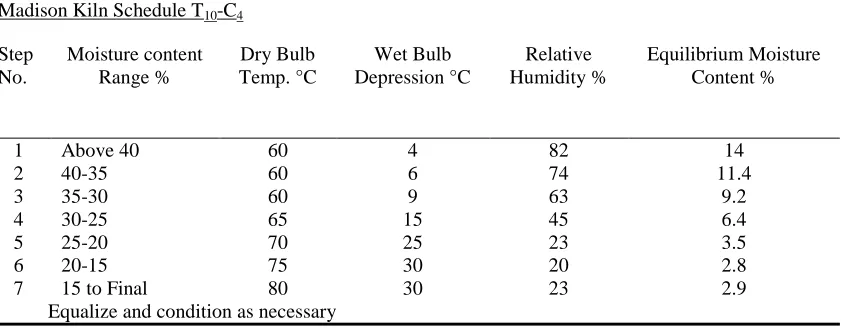
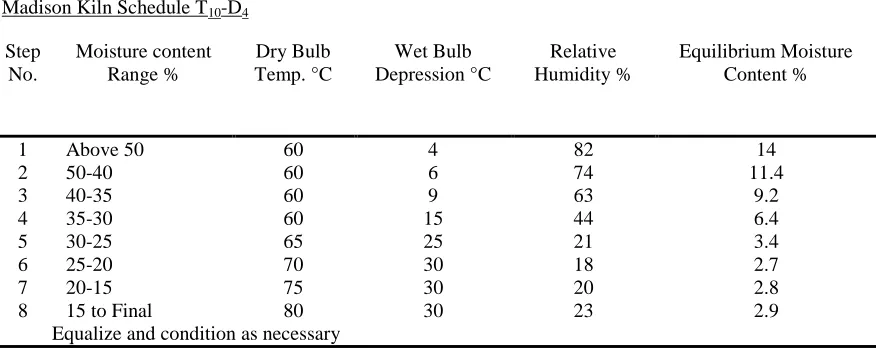
The experimental dry kiln schedules for lumber of thickness up to 38 mm have been assembled in Tables 3 and 4. In the schedules for both species, the initial WBD of 4.3°C as determined in Table 2was rounded to the nearest figures. Mild and moderate kiln schedules of T10-C4 and T10-D4 were proposed for Cola nitida (Bese) and Funtumia elastica (Funtum) respectively. These proposed schedules conform to those of Sterculia rhinopetala and Alstonia boonei respectively as proposed by Ofori and Brentuo (2010b).
Table 3: Experimental kiln drying schedule for Cola nitida
Madison Kiln Schedule T10-C4
Step No.
Moisture content Range %
Dry Bulb Temp. °C
Wet Bulb Depression °C
Relative Humidity %
Equilibrium Moisture Content %
1 Above 40 60 4 82 14
2 40-35 60 6 74 11.4
3 35-30 60 9 63 9.2
4 30-25 65 15 45 6.4
5 25-20 70 25 23 3.5
6 20-15 75 30 20 2.8
7 15 to Final 80 30 23 2.9
74
Table 4: Experimental kiln drying schedule for Funtumia elastica
Madison Kiln Schedule T10-D4
Step No.
Moisture content Range %
Dry Bulb Temp. °C
Wet Bulb Depression °C
Relative Humidity %
Equilibrium Moisture Content %
1 Above 50 60 4 82 14
2 50-40 60 6 74 11.4
3 40-35 60 9 63 9.2
4 35-30 60 15 44 6.4
5 30-25 65 25 21 3.4
6 25-20 70 30 18 2.7
7 20-15 75 30 20 2.8
8 15 to Final 80 30 23 2.9
Equalize and condition as necessary
4. CONCLUSIONS
This study on the development of kiln drying schedules for Cola nitida and Funtumia elastica was necessitated by the over dependence of the timber industry on few species and the lack of technical data on the many species growing in Ghana’s forests. Checks in the early stage of drying were less severe in both Cola nitida and Funtumia elastica
samples (Class 3). There were no honey combing (Class 1) in both Cola nitida and
Funtumia elastica species. There was no deformation (Class 1) in both Cola nitida and
Funtumia elastica species during drying. The following experimental kiln dry schedules for lumber of thickness up to 38 mm corresponding to the FPL Madison schedules are proposed: Cola nitida (T10 – C4) and Funtumia elastica (T10 – D4).
ACKNOWLEDGEMENT
Our special gratitude goes to the management and staff of CSIR-FORIG, especially Madam Bridgette Brentuo for her support and assistance on this project.
REFERENCES
[1] Ofori, J. & Appiah, J. K. (1998). Some drying characteristics of five Ghanaian lesser-known wood species. Ghana Journal of Forestry. 6:19-27.
[2] Ofori, J., Sagoe, J. K. & Hellem, S. (2000). Performance testing of a new drying kiln at a sawmill for airflow and moisture content. Ghana Journal of Forestry,
75
[3] Attah, A. N., Bues, C. T. & Sagoe, A. J. (2005). Accelerated kiln drying of Wawa sawn timber. Bois et forets des Tropiques, 284: 23-33.
[4] TEDB, (1994). Timber Export Development Board. The Tropical Timbers of Ghana. Ghana Forestry Commission. Accra. Ghana, pp 1-20.
[5] Hall, J. B. & Swaine, M. D. (1981). Distribution and ecology of vascular plants in a tropical rain forest: Forest vegetation in Ghana. Geobotany 1. Junk, The Hague.
[6] Ghartey, K. K.. (1989). Results of the Ghana Forest Inventory project. UK Overseas Development Administration / Ghana Forestry Department. Proceedings Ghana Forest Inventory Project Seminar. Accra, Ghana.
[7] Jayanetti, L., Ofori, J. & Ayeh, S. (1999). Bridges for rural feeder roads: Sustainable timber solutions. Timber bridges- A Review Report (DFID).
[8] Upton, D. A. J. & Attah, A. (2003). Commercial Timbers of Ghana. The potential for lesser-used species. Forestry Commission of Ghana, Accra.
[9] Simpson W. T. & Verrill, S. P. (1997). Estimating kiln schedules for Tropical and temperate hardwoods using specific cravity. Forest Products Journal, 47: 7-8. [10] Cabardo, S. J. & Langrish, T. A. G. (2006). Within–tree variability in the drying
properties for blackbutt timber in New South Wales. Maderas. Ciencial Y technologia 8 (1): 15 – 24.
[11] Simpson, W. T. (1992). Drying technology in tropical countries. Proc. IUFRO All-Division 5(Forest Products) Conference, Nancy, France: 497-507.
[12] Simpson, W. T. (1991). Dry Kiln Operator’s Manual. United States Department of Agriculture, Forest Products Laboratory, Madison, USA. Agriculture Handbook No. 188, Pp. 133-149.
[13] Hoadley, R. B. (2000). Understanding wood: A Craftsman’s Guide to Wood
Technology. The Taunton Press, Newtown, Connecticute, USA.
[14] Terazawa, S. (1965). Methods for easy determination of kiln drying schedules of wood: Japan Wood Industry, 20(5): 216 - 226.
76
[16] Rasmussen, E. F. (1961). Dry Kiln Operator’s Manual. U. S. Department of Agriculture, Forest Products Laboratory, Madison, USA. AgricultureHandbook. 188: 117-122.