Open Access
R E S E A R C H
© 2010 Seemann et al; licensee BioMed Central Ltd. This is an Open Access article distributed under the terms of the Creative Commons Attribution License (http://creativecommons.org/licenses/by/2.0), which permits unrestricted use, distribution, and reproduction in any medium, provided the original work is properly cited.
Research
Hierarchical folding of multiple sequence
alignments for the prediction of structures and
RNA-RNA interactions
Stefan E Seemann
†1, Andreas S Richter
†2, Jan Gorodkin
1and Rolf Backofen*
2Abstract
Background: Many regulatory non-coding RNAs (ncRNAs) function through complementary binding with mRNAs or
other ncRNAs, e.g., microRNAs, snoRNAs and bacterial sRNAs. Predicting these RNA interactions is essential for
functional studies of putative ncRNAs or for the design of artificial RNAs. Many ncRNAs show clear signs of undergoing compensating base changes over evolutionary time. Here, we postulate that a non-negligible part of the existing RNA-RNA interactions contain preserved but covarying patterns of interactions.
Methods: We present a novel method that takes compensating base changes across the binding sites into account. The algorithm works in two steps on two pre-generated multiple alignments. In the first step, individual base pairs with
high reliability are found using the PETfold algorithm, which includes evolutionary and thermodynamic properties.
In step two (where high reliability base pairs from step one are constrained as unpaired), the principle of cofolding is
combined with hierarchical folding. The final prediction of intra- and inter-molecular base pairs consists of the
reliabilities computed from the constrained expected accuracy scoring, which is an extended version of that used for individual multiple alignments.
Results: We derived a rather extensive algorithm. One of the advantages of our approach (in contrast to other RNA-RNA interaction prediction methods) is the application of covariance detection and prediction of pseudoknots
between intra- and inter-molecular base pairs. As a proof of concept, we show an example and discuss the strengths
and weaknesses of the approach.
Background
Predicting RNA-RNA interactions is a rapidly growing area within RNA bioinformatics and is essential for the process of assigning function to known as well as de novo
predicted non-coding RNAs (ncRNAs) such as those identified in in silico screens for RNA structures [1-7]. This candidate information along with the data generated from deep sequencing analyses emphasise the need to predict RNA-RNA interactions. In part, this is because there currently is no high-throughput method available for the reliable analysis of RNA-RNA interactions; how-ever, computational prediction of RNA-RNA interactions is also essential for the identification of putative targets of
known and de novo predicted ncRNAs. With the main
exception of microRNA target prediction, the current approaches essentially evaluate the stabilities of the com-mon complexes between ncRNAs and target RNAs by computing the overall free energy using two major strate-gies (see, e.g., [8] for a recent review).
The first strategy, represented through the implemen-tations of RNAup[9] and IntaRNA[10], uses pre-calcu-lated values for all possible regions of interaction to determine the energy required to make that site accessi-ble (called the ED-value for the energy difference). The ED-value is then used to calculate a combined energy of the energy given by the duplex formed by the two interac-tion regions and the ED-values of both interacinterac-tion regions. RNAup has a complexity of O(n3 + nw5), whereas
IntaRNA has a complexity of O(n2), which makes it fast enough to be used in genome-wide screens. Both meth-ods are able to predict complex interactions, like kissing
* Correspondence: [email protected]
2 Bioinformatics Group, University of Freiburg, Georges-Köhler-Allee 106, Freiburg, 79110, Germany
† Contributed equally
hairpins, as long as the interaction is restricted to one region. However, there are well-known examples where several interaction sites were found, especially for longer ncRNAs. A prominent example is the interaction between OxyS and fhlA shown in [11].
The second strategy for RNA-RNA interaction predic-tions is usually handled with a class of approaches that simultaneously predict a common structure for both RNAs including their interaction. Some of the first approaches, e.g., pairfold[12], RNAcofold[13] and the method presented by Dirks et al. as part of the NUpack package [14], concatenate the two sequences using a special linker character. Then, a modified version of the usual RNA folding methods (like Mfold[15] and RNAfold[16]) is applied to cope with the linker symbol to predict the correct energies. Otherwise, a loop con-taining the linker symbol would be treated like a hairpin or internal loop, leading to incorrect energy values.
The main disadvantage of the concatenation approach is that the set of candidate joint structures becomes restricted. For this reason, double kissing hairpin interac-tions (like in OxyS-fhlA) cannot be considered. However, alternative (but also most resource demanding) methods have been introduced and extend the class of allowed joint structures. The IRIS tool [17] allowed several kiss-ing hairpins uskiss-ing a maximum number of base pair energy model. Then, Alkan et al. [18] presented a more realistic energy model and showed the NP-completeness of an unrestricted model. Both approaches predict struc-tures with minimum free energy.
A more stable approach is to consider the partition function because it allows the calculation of interaction probabilities and melting temperatures. This problem was solved independently by Chitsaz et al. [19] and Huang et al. [20]. In [21], hybrid probabilities were calcu-lated. These approaches have high time complexities of O(n6), which makes them infeasible for genome-wide applications. Methods to reduce the complexity range from approximation approaches [22,23] to sparsification of the dynamical programming matrix [24].
Here, we present an algorithm for the prediction of RNA-RNA interactions in existing multiple alignments of RNA sequences. Its rationale is based on the assumption that a non-negligible amount of the RNA-RNA interac-tions contain compensatory base changes across the binding sites. The algorithm presented herein is an exten-sion of the PETfold algorithm [25] and makes further use of the principles from RNAcofold [13] and compu-tational strategies for hierarchical folding, e.g. [26,27]. The latter approach was chosen due to the high computa-tional costs of pseudoknot searches.
Algorithm
The main idea of the introduced method is to use a hier-archical approach to predict an interaction by predicting reliable base pairs within a ncRNA and a mRNA (or another ncRNA), which is followed by prediction of reli-able base pairs in the combined sequence. Via this approach, we are able to predict combined pseudoknot-ted structures, like kissing hairpins, that would be missed otherwise. In both steps, we apply a combined scoring method that predicts consensus base pairs from an align-ment using evolutionary conservation and thermody-namic stability information.
The scoring for the first step is according to the stan-dard PETfold approach, where we use thresholds for reliable base pairs that have been identified according to training on more than 30 verified interactions in bacteria, which is described later. For the second step, we define a constrained version of the PETfold scoring scheme.
Throughout this paper, we consider the concatenation of the two alignments and subsequently (in the base pair prediction process) the concatenation of the correspond-ing structures. σ will denote a set of base pairs, where the substructures in each part (e.g., ncRNA, mRNA and the base pairs that participate in the interaction) in respective alignments are concatenated or nested (in the dot bracket notation, these substructures have alignment lengths of the ncRNA and mRNA respectively). We use (i, j) to denote a Watson-Crick or G-U wobble base pair between columns i and j. This base pair could be an intra -molecu-lar pair in each of the RNA molecules (ncRNA or mRNA) or an inter-molecular pair that is involved in an interac-tion between molecules.
Depending on the context, σ will either be interpreted as a specific structure that implicitly defines the single-stranded positions or as a partial structure that describes an ensemble of structures. In the first case, we define the set of single-stranded positions of a sequence s as
In the second case, we use E(σ) = {σ'|σ' ? σ} to denote the ensemble of all specific structures σ' extending σ. (s) denotes the set of nested secondary structures that are defined for the sequence s. We use the same notation for the consensus structures of a given multiple alignment with n sequences s1 ... sn. In this case, a position 1 ≤ i ≤
| | refers to a column in the alignment. Furthermore, we use s to indicate a sequence s1 ... sn from the
align-ment.
ss( ) | |
,...,| |: (( , ) ( , ) ) .
s
s s
= ≤ ≤ ∧
∀ = ∉ ∧ ∉
⎧ ⎨ ⎪ ⎩⎪
⎫ ⎬ ⎪ ⎭⎪
i i s
j s i j j i
1 1
S
A A
The algorithm, like PETfold is a maximum expected scoring approach that combines the evolutionary proba-bilities Prev[σ| ] of a consensus structure, σ, given an alignment, with the thermodynamic probabilities of the associated structures in each sequence. Prev[σ| ] is gen-erated using the stochastic context-free grammar (SCFG) from the Pfold model [28]. The Pfold model allows the computation of the probability Pr[σ| , T, M] of a con-sensus structure σ given an alignment , a phylogenetic tree T for that alignment, and a general background model M for secondary structures. Because the tree T is calculated from the alignment , and M is constant, we use Prev[σ| ] as short for Pr[σ| , T, M].
The (secondary structure) model itself is based on a SCFG that provides a distribution of secondary struc-tures for a given alignment. The combined probability of an alignment and a consensus structure σ is
where Pr[σ|T, M] is the prior distribution of secondary structures and Pr[ |T, σ ] is the probability of the align-ment, given a known consensus structure. This is then transformed into Pr[ , σ|T, M] by applying the Bayesian rule, and further into the posterior distribution Pr[σ| , T, M] of consensus structures σ by dividing by Pr[ |T, M], which is the sum of all parse trees for an alignment given T and M. Note that the comma sign here is just a shortcut for ∧, i.e. Pr[A, B] = Pr[A ∧B]. We will still use
∧ where it is appropriate.
The probability distributions themselves are formed as follows. For Pr[ |T, σ ], there is an independent evalua-tion of all base pairs and single-stranded posievalua-tions:
where is the ith column of , and
for the constrained folding, where ( resp.) is the constrained structure on the first (second resp.) of the two concatenated alignments. For the prior model, the probability Pr[σ|T, M] provides an overall distribution of the secondary structures, which is estimated from rRNA and tRNA sequences. M is given by the following simple SCFG:
The evolutionary model and the prior model for RNA structures used in the Pfold model are combined into a single SCFG that provides a distribution over Pr[A, σ|T, M] (see additional file 1 for details).
To model the thermodynamic probabilities, we define σ (sk, ) as the structure for the k-th sequence sk of an
alignment associated with the consensus structure σ of . Prth[σ (sk, )|sk] is the corresponding
thermody-namic probability as defined by McCaskill's partition function approach [29].
Using the maximum expected scoring approach, these probabilities are transformed into reliabilities in a two-step approach. Throughout the paper, (i) is used to denote the reliability of a single-stranded region at align-ment position i and (i, j) the reliability of a consensus base pair (i, j), where < = 1, 2 refers to Step 1 or Step 2 of the combined approach.
Refresher: PETfold scoring
Here, we briefly recall the scoring of PETfold, which is a maximum expected accuracy scoring method. For sim-plicity, we will exclude a description of the scoring of sin-gle-stranded positions. However, they are scored the same way as in the original PETfold approach; for more details, see [25].
The PETfold score is the sum of the evolutionary accuracy values plus the average sum of the thermody-namic accuracy values. For the evolutionary part, we compute the expected accuracy (or overlap) EAev(σ) of a specific consensus structure σ with all possible consensus structures, which are weighted according to their proba-bilities:
Recall that Prev[σ'| ] denotes the evolutionary proba-bility of a structure σ' according to the Pfold SCFG as described above. |σ ∩σ'| is the number of base pairs that are common between σ and σ' and thus denotes the over-lap between these two structures.
For the thermodynamic part, the expected accuracy EAth(σ) of σ with all structures for all sequences according to the thermodynamic ensembles is defined by
A
A
A A
A
A A
A
Pr[ ,As| ,T M]=Pr[A| , ]Pr[ | ,T s s T M],
A A
A A A
A
Pr[ | , ] Pr [ | ] Pr [ | ],
( , ) ( )
A T A Ai j T A T i j
i i
s
s s
= ×
∈ ∈
∏
bp∏
ssss
Ai A
s∉s1P∪s2P
s1p s2p
S→LS L| F→dFd LS L| →s dFd| .
A A
A A
Rss
Rbp
EAev( )s |s s | Pr [evs | ].
s
= ∩ ′ × ′
′
∑
A (1)A
EAth( ) | | Pr [ ( ,th ) | ].
( )
s s s s
s
= ∩ ′ × ′
′∈
∑
∑
s ss s
A
S
The combined expected accuracy consists of both parts, generally weighted with 1 for the conservation por-tion and β for the thermodynamic accuracy:
where n is the previously described number of sequences in the alignment. As shown previously [25], this final score can be calculated using the base pair reli-abilities, where the combined reliability Pbp(i, j) for a base pair (i, j) is given by
where (i, j, s) is the base pair probability of the pair (k, l) associated with columns (i, j) in sequence s. These reliabilities are calculated with an inside/outside algo-rithm and are central to the hierarchical approach pre-sented in the following sections. The expected accuracy can then be calculated from the base pair reliabilities by
The consensus structure with the maximal reliability is then calculated using a Nussinov-style algorithm [30], where the base pairs are evaluated with reliabilities.
Step 1: Intra-molecular partial structures
We use two alignments and of sequences
and , where is a ncRNA and is its target sequence. For convenience, we adopt the
conven-tion of RNAcofold and assume that the positions in
are numbered 1 ≤ i ≤ | | and the positions in are
numbered | | + 1 ≤ i ≤ | | + | |.
Selection of the initial structure
In the first step of the pipeline, we obtain the base pair
reliabilities from Equation (4), which we denote (i, j). Using these reliabilities, the partial (constrained)
struc-tures and are determined independently for
and . In the following steps, let be either or
and σp be the partial structure calculated for . This
is done by selecting only base pairs (i, j) with
where δ is a cut-off that must be ≥ 0.5 to avoid crossing structures. This is similar to the method by which con-sensus structures are predicted for single sequences [31] and has been shown to be more reliable for the prediction of consensus structures from alignments.
Here, however, we also have to estimate the contribu-tion of each of the partial structures to the complete solu-tion. Because the set of base pairs from a predicted consensus structure do not necessarily form a reasonable structure, we account for this by introducing a second threshold γ. High values for this threshold guarantee that each sequence used to create the consensus structure has a high likelihood and that the approximation, which we apply in the second step (as will be described by Equation (14)), is accurate.
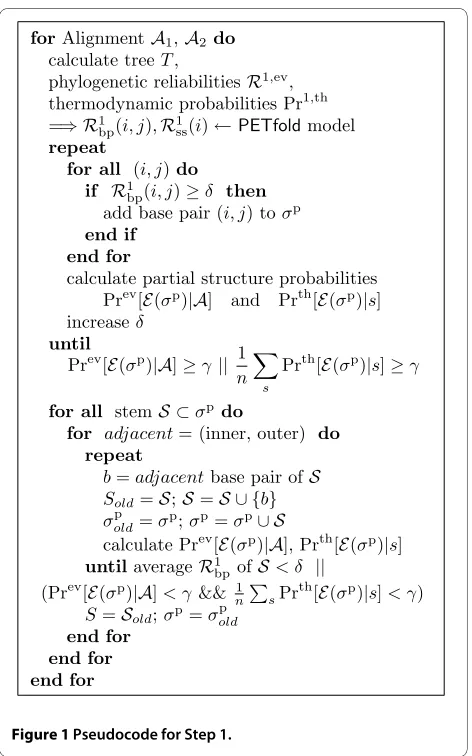
To find the optimal value of the reliability threshold δ, its value is increased until the resulting ensemble of structures ε(σp) that are compatible with the partial
struc-ture σp is probable enough in the evolutionary model, in
the thermodynamic model, or in both models, which is when
Here, Prev[ε(σp)| ] (= Prev[ε(σp)| , T, M]) is the
probability of the partial structure σp given the alignment
in the evolutionary model M and tree T. This can be calculated from Pfold with the SCFG that combines the prior structural model with evolutionary information from the alignment (see additional file 1) as follows:
The term Pr[ |T, M] has already been calculated (per-sonal communication with Bjarne Knudsen) in Pfold as
EA( )s =EAev( )s +b ×EAth( ),s
n (3)
R A
A
bp
ev
with
th
( , ) Pr [ | ]
Pr [ ( , ) | ]
( , )
i j
n s s
i j
= × ′
+ × × ′
′ ∈ ′
∑
11 s
b
s s
s
′′ ∈ ′
∑
∑
∑
= + ×
s s
b with
bpev bpth
( , )
( , , ) Pr ( , , ),
i j s
s i j A
n i j s
R
(4)
Prbpth
EA( ) bp( , ).
( , ) s
s
=
∈
∑
Ri j
i j (5)
A1 A2
s11…s1n s12…s2m s1k sk2
s1k
s1k sk2
s1k s1k s2k
Rbp 1
s1p s2p A1
A2 A A1
A2 A
Rbp1( , )i j ≥d,
Pr [ (evE p) |A] or Prth[ ( p( , )) | ] .
A E A
≥
∈∑ ≥
1
n s s s
A A
A
Pr [ ( ) | , , ]
Pr[ ( )| , , ] Pr[ | , ]
Pr[ | , ]
Pr[
ev p
p
E A
E A A
A
s
s
T M
T M T M
T M
= ×
×
=
1
EE A A
( ), | , ]
Pr[ | , ]
sp T M
T M
(6)
A
the sum of all possible parse trees for an alignment , given T, M:
Here, we add the calculation of
to Pfold by summing over all possible parse trees that are compatible with σ.
Prth[ε(σp(s, ))|s] is the probability of the partial
struc-ture σp given a sequence s in the thermodynamic model.
This probability can be calculated using constrained par-tition folding as follows:
where is the free energy of the whole ensemble (as determined by RNAfold with parameters -p -d2) and
is the free energy of the ensemble of
struc-tures ?(σp(s, )) with the base pairs in σp(s, ) as
con-straints, which can be calculated by RNAfold with parameters -C -p -d2.
Extension of constrained stems
Reliable intra-molecular base pairs are constrained as single-stranded in Step 2 of the algorithm because we are interested in pseudoknots of the concatenated sequence and the interactions in these induced loop regions. The drawback of this ansatz is that intra-molecular stems get instable because of intermediate unbased constraints. Thus, we may get incomplete stems. To deal with this problem, we extend the constrained stems. Inner and outer base pairs are added as long as the average reliabil-ity of the inner or outer extended stem, respectively, is larger than the threshold δ, and the probability of the par-tial structure is greater than or equal to γ either in the evolutionary or the thermodynamic model. That is, the average reliability of the total, extended stem has to be larger than a threshold.
Step 1 is summarised as pseudocode in Figure 1.
Step 2: Constrained expected accuracy scoring
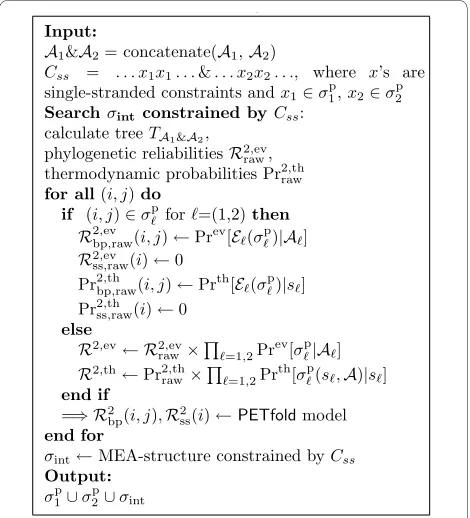
In the following, s1&s2 denote the concatenated sequences of the two sequences s1, s2 using the additional linker symbol & as done in RNAcofold. For Step 2 of the scoring, we calculate the expected accuracy of the ensem-ble of structures σ of s1&s2, which constitutes an interac-tion under the constraint that σ contains the partial
reliable structures and of s1 and s2, respectively. Because we use the numbering convention of
RNAco-fold, the union of the two partial structures
and is the partial structure of s1&s2.
Now we have two problems to solve. On the one hand, we want to calculate the constrained accuracy given the
partial structures and , which is defined as
A
Pr[ | , ]A T M =
∑
Pr[ , | , ].A s T M sPr[ ( ), | , ] Pr[ , | , ]
( )
E A A
E
s s
s s
p
p
T M = T M
∈
∑
A
Pr [ ( ( , )) | ]
( ( , ))
( (
th p
p
p
E A
E A
E
s s e
E s s
RT
e Ealls
RT
e Ealls E
= −
−
= −
ss s
RT
, ))
,
A
(7)
Ealls
EEs(sP( , ))sA
A A
s1p s2p
s1p∪s2p
s1p s2p
s1p s2p
EA p p EAevp p EAthp p
s s s s s s s s
b
s
1, 2( )= 1, 2( )+ n× 1, 2( ).
(8) Figure 1 Pseudocode for Step 1.
forAlignmentA1,A2do calculate treeT,
phylogenetic reliabilitiesR1,ev, thermodynamic probabilities Pr1,th =⇒ R1bp(i, j),R1ss(i)←PETfoldmodel
repeat
for all (i, j)do
if R1bp(i, j)≥δ then add base pair (i, j) toσp
end if end for
calculate partial structure probabilities Prev[E(σp)|A] and Prth[E(σp)|s] increaseδ
until
Prev[E(σp)|A]≥γ|| 1 n
s
Prth[E(σp)|s]≥γ
for all stemS ⊂σpdo
for adjacent= (inner, outer) do repeat
b=adjacentbase pair ofS
Sold=S;S=S ∪ {b}
σpold=σp;σp=σp∪ S
calculate Prev[E(σp)|A], Prth[E(σp)|s]
untilaverageR1bpofS< δ ||
(Prev[E(σp)|A]< γ && 1nsPrth[E(σp)|s]< γ)
S=Sold;σp=σoldp
end for end for end for
s
s
On the other hand, we have to find a combined score
for the partial structures and , and the interaction σint to evaluate the quality of an predicted interaction.
The score must be maximal according to Equation (8). We will demonstrate the problem and our solution for the thermodynamic folding. However, the same analysis applies to the evolutionary part, which is described later.
The thermodynamic part
The simplest formal solution to this problem would be to investigate directly the expected accuracy of joint struc-tures σ:
where is the expected accuracy of a
struc-ture in one sequence pair s1&s2 .
However, this would require that we compute the dis-tribution Prth[σ|s
1&s2], which can be done by a partition
function approach for interacting structures. This is NP-complete in the full model [18] and even O(n6) in a
restricted model [19,20], which is why the two-step approach is necessary. In the following, we ignore the index "th" for simplicity.
The relationship between and EA(σ) is
now quantified. In the following, for a structure σ, we use σ1 ∪ σ2 ∪σint to denote the partition of the base pairs of the first sequence, σ1, the base pairs of the second sequence, σ2, and the interacting base pairs, σint. Further-more, for the partial structure σ, we use e1(σ) to denote the set of structures that extends σ using base pairs within the first sequence, i.e.,
The ensembles e1,int(σ), e2,int(σ) and e1,2(σ) are defined analogously.
Our approach uses one simplification, namely the assumption that the reliabilities for intra-molecular base pairs are dominated by the intra-molecular folding. This
is equivalent to the assumption that the two structures fold independently. We formulate this as follows:
Because σ1 and σ2 are partial joint structures, this can be written using the ensemble function
The implication of this assumption is that the probabil-ities of the two structures σ1 and σ2 are merged indepen-dently into the joint probability Pr[εint(σ1∪σ2)|s1&s2], see
Equation (11) below. First, note that for two partial struc-tures
by definition. Hence,
Intuitively, Pr[e1,int(σ2)|s1&s2] should be the same as Pr[σ2|s2]. This can be derived using the total probability
formula:
Combining these equations we obtain the indepen-dence property:
s1p s2p
EA EA th th th ( )
| ( & , ) | Pr [ | & ]
(
&
& s
s s s
s
= ∩ ′ × ′
=
′
∑
∑
s s s ss s
s s
1 2 1 2
1 2
1 2
A
s
s( & , )),
& s s s s 1 2 1 2 A A ∈
∑
EAths s
1&2( )s
A
EA p p
s1,s2( )s
E E 1 1 2 1 ( ) { | ( , ) \ : | |} ( ) { | ( , ) \
s s s s s
s s s s s
= ′ ⊇ ∀ ∈ ′ ≤ < ≤
= ′ ⊇ ∀ ∈ ′
i j i j s
i j ::
| | | |}
( ) { | ( , ) \ :
| | | |
int
s i j s
i j
i s s
1 2
1 1
1
1
+ ≤ < ≤
= ′ ⊇ ∀ ∈ ′
≤ ≤ ∧ +
E s s s s s 1
1≤ ≤j |s2|}
Pr[s1|s2,s1&s2]=Pr[s1| ].s1
Pr[E2,int(s1) |E1,int(s2),s1&s2]=Pr[s1| ].s1 (9)
Pr[ (E sp∪sp′) | ]s =Pr[ (Esp)∧E(sp′) | ],s
Pr[ ( ) | & ]
Pr[ ( ) ( ) | & ]
Pr[ int ,int ,int E E E E s s s s
1 2 1 2
2 1 1 2 1 2
∪ = ∧ = s s s s 2
2 1 1 2 1 2
1 2 1 2
9
,int ,int
,
.( )
( ) | ( ), & ]
Pr[ ( ) | & ]
Pr s s s E E s s s s int Eq ×
= [[s1| ] Pr[s1 × E1,int(s2) |s1&s2].
Pr[ ( ) | & ]
Pr[ ( ) | ( ), & ]
Pr[ , , , E E E E
1 2 1 2
1 2 2 1 1 2
2 int int int s s s s s s s = × ,, .( ) ,
( ) | & ]
Pr[ | ] Pr[ (
int Eq int s s s s s s s s
1 1 2
9
2 2 2
1 1 ⎛ ⎝ ⎜⎜ ⎞⎠⎟⎟ = ×
∑
∑
E 11 1 22 2 2 1 1 2
1
2 2 1
) | & ]
Pr[ | ] Pr[ ( ) | & ]
Pr[ | ]
,
s s
s s s
s int = × = ×
∑
s s s s E (10)Now we will use this property to relate to
EA(σ). The independence property, as described in Equa-tion (9), and the additivity of the expectaEqua-tion is the impli-cation of the expected accuracy of a joint structure, which is the sum of the expected accuracy of the intra-molecu-lar structures and the expected accuracy of the inter-molecular portion. To illustrate this, note that for any σ, σ'
by definition. Hence, by the additivity of the expecta-tion we get
Now we can rewrite the first term
using the independence property as follows:
which is the expected accuracy of σ1 in the sequence s1. Analogously, we can do this for the second term
. Thus, is
the sum of the expected accuracies in the first and the second sequences and the expected accuracy of the inter-action:
For the expected accuracy of the interaction
we still need to define Pr[σ|s1&s2]. For every σ = σ1 σ2 σint,
Thus, in principle, to calculate the expected accuracy
EAth, int (σ) for the interaction, we must sum over all
struc-tures in σ1 and σ2:
Because this is not feasible, we restrict ourselves to an ensemble of structures. Thus, instead of summing over all
possible σ1 and σ2, we use the partial structures and
that were determined in the first step and approxi-mate EAth,int(σ) by
EA p p s1,s2( )s
|s∩ ′ =s | |s1∩ ′ +s1| |s2∩ ′ +s2| |sint∩ ′sint|
EAths s th s s
s
1 2 1 2
1 1 1
& ( ) | | Pr [ | & ]
| | Pr[ |
s s s s
s s s
s s = ∩ ′ × ′ = ∩ ′ × ′ ′ ′
∑
∑
&& ] | | Pr[ | & ]| int int| Pr[ | &
s
s s
s s
2
2 2 1 2
1 2 + ∩ ′ × ′ + ∩ ′ × ′ ′ ′
∑
∑
s s s
s s s
s
s
]].
|s s | Pr[s | & ]
s′ 1∩ ′ ×1 ′ 1 2
∑
s s| | Pr[ | & ]
| | Pr[
, int
s s s
s s s s
s
s s s
1 1 1 2
1 1 1 2
2 1 ∩ ′ × ′ = ∩ ′ × ′ ∪ ′ ′ ′ ′ ′
∑
∑
∑
s s ∪ ∪ ′ = ∩ ′ × ′ = ′∑
ss s s
s
int
,int
.( )
| & ]
| | Pr[ ( ) | & ]
|
s s
s s
Eq
1 2
1 1 2 1 1 2
10 1
E
s
s s s
s
1 1 1 1
1
∩ ′ × ′
′
∑
| Pr[ | ],s|s s | Pr[s | & ]
s′ 2∩ ′ ×2 ′ 1 2
∑
s s EAths1&s2( )sEAths s EAths EAths
s
1& 2 1 1 2 2
int int
( ) ( ) ( )
| | Pr[ |
s s s s s s
s
= +
+ ∩ ′ × ′
′
∑
11& s2].(12)
EAth,int( )s |sint sint| Pr[s | & ] s
= ∩ ′ × ′
′
∑
s1 s2(13)
Pr[ | & ]
Pr[ ( ) ( ) | & ]
Pr[
int
int , int
s s s
s s s
1 2 1 2
1 2 1 2 1 2
∪ ∪ = ∪ ∧ = s s s s E E
E11 2 1 2 1 2
1 2 1 2
11
, int int
int . )
( ) | ( ), & ]
Pr[ ( ) | ]
s s s
s s E E ∪ × ∪ × = s s s s Eq P
Pr[ ( ) | ( ), & ]
Pr[ | ] Pr[ | ]
, int int
E1 2 E 1 2 1 2
1 1 2 2
s s s
s s ∪ × × s s s s EAth,int int int , int ( )
| | Pr[ |
int
s
s s s s s
s s s = ∩ ′ × ′ ∪ ′ ∪ ′ ′ ′ ′
∑
∑
1 21 2 s1&& ]
| int int| Pr[ int | & ]
, int
s
s s
2
1 2 1 2
1 2
= ∩ ′ × ′ ∪ ′ ∪ ′
′ ′ ′
∑
s s∑
s s ss s s
s1p
s2p
EAth,int
int int int
( )
| | Pr[ | & ]
int
′
′ ′
=
∑
∩ ′ × ′ ∪ ′ ∪ ′s
s s s s s
s s
1 2 1 2
The second sum can now be simplified as follows:
where Equation (11') indicates the variation of the inde-pendence assumption of Equation (11) for the structure ensembles (see additional file 1). Thus, we finally have
Now is the
con-strained folding, where the positions covered by and
are fixed. However, we have the problem that these structures might contain pseudoknots. Recall that the
positions in and are fixed for folding and that we
are considering all structures σ that contain
and are nested on . Technically, we solve the problem using the fact that the set of structures
that is nested on σint and compatible with is selected by considering all structures where the positions
of are constrained as single-stranded. This implies that we use constrained cofolding via RNAco-fold (parameters -C -p -d2), and the constraint ... x1x1 ... & ... x2x2 ..., where x1 (resp. x2) denotes a position
from (resp. ) that is constrained as single-stranded. The main difference is that the energy contri-butions could be slightly different, and therefore, we obtain only an approximation of the real distribution. For
example, an extension of a helix in would be evalu-ated as an internal loop or hairpin. Note that this is not a major problem because we are mainly interested in the
inter-molecular base pairs between s1 and s2 in this step. However, the recursion scheme of RNAcofold could easily be adapted to use new symbols for base pair con-straints and a scoring scheme that is common to hierar-chical approaches of pseudoknot structure prediction, which would avoid these problems.
Finally, we can rewrite the thermodynamic accuracy as the sum of probabilities as indicated in Equation (5). As
shown in Equation (12), for a base pair (i, j) ∈ (< = 1, 2), we want to use the probability of the associated sequence. To avoid competition with the probabilities for the intra-molecular base pairs calculated from RNAco-fold, we set all of these base pairs to the same
probabil-ity as described in Equation
(7). For the inter-molecular base pairs, we use the base pair probabilities as provided by RNAcofold with
con-straints, which model from
the constrained cofolding. However, these raw base pair
probabilities (in the following denoted by )
are calculated under the constraint of and have therefore (to obtain the final base pair probabilities) to be
multiplied by as
indi-cated by Equation (14). Thus, we can score each base pair as follows:
where the 1 reflects the fixed reliability. However, we deviate from this scoring to weaken the independence assumption for the intra-molecular base pairs, which allows us to determine new intra-molecular base pairs from the constrained application of RNA-cofold. Thus, we score only the base pairs from the partial structures
and with the probability in the associated sequence. In addition, to avoid competition with the probabilities for these base pairs calculated from RNAco-fold, we simply set all of these base pairs to the same
probability as described in
Equation (7). To summarise, given the partial consensus
structures and for an alignment as
cal-Pr[ | & ]
Pr[ ( int ( ) ( ) , int ′ ∪ ′ ∪ ′ = ′ ′∈ ′ ∈
∑
s s ss
s s
s s
1 2 1 2
1 2 1 1 2 2 s s E E E p p ∪ ∪ ∪ = ′ ∧ ∪ = s s
s s s
1 2 1 2
1 2 1 2 1 2
1 2
p p
p p
) | & ]
Pr[ ( ) ( ) | & ]
Pr[ , int , s s s s E E
E (( ) | ( ), & ]
Pr[ ( ) | & ]
Pr int .( ) ′ ∪ × ∪ = ′
s s s
s s
E E
1 2 1 2
1 2 1 2
11 p p p p s s s s Eq
[[ ( ) | ( ), & ]
Pr[ ( ) | ] Pr[ ( ) |
, int
E E
E E
1 2 1 2 1 2
1 1 1 2 2
′ ∪
× ×
s s s
s s
p p
p p
s s
s ss2],
EAth
p p
,int
int int
( )
| | Pr[ ( ) | ] Pr[ ( )
Pr
′
= ∩ ′ × ×
×
s
s s E1s1 s1 E2s2
[[ , ( int) | ( ), & ]
int E1 2 ′ E 1 ∪ 2 1 2 ⎛
⎝ ⎜ ⎜
′
∑
s s ss
p p
s s
(14)
Pr[E1 2,(s′int) | (Es1p∪s2p),s1&s2]
s1p
s2p
s1p s2p
s1p∪s1p
sint =s \ (s1p∪s2p)
s1p∪s1p
s1p∪s2p
s1p s2p
s1p
sp
Pr [ (th E sp( , )) |s A s]
Pr[s′| (Es1p∪s2p)∧s1&s2]
Prbp raw2,th, ( , )i j
s1p∪s2p
Pr[ (E1s1p) | ] Pr[ (s1 × E2s2p) |s2]
Pr ( , , & )
Pr ( , , ) , | |
Pr ( , bp th bpth bpth if 2 1 2
1 1 1
i j s s
i j s i j s
=
× ≤ ≤
×
1
1 ii j s s i j s
i j s
, , ) | | , | |
Pr ,, ( , ) Pr [ ( ( ,
2 1 2
2
1 if
bp rawth th p
+ ≤ ≤
×
∏
=, Es AA)) |s] ⎧ ⎨ ⎪ ⎪ ⎩ ⎪⎪ 1 2
(15)
s1p s2p
Pr [ (th E sp( , )) |s A s]
culated in Step 1, the probability for a base pair (i, j) in sequence s1 &s2 ∈ in the second step is:
Single-stranded probabilities
Single-stranded probabilities are integrated in a similar way as the base pair probabilities, but with different weighting. The single-stranded probabilities are as fol-lows:
Given the structure σ on an alignment with m col-umns, the set of all single-stranded positions in the con-sensus structure is denoted as ss(σ) = {i ∉σ|1 ≤ i ≤ m}. Taking this into consideration, the complete version of Equation (2) is
and the evolutionary accuracy is determined similarly. The combined score is the sum of the base pair reliabili-ties and single-stranded reliabilireliabili-ties (weighted with the parameter α). For details, see [25].
The evolutionary part
The calculation for the presented thermodynamic accu-racy is purely based on constrained folding. To obtain the complete constrained folding, we use the same approach for the evolutionary accuracy by applying a version of Pfold[28] that incorporates the constraints. For that
purpose, the raw structural reliabilities (i, j) and
(i) are calculated by the constrained folding with Pfold using the phylogenetic tree deduced from the concatenated alignment. As a linker, three prior-free col-umns are inserted between both alignments. The
evolu-tionary reliabilities (i, j) for a base pair (i, j) and
(i) for a single-stranded position i are calculated in
the same manner as in Equation (16):
as well as in Equation (17):
The probabilities of the partial structures
and are calculated
A1&A2
Pr ( , , & )
Pr [ ( ( , )) | ] ( , )
, bpth
th p p
if
2
1 2
1 1 1 1 1
i j s s
s s i j
=
× ∈
×
1
1
E s A s
P
Pr [ ( ( , )) | ] ( , )
Pr ,, ( , ) Pr [
th p p
bp rawth th
if
E2 2 2 A 2 2 2
s s s i j s
i j
∈
×
∏
=, EE(sp( ,s A)) |s] ⎧⎨ ⎪⎪
⎩ ⎪
⎪ 1 2
(16)
Pr ( , & )
( , ) ( , )
, ss th
p p
if with or
if 2 1 2 1 1 0 0
i s s
j i j j i
j
=
∃ ∈ ∈
∃
s s
with p or p
ss,rawth th
( , ) ( , )
Pr , ( ) Pr [
,
i j j i
i
∈ ∈
×
=
∏
s2 s2
2
1 2
E((s( , )) | ] p
el
s A s
⎧ ⎨ ⎪⎪ ⎩ ⎪ ⎪ (17) A EA ss ss th th ( )
[| | | ( ) ( ) |] Pr [ ( , ) | ]
, s
s s a s s s
s
= ∩ ′ + ∩ ′ × ′
′
∑
s s A sRbp raw2,ev,
Rss raw ev , , 2 Rbp ev 2,
Rss2,ev
Prbp2,th( , ,i j s1&s2)
R A A E A E
bp ev
ev p p
ev
if
2
1 2
1 1 1 1
2 ,
( , , & )
Pr [ ( ) | ] ( , )
Pr [ i j i j = × ∈ × 1 1 s s (( ) | ] ( , )
( , ) Pr [ ( ) | ]
, ,
s s
s
2 2 2
2
p p
bp rawev ev p
if
e
A
R E A
i j i j ∈ × =
∏
⎧ ⎨ ⎪⎪ ⎩ ⎪⎪ 1 2,
(18)
Prss2,th( ,i s1&s2)
Rssev A A
p p
if with or
if 2 1 2 1 1 0 0
, ( , & )
( , ) ( , )
i
j i j j i
j = ∃ ∈ ∈ ∃ s s w
with p or p
ss,rawev ev p
( , ) ( , )
( ) Pr [ ( ) |
,
i j j i
i A ∈ ∈ × s s s 2 2 2
R
∏
=, E ]] else ⎧⎨ ⎪⎪
⎩ ⎪
⎪ 1 2
(19)
Pr [ (evE1s1p) |A1] Pr [ (evE2s2p) |A2]
Figure 2 Pseudocode for Step 2.
p
Input:
A1&A2= concatenate(A1,A2)
Css = . . . x1x1. . .&. . . x2x2. . ., where x’s are
single-stranded constraints andx1∈σp1,x2∈σp2 Searchσintconstrained byCss:
calculate treeTA1&A2,
phylogenetic reliabilitiesR2,ev raw,
thermodynamic probabilities Pr2,th raw for all(i, j)do
if (i, j)∈σpfor=(1,2)then R2,ev
bp,raw(i, j)←Prev[E(σp)|A]
R2,ev ss,raw(i)←0
Pr2bp,th,raw(i, j)←Prth[E(σp)|s]
Pr2ss,th,raw(i)←0
else
R2,ev← R2,ev
raw×=1,2Prev[σp|A]
R2,th←Pr2,th
raw×=1,2Prth[σp(s,A)|s] end if
=⇒ R2bp(i, j),R2ss(i)←PETfoldmodel end for
σint←MEA-structure constrained byCss Output:
as described in Equation (6). Step 2 is summarised as pseudocode in 1.
The final scoring
To summarise the reliabilities, a combined structure will be determined using the Nussinov algorithm on the fol-lowing reliabilities:
where and are
defined as above, as in Equation (16)
and as in Equation (17).
Note that the base pairs in have a weight of 0 during folding of the constrained structure to allow for pseudoknot formation. Finally, we add the base pairs in
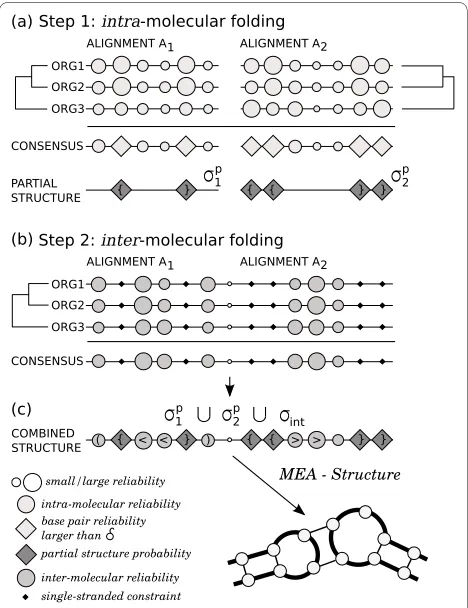
to the constrained structure of Step 2. The flow of the structure reliabilities in the pipeline is summarised in Figure 3.
Results and discussion
The algorithm presented herein was implemented in PETcofold (Seemann et al., submitted). As a proof of concept, we present an example of a bacterial sRNA-mRNA interaction. The in-depth analysis is described elsewhere (Seemann et al., submitted).
Joint structure prediction of bacterial sRNA OxyS and its target mRNA fhlA
The small RNA OxyS represses the translation of the mRNA fhlA, which is mediated through base pairing at the ribosome binding site [11]. However, the OxyS-fhlA interaction involves a second binding site within the cod-ing region of fhlA. Both interaction sites reside in stem loops such that OxyS and fhlA form a double kissing hair-pin interaction.
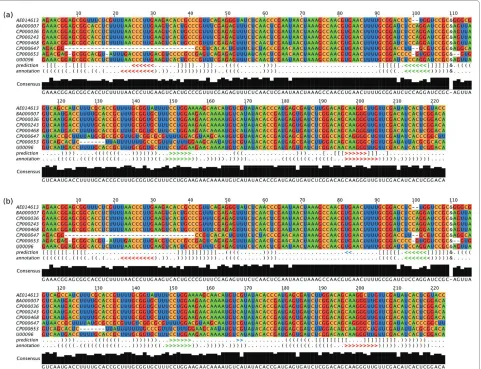
Figure 4 shows the alignment and joint secondary structure prediction of the OxyS-fhlA complex, i.e., the secondary structures of OxyS and fhlA and the interac-tion between them, as predicted by our algorithm. The result of the prediction without extending the con-strained stems is shown in Figure 4a, and the result with the extension of the constrained stems is shown in Figure 4b.
For OxyS-fhlA, our algorithm was able to consistently predict one of the two interaction sites. The second inter-action site, which is situated in the fhlA coding region, was only predicted when the constrained stems were not extended in Step 1 of our algorithm. Otherwise the stem of fhlA that resides the second interaction site was extended both by inner and outer base pairs. Conse-quently, the unpaired region of the hairpin containing the second interaction site became shorter such that no interaction was predicted at this site.
Algorithmic restrictions and potentials
The algorithm supports pseudoknots between the intra-molecular and inter-intra-molecular base pairs, while the time complexity of O(N × I × L3) is much lower than that of
other approaches with the same ability. The time com-plexity is in the magnitude of PET-fold for the added sequence length L of both alignments, and it is linear with respect to the number of sequences N in the alignments
R R A A
R
bp bp
ev
bpth
s
2 2
1 2
2
1 2
1 2
( , ) ( , , & )
Pr ( , , & )
,
,
&
i j i j
n i j s s
s s
= +
∑
b
ss ss
ev
ss th
2 2
1 2
2
1 2
1 2
( ) ( , & )
Pr ( , & ),
,
,
&
i i
n i s s
s s
= +
∑
R A A
b
Rbp2,ev( , ,i j A1&A2) Rss2,ev( ,i A1&A2)
Prbp2,th( , ,i j s1&s2)
Prss2,th( ,i s1&s2)
s1p∪s2p
s1p∪s2p Figure 3 Scoring pipeline. The pipeline illustrates the flow of base pair probabilities during the structure scoring. The PETcofold pipeline consists of two steps: (a) intra-molecular folding by PETfold of both alignments and selection of a set of highly reliable base pairs that form the partial structures σp; (b) inter-molecular folding by an adaptation of
and the number of iterations I in the adaptation of δ to find probable partial structures (I <M/2, where M is the sequence length of the longer alignment).
Pfold combines a SCFG with evolutionary informa-tion from an alignment of RNA sequences through an explicit evolutionary model. It is not clear whether the model learned from tRNA and rRNA secondary struc-tures is appropriate for RNA cofolding. To avoid the bias of a wrong prior probability distribution Pr[σ|T, M] dur-ing the evolutionary scordur-ing of the cofolddur-ing step, we omitted all SCFG rule probabilities as well as base pair substitution rates. In these cases, all base pair probabili-ties were calculated independently, and the different sub-stitution rates of base pairs were ignored; thus, we observed that the entire performance decreased. A possi-ble optimisation would be an adapted prior distribution
for the cofolding step, which could be generated when sufficient verified RNA-RNA interaction data becomes available. However, the prediction of RNA secondary structure using evolutionary history is robust for differ-ent evolutionary speeds and substitution rate variations [32]. Hence, it is reasonable to assume that the deviation is fairly low using the prior probability distribution of intra-molecular structures.
The presented method assumes that both alignments have the same evolutionary history during the cofolding step. A more accurate method would consider indepen-dent phylogenetic trees for both RNAs, such as in Step 1, and a common tree for the interaction site. However, we do not know the interacting region in advance; thus, we would need an expectationm maximization algorithm, which would increase the running time of the algorithm
to an unreasonable level. Furthermore, the energy contri-bution of the cofolding step might be slightly biased due to the constraint of the partial structures as single-stranded. We partly solve the resulting intra-molecular false predictions by extending the reliable stems in the partial structures, and, as already mentioned above, the RNAcofold algorithm and scoring scheme could be adapted to handle base pair constraints as single-stranded.
Furthermore, there is a limitation of the presented method with regard to interaction sites that are located outside conserved RNA structures. These regions are hard to align if they are, in addition, sequentially uncon-served. Thus, our method will most likely miss binding sites located in unstructured and otherwise unrelated regions, e.g., miRNA target sites in UTR regions. How-ever, once a correct alignment is found for these regions, then the presented approach still works if the interaction region is conserved or shows enough covariation.
Our algorithm is able to predict pseudoknots between the intra-molecular and (inter-)molecular base pairs. In addition, we are interested in more pseudoknots that can be predicted in a similar way using a pipeline of con-strained structures. During an iteration of Step 2, addi-tional reliable partial inter-molecular structures are constrained as long as new reliable base pairs appear. The final consensus structure is the union of all cofolding base pairs and the partial structures. The main unsolved prob-lem is the weighted combination of the decreasing partial structure probabilities in one scoring scheme when the amount of constraints increases with each iteration.
Conclusions
In summary, we introduced an extension of the PET-fold algorithm for the identification of interactions between two sets of multiple aligned RNA sequences, which exploits compensating base changes while taking intra-molecular partial structures and interaction sites into account. The implementation of the algorithm in PETcofold and its application are described in See-mann et al. (submitted).
Additional material
Competing interests
The authors declare that they have no competing interests.
Authors' contributions
SES, RB and JG designed the algorithm. SES implemented the algorithm. ASR designed and performed the analysis of the algorithm. RB drafted the manu-script. All authors contributed to the manuscript, read and approved the final manuscript.
Acknowledgements
We thank Bjarne Knudsen for inspiring discussions about extensions of the
Pfold method.
This work was supported by the Lundbeck Foundation (grant 374/06 to J.G.), the Danish Research Council for technology and production (grant 274-09-0282 to J.G.), the Danish Center for Scientific Computation (J.G.), the German Federal Ministry of Education and Research (BMBF grant 0313921 FRISYS to R.B.) and the German Research Foundation (DFG grant BA 2168/2-1 SPP 1258 to A.S.R. and R.B.).
Author Details
1Center for non-coding RNA in Technology and Health, IBHV, University of Copenhagen, Grønnegårdsvej 3, Frederiksberg C, 1870, Denmark and 2Bioinformatics Group, University of Freiburg, Georges-Köhler-Allee 106, Freiburg, 79110, Germany
References
1. Washietl S, Hofacker IL, Lukasser M, Hüttenhofer A, Stadler PF: Genome-wide mapping of conserved RNA secondary structure structures predicts thousands of functional non-coding RNAs in human. Nature Biotechnology 2005, 23:1383-1390.
2. Pedersen JS, Bejerano G, Siepel A, Rosenbloom K, Lindblad-Toh K, Lander ES, Kent J, Miller W, Haussler D: Identification and classification of conserved RNA secondary structures in the human genome. PLoS Comput Biol 2006, 2:e33.
3. Torarinsson E, Sawera M, Havgaard JH, Fredholm M, Gorodkin J: Thousands of corresponding human and mouse genomic regions unalignable in primary sequence contain common RNA structure.
Genome Research 2006, 16:885-889. [(Erratum in: Genome Res. 2006 16:1439)].
4. Uzilov AV, Keegan JM, Mathews DH: Detection of non-coding RNAs on the basis of predicted secondary structure formation free energy change. BMC Bioinformatics 2006, 7:173.
5. Washietl S, Pedersen JS, Korbel JO, Stocsits C, Gruber AR, Hackermüller J, Hertel J, Lindemeyer M, Reiche K, Tanzer A, Ucla C, Wyss C, Antonarakis SE, Denoeud F, Lagarde J, Drenkow J, Kapranov P, Gingeras TR, Guigó R, Snyder M, Gerstein MB, Reymond A, Hofacker IL, Stadler PF: Structured RNAs in the ENCODE selected regions of the human genome. Genome Research 2007, 17:852-864.
6. Will S, Reiche K, Hofacker IL, Stadler PF, Backofen R: Inferring noncoding RNA families and classes by means of genome-scale structure-based clustering. PLoS Computational Biology 2007, 3:e65.
7. Torarinsson E, Yao Z, Wiklund ED, Bramsen JB, Hansen C, Kjems J, Tommerup N, Ruzzo WL, Gorodkin J: Comparative genomics beyond sequence based alignments: RNA structures in the ENCODE regions.
Genome Research 2008, 18:242-251.
8. Backofen R, Hess WR: Computational prediction of sRNAs and their targets in bacteria. RNA Biol 2010, 7:.
9. Mückstein U, Tafer H, Hackermüller J, Bernhart SH, Stadler PF, Hofacker IL: Thermodynamics of RNA-RNA binding. Bioinformatics 2006, 22(10):1177-82.
10. Busch A, Richter AS, Backofen R: IntaRNA: efficient prediction of bacterial sRNA targets incorporating target site accessibility and seed regions. Bioinformatics 2008, 24(24):2849-56.
11. Argaman L, Altuvia S: fhlA repression by OxyS RNA: kissing complex formation at two sites results in a stable antisense-target RNA complex. Journal of Molecular Biology 2000, 300(5):1101-12.
12. Andronescu M, Zhang ZC, Condon A: Secondary structure prediction of interacting RNA molecules. Journal of Molecular Biology 2005, 345(5):987-1001.
13. Bernhart SH, Tafer H, Mückstein U, Flamm C, Stadler PF, Hofacker IL: Partition function and base pairing probabilities of RNA heterodimers.
Algorithms Mol Biol 2006, 1:3.
14. Dirks RM, Bois JS, Schaeffer JM, Winfree E, Pierce NA: Thermodynamic Analysis of Interacting Nucleic Acid Strands. SIAM Review 2007, 49:65-88.
15. Zuker M: Prediction of RNA secondary structure by energy minimization. Methods in Molecular Biology 1994, 25:267-94. Additional file 1 Probability distributions of the Pfold model and
Implications of the independence property. Combined probability dis-tributions of the Pfold model and theimplications of the independence property (Equation (11)) for partial structures are described.
Received: 10 April 2010 Accepted: 21 May 2010 Published: 21 May 2010
This article is available from: http://www.almob.org/content/5/1/22 © 2010 Seemann et al; licensee BioMed Central Ltd.
16. Hofacker IL, Fontana W, Stadler PF, Bonhoeffer S, Tacker M, Schuster P: Fast Folding and Comparison of RNA Secondary Structures. Monatshefte Chemie 1994, 125:167-188.
17. Pervouchine DD: IRIS: intermolecular RNA interaction search. Genome Inform 2004, 15(2):92-101.
18. Alkan C, Karakoc E, Nadeau JH, Sahinalp SC, Zhang K: RNA-RNA interaction prediction and antisense RNA target search. Journal of Computational Biology 2006, 13(2):267-82.
19. Chitsaz H, Salari R, Sahinalp SC, Backofen R: A partition function algorithm for interacting nucleic acid strands. Bioinformatics 2009, 25(12):i365-73.
20. Huang FWD, Qin J, Reidys CM, Stadler PF: Partition function and base pairing probabilities for RNA-RNA interaction prediction.
Bioinformatics 2009, 25(20):2646-54.
21. Huang FWD, Qin J, Reidys CM, Stadler PF: Target prediction and a statistical sampling algorithm for RNA-RNA interaction. Bioinformatics
2010, 26(2):175-81.
22. Chitsaz H, Backofen R, Sahinalp SC: biRNA: Fast RNA-RNA Binding Sites Prediction. Proc. of the 9th Workshop on Algorithms in Bioinformatics (WABI), Volume 5724 of Lecture Notes in Computer Science 2009:25-36. 23. Salari R, Backofen R, Sahinalp SC: Fast prediction of RNA-RNA Interaction.
Proc. of the 9th Workshop on Algorithms in Bioinformatics (WABI), Volume 5724 of Lecture Notes in Computer Science 2009:261-272.
24. Salari R, Möhl M, Will S, Sahinalp SC, Backofen R: Time and space efficient RNA-RNA interaction prediction via sparse folding. Proc of RECOMB 2010 2010 in press.
25. Seemann SE, Gorodkin J, Backofen R: Unifying evolutionary and thermodynamic information for RNA folding of multiple alignments.
Nucleic Acids Research 2008, 36:6355-6362.
26. Gaspin C, Westhof E: An interactive framework for RNA secondary structure prediction with a dynamical treatment of constraints. J Mol Biol 1995, 254:163-174.
27. Jabbari H, Condon A, Pop A, Pop C, Zhao Y: HFold: RNA Pseudoknotted Secondary Structure Prediction Using Hierarchical Folding. In
Algorithms in Bioinformatics, 7th International Workshop, WABI Philadelphia, PA, USA, September 8-9, 2007, Proceedings 2007:323-334.
28. Knudsen B, Hein JJ: RNA secondary structure prediction using stochastic context-free grammars and evolutionary history.
Bioinformatics 1999, 15:446-454.
29. McCaskill JS: The equilibrium partition function and base pair binding probabilities for RNA secondary structure. Biopolymers 1990, 29(6-7):1105-19.
30. Nussinov R, Pieczenik G, Griggs JR, Kleitman DJ: Algorithms for Loop Matchings. SIAM Journal on Applied Mathematics 1978, 35:68-82. 31. Ding Y, Chan CY, Lawrence CE: RNA secondary structure prediction by
centroids in a Boltzmann weighted ensemble. RNA 2005, 11(8):1157-66. 32. Knudsen B, Andersen ES, Damgaard C, Kjems J, Gorodkin J: Evolutionary
rate variation and RNA secondary structure prediction. Comput Biol Chem 2004, 28(3):219-226.
33. Waterhouse AM, Procter JB, Martin DMA, Clamp M, Barton GJ: Jalview Version 2-a multiple sequence alignment editor and analysis workbench. Bioinformatics 2009, 25(9):1189-91.
doi: 10.1186/1748-7188-5-22