The Role of Quantitative Risk Assessment
in Improving Hazardous Installations Siting: A Case Study
Badri, Naser; Nourai, Farshad; Rashtchian, Davood*+ Faculty of Chemical and Petroleum Engineering, Sharif University of Technology
P.O. Box 11365-8639 Tehran, I.R. IRAN
ABSTRACT: Safety distance has already been a main measurement for the hazard control of chemical installations interpreted to mean providing space between the hazardous installation and different types of targets. But, the problem is how to determine the enough space. This study considers the application of quantitative risk assessment to evaluating a compressed natural gas station site and to identify nearby land use limitations. In such cases, the most important consideration is to assure that the proposed site would not be incompatible with existing land uses in the vicinity. This scope is possible by categorization of estimated levels of risk imposed by the proposed site. It means that an analysis of the consequences and likelihood of credible accident scenarios coupled with general acceptable risk criteria should be undertaken. This enables the calculated risk of the proposed site to be considered at an early stage, to allow prompt responses or in the later stages to observe limitations. It is concluded that not only adequate distance is not been provided but also the compressed natural gas station is located in the vicinity of populated areas and this is chiefly because of inadequate risk assessment studies and ambiguities in defining acceptable risk criteria.
KEY WORDS: Siting, Quantitative risk assessment, Consequence analysis, Hazardous installations.
INTRODUCTION
Siting is a comprehensive procedure to find a location to construct a process unit and should be considered earlier relative to other steps in process design. Because, to implement this procedure may be extremely costly when the site is already selected and consequently process unit is constructed. Optimum siting must minimize material and construction costs, but more importantly, must reduce the risk of offsite losses throughout the process unit’s life cycle by considering safe distances [1,2]. Therefore, siting provides a fundamental aspect of risk management, because,
it firstly separates sources of potential release, fire and explosion from adjacent areas that might become affected by incidents [3] and secondly, it limits the incident sequence before they impose major impacts on people, properties and environment [4]. There are various methods to fulfill the above goals ranging from experience-based methods, including codes and standards [5,6], to consequence-based ones [7,8]. In this way, Quantitative Risk Assessment (QRA) can be used as a proper tool, which not only has some advantages of former methods but also is more realistic. QRA is *To whom correspondence should be addressed.
+E-mail: [email protected]
a measure to weigh up whether enough precautions have been taken or should be done more thoroughly to prevent fatalities, injuries and damage in process industries [9,10]. The need for QRA of process plants has become increasingly critical due to the trend towards larger and more complex units. Moreover, the potential damage has been magnified by the proximity of many such operations to densely populated areas [11]. Ignoring former facts and improper siting has caused large number of fatalities during process industries history chiefly in Bhopal and Mexico City, with more than 2,000 and 600 fatalities, respectively [12].
To demonstrate the applicability of QRA, the site of a Compressed Natural Gas (CNG) refueling station in Tehran was selected for a detailed study. The flammable nature of methane [13], high pressure condition and proximity to densely populated areas are the most significant reasons that highlight the importance of siting studies for CNG stations. A recent survey revealed several CNG station accidents with considerable number of injuries and fatalities occurred throughout the world: gas cylinder explosions in Pakistan (2006), fire incidents in India (2003), China (1998) [14-16] and more than 30 accidents in CNG stations with about 25 fatalities and injuries in Iran just in the past three years [17]. More than 1,000 gas stations were built in Iran up to 2010 and they are planned to grow in number by a factor of two by the end of 2011, because of the Iranian government policy to extend use of Natural Gas Vehicles (NGV) technology. This paper is trying to clarify the QRA role in the safety aspect of siting procedure by evaluating a typical CNG station site. The main purpose is to quantify the probable hazards and their consequences to estimate the risk to surrounding population.
Siting procedure
Site selection is a very complex process with many unknowns and concerns that are difficult to resolve [18]. To complete any comprehensive siting procedure, the following data should be gathered and assessed to cover all involved parameters [1]:
• Geographical and meteorological data: maps,
topography, weather conditions, seismic history and soil properties.
• Transportation issues: product and material handling, pipelines and special transportation requirements.
• Utilities: water supply, steam supply and fuel.
• Electrical and communication systems.
• Environmental controls: wastewater treatment and
control, air quality control, sanitary sewage collection and treatment, noise and luminosity level design limitations.
• Hazard screening.
The majority of above measures are trying to solve the siting problem chiefly by considering economic aspects and decreasing capital and operating costs. Whereas, from a safety perspective, selecting a site that is not adequately sized or where the impact on adjacent sensitive locations has not been estimated may result in additional prevention or mitigation activities being required and in some cases, this additional expense may not be compensated.
Therefore, the hazard screening step has an indispensable role in siting procedure which has not been given enough weight in comparison with other steps whereas the result of this step has such importance that can reject a site or propose an alternative one. Assuming all first five steps has been considered to site the CNG station, the purpose is to check the hazard screening step using QRA as the selected tool to study safety requirements.
CNG STATION DESCRIPTION
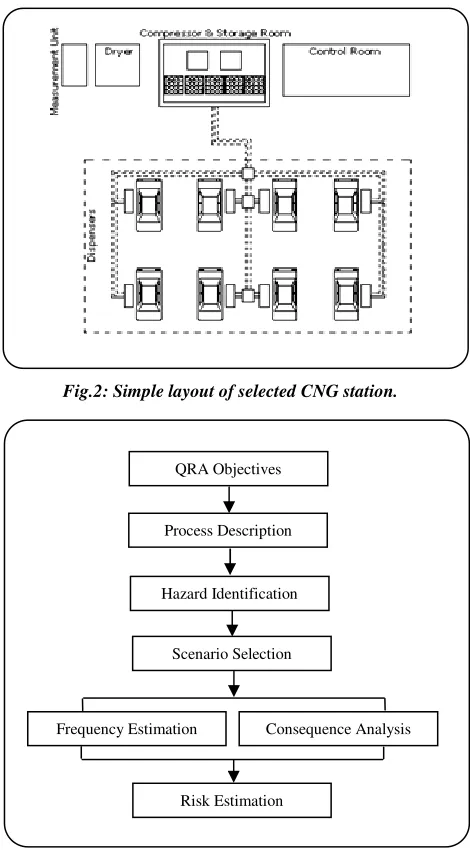
CNG stations are designed to refuel a vehicle in a similar time to a liquid fuel station and are analogous to these stations in many aspects of their operation [19]. For this study, one of the largest CNG stations in Tehran (Figs. 1 and 2) was selected as a case study to obtain required information. For this station fed by public distribution network, five main components can be distinguished as follows:
• Measurement Unit: A metering unit is required
at the CNG station inlet to record gas flow at low pressure (20 bar).
• Dryer: The moisture content of CNG must be controlled at the filling station as it can cause operational problems in the station or the vehicles if not reduced to levels at which condensation does not take place.
• Compressor: This station uses two large reciprocating compressors that are electrically powered. These compressors are designed to pressurize gas to 250 bar in three stages.
• Cylinders: Compressed gas is stored in cylinders
cylinders. Gas is stored at three pressure levels; Low (160 bar), Medium (200 bar) and High (250 bar). There are 36 cylinders at Low-, 27 cylinders at Medium- and 12 cylinders at High pressure levels.
• Dispensers: The dispenser is the interface of the CNG station with the vehicles. In this station 8 dispensers are connected to gas cylinders by pipes conveying gas at three pressure levels [20].
QRA (QUANTITATIVE RISK ASSESSMENT) In order to introduce the framework, this section provides a brief overview of a QRA. The present study was aimed to follow a systematic QRA procedure (Fig. 3) to assess the risk imposed on neighborhood by the operation of the CNG station [9].
QRA objectives and process description were discussed in previous sections.
Hazard identification and scenario selection
This step is so critical, because a hazard omitted is a hazard not analyzed. Scenarios begin with an incident, which usually result in the loss of containment of material from the process. Typical incidents might include rupture, break of a pipeline and a hole in a cylinder or pipe [21]. The major causes that may lead to hazards in the CNG station are “corrosion in dryer section due to moisture content of gas” and “high pressure in cylinders and dispensers”. Finally, after screening low frequency and low consequence scenarios the most credible ones in the selected CNG station have been determined as summarized in Table 1.
Consequence analysis
Consequence analysis is supposed to be carried out in several steps to model the effect of various scenarios. Once the scenario is defined, source models are selected to describe how materials are discharged. The source model provides a description of the discharge rate and the total quantity discharged. A dispersion model is subsequently used to describe how the material is dispersed to certain concentration levels. Then, fire and explosion models convert the source model information on the release into hazard potentials such as thermal radiation and explosion overpressures [22]. Vapour Cloud Explosion (VCE), Vapour Cloud Fire (VCF) and jet fire are the only probable type of accidents that may occur in the
Fig.1: Top view of selected CNG station (dotted square).
Fig.2: Simple layout of selected CNG station.
Fig. 3: Flow diagram of the procedure used for QRA [9].
QRA Objectives
Process Description
Hazard Identification
Scenario Selection
Consequence Analysis Frequency Estimation
CNG station. All of the mentioned steps have been modelled using PHAST 6.5 software package developed by DNV. Finally, effect models convert results obtained by software into effects on people represented by probability of death. Probit equations [23] are commonly used to quantify the expected rate of fatalities for the exposed population. These equations and can be written as: Y=K1+K2×Ln (V) (1)
Where Y is probit variable, K1 and K2 are constants and V represents the dose of hazard (radiation and overpressure). A useful expression for performing the conversion from probit variable to probability of fatality (P) is given by:
Y 5 Y 5
P 0.5 1 erf( )
Y 5 2
− −
= +
− (2)
In the case of VCF, the above equation has only two values of 1 and 0 for the areas in which gas concentration is above and below flammable concentrations respectively.
Combining the above equation and population
distribution data (0.076 people/m2 in daytime and
0.038 people/m2 at night) will give the number of fatalities
in all incident outcomes by using:
× =
A
dA P
N (3)
Where N is number of fatalities, P is uniform population distribution and A is the area affected by the incident.
Consequence analysis in general requires the dispersion modelling of flammable clouds for several realistic scenarios in a range of representative atmospheric conditions. These conditions comprise wind data, such as average wind speed, atmospheric stability, ambient temperature and humidity. All of the selected scenarios have been investigated in two different atmospheric conditions (Table 2) corresponding to day and night.
Frequency estimation
Frequency estimation is the methodology used for estimation of the number of occurrences of a scenario in a year. Estimates may be obtained from generic data [24] or from failure sequence models, such as Fault Tree Analysis (FTA) [25]. In this study, generic values have been used to estimate scenario frequencies (Table 3).
Table 1: Credible scenarios in the CNG station.
Scenario No. Scenario Description
01, 02 5mm and 25mm holes in drying section
03 Full bore rupture in drying section
04, 05 5mm and 25mm holes in cylinders
06 Rupture in cylinders
07 5mm hole diameter in dispensing section
08 Full bore rupture in dispensing section
Table 2: Atmospheric conditions corresponding to day and night.
Day Night
Wind velocity (m/s) 2.5 2.1
Atmospheric stability class A D
Ambient temperature (˚C) 27 3
Relative humidity 35% 70%
Table 3: Estimated frequencies of credible scenarios.
Scenario No. Estimated frequency (1/yr)
01 1.13E-02
02 3.30E-03
03 2.58E-03
04 2.81E-03
05 7.10E-03
06 7.25E-04
07 6.98E-02
08 1.77E-02
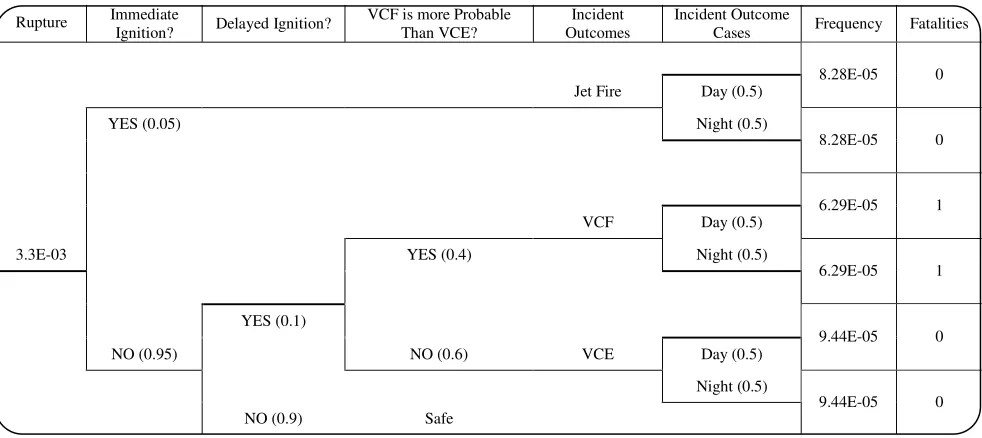
Table 4: Event tree for the second scenario (25 mm hole diameter in the dryer section).
Rupture Immediate
Ignition? Delayed Ignition?
VCF is more Probable Than VCE?
Incident Outcomes
Incident Outcome
Cases Frequency Fatalities
Jet Fire Day (0.5)
8.28E-05 0
YES (0.05) Night (0.5)
8.28E-05 0
VCF Day (0.5)
6.29E-05 1
3.3E-03 YES (0.4) Night (0.5)
6.29E-05 1
YES (0.1)
NO (0.95) NO (0.6) VCE Day (0.5)
9.44E-05 0
Night (0.5)
NO (0.9) Safe
9.44E-05 0
done for all other scenarios. The number of fatalities for each incident outcome case is also illustrated in Table 4.
In all event trees, different conditional event probabilities are used, which must be determined carefully and according to historical data. Immediate ignition probability in all scenarios is 0.05, because of the few number of electrical devices in a CNG station and other measures for eliminating sources of igniton. Delayed ignition probability depends on the discharge gas flow and is different for each scenario. In all scenarios, the probability of vapor cloud fire in delayed ignition condition was set at 0.4 and for vapor cloud explosion at 0.6 [12].
Risk estimation results
Experience has shown that, to get a balanced perspective of risks associated with process plant operations, risk must be evaluated from two perspectives: (1) the risk to individuals and (2) the risk to groups of people. These are referred to, respectively, as Individual Risk (IR) and Societal Risk (SR) [26].
The IR is defined as the probability of death at any particular location due to all undesired events. It can be expressed as the probability of a person at a specific location becoming a casualty within a year and analyzed area [9]. The IR study has been performed before [27] and shown improper siting of the CNG station according to general tolerable criteria for IR [28]. Nevertheless, to complete the study, in addition to considering individual risk, it is a need to consider the population exposed to risk.
Societal Risk (SR) is normally used for evaluating the exposed risk on a group of people. SR is the relationship between the frequency and the number of people suffering from a specified level of harm in a given population from the realization of specified hazards [29]. It can be expressed as a single number, tabular sets of numbers, or graphical summaries with the most common graphical representation being the Frequency - Number (F-N) curve [26]. This curve is usually presented on log-log plots with the x-axis representing the scale of the consequences in terms of N fatalities and the y-axis representing F, the likelihood or expected frequency of N or more fatalities, which can be calculated by[9]:
FN= i Fi , when Ni(x,y)>N (4)
Where, Fi is the frequency and Ni(x,y) is the fatalities
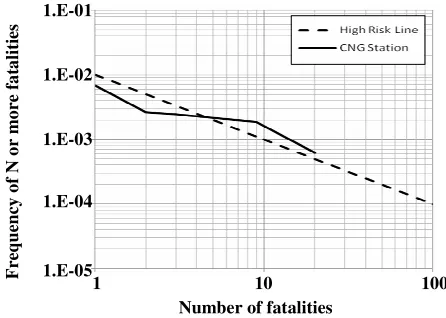
of incident outcome i from frequency estimation and consequence analysis, respectively. The estimated FN curve from the CNG station risk analysis and the general intolerable risk criterion line [26] are shown in Fig. 4. This line has been recommended as a general intolerable risk criterion by UK Health and Safety Executive for companies who have not developed SR criteria.
Fig. 4: A comparison between CNG station FN curve and intolerable risk criterion line
and occasionally two orders of magnitude lower than the intolerable risk criterion line [26,28] depending on the company’s policy in risk assessment.
It is clear that the CNG station risk curve (Fig. 4) is not always above the intolerable risk criterion line. However, since it is very close, a small inaccuracy in calculations or in the input values used may have been the reason, because all input data and used procedures including process conditions, meteorological data, generic frequencies and consequence modeling software faced some uncertainties which could affect on final results.
CONCLUSIONS
This paper has tried to introduce risk assessment as an effective approach to complete the safety aspect of siting procedure by quantification the probable hazards. In fact, the main target was to show the capabilities of this method to estimate the safe distance around hazardous installations. To fulfill the recent aim, a CNG station was selected to investigate in details as a case study.
According to the firstly hazard identification studies, drying and dispensing components in the CNG station were revealed as the main sources of hazard which may mirror the effect of corrosion and high pressure condition respectively. Subsequent consequence analysis including a spectrum of different scenarios distinguished VCF as the more fatal incident outcome against jet fire and VCE. Whereas, VCF was determined as the less probable one based on the frequency estimation studies. Thus, it was clear that nor consequence analysis neither frequency estimation could be considered as the main parameter
to make a decision solely. Therefore, a comprehensive QRA study was used to clear this ambiguity by combining both measures to have their advantages simultaneously and because of the highly populated neighborhood, SR measure was selected to investigate.
Final results of QRA studies was drawn as a FN curve and compared with general intolerable risk criteria and this comparison disclosed high difference from acceptable condition. Therefore, obtained results from QRA studies introduced many limitations to site a CNG station in populated areas, chiefly originating from inadequate studies in safety aspect of siting. It is notable, to obtain all above results, a general risk criterion has been used for evaluating the calculated results, which is very useful to estimate the current condition. Nevertheless, if there is a need to make an important decision it will not be possible without developing national risk criteria.
It is clear to conclude that conventional siting procedures may seem perfect but major problems will rise because of ignoring safety facets and consequently impose unacceptable risk on people living and working in the neighborhood. Considering this point that CNG stations are usually constructed in populated areas to facilitate vehicle-refueling operations this undesirable outcome is usually present.
Finally, this method had better be considered before any new installation to prevent extra costs in the future, but, it is also worthy to be for existing installation development and even for Population development around an existing installation.
Received : Jun. 21, 2010 ; Accepted : Apr. 25, 2011
REFERENCES
[1] Center for Chemical Process Safety (CCPS)., “Guidelines for Facility Siting and Layout”, American Institute of Chemical Engineers (AIChE), New York, pp. 1-50 (2003).
[2] Cozzani V., Bandini R., Basta C., Christou D., Application of Land-Use Planning Criteria for the Control of Major Accident Hazards: A Case-Study,
Journal of Hazardous Materials., 136, p. 170 (2006).
[3] Bajpai S., Gupta J.P., Site Security for Chemical
Process Industries, Journal of Loss Prevention in the
Process Industries., 18, p. 301 (2005).
Number of fatalities
1 10 100
F
re
q
u
en
cy
o
f
N
o
r
m
o
re
f
a
ta
li
ti
es
1.E-01
1.E-02
1.E-03
1.E-04
[4] Abdolhamidzadeh B., Rashtchian D., Ashouri E., A New Methodology for Frequency Estimation of Second or Higher Level Domino Accidents In Process Plants Using Mote Carlo Simulation,
Iranian Journal of Chemistry and Chemical Engineering., 28, p. 21 (2008).
[5] Havens J., Spicer T., United States Regulations for Siting LNG Terminals: Problems and Potential,
Journal of Hazardous Materials., 140, p. 439 (2007). [6] Kaszniak M., Holmstrom D., Trailer Siting Issues: BP
Texas City, Journal of Hazardous Materials., 159,
p. 105 (2008).
[7] Marangon A., Carcassi M., Engebo A., Nilsen S.,
Safety Distances: Definition and Values, International
Journal of Hydrogen Energy., 32, p. 2192 (2007). [8] Taylor S.W., The Role of Consequence Modeling
in LNG Facility Siting, Journal of Hazardous
Materials,142, p. 776 (2007).
[9] Center for Chemical Process Safety (CCPS), “Guidelines for Chemical Process Quantitative Risk
Analysis”, 2nd ed., American Institute of Chemical
Engineers (AIChE), New York, pp. 95-118 (2000). [10] Medina H., Arnolds J., Casal J., Process Design
Optimization and Risk Analysis, Journal of Loss
Prevention in the Process Industries, 22, p. 566 (2009).
[11] Rigas, F. and Sklavounos, S., Major Hazards Analysis for Populations Adjacent to Chemical
Storage Facilities, Process Safety and
Environmental Protection., 84, p. 1 (2004).
[12] Lees F.P., “Loss Prevention in the Process
Industries”, 3rd ed, Butterworth-Heinemann, Oxford.
pp. 853-952 (2005).
[13] Cheremisinoff, N.P., “Handbook of Hazardous
Chemical Properties”, Butterworth-Heinemann,
London, pp. 311-350 (2000).
[14] “CNG Station in F-6 Afire After Gas
Cylinder Explosion”, Available from
http://www.ParkTribune.com, Saturday, Nov. 04, (2006).
[15] “Blueline Gutted at CNG pump”,Chandigarh, India,
Available from http://www.Tribuneindia.com,
Thursday, Aug. 21, (2003).
[16] Xieqin, “High-Pressure Gas Storage at the Filling Station of Vehicle Compressed Natural Gas”,
Tianranqi Gongye/Natural Gas Industry, 18, (1998).
[17] Communication with HSE Department, Gaz Khodro Company, National Iranian Gas Company (NIGC), (2010).
[18] Chung J.B., Kim H.K., Competition, Economic Benefits, Trust, And Risk Perception in Siting A
Potentially Hazardous Facility, Landscape and
Urban Planning., 91, p. 8 (2009).
[19] Ward P., Susan B., "Evaluation of Compressed Natural Gas (CNG) Fueling System", California Energy Commission, (1999).
[20] "Process Manual of Banihashem CNG Station", Greater Tehran Gas Company, Tehran, Iran, (2001). [21] Center for Chemical Process Safety (CCPS),
“Guidelines for Hazard Evaluation Procedures”, 3rd ed., American Institute of Chemical Engineers (AIChE), New York, pp. 425-568 (2007).
[22] Center for Chemical Process Safety (CCPS), “Guidelines for Consequence Analysis of Chemical
Releases”, American Institute of Chemical
Engineers (AIChE), New York, pp. 108-215 (1999). [23] Casal, J, “Evaluation of the Effects and
Consequences of Major Accidents in Industrial Plants”, Elsevier, Oxford, UK, pp.185-211 (2008). [24] Det Norske Veritas (DNV), Activity Responsible
Function (ARF) Technical Library, Internal DNV Report, Norway, (1996).
[25] System and Reliability Research, “Fault Tree Handbook”, U.S. Nuclear Regulatory Commission, Washington, (1981).
[26] Center for Chemical Process Safety (CCPS), “Guidelines for Developing Quantitative Safety Risk Criteria”, American Institute of Chemical Engineers (AIChE), New York, pp. 298-305 (2009).
[27] Badri N., Nourai F., Rashtchian D., Quantitative Risk Assessment to Site CNG Refueling Stations,
Chemical Engineering Transactions., 19, p. 255 (2010).
[28] Hirst I.L., Carter D.A., A Worst Case Methodology for Risk Assessment of Major Accident Installations,
Process Safety Progress., 19, p. 2 (2000).