Corresponding Author E-mail:[email protected] 1320 | Page
http://www.ijabbr.com
Available online at
International journal of Advanced Biological and Biomedical Research
Volume 1, Issue 11, 2013: 1320-1331
The Application of New Ligands Including Different Atoms & Evaluation their
Nucleophile Effects against Various Metals
Saman Hajmohamadi *1, Saeedreza Hajmohamadi 2
1
Department of Chemistry, Sirjan Branch, Islamic Azad University, Sirjan, Iran
2
Department of Management, Sirjan Branch, Islamic Azad University, Sirjan, Iran
ABSTRACT
The objectives of this experiment were to investigate the application of new ligands including different atoms & evaluation their nucleophile effects against various metals. Chemistry researchers are really interested in this field. From among various ligands, there are some ligands with different coordinating ligands as well. There are great number of intermediate complexes and major elements of organic compositions with various atoms. There is a regular adding of new compositions. Complexes are the most important chemical combinations with various catalysts and biological, medicine and other applications. Those complexes with ligands including different atoms givers are really important and their synthesis could solve most of chemical problems. Supplying of new ligands is an important and key part of coordination chemistry which may cause some varieties and different properties in complexes with equal central nucleus. As a result, this research has evaluated new ligands including different coordination atoms (such as Oxygen, Nitrogen and …) along with their behavior against various metals like Copper, Nickel, Iron and…
Key words: Ligands, Nucleophile, Iron, Cobalt, Copper
INTRODUCTION
There are lots of works and studies about coordination chemistry up to now. Chemistry researchers have evaluated various ligands including sulfur, oxygen and nitrogen as the most important ligands as well. Recently, some new open-Schiff ligands are produced by the use of heterocyclic amines. Also the coordination chemistry of various synthesized ligands are studied against various metals especially copper (I) and Silver (I). Then by the help of research group, we decided to synthesize a number of complexes by the use of any compositions including Nitrogen and Oxygen atoms.
1-1-Anlmine compositions
1321 | Page
carbonyl compositions (Reaction I). These are named as Schiff base compositions. Aromatic Aldehydes have reaction under soft condition and little temperatures with a suitable solution or without any solutions. Regarding aromatic ketons, it is necessary to have long-term reaction time and applying a suitable catalyst and omission of water as well. Some of the acidic catalysts are Louis acids like ZnCl2, BF3 and POCl3. Anlmines are involved with most of synthesis processes of biologic materials. Furthermore amino acids are the fundamental molecules of creatures and participate in most reactions for making anlmines. Anlmines are also the Louis base in metallic ions coordination. Most of mentioned molecules are used as synthetic intermediates and are interesting as the important biologic molecules.
1-2-Introducing of salen
Salen is the abbreviation of a Key lit ligand resulted from a reaction between Di Amines with Aldehydes against OH aldehyde group. For instance, there are two salen ligands reaction out of one mole of de amine ethylene with 2 moles of aldehyde Salicyl accompanied with omission of two water molecules through reaction (2). It is named as H2- salen. Salen in coordination compositions is applied as a 4-dents ligand and is similar to porphyrins, curines some other open-Schiffs. At first Pfeiffer innovated Salen H2-. It makes complex intermediates with most of metals while metal is mounted in a 8-folded structure and/or an square pyramid like Ni(Salen), Cu(Salen), Pd(Salen) and … which are made by reaction (3).
Nickel complex with Base exim Open-Schiff ligands
Base exim ligands with giving atoms of Nitrogen & Oxygen are major factors of preparing polymer forms of complexes including this type of ligands. There are also lots of applications in the field of magnetic, photo- electricity and analysis. (Reaction4).
The mentioned complex is resulted from a reaction between tetra hydrate nickel acetate solution in methanol and base exim ligand. Its molecular structure is recognized through crystallography as well. This structure is crystallized in a try-clinic system with P1 spatial group. This complex includes three nickel atoms with two positions of (L2)2- out of a base exim ligand, two acetate ions, two coordinated methanol molecules, two crystalline methanol molecules and two crystalline acetone molecule. All three nickel atoms have hexagonal geometric structure. The obvious difference is that Ni2 terminal has coordinated with methanol oxygen (instead of water oxygen) and violates the structure.
Regarding the importance of salen ligands in coordinated compositions with special structures and properties, this research intends to recognize and supply new ligands of salens and their complexes with Nickel (II).
General method of preparingof Ligand (L) and complex of Intermediate elements serial 3d
Required tools and devices:
IR scopes are applied by spectrumeter IR model Shimadzu (470), tablet KBr in the scope of (400-4000 cm-1). NMR scopes by NMR spectrumeter model BRUKER (AX-200) (300MHz).
Crystalline structure by single beam-shooting X model noniius Kappa CCD.
Used materials
1322 | Page
All mentioned materials and solutions are supplied from Dutch Merck Company and Flooca Switzerland without purification.
Ligand supplying method (L)
Firstly a solution made from Di amine ethylene for 0.3005 gr (5 mm) in 10ml of ethanol. Then we should add it to a solution including 1.5215gr of 2-hydroxy and 4-metoxy bans-aldehyde in 20ml of ethanol along with 3 drops of chloride acid. Finally the reaction complex will be cleared by reflex in 6 hours (reaction 5). After some days, there were some crystals which would be recognized by IR spectrometer and H-NMR. Followings are the obtained data through IR & H-NMR scopes of this composition.
Followings are relevant scopes of IR & H-NMR ligands out of the reaction:
IR(KBr,cm-1):
3655(s),3545(s),3350(s),2965(s),2730(s),1994(s),1732(w),1615(s),1579(s),1440(s),1391(s),1218(s),1109( s),1020(s),848(s),578(s).
H-NMR (d6-DMSO): =3/75(s,3H,CH3O),3/82(s,2H,CH2),,6/34(d,1H,Ar), 6/40(m,1H,Ar),7/26(d,1H,Ar),8/42(s,1H,CH=N)ppm
Preparing a complex by Nitrate Cupper (II) –three water and a Ligand (L)
Firstly we should add a ligand L for 0.1640 gr (0.5 mm) in 10ml of sto-nytrile for a solution including 0.1208 (0.5mm) of nitrate cupper (II) three water. It should be mixed for 8 hours in lab temperature (25º C) and control the next steps of reaction by TLC. After the reaction time, it has sediments which should be separated and obtain suitable crystals after some days by gradual evaporation. Then it is necessary to obtain IR scope for which all IR scopes are mentioned as follows: (Reaction 6):
IR(KBr,cm-1) :3700(s),3375(s),3005(s),2900(s),1602(s),1540(s),1426(s),1305(s), 1214(s),1129(s),1021(s).
Supplying of a complex from Nitrate Cobalt (II) with six water with Ligand L
A reaction was made between Ligand L and nitrate cobalt (II) with six water with molecular rate of 1 to 1. Then we add 10ml of stonitril to Ligand L (0.1640gr, 0.5mm) and also nitrate cobalt (II) with six water (0.1455gr, equal to 0.5mm). It has been mixed for 8 hours at lab temperature (25ºC) with controlling the next steps of reaction by TLC. After the reaction time, it has sediments which should be separated and obtain suitable crystals after some days by gradual evaporation. Then it is necessary to obtain IR scope for which all IR scopes are mentioned as follows similar to reaction 6:
IR ligand scope out of the reaction:
Ir(KBr,cm-1):3770(m),3385(m),3040(s),2865(m),1630(s),1535(s),1441(s),1361(s),1221(s), 1122(s),1015(m).
1323 | Page
A reaction was made between Ligand L and nitrate iron (II) three water with molecular rate of 1 to 1. Then we add 10ml of stonitril to Ligand L (0.1640gr, 0.5mm) and also nitrate iron (II) six water (0.1140gr, equal to 0.5mm). It has been mixed for 8 hours at lab temperature (25ºC) with controlling the next steps of reaction by TLC. After the reaction time, it has sediments which should be separated and obtain suitable crystals after some days by gradual evaporation. Then it is necessary to obtain IR scope for which all IR scopes are mentioned as follows similar to reaction 6 IR ligand scope out of the reaction:
Ir(KBr,cm-1):3745(m),3384(m),3040(s),2895(m),1630(s),1535(s),1441(s),1355(s),1221(s), 1142(s),1063(m).
Conclusion
A new ligand has been supplied from salen family in this research accompanied with prepartion of other complexes from various metals like iron, cupper and cobalt. In some cases in which it was possible to prepare a single crystal or access to X-ray, we could specify mollecular structure by X-ray. In lack of recognition of the composition by X-ray, we could specify the complex according to the spectrometer data.
Data evaluation of Ligand
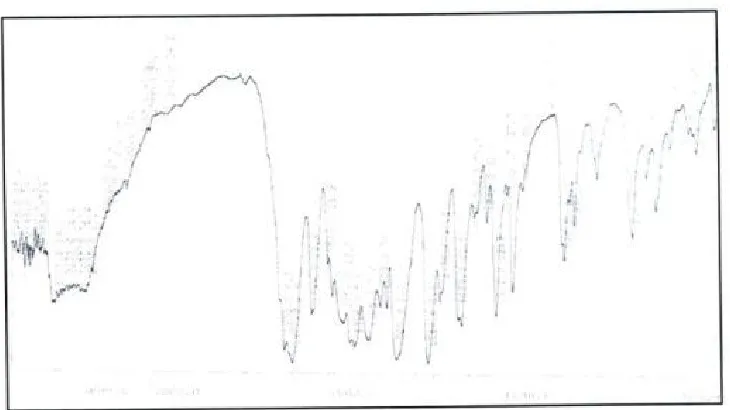
The powerful absorption tape at 1615cm-1 in IR scope (Figure 2) shows the factor group of C=N. The observed signal in 3.83 ppm in H-NMR scope of this form (figure 3) is related to CH2 hydrogen. All hydrogen of CH3O group are observed in 3.75ppm while the observed signals in 6.33 to 7.27ppm are related to relevant hydrogen of aromatic ring. The related hydrogen of CH imine is reported in the scope of 8 to 10ppm. The Anlmines CH in ligand is obvious in 8.42ppm.
Evaluation of crystalography of complexes
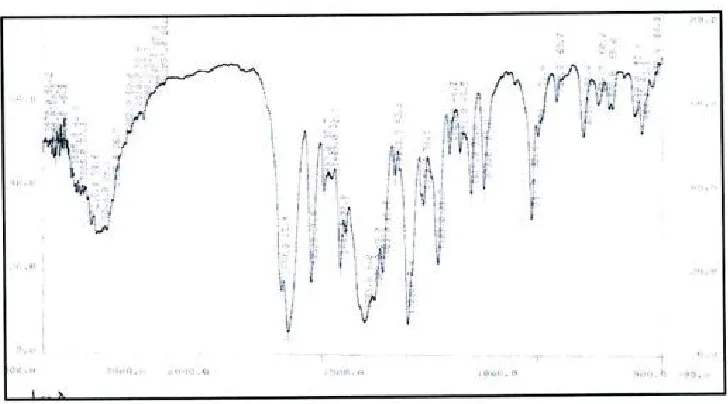
As it is obvious in figure 4, Ni(II) is four coordinated in relevant complex. This ligand is connected to Ni(II) through two oxygen atoms and two nitrogen ones in a form of four dents ligand. Relevant degrees of angles O(1)-Ni(1)-O(2), N(1)-Ni(1)-0(1), N(2)-Ni(1)-O(2) and N(1)-Ni(1)-N(2) are respectively as 85.42(9), 94.87(10) & 85.81 \(11). Then the angles of Ni(2)-Ni(1)-O(1), N(1)-Ni(1)-O(2) are respectively as 175.91(10) and 177.72(9) which may confirm urtrombic geometrical structure for Ni complex. This complex has been crystalized in urtromic crystaline system with spatial group of Pna21 which are manufacturing units of 4x mollecules. The tape of 1602cm-1 shows the factor group of C=N in relevant scope of IR of cupper complex (figure 5) which is obvious with lower frequency in comparison with relevant ligand absorption tapes (1615cm-1). It is a sign of coordination condition of metal to ligand. It is impossible to find out more complete information about coordination of ligands to metals and making any bridges and making multi-nucleic system and other details by IR scope. For finding a complete knowledge about this composition, it is very useful to use X-ray beam.
REFERENCES
1) Mitra Ghassemzadeh, Masoomeh Tabatabaee, Samaneh Soleimani and Bernard Neumuller. Synthesis, Characterization and Crystal Stractures of new 1,2,4-Triazole based Schiff-bases and their Copper(I) Complexes(Z.Anorg.Allg.Chem.631,2005).
1324 | Page
3) Mitra Ghassemzadeh , Masoomeh Tabatabaee , Mostafa M. Pooramini, Majid M. Heravi and Bernard Neumuller. Synthesis and Characterization of the first Copper(II) complex of 6-Azathymine crystal stricture of [CuCl2(H2O)2(AT)]2.2H2O;(AT=Azathymine) (Z.Anorg. Chem.630,2009 .
4) Masoomeh Tabatabaee , Mitra Ghasemzadeh ,Behnaz Zarabi , Majid M. Heravi and Mohammad Anari – Abbasinejad , Solvent – free microwave synthesis of
5) (Aryl – and Hetroaryl – methylene )- Amino – derivatives… thioxo – 2H-1,2,4-triazine. (Z.Anorg. Chem.630,2013)
6) Masoomeh Tabatabaee, Mitra Ghasemzadeh, Behnaz Zarabi and Bernard Neumuller. Synthesis and Crystal structural of Schiff- Based on AMTTO (AMTTO =4 amino ,6-methyl, 3- thio,3,4-dihydro.1,2,4-triazin-5(2H)-one, (Z.Anorg. Chem.632,2004)
7) S. Hajmohammadi, M. Tabatabaee, S. HajmohammadiI, N. B. Ghafoori, M. Parvez, Z. Kristallogr. Crystal structure of N,N'-bis(2-hydroxy-4-methoxysalicylidene)-ethylenediaminatonickel(II), Ni(C18H18N2O4)NCS 226 (2011) 131-132.
8) H.Schiff,Ann.Chem.1864,131,118.
9) S.Dayagi, Y.Degani,”The Chemistry of Of Carbon – Nitrogen Double Bound.,” ed.S.Patai,Willey – interscience, New York,1970,P.61.
10) R.W.Layer,Chem,Rev.,1963,63,489. 11) J.H.Billman,K.M.Taj,J.Org.Chem.1957,23,535. 12) M.E.Talor,T.J.Fletcher,J.Org.Chem.1961,26,946. 13) G.Reddelien,Chem,Ber.,1910,43,2470. 14) D.Y.Curting,J.W.Hausser,J.Amer.Chem,Soc.,1961,83,3414. 15) G.Reddelien,Chem.Ber.,1910,43,2470. 16) J.Kolsa,Arch.Chem.,1954,62,287.
17) R.L.Reeves,Chemistry of the Carbonyl Group .Ed.S.P. Patai., Interscience .,1966,P.567. 18) T.Tsumaki,Bull.Japan Chem.Soc.,1938,13,252.
19) H.Y.Han,Y.L.Song,H.W.Hou,Y.T.Fan,Y.Zhu,J.Chem.Soc.,Dalton Trans.2006,1972 .
20) E.Braun,C.D.Steffek,J.Kim,P.G.Rasmussen,O.M.Yaghi,Chem.Commun.,4,2002,401.
21) N.L.Rosi,M.Eddaoudi,J.Kim,M.O’Keeffe,O.M.Yaghi,Cryst.Eng.Commun.,4, 2002,401.
1325 | Page
23) B.Chen,M.Eddaoudi,S.T.Hyde,M.O’Keeffe,O.M.Yaghi,Science,291,2001, 1021.
24)J.Kim,B.chen,T.M.Reineke,H.Li,Eddaoudi,D.B.Moler,M.O’Keeffe,O.M.Yaghi,J.Am.Chem.Soc.,123, 2001,8239.
25) O.M.Yaghi,M.O’Keeffe,N.W.Ockwig,H.K.Cae,M.Eddaoudi,J.kim,Nature,423,2003,705.
26) P.M.Forster,A.K.Cheetham,Micropor.Mesopor.Mater.,73,2004,57.
27) W.K.Dong,Y.X.Sun,C.Y.Zhao,X.Y.Dong,L.Xu,Polyhedron,29,2010,2087.
28) M.Tabatabaee,M.Ghasemzadeh,B.Zarabi,Heravi,M M.Anary-Abbasinejad ,B .
29) Neumuller ,Phosphorus,Sulfur Silicon,And the Related Elements, 182,2007.
Reaction (1): Preparation of Open-Schiff reaction
H2-1326 | Page
Reaction (3) - Preparing of Salen H2- with intermediate metals like (Cu, Ni, Pd,…)
1327 | Page
Reaction 5
1328 | Page
Figure (1) - Complex molecular structure [NiL3(OAc)(CH3OH)]2Ni
1329 | Page
1330 | Page
Figure 4 -Crystalline strucutre of complex
1331 | Page
Figure 6- IR scope of iron complex