Corresponding author, email: [email protected] (R. Mohammadi). Tel.: +9841 34789019.
Asian Journal of Green Chemistry
Journal homepage: www.ajgreenchem.com
Orginal Research Article
Adsorption of azo dye methyl orange from aqueous
solutions using TiO
2-SiO
2/alginate nanocomposite
Robab Mohammadi
a,*, Nasrin Sabourmoghaddam
ba Department of Chemistry, Payame Noor University, PO box 19395-3697, Tehran, Iran
b Department of Environment and Natural Resources, Payame Noor University, P.O. Box 19395-3697 Tehran, Iran
A R T I C L E I NF O R MA T I O N A B S T R A C T
Received : 18 December 2018
Received in revised: 16 February 2019 Accepted : 18 February 2019
Available online : 6 April 2019
DOI: 10.33945/SAMI/AJGC.2020.1.9
In this research work, TiO2-SiO2/alginate nanocomposite with high surface
area has been prepared and applied as adsorbent for the removal of azo dye methyl orange from aqueous solutions. Characteristics of phases and crystallite size of TiO2-SiO2/alginate nanocomposite were obtained from XRD
and the surface area and pore size distribution were achieved from BET and BJH analysis methods. TiO2-SiO2/alginate nanocomposite with pure anatase
phase, the average crystallite size of 8.3 nm, has specific surface area of 188.4 m2/g–1. To find the nature of adsorption procedure, the equilibrium
adsorption isotherms were investigated. The linear correlation coefficients of Langmuir, Freundlich and Temkin isotherms were obtained. Based on results, Langmuir isotherm model fitted the experimental data better than the other models. According to the Langmuir isotherm model, the maximum adsorption capacity of TiO2-SiO2/alginate nanocomposite for sequestering
methyl orange was about 68.85 mg/ g−1. Furthermore, negative ΔG0 and ΔH0
values obtained through thermodynamic investigation indicated that the adsorption of methyl orange onto TiO2-SiO2/alginate nanocomposite was
simultaneous and exothermic in nature, respectively.
© 2020 by SPC (Sami Publishing Company), Asian Journal of Green Chemistry, Reproduction is permitted for noncommercial purposes.
KEYWORDS
TiO2-SiO2/alginate nanocomposite
Azo dye
Graphical Abstract
Introduction
TiO2 has attracted much consideration in last score years not only for its effectiveness as materials
for photoelectric conversion and catalysis, but also for its inexpensiveness, nontoxicity, easy production, outstanding chemical stability, and excellent degradation of organic pollutants [1]. To date, different investigations have been conducted that the application of mixed oxide such as TiO2/SiO2 is more effective than that of titanium dioxide [2]. The activity of TiO2 can be improved via
the addition of SiO2 which enhances the available surface area of the catalyst, allowing an increase in
adsorption of pollutant molecules. The improved adsorption of pollutant molecules on the surface of SiO2, in turn improves the catalytic activity of TiO2/SiO2 mixed oxides as compared to pure TiO2 [3].
However, it is difficult to remove nanosized crystals from treated wastewater because of the ir fine size; one effective alternative to overcome this problem is to find a suitable support for the immobilization of nanomaterials [4]. The usage of immobilized nanomaterials has several advantages, including easy separation of the adsorbent, high adsorbent density and enhancing the retention of adsorbent in the reactor [5]. The entrapment of adsorbents such as unsupported nanomaterials within a polymeric matrix is one of the techniques applied for immobilization. The application of polymeric matrixes such as alginate, chitosan and different resins is one of the most widely applied techniques to immobilize. In recent years, chitosan has demonstrated multifunctional performance with TiO2 in heterogeneous photo catalysis procedure, including its application as a
stabilizer, a recovery agent for enhancing the adsorption capacity of TiO2/chitosan adsorbent in the
pollutant species [6‒8]. In addition, adsorption capacity of the chitosan for sequestering anionic dyes because of the electrostatic attraction between the protonated amine groups on the chitosan and the sulfonic groups of the anionic dyes would be beneficial to increase the adsorption of anionic dyes together with the immobilized adsorbent [9].
Herein from the viewpoint of environmental friendliness, TiO2-SiO2/alginate nanocomposite as an
adsorbent was prepared, and we would like to further describe the possibility over the effectiveness of removal of anionic dye methyl orange from aqueous solutions. Meanwhile, characterization of nanocomposite and relevant investigations over the adsorption procedure and thermodynamic were also discussed. To the best of our knowledge, there is no report on the application of TiO2
-SiO2/alginate nanocomposite for the adsorption of textile dyes such as methyl orange in aqueous
solutions.
Experimental
Materials and methods
Titanium n-butoxide (TBOT), tetraethyl orthosilicate (TEOS), ethanol of absolute grade, sodium hydroxide, acetic acid, nitric acid and methyl orange were purchased from Merck Co (Germany). Chitosan, which was of analytical grade,was purchased from Sigma Aldrich, USA.
Preparation of SiO2/TiO2 mixed oxides bysol–gel method
SiO2-TiO2 mixed oxides with 15 mol% SiO2 contents was synthesized via sol–gel method [3].
Initially, titanium n-butoxide was slowly dissolved in absolute ethanol. Then, distilled water was added drop by drop into a flask containing TBOT/EtOH mixture under reflux and magnetic stirring. The molar ratio of TBOT/EtOH/H2O was 1:1:65. The yellowish transparent titania sol was yielded
after continuously stirring for 3 h. Tetraethyl orthosilicate was dissolved in ethanol, after which a few drops of nitric acid were added to TEOS as catalyst. The pH of mixed solution was adjusted to about 3. The molar ratio of TEOS/EtOH was 1:2. Afterward, the mixture was kept in a water bath maintained at 70 °C for 2 h. This mixture was added drop wise to the titania sol and stirred for 1 h at reflux temperature. This solution was placed in a teflon-lined stainless steel autoclave, in which it was heated at 150 °C for 24 h, and then calcined at 500 °C for 2 h with a heating rate of 10 °C/min in air atmosphere.
Preparation of TiO2-SiO2/alginate nanocomposite
To prepareTiO2-SiO2/alginate nanocomposite, first chitosan (8 g) was dissolved in 1000 mL of 1
the concentrated solution and magnetically stirred for 1 h to reach homogeneity. The resulted mixture was kept for 8 h in a stable place. The weight ratio of chitosan to TiO2-SiO2 was 2:1. The
mixture was added dropwise via a syringe to a 500 mL solution containing 15% NaOH and 85% ethanol. Then, they were stored in the solution for 24 h to allow the nanocomposite to be produced. The resulted nanocomposite was withdrawn from the solution and washed with deionized H2O
several times to remove impurities. The obtained nanocomposite was dried in room temperature.
Characterization of prepared samples
The crystal phase composition and the crystallite size of synthesized catalysts were recorded using X-ray diffraction (XRD) (Siemens/D 5000) with Cu Kα radiation (0.15478 nm) in the 2θ scan range of 10°–70°. The average crystallite size (D in/nm) was calculated using Scherrer’s formula [10]:
𝐷 = 𝑘𝜆
𝛽𝑐𝑜𝑠𝜃 (1)
where k is a constant equal to 0.89 λ, the X-ray wavelength equal to 0.154056 nm, β, the full width at half maximum intensity (FWHM) and θ, the half diffraction angle. Transmission electron microscopy (TEM) observation was carried out on Zeiss EM 900–80 keV electron microscopy instrument. The texture and morphology of the prepared nanocomposite was measured via scanning electron microscope (SEM) (Philips XL-30ESM). The nitrogen adsorption and desorption isotherms at 77 K were measured using BELSORP mini II. The specific surface area and the pore size distribution (Average pore diameter and mean pore volume) were measured from the adsorption isotherm using the brunauer-emmett-teller (BET) method and from the desorption isotherm using the barret-joyner-halender (BJH) method, respectively.
Experimental procedure
Adsorptive removal of methyl orange was used as a model reaction to investigate the catalytic activity of synthesized samples. The catalytic activity measurements carried out at atmospheric pressure in a batch quartz reactor. For the batch adsorptive removal of methyl orange via TiO2
-SiO2/alginate nanocomposite without light illumination, the set-up was placed inside a fully covered
box in order to prevent any exposure towards light irradiation. In each run, 40 mg of prepared sample and 20 mg/L-1 of dye were fed into the quartz tube reactor. The residual of dye was determined via
𝑞 =(𝐶0 − 𝐶) 𝑉
𝑀 (2)
where q, Co and C are the amount of adsorbed methyl orange (mg/g_1), the initial concentration and
the final concentration of dye in the solution (mg/L-1), respectively. In addition, V is the volume of
the solution (L) and M is the weight of the catalyst (g)[11].
Results and Discussion
Characterization of prepared samples
X-ray diffraction
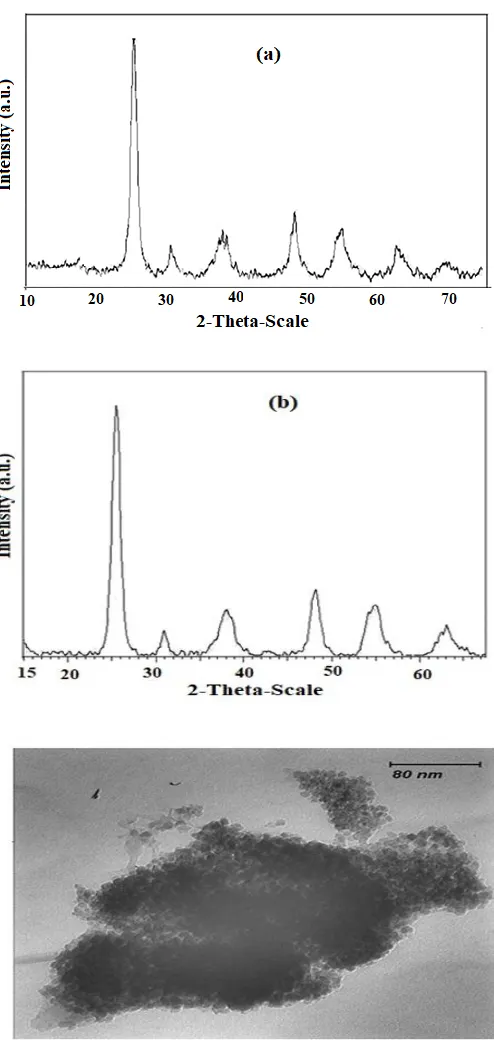
XRD patterns of TiO2-SiO2 and TiO2-SiO2/alginate samples are shown in Figure 1. Pure
anatasephase can be seen for the prepared samples. No SiO2 crystal phase was observed in the
samples. This shows that SiO2 existed as an amorphous phase in the SiO2-TiO2 mixed oxides [12]. The
shape and the location of the peaks of TiO2-SiO2 and TiO2-SiO2/alginate sample are the same,
indicating that TiO2-SiO2/alginate synthesis have no influence on the characteristic structure of TiO2
-SiO2. The average size of crystallites for TiO2-SiO2 and TiO2-SiO2/alginate determined from the XRD
pattern based on the Scherrer’s formula were about 10 and 8.3 nm, respectively. Smaller crystal size
obtained for TiO2-SiO2/alginate implies that chitosan biopolymer is able to hinder the crystal growth
of TiO2-SiO2.
TEM analysis of TiO2-SiO2/alginate nanocomposite
Figure 2 shows TEM image of TiO2-SiO2/alginate nanocomposite. It can be seen that the particles
exhibit a relatively uniform particle size distribution. The average size of the primary particles estimated from the TEM image is about 8-10 nm, which is in good agreement with that calculated from the XRD pattern using Scherrer equation.
SEM analysis of TiO2-SiO2/alginate nanocomposite
SEM image of TiO2-SiO2/alginate nanocomposite is shown in Figure 3. A rough structure on
surface for prepared nanocomposite can be seen from this Figure. The roughened surface is suitable for sequestering dye molecules in aqueous phase. Also, Figure 3 implies TiO2-SiO2/alginate
nanocomposite has a highly porous structure proposes the appropriate of the nanocomposite as adsorbent for removal of methyl orange from aqueous solutions.
Figure 4 shows nitrogen adsorption-desorption isotherms of TiO2-SiO2/alginate nanocomposite,
which provide information about the structural properties and pore geometries of the prepared composite. From this Figure, TiO2-SiO2/alginate nanocomposite shows the isotherm of type IV. At
high relative pressure range from 0.4 to 1, the isotherm exhibits a hysteresis loop of type H2 associated with the ink bottle pores, implying that the powders contain mesopores because of the aggregation of crystallites [13].
Figure 1. XRD patterns of a) TiO2-SiO2, b) TiO2
-SiO2/alginate
Figure 2. TEM image of TiO2
Figure 3.SEM image of TiO2-SiO2/alginate nanocomposite
Figure 4.N2 adsorption–desorption isotherms of TiO2-SiO2/alginate nanocomposite
The hysteresis loopin the lower relative pressure range (0.4<P/P0) was attributed to the finer
intra-aggregated pores generated between intra agglomerated primary particles, and that in the higher relative pressure range (0.8<P/P0<1) was associated with larger interaggregated pores
formed via interaggregated secondary particles. The porous structure is believed to facilitate the transporting of reactant molecules and products through the interior space because of the interconnected porous frameworks and favor the harvesting of exciting light due to enlarged surface area and multiple scattering within theporous network [14]. Figure 5 shows the pore size distribution of TiO2-SiO2/alginate nanocomposite as estimated according to the BJH method from the
adsorption branch. With hybridization of TiO2-SiO2 with alginate, the average pore size decreases
slightly from 9.4 to 8.13 nm. The aggregation of smaller crystallites forms smaller pores.
BET characterization implies that hybridization of TiO2-SiO2 with alginate enhances its pore
0.168 cm3/g−1 of TiO2-SiO2 (It is not shown for TiO2-SiO2). The specific surface areas of TiO2
-SiO2/alginate nanocomposite and TiO2-SiO2 are 188.4 and 95.03 m2/g−1, respectively. It can be
concluded that the hybridization of TiO2-SiO2 with chitosan may significantly increase its surface
area. Chitosan inhibits particle growth during drying step because of mixed bond Ti/O/C, which can prevent the interaction among Ti particles. It is known that large specific surface area can allow more pollutants to be absorbed onto the surface of catalyst. Therefore,TiO2-SiO2/alginate nanocomposite
is a catalyst with better activity.
The effect of reaction time
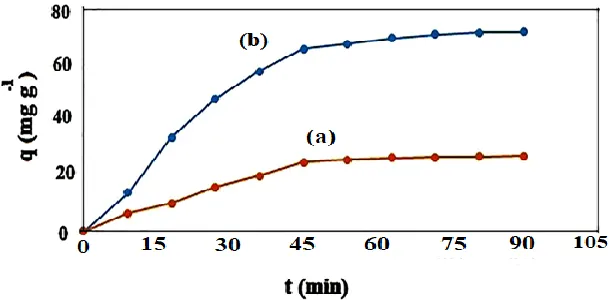
Figure 6 shows the adsorptive removal of methyl orange from aqueous solution using prepared samples. From Figure 6, the efficiency of methyl orange removal in the presence of TiO2-SiO2/alginate
nanocomposite is higher than that of TiO2-SiO2. Particle size is an important parameter influencing
catalytic activity, since it directly impacts the specific surface area of a catalyst. When particle size is small, the number of active surface sites increases. Therefore, more pollutants can be absorbed onto the surface of catalyst [14]. Also, the superior removal efficiency of TiO2-SiO2/alginate
nanocomposite may be related to a larger surface area compared to TiO2-SiO2. A large surface area
can be an important parameter in certain catalytic decolorization reactions, as a large amount of adsorbed organic pollutants promotes the reaction rate [15]. Accumulation of a substance between the liquid–solid interface or gas–solid interface because of physical or chemical associations is termed an adsorption procedure. Adsorption process can be controlled via physical parameters on most of the adsorbents such as polarity, Van der Waals forces, hydrogen bonding, dipole–dipole interaction, π–π interaction, etc. [16]. So, the design of an adsorbent generally depends on the type of substance to be adsorbed or removed. Methyl orange as an anionic dye can be removed via an adsorbent showing strong affinity toward negatively-charged species. The incorporation of TiO2 with
Ti-OH groups into the chitosan with positively charged amino groups led to the grafting of these functional groups which is desirable for the adsorption of methyl orange containing negatively charged carboxylic groups. This electrostatic force of attraction could be the essential driving force leading to the increased adsorption of methyl orange. So, the presence of chitosan in synthesized nanocomposite plays a crucial role in the removal of anionic dye from aqueous solutions [17].
Figure 5.Pore diameter distribution of TiO2-SiO2/alginate nanocomposite
Figure 6.Effect of contact time on methyl orange adsorption onto a) TiO2-SiO2, b) TiO2-SiO2/alginate
with passage of time, the remaining vacant surface sites are difficult to be occupied because of repulsive forces between the solute molecules on the solid phase and in the bulk liquid phase [18].
The effect of temperature and thermodynamic study
(kJ/mol-1), enthalpy change (ΔH0) (kJ/mol-1) and entropy change (ΔS0) (kJ/mol-1/K_1) for the
adsorption of MB were calculated through Eqs. (3) and (4):
Δ𝐺0= −𝑅𝑇𝑙𝑛𝐾𝐷 (3)
𝑙𝑛𝐾𝐷= ( ΔS0
𝑅 ) − ( ΔH0
𝑅𝑇) (4)
where R, T (K) and KD (qe/Ce) are the universal gas constant, temperature and the distribution
coefficient, respectively [20]. To investigate the thermodynamic of methyl orange adsorption onto
TiO2-SiO2/alginate nanocomposite, thermodynamic constants such as ΔG0, ΔH0 and ΔS0 were
calculated using Eqs. (3) and (4). The thermodynamic parameters were tabulated from the plot of ln KD versus 1/T (Figure 7). The values of these parameters are summarized in Table 1. As exhibited,
the negative ΔH0 and ΔG0 values, demonstrated that the adsorption of methyl orange onto TiO2
-SiO2/alginate nanocomposite was exothermic and spontaneous in nature, respectively [20]. The
value of ΔG0 was declined with enhancing temperature from 298 to 328 K, suggesting favorable
adsorption of methyl orange onto nanocomposite at low temperature. The negative value of ΔS0
reveals the decrease of degree of freedom of adsorbed dye on the binding sites of the nanocomposite at the solid–solution interface, indicating a strong binding of dye ions onto the active sites [21].
Adsorption isotherm analysis
The equilibrium adsorption isotherms can be used to investigate the nature of adsorption process and describe the interaction of solutes with adsorbent. Langmuir, Freundlich and Temkin models as the most widely used isotherm models were investigated. The linear form of the Langmuir model is shown via Eq. (5):
Figure 7.Thermodynamic
profile for methyl orange adsorption onto TiO2
Table 1. Obtained parameters from thermodynamic study of methyl orange adsorption onto TiO2
-SiO2/alginate nanocomposite
Temperature (K) (ΔG0) (kJ/mol-1) (ΔS0) (kJ/mol-1/K-1) (ΔH0) (kJ/mol-1)
298 -1.299 -0.064 -20.56 303 -1.046 - - 308 -0.765 - - 313 -0.415 - -
1 𝑞𝑒
= ( 1
𝐾𝑙𝑞𝑚 ) 1 𝐶𝑒 + 1 𝑞𝑚 (5)
where qm (mg/g_1), qe (mg/g_1), Ce (mg/L-1) and KL (L/mg_1) are the maximum amount of adsorbed
dye per unit weight of the adsorbent, the amount of methyl orange adsorbed at equilibrium, the equilibrium concentration of methyl orange and the affinity of the binding sites (Langmuir constant), respectively [22]. Essential features of Langmuir isotherm model can be expressed in term of separation factor, RL, as below equation:
𝑅𝐿=
1 1 + 𝐾𝑙𝐶0
(6)
where Co (mg/L_1) is the initial dye concentration [23]. The linear form of the Freundlich isotherm
model is shown via Eq. (7):
ln 𝑞𝑒=
1
𝑛𝑙𝑛𝐶𝑒+ 𝑙𝑛𝐾𝐹 (7)
where n and KF[(mg g_1) (L mg_1)1/n]are the constant related to the adsorption intensity and the
constant related to adsorption capacity, respectively [24].
The linear form of the Temkin isotherm model is shown via Eq. (8):
𝑞𝑒= 𝐵1𝑙𝑛𝐶𝑒+ 𝐵1𝑙𝑛𝐾𝑇 (8)
where KT (L/g-1) and B1 are equilibrium binding constant and the heat of adsorption, respectively
[25].
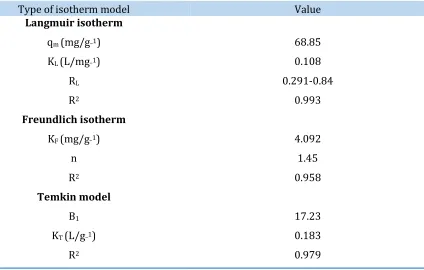
The values of Langmuir, Freundlich and Temkin parameters can be estimated from the slope and intercept of linear plots of 1/qe versus 1/Ce, ln qe versus ln Ce and qe versus ln Ce, respectively. From
As can be seen in Table 2, the obtained correlation coefficient for Langmuir isotherm model (R2=0.993)was higher than that of Freundlich model (R2=0.958) and Temkin model (R2=0.979),
which implies the suitability of Langmuir isotherm model for describing adsorption of methyl orange onto TiO2-SiO2/alginate nanocomposite. Based on Langmuir model, the maximum adsorption
capacity of TiO2-SiO2/alginate nanocomposite for the adsorption of methyl orange was found to be
68.85 mg/g-1. The values of RL arranged as RL= 0, 0<RL<1 and RL>1 propose that adsorption is
irreversible, favorable and unfavorable, respectively. Table 2 shows that RL values are between 0.291
and 0.84, which indicates the adsorption of methyl orange onto TiO2-SiO2/alginate nanocomposite is
favorable [26].
Table 2. Isotherm parameters for methyl orange adsorption onto TiO2-SiO2/alginate nanocomposite
Type of isotherm model Value
Langmuir isotherm
qm (mg/g_1) 68.85
KL (L/mg_1) 0.108
RL 0.291-0.84
R2 0.993
Freundlich isotherm KF (mg/g_1) 4.092
n 1.45
R2 0.958
Temkin model
B1 17.23
KT (L/g_1) 0.183
R2 0.979
Conclusion
The present study was carried out to prepare and investigate the efficiency of TiO2-SiO2/alginate
nanocomposite to adsorb and degrade methyl orange from aqueous solution. The XRD results showed that the crystallite size decreased but an increase in surface area, pore volume, and adsorption ability was observed. SEM analysis proved a highly porous structure for TiO2
-SiO2/alginate nanocomposite, which is suitable for sequestering dye molecules in aqueous phase. The
separation factor, RL, was obtained less than 1, implying the favorable nature of methyl orange adsorption on TiO2-SiO2/alginate nanocomposite. Besides, the results of thermodynamic
investigation showed that the adsorption of methyl orange by TiO2-SiO2/alginate nanocomposite is
spontaneous and exothermic.
Acknowledgments
The authors acknowledge the support of the Payame Noor University of Iran.
Disclosure Statement
No potential conflict of interest was reported by the authors.
References
[1]. Rana M.S., Maity S.K., Ancheyta G., Murali Dhar G., Prasada Rao T.S.R. Appl. Catal. A., 2004, 258:215 [2]. Mohammadi R., Eskandarloo H., Mohammadi M. Desalin. Water Treat., 2015, 55:1922
[3]. Mohammadi R. Desalin. Water Treat., 2016, 57:22370
[4]. Darvishi Cheshmeh Soltani R., Shams Khorramabadi G., Khataee A.R., Jorfi S. J. Taiwan Inst. Chem.
Eng., 2014, 45:973
[5]. Luan T.G., Jin J., Chan S.M.N., Wong Y.S., Tam N.F.Y. Process Biochem., 2006, 41:1560 [6]. Sayilkan F., Bilge Emre F. Turk. J. Chem., 2016, 40:28
[7]. Nawi M.A., Jawad A.H., Sabar S., Ngah W.S.W. Desalination., 2011, 280:288 [8]. Chang M.Y., Juang R.S. J. Colloid. Interface. Sci., 2004, 278:18
[9]. Darvishi Cheshmeh Soltani R., Khataee A.R., Safari M., Joo S.W. Int. Biodeter. Biodegr., 2013,
85:383
[10]. Chen M.L., Park C.Y., Choi J.G., Oh W.C. J. Eur. Ceram. Soc., 2011, 48:147 [11]. Hojamberdiev M., Zhu G., Eminov A., Okada K. J. Clust. Sci., 2013, 24:97 [12]. Akhavan O. J. Coll. Interface. Sci., 2009, 336:117
[13]. Mohammadi R., Massoumi B., Rabani M.Int. J. Photoenergy, 2012, 2012:11 pages [14]. Madhusudan P., Ran J., Zhang J., Yu J. Liu G. Appl. Catal. B., 2011, 110:286
[15]. Yu J.G., Zhao X.J., Du J.C., Chen W.M. J. Sol-gel. Sci. Technol., 2000, 17:163 [16]. Chaturvedi S., Dave P.N., Shah N.K. J. Saudi Chem. Soc., 2012, 16:307 [17]. Sharma V., Rekha P., Mohanty P. J. Mol. Liq., 2016, 222:1091
[18]. Bao N., He S., Zhang Q.Z., Yin Z., Zhang Y.X., Xu X.H. Ceram. Int., 2015, 41:5916
[21]. Lawal O.S., Sanni A.R., Ajayi I.A. J. Hazard. Mater., 2010, 177:829 [22]. Ahmaruzzaman M., Gayatri S.L. J. Chem. Eng. Data, 2010, 55:4614 [23]. Langmuir I. J. Am. Chem. Soc., 2000, 38:2221
[24]. Rahmani A., Zavvar Mousavi H., Fazli M. Desalination., 2010, 253:94
[25]. Khorramabadi G.S., Darvishi Cheshmeh Soltani R., Rezaee A., Khataee A.R., Jonidi Jafari A. Can. J.
Chem. Eng., 2012, 90:1539
[26]. Mohammadi R., Massoumi B., Emamalinasabb B., Eskandarloo H., Desalin. Water Treat., 2017,
82:81
How to cite this manuscript: Robab Mohammadi*, Nasrin Sabourmoghaddam. Adsorption of azo dye methyl orange from aqueous solutions using TiO2-SiO2/alginate nanocomposite.Asian Journal