Volume 3, Issue 3 May- June -2016
1
ISRA IMPACT FACTOR: 0.46
PELLETS: AS PHARMACEUTICAL DOSAGE FORM
Ghorpade I.P.*
1, Pande V.V.
1, Mahanavar S.M
1, Jadhav K.S.
1, Deshmukh P.D.
2.Abstract: Pelletization is a technique to convert drugs or excipients to small free flowing, spherical or semi spherical units, which are produced by agglomerating fine powdered drugs/ excipients with a binder solution. Pellets range in size, typically, between 0.5 – 2 mm. these pelletized dosage forms have gained popularity considerably from then because of their distinct advantages, such as ease of capsule filling because of the better flow properties of the perfectly spherical pellets; enhancement of drug dissolution; ease of coating; sustained, controlled, or site-specific delivery of the drug from coated pellets; uniform packing; even distribution in the GI tract; and less GI irritation. Pelletized dosage forms can be prepared by a number of techniques, including drug layering on nonpareil sugar or microcrystalline cellulose beads, spray drying, spray congealing, roto granulation, hot-melt extrusion, and spheronization of low melting materials or extrusion-spheronization of a wet mass. The techniques namely extrusion-spheronization, hotmelt extrusion, freeze pelletization, cryopelletization have been discussed along with formation requirement for the process, parameters affecting pelletization. Evaluation of quality of the pellets is discussed with reference to the size distribution, shape, specific surface area, friability, tensile strength, porosity.
Key words: pellets, pelletization, extrusion- speronization.
1. INTRODUCTION:
Pelletization is often referred to as a size-enlargement process that involves the manufacture of agglomerates with a relatively narrow size rang, usually with mean size 0.5 to 2 mm named pellets1. Pellets are small particles
typically created by compressing an original materiel. Pellets is small, free flowing, spherical or semi-spherical solid units, typically from about 0.5mm to 1.5mm and intended usually for oral administration, manufactured by the agglomerates of fine powders or granules of bulk drug and excipients using appropriate processing equipment (2).
Pellets are defined as spherical, free-flowing granules with a narrow size distribution, typically varying between 500 and 1500 µm for pharmaceutical applications (3). Pellets can
be various kinds of subunits with defined less porous surface, spherical shape and low surface area to volume ratio, suitable for flexible and uniform drug polymer
(4).pellets are generally produced via a pelletization
process, whereby a powder blend consisting of an API and excipient particles is agglomerated into spherical granules. After being produced, pellets are usually filled into hard gelatin capsules or compressed into tablets.
******************************************
Ghorpade I.P.*1, Pande V.V.1, Mahanavar S.M1, Jadhav K.S.1, Deshmukh P.D.2. Department Of Pharmaceutics, Sanjivani College of Pharmaceutical Education and Research, Kopargaon, Dist: Ahmednagar-423603, Maharashtra, India.
Furthermore, they can be formulated as immediate release dosage forms or coated in order to sustain drug release over a longer period of time or to deliver a drug to a specific site of action in the gastrointestinal tract.
They most widely used today:
Regardless of which manufacturing process is used, pellets have to meet the following requirements. They should be near spherical and have a smooth surface; both considered optimum characteristics for subsequent film coating.
The particle size should be as narrow as possible. The optimum size of pellets for pharmaceutical use is considered to be between 600 and 1000mm.
The pellets should contain as much as possible of the active ingredient to keep the size of the final dosage form within reasonable limits. They should be near spherical and have a smooth surface; both considered optimum characteristics for subsequent film coating.
2
Improved appearance of the product. Coating of pellets can be done with different drugs to enable a controlled release rate.
In the case of release product larger surface area of pellets better distribution.
Chemically incompatible product can be formed into pellets and delivered in a single dose by encapsulating them.
In the chemical industries it is used to avoid powder dusting.
Varied applications are possible in the pellet form. Eg. Sustained release.
The coating material may be colored with a dye materials so that the beads of different coating thickness will be darker in color and distinguishable from those having fewer coats.
The beads or granules of different thickness of coating are blended in the desired proportions to give the desired effect.
The thickness of the coat on the pellets dictates the rate at which the drug/ contents are released from the coated particles. A smooth surfaced of the pellets and uniform coating thickness for each pellets.
By selecting the proper formulation, processing conditions and processing equipment it is possible to attain smooth surfaced and uniform pellets.
Pellets have good flow properties which ensure reproducible die or capsule filling and consequently good content uniformity (5).
1.2 Advantages of pellets:
Pellets have some important pharmacological as well as technological advantages over conventional “single-unit” solid dosage forms. The advantages are:
Improved the appearance of the product as well as the core is pharmaceutically elegant.
Pelletization offers flexibility in dosage form design and development.
Mechanism. Any coating imperfection would therefore only affect the release of a small drug portion, in contrast to complete “dose dumping” from a single-unit drug reservoir. Pellets are less susceptible to dose dumping.
Pellets offer the possibility of combining several active components, incompatible drugs or drugs with different release profiles in the same dosage unit.
A pellet reduces localized concentration of irritative drugs.
It improves safety and efficacy of drugs.
Pellets reduced variation in gastric emptying rate and transit time.
It disperses freely in GIT and invariably maximizes drug absorption and also reduce peak plasma fluctuation.
Pellets improved flow properties in formulation development.
Without process/ formulation changes possibility of developing of developing different dosage strengths.
Pellets have stable therapeutic effect over single unit dosage forms.
It is used to provide different release profile at the same or different sites in the gastrointestinal tract.
Pellets offer high degree of flexibility in the design and development of oral dosage form like suspension, sachet and capsule.
It disperses freely in gastro intestinal tract, increasing drug absorption, and reducing local irritation of mucosa by certain irritant drugs.
It released active ingredients may offer a greater bioavailability than usual drugs.
Good tolerability- it reduces side effects by maintaining plasma levels within the therapeutic zone. It delivers steady plasma levels hour by hour for day and nightcontrol.
Better patient compliance- orally disintegrating MUPS tablets having a palatable taste which is suitable for pediatric and geriatric patients who cannot swallow tablets or capsule.
Uniform emptying of micro pellets from stomach into small intestine facilitates rapid dissolution of enteric coating and drug release resulting in tmax and Cmax (peak time and peak plasma concentration) in case of delayed- release formulation (6).
1. RATIONAL OF WORK:
3
counterpart. Particles smaller than 2-3 mm are rapidly emptied from the stomach regardless of the feeding state of the patient and the influence of gastric emptying rate on the upper gastro-intestinal transit time of pellets is minimized, thus lowering the intra- and inter-subject variability of drug plasma profiles compared to single-unit formulations. The pellets should contain active ingredient to keep the size of the final dosage form within reasonable limits. The uniform dispersion of a drug into small dosage units reduces the risk of high local drug concentration and their potentially irritating effect on gastric mucosa.
2. METHODOLOGY OF PELLETS: 3.1 Formulations of pellets:
Excipients for pellets:
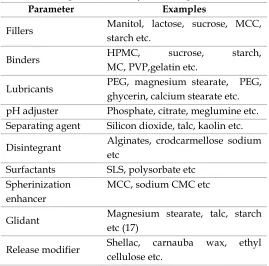
excipients are used to convert the active pharmaceutical ingredient into dosage forms suitable for administration to patients. Since pellets are intended to be administered orally, the excipient used in the pellets dosage forms are typically the same as those used in tablet or capsule formulations. The excipients are disintegrant, surfactants, pH adjusters, separating agents, spherinization enhancers, glidants and release modifiers etc. some examples of such excipients are given in table 1.
Table 1: example of commonly used excipients (7)
Parameter Examples
Fillers Manitol, lactose, sucrose, MCC, starch etc.
Binders HPMC, sucrose, starch, MC, PVP,gelatin etc.
Lubricants PEG, magnesium stearate, PEG, ghycerin, calcium stearate etc. pH adjuster Phosphate, citrate, meglumine etc. Separating agent Silicon dioxide, talc, kaolin etc.
Disintegrant Alginates, crodcarmellose sodium etc
Surfactants SLS, polysorbate etc Spherinization
enhancer
MCC, sodium CMC etc
Glidant Magnesium stearate, talc, starch etc (17)
Release modifier Shellac, carnauba wax, ethyl cellulose etc.
Polymer:
The nature of the polymer, type and amount of polymer coating has significant impact on the compression-induced changes in the film coating structure.
Nature of polymer and polymer coating:
Polymers play an important part in any controlled or modified-release dosage form. The final release of the drug from the formulation depends on the polymer used. A polymer must have appropriate plastic and elastic properties to withstand the shear of compression and compaction (16). Polymers used in the film coating of solid dosage forms fall into two broad groups; cellulosic polymer and acrylic polymer. Many of the polymers used for controlled release have been formulated into aqueous dispersions so as to overcome the disadvantages associated with the use of organic polymer solutions. The polymer coating should be highly elastic and flexible to be able to adapt to the deformation of the pellets without rupturing. The polymer coat shout not get ruptured during compression. It should have sufficient mechanical stability and should remain intact during compression in order to control the drug release.
Amount of polymer coating:
The amount of coating has its role in protecting the polymer film integrity during compression. A thicker coating can withstand damage better than a thinner one. The elasticity improves with the coating thickness of elastic coatings. It was found that the coating must be at least a specific lowest thickness for the elasticity to have a synergistic effect on reduction of the coating damage during compaction. It was concluded that thicker coatings offer better resistance to frictional forces, and consequently cracks that are introduced into the coating during compression.
3.2 Method of preparation of pellets:
Compaction and drug layering are the most widely used pelletization techniques in pharmaceutical industry. In the compaction techniques, extrusion, and spheronization is the most popular method. Other pelletization methods such as globulation, balling and compression are also used in development of pharmaceutical pellets although in a limited scale.
Powder layering:
4
picked off by the wet mass of pellets that is being layered. If the process is set-up properly, hourly weight gains up to 300% are possible, which indicates the processing option is very fast and efficient.
Solution / suspension layering:
Solution / suspension layering involves the deposition of successive layers of solution or suspensions of drug substances and binder over the starter/ non-partial seeds, which is an inert material or crystals/ granules of the same drug. In fact the coating process involved in general is applicable to solution or suspension layering technology. Conventional coating pan, fluidized beds, centrifugal granulators, wurster coaters have been used successively to manufacture pellets by this method (8).
Pelletization by extrusion and spheronization:
The process involves first making the extrude from the powder material and then converting the extrudes into beads using the spheronizer. The powder material could be any kind of powder (drug powder, ayuevedic powder, food ingredient powder, detergent powder, nuclear powder etc.). Beads as fine as 0.6mm can be made. The process parameters of the extruder should be as much investigated as the formulation since they have a major impact on the final product characteristics (9). This
technique for production of pellets with high quality. Due to the fact that it is multi-step process, a number of process parameters should be controlled. The pelletized product can improve the safety and efficacy of the active agent (10).
It involves several distinct preparation phases: a uniform powder mixture of drug and excipients is wet massed by the addition of a liquid binder, followed by pressing of the moistened mass through an extrusion screen (extrusion) to form cylindrical extrudates, which are subsequently broken into smaller cylindrical rods and rounded into spherical granules by means of a fast friction plate and finally dried.
Other methods of pelletization:
Other methods of pelletization such as globulation, cryopelletization, balling and compression are used, although a limited scale in the preparation of pharmaceutical pellets.
Globulation or droplet formations consists two related processes spray drying and spray congealing.
Spray drying:
It is the process in which drugs in the suspension or solution without excipients are sprayed in to a hot stream to produce dry and more spherical particles. This process
is commonly used for improving the dissolution rates; hence bioavailability of poorly soluble drugs.
Spray congealing:
It is the process in which a drug is allowed to melt, disperse or dissolve in hot melts of gums, waxes or fatty acids, and is sprayed into an air chamber where the temperature is kept below the melting point of the formulation components, to produce spherical congealed pellets. Both immediate and controlled release pellets can be prepared in this process depending on the physiochemical properties of the ingredients and formulation variables (18).
Freeze pelletization:
Freeze pelletization is a simple and technique. In this technique a molten solid carrier along with a dispersed active ingredient is introduced as droplets into an immiscible column of liquid. The technique involves less process variable and also offers several advantages over other pelletization methods (3).
Compression:
It is type of compaction technique for preparing pellets. Compacting mixtures or blends of active ingredients and excipients under prepare pellets of definite sizes and shapes. The formulation and process variables controlling the quality of pellets prepared are similar to those in tablets manufacturing.
Balling:
It is the pelletization process in which pellets are formed by a continuous rolling and tumbling motion in pans, discs, drums or mixtures. The process consists of conversion of finally divided particles in to spherical particle upon the addition of appropriate amounts of liquid.
Fluidized bed processer:
Fluidized bed processer is equipment that can perform multiple functions like coating, drying, granulation and pelletizing.
Top spray coating:
5
Bottom spray coating:The process suitable for pellets suspension coating or film/ sugar coating, particularly useful for a control release active ingredients. When the hot air flows through the bottom screen of container and coating column, it will generate the siphon age principle. Convection is created through the strong force from bottom toward top. The granules will then fall down and will be sucked into the coating column again, while the bottom spray gun will spray towards top to achieve coating purpose.
Tangential spray coating (Rotor pellet coating):
This process is particularly suitable for pellets powder coating, suspension coating or film/ sugar coating. In this process the cores are placed on the turntables and hot are blown upward between the turntables and the granulation area. The passage of air causes the cores to roll on the turntables. At the same time, the coating solution is sprayed on the rolling cores through the pump and spray gun. The process involves simultaneous coating and draying of the cores, layer after layer, until the repeated actions achieve the desired coating thickness or granule size.
3.3 Characterization of pellets: Size of pellets:
At the same coating level, smaller pellets were more fragile than larger pellets. This was attributed to the reduced film thickness of the smaller pellets because of the larger surface area. Small pellets have been found to be less affected than larger pellets by the compaction process. The smaller beads were significantly stronger, relative to their size, than the larger ones (11). The size of the coated
pellets can be maximum upto 2mm to withstand compression pressure. Thus influences content uniformity of the final tablets. To avoid segregation within the pellet-excipient mixture, some authors prefer filler-binders that are almost equal in size to the pellets (12). If increasing the
particle size resulted in more damage to the coating, as indicated by larger differences between the release profiles of compressed and uncompressed pellets.
Shape of the pellets:
The shape-increased degree of granule deformation during compression resulted in tables of a more closed pore structure and a higher tensile strength. An irregular shape and a rougher surface texture made the granules less sensitive to lubrication in terms of their compatibility. This was possibly the result of a rupture of the lubricant film due to deformation or attrition during compression, or of an incomplete surface coverage of the granules by the
lubricant before compression. The shape of the pellets should be spherical or nearly spherical for good rhombohedral packing. A more deviation in spherical shape does not result in compacts of characteristic release due to flaws and cracks during compression.
Density of pellets:
Density of pellets is of particular importance especially if it is required to achieve prolonged gastric residence. Density and size of the pellets play an important role in this regard. If pellets are compressed with excipients of smaller particle size and lesser density, weight variation occurs because of segregation. This problem can be solved if pellets with a narrow size distribution are compressed together with excipients of similar size, shape and density
(11).
Porosity:
Porosity of pellets depends upon materials such as granulating fluid used in their formulation. Increasing the amount of the water in the mixture resulted in harder and less porous tablets and a slower drug release. Pellets prepared using 95% ethanol has excellent compressibility compared with that of water (13). Porosity of pellets plays a
major role in compression thereby relates to deformation. The excipients used should not interfere with the pellets which alter the drug release profile. The extragranular material must form closest packing with the deformed pellets (14). If low porosity pellets, the influence of
compaction was obvious, whereas degree of densification and deformation was slight. High porosity pellets are more suitable to be made into tablets to maintain release behavior. After regulating porosity of pellets cores, compaction technologies can be optimized to achieve ideal drug release (15).
3. CONCLUSION
6
dosage form and also improved appearance of the product.
4. ACKNOWLEDGMENT:
Authors are thankful to the management of Sanjivani College of pharmaceutical education and research, Kopargaon for providing the necessary service in collecting the several data needed for the preparation of this article.
5. REFERENCES:
1. Deb Ratul, Ahmed Abdul Baquee, Pellets and Pelletization Techniques: A Critical Review, International Research journal of Pharmacy, 2013, 4(4).
2. Kumar Vikash, Mishra Santosh Kumar, Lather Amit, Vikas, Singh Ranjit, Multiple Unit Dosage Form-Pellets And Pelletization Techniques: On Overview, IJRAP, 2011, 2(1), 121-152.
3. Tripurasundari P, Bala Prabhakar, Review On The Production Of Pellets Via Extrusion- Spheronization Exclusive Of Microcrystalline Cellulose, International Journal Of Pharmaceutical Review And Research, Vol.2/Issue 1/ 2012/ 1-10.
4. Sirisha V.R, K. Suresh, K. Vijayasree, N. Devanna, P.N. Nurthy, Recent Advances In Pelletization Techniques- A Review, International Journal Pharmaceutical Science Review. 2014,27(1), 217-223.
5. Dukic Ott, M. Thommes, J.P. Remon, P. Kleinebudde, C. Vervaet, Production Of Pellets Via Extrusion-Spheronisation Without The Incorporation Of Microcrystalline Cellulose: A Critical Review, European J. Of Pharmaceutical and Biopharmaceutics, 71(2009) 38-46.
6. Srujan Reddy, Palash Das, Harika Das, Arpita Ghosh, MUPS (Multiple Unit Pellet System) Tablets- A Brief Review, Journal Of Pharmaceutical And Biomedical Sciences, 2011, 12(02).
7. Hardik Patel, Viral Shah, Umesh Upadhyay, New Pharmaceutical Excipien In Solid Dosage Forms- A Review, International J. Of Pharm and Life Sciences, 2(8), 2011.
8. Samjay Kumar Panda, Kirti Ranjan Parida, Harekrishna Roy, Priti Talwar, Palaniyandi Ravanan, A Current Technology For Modified Release Drug Delivery System: Multiple- Unit Pellet System (MUPS), International Journal Of Pharmaceutical Science And Health Care, Issue3, Vol 6. 2013.
9. Thiry J, F. Krier, B. Evrard, a Review of Pharmaceutical Extrusion: Critical Process Parameters And Scalingup, International Journal Of Pharmaceutics, Vol 479, 2015, 227-240.
10. Kandukuri J.M, Allenki V, Eaga C.M, Keshetty V, Jannu K.K., Pelletization Techniques For Oral Drug Delivery, International journal Of Pharmaceutical Sciences and Drug Research 2009: 1(2):63-70
11. Murthy Dwibhashyam N.S.N, J. Vijaya Ratna, Key Formulation Variables In Tableting Of Coated Pellets, Indian Journal of Pharmaceutical Science, 2008, 70:555-564.
12. Shajahan abdul, anil chandewar, sunil jaiswal, A flexible technology for modified-release drugs: multiple-unit pellet system (MUPS), Journal of controlled release, 2012, 147, 2-16.
13. Nilesh Choudhary, Jasmine Avari, Tableting Of Coated Pellets, International journal Of Pharmaceutical Tech Research, 2013, Vol 5, 1355-1359. 14. Sirisha V.R, K. Vijaya Sri, Suresh, G. Kamalakar
Reddy, Multiple Unit Pellet System: A Review, International journal Of Pharmacy, 2012; 2(2):419-125. 15. Xueying Tan, Jingo Hu, Investigation for the Quality
Factors on the Tablets Containing Medicated Pellets, Saudi Pharmaceutical Journal, 2015.
16. Abhijit V. Gothoskar, Mitesh D. Phale, Multiunit Particulate Systems: A Current Drug-Delivery Technology The Current Review Describes The Role And Selection Of Excipient, Pellet Core, Coating Materials, And Compression With Various Cushioning Agent, Pharmaceutical Technology, 2011, Vol 35, Issue 7.
17. Sunil Goswami, Sonali Naik, Natural Gums And Its Pharmaceutical Application, Journal Of Scientific And Innovative Research, 2014; 3(1):112-121.