Bootstrap Current Simulations with Experimental LHD Plasma
Density and Temperature Profiles, Energy Scattering and Finite
Orbit Width
Maxim Yu. ISAEV, Kiyomasa Y. WATANABE
1), Shinsuke SATAKE
1), Yuji NAKAMURA
2)and Wilfred A. COOPER
3)National Research Centre “Kurchatov Institute”, Moscow, 123182, Russia 1)National Institute for Fusion Science, Toki 509-5292, Japan
2)Graduate School of Energy Science, Kyoto University, Uji 611-0011, Japan
3)Ecole Polytechnique Fédérale de Lausanne (EPFL), Centre de Recherches en Physique des Plasmas, Association
Euratom-Confédération Suisse, CH-1015 Lausanne, Switzerland (Received 6 December 2011/Accepted 26 April 2012)
Bootstrap current calculations with the neoclassical SPBSC and VENUS+δf codes have been performed on experimental Large Helical Device (LHD, NIFS, Japan) configurations with different magnetic axis positions and simplified plasma density and temperature profiles. In this paper, we use experimentally obtained electron density and temperature profiles for the LHD discharges #61863 and #82582 to compute the corresponding magnetohydrodynamic equilibrium states and collisional frequency. An improved collisional operator has been implemented into the VENUS+δf code. The comparison between the measured LHD bootstrap current and that expected from neoclassical simulations is discussed.
c
2012 The Japan Society of Plasma Science and Nuclear Fusion Research
Keywords: heliotron, stellarator, magnetic configuration, neoclassical transport, bootstrap current, 3D numerical orbit,δf method
DOI: 10.1585/pfr.7.1403077
1. Introduction
The bootstrap current jbis connected with collisional movements of the charged particles trapped in local mirror fields. For non-axisymmetric toroidal systems, the prob-lems are connected with the complicated three-dimentional (3D) structure of the stellarator magnetic fields. Numer-ical tools to calculate the neoclassNumer-ical bootstrap current in non-axisymmetric magnetic configurations use several models and approaches. The fast SPBSC code [1] based on a quasi-analytical fluid moment approach uses a monotonic approximation (connection formula) between the semi-analytical limits, including so-called long-mean-free-path (LMFP) or Shaing-Callen limit [2]. The SPBSC code has been successfully applied for the Large Helical Device (LHD, Japan) configurations [3] with different magnetic axis positions. A module [4] of the 3D ideal MHD TERP-SICHORE code [5] computes the bootstrap current in the collisionless limit taking into account a wide spectrum of the magnetic field in Boozer coordinates [6] in addition to a resonance detuning procedure. These fast numerical tools based on semi-analytical limits provide the possibility to obtain iterative self-consistent equilibria with the bootstrap current and to compute the corresponding MHD stabil-ity [4].
Experimental verification of the validity of some of
author’s e-mail: [email protected]
the earlier bootstrap current models in the ATF torsatron was examined in [7]. Validation of bootstrap current model in stellarator configurations has been performed for the Wendelstein-7AS (Germany) device [8] with the drift-kinetic equation solver (DKES) code [9]. In the long-mean-free-path regime, differences exist between the mo-noenergetic bootstrap current coefficients calculated with the DKES and SPBSC codes for several 3D configura-tions [10,16], which motivates further development of new bootstrap current simulation tools.
Analysis of neoclassical transport in the banana regime with the DKES code for the LHD configuration with model magnetic field strength spectra and momentum conservation neglected has been presented in Ref. [11]. In that paper, the mono-energetic bootstrap current coefficient is analysed with respect to the collisionality as well as to the radial electric field. The results for finite but low col-lisionalities are compared with the collisionless limit [2]. The results show that the ion bootstrap current coefficients depend on the radial electric field.
The more time-consuming VENUS+δf code [12] uses guiding centre numerical orbits in Boozer coordinates calculated with the TERPSICHORE code, Monte Carlo pitch angle scattering [13] and a δf method to compute the neoclassical bootstrap current. A careful benchmark of the neoclassical coefficients for arbitrary collisionality
c
2012 The Japan Society of Plasma
has been performed in the frame of the International Col-laboration on Neoclassical Transport in Stellarators [14]. Good agreement of the monoenergetic bootstrap current coefficients with different radial electric field for various stellarator configurations (LHD, NCSX, W7X) was ob-tained with the DKES, VENUS+δf, MC and NEO-2 codes [15, 16]. Additional numerical efforts have been devoted with the VENUS+δf code to simulate the effect of different magnetic axis positions on the monoenergetic bootstrap current coefficients in LHD [17]. Total bootstrap current calculations with the updated VENUS+δf code that incorporates energy convolution and the momentum correction technique have been performed for the refer-ence tokamak JT-60U cases and for the experimental LHD configurations with different magnetic axis positions, zero electric field and simplified plasma density and tempera-ture profiles [18].
In this paper, we present the improved conserva-tive collision operator [19] implemented in the VENUS+δf code with new correction terms which satisfy not only the momentum, but also energy and particle number conser-vation (Sec. 2). We use experimentally obtained plasma density and temperature profiles [20] to compute with the SPBSC, TERPSICHORE and VENUS+δf codes the cor-responding magnetohydrodynamic equilibrium states and the neoclassical bootstrap current for the LHD discharge #61863 with the magnetic axis atRaxis = 3.90 m (Sec. 3) and for the LHD discharge #82582 with the magnetic axis atRaxis =4.05 m (Sec. 4). These two LHD configurations with the different magnetic axes are selected for the sim-ulations because the bootstrap current is significantly sen-sitive to the magnetic axis position. The measured LHD bootstrap current (with the help of motional Stark effect) is compared with that expected from neoclassical simula-tions.
2. Improved Conservative Collision
Operator Implemented into the
VENUS
+
δ
f Code
To calculate the neoclassical transport in he-liotrons/stellarators, the VENUS+δf code uses accurate VENUS guiding centre numerical orbits [21] in 3D mag-netic fields calculated with the TERPSICHORE code in Boozer coordinates. The equilibrium is computed with the ideal MHD VMEC2000 code [22] taking into account experimental plasma pressure profile and the complicated 3D shape of the plasma boundary magnetic surface of the experimental LHD configuration. The Coulomb colli-sions with the velocity dependent like-particle collisional frequency ν (V) are implemented in two steps. Pitch-angle and energy scattering is modelled by a standard Monte-Carlo procedure [13]. Then the perturbed distribu-tion funcdistribu-tionδf =w/pis modified to provide the particle number, energy and momentum conservation in a 2-weight
evolution scheme [19, 23]: dw
dt =− p fM
Vd∇fM+pPS, (1)
dp dt =
p fM
Vd∇fM, (2)
whereVd is the drift velocity of a particle with energy E and massm,fm(s,E)=n(s)(2πT(s)/m)−3/2e−E/T(s)is a lo-cal Maxwellian on the magnetic flux surface labelled ass, with plasma temperatureT(s)=mVth2/2 and densityn(s). sis proportional to the square of the normalized minor ra-dius,s =1.0 correspond to the plasma boundary. A full conservative collision operator is applied with the weight correction term
PS=−δN
1−3
π 2(μ−μ
)/x
−δPμV||x−3−δE(μ−μ)/x, (3) μ(x)=er f(x)−(2/√π)xe−x2, (4) wherex=V/Vth,V||is a particle velocity component par-allel to the magnetic field with strengthB. δN,δP,δEare the particle number, momentum and energy changes (er-rors) due to collisions, respectively,μ(x) is the Maxwellian integral. The ion bootstrap current density with a particle chargeq and a phase-space volume element dΩis com-puted from time-averaging equation
j||B=nqV||BδfdΩ fMdΩ
(5) Our main assumption is the equal temperature and density profiles imposed on electrons and ions, which con-stitutes the current experimental LHD practice for these specific discharges. In this paper we consider two dif-ferent methods to calculate the bootstrap current with the VENUS+δf code: (ii) using mainly the ions contribution and (ei) using the mixed electrons-ions contributions.
In the first method (ii) the radial electric field is ne-glected, the contribution of ions and electrons to the total bootstrap current is supposed to be equal; that simplifies the simulation process by limiting the computation to the ion fraction of the total current only (with ion-ion colli-sions). In the case of equal impact of ions and electrons, the flux derivative of the total current dJBS/dsis obtained from equation
dJBS/ds=2πa2j||B/B0, (6) whereais the average minor plasma radius andB0 is the magnetic field strength on the magnetic axis, the total boot-strap current is
JBS= 1
0 dJBS
ds ds (7)
electric field is calculated from the zero ion radial flux con-dition (“ion root”), the ions contribution to the bootstrap current is small, the electrons contribution includes both electon-electron and electron-ion collisions and dominates in the bootstrap current.
In our previous paper [17] we used a one-weight evo-lution scheme with the momentum correction termΔδf of the form, proposed in [24]:
Δδf =−ν(V)V||δP fM
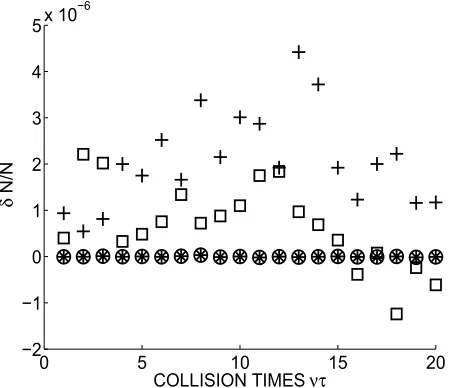
νV||2fMdΩ (8) The difference between the application of the full con-servative operator (3) and the application of the momentum correction term (8) is visible on the test JT-60 tokamak re-sults [18] with the relative errors due to collisions and in-tegration along the orbits, presented in Figs. 1-3. In these test simulations the total number of particles was not very large and equal to 16000. Figure 1 shows the evolution of the relative particle number errorδN/Nfor the normalized collisional frequenciesν∗=0.018 andν∗=0.035 with the full collisional operator (3) (stars and circles) and only with the momentum correction term (8) (+signs and squares).
Figure 2 shows the evolution of the relative energy er-rorδE/E for the normalized collisional frequenciesν∗ = 0.018 andν∗=0.035 with the full collisional operator (3) (stars and circles) and only with the momentum correc-tion term (8) (+signs and squares). Applications with the full collisional operator (3) decrease the relative particle number error and the relative energy error by several or-ders of magnitude. This property provides more reliable
Fig. 1 Evolution of the relative particle number error (δN/N ver-sus collision timesντ) is shown for the normalized col-lisional frequency ν∗ = 0.035 with the improved col-lisional operator (circles) and only with the momentum correction term (squares); for the normalized collisional frequencyν∗=0.018 with the improved collisional oper-ator (stars) and only with the momentum correction term (crosses).
and long steady-state results for the simulations with large number of collision times in agreement with the similar plots from Ref. [23]. Recently the successfull benchmark of the neoclassical transport, calculated by the FORTEC-3D code with the improved collisional operator (3) against global gyrokinetic particle-in-cell code ORB5 and theory has been reported in Ref. [25]. Good conservation proper-ties of operator (3) have been also shown for the unlike-particle collisions in Ref. [26].
Figure 3 shows the evolution of the relative
momen-Fig. 2 Evolution of the relative energy error (δE/Eversus col-lision timesντ) is shown for the normalized collisional frequencyν∗ =0.035 with the improved collisional op-erator (circles) and only with the momentum correction term (squares); for the normalized collisional frequency
ν∗ =0.018 with the improved collisional operator (stars)
and only with the momentum correction term (crosses).
Fig. 3 Evolution of the relative momentum error (δP/Pversus collision timesντ) is shown for the normalized collisional frequencyν∗ =0.035 with the improved collisional op-erator (circles) and only with the momentum correction term (squares); for the normalized collisional frequency
ν∗ =0.018 with the improved collisional operator (stars)
tum errorδP/Pfor the normalized collisional frequencies ν∗ =0.018 andν∗ =0.035 with the full collisional opera-tor (3) (stars and circles) and only with the momentum cor-rection term (8) (+signs and squares). This figure shows the near equivalence of Eqs. (3) and (8) with respect to the momentum correction; the modulus of the relative errors in both cases does not exceed the value of 10−8.
The improved VENUS+δf collisional operator in-cludes the additional energy scattering terms [13]. The cor-responding terms, implemented into the DKES code, mod-ify the bootstrap current of the Wendelstein-7X stellarator by 10-20% [27]. We present the effect of the energy scat-tering as well as the effect of the finite orbit width (FOW) with the VENUS+δf code for the LHD configurations in the next sections.
3. Bootstrap Current in the LHD
Dis-charge #61863
Figure 4 shows the experimentally measured and smoothly fitted electron density (circles) and tempera-ture (stars) profiles versus the normalized toroidal flux la-bel s at t = 3.1 sec of the LHD discharge #61863 with Raxis =3.90 m. The electron density has a rather flat pro-file, while the temperature drops linearly. Motional Stark Effect measurements provide the rotational transform pro-file estimation and the corresponding total current of about 10 kA [20].
Additional details of these measurements, the experi-mental LHD setup, the determination of the bootstrap cur-rent and its uncertainties can be found in Refs. [3, 20]. In this discharge, balanced neutral beam injection has been used so the beam-induced current is small. The most prob-able candidate as a driving mechanism of the non-inductive
Fig. 4 The electron density (circles) and the temperature (stars) versus the flux label s for the LHD discharge #61863 (Raxis=3.90 m).
current can be attributed to the bootstrap current.
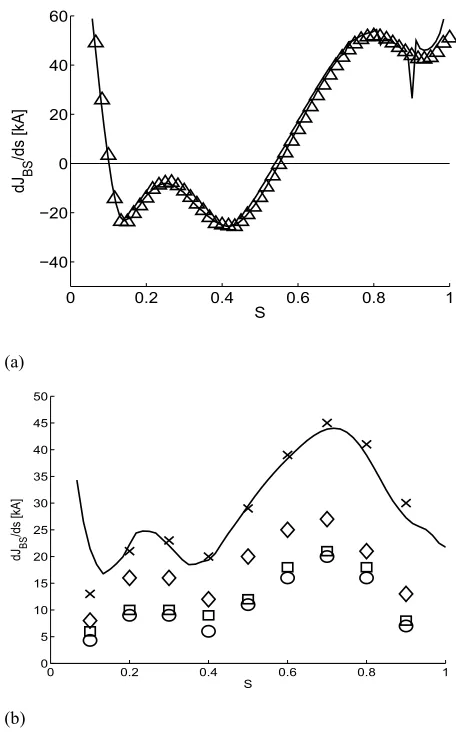
The bootstrap current flux derivatives dJBS/ds as a function of the normalized flux sfor the LHD discharge #61863 are presented in Fig. 5. The SPBSC and the TERP-SICHORE code results in the collisionless limit are shown in Fig. 5 (a) as triangles and by the solid line, respectively. In the plasma core the SPBSC and the TERPSICHORE code results in the semi-analytical collisionless limit are almost the same. This means that the reconstruction to the Boozer coordinates, performed with the different magnetic field spectra width in these codes, leads to the same spa-tial dependencies. A difference is visible near the mag-netic axis, where the numerically obtained equilibrium force balance is poor. Near the plasma edge, the TERP-SICHORE code has found 2 resonant surfaces (2 spikes on the solid curve). In the collisionless regime (not
ex-Fig. 5 (a): The LHD#61863Raxis = 3.90 m bootstrap current
derivative dJBS/ds versus the flux label scalculated in
perimentally relevant) the integration of the dJBS/ds func-tion gives a total bootstrap currentJBS of 18 kA from the TERPSICHORE code in the Shaing-Callen limit andJBS of 10 kA from the SPBSC code.
For the given experimental conditions the total boot-strap current of 27 kA is obtained from integration of the function dJBS/dsin the SPBSC code (Fig. 5 (b), solid line), using the connection formula between the collisionless and collisional limits.
In this paper with the usage of the VENUS+δf code we explore the effects of the finite orbit width on the boot-strap current for the LHD #61863 discharge. In the simula-tions we consider two different cases – protons with atomic massA = 1 (wide orbits) and ions with artificial atomic massA = 2.e-3 (smaller orbit width). The average ratio of the orbit width withA =1 to the temperature gradient length is on the level of 0.01.
The function dJBS/ds, calculated with the VENUS+δf code with (ii) method without the energy scattering and with atomic mass A = 1 is shown in Fig. 5 (b) by cir-cles, the integration yields a total bootstrap currentJBS = 10 kA. The functions dJBS/dswith the energy scattering are shown as squares forA=1.0 (total bootstrap current is JBS = 12 kA) and with crosses forA =2.e-3 (total boot-strap current isJBS = 26 kA). The energy scattering ef-fect increases the result by 10-20%. The function dJBS/ds, calculated with the VENUS+δf code with (ei) method, is shown in Fig. 5 (b) by diamonds and yields a total boot-strap current equal to 16 kA. The statistical results from the VENUS+δf code are obtained with 200000 markers with an accuracy 10% and do not depend on the integration time step size.
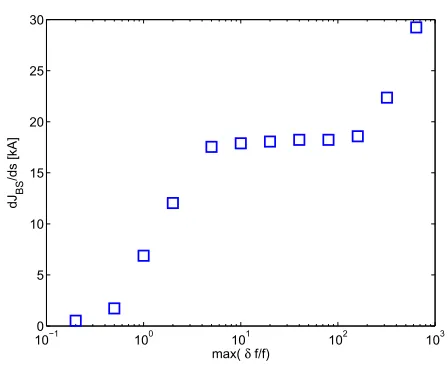
Under the given experimental conditions the electrons have thin orbits. However, heavy ions trapped in non-symmetric magnetic fields not subject to the orbit width limitation (or without the weight filter procedure) tend to accumulate their weights after a lengthy simulation time in regions far from their initial surface. This effect causes an impact on the bootstrap current that becomes exces-sively large. We have implemented in the VENUS+δf code the filter procedure to reinject the markers with very large weightδf (compare, for example, with variance re-duction procedure in Ref. [28] or filtration in [19]). Fig-ure 6 presents the typical influence of the filter size max (δf/f), proportional to the spacial bin size Δs, on the function dJBS/dsat s = 0.7. One can see the significant “plateau” region, where the function dJBS/dsdoes not de-pend on value max (δf/f) and reinjected particles do not change the result. We assume that the optimal filter size chosen should lie in this “plateau” region.
The total bootstrap currentJBSof 10-12 kA obtained with the ions for A = 1, calculated with the VENUS+δf code, is in good agreement with the experimentally ob-tained total bootstrap current of 10 kA. Smaller orbit width for the ions with atomic mass A = 2.e-3 from the VENUS+δf code yields the total bootstrap current of
Fig. 6 Particle weight filter max (δf/f) study for ions with A = 1, performed for the LHD#61863Raxis = 3.90 m
bootstrap current derivative dJBS/dsons=0.7 with the
VENUS+δf code.
Table 1 The LHD#61863 total bootstrap current from the exper-imental observation (column #1), from the SPBSC code with the connection formula (column #2) and in the col-lisionless limit (column #3), from the TERPSICHORE code (column #4), from the VENUS+δf code without the energy scattering, A = 1 (column #5), with the energy scattering,A = 1 (column #6) and A = 2.e-3 (column #7), with (ei) method (column #8).
JBS=26 kA, (ei) method also with small orbit width yields JBS=16 kA. The summary of this section is shown in Ta-ble 1.
4. Bootstrap Current in the LHD
Dis-charge #82582
Figure 7 shows the experimentally measured and smoothly fitted electron density (circles) and temperature (stars) profiles versus the normalized toroidal flux label s att = 3.9 sec of the LHD discharge #82582 withRaxis = 4.05 m.
Fig. 7 The electron density (circles) and the temperature (stars) versus the flux label s for the LHD discharge #82582 (Raxis=4.05 m).
Fig. 8 (a): The LHD#82582Raxis = 4.05 m bootstrap current
derivative dJBC/dsversus the flux label scalculated in
the collisionless limit with the SPBSC code (triangles) and with the TERPSICHORE code (solid line), (b): with the connection formula with the SPBSC code (solid line), with the VENUS+δf code with (ii) method without en-ergy scatteringA=1.e-3 (circles), with energy scattering A =1.e-3 (squares), A =1 (crosses), with (ei) method (diamonds).
The bootstrap current derivative dJBS/dsfor the LHD discharge #82582 from the connection formula in the SBPSC code is presented in Fig. 8 (b) with the solid line. The total bootstrap current from this code is JBS = −5.5 kA. VENUS+δf code results with atomic massA = 1.e-3 (small orbit width) without the energy scattering are shown with circles, with energy scattering, these are shown as squares forA = 1.e-3 and as crosses forA = 1.0 (fi-nite orbit width effect). VENUS+δf code results with (ei) method are shown with diamonds.
The total bootstrap current, calculated with the VENUS+δf code is equal to−6.2 kA without the energy scattering and equal to−3.5 kA with energy scattering for the ions with the artificial atomic massA = 1.e-3, which is close toJBS = −3.8 kA from (ei) method. The energy scattering effect is more visible for the LHD discharge #82582 than for the LHD discharge #61863 according to the VENUS+δf code simulations.
Finite orbit width for the ions with A = 1 and with the energy scattering yields small negative total bootstrap current of−3.0 kA. The absolute value of experimentally measured total current of−14 kA is larger than the boot-strap currents obtained from the SBPSC and VENUS+δf codes (see Table 2 as a summary of this section).
Table 2 The LHD#82582 total bootstrap current (kA) from the experimental observation (column #1), from the SPBSC code with the connection formula (column #2) and in the collisionless limit (column #3), from the TERPSI-CHORE code (column #4), from the VENUS+δf code with (ii) method without the energy scattering,A=1.e-3 (column #5), with the energy scattering,A=1.e-3 (col-umn #6) andA=1 (column #7), with (ei) method (col-umn #8).
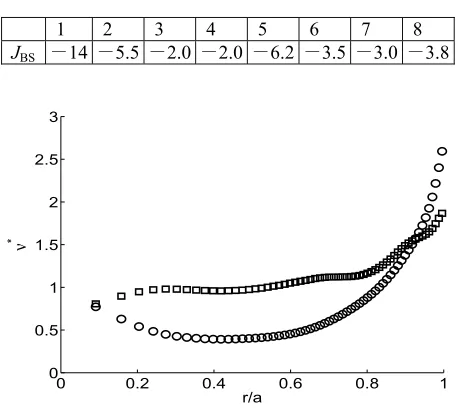
Fig. 9 The normalized collisional frequencyν∗ versus the nor-malized plasma radius r/a = s0.5, calculated with the
Figure 9 shows the normalized collisional frequency ν∗ profiles, calculated with the SPBSC code, correspond-ing to the LHD discharges #61863 (circles) and #82582 (squares). For these discharges, the normalized collisional frequency is enclosed in the interval [0.5 – 2.5] and belongs to plateau collisional regime.
5. Summary and Discussion
Bootstrap current simulations for the experimental Heliotron LHD discharges #61863 and #82582 have been performed with the 3D neoclassical codes SPBSC, TERP-SICHORE (only as a test in the collisionless limit) and with the VENUS+δf code with the improved conservative operator. This work constitutes a further step towards in-creasing the accuracy of the 3D simulation tools and the applications of the exact input experimental data (electron temperature and density, complicated shape of the bound-ary magnetic surface). However, taking into account the significant role of the turbulent transport in plasmas, it is not clear at this time how accurate and how close to the experimental results could our numerical tools, based only on neoclassical approaches, be.
Different bootstrap current models, implemented into the 3D neoclassical codes SPBSC and VENUS+δf, show an agreement with the experimentally obtained positive total bootstrap current of 10 kA in the LHD discharge #61863 with the magnetic axis ofRaxis=3.90 m and nega-tive total bootstrap current of−14 kA in the LHD discharge #82582 withRaxis=4.05 m. The difference of the current profiles between the SPBSC connection formula prediction and the VENUS+δf code simulation can be also partially explained by the difference between the experimentally ob-tained rotational transform profiles with the error bars [19] and the corresponding time-dependent rotational transform based on the SPBSC simulation.
Energy scattering effects implemented into the VENUS+δf code change the total bootstrap current by 10-20% for the LHD discharge #61863. For the LHD discharge #82582 the energy scattering effect with the VENUS+δf code changes the bootstrap current by a fac-tor of 2, however, the total bootstrap current for this case is rather small. Finite orbit widths with the VENUS+δf code due to the different marker masses can significantly change the absolute value of the simulated ion bootstrap current for both LHD #61863 and LHD#82582 discharges. Accurate bootstrap current simulations include the electric field and inductive current effects as well as the non-equal impact of electrons and ions as it was recently done with the DKES, NEO-MC and MOCA codes for the TJ-II stellarator [29, 30]. In our paper we have also made the additional simulations with the ambipolar radial elec-tric field simulation (ion root) and with the different im-pact of electrons and ions - with (ei) method. The diff er-ence between the total bootstrap current, computed with (ii) method and with (ei) method for these given LHD
dis-charges, has been presented in our paper.
Acknowledgments
The work was supported in part by the NIFS/NINS under the project of International Network of Scientific Collaboration (Japan), by the budget NIFS11ULPP022, by CRPP (Switzerland), by the Fonds National Suisse de la Recherché Scientifique, by Euratom, by the RosAtom Contract H.4A.52.90.12.1006, by grant 4361.2012.2 of President of Russian Federation for Leading Scientific Schools. The computational results were performed on clusters CSCS, Pleiades2 (Switzerland), Opteron (NIFS, Japan), LSPP-ITER (Kurchatov Institute, Russia). M. Isaev thanks C.D. Beidler and H. Maaβberg (IPP, Greifswald) for their valuable comments and corrections.
[1] K.Y. Watanabeet al., Nucl. Fusion35, 335 (1995). [2] K. Shaing and J. Callen, Phys. Fluids26, 3315 (1983). [3] K.Y. Watanabeet al., J. Plasma Fusion Res. SERIES5, 124
(2002).
[4] W.A. Cooperet al., Plasma Phys. Control. Fusion44, 1 (2002).
[5] D.V. Andersonet al., J. Supercomput. Appl.4, 34 (1990). [6] A.H. Boozer, Phys. Fluids24, 1999 (1981).
[7] M. Murakamiet al., Phys. Rev. Lett.66, 707 (1991). [8] H. Maaβberget al., Plasma Phys. Control. Fusion47, 1137
(2005).
[9] W.I. Van Rij and S.P. Hirshman, Phys. Fluids B 1, 563 (1989).
[10] C.D. Beidleret al., Proc. 30th EPS Conf. on Control. Fu-sion and Plasma Phys. (St. Petersburg, Russia 2003) ECA
27A, P3.2 (2003).
[11] Y. Ogawaet al., Nucl. Fusion32, 119 (1992).
[12] M.Yu. Isaevet al., Fusion Sci. Technol.50, 440 (2006). [13] A.H. Boozer and G. Kuo-Petravic, Phys. Fluids 24, 851
(1981).
[14] C.D. Beidleret al., Proc. 22nd IAEA Fusion Energy Conf., Geneva, Switzerland, TH/P8-10 (2008).
[15] K. Allmaieret al., CDROM with Proc. of Joint Conf. of 17th Int. Toki Conf. on Physics of Flow and Turbulence in Plasmas and 16th Int. Stellarator/Heliotron Workshop, 615 (2007).
[16] C.D. Beidleret al., Nucl. Fusion51, 076001 (2011). [17] M.Yu. Isaevet al., Plasma Fusion Res.3, 036 (2008). [18] M.Yu. Isaevet al., Nucl. Fusion49, 075013 (2009). [19] S. Satakeet al., Plasma Fusion Res.3, S1062 (2008). [20] Y. Nakamuraet al., Proc. 22nd IAEA Fusion Energy Conf
Geneva Switzerland EX/P6-20 (2008). [21] O. Fischeret al., Nucl. Fusion42, 817 (2002).
[22] R. Sanchezet al., Comput. Phys. Commun.141, 55 (2001). [23] W.X. Wanget al., Plasma Phys. Control. Fusion41, 1091
(1999).
[24] A. Bergmannet al., Phys. Plasmas8, 5192 (2001). [25] T. Vernayet al., Phys. Plasmas17, 122301 (2010). [26] R.A. Kolesnikovet al., J. Comput. Phys.229, 5564 (2010). [27] H. Maaβberg and C.D. Beidler, Phys. Plasmas17, 052507
(2010).
[28] K. Allmaieret al., Phys. Plasmas15, 072512 (2008). [29] J.L. Velasco et al., Plasma Phys. Control. Fusion 53,
115014 (2011).