ECONSPEAK: A Journal of Advances in Management IT & Social Sciences Page 1 CURRENT STUDY ON THE PLANNING AND SCHEDULING ACTIVITIES IN TERMS OF GENETIC
ALGORITHM
V. Rama Rao1, Dr. Arvind Kumar Sharma2 Department of Computer Science and Engineering
1,2
OPJS University, Churu (Rajasthan) Abstract
Planning and scheduling are zones drawing in a constant consideration of software engineering group. In any case, notwithstanding of their comparable character, planning and scheduling issues are normally handled freely utilizing distinctive techniques and advances. While Artificial Intelligence innovation is more important for planning issues, Operations Research has a long custom in considering scheduling issues. As of late, Constraint Programming conveys a crisp breeze to both zones as it permits a blend of different strategies to take care of the planning and scheduling issues inside single decisive structure. In the paper we give an investigation of mixed planning and scheduling approach to tackle the scheduling issues in complex generation conditions. We break down three reasonable models and we look at their favorable circumstances and impediments from the mixed planning and scheduling perspective. We additionally give a mechanical foundation to legitimize the components required in the models. The models were contemplated inside the Vis Opt project whose objective is to built up a non specific scheduling motor material to different complex generation conditions. However the outcomes can be connected to other (non-generation) issue territories where mixed scheduling and planning capacities are attractive.
Keywords: planning, scheduling, mixed approach, modeling
1. INTRODUCTION
Planning and scheduling pull in high
consideration among inquires about in different ranges of software engineering. Now and then, there is perplexity what issues planning and scheduling manage and what are the likenesses and the distinctions. Generally, planning
manages discovering arrangements to
accomplish some objective. All the more correctly, a planning errand is characterized as finding a grouping of activities that will exchange the underlying scene into one in which the objective depiction is valid. Normally, the conceivable groupings of activities are confined by requirements portraying the restrictions of the world. Planning has been examined in Artificial Intelligence (AI) for a considerable length of time and the strategies created there, similar to the STRIPS portrayal
and planning calculation are the center of many planning frameworks [1].
Inverse to planning, scheduling manages the correct portion of assets to exercises after some time, i.e., finding an asset that will procedure the movement and finding the season of preparing. Once more, the scheduler must
regard the priority, term, limit and
contradiction requirements. Operations
Research (OR) has a long custom in considering scheduling issues and numerous fruitful techniques to manage the issue were produced there.
ECONSPEAK: A Journal of Advances in Management IT & Social Sciences Page 2 of exercises in planning versus appointing
exercises to assets and time in scheduling, is smothered here. Both modern planning and scheduling manage the undertaking of finding a succession of exercises to accomplish some objective and allotting these exercises to assets. The principle distinction is in the determination of the subsequent arrangement or calendar. While the modern planning manages the errand of discovering "unpleasant" arrangements for longer timeframe where exercises are relegated to offices and so forth, the mechanical scheduling manages the undertaking of discovering subtle element plans for individual machines for shorter timeframe. Starting here of view, scheduling can be viewed as a high-determination here and now planning [2].
Planning and scheduling draw in high consideration among examines in different ranges of software engineering. Once in a while, there is disarray what issues planning and scheduling manage and what are the likenesses and the distinctions. Generally, planning
manages discovering arrangements to
accomplish some objective. All the more
unequivocally, a planning errand is
characterized as finding a succession of activities that will exchange the underlying scene into one in which the objective portrayal is valid. Actually, the conceivable arrangements of activities are confined by imperatives portraying the constraints of the world. Planning has been considered in Artificial Intelligence (AI) for quite a long time and the strategies created there, similar to the STRIPS portrayal and planning calculation, is the center of many planning frameworks.
Inverse to planning, scheduling manages the correct distribution of assets to exercises after some time, i.e., finding an asset that will procedure the movement and finding the season of handling [3]. Once more, the
scheduler must regard the priority, length, limit
and contrariness limitations. Operations
Research (OR) has a long convention in contemplating scheduling issues and numerous fruitful techniques to manage the issue were created there.
2. PROBLEM AREA
In the Vis Opt scheduling project [4] we manage complex generation territories like plastic, petrochemical, substance or pharmaceutical ventures. The undertaking is to build up a bland scheduling motor that can be redone effortlessly for specific condition by means of the depiction of assets, beginning circumstance and expected future circumstances.
The issue space can be portrayed as a heterogeneous domain with a few assets meddling with each other. As of now we are working with makers, movers and stores, later different assets like laborers and devices will be included. A few assets can handle a few assignments at any given moment (this is called bunch preparing) and the undertaking can be planned to various option assets. Likewise the request of undertakings prepared by the asset is not discretionary but rather the handled errand impacts what assignments can take after. Thusly, we should take after the move designs and accept the set-up times between the assignments too. The preparing time is generally factor and there is characterized a working time when the errands can be handled in assets.
ECONSPEAK: A Journal of Advances in Management IT & Social Sciences Page 3 that can be sold as another option to the
requested item. Handling of both by-items and co-items must be planned also due to constrained limit of stockrooms where every one of the items is put away. Likewise the similarity imperatives portraying which items
can be prepared, i.e., created, moved or put away together, must be considered. To wrap things up there is a probability of cycling, i.e., handling the thing for a few times for instance to change components of the thing or just to
tidy up the store [5].
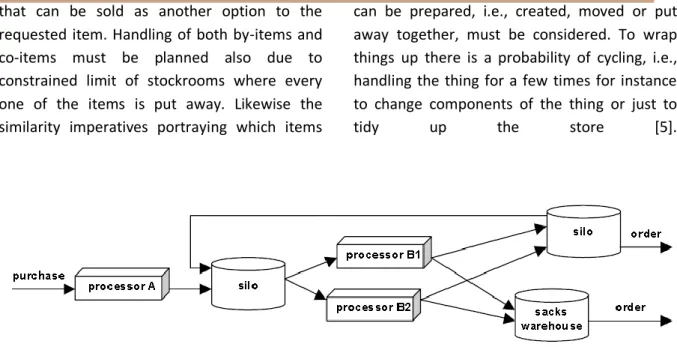
Figure 1: complex production environment
Typically, the production is not driven by the custom orders only but it is possible to schedule the production for store according to the factory patterns and the forecast. It means that a customer ordered not everything that is really produced.
3. PLANNING AND SCHEDULING: A COMPARISON
In most current APS (Advanced Planning and Scheduling) frameworks the planning and
scheduling assignments are handled
independently in various modules and the correspondence between the modules is restricted. Such disintegration appears to be regular in light of the fact that the customary planning and scheduling manage somewhat unique assignments and diverse techniques are utilized to fathom the errands. On the opposite side, in industry the thoughts of planning and scheduling are consolidated and the contrast between them is fuzzier [6].
Traditional Planning and Scheduling
The conventional meaning of planning says that planning handles the issue of discovering arrangements to accomplish some objective, i.e., finding a succession of exercises that will exchange the underlying scene into one in which the objective depiction is genuine [7]. It implies that a portrayal of the underlying scene, the detail of the coveted world and the rundown of accessible exercises make the contribution of the organizer. The yield comprises of the grouping of exercises. An ordinary planning errand in the business comprises of finding the creation successions to fulfill the custom requests.
The conventional scheduling assignment
manages the correct distribution of exercises to assets (or assets to exercises) after some time
regarding priority, length, limit, and
ECONSPEAK: A Journal of Advances in Management IT & Social Sciences Page 4 Figure 2: separate planning and scheduling
As Figure 2 demonstrates the correspondence
between independent planning and
scheduling modules is basic: the organizer readies the rundown of exercises and in addition a few requirements, in particular the priority and span limitations, for the scheduler [9]. The rest of the limitations for the scheduling, similar to the limit and similarity imperatives, and the rundown of assets are gotten from the plant particular. This basic decay is the more pleasant side of the thing.
Industrial Planning and Scheduling
In the genuine living, the ideas of planning and scheduling are not entirely recognized and some of the time there is disarray between them.
The idea of planning means setting up an arrangement yet what is it an arrangement? We may have an advertising arrangement that portrays the amounts and rough discharge times of items utilizing market gauge and current custom requests. This arrangement is as a rule for a more extended day and age and it is more precise in prior circumstances than in later circumstances. See that the advertising planning has nothing in the same manner as the conventional planning depicted in the past segment. The aftereffect of advertising planning comprises of the rundown of demands to the creation so there are no arrangements of activities that "change the world"[10].
The showcasing arrangement makes the contribution to creation planning whose errand is to create a generation arrange, i.e. a grouping of exercises important to fulfill the requests (demands) from the showcasing arrangement. The meaning of generation planning is near the conventional planning however the creation planning generally covers the allotment of the exercises to manufacturing plant divisions also that is a run of the mill scheduling assignment. Creation planning utilizes data like BOM (bill of materials) to produce preparing courses and to discover what crude material ought to be requested and when. Once more, the generation plan is set up for a more drawn out timeframe.
At last, there is a generation scheduling which apportions the exercises from the creation plan to specific assets after some time [11]. The scheduler works with the detail data about the assets, similar to limit and similarity requirements, and the subsequent calendar is set up for a shorter timeframe than the creation arrange (on account of effectiveness issues and sudden changes in nature). The
meaning of generation scheduling is
ECONSPEAK: A Journal of Advances in Management IT & Social Sciences Page 5 Figure 3: Planning and scheduling in industry
As you see, there is no applied contrast
between the creation planning and
scheduling. Both undertakings cover the creating of exercises and additionally doling out the exercises to the assets. The determination of the outcome is the principle distinction between the generation planning and scheduling. While the generation planning works with divisions and a more drawn out timeframe, the creation scheduling handles singular machines in shorter timeframe.
The similitude between the generation planning and the creation scheduling conveys us to handling both undertakings together inside single mixed structure [12].
Mixed Planning and Scheduling Approach
Give us now a chance to come back to the particular elements of the issue region that are depicted in Chapter 2 and dissect them from the planning and scheduling perspective.
To begin with, there are elective handling courses, elective creation recipes and option crude materials. The decision of the option is a piece of the planning undertaking however the data essential for good choice is accessible at the scheduler level in light of the fact that the choice relies on upon specific portion of exercises to assets.
Second, there is a creation of the by-items and the low-quality items that are delivered as "waste" or amid the move between exercises. Once more, the organizer is in charge of creating the exercises to prepare these items yet the scheduler chooses what and if any by-item shows up by doling out the action to a specific asset. Take note of that preparing of the by-items ought to be booked also on the grounds that they may fill the stores generally.
Third, there are move examples and set-up times that are generally displayed utilizing exceptional move or set-up exercises [13]. Era of these exercises is a piece of planning undertaking yet the presence of the exercises relies on upon the portion of different exercises to assets that is a scheduling assignment.
ECONSPEAK: A Journal of Advances in Management IT & Social Sciences Page 6 Figure 4: Mixed planning and scheduling
The correspondence between the generator and the allocator is basic by means of single exercises. The generator acquaints movement with the framework and requests that the allocator plan it [14]. The allocator impacts the era of further exercises by confining the spaces of movement parameters and it can request that the generator present new exercises, e.g., set-ups or moves. The generator is driven by the arrangement of starting exercises that can portray the underlying circumstance and also the future demands produced by the promoting organizer. Additionally see that relying upon the determination of the scheduling we can utilize the creation scheduler both for the generation planning and for the generation scheduling portrayed in the past section [15].
4. CONCEPTUAL MODELS
In the Vis Opt project we concentrated three reasonable models of complex generation conditions with two distinct perspectives of time. The course of events model anticipates that time will be discrete, i.e. we are bouncing starting with one time point then onto the next [16]. The second perspective of time expects occasion based time. We consider time ventures between intriguing occasions there, specifically between changing exercises in the asset. We concentrated two applied
models that utilization occasion based time, to be specific request driven and asset driven models that contrast in the method for overseeing conditions between exercises.
Time-Line Model
The course of events model (likewise called a timetable approach) is a general strategy for
depicting dynamic procedures utilizing
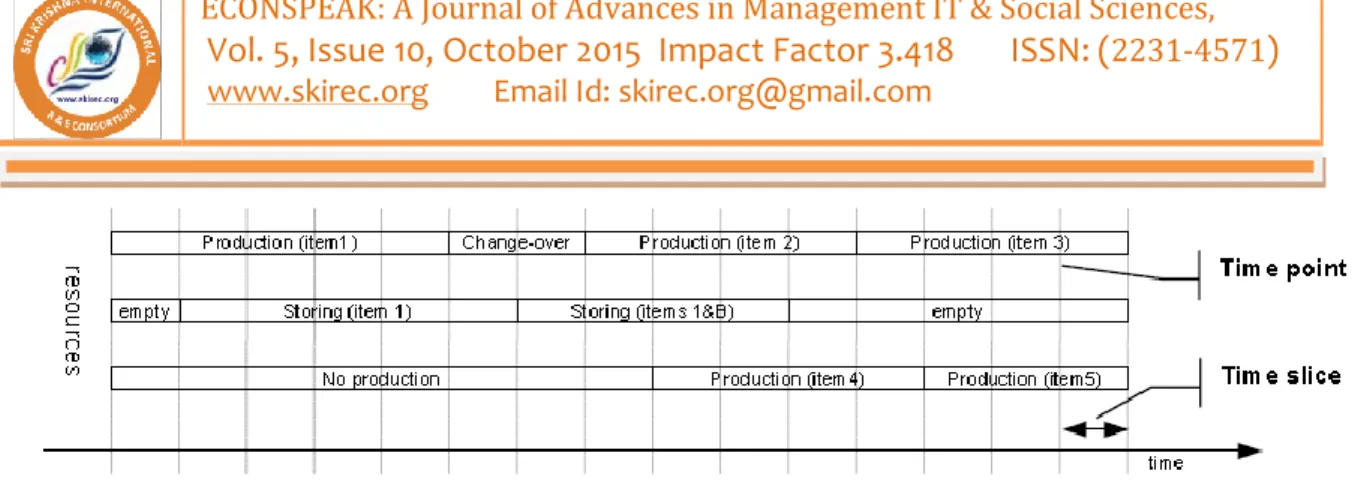
discrete time interims. To begin with, we separate the course of events into succession of time cuts with indistinguishable length and at each time point (the point between two cuts) we depict the circumstance of every asset utilizing a few factors. It is expected that the conduct of asset is homogeneous between two back to back time focuses, i.e., the key occasions like changing movement happen just at the edge of two sequential time cuts[17].
ECONSPEAK: A Journal of Advances in Management IT & Social Sciences Page 7 Figure 5: A time-line model
Presently we can depict the circumstance at each time point utilizing an arrangement of factors. For instance in the event of store there is a variable for everything that can be put away and this variable determines the put away amount. Different factors can indicate the condition of asset and so on[18]. The asset requirements tie factors in the time point and they can express similarity amongst put away and handled things or limit cutoff points of the asset. Additionally we require imperatives restricting factors from various time focuses
and distinctive assets. Such requirements express provider/shopper conditions or move designs.
Since we know the quantity of time focuses ahead of time (it is gotten from the booked term) we can speak to the model utilizing a table of factors where one pivot relates to the factors depicting the assets and the second hub compares to the time focuses. This portrayal requires normalizing the asset parameters in unequaled focuses.
Figure 6: A table representation of the time-line model
By setting the estimation of a few factors or limiting their areas we can express both the underlying circumstance and the coveted future circumstances that are gotten from the promoting arrangement [19]. See that in this model the planning and scheduling segments are mixed significantly more and there is no strict fringe between them. We don't have to produce exercises on the grounds that the prepared movement in given time is depicted by the variable in the time point. Thus, we can
utilize a similar imperative proliferation innovation to tackle both the planning and the scheduling undertaking.
ECONSPEAK: A Journal of Advances in Management IT & Social Sciences Page 8 expect not great effectiveness from the course
of events model if connected to huge scale scheduling issues. All things considered, we trust that the model can be connected effectively in situations when:
Order-centric Model
Arrange driven model is a customary model for employment shop scheduling where occasion based time is utilized (occasion = changing
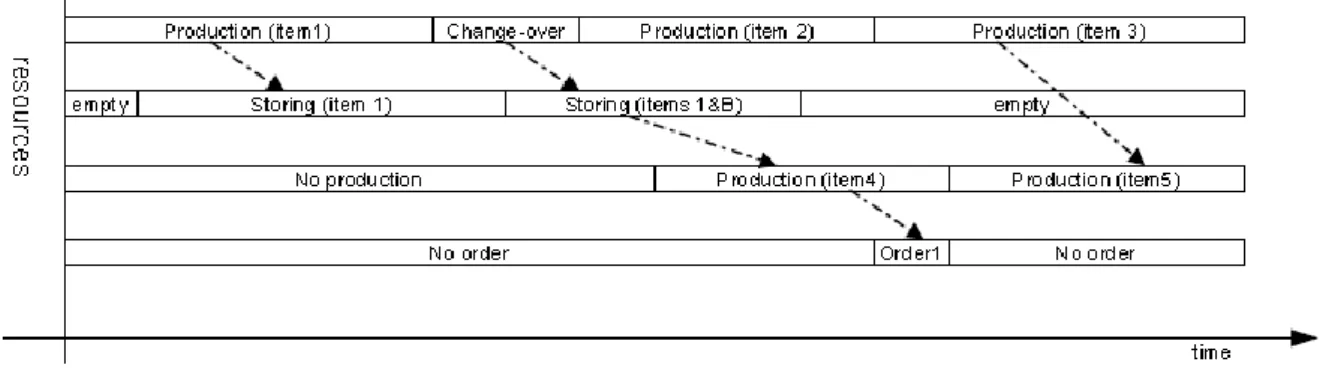
movement in the asset). It depends on thought of characterizing the affix of exercises important to deliver the requested thing or, by and large, to fulfill the request. The objective is to calendar such generation chains for all requests regarding as far as possible. In Figure 7 we demonstrate a case of creation chain. You may see that by the thought of creation chain we mean a direct grouping of exercises as well as, for instance, a tree of exercises with the root relating to the last item or the request.
Figure 7: A production chain in the order-centric model
We depict the exercises utilizing an arrangement of factors, ordinarily including the beginning and culmination times and the asset variable. Again there are the asset limitations that quandary factors from the exercises apportioned to a similar asset and the provider/customer imperatives that predicament factors from exercises in single creation chain [20].
Resource-centric Model
An asset driven model is like the request driven model in the method for utilizing the exercises and occasion based time. Presently, we are working with the rundown of exercises per single asset and the chain of exercises per request is handled certainly by methods for conditions between assets.
Figure 8: a resource-centric model
Every asset in the model is portrayed utilizing the arrangement of movement types3 that
ECONSPEAK: A Journal of Advances in Management IT & Social Sciences Page 9 the movement (the action sort) are the same
as in the request driven model however we
needn't bother with the parameter
recognizing the asset for action (every action is relegated to the asset certainly) and we
require new parameters distinguishing
providing and expending exercises.
5. CONCLUSION
The request driven model is a customary model of employment shop scheduling when request driven creation is utilized. Typically the static portrayal is utilized for this model however in the event that choices ought to be displayed then we propose the dynamic portrayal that is more straightforward. By and by, the request driven model is as yet not able to misuse completely the planning abilities and the creation for the store can't be displayed.
The asset driven model is presumably the best model for mixed planning and scheduling. It has an indistinguishable power from the course of events model, i.e. it is able to catch every one of the circumstances as depicted,
yet it evacuates the fundamental
disadvantage of the timetable model, to be specific the superfluous extensive number of factors. We picked this model as the most
encouraging one for the following
examination that will cover the look techniques both for the planning part of the frameworks and for the scheduler.
References
1. Baptiste, P., Le Pape, C., Nuijten,
W.: Constraint Based Optimisation and Approximation for Job-Shop Scheduling, in Proceedings of the
AAAI-SIGMAN Workshop on
Intelligent Manufacturing Systems, IJCAIs-95, Montreal, Canada, 1995
2. Barták, R.: Dynamic Constraint
Models for Complex Production Environments, in Proceedings of the 1999 ERCIM/Compulog Net Workshop on Constraints, Paphos, Cyprus, October 1999
3. Barták, R.: Conceptual Models for
Combined Planning and Scheduling, in Proceedings of the CP99 Post-Conference Workshop on Large Scale Combinatorial Optimisation and Constraints, Alexandria, USA, October 1999
4. Bartak, R.: Vis Opt – The Solver
behind the User Interaction, White Paper, InSol Ltd., Israel, May 1999
5. Bartak, R.: On-line Guide to
Constraint Programming,
http://kti.mff.cuni.cz/~bartak/const raints/
6. Bosi, F., Milano, M.: Enhancing CLP
Branch and Bound Techniques for Scheduling Problems, Tech. Report
DEIS-LIA-98-002, University
Bologna, 1998
7. Brusoni, V., Console, L., Lamma, E.,
Mello, P., Milano, M., Terenziani, P.: Resource-based vs. Task-based
Approaches for Scheduling
Problems, in: Proceedings of the 9th ISMIS96, LNCS Series, Springer Verlag
8. Buzzi, S., Lamma, E., Mello, P.,
Milano, M.: Consistent Orderings
for Constraint Satisfaction
Scheduling, Tech. Report DEIS-LIA-97-001, University Bologna, 1997
9. Caseau, Y., Labour the, F.: A
ECONSPEAK: A Journal of Advances in Management IT & Social Sciences Page 10 RCPSP, in: Proceedings of the CP97
Workshop on Industrial
Constraint-Directed Scheduling, Schloss
Hagenberg, Austria, November 1997
10. Caseau, Y., Laburthe, F.: Improved
CLP Scheduling with Task Intervals, in: Proceedings of ICLP94, pp. 369-383, MIT Press, 1994
11. Caseau, Y., Labour the, F.:
Cumulative Scheduling with Task
Intervals, in: Proceedings of
JICSLP96, pp. 363-377, MIT Press, 1996
12. Crawford, J.M.: An Approach to
Resource Constrained Project
Scheduling, in: Artificial Intelligence
and Manufacturing Research
Planning Workshop, 1996
13. Fikes, R. E., Nilsson, N. J.: STRIPS: A
new approach to the application of theorem proving to problem solving, in: Artificial Intelligence Vol. No. 3-4, pp. 189-208
14. Lamma, E., Mello, P., Milano, M.,
Temporal Constraint Handling in Scheduling Problems, Invited Paper
at Intersymp95, Baden-Baden,
August 1995
15. Lever, J., Wallace, M., Richards, B.:
Constraint Logic Programming for Scheduling and Planning, in BT Technical Journal, Vol. 13 No. 1, pp. 73-81, 1995
16. Pegman, M.: Short Term Liquid
Metal Scheduling, in: Proceedings of PAPPACT98 Conference, London, 1998
17. Pool, D., Mackworth, A., Goebel, R.:
Computational Intelligence – A Logical Approach, Oxford University Press, Oxford, 1998
18. Simonis, H., Cornelissens, T.:
Modelling Producer/Consumer
Constraints, in: Proceedings of CP95, pp. 449-462, 1995
19. Smith, A.W., Smith, B.M.:
Constraint Programming
Approaches to Scheduling Problem in Steelmaking, in Proceedings of CP97 Workshop on Industrial
Constraint-Directed Scheduling,
Schloss Hagenberg, Austria,
November 1997
20. Tsang, E.: Foundations of
Constraint Satisfaction, Academic Press, London, 1995
21. Wallace, M.: Applying Constraints