CLOUD COMPUTING — NEXT GENERATION COMPUTING
Anoop Sharma
School of Computer Science and IT, Singhania University, Rajasthan, INDIA.
ABSTRACT
In the era of technology, information technology becomes an essential part of an organization. Every organization has to invest a huge amount in the establishment of IT infrastructure (Hardware, Business Applications, Data Centers, office space, etc.) and for the team of technical experts to maintain it. Once, one of the technologies becomes obsolete, it becomes vital to update it to survive in this competitive era. Due to high capital cost, we need to switch from company owned infrastructure to a kind of IT model that should be cost effective, swift, flexible, reliable and secure in terms of IT services and it should be leverage with the latest trends. Cloud computing offers an alternative to reduce capital cost of IT infrastructure of an organization at a remarkable level. It is growing as the next generation computing which provide flexible, reliable and secure services like IaaS (Infrastructure as a Service), PaaS (Platform as a Service), SaaS (Software as a Service) based on pay - as - you - use model. In this paper we will discover the key components of the cloud computing which makes it the next generation computing and how it will be beneficial for the industry. Keywords:IaaS, PaaS, SaaS, Data center, Business Applications.
1. INTRODUCTION
According to a survey “The maintenance and establishment cost of IT infrastructure is 40-50% percent of total project cost”. Suppose we are going to establish a company and for that purpose we have to invest a huge amount of the project cost for buying hardware equipments. Buying the only hardware (pc, servers, data centers etc.) is not sufficient; we have to buy necessary software packages (DBMS, server management, application software, etc.) in order to utilize the hardware equipments.
In the present scenario software technologies obsoletes / becomes out of trend more quickly than hardware i.e. if an organization working with obsolete hardware can survive for a while in the market but once its software package becomes out dated, organization can’t survive with it. This means that they have to buy new software packages to run the organization. High profile organizations can survive in this present scenario of market but small and middle level organization loss their existence.
Cloud computing reduce cost of computing dramatically. Cloud computing is web-based computing technology that offers a degree of freedom in the establishment of IT infrastructure. The cloud computing offers both hardware and software as a service based on pay - as - you use model. Cloud computing offers services from the simple word processing to complex data analysis, and from the data management to server management. With the help of cloud computing we can increase the capabilities of existing IT infrastructure of the organization without investing a lot of money, which is required in the updating of existing IT infrastructure.
Cloud computing is very elastic and scalable in terms of its services provided by the cloud vendor. We can utilize the services of cloud (both hardware and software) according to the workload of the organization. Furthermore, organizations with large batch-oriented tasks can get outcome as swiftly as their programs can scale, since using 100 servers for a day cost is not more than using one server for 100 hours.
1.1 Delivery Models of Cloud Computing
Cloud computing offers both the software and hardware as a service over the internet. These services are classified into three categories: 1. Software as a Service (SaaS) 2. Platform as a Service (PaaS) 3. Infrastructure as a Service (IaaS)
1.1.1 Software as a Service (SaaS)
Software as a Service is a software delivery model through which cloud computing make the availability of software's to its end user. These software services are delivered through a web browser to its user as a service on demand. To use software as a service through cloud computing, user just request for the service of a particular software to its vendor and the vendor will provide the services of the software to its user. The end user has not to worry about the software licensing and other issues related to the genuineness of the software that he is using. Advantage of SaaS
• No need of Specific Hardware to run software • Pay per use
• Instant Scalability • Security
• Reliability Examples • CRM
1.1.2 Platform as a Service (PaaS)
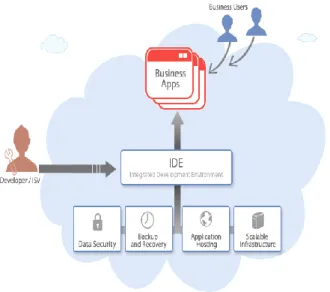
PaaS is like SaaS delivery model which deliver computing platform as a service over the web. Platform as a Service dramatically changed the scenario of development, deployment and run process of business applications. As the core element of cloud computing, PaaS eliminates the costs and complexity of evaluating, buying, configuring, and managing all the hardware and software needed for enterprise applications. [4].
PaaS provides all the facilities required to support the complete life cycle of building and delivering web applications entirely on the web [5].
Fig. 1: Platform as a Service Popular Services
• Storage • Database • Scalability
Advantages of PaaS
• No need to buy special hardware and software to develop and deploy enterprise applications. • Pay per use
• Instant Scalability • Security
• Reliability
1.1.3 Infrastructure as a Service (IaaS)
equipment and is responsible for housing, running and maintaining it. The client typically pays on a per-use basis. Access to infrastructure stack include Full OS access, Firewalls, Routers, Load balancing etc. Services.
Advantage of IaaS • Pay per use • Instant Scalability • Security • Reliability • APIs
Examples • Flexiscale • AWS: EC2 1.2
1.2 Advantages of Cloud Computing
Cloud computing has a lot of advantages over traditional computing. The benefits of deploying applications using cloud computing include reducing run time and response time, minimizing the risk of deploying physical infrastructure, lowering the cost of entry, and increasing the pace of innovation. Some other advantages of cloud computing are:
• Lower cost of ownership
• Reduce infrastructure management responsibility
• Cloud computing users avoid capital expenditure (CapEx) on hardware, software, and services when they pay a provider only for what they use.
• Allow for unexpected resource loads • Faster application rollout
Other benefits of this approach are low barriers to entry, shared infrastructure and costs, low management overhead, and immediate access to a broad range of applications. In general, users can terminate the contract at any time (thereby avoiding return on investment risk and uncertainty), and the services are often covered by service level agreements (SLAs) with financial penalties [6] [7].
Examples of Cloud Computing
• Microsoft-Window Live Service (Windows Live Mesh (Mesh Operating Environment), • Google-Google Does, Google APP Engine, Google Chrome.
• Amazon - Amazon S3 Service (Simple Storage Service), EC2 (Elastic Compute Cloud), AMIs • Apple - Mobile Me
• IBM - Blue Cloud
• Clunet - CCN (Cloud Computing Network) • Bangee - Bangee Connect
2. CONCLUSION
REFERENCES
*1+ Gartner Research. “Cloud Computing: Defining and Describing an Emerging Phenomenon”. [2]“Gartner Says Cloud Computing Will Be As Influential As E-business”.Gartner.com.
http://www.gartner .com/it/page.jsp?id=707508.
[3]Gruman Galen, (2008-04-07). “What Cloud Computing Really Means”. Info World. http://www.infoworld.com/d/cloud-computing/what-cloud-computingreally-means-031.
[4] http://www.salesforce.com/paas/ [5] http://www.zoho.com/creator/paas.html
[6] http://www.eweek.com/c/a/Enterprise-Applications/Forresters-Advice-to-CFOs-EmbraceCloud-Computing-to-Cut-Costs/
*7+“Five Cloud Computing Questions”.Networkworld.com.