Original Research Article
Epidemiology of admissions with respiratory illnesses: a single
tertiary centre experience
Satyaki Das
1, Swapan Kumar Ray
2, Mallar Mukherjee
1, Anirban Maitra
1,
Kripasindhu Chatterjee
2, Sukanta Sen
3*
INTRODUCTION
Respiratory illnesses in children form a substantial disease burden in emergency care, outpatients and hospitalized patients. Respiratory symptoms comprise 27.5% of pediatric emergency department visits.1 In
addition to the consequences of high disease burden on health service provision, they are a common cause for school and work related absenteeism and loss of productivity.
Studies exploring the pattern of emergency room visits and hospitalization for individuals with respiratory complaints could inform decisions regarding the effective
organization and planning of health services, particularly in a resource poor setting. Nevertheless, much of the data is extrapolated from geographical regions elsewhere with different demographics and there is paucity of epidemiological data on children admitted with respiratory complaints in the Indian context. The present study intends on exploring the pattern of respiratory illnesses seen in Indian children admitted with respiratory illnesses in a tertiary care.
Aim of the study was collection and analysis of data describing the epidemiologic profile of children admitted with acute respiratory illnesses, ascertaining information regarding our common clinical practice.
ABSTRACT
Background: Respiratory illnesses in children form a substantial disease burden in emergency care, outpatients and hospitalised patients. Studies exploring the pattern of emergency room visits and hospitalization for individuals with respiratory complaints could inform decisions regarding the effective organisation and planning of health services.
Methods: The present prospective observational study was conducted in children between one month to 18 years of age admitted with acute respiratory illness at Institute of Child Health, Kolkata from1st of February 2015 - 28th of
February 2015.
Results: Preliminary data shows that most of them were diagnosed provisionally as pneumonia (30%) followed by wheeze associated lower respiratory infection (WALRI) (29%). Approximately 10% of admitted patients required PICU support. Antibiotics and bronchodilators were the most commonly used medications.
Conclusions: CRP is significantly elevated in bacterial respiratory tract illnesses but a normal or low CRP does not exclude bacterial infection. Best practice may be to avoid antibiotics where possible unless clinically indicated and hospital courses determine so.
Keywords: Bronchodilator, CRP, Pneumonia, Respiratory illnesses, WALRI
1Department ofPediatrics, Institute of Child Health, Kolkata, West Bengal, India
2Department of Pediatrics, 3Department of Pharmacology, ICARE Institute of Medical Sciences and Research, Haldia,
West Bengal, India
Received: 22 December 2016
Accepted: 27 December 2016
*Correspondence:
Dr. Sukanta Sen,
E-mail: [email protected]
Copyright: © the author(s), publisher and licensee Medip Academy. This is an open-access article distributed under the terms of the Creative Commons Attribution Non-Commercial License, which permits unrestricted non-commercial use, distribution, and reproduction in any medium, provided the original work is properly cited.
METHODS
The present prospective observational study was conducted in children between one month to 18 years of age admitted with acute respiratory illness at Institute of Child Health, Kolkata from1st of February 2015 - 28th of
February 2015 after taking permission from institutional ethics committee. All children between the age limit with acute respiratory illness were included in the study. Children suffering from coexisting diseases like congenital heart disease, immunodeficiency, and children admitted outside of the specified time period and children whose parents not willing to give consent were excluded from the study. First standardized questionnaires were formulated and then questionnaires were filled up through interviewing and from bed head tickets. Finally data were collected and analysed.
RESULTS
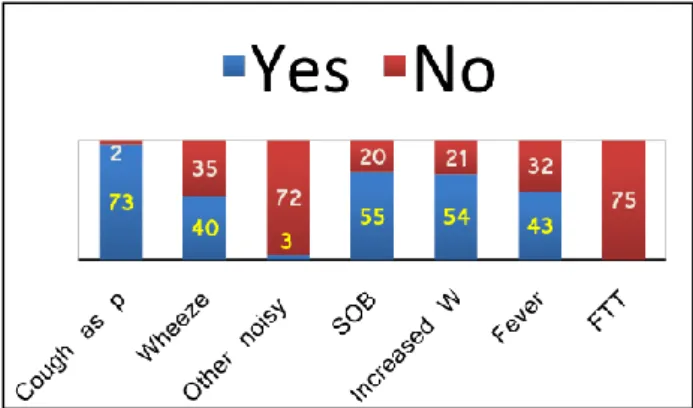
Preliminary data showed majority of the children presented with cough (97%) as chief respiratory illness followed by shortness of breath (73%) and wheeze (53%) (Figure 1).
Figure 1: Initial complaints at admission.
The mean duration of cough and wheeze were 5.8 days and 3.4 days respectively. Most of them (30%) were diagnosed provisionally as pneumonia followed by wheeze associated lower respiratory infection (WALRI) (29%). Bronchiolitis and asthma were subsequent diagnosis on admission (Figure 2).
Figure 2: Provisional diagnosis.
Initial physical examination of vitals revealed mean heart rate 122/min, respiratory rate 47/min, saturation in air 96% and temperature 99.4 F. The routine pathological and biochemical examination revealed mean hemoglobin (Hb) 10.3, total leukocyte count (TLC) 13,700/cmm, platelet 3.47 L/cmm with a C-reactive protein (CRP) between 0-50 (Figure 3).
Figure 3: CRP distribution.
Figure 4: Medication used.
Figure 6: Antibiotics used in wheezing illness.
70% children have received antibiotics followed by bronchodilator (69%) in any form (Figure 4). Amongst the bronchodilator, 84% patients have received in nebulized form in which levosalbutamol (82%) were used most. Bronchodilator usage in pneumonia and other lower respiratory tract illness (LRTI) were 30% and 90% respectively and on the contrary 30% patients with wheezing illness in any form have received antibiotics (Figure 5, Figure 6).
The mean duration of total hospital stay were 7 days with maximum 75 days, where as in case of PICU stay it were 4.6 days and 7 days respectively. 99% children were improved and most of them had diagnosed as pneumonia (36%) followed by LRTI (27%) when discharged (Figure 7).
Figure 7: Final diagnosis at discharge.
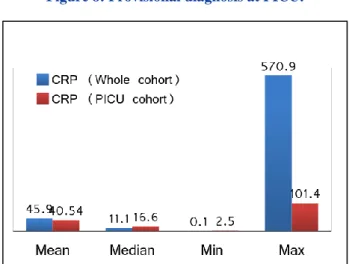
In case of PICU sub-analysis, cough was the chief presenting complaints followed by shortness of breath. Routine pathological and biochemical investigations of PICU graduates revealed mean Hb 9.9gm/dl, TLC 15700/cmm, platelet 3.2L/cmm and CRP 40.54. 57% children were diagnosed provisionally as pneumonia at PICU admission (Figure 8). The mean CRP of whole cohort was 45.9 whereas in PICU cohort it was 40.54
with maximum CRP of whole cohort was 570.9 and in PICU cohort 101.4 (Figure 9).
Figure 8: Provisional diagnosis at PICU.
Figure 9: CRP analysis whole cohort versus PICU cohort.
DISCUSSION
Respiratory distress is difficulty in breathing characterized by increase in rate and depth of breathing. It causes decreased feeding, cyanosis, grunting, nasal flaring, intercostal retractions (increased work of breathing), sweating, fever and wheeze. It may be due to inflammation of the parenchyma of the lungs caused by microorganisms, mostly viruses, but may also be due to aspiration of food or gastric acid, especially in recurrent cases, and is a substantial cause of morbidity and mortality in childhood.2
Yu WL et al China, Goh AY et al Malaysia and had admission rates of 1.44%, 4.2% and 6.3% because of respiratory distress, respectively.3,4 Martino Alba R et al
found in their study that infection with associated inflammation was the predominant event triggering respiratory distress.5 M. M. Karambin et al found in their
study that the most common cause of respiratory distress was pneumonia followed by asthma, croup, and bronchiolitis.6 Walker TA et al and Goh AY et al found
that the leading cause for respiratory distress was sepsis followed by pneumonia in their studies. Similarly our study reveals pneumonia is the leading cause for hospital as well as PICU admission followed by WALRI. Also characteristics associated with PICU admission included lower socio-economic status and low saturation in air at admission. Similar results had been found in the study by Oliveira et al Malaysia.2,4,7
Peripheral white blood cell (WBC) count in viral disease is less than 20,000/mm with increased lymphocytes while in bacterial disease is in the range of 15,000-40,000/mm with predominant granulocytes with associated pleural effusion, lobar consolidation, high fever at the onset of the illness, increased erythrocyte sedimentation rate (ESR) and C–reactive protein (CRP).8 In this study, the
mean haemoglobin was (Hb) 10.3, total leukocyte count (TLC) 13,700/cmm, platelet 3.47 L/cmm with a C-reactive protein (CRP) between 0-50.8 The maximum
CRP of whole cohort (570.9) was greater than PICU cohort (101.4) suggesting a high CRP is not corroborative with severity of illness. Chest radiography helps confirm the diagnosis and may indicate a complication such as a pleural effusion or empyema, and hyperinflation with bilateral infiltrates in viral disease and lobar consolidation in bacterial disease. Definitive diagnosis of a viral infection is done by isolation of a viral antigen or genome with culture, DNA test, RNA test and serological tests while bacterial infection is confirmed by blood culture, sputum smear and isolation of organism from pleural fluid or respiratory secretions.
Regarding treatment, our study revealed some interesting aspects about current practices of medications. Antibiotics and bronchodilators were the most commonly used medications. Among bronchodilator usage, oral bronchodilators were used in almost a 10% patient that is probably unnecessary. There was over-reliance on nebulised bronchodilators probably arising from the notion that nebulisers are better than inhalers.9
Levo-salbutamol was the most commonly prescribed bronchodilator in this cohort despite the lack of evidence to support its use.10 In a study by Shah D et al, it had been
found that as wheezing is seen in majority of under-five children who are otherwise diagnosed as having ‘pneumonia’ or ‘severe pneumonia’ as per WHO/IMCI definitions, the case management guidelines for diagnosis of wheeze in children with acute respiratory illness(ARI) need to be refined.11 A large proportion of these children
can be successfully managed without antibiotics, using simple devices and medications. Health workers in
community need to develop skills in recognizing and managing wheeze in order to successfully manage ARI, and to rationalize antibiotic therapy. We have also found that 1/3rd of patients with pneumonia received bronchodilators and on the contrary antibiotics were used in the majority of children who were labeled as having ‘viral triggered wheeze’ and other also in other ‘viral’ illnesses like bronchiolitis. Joseph et al found that there were 4 cases of severe anemia in their study that were unresponsive to bronchodilators and blood transfusion resolved their condition.12 In our study, 3 (4%) children
with severe anemia who needed PICU support improved with packed red cells infusion and were discharged successfully.
The strengths of our study were firstly it was prospective in design and probably it was the first such epidemiological study from Eastern India. The current practices have been better reflected by the study. Moreover conclusions from final analysis might inform policy formulation.
However there are some limitations of our study. Firstly, it was a tertiary center based study and hence may not be representative of diseases pattern in the community. Secondly the duration of study period was towards the end of the winter season so seasonal variations of respiratory illnesses were not encounter in this study. Finally the number of patients were relatively small that might result in the deviation of statistical assumption.
CONCLUSION
Established preliminary CRP analysis suggest that it is significantly elevated in bacterial respiratory tract illnesses but a normal or low CRP does not exclude bacterial infection. Best practice may be to avoid antibiotics where possible unless clinically indicated and hospital courses determine so. Future analysis would involve differences in mean testing. Standardised protocols should be developed in managing the defined group of patients. Finally, similar observational studies across many tertiary centres are to be performed over longer time to get better data.
Funding: No funding sources Conflict of interest: None declared
Ethical approval: The study was approved by the Institutional Ethics Committee
REFERENCES
1. Stapczynski JS, John OM, David MC. Tintinalli's emergency medicine: a comprehensive study guide, In Tintinalli JE. Pulmonary Emergencies, 7 edition. McGraw Hill Education; 2011.
3. Yu WL. Prospective, multicenter study of mortality and risk factors in children with acute respiratory distress syndrome in 25 pediatric intensive care units in China. Chinese Med J. 2012;125(13):2265-71.
4. Goh AY, Chan PW, Lum LC, Roziah M. Incidence of acute respiratory distress syndrome: a comparison of two definitions. Arch Dis Child. 1998;79(3):256-9.
5. Martino AR. Changes in the epidemiology of the acute respiratory distress syndrome (ARDS) in children. An Esp Pediatr. 1999;50(6):566-70. 6. Karambin MM, Hashemian H. Causes of respiratory
distress in children. Acta Medica Iranica. 2008;46(5):405-8.
7. Oliveira RH, Basille FA. Incidence of acute lung injury and acute respiratory distress syndrome in the intensive care unit of a university hospital: a prospective study. J Bras Pneumol. 2006;32(1):35-42.
8. William A, Horton J, Hetcht T. Disorder involving ion transporters. In Kliegman. Stanton. ST. Geme.
Schor. Behrman, editors. Nelson textbook of paediatrics, 19th edition: New Delhi. Elsevier.
2013:688:2430-1.
9. Fernández BJ, Balenciaga GM, Zache CS, Ronco MA, Raso MS. Salbutamol via metered-dose inhaler with spacer versus nebulization for acute treatment of pediatric asthma in the emergency department. Pediatr Emerg Care. 2004;20(10):656-9.
10. Gupta MK, Singh M. Evidence based review on levosalbutamol. Indian J Pediatr. 2007;74(2):161-7. 11. Shah D, Gupta P. Pertinent issues in diagnosis and
management of wheezing in under-five children at community level. Indian Pediatrics. 2010;47:56-60. 12. Hetzel TM, Losek JD. Unrecognized severe anemia
in children presenting with respiratory distress. Am J Emerg Med. 1998;16(4):386-9.