THE UNIVERSITY OF KANSAS Policy Research Institute
The Role of Public Libraries in Local Economic
Development
Prepared for The Kansas State Library
By
Robert H. Glass, Assistant Scientist Norman Clifford, Associate Scientist
Brian Harris, Research Associate Carol Rose, Research Associate
With
Charles E. Krider, Professor of Business Susan Mercer, Interim Assistant Director
Cheri Woolsey, Research Associate Chris Horak, Survey Lab Director
Report No. 260 November 2000
Dr. Steven Maynard-Moody, Interim Director Policy Research Institute
Table of Contents
Executive Summary ... i
Introduction ... 1 Survey of Public Libraries... 3
Survey of Businesses, Chambers of Commerce, and Small Business Development
Centers... 29 Conclusions and Recommendations... 55 Appendix I: Focus Group Report ... A1 Appendix II: Case Studies Report ... A31 Appendix III: Regions of the State... A37 Appendix IV: Survey Instruments and Frequency Tables ... A39
EXECUTIVE SUMMARY
Introduction
The Institute for Public Policy and Business Research undertook this study on behalf of the Kansas State Library. The purpose of the study was to determine how Kansas public libraries could play a more active roll in supporting business and economic development in their communities. The study focused on three primary questions. (1) What is the current level of support for business and economic development by Kansas public libraries? (2) What are the ways that Kansas public libraries might be helpful to local businesses and economic development? (3) What specific steps can Kansas libraries take to develop more active economic development and business assistance programs?
The research employed three main tools: (1) focus groups with librarians and businesses, (2) case studies of four local libraries, and (3) surveys of public libraries, businesses, Chambers of Commerce, and Small Business Development Centers.
Focus groups
Focus groups with librarians and businesspersons were held in Hays, Dodge City, Wichita, Topeka, and Iola.
The library focus groups explored librarians’ interest in, understanding of, and ability to provide resources for their business communities. The business focus groups probed what businesses think that public libraries can do to support businesses in their local
communities. Focus group results were important in designing the questionnaires for the surveys and in interpreting the survey results.
Case Studies
Case studies were undertaken in Johnson County, Wichita, Hutchinson, and Meade to provide an in-depth look at how selected libraries provide economic development and business resources to their communities.
Surveys
Surveys of Kansas public libraries, businesses, Chambers of Commerce, and Small Business Development Centers were conducted. These surveys were designed to assess the current capacity of the state’s public libraries to serve the informational needs of the business community and the extent to which businesses and other economic entities currently make use of public library facilities. In addition, the surveys attempted to explore public libraries’ perceptions of their role in serving the business community, and where such service fits into their overall priorities. Finally, the surveys were designed to gather the attitudes of the business community and economic development agencies about the use of the public library for business purposes and possible changes that would allow libraries to better serve the needs of the business community.
Major Findings and Recommendations
1. Major findings relating to the role to be played by public libraries in local economic
development and recommendation 1:
The case studies of large libraries such as those in Wichita and Johnson County clearly show that those libraries play an important role in providing materials and services to the business community.
Information gathering and research are essential for many (but not all) types of
businesses. This is supported by the fact that about a third of businesses have their own libraries, as shown by the survey of businesses, Chambers of Commerce, and Small Business Development Centers. The results of that survey show that nearly a third of businesses and economic development organizations in all parts of the state use public libraries as a resource. These results also show that businesses need general as well as specialized knowledge; a high proportion of businesses that have their own libraries also use the resources and services of public libraries, in most cases their local public libraries. Furthermore, the businesses that do use public libraries as a resource express a fairly high degree of satisfaction with the resources and services that they receive from the libraries. However, there is room for an expanded role for the states’ public libraries. Beyond the provision of traditional business reference service, public librarians do not always know how to assist in informational activities that would proactively foster local economic development. Many business people do not think of the public library as a source of such help, because although librarians are more than willing to exert extra effort on behalf of businesses, they often lack funds for narrowly-focused collections and the training needed to meet highly-specialized business needs.
Recommendation 1: Public Libraries could and should play a larger roll in local
economic development, especially in providing resources for existing business and for potential business startups.
2. Major findings related to the training of library staff in the area of serving the needs
of business and economic development and recommendation 2:
Although most libraries have staff that are trained in generalized skills, such as the use of electronic resources in the library, that can be made responsive to the needs of the
business community, the majority of libraries do not have a staff person who has received training in serving the needs of patrons who request business or economic information. In addition, only about a third of the public libraries have a person who is designated to handle the requests for information and services from the business community.
Public libraries themselves state that an important barrier to providing effective service to the business community is staff who are insufficiently trained to meet the demands of the business community. And businesses that use the public library say that the library staff’s lack of familiarity with specific resources or materials that business patrons request is a major barrier faced when businesses use library services.
Currently, it appears that library staff members often get their training in serving the needs of business by getting experience on the job. This may not be the most efficient method for training staff in fulfilling the demands of business; even worse, unless a staff member is given time to learn the necessary skills on the job, he or she may never reach an appropriate level of expertise.
Several methods of meeting the training needs of library staff in satisfying the demands of the business community could be explored. One avenue might be to have the library school at Emporia State University offer a course in managing business collections for those getting a library science degree. Such a course would prepare librarians with library science degrees to handle the diverse requirements of the business community.
Simply making formal training available to those obtaining library degrees would not be sufficient to solve the training problem, however. First of all, it would take some time before such personnel were generally employed in the state’s public libraries. But more importantly, there are many libraries in which a high level of formal training is simply not present; nearly two-thirds of the state’s public libraries have no staff with a Master of Library Science degree. A complementary training program with the goal of producing one specially trained staff member in each library with an annual budget of $100,000 per year or more could be developed under the leadership of the Kansas State Library. The actual program could be developed under the guidance of the business librarians from the Johnson County Library, the Wichita Public Library, and perhaps one or two other large public libraries in the state and could be administered and delivered by the state’s Regional Library Systems.
Public libraries with annual budgets of less than $100,000, though less stressed in terms of business-demands, may find themselves met with economic development requests as well. A statewide electronic and telephone referral list of business reference and
economic development specialist librarians could be developed for their use by the Kansas State Library.
Recommendation 2: The question of training for library staff in the area of serving the
needs of business and economic development should be addressed explicitly.
3. Major findings related to the level of business resources in the state’s public libraries and recommendation 3:
More than two-thirds of the libraries in the survey cited the high cost of business materials relative to their low usage rates as a very important barrier to providing
effective service to the business community. This was higher than for any other barrier. In addition, almost another fifth cited it as a somewhat important barrier. Only 12 percent of the libraries in the survey felt that it was not a barrier.
Well over half of the libraries feel that having an inadequate budget to purchase materials and services requested by business patrons is a very important barrier to providing
effective service to the business community. Another fourth feel that it is a somewhat important barrier. Only 17.5 percent feet that it is not an important barrier.
In most libraries, interlibrary loans are the means of fulfilling business information requests less than 10 percent of the time. One interpretation of this number, born out by the responses of some businesses in the focus groups, is that inter-library loans are often too slow to meet the information needs of businesses.
Even the Wichita Public Library, with its large size and significant history of providing service to business, appears to be struggling a bit with moving to electronic and Internet-based references. The state library system could probably provide basic Internet-Internet-based reference services for all libraries in the state at a lower cost than if all of the libraries sought to acquire them on their own. The role of the local library would be to provide computer access along with some trained staff to assist individuals in using the references.
Recommendation 3: The state library system should investigate the possibility of
providing additional business resources on-line for all of the libraries in the state.
4. Major findings related to computer capacity in public libraries and
recommendation 4:
It is clear from the business survey results that the size and resources of public libraries varies widely. A large number of the libraries in the state are relatively small and have very limited budgets. About two-thirds of the public libraries impose time-limits on their on-line searching, indicating that the resources for accomplishing such searches are scarce.
On the other hand, technology improvements, including new and upgraded computers, are the top priority for the next 5 years among public libraries across the state. In libraries that have specific programs or policies designed to meet the needs of the business
community, those programs are most likely to involve computing – the creation of a computer lab, Internet use, or Web page development.
Providing funding for computing that is explicitly a part of a state library system program aimed at improving the services and resources that public libraries provide for business and economic development is an example of public support for libraries in this area. On a smaller scale, such support by the Wichita City Commission for business references and information, was the impetus for the public library to really get started in the business
area. Perhaps statewide support would provide impetus to public libraries across the state. This impetus would be even stronger if the state library system provided additional support for business and economic development resources through setting up a training program and providing electronic databases for public libraries.
Recommendation 4: The state library system should investigate the possibility of
providing funding for computer equipment in libraries across the state.
5. Major findings related to relaxing resource constraints in public libraries and
recommendation 5:
In terms of the resources available for improving service to business patrons, most
libraries face severe budget constraints. The library survey showed that for most libraries, their highest budgetary priorities did not specifically include a focus on providing
resources and information for business and economic development. This is most clearly indicated by the fact that when asked “How important, relative to your budget, would the adding to a business or economics section be?” only 13.3 percent of the libraries
responded that it would be very important.
Libraries' resource constraints are also illustrated by the fact that libraries find the lack of funds or staff time to promote library resources and services to the business community to be one of the most significant barriers to improving service to the business community. More directly on point, libraries also find that having their staff insufficiently trained to meet the demands of the business community poses an important barrier to improving service to business.
In the library survey, libraries were positive about the possibility of “ obtaining resources from a centralized site with specialized resources and personnel” as a way of improving service to business patrons. More than 60 percent of libraries were “very willing” to do so, while another 30 percent were “somewhat willing.”
Although currently most businesses go to the library in order to access business
information and services, telephoning the library was the second most frequent method of access. In case studies, the large libraries with business reference librarians reported a high volume of business requests that were handled completely over the telephone. Businesses say that the most important improvement that public libraries could make to improve their service to business is to make the library electronically accessible from the office. Barring that, the next closest thing might be to make library resources and
expertise available over the phone.
A telephone reference service requires access to a very extensive set of reference
materials. An equally critical part of such a system is highly-trained librarians to interpret business requests for information, to gather the information quickly, and to communicate the information to the businesses and economic development professionals. Supporting such an operation is undoubtedly beyond the capabilities of small or even medium-sized
libraries. For smaller libraries especially, the volume of requests would be low enough that such an operation would not be cost efficient.
A centralized telephone business reference system could be operated from a single location. One of the large urban libraries like the Johnson County Library or the Wichita Public Library would already be well along in terms of collections and staff expertise. It might make sense to locate a telephone business reference service in one of those libraries. Or if libraries and businesses would be more likely to call a regional center (a position that was expressed during the focus groups), such centers could be established at both of the libraries mentioned above as well as at one more location further west.
Recommendation 5: The state library system should investigate the possibility of a
centralized phone reference service for business questions.
6. Major findings related to the standards for business resources that should be
available in libraries of different sizes and recommendations 6A, 6B and 6C:
Both the surveys and the focus groups brought out the growing importance of the Internet to businesses and economic development as a source of information. It is likely that this source of information will become even more important as time goes on. An adequate number of computers as well as computers with sufficient power and features are
important not only for providing Internet access but also for giving the library a basis for searching on-line and CD-ROM or DVD databases that may become available to the library. More than 90 percent of public libraries currently allow patrons to use the Internet at the library.
From the surveys, local economic and demographic information and local government regulations and reports are two types of information that are not specific to particular kinds of business that businesses frequently use. It is appropriate for this type of information to be kept at the local library level.
Although the survey of existing businesses could not bring out the importance of materials on business startups, the focus groups and the surveys of Chambers of Commerce and Small Business Development Centers raised the importance of such a resource. Such materials could have a general component that could be common to all libraries in the state and also features that would be specific to the local community, such as local regulations or resources available in the local community. Two-thirds of libraries already have resources for small business startups.
Although the resources available at the local library may be minimal, it is important that library staff be aware of what these resources are and how they can be used to answer business questions. It is also essential that they know what questions cannot be answered using local resources, and be able to access outside resources or send businesses to them. Such outside resources may be contained in other public libraries or in regional centers as suggested in another recommendation.
Marketing and in general keeping businesses and potential new businesses aware of the public library’s resources for helping business is crucial. Businesses that do not use a public library cite the library’s failure to market or communicate its services to business patrons as a significant barrier to the use of the public library by businesses. To the extent that they do so, small libraries today tend to use newspaper or radio advertising and special promotional events to inform the business community of the resources that they have available. Whether these are the most effective forms of marketing and
communication, and whether they are extensive enough, should be investigated further. Public libraries have generally established relationships with local business organizations, either by having a representative who is a member of such an organization (nearly three-fourths of public libraries), or by meeting with business people to explain the resources that the libraries have (three-fourths of public libraries). Furthermore, libraries firmly express a willingness to establish strong relationships with local Chambers of Commerce and Small Business Development Centers as a step in improving their services to the business and economic development communities. As some in the focus groups pointed out, such relationships could pay off in broader community support for all of the library's activities.
Recommendation 6A: There should be a minimal configuration of business resources in
small libraries. The general shape of this configuration would include: 1. Internet access;
2. Adequate number of sufficiently high quality computers; 3. Local demographic and economic information;
4. Local government regulations and reports; 5. Materials on business startups;
6. Staff training on the business resources, materials, and services available at the library;
7. A plan or schematic for where to send patrons who seek business-related materials when they are not available at the public library;
8. Some training for staff on whom to contact or where to send patrons for business resources that are not available at the public library;
9. A kit for businesses that describes the resources available to them at the public library;
10. An ongoing method of informing businesses and potential businesses of the library's business resources and services;
11. Regular contact with local business and economic development organizations. The features of medium sized libraries would include those listed in recommendation 6A for small libraries plus some additional features. Some of the features of small libraries might themselves be more extensive in medium-sized libraries. For example, an adequate number of computers for Internet access will be greater as the library gets larger.
knows what business references and services are available at the library will be greater simply because the quantity of references and services will be larger and more varied. Many libraries provide resources and services in addition to the ones in listed in recommendation 6A. One-fourth of the libraries surveyed have CD-ROM/DVD
databases. Standard and Poor’s Register and the Thomas Register are the most commonly held. About one-fourth of the libraries provide access to on-line vendor systems. First Search was the one most commonly cited by librarians in the survey. About one-third of the libraries have on-line databases. OCLC and INFOTRAC were the ones most
frequently mentioned by libraries that have such systems. ABI/INFORM and Business Periodicals Index are ones that are most commonly searched.
Recommendation 6B: There should be a minimal configuration of business resources in
medium-sized libraries. The general shape of this configuration would include, in addition to the resources and services listed for small libraries:
12. Most commonly used CD-ROM/DVD databases; such as Standard and Poor’s Register and Thomas Register;
13. Most commonly used on-line vendor systems, e.g. First Search;
14. Most commonly used on-line database systems: e.g. OCLC, INFOTRAC, ABI/INFORM and Business Periodicals Index;
15. State government regulations;
16. A more intensive program of marketing services to business than small libraries;
17. A training program for people interested in using business resources in the public library.
Large libraries can provide an even more extensive array of business services than medium-sized libraries. Among many other resources and services directed towards business, the Johnson County Library and the Wichita Public Library both have a business librarian, a complete set of business references, and an intensive program of marketing services to businesses. As suggested above, these libraries, with some additional resources, might serve as the basis for regional centers for business and economic development information and services.
Recommendation 6C: There should be a minimal configuration of business resources in
large libraries. The general shape of this configuration would include, in addition to the resources and services listed for small and medium-sized libraries:
18. A business reference librarian;
19. A “complete” set of business references – including CD-ROM/DVD databases, on-line vendor systems, on-line database systems;
20. A more intensive program of marketing services to business than small or medium-sized libraries.
7. Findings related to the role of the state library system in increasing the role played by public libraries in local economic development and recommendation 7:
The core of the above recommendations involves a strong leadership role for the state library system. The budget limitations and competing demands of local libraries make it extremely unlikely that most will undertake changes that involve a substantial
reallocation of their limited resources. However, the stated priorities of local public libraries make it at least possible that strong leadership at the state level could guide them. That leadership would have to take the form of providing some resources
(computer equipment, staff training programs, and centralized information resources and services), as well as providing guidelines and a plan for local libraries to move in the desired direction. The examples of Johnson County and Wichita, although they are in many ways atypical, do show that injections of support from their county and city commissions, respectively, have strongly influenced the development of business resources and services at the public libraries. It could be that if the state provides to the state library system some funding dedicated for economic development and business support, public libraries across the state would respond in the same ways that the Wichita Public and Johnson County Libraries have responded to the funding from their county and city commissions.
Recommendation 7: The state library system should take a lead role in moving the
state’s public libraries into taking a larger role in local economic development. State-level leadership and resources will determine the nature and extent of improved library services to business and economic development.
INTRODUCTION
The Institute for Public Policy and Business Research undertook this study on behalf of the Kansas State Library. The purpose of the study was to determine how Kansas public libraries could play a more active roll in supporting business and economic development in their communities. The study focused on three primary questions. (1) What is the current level of support for business and economic development by Kansas public libraries? (2) What are the ways that Kansas public libraries might be helpful to local businesses and economic development? (3) What specific steps can Kansas libraries take to develop more active economic development and business assistance programs?
The research employed three main tools: (1) focus groups with librarians and businesses, (2) case studies of four local libraries, and (3) surveys of public libraries, businesses, Chambers of Commerce, and Small Business Development Centers.
Focus groups were used to explore the underlying issues and concepts as seen by participants in the relationship between libraries and business. Ten focus groups were conducted in all, five with librarians and five with businesspersons. The focus groups were held in Hays, Dodge City, Wichita, Topeka, and Iola.
The library focus groups explored librarians’ interest in, understanding of, and ability to provide resources for their business communities. The business focus groups probed what businesses think that public libraries can do to support businesses in their local
communities. The focus group results, aside from being of interest in their own right, were important in designing the questionnaires for the surveys and in interpreting the survey results.
Case studies were undertaken to provide an in-depth look at how selected libraries
provide economic development and business resources to their communities. Case studies were undertaken of public libraries in Johnson County, Wichita, Hutchinson, and Meade. The case studies included interviews with librarians as well as local businesses,
Chambers of Commerce, and Small Business Development Centers.
Finally, surveys of Kansas public libraries, businesses, Chambers of Commerce, and Small Business Development Centers were conducted. These surveys were designed to assess the current capacity of the state’s public libraries to serve the informational needs of the business community and the extent to which businesses and other economic entities currently make use of public library facilities. In addition, the surveys attempted to explore public libraries’ perceptions of their role in serving the business community, and where such service fits into their overall priorities. Finally, the surveys were designed to gather the attitudes of the business community and economic development agencies about the use of the public library for business purposes and possible changes that would allow libraries to better serve the needs of the business community.
This report presents the results of the library survey and the survey of businesses, Chambers of Commerce, and Small Business Development Centers in detail. It then
presents conclusions and recommendations based on a synthesis of the results of the focus groups, case studies, and surveys. Separate reports on the focus groups and the case studies are contained in an appendix to this report. The survey instruments and frequency tables for the surveys are also included in an appendix.
SURVEY OF PUBLIC LIBRARIES
Methodology
A telephone survey of Kansas public libraries was conducted during late November and early December of 1999. The survey population consisted of all Kansas public libraries that provide at least 25 hours of public service per week. The Kansas State Library provided a database of all such libraries. The sample consisted of the entire population of 173 such libraries. A total of 143 surveys were completed.
The survey questionnaire was developed based partly on the results of the focus groups and case studies. The questionnaire was submitted to the Kansas State Library and reviewed by several public libraries throughout the state. Revisions in the survey were made based on this review, leading to the final version that appears in Appendix IV of this document.
Survey Results
The results of the survey are organized into eight sections. In section 1 the general characteristics of the surveyed libraries are presented to provide a broad picture of the libraries that responded to the survey. Section 2 covers the training of library staff that is relevant to the library’s ability to serve the needs of the business community. Section 3 describes the types of business clients that are served by public libraries. Section 4 details the resources – physical layout, materials, and services – that public libraries currently have available for serving the business community. Section 5 discusses the extent and means by which public libraries market their services to, and interact with, businesses. Section 6 summarizes the direction of change of public libraries over the past few years, as perceived by the public libraries themselves. Section 7 examines the attitudes of the public libraries toward serving the business community and ranks the perceived priority of their serving the business community among their many other goals. Section 8 discusses public libraries’ perceived barriers to serving the business community and investigates the attractiveness to public libraries of various changes that could be made to improve their service to the business community.
1. Profile of the surveyed libraries
The characteristics of the libraries that responded to the survey are summarized in Table 1. The salient feature of the table is the size distribution of the state’s public libraries; by almost any measure, most of the state’s public libraries are relatively small. Looking at their total budgets, nearly 60 percent of the public libraries had budgets of less than $100,000, while more than 80 percent had budgets of $300,000 or less. About 10 percent of the libraries had budgets of $300,000 to $1 million dollars, while 9 large libraries (6.3 percent) had budgets of over $1 million. (Of the 146 public libraries in Kansas that were not part of the survey population, only one had an annual budget of about $50,000 and only six others had budgets over $20,000.)
Table 1
Characteristics of Surveyed Libraries Library Size as Measured by Total Budget Total budget Number Percent Less than $100,000 84 58.7 $100,000 to $300,000 35 24.4 $300,000 to $500,000 8 5.6 $500,000 to $1,000,000 7 4.9 Over $1,000,000 9 6.3
Population Served
Number of People Number Percent 2000 or less 47 32.9 2001 to 5000 50 35.0 5001 to 10,000 20 14.0 10,001 to 25,000 13 9.1 25,001 to 100,000 9 6.3 More than 100,000 4 2.8
Hours of Service per Week
Hours of service per week Number Percent
25 to 30 18 12.6
More than 30 to 40 27 18.9 More than 40 to 50 36 25.2 More than 50 to 60 27 18.9 More than 60 to 100 27 18.9 More than 100 8 5.6
Fulltime Equivalent Staff
Staff Number Percent
1 or fewer 24 16.8 More than 1 to 2 33 23.1 More than 2 to 5 47 32.9 More than 5 to 10 18 12.6 More than 10 to 20 11 7.7 More than 20 to 50 6 4.2 More than 50 4 2.8
Total: 143 surveyed libraries
The wide discrepancy in library size is reflected in the distribution of the populations served by the libraries. Nearly a third of the libraries in the survey sample serve
Roughly a fourth of the surveyed libraries serve populations of between 5000 and 25,000, while less than 10 percent serve populations of more than 25,000.
The variability in library size is also reflected in the hours of service per week that libraries provide. Our survey population included only public libraries that provide 25 or more hours of service per week. Among such libraries, nearly a third provide 40 hours per week or less of service. Another fourth provide between 40 and 50 hours per week. Nearly a fifth of the surveyed libraries provide between 60 and a hundred hours of service to the public per week, while 8 of the libraries (5.6percent) provide more than a hundred hours of service per week. (For some large libraries with branches, the number of hours of service per week can be very large because the hours for each branch are counted.)
Finally, the number of full-time equivalent staff varies considerably across libraries, as one would expect. Nearly 17 percent of the surveyed libraries had one or less full-time equivalent staff, while nearly two-fifths had two or less and nearly three-fourths had five or less. Only ten of the surveyed libraries had more than 20 full-time equivalent staff. A few large libraries had full-time equivalent staff of more than 50, with the largest library having more than 200.
There is a wide range on the size of the public libraries in Kansas. Any policy for
improving the library’s ability to serve business patrons will have to take explicit account of this extreme variability.
2. Training of library staff
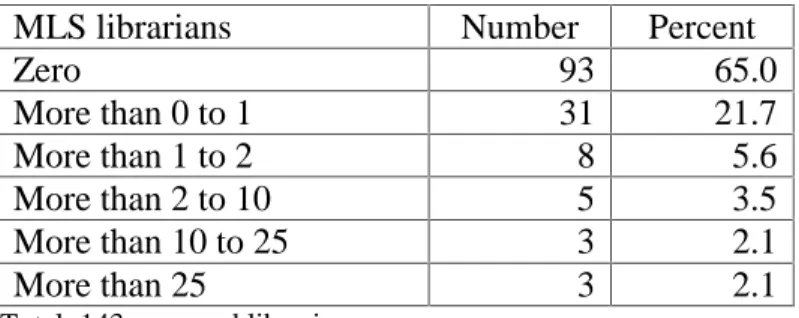
Table 2 summarizes the full-time equivalent Master of Library Science (MLS) librarians in the surveyed public libraries. A majority of the libraries (65%) have no full-time equivalent MLS librarians, while slightly more than another fifth have between zero and 1 full-time equivalent MLS librarian. Only 7.7 percent of the libraries have more than 2 full-time equivalent MLS librarians and 6 libraries (4.2 percent) have more than 10 such librarians.
Table 2
Fulltime Equivalent MLS Librarians MLS librarians Number Percent
Zero 93 65.0
More than 0 to 1 31 21.7 More than 1 to 2 8 5.6 More than 2 to 10 5 3.5 More than 10 to 25 3 2.1 More than 25 3 2.1
Serving business community needs can possibly be done with less extensive, more focused training than that required for a Master of Library Science degree. Some other types of training are summarized in Table 3. Most libraries have at least one librarian who has received training in using electronic resources in the library (89.5 percent), and most have at least one librarian who has received specialized training in using the Internet (90.2 percent). Many fewer libraries (44.1 percent) have at least one librarian with
specialized training in serving the needs of those patrons who request business or economic information.
Table 3
Libraries in Which At Least One Librarian Has Received Specialized Training in an Area
Area Number Percent
Using electronic resources in the library 128 89.5
Using the internet 129 90.2
Serving the needs of those patrons who request business or
economic information 63 44.1
Total libraries = 143
Libraries in Which At Least One Librarian Has Received Specialized Training in an Area By Size of Library Budget
(Percent is Percent of Libraries in Size Category)
Using electronic resources in the
library Using the internet
Serving the needs of those patrons who request business or economic information
Total budget Number Percent Number Percent Number Percent Less than $100,000 72 85.7 73 86.9 35 41.7 $100,000 to $300,000 33 94.3 33 94.3 18 51.4 $300,000 to $500,000 8 100.0 8 100.0 2 25.0 $500,000 to $1,000,000 6 85.7 7 100.0 2 28.6
Over $1,000,000 9 100.0 8 88.9 6 66.7
Total libraries = 143
These overall training percentages do not vary much when we look at libraries of various sizes. Even among the smallest libraries surveyed (budget less than $100,000), 85.7 percent report that at least one librarian has received specialized training in using
electronic resources in the library. Of these same libraries, 86.9 percent report that at least one librarian has received specialized training in using the Internet, and 41.7 percent report that at least one librarian has received specialized training in serving the needs of those patrons who request business or economic information.
3. Types of users of business-related materials served by public libraries
The types of users and frequency with which they use business-related materials in the public libraries are shown in Table 4. The two types of users of business-related materials that most frequently use these materials are individuals seeking personal investment information (39.9 percent of the libraries reported such users as “frequent” or “very frequent”) and students seeking information about business-related subjects (30.8 percent of the libraries reporting such users as “frequent” or “very frequent”).
The next most frequent type of user of business materials is entrepreneurs or start up companies (20.3 percent of libraries reported such users as “frequent or very frequent”). Personnel from small and medium sized businesses were reported to be “frequent” or “very frequent” users by 11.9 percent of libraries, but very few libraries (2.1 percent) reported personnel from large corporations as “frequent” or “very frequent” users of business-related materials.
Special interest groups seeking information about business-related subjects were cited as “frequent” or “ very frequent” users by 9.8 percent of libraries, while companies or institutions with job-training needs were cited as “ frequent” or “ very frequent” users by 5.6 percent of libraries.
The frequency with which libraries serve various types of business material users is sensitive to the size of the libraries for some types but not others. For instance, the most frequent type of business patron, an individual seeking personal investment information, was cited as a frequent or very frequent type of user by 86.6 percent of the 22 libraries with budgets over $300,000, but by only 32.2 percent of the libraries with budgets of less than $300,000. On the other hand, students seeking information about business-related subjects were cited as at least frequent users by 45.5 percent of libraries with budgets over $300,000 and 28.8 percent of libraries with budgets under $300,000, and as at least moderate users by 77.3 percent of the former and 63.5 percent of the latter. Libraries appear to serve students seeking business related-materials fairly regularly regardless of library size.
Entrepreneurs and start-up companies appear to be served with greater frequency by larger libraries. Of 22 libraries with budgets greater than $300,000, 19 (86.4 percent) serve them with at least moderate frequency, while 50 of 118 libraries with smaller budgets (42.4 percent) serve them with at least moderate frequency. Perhaps surprisingly, library size does not seem to be strongly related to the rate at which libraries serve small to medium sized-businesses. Only 2 larger libraries (9.1 percent) said they serve such clients at least frequently, while 15 smaller libraries (12.7 percent) cited such service. The larger libraries were, however, somewhat more likely to say that they serve small to medium-sized businesses moderately than were the smaller libraries.
Table 4
Types of Users of Business-Related Materials and Frequency of Use (Percents in Parentheses)
Type of User
Very
Infrequently Infrequently Moderately Frequently
Very Frequently Personnel from
small and medium- sized businesses 44 (30.8) 43 (30.1) 36 (25.2) 13 (9.1) 4 (2.8) Personnel from large corporations 119 (83.2) 14 (9.8) 4 (2.8) 1 (0.7) 2 (1.4) Entrepreneurs or
start-up companies 43 (30.1) 28 (19.6) 40 (28.0) 23 (16.1) 6 (4.2) Researchers or technicians from business or government 85 (59.4) 33 (23.1) 18 (12.6) 2 (1.4) 2 (1.4) Students seeking information about business-related subjects 23 (16.1) 25 (17.5) 48 (33.6) 33 (23.1) 11 (7.7) Special interest groups seeking information about business-related subjects 62 (43.4) 39 (27.3) 25 (17.5) 10 (7.0) 4 (2.8) Companies or institutions with job training needs
93 (65.0) 26 (18.2) 13 (9.1) 4 (2.8) 4 (2.8) Individuals seeking personal investment information 23 (16.1) 24 (16.8) 36 (25.2) 31 (21.7) 26 (18.2)
4. Facilities, materials, and services for serving business patrons.
Physical facilities for serving business patrons. Libraries’ abilities to serve business patrons are influenced by the physical resources of the library, the materials that can be accessed at or through the library, and the services that the library can provide. This section characterizes capacity of the state’s public libraries to provide such service. Only 41 of the 143 libraries surveyed (28.7 percent) have a special reference or service area devoted to business and economics. As one would expect, the existence of such an area depends on the size of the library. All but one of the 9 libraries with budgets over $1,000,000 have such an area, while 8 of 15 libraries with budgets between $300,000 and $1,000,000 have one. Only about a fifth of the smaller libraries (budget less than
$300,000) have a special reference area devoted to business and economics. However, such areas are not totally absent even in the smallest libraries (budget less than
$100,000); 19 of 84 such libraries have a special reference area devoted to business and economics.
Of the 41 libraries that have a special service area devoted to business and economics, 33 described it as a business information area located in the main library. Of the other 8, four described their business and economics reference area as being a part of the reference section or mixed in with the general collection.
Staff allocated to serving business patrons. Only 47 of the 143 libraries (32.9 percent) have a specific person or persons who primarily handle the requests for information and services made by the business community. Half of the larger libraries (budget greater than $300,000) report having such a person, while 29.4 percent of the smaller libraries (budget less than $300,000) have such a person. This distribution is stable within smaller groups; for example, 5 of the nine libraries with budgets over $1,000,000 have such a person and 31 percent of the 84 libraries with budgets less than $100,000 have such a person.
Materials and services available to business patrons. Libraries were asked about the availability of business information and reference materials. The results are shown in Table 5. The most commonly available of the materials listed are legal indexes,
dictionaries, and encyclopedias (available in 86.0 percent of the libraries), employment, occupation and job training resources (available in 81.1 percent of the libraries) and local and state regulations and reports (available in 76.2 percent of the libraries). The
distribution is somewhat uniform relative to the size of the libraries. Looking just at libraries with budgets of less than $100,000, legal indexes, dictionaries, and
encyclopedias are available in 84.5 percent of the libraries; employment, occupation and job training resources are available in 72.6 percent of the libraries; and local and state regulations and reports are available in 71.4 percent of the libraries.
The next most commonly available materials are government documents (available in 48.3 percent of the libraries), industry data, statistics and trends (available in 42.7 percent of the libraries), subject and industry-specific newspapers and journals (available in 39.2
percent of the libraries), and company reports and company data (available in 37.1 percent of the libraries). The availability of government documents does not depend on library size. However, industry data, statistics, and trends are available in 79.2 percent of the libraries with budgets over $300,000 versus only 35.3 percent available in libraries with less than $300,000 budgets. Subject and industry-specific newspapers and journals (63.5 percent versus 34.5 percent) and company reports and corporate data (79.2 percent versus 28.5 percent) are all more likely to be available in a library with a budget of more than $300,000 than in a library with a budget of less than $300,000.
Table 5
Libraries Whose Collections Contain Specific Business Information or Reference Materials
Type of business information or reference materials Number Percent Subject-specific indexes, like Dunn’s Business Locator or Moody’s
Company Data 24 16.8
Any government document 69 48.3
Company reports or company data 53 37.1 Industry data, statistics, trends 61 42.7 Subject and industry-specific newspapers, journals 56 39.2
Newspaper clipping files 41 28.7
Newsletters 41 28.7
Local and state regulations and reports 109 76.2 Legal indexes, dictionaries, encyclopedias 123 86.0 Employment, occupation and job training resources 116 81.1
Total libraries = 143
The least commonly available resources are newspaper clipping files and newsletters (each available in 28.7 percent of the libraries) and subject-specific indices like Dunn’s Business Locator or Moody’s Company data (available in 16.8 percent of the libraries). The availability of newspaper clipping files does not depend on library size. However, newsletters are about twice as likely to be found in libraries with budgets greater than $100,000 than in those with budgets less than $100,000 (40.6 percent to 20.2 percent). Subject-specific indexes are available in over half of the libraries with budgets greater than $300,000, but in only 10 percent of libraries with budgets of less than $300,000. Libraries were also asked if their library holdings contained any CDROM/DVD databases. About one-fourth of the libraries (36 of 143) indicated that their holdings included such databases. The existence of such databases is closely correlated with library size. All 9 libraries with budgets of more than $1,000,000 have some such databases. Among libraries with budgets between $100,000 and $1,000,000, 32 percent have some such databases. Only 13 percent of the smallest libraries (budget less than $100,000) have any CDROM/DVD databases.
Some types of CDROM/DVD databases that libraries have are shown in Table 6. The most commonly-available databases are Standard and Poor’s Register (available at 12 libraries) and Thomas Register (available at 23 libraries). Both of these databases are available at some smaller as well as some larger libraries. The Thomas Register is
available at 14 libraries with budgets of less than $300,000, while the Standard and Poor’s Register is available at 6 such libraries. The other databases in the table are available at only a small number of libraries. Four of the five libraries that have ABI/INFORM have budgets of over $1,000,000. On the other hand, two of the three libraries that have CIRR have budgets of under $100,000, while three of the 5 libraries that have Compact
Disclosure have budgets of under $300,000. In answer to an open-ended question, five libraries mentioned American Business Disc as a CDROM/DVD database available at their library.
Table 6
Libraries Whose Collections Contain Various CDROM/DVD Databases CDROM/DVD Database Number Percent
Compact Disclosure 5 13.9
ABI/INFORM 5 13.9
Business Abstracts 1 2.8
CIRR 3 8.6
Standard and Poor’s Register 12 33.3 Thomas Register 23 63.9 Total: 36 libraries having any CDROM/DVD databases
Respondents were asked if they had any on-line vendor systems available in their
libraries. Thirty-nine of the 143 libraries (27.3 percent) reported having an on-line vendor system available. Half of the 16 libraries with budgets over $500,000 had an online vendor system available, while 24.4 percent of libraries with budgets under $500,000 had such a system available.
The particular on-line vendor systems that libraries reported having available are shown in Table 7. The number of libraries that reported having any one of these systems is small. The Dow Jones News Retrieval, DIALOG, and WILSONLINE were each available at four libraries. The Dow Jones News Retrieval was available at 3 of the smallest libraries with budgets under $100,000 and one library with a budget over $1,000,000. DIALOG was available at one library with a budget of less than $300,000, one library with a budget between $500,000 and $1,000,000, and two libraries with budgets of over $1,000,000. WILSONLINE was available at two libraries with budgets of less than $300,000 and two libraries with budgets of over $1,000,000. The other four instances of available on-line vendor systems in Table 7 (two libraries with BRS and one each with Lexis/Nexus and Orbit) occurred at libraries with budgets of less than
$300,000. Three of the four were at libraries with budgets of less than $100,000. In response to an open-ended question, 9 respondents reported First Search as an on-line vendor system that is available in their library.
Table 7
Libraries With Various Online Vendor Systems CDROM/DVD Database Number Percent
BRS 2 5.1
Dow Jones News Retrieval 4 10.3
DIALOG 4 10.3
NewNet 0 0.0
Lexis/Nexis 1 2.6
Orbit 1 2.6
VU?TEXT 0 0.0
WILSONLINE 4 10.3
Total: 39 libraries having online vendor systems
Libraries were asked to indicate which online databases library staff or patrons looking for business or industry information frequently search. The results are shown in Table 8. The two most commonly cited online databases are ABI/INFORM (11 libraries) and Business Periodicals Index (7 libraries). ABI/INFORM was cited by 3 libraries with budgets of over $1,000,000, one library with a budget between $300,000 and $500,000, and 7 libraries with budgets of less than $300,000. Four libraries with budgets of over $1,000,000 and three libraries with budgets of under $100,000 cited business Periodicals Index.
Table 8
Libraries Responding That Currently Online Databases are Frequently Searched by Library Staff or Patrons looking for Business or Industry Information
Online Database Number Percent
ABI/INFORM 11 28.2
American Banker Full Text 0 0.0
BioBusiness 1 2.6
Business Dateline 3 7.7 Business Periodicals Index 7 17.9 Business Software Database 0 0.0
CENDATA 1 2.6
Chemical Industry Notes 0 0.0 Total: 39 libraries having online vendor systems
Libraries were also asked if they subscribe to any on-line database services. Fifty-three libraries (37.1 percent) said that they do subscribe to such services. The largest libraries are somewhat more likely to subscribe to such database services. Six of 8 libraries with budgets of over $1,000,000 subscribe to such database services, while 27 of 83 libraries with budgets of less than $100,000 (32.5 percent) subscribe.
The specific on-line databases that libraries subscribe to are shown in Table 9. The most frequently-cited databases are OCLC (33 libraries) and INFOTRAC (26 libraries). In addition, 24 libraries mentioned First Search in response to an open-ended question asking what other on-line databases they subscribe to. All 6 of the libraries with budgets over $1,000,000 that subscribe to an on-line database service subscribe to OCLC, while 5 of the 6 subscribe to INFOTRAC. Seventeen of the 27 libraries with budgets under $100,000 that subscribe to an on-line database subscribe to OCLC, while 11 subscribe to INFOTRAC.
Table 9
Libraries Subscribing to Various Online Data Bases Online database service Number Percent
DIALOG 4 7.5
INFOTRAC 26 49.1
OCLC 33 62.3
PROQUEST 6 11.3
RLIN 0 0.0
SIRS 7 13.2
SORKINS 2 3.8
WESTLAW 0 0.0
Total: 53 libraries that subscribe to some online database service
Table 10 shows the restrictions that libraries place on online searching by business patrons. The main restrictions are fees for printing (imposed by 83.2 percent of the libraries) and time limits on searches (imposed by 63.6 percent of libraries). The
existence of both fees for printing and time limits for searches are independent of library size. Twelve libraries (8.4 percent) impose a fee for downloading. Eleven of these libraries have budgets of less than $300,000.
Table 10
Libraries with Various Restrictions on Online Searching by Business Patrons Type of restriction Number Percent Fee based reference searching 4 2.8 Restrictions on number of data bases searched 3 2.1 Restrictions on the number of citations printed 3 2.1 Restrictions of full text records printed 5 3.5 Time limits on searches 91 63.6 Fee for printing 119 83.2 Fee for downloading 12 8.4
Services provided to business patrons. Libraries were asked about services that were directed toward business users and more general services that could be of use to business users as well as other library patrons. When asked if their libraries had developed any specific programs or policies designed to meet the needs of the business community, 17 of the 143 respondents said yes. Four of the nine libraries with budgets over $1,000,000 have developed such programs, while 13 of the 119 libraries with budgets of less than $300,000 have developed such programs. No libraries with budgets between $300,000 and $1,000,000 have developed such programs.
The most common type of program developed by libraries to serve business is one that has some relation to computing; 10 of the 17 libraries described programs that involved a computer lab, the Internet use, or web-page development. The libraries with budgets under $100,000 tended to try to make information available by setting up web pages. The libraries with budgets between $100,000 and $300,000 were more concerned with
making technology available by setting up computer labs or upgrading their computers. Libraries were asked if they have any special services or resources designed to help a person who is trying to start a small business. Ninety-five of the 143 libraries (66.4 percent) answered in the affirmative. The distribution of affirmative answers by size of libraries was nearly uniform. For example, 61.4 percent of libraries with budgets of less than $100,000 answered yes, while 55.6 percent of libraries with budgets of over $1,000,000 answered yes. However, libraries with budgets under $100,000 were more restricted in what they tried to do for business and in about 40 percent of the cases could not provide a description of what they had done for business. For the larger libraries, only about 20 percent could not identify what they had done for business.
The main type of resource or service that libraries reported having was books or other media (pamphlets, brochures, videos, and information packets) that provide guidance for those who are starting a small business. Seventy-three of the 95 libraries that reported having resources or services to help a person starting a small business reported resources of the above type.
Libraries were asked if they include referring patrons to corporate libraries as part of the services. Twenty-eight libraries (19.6 percent) said that they do. Libraries of all sizes said that they made such referrals. Nine of the libraries that said that they make such referrals named large public libraries as the target of their referral. Some mentioned the state library, law libraries, medical libraries, technical libraries and academic libraries. A few identified the libraries of private corporations.
Interlibrary loans are a service that libraries provide to their general patrons that can be of use to business patrons in particular. Table 11 shows the percentage of libraries’
interlibrary loan requests that are for business or economic information. For the vast majority of libraries (about 4/5), interlibrary loan requests for business or economic information make up no more than 10 percent of all interlibrary loan requests, and for all but a handful they make up no more than 20 percent.
Table 11
Percentage of Interlibrary Loan Requests for Business or Economic Information Percentage of Requests Number Percent
0-5 81 56.6
5-10 33 23.0
10-20 12 8.4
20-40 8 5.6
Don’t know 3 2.1
Total: 143 libraries; 6 missing
Table 12 tabulates the importance of various types of interlibrary loan requests for supplementing libraries’ business collections. Resources in other related subject fields (cited as important or very important by 42.7 percent of libraries) and back-file periodicals (cited as important or very important by 42.0 percent of libraries) were the most important types of interlibrary loans for supplementing the business collections of libraries. Government documents (rated as important or very important by 30.8 percent of libraries) and obscure or scholarly periodicals (rated as important or very important by 28.0 percent of libraries) were the next most important types of interlibrary loan requests for supplementing the library's business resource collection. Company and industry data (rated as important or very important by 23.1 percent of libraries) and dissertations or theses (rated as important or very important by 16.1 percent of libraries) were the least important types of interlibrary loan requests for supplementing a library's business collection.
The importance of resources in other related subject fields, obscure or scholarly
periodicals, and dissertations or theses does not vary by library size. However, back-file periodicals and government documents on interlibrary loan are less important for the largest libraries (budget over $1,000,000) than they are for other libraries. Furthermore, company and industry data are not at all important for the largest libraries.
Another service that libraries provide to their general patrons that can be of particular use to business patrons is Internet access. The vast majority of libraries (92.3 percent) allow patrons to use the Internet in the library. The percentage varies somewhat by size of library, but even among the smallest libraries (budget less than $100,000) more than 90 percent of the libraries allow patrons to use the Internet. However, only libraries with less than $300,000 budgets charge for Internet access (8 libraries) and do not allow Internet access (10 libraries).
In Table 13, two of the features of the Internet access provided by libraries are
summarized. First, most libraries, small, medium or large, do not charge for access to the Internet. The 8 libraries that do charge are all smaller libraries with budgets of less than $300,000. Second, nearly three-fourths of the libraries allow patrons to have E-mail accounts. The size of the library is not correlated with whether it allows patrons to have E-mail accounts or not.
Table 12
Importance of Types of Interlibrary Loan Requests For Supplementing the Library’s Business Collection
(Percents in Parentheses) Type of
Resource
Not at all important
Marginally useful
Somewhat
important Important
Very important Don’t know Resources in other related subject fields 22 (15.4) 15 (10.5) 37 (25.9) 17 (11.9) 44 (30.8) 7 (4.9) Obscure or scholarly periodicals 57 (39.9) 23 (16.1) 20 (14.0) 17 (11.9) 23 (16.1) 2 (1.4) Dissertations/ theses 72 (50.3) 27 (18.9) 17 (11.9) 11 (7.7) 12 (8.4) 3 (2.1) Back-file periodicals 28 (19.6) 17 (11.9) 34 (23.8) 28 (19.6) 32 (22.4) 2 (1.4) Government Documents 40 (28.0) 35 (24.5) 21 (14.7) 23 (16.1) 21 (14.7) 1 (0.7) Company/ Industry data 59 (41.3) 27 (18.9) 20 (14.0) 19 (13.3) 14 (9.8) 1 (0.7)
Total: 142 libraries; 1 missing. Note: Respondents were asked to rate the importance from 1 to 5, with 1 being "Not at all important" and 5 being "Very important". "Marginally useful" in the table corresponds to a response of "2", "Somewhat important to a response of "3", and Important to a response of "4".
Table 13
Features of Internet Use by Patrons at Libraries
Feature Number Percent
Charge for access 8 6.1 Patrons allowed to have E-Mail accounts 96 72.7
Total: 132 libraries allowing internet use
5. The marketing of public libraries’ business resources and public libraries’ interaction with the business community
A particular focus of the library survey was to determine the extent to which public libraries market their business resources to the members of the business community, the methods that they use for marketing, and the extent and types of interaction of library staff with the business community. The size of a library influences whether the library markets itself to the business community. Twenty-one percent (30 of 143 libraries) actively market their business information and reference services. Eleven of 24 libraries with budgets of more than $300,000 (45.8 percent) market their business and information services, while 19 of 119 libraries with budgets of less than $300,000 (16.0 percent) market such services.
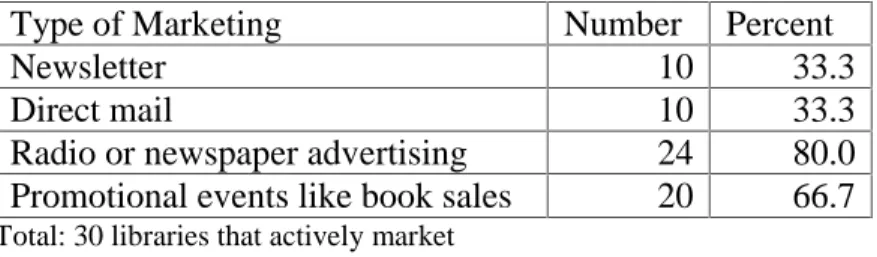
Table 14 summarizes the types of marketing used by libraries that market their business information and reference services. Radio and newspaper advertising and promotional events like book sales are the most commonly used methods of marketing a library’s business resources. Large libraries (those with a budget of more than $1,000,000) are more likely to use a newsletter or direct mail. The smallest libraries (ones with a budget of less than $100,000) are more inclined to use newspaper or radio advertising, or promotional events like book sales. Libraries with budgets between $100,000 and $1,000,000 are most likely to use radio or newspaper advertising to promote their business information and reference services. These libraries are also more likely to have newsletters and use direct mail to inform the business community.
Table 14
Libraries Using Various Types of Active Marketing of Business Information and Reference Services Type of Marketing Number Percent
Newsletter 10 33.3
Direct mail 10 33.3
Radio or newspaper advertising 24 80.0 Promotional events like book sales 20 66.7
Total: 30 libraries that actively market
Table 15 summarizes public libraries’ modes of interaction with business groups. Slightly more than three-fourths of the libraries have met with representatives of the Chamber of Commerce or attended meetings with members of the business community to explain what resources the library has. All but one of the 24 libraries with a budget of more than $300,000 has attended meetings with business people to explain the library’s resources, while 85 of 119 libraries (71.4 percent) with smaller budgets have done so. All but three of the 24 larger libraries have met with representatives of the Chamber of Commerce, while nearly three-fourths of the smaller libraries have done so. However, the libraries with less than $100,000 budget are less likely to have interacted with the local Chamber of Commerce than the libraries with budgets over $100,000.
Table 15
Libraries That Have Had Outside Interaction with Business Groups
Type of interaction Number Percent Attended meetings with members of the business community to
explain what resources the library has 108 75.5 Become a member of a business organization such as the Chamber
of Commerce or Rotary 99 69.2
Met with representatives of the Chamber of Commerce 109 76.2 Had any interaction with the Small Business Development Center 51 35.7
Nearly 70 percent of libraries reported having a representative become a member of a business organization such as the Chamber of Commerce or Rotary. All but one of the 24 larger libraries reported such an action, while nearly 74 percent of the smaller libraries had done so. A much smaller proportion of libraries had had any interaction with the small business development center, just under 36 percent. Half of the 24 larger libraries had done so, while a third of smaller libraries had such an interaction.
6. Recent changes experienced by libraries.
The library survey explored libraries’ perceptions of changes in their environment related to the services that they provide to business customers. Specifically, the survey probed libraries perceptions of changes in their budgets, resources devoted to providing resources and services to the business community, the number of persons from the business community seeking materials and services from the library, and the number or proportion of all patrons requesting business, economic, investment, or industry-related material. The results from this part of the survey are presented in Table 16.
Table 16
Changes in Library Budgets and Activities (Percents in Parentheses)
Activity Increased
Remained
the same Decreased
Don't Know Library Budget 100 (69.9) 33 (23.1) 7 (4.9) 0 (0.0) Resources committed to purchasing
materials or providing services for members of the business community
41 (28.7) 94 (65.7) 5 (3.5) 0 (0.0) Number of individuals from the
business community seeking materials or services
43 (30.1) 89 (62.2) 8 (5.6) 1 (0.7) Number or proportion of all patrons
requesting business, economic, investment or industry-related information 63 (44.1) 73 (51.0) 4 (2.8) 1 (0.7)
Total: 143 libraries
Nearly 70 percent of libraries say that their budgets have increased during the last few years, whereas only about 5 percent perceive a decrease. This distribution is nearly independent of the size of the library, although 5 of the 7 libraries that said that their budgets had decreased were small libraries with annual budgets of less than $100,000. Nearly two-thirds of the libraries feel that the amount of resources committed to
purchasing materials or providing services for the business community have remained the same over the past few years. A substantial 28.7 percent, however, believed that the
amount of such resources had increased during the last few years. A very small fraction of libraries (3.5 percent) perceived a decrease in these resources. This distribution did not depend significantly on the size of libraries.
More than three-fifths of the libraries (62.2 percent) said that the number of individuals from the business community seeking materials or services has remained the same over the last few years. Nearly a third (30.1 percent) responded that the number of such individuals had increased. Only 5.6 percent of libraries said that the number of individuals from the business community seeking materials or services has decreased over the past few years. This distribution is nearly independent of the size of the libraries, although the smallest libraries (budget less than $100,000) were somewhat less likely to have perceived an increase in business patrons.
Almost half of the libraries (44.1 percent) said that the number or proportion of all patrons requesting business, economic, investment or industry-related information had increased, while slightly more than half said that it had remained the same. Only four libraries felt that the number or portion of such patrons had decreased. Again, the distribution is nearly the same across all size categories, except that the smallest libraries are somewhat less likely to have perceived an increase in the number or proportion of patrons requesting business, economic, investment or industry-related information. The major area of difference between the smaller libraries (less than $100,000 budget) and the larger libraries (more than $100,000 budget) is the difference between the
perception of increased budgets and the perception of increased demand for services. The same proportion of smaller as larger libraries perceive getting increases in budgets, but a larger proportion of larger libraries perceive an increase in the demand for business services than smaller libraries. The one group of libraries that seem to be getting squeezed the most is the libraries with budgets between $100,000 and $300,000. The demands by the business community seem to be more like the demands the larger libraries face, but their resources available to meet these demands seem to be more like those of the smaller libraries.
7. Priorities of public libraries.
The survey contained two open-ended questions intended to uncover libraries’ priorities. The first question asked libraries what their priorities were over the next five years in terms of improving services to the public. Technology was the area that was mentioned most frequently by the libraries. Sixty-five libraries included technology-related items such as new and upgraded computers, automation of the library, adding or improving Internet access, and web page development among their priorities for the next 5 years. Adding to collections, including electronic media, was the next most frequently-
mentioned category, cited by 32 libraries. Nineteen libraries listed capital improvements among their priorities and 7 included improved marketing of their library’s services to the public.