Benchmarking Report
Performance & Development Review (P&DR) Systems
U21 HR Working Group, led by the University of GlasgowApril 2012
Authors:
Christine Barr, Deputy Director – Human Resources Fiona Docherty, International Director & U21 Manager
U21 HR Benchmarking Report
Performance & Development Review (P&DR) Systems
Contents:
Executive Summary page 3
1. Introduction page 4
1.1 Background and Context page 4
1.2 Definition of ‘Performance & Development Review’ Systems page 4
1.3 Benchmarking participants page 4
1.4 Research Methodology page 5
2. Performance & Development Review: Findings page 5
2.1 Overall Approach page 5
2.2 Structure of Reviews page 8
2.3 Approval & Appeal Mechanisms page 8
2.4 Setting of Objectives: Link to Strategy page 9
2.5 Training to Undertake Reviews page 10
2.6 Ranking and Pay page 12
2.7 Participation page 14
2.8 Recording, Audit and Data Analysis page 14
2.9 Key Benefits page 15
2.10 Key Challenges page 15
2.11 Key Conclusions page 16
Executive Summary
In 2011, the U21 Human Resources group identified key topics in HR for benchmarking research in order to share best practice. University of Glasgow offered to take a lead in chairing the group for the first year, and initiating the first project looking at Performance Management Systems across participating institutions of the U21 network. Eleven U21 universities participated in the benchmarking survey and shared HR policy documentation to illuminate good practice in performance management.
We found that participating organisations share a common goal of performance management in aligning individual performance to institutional purpose, and share a view that performance and development review is a key means of impacting on the culture of their organisation, with staff engagement cited as one of the main benefits of the P&DR process. Although the P&DR process is mandatory in most cases, participants usually encourage an ongoing conversation between managers and staff as good practice.
The survey highlighted areas of considerable expertise and good practice across U21, with examples from all participants. These include leadership training and development, one-to-one coaching, training in international issues and career planning.
We also found common challenges in the practice of Performance and Development Review: most commonly, ensuring the quality of conversation between managers and staff, how to set goals effectively and how to ensure a consistency of approach across different
departments.
Key discussion points emerging from the report include how to increase compliance in P&DR; key approaches to consistency and quality of P&DR conversations; the use of statistical information to determine trends; and effective ways to link individual objectives to institutional strategy.
The report offers some key areas for further discussion which will enable a more in-depth examination of what works well in those universities who excel in P&DR practice, and how this can be shared and reworked into models which work for others. The HR group plan to use the key discussion points as the basis for a workshop to examine specific topics in more detail and to discuss further topics from those identified initially by the HR group.
We aim to share the U21 HR report across the U21 network, including those who did not participate in this particular piece of work but who may wish to benefit from the findings and join the HR group at a later date. A report from the workshop will also be made available, where we hope to share practical strategies for address the key challenges and discussion points outlined above.
1. Introduction
This report aims to provide an overview of current PD&R practice across participating U21 institutions in order to stimulate discussion and improve good practice in HR. By highlighting commonalities and differences in PD&R practice between universities and offering several mini case studies which demonstrate innovative practice, we aim to inform further discussion and share best practice through workshop and teleconferencing.
1.1 Background and Context
The U21 Human Resources group is made up of professionals from across the network, aiming to pool experiences, share best practice, policies and information on effective ways to improve HR services in member universities. Reinvigorated in late 2011, the group aims to undertake two benchmarking exercises each year, providing a strong focus for the
collaboration, as well as a tangible and practical output. In addition to benchmarking, the U21 HR group provides the opportunity for members to communicate on an informal level with international colleagues, on matters of local importance.
The group was surveyed in August 2011 to identify key issues for discussion over the coming years. The ‘hot topics’ identified were:
performance management
leadership development for senior managers and academics
organisational development and change management
measuring HR effectiveness
early career researcher training
The group will be hosted on an annual basis by a U21 member university. For 2012 this is the University of Glasgow, which is taking responsibility for compiling the first benchmarking report on Performance & Development Review systems.
1.2 Definition of ‘Performance & Development Review’ Systems
Performance and Development Review (P&DR) is central to how an organisation
approaches performance management, aligning individual objectives and development to institutional strategy and purpose, and ensuring that individuals are held accountable for their performance.
1.3 Benchmarking participants
U21 has a membership of 23 universities [as of April 2012], of which ten are active members of U21 HR group. However, in response to interest from a wider group of members, the research will be available for discussion to all U21 members. Those who participated in the inaugural benchmarking survey were:
University of Auckland University of Melbourne University of Birmingham University of New South Wales University College Dublin University of Nottingham
University of Glasgow University Singapore University of Lund University of Virginia University of Hong Kong
1.4 Research Methodology
The approach taken to gathering data was a straightforward on-line survey, gathering both quantitative and qualitative responses, depending on the nature of the question. Where the survey has highlighted innovative practice respondents were approached to gain more detail for brief case studies. Although there were eleven respondents to the survey, not all
responded to every question due to differing P&DR practices.
See Appendix 1 for more information on the methodology for this project.
2. Performance & Development Review: Findings 2.1 Overall Approach
i. Systems
The majority of universities surveyed have a mechanism in place for performance and development review within their institution. Only one respondent did not because it had not been prioritised in their institution, although this was currently under review. Six respondents call their system ‘performance development review’, with three naming it ‘performance management system’ and one respondent calling it ‘performance appraisal.’
‘We see the performance appraisal process as the best opportunity to impact on the culture of the organisation and are taking it very seriously.’
There is considerable expertise across the network in this area. Half of respondents have had a performance management system in place for more than ten years (two of whom have been operating their system for over 20 years). A further three universities have had a
system in place for between 5 and 10 years, with one member implementing a new system three years ago. Any member considering introducing a performance management process in the future could draw on the significant experience within the U21 network.
ii. Timing
The majority of respondents conducted their P&DR process once a year with one member carrying it out twice a year. Of those reviewing annually, more than half said that they
encouraged regular informal discussion on an ongoing basis although the formal review only takes place once a year.
‘The resources and training we offer supervisors encourage them to have an ongoing conversation between the annual reviews.’
Timing of the staff performance review was mixed amongst those who responded to the question: three universities aligned review meetings to start/end of the calendar year; two held meetings from February to April; and in one institution academic and financial years were aligned with reviews held at year end.
iii. Coverage
Most institutions operate different types of review for different staff groups, with almost half distinguishing between academic and non-academic staff. A smaller group (three universities) operate three different systems between academic, professional and support staff.
‘There are 3 different groups of staff with various degrees of complexity in the reviews: academic staff where the focus would be on their contribution and performance in the areas of teaching, research and service; executive & professional where there is the portion on the key deliverables of their jobs (the MBO component), their competencies, managerial and development aspects; and support staff where the focus is more on their know-how in the key requirements of the job, the attitudinal and personal and development areas.’
Most respondents stated that all staff are reviewed under the system, with one university qualifying that staff on fixed-term contracts of less than one year would not be expected to be reviewed. One respondent commented that although their policy is for all staff to be
reviewed, compliance stands at around 80%.
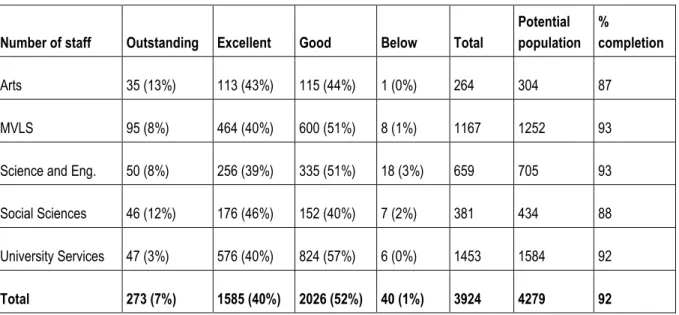
Please see table below for distribution over four outcomes both at College and Grade level, for University of Glasgow, academic year 2011/12.
Table 1: University Profile (Grouped by College and overall performance ranking)
Number of staff Outstanding Excellent Good Below Total
Potential population % completion Arts 35 (13%) 113 (43%) 115 (44%) 1 (0%) 264 304 87 MVLS 95 (8%) 464 (40%) 600 (51%) 8 (1%) 1167 1252 93
Science and Eng. 50 (8%) 256 (39%) 335 (51%) 18 (3%) 659 705 93
Social Sciences 46 (12%) 176 (46%) 152 (40%) 7 (2%) 381 434 88
University Services 47 (3%) 576 (40%) 824 (57%) 6 (0%) 1453 1584 92
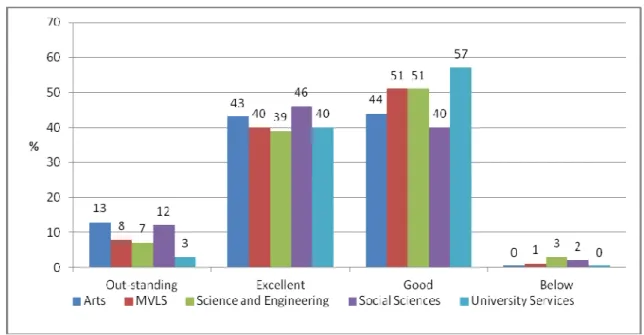
Chart 2: University Profile (Grouped by College and overall performance ranking)
Table 3: Overall University Profile (Grouped by Staff Grades)
Number of staff Outstanding Excellent Good Below Total
Potential population % completion Grades 1 - 5 53 (4%) 555 (38%) 829 (57%) 8 (1%) 1445 1560 93 Grades 6 - 9 175 (8%) 907 (42%) 1051 (49%) 24 (1%) 2157 2397 90 Grade 10 45 (13%) 123 (38%) 146 (45%) 8 (2%) 322 322 100 Total 273 (7%) 1585 (40%) 2026 (52%) 40 (1%) 3924 4279 92
For a further three universities, although the review has differences based on key
performance indicators or a different approach to carrying out the review, it is nevertheless based on a common model across all staff. One university commented that although they have been operating a common model across all staff, they were in the process of reviewing this to make their system more bespoke, particularly for academic staff.
2.2 Structure of Reviews
There is remarkable synergy in terms of the areas covered across the network. All
respondents include the following areas within the performance and development review:
Review of performance in the past year
Performance against specific objective/strategic plan
Issues/challenges
Training/personal development progress
Career aspirations
Objectives for next 12 months
Training/development for next 12 months
‘The evaluation is in three parts. Part 1 addresses what was accomplished, measuring progress against pre-established goals and objectives. Goals are cascaded from the university level (President's Goals) to the Vice Presidents and Deans, to departments, to the individual. Part 2 addresses how the work was accomplished, measuring against pre-established competencies with specific behaviours. Part 3 addresses career development activities and aspirations.’
2.3 Approval & Appeal Mechanisms
The review is undertaken by the immediate line manager or supervisor in all universities. In approving the outcome of the review, 50% respondents involved the line manager in approval of review, with a further 30% involving subsequent levels in the management hierarchy. 90% involved reviewees in approving or signing off the review. One institution commented that they operate a ‘calibration’ process where at the second level review stage, department heads review the consistency of approach across the managers in their area, and intervene where appropriate.
In the event that a staff member or reviewer disagrees on the performance review, six universities refer the matter to the next level of management authority for resolution. In one institution this was done by requesting a confidential meeting by either party with the next in authority line, which would seek to resolve the matter through discussion. In two universities, the staff member and reviewer would be expected to resolve the disagreement themselves. Two universities offer a system of appeal while a further university offers appeals only on the basis of procedural irregularity. This amounted to nearly a third offering some system of appeal in total. Two universities offer the opportunity to refuse signature of the review document with a further one university asking the reviewee to sign the document on the basis that they have read the review, rather than that they agree with it.
When staff performance falls below the standard required, two thirds of universities surveyed implement a performance review plan with an expectation that staff performance will improve within 3-6 months. Of these respondents, the approach to and outcome of the performance review plan differed:
Staff offered guidance and counselling from their HR department as part of the process
Staff informed that poor performance may impact on salary
Reviewer expected to offer advice and development support to ensure the employee can meet the standard required for the post, to ensure the improvement of performance One university responded that the outcome of poor performance depends largely on their line manager but this institution is currently evaluating their processes to ensure a consistent approach across the organisation. One university felt that the Performance Development Review is not the correct mechanism for dealing with poor performance. In this case, poor performers are referred to Head of School for monitoring and counselling before proceeding to formal action in accordance with relevant university procedure where performance is not satisfactorily improved.
Review and moderation mechanisms to ensure fairness and consistency varied between institutions, but broadly fell into three camps:
Complex moderation procedures across school, faculty, college and university levels, with Human Resources departments taking an active role.
Faculty-based approach to moderation, which has expectations of academic staff performance set at faculty level (although this can compromise consistency across disciplines).
Heads of School/Budget Heads moderatING performance management systems or moderation through Deans and Vice Principals.
‘Where there are significant areas of improvement required, the department is expected to communicate to the employee and come up with a performance improvement plan on what is expected within agreed period of review (typically within a 3 to 6 month period). We call this process a Performance
Improvement Plan. Each year, where staff are assessed to be in that category, HR will follow up with the line department to ensure that due process of the Performance Improvement Plan is conducted and decision on the reward/actions to be taken would be meted out.’
Over a third of respondents use statistical analysis to moderate performance management systems, commenting that this helps to identify trends and patterns in conduct of
performance management review.
Some of the challenges of moderation include maintaining a consistency of approach across a large number of line managers carrying out P&D review meetings: a ‘one size fits all’ doesn’t work across colleges, since metrics applied to academic excellence in one area may be different in another school. The P&DR process needs meaningful discussion, balanced with a need for calibration and consistency.
2.4 Setting of Objectives: Link to Strategy
In all respondents, performance and development review linked to University strategy, with almost all relating staff objectives to corporate plans, to division or college plans, or to school planning. One university commented that the level of linkage depended on the seniority of staff member, with senior members’ objectives aligned to the university strategy and junior staff relating to school or service plans.
‘The degree of alignment at these different levels depends on the seniority of the staff - those at the more senior leadership and management levels will have greater linkage at the strategic levels while those at the lower levels will be more localized to their functional and divisional plans.’
The way in which the strategic planning cycle influences staff performance and development differed in approach between universities. 40% respondents reported that university plans are cascaded through faculty or college, school and then aligned to operational and staff objectives, whilst a further 40% aligned staff objectives specifically with their school or unit priorities.
‘The goals from planning are "cascaded" through the organisation, from President to VP or Dean, to the school, department, and then to individual goal setting.’
20% respondents took a ‘bottom-up’ approach to alignment, with individual staff objectives matched to department, faculty and university goals, although in practice this may achieve a similar strategic link to overall university plans. 20% respondents commented that although their institution had a commitment to linking strategic planning with individual staff objectives in theory, in practice the link was not realised to any significant degree.
The University of Melbourne has a clear diagram depicting strategic alignment with individual performance on page six of the Performance Development Framework guide for Staff and Supervisors (see Appendix 7).
2.5 Training to Undertake Reviews i. Core Training
All universities have developed training to underpin the performance and development review process. Responses suggest that this is driven by HR departments, as might be expected.
‘We offer web guidance materials and notes on the conduct and practice of PDR, PDR Reference Guide, online training tool, bespoke training courses as determined at a local level and general training courses utilising one size fits all approach for reviewers and reviewees, including objective setting.’
Two thirds offered face-to-face training, usually in the form of staff reviewer and reviewee workshops, in preparation for the performance management review process. Nearly half offered some form of online training. One respondant commented that although take-up on training was good when the performance management system was first implemented, this has now diminished to a limited take-up on training opportunities.
ii. Advanced Training
The University of Auckland provided detailed information on training available for reviewers at a senior grade level; mandatory to those who manage and supervise professional and academic staff. Training includes:
recognition and development
managing grievance and disciplinary matters
equality issues
health and safety responsibility
organisational ethics and compliance
knowing your ‘enterprise agreement’ (research collaboration agreement)
The University of Auckland has also initiated four leadership programmes for senior staff which encourage individual senior staff to reflect on their awareness of leadership behaviours and how these impact on others with the aim of establishing more effective performance appraisal engagement. Topics include self-leadership, demonstrating your leadership behaviours, leading and managing self and others. University of New South Wales offers one-to-one coaching for Heads of School in performance management. It was clear from several respondents that HR expertise in performance management is key to the success of P&DR systems.
At University of Glasgow, the Staff Development Programme to support the implementation of P&DR consists of a number of different ‘learning interventions’ for both reviewers and reviewees. The programme has been developed in partnership with HR managers within each college/service, to position the strategic context and clarify the process. There is an introductory course for staff who are new to the process which will cover best practice in conducting reviews. In addition, there is a range of 90 minute surgery style sessions for reviewers focusing on topics like setting objectives, challenging conversations, giving
feedback and personal development planning. These surgeries are designed to blend theory with practical examples with the facilitator working with participants on current issues.
iii. Link to Training Strategy
The way in which performance and development outcomes influence future training provision varied across institutions. Two thirds of universities collated information on training needs in order to establish broad trends across the institution. Two universities developed training plans at a local school level, one of which collated all training plans into one development plan for training provision across the university. Of these, some commented that the lack of an electronic system made follow-up on training and development needs more challenging. Those who did capture data electronically saw the benefit of being able to respond more quickly and effectively to emerging training needs.
Three universities appeared to operate a more reactive model, where staff chose from a discrete list of training options.
‘Performance outcomes are built into the annual review conversation and reflected in the form that is completed in development and career planning. This discussion usually influences training provision at the local level. Also requests are put through the University Staff Development Committee if the need is something to be considered at university level. Recent examples are: Early-Career academic
programme; career progression for academic women wishing to move from level C to level D.’
In terms of developing training in response to needs flagged up through P&DR, Glasgow has developed a new range of training courses around Internationalisation which can be
reviewed at Appendix 9. Courses include a workshop in ‘Negotiating and Influencing Internationally’, and an ‘International Toolkit’ covering understanding cultures and customs
The University of Melbourne stated that they are moving towards a new system for managing emerging talent, where they assess staff potential, with performance providing one key indicator on this. To support with career development, Melbourne offers a ‘mini-lesson’ in developing careers for managers, which explains the importance of career development for the university and offers model questions on which to focus the career conversation.
These include questions around the employee’s current job, likes and dislikes, professional growth goals for the next two/three years, untapped abilities, job satisfaction and new skills and capabilities. Questions within ‘untapped abilities’ include:
Is there something more that you could do that would make a greater contribution to your organisation?
Is there a new task/role you could take on that would make better use of your talents?
What additional value could you provide? What would it take to release this?
What are you not ‘allowed’ to do that you could do and would like to do?
What challenges would you like to face that might help you grow?
Such questions help to open up the subject of future development and give the reviewer well-framed open questions to structure the career development conversation. See Appendix 3 for ‘Mini Lesson’ document.
2.6 Ranking and Pay i. Ranking of Staff
Two thirds of respondents stated that they use a performance ranking or scoring system. Of these, one university qualified that the system was used for ‘banding’ purposes rather than discrete ranking; this system allows staff to be grouped into performance bands with a guideline on percentages within performance bands set by HR and used as a reference in the moderation process. Another commented that the system is not compulsory, with the emphasis on having the conversation with the member of staff, rather than on ranking figures
per se, since some schools prefer to use the ranking system and others do not. A further
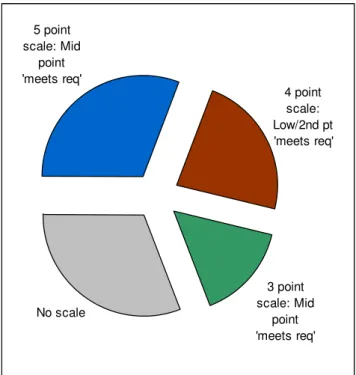
respondent qualified that their ranking system operates for support staff only and not for academic staff since there is no relation between performance development review and pay. Within those who do not operate a ranking system, one commented that ranking is too subjective and therefore not a useful means of measuring performance. Of those using a scoring system, the most popular was a five point rating scale, followed by a four point scale and then a three point scale. One university currently using a four point scale stated their intention to change the rating to a three-point scale in response to criticism from staff. Of those using a five point scoring system, all used a mid score point (i.e. point three) to describe a performance which ‘meets requirements’. One point above denoted a
performance which ‘exceeded expectations’ and the top score denoted ‘exceptional performance’. Below the mid point score, points showed ‘less than satisfactory’ and ‘poor performance’ respectively.
Of those who have adopted a four point scale, one university scores the lowest level as ‘performance meets grade’ and those above denote ‘good’, ‘excellent’ and ‘outstanding’ performances. The other university on a four point scale grades the lowest level as ‘improvable’, resulting in performance improvement measures and where appropriate withholding salary increments. Grades above denote ‘good’, ‘higher’ and ‘exceptional’ performances respectively. The university currently operating a three point scale scores ‘below’, ‘meets’ and ‘exceeds’ performance.
Of those using a scoring system, one has a quota system in place or ‘performance bands’ with guidelines on distribution of performance across the bands determined by HR and used as a reference in moderation. Two further respondents stated that although they do not operate a quota system, they do offer guidelines to managers. One university offers 10% as a guide at ‘outstanding’ level, with the majority of staff expected to achieve a good or
satisfactory rating. Another respondent, whose institution only uses scoring for support staff, maintains a guideline of 20% support staff who will gain some level of pay increase as a result of the performance management review, with the justification that the institution needs to manage the cost of the process.
Table 5: Ranking scales – all participants
ii. Performance Linked to Pay
Two thirds of universities link staff review to the setting of individual pay, with a further one respondent about to change to this system. Of these, the majority link staff performance to incremental annual pay increases. Some link performance to promotion or advancement, and some offer a bonus on the basis of excellent or outstanding performance.
Nearly three quarters of respondents link performance review to a discretionary bonus scheme. The application of this varied broadly across institution, with some limiting this to a certain group of staff (e.g. senior executive staff only, support staff only, staff up to grade 9 level, where the bonus is called a ‘reward and recognition award’ which can be applied for by staff or recommended by line managers).
No scale 5 point scale: Mid point 'meets req' 4 point scale: Low/2nd pt 'meets req' 3 point scale: Mid point 'meets req'
One university pays a discrete bonus if an employee is graded as very good or outstanding, whilst another institution pays a bonus where an employee is already at the top of their pay scale. A further university can make a bonus payment either as an increase to the level of base pay or as a discrete payment.
‘There is general acceptance of performance linked reward system. The difficulty is how to motivate staff who have reached the top point of their salary scale. Particularly for those who are good performers, they view the performance and development exercise as 'wasting' their time. There is a need to develop a much more simplified process for this group.’
In response to the way that the performance and development process informs reward and recognition, promotion, regrading and/or succession planning, over half of respondents stated that P&DR informs reward and recognition, one of which stated this was the case specifically for ‘outstanding’ employees.
Over half of universities also said that PDR informs staff promotion; with one respondent qualifying that this was the case only for academic staff, and one, as above, specifically relating promotional prospects to outstanding employees.
Two respondents stated that the link between PDR and reward is not a formal one, although it does exist in practice, and stated that they are working to develop the link further. Four universities use PDR to inform succession planning, one of whom is in the early stages of developing this within their institution, and one of whom only utilises this for academic staff. Two universities use P&DR data for re-grading purposes and one stated use of data for reappointment or extension of contract.
2.7 Participation
Three universities stated that their performance review system is mandatory and therefore the percentage of participation is assumed to be 100% unless otherwise stated. On this basis, six out of ten universities state 100% participation in performance development review, with one of these respondents qualifying that this reflected support staff only, with academic participation being lower.
Three stated a participation rate of between 75% and 86% and a further university stated that they find it difficult to audit due to the performance review currently taking the form of a paper-based system. No respondents stated that employees are able to decline participation in performance review.
‘After many refinements to the online system in the past few years, our staff are getting used to completing the performance and development review on an annual basis.’
2.8 Recording, Audit and Data Analysis
Five respondents use both paper and electronic-based systems with a further three using electronic system only and two using paper-based system only. One respondent
commented that certain indicators (research outputs, grant/contractual income, PGR supervision numbers and supervision responsibilities for teaching and research staff) are electronically captured and pre-populated on research and training staff PDR forms for career academic staff and professorial level.
Two thirds monitor the performance development review process centrally whilst a third monitor at a local or school level. Of these, two universities monitor at school, college and
university-wide level.
In terms of recording, almost half use electronic forms to capture the performance review, with the remainder recording the review on paper and then logging information onto local and/or central systems.
When asked to describe the level of data analysis which occurs at university level using performance review outcomes, almost all universities stated that they measure completion/ compliance with the performance development review process. Two thirds undertake further analysis of PDR data at university level, one of whom only for senior staff, and one only for support staff.
A further university is about to start using data to measure training needs.
Of those undertaking further analysis of data, half stated that they use data to identify and understand current issues which are being raised through PDR, one of which specified was monitoring of equality and diversity. Others said they use data to identify training and development needs; or to allocate proportional rewards to faculties or departments.
2.9 Key Benefits
Respondents gave varied answers to the question of what works best about their system. Two universities stated that mandated empowerment, one to line managers and one to faculties, had been a great benefit to participation in their performance management system. Other key benefits were:
online system
supervisors’ goodwill towards their staff
alignment between PDR and the business needs of the university
engagement of support staff (this institution worked closely with unions to get support staff ‘buy in’ to the performance management system. They are currently implementing a similar system for academic staff but it is too early to tell what the level of
engagement will be).
2.10 Key Challenges
In stating key challenges to operating a performance management system, responses were diverse. One commonality across many respondents related to the skills of managers in conducting performance review, including:
the quality of the conversation between reviewer and reviewee
effective goal setting
knowledge of how to link staff goals to institutional strategy Other shared challenges included:
how to communicate expectations regarding sub-performance
how to address typical side effects of review
how to ensure honesty when the system tends to skew performance favourably
One respondent commented that their institution has focused on objective-setting to date, but now needs to look at how to incorporate behaviours within the performance management framework.
‘While there is no formal link, there has been heavy emphasis on performance development needing to be consistent with promotion. For example, there’s no point telling someone they are outstanding year in year out and have them miss out on promotion because they haven’t had honest feedback. While we are still in the early stages of succession planning,
performance development is certainly feeding into that process.’
The most common areas for improvement amongst respondents were:
importance of honest, high-quality conversations taking place during performance development review
need for confidence and skills in supervisors
importance of effective objective setting with real measures against goals
higher level of strategic alignment and connectivity between PDR systems and organisational goals
streamlining of the performance management process, through adopting an electronic format
key area of staff engagement
2.11 Key Conclusions
Participants share a common goal of performance management in aligning individual performance to institutional purpose and cover similar areas within the P&DR including performance review over the past year, performance against strategic objectives, training/development progress, career aspirations and future development and objectives for the coming year.
Participants shared a view that P&DR is a key means of impacting on the culture of their organisation.
In making the link from individual to institutional strategy, universities offered three main approaches: complex moderation across school/faculty/college/university; faculty-based approach; Heads of School/Deans providing moderation.
Many universities saw greater linkage with institutional objectives at senior leadership level although this was changing in some universities, to ensure strategic ‘buy-in’ at all levels of staff.
All universities offer P&DR training to staff using a range of methods including web-based materials, workshops and bespoke training, driven by HR departments in most cases. Some universities offered advanced and specialist leadership training, and one-to-one coaching for senior staff.
Most universities use a ranking system which allows for two grades either side of ‘meets requirements’ to denote good/outstanding, and less than satisfactory/poor. Most linked performance review to the setting of pay and/or discretionary bonus scheme.
Most universities regard P&DR as mandatory but compliance varies across institutions from 75% upwards.
Most universities encouraged an ongoing conversation between managers and staff, and most saw staff engagement as a key benefit of P&DR.
Key challenges across respondents including ensuring the quality of conversation between reviewer and employee, effective goal setting and consistency of approach.
2.12 Key Discussion Points
How do we increase compliance within a mandatory system of P&DR?
What are some key approaches to ensuring a consistency of approach at P&DR? How can we improve the quality of conversation that takes places between manager and employee?
How have institutions used statistical analysis to determine trends and patterns – in conduct and in training provision, for example?
What have members found to be the most effective methods of linking individual objectives to institutional strategy?
What are the most effective means of offering training on P&DR?