Sharif University of Technology
Scientia IranicaTransactions E: Industrial Engineering www.scientiairanica.com
Research Note
A mathematical model to evaluate knowledge in the
knowledge-based organizations
R. Bagheri
a;, A. Rezaeian
aand A. Fazlaly
ba. Faculty of Management and Accounting, Shahid Beheshti University, Daneshju Blvd, Evin Square, Tehran, P.O. Box 1983963113, Iran.
b. Faculty of Industrial Engineering, Khajehnasir Toosi University, Kaviyan, Tehran, P.O. Box 1541849611, Iran. Received 24 September 2012; accepted 11 October 2014
KEYWORDS Knowledge management; Data envelopment analysis;
Mathematical model; BCC model;
Fuzzy set.
Abstract. Knowledge and its intangible appurtenances have not only resulted in movement in various businesses, but also, nowadays, have been viewed as the whole or a part of products of distributors' companies as well as service and military organizations. In recent years, estimation of knowledge level in organizations and industry companies has attracted considerable attentions. Contrary to a lot of prevalent models used for measuring eciency, Data Envelopment Analysis (DEA) can take into account multiple inputs and outputs. In this regard, DEA was traditionally applied with crisp inputs and outputs, while in practical cases, we need to estimate organization eciency in a dierent situation in which we have to deal with fuzzy or imprecise data. The aim of this paper is to present a DEA, employing fuzzy input and output data, toward assessing the knowledge levels established in a knowledge based-organization in various time intervals. In this case, the organization is able to dene some areas in which it can improve its established knowledge level.
© 2015 Sharif University of Technology. All rights reserved.
1. Introduction
Nowadays, companies feel more pressure resulted from competitive market than before. In the era in which economy is going to be smaller, they should employ fewer resources to do more work. In order to establish new knowledge, many organizations have recently been inclined to hire Knowledge Management (KM) sys-tems. Some specialists believe that the recent obtained knowledge may only be the result of this competition. By using the obtained knowledge, a better knowledge management system is made, a more ecient team
*. Corresponding author. Tel.: +98 21 22431842 E-mail addresses: R [email protected] (R. Bagheri); A [email protected] (A. Rezaeian); [email protected] (A. Fazlaly)
working is constituted, and nally learning is necessary. The concept of knowledge does not necessarily mean information transferring, but creativity and dynamism. In this case, a knowledge-based organization is idea maker, applies new ideas, and hence achieves competi-tive merit.
Shang & Sueyoshi [1] introduced DEA as a linear programming based technique to measure relative ef-ciency of an organization or dierent organizations, such as banking, post, hospitals, education centers, powerhouses, reneries, and so on. In addition to eciency score, DEA can give very useful results to managers and determine pioneers for inecient DMUs. This technique also provides strategic solution and eciency improvement for developing the organization, and nally assists organizations to assign resources properly [2].
This paper attempts to propose DEA-based ap-proach with fuzzy data to estimate relative eciency of knowledge-based organizations using knowledge man-agement criteria. In this case, the organizations are able to detect their improvement areas.
The rest of this paper is organized as follows: Section 2 gives a brief literature review. The proposed mathematical model is introduced in Section 3. Inputs and outputs of the proposed DEA model are dened in Section 4. The solution procedure and computational results are given in Section 5, and nally Section 6 is devoted to some conclusion remarks.
2. Literature review
American Productivity and Quality Center (APQC) denes knowledge as strategies and processes for detecting, acquiring, and distributing knowledge to strengthen the competition power of the organization. Based on the idea of Gartner Group, many organiza-tions are going to implement knowledge management systems and one third of the fortune 1000 companies apply knowledge management plans and strategies. Davenport & Prusak [3] introduces knowledge man-agement as a structured approach containing proce-dures for detecting, evaluating, organizing, saving, and implementing knowledge toward covering requirements and objectives of organizations. Jakov Crnkovic et al. [4] proposed a comprehensive approach to KM which relates key processes of KM to critical factors for implementing it successfully. Using a matrix composing of the process and key success factors, they described an organization and estimated the KM criteria.
Eciency evaluation has been comprehensively addressed by scholars because of its importance for performance evaluation of an organization.
Farrell [5] exploited a method which had been employed for eciency evaluation, in engineering is-sues, to measure eciency of a production trim. The study by Farrell involved just one input and one output. Farrell's study included measuring technical eciency and derivative of ecient production func-tion. Data Envelopment Analysis (DEA) is a mathe-matical programming based approach to estimate tech-nical eciency and ineciencies in production. This method does not suppose any pre-determined shape for production function curve and estimates production or cost function applying mathematical models for actual input and output data of Decision Making Units (DMUs).
Charnes et al. [6] proposed the rst mathematical DEA based on Farrell's denition of relative eciency. The aim of this model was to measure and compare relative eciency of Decision Making Units (DMUs) using multiple homogeneous inputs and outputs.
Banker et al. [7] proposed a new DEA model called BCC, which considered eciency of DMUs with variable return to scale.
In fuzzy environment, Sengupta [8] proposed a fuzzy programming approach in which the objective function was crisply, not satised. He examined DEA model with multiple inputs and one output.
Kao and Liu [9] developed a method to nd the membership functions of the fuzzy eciency scores when some observations are in fuzzy numbers. En-tani et al. [10] proposed interval eciency obtained from the pessimistic and the optimistic viewpoints. Since Zadeh [11,12] initiated the possibility measure, many researchers such as Guo & Tanaka [13] and S. Lertworasirikul et al. [14] have introduced it into DEA.
Wen & Li [15] proposed a fuzzy DEA model for ranking and evaluating. In this regard, they introduced a hybrid model with fuzzy simulation and genetic algorithm, in which fuzzy triangular and trapezoidal fuzzy number were exploited. They, then, transformed the hybrid model to a linear mathematical model and applied it to solve a simple numerical example.
Yuan Feng Wen [16] introduced criteria to mea-sure knowledge management by reviewing literature, using scholars and practitioners in the areas of KM and AHP and a questionnaire. Leibowitz & Suen [17] and Bose [18] proposed more criteria to measure knowledge management. There exist many criteria to measure KM; the interesting point is that the majority of the proposed criteria are human based and can be utilized to quantify knowledge management plans and implementation. The criteria proposed by ICM group include value adding customer resource, infrastructure resource and human resource the proposed mathemat-ical model.
In this section, a fuzzy DEA mathematical model is formulized to assess knowledge level of a knowledge-based organization in various time intervals, which can monitor the organization progress in terms of knowledge management. In this regard, the BCC model is developed by fuzzy input and output data using Zadeh's extensions principle. The following programming problem gives the upper band of -level cut of fuzzy eciency measure of a DMU understudy, in which the primal BCC model is applied:
MaxZ0= s
X
r=1
ryr0+ w0;
s
X
r=1
ryrj+ w0 m
X
i=1
wixij 0;
m
X
i=1
(~yrj)L yrj (~yrj)U;
(~xij)L xij (~xij)U;
r; wi 0; w0 free:
In the above-mentioned programming problem, xij
denotes the ith input of the jth DMU. The weight assigned to the ith is represented by wi. On the other
hand, yrj is the rth output from the jth DMU. The
weight of rth output is described by r. The variable
return to scale in the aforementioned programming problem is represented by w0, where if w0 < 0, then it
is said that return to scale is decreasing, and if w0> 0,
then it is increasing, otherwise, it is constant. Since, in the present study, it is supposed that the input and output data are in the form of fuzzy numbers, -level cut of ~xij and ~yrj are represented as (~xij) =
h
(~xij)L; (~xij)U
i
and (~yrj)=
h
(~yrj)L; (~yrj)U
i
, respec-tively.
In order to obtain the lower bound of -level cut of fuzzy eciency measure, the dual form of BSS model is applied. In this case, using Zadeh's extension principle, we have:
Miny0= ; n
X
j=1
jyrj yr0;
xi0 n
X
j=1
jxij 0;
n
X
j=1
j = 1;
(~yrj)L yrj (~yrj)U;
(~xij)L xij (~xij)U;
j 0; free:
In the aforementioned programming problem, and j, j = 1; ; n, are the decision
vari-ables corresponding = and constraints, respec-tively, in primal BCC model. Other parameters and variables are the same as those in primal BCC model.
3. Introducing input and output in the proposal model
It should be pointed out that DEA models are su-ciently valid if their inputs and outputs are identied properly. This has a signicant role for model's valida-tion. In the present study, to assess knowledge level by the mathematical models, several criteria are dened using experts' opinion and reviewing the literature, which directly relate to knowledge management and inuence knowledge level of the organization. In this regard, inputs and outputs to be used in the proposed fuzzy DEA model are dened as represented in Table 1.
4. Solution procedure
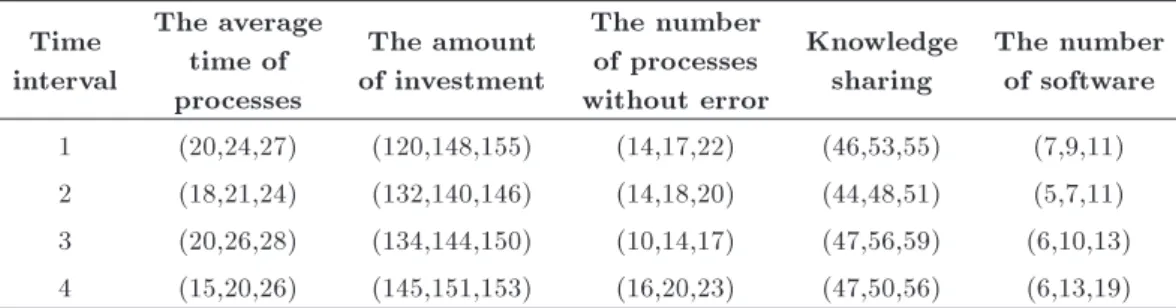
In this section, input and output data collected from reviewing literature are introduced to be used in the proposed fuzzy BCC model. Table 2 represents these data for four various time intervals that includes the input data of the processes (min) and the amount of investment (million), respectively. The fourth, fth, and sixth columns are the output data which
Table 1. Inputs and outputs of the proposed model.
Inputs Outputs
Amount of investment Knowledge sharing among personnel Average time of each process The number of software and new plans
Table 2. The inputs and outputs data of the problem. Time
interval
The average time of processes
The amount of investment
The number of processes without error
Knowledge sharing
The number of software 1 (20,24,27) (120,148,155) (14,17,22) (46,53,55) (7,9,11) 2 (18,21,24) (132,140,146) (14,18,20) (44,48,51) (5,7,11) 3 (20,26,28) (134,144,150) (10,14,17) (47,56,59) (6,10,13) 4 (15,20,26) (145,151,153) (16,20,23) (47,50,56) (6,13,19)
indicate the number of processes without error, knowl-edge sharing, and the number of software, respec-tively.
5. Computational result
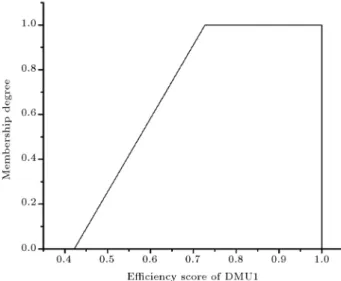
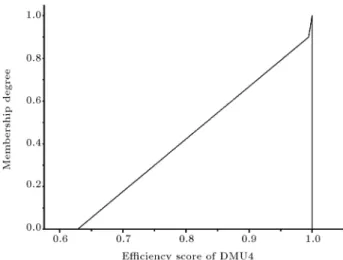
In this section, the proposed fuzzy BCC model is solved for a knowledge based organization with the data given in Table 2 and Lingo 12 solver. The outcome of the proposed model, in fact -level cut of fuzzy eciency measure of the organization under study, is applied to construct membership functions, depicted in Figures 1 to 4.
After deriving the membership functions fuzzy eciency measures as described before, it is the turn to describe a procedure to be used for making a decision about whether or not the capability of the variable measurement system under study with fuzzy data is acceptable. To do this, the abovementioned criteria should be compared with their corresponding critical values in fuzzy environment. In this regard, it necessitates a method to be applied for ranking fuzzy numbers. There are a lot of methods in the literature in this area [19-23]. However, most of them need membership functions of the fuzzy numbers to be ranked. The method proposed by Chen and Klein [20], on the other hand, is very appropriate for the present study, because it is based on -level cuts.
To describe the method proposed by Chen and Klein [20], suppose the fuzzy numbers ~Aj; j =
1; ; m, are going to be ranked. Let h be the maximum height of A~j; j = 1; ; m. Assume h
is split into n equal intervals such that i = ih=n;
i = 0; ; n. Chen and Klein [20] proposed the following index to be used for ranking fuzzy numbers:
Ij = n
X
i=1
~ Aj
U i c
, " n X
i=1
~ Aj
U i c
Xn
i=1
~ Aj
L i d
#
n ! 1; where:
c = min
i;j
~ Aj
L
i
;
d = max
i;j
~ Aj
U i
:
The larger (smaller) value of index Ij, the larger
(smaller) the fuzzy number ~Ajis. While this method is
Figure 1. Membership function of fuzzy eciency score in the rst time interval.
Figure 2. Membership function of fuzzy eciency score in the second time interval.
Figure 3. Membership function of fuzzy eciency score in the third time interval.
Figure 4. Membership function of fuzzy eciency score in the fourth time interval.
authentic when n advances innity, Chen and Klein [20] proposed that n = 3 or 4 suces to discriminate the dierences.
Using the abovementioned procedure for ranking fuzzy eciency measure of the organization in four suc-cessive time intervals with the membership functions delineated in Figures 1-4, we have c = 0:0189 and d = 1. In this case, Chen and Klein's index for obtained fuzzy eciency measures is corrupted as follow:
IDMU1= 0:6976; IDMU2= 0:7374;
IDMU3= 0:5579; IDMU4= 0:8535:
As it is observed, the organization is the most and least ecient in the fourth and third time intervals, respectively.
6. Conclusion
This paper was an eort to propose a fuzzy BCC model to assess knowledge level of a knowledge-based organi-zation, wherein it was supposed that input and output data are fuzzy numbers. The proposed approach can also be used to rank similar organizations in term of knowledge management criteria. The approach is specically applicable for organizations which want to compare themselves with similar organizations in terms of knowledge management and select the most ecient benchmark.
In this case, the inecient organizations try to improve their performance in the area of knowledge management toward being assessed as ecient.
References
1. Shang, J. and Sueyoshi, T. \A unied framework
for the selection of a exible manufacturing system", European Journal of Operational Research, 85(2), pp. 297-315 (1995).
2. Brown, M.G. and Svenson, R.A. \Measuring R &
D productivity", Research Technology Management, 41(6), pp. 30-35 (1998).
3. Davenport, T.H. and Prusak, L., Working Knowledge:
Managing What Your Organization Knows, Harvard Business School Press (1998).
4. Crnkovic, J., Belardo, S. and Asoh, D.A. \Exploring
the knowledge management index as a performance diagnostic tool", Systemics, Cybernetics and Informat-ics, 3(2), pp. 27-33 (2004).
5. Farrel, M.J. \The measurement of productive
e-ciency", Journal of the Royal Statistical Society, 120, pp. 253-281 (1957).
6. Charnes, A., Cooper, W.W. and Rhodes, E.
\Measur-ing the eciency of decision mak\Measur-ing units", European Journal of Operational Research, 2, pp. 429-444 (1978).
7. Banker, R.D., Charnes, A. and Cooper, W.W. \Some
models for estimating technical and scale eciencies in data envelopment analysis", Management Science, 30(9), pp. 1078-1092 (1984).
8. Sengupta, J.K. \A fuzzy system approach in data
en-velopment analysis", Computers & Mathematics with Applications, 24, pp. 259-266 (1992).
9. Kao, C. and Liu, S.T. \Fuzzy eciency measures in
data envelopment analysis", Fuzzy Sets and Systems, 119, pp. 149-160 (2000).
10. Entani, T., Maeda, Y. and Tanaka, H. \Dual models
of interval DEA and its extension to interval data", European Journal of Operational Research, 136(1), pp. 32-45 (2002).
11. Zadeh, L.A. \Fuzzy sets", Information and Control, 8, pp. 338-353 (1965).
12. Zadeh, L.A. \Fuzzy sets as a basis for a theory of
possibility", Fuzzy Sets and Systems, 1, pp. 3-28 (1978).
13. Guo, P. and Tanaka, H. \Fuzzy DEA: A perceptual
evaluation method", Fuzzy Sets and Systems, 119, pp. 149-160 (2001).
14. Lertworasirikul, S., Fang, S.C., Joines, J.A. and Nut-tle, H.W. \Fuzzy data envelopment analysis (DEA): A possibility approach", Fuzzy Sets and Systems, 139, pp. 379-394 (2003).
15. Wen, M. and Li, H. \Fuzzy data envelopment analysis
(DEA): Model and ranking method", Journal of Com-putational and Applied Mathematics, 223, pp. 872-878 (2009).
16. Wen, Y.F. \An eectiveness measurement model for
knowledge management", Knowledge-Based Systems, 22, pp. 363-367 (2009).
17. Leibowitz, J. and Suen, C.Y. \Developing knowledge
management metrics for measuring intellectual capi-tal", Journal of Intellectual Capital, 1(1), pp. 54-67 (2000).
18. Bose, R. \Knowledge management metrics", Industrial Management & Data Systems, 104(6), pp. 457-468 (2004).
num-bers by distance minimization", Applied Mathematical Modelling, 31(11), pp. 2589-2598 (2007).
20. Chen, C.B. and Klein, C.M. \A simple approach to
ranking a group of aggregated fuzzy utilities", IEEE Transaction on Systems Man and Cybernetics, 27(1), pp. 26-35 (1997).
21. Chou, S.Y., Dat, L.Q. and Yu, V.F. \A revised method
for ranking fuzzy numbers using maximizing set and minimizing set", Computers & Industrial Engineering, 61(4), pp. 1342-1348 (2011).
22. Chu, T.C. and Tsao, C.T. \Ranking fuzzy numbers
with an area between the centroid point and original point", Computers and Mathematics with Applica-tions, 43, pp. 111-117 (2002).
23. Wang, X. and Kerre, E.E. \Reasonable properties for
the ordering of fuzzy quantities (I) and (II)", Fuzzy Sets and Systems, 118(3), pp. 387-405 (2001).
Biographies
Rouhollah Bagheri was born on March 1981, in Iran. He received his Master's degree in MBA from Amirk-abir University of Technology, Tehran, Iran, in 2012, and he is currently a PhD student in Systems Manage-ment at the Faculty of ManageManage-ment and Accounting in Shahid Beheshti University. He has published 9 books and 12 international papers in dierent conferences
and journals; also, he has won 5 international and national awards. His major research interests include information technology management, business process reengineering, knowledge engineering, articial intelli-gent methods, and knowledge management, especially knowledge strategies.
Ali Rezaeian received his PhD in Organizational Be-havior from United States International University, San Diego, California. He is now president at the Faculty of Management and Accounting in Shahid Beheshti University. He became a member of Iranian Science and Culture Hall of Fame in the eld of Management in 2006. He has published a lot of books and international papers in dierent conferences and journals. His ma-jor research interests include organizational behavior, information technology management, and knowledge management, especially knowledge strategies.
Amir Fazlaly was born on March 1983, in Iran. He received his Master's degree in Industrial Engineer-ing from Khajehnasir Toosi University of Technology, Tehran, Iran, in 2012. He is currently a researcher at a research rm. His major research interests include, business process reengineering, knowledge engineer-ing, and knowledge management, especially knowledge strategies.