A Generic Type-and-Effect System
Daniel Marino
Todd Millstein
Computer Science Department University of California, Los Angeles
{dlmarino,todd}@cs.ucla.edu
Abstract
Type-and-effect systems are a natural approach for statically rea-soning about a program’s execution. They have been used to track a variety of computational effects, for example memory manipula-tion, exceptions, and locking. However, each type-and-effect sys-tem is typically implemented as its own monolithic type syssys-tem that hard-codes a particular syntax of effects along with particular rules to track and control those effects.
We present a generic type-and-effect system, which is parame-terized by the syntax of effects to track and by two functions that together specify theeffect disciplineto be statically enforced. We describe how a standard form of type soundness is ensured by quiring these two functions to obey a few natural monotonicity re-quirements. We demonstrate that several effect systems from the lit-erature can be viewed as instantiations of our generic type system. Finally, we describe the implementation of our type-and-effect sys-tem and mechanically checked type soundness proof in the Twelf proof assistant.
Categories and Subject Descriptors D.3.1 [Formal Definitions and Theory]: Semantics, Syntax; F.3.3 [Studies of Program Con-structs]: Type structure
General Terms Languages, Theory
Keywords type-and-effect systems
1.
Introduction
Type-and-effect systems (or simplyeffect systems) (Gifford and Lu-cassen 1986) are an approach for augmenting static type systems to reason about and control a program’s computational effects. Such systems were originally developed to statically track the manipula-tion of dynamically allocated memory. However, many other kinds of computational effects can be controlled via an effect system. For example, Java’s type system for checked exceptions (Gosling et al. 2005) can be formulated as an effect system. Other applications abound in the research literature. Effect systems have recently been used to enforce a locking discipline to prevent race conditions in Java (Flanagan and Freund 2000; Abadi et al. 2006) and to ensure strong atomicity for a transactional memory system (Abadi et al. 2008).
Permission to make digital or hard copies of all or part of this work for personal or classroom use is granted without fee provided that copies are not made or distributed for profit or commercial advantage and that copies bear this notice and the full citation on the first page. To copy otherwise, to republish, to post on servers or to redistribute to lists, requires prior specific permission and/or a fee.
TLDI’09, January 24, 2009, Savannah, Georgia, USA. Copyright c2009 ACM 978-1-60558-420-1/09/01. . . $5.00
In each of the above examples, a particular notion of effects and an associated discipline for controlling those effects is built into the language’s type system. While it is intuitively clear that different effect systems have much in common, it is not obvious how to make these commonalities precise. Indeed, others have explicitly posed the formulation of a “general theory of effects” as an open problem, with the aim of “avoiding the need to create a new effect system for each new effect” (Wadler and Thiemann 2003). Such a theory would make it much easier to understand the relationships among effect systems and to experiment with new effect systems.
In this paper we take the first steps toward such a theory. We present a generic type-and-effect system with the following techni-cal contributions:
•We describe a uniform and general approach to instrumenting a language’s type system with “hooks” that can be used to track and control a set of computational effects. A particular effect system is instantiated from our generic effect system by provid-ing a syntax of effects as well as definitions of the hooks. The hooks employ a style of representing effects dually asprivileges
(orcapabilities(Walker et al. 2000)), which is commonly used to formalize effect systems that enforce a programming disci-pline (e.g., (Abadi et al. 2006, 2008; Neamtiu et al. 2008)). •A basic notion of type soundness for any type-and-effect system
requires static effect checking to conservatively approximate the checking done by a dynamic semantics that is instrumented with effects (e.g., (Talpin and Jouvelot 1992; Wadler and Thie-mann 2003; Neamtiu et al. 2008)). We show that it is sufficient to impose a natural set ofmonotonicityrequirements on the ex-ternally provided privilege discipline in order to guarantee this form of type soundness. The effect system designer must sep-arately establish that this notion of type soundness guarantees the program behavior that the system is intended to ensure. •We have formalized our generic effect system in the context
of a polymorphic lambda calculus with mutable references. We have implemented this language, the generic effect system, and a mechanically verified type soundness theorem in the Twelf proof assistant (Pfenning and Sch¨urmann 1999).
•We demonstrate that several effect systems from the literature can be viewed as instantiations of our generic effect system. These systems include the original effect system for memory manipulation (Gifford and Lucassen 1986), an effect system for tracking yields in a cooperative multitasking system (Fis-cher et al. 2007; Isard and Birrell 2007), and an effect system that ensures strong atomicity for software transactional mem-ory (Abadi et al. 2008). Further, these effect systems all satisfy our monotonicity requirements that ensure type soundness. Aside from its theoretical interest, we believe our work could serve as the foundation for a practical framework that allows pro-grammers to easily and reliably augment their language’s static
Φ∪canThrow;Γ;Σ`e1:τ Φ;Γ;Σ`e2:ExnType→τ Φ;Γ;Σ`trye1withe2:τ
(T-TRY)
Φ;Γ;Σ`e:ExnType canThrow∈Φ
Φ;Γ;Σ`throwe:τ (T-THROW)
Figure 1. Part of a type system that enforces checked exceptions.
Φis the set of held privileges.ΓandΣare the type environment
and store typing as usual.
type system to track new kinds of effects and to control these effects with programmer-specified disciplines. Such a framework would do for effects what systems like CQUAL(Foster et al. 1999, 2006) and Clarity (Chin et al. 2005) do for type qualifiers. In addition to the benefits for programmers, a programmer-definable effect sys-tem would be very useful for type syssys-tems researchers.
The rest of the paper is structured as follows. Section 2 describes our approach informally, and Section 3 presents our formal type system. Section 4 illustrates several existing effect systems that fit our model. Section 5 formalizes the dynamic semantics of our lan-guage, and Section 6 discusses our type soundness result. Section 7 details the implementation of our language, type system, and type soundness proof in Twelf. Section 8 compares with related work, and Section 9 concludes with a discussion of future work.
2.
Overview
In this section, we give an informal overview of our generic effect system. We first show how a few standard effect systems can be described intuitively as granting and checking privileges. We then illustrate how we can abstract the specific privilege discipline being enforced and instrument the static semantics of any language with privilege checking in a generic way. Finally, we discuss how to achieve a standard notion of type soundness for the resulting type system.
2.1 Effect Systems as Privilege Checking
Consider an effect system that statically ensures that exceptions are eventually caught, as in Java (Gosling et al. 2005). Such a system enforces the discipline that a program may only raise an exception within the dynamic lifetime of atryexpression. If we consider the ability to throw an exception as a privilege (assume for simplicity that there is a single kind of exception), then it is natural to describe this effect system asgrantingthe privilege to throw an exception before typechecking the body of atryexpression andchecking
that this privilege is held when typechecking athrowexpression. Figure 1 formalizes the discipline for exceptions described above. The typing judgment tracks a set of held privilegesΦ, and we use a privilegecanThrowto designate the capability to throw an exception. RuleT-TRYgrantsthecanThrowprivilege in the body of thetryby adding this privilege toΦbefore typecheckinge1. Rule T-THROWchecksthat thecanThrowprivilege is inΦin order for athrowexpression to typecheck. These two actions form the core of the effect system; the other typing rules simply ensure that this privilege discipline is enforced recursively on all subexpressions.
Table 1 describes how other standard effect systems can simi-larly be viewed as granting and checking privileges. The formula-tion of effects as privileges is natural when the intent is to enforce a particular discipline on a program rather than to simply determine the set of effects that may occur in the program. Each of these ef-fect systems can be formalized as its own extension to a base type system, as we have shown with checked exceptions.
As in these examples, we formalize our generic effect system as granting and checking privileges, tracking a setΦof held privileges
during typechecking. However, the system is parameterized both by the syntax of privileges to track and the discipline for granting and checking privileges. Particular choices for these parameters yield a type system equivalent to our exception checker in Figure 1, but many other effect systems can be derived by making different choices.
The syntax of privileges is specified simply as a set of atomic constants. For example, to define our exception checker one would specify a single privilege canThrow, while a memory checker might employ privilegesread,write, andalloc. For greater ex-pressiveness, privileges can optionally refer totags, which provide information about program values. We augment the host language to allow tagging of expressions that construct values, and the type system tracks the set of possible tags (ortagset) of each expres-sion’s value. We useεto range over a set of globally defined tags andπto range over tagsets. For example,read(ε)could be used to denote the privilege to read any memory location tagged withε.
The privilege discipline is specified by providing the defini-tions of two funcdefini-tions, which respectively specify howΦshould be
adjusted(a generalization of granting that also supports privilege revocation) andcheckedduring typechecking. Rather than hard-coding the privilege discipline as we did for exceptions in Figure 1, the typing rules in our generic effect system are uniformly instru-mented with invocations of these two functions, which are the only parts of the type system that directly modify or inspectΦ. For
ex-ample, using our approach, the ruleT-TRYwould invoke the adjust function to determine the privileges to use when typecheckinge1, whileT-THROWwould invoke the check function to determine what privileges are required upon athrow. These two functions are sim-ilarly invoked from the other rules in the type system, allowing any language feature to be controlled by the externally defined privilege discipline.
2.2 Checking and Adjusting Privileges, Generically
Our key contributions are a general interface for the check and adjust functions and a uniform approach to instrumenting a lan-guage’s type system with invocations of the two functions. First, consider the function to check privileges. Intuitively, a particular effect system may want to disallow an arbitrary computation step (e.g., an exception being thrown, a write to memory) based on the set of held privileges. Therefore, a generic effect system should consult the check function as a premise in the typing rule for each syntactic form that represents a step of computation. Next consider the function to adjust privileges. Intuitively, a particular effect sys-tem may want to adjust privileges in any syntactic context that might arise dynamically (e.g., atryblock, aletregion expres-sion). Therefore, a generic effect system should consult the adjust function to modifyΦin typing rules before typechecking
subex-pressions of the current expression.
We make these ideas precise and applicable to any language by adapting two standard notions for formalizing a language’s dynamic semantics:redexesandevaluation contexts(Wright and Felleisen 1994). The type system will have one call to the check function for each redex form in the language. The type system will have one call to the adjust function for each evaluation context form in the language.
The check function is invoked in the typing rule for each ex-pression form that can evaluate to a redex, passing the current set of privileges and acheck contextthat describes the information known statically about that redex. The function returns a boolean indicat-ing whether the reduction step represented by that expression is allowed. To make things concrete, Figure 2 shows how the redexes of a lambda calculus with mutable references andletdetermine the check contexts for that language. Each value form in a redex is replaced by a tagset,π, which represents the information known
Table 1. Standard effect system enforcement as privilege checking.
Discipline Privilege Grant Check
checked exceptions in Java allowed to throw an exception tryblock throwstatement
race condition checking in Java allowed to access shared data synchronizedblock read or write to shared memory (Abadi et al. 2006)
region-based memory management allowed to access memory in region letregionexpression read or write to memory in region (Tofte and Talpin 1994)
Redex Z=⇒ Check Context (C)
(λx.e)v π1π2
refv refπ
!l !π
l:=v π1:=π2
letx=vine letx=πin ↑
Figure 2. From redexes to check contexts. Metavariablevranges over values,eover expressions, andlover memory locations.
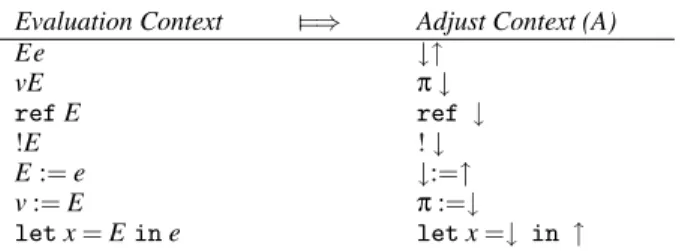
Evaluation Context Z=⇒ Adjust Context (A)
Ee ↓↑
vE π↓
refE ref ↓
!E !↓
E:=e ↓:=↑
v:=E π:=↓
letx=Eine letx=↓ in ↑
Figure 3. From evaluation contexts to adjust contexts. Metavari-ableEranges over evaluation contexts.
statically about an expression’s value, as determined by static type-checking. Expressions that are not necessarily values appearing in a redex are replaced by the↑symbol in the check context, indicat-ing that information about this subexpression is not relevant to the reduction step being checked.
Consider our example of checked exceptions. Following the approach for formalizing a generic effect system described above, a language containing an expression throw e would include a check context of the formthrow πdue to the redex formthrow v. Therefore, the typing rule forthrowwill invoke check(Φ,throw π), where Φ is the current set of privileges and π is the set of
possible tags ofe(determined by typecheckinge). The following check function implements the hard-coded privilege checking behavior of T-THROW in Figure 1 and specifies that privilege checking for all other kinds of reduction steps should trivially succeed:
check(Φ,C) =
(
canThrow∈Φ if C=throwπ
true otherwise
The adjust function is invoked once per evaluation context re-lated to the current expression form in a typing rule, passing the current set of privileges and anadjust contextthat describes the in-formation known statically about that evaluation context. The func-tion returns a new set of privileges to be used when typechecking a designated subexpression indicated by the adjust context. Figure 3 shows how the evaluation contexts of our extended lambda calcu-lus determine the associated adjust contexts. As before, values are replaced by tagsets and arbitrary expressions are replaced by the↑
symbol. Finally, wherever the evaluation context contains a recur-sive evaluation context, the corresponding adjust context contains a
↓symbol indicating the subexpression for which privileges should be adjusted.
Consider again our exceptions example. A language containing an expressiontry e1 with e2would include an adjust context of the formtry ↓ with ↑due to the evaluation contexttry E with e. Therefore the typing rule for trywill invoke adjust(Φ,try ↓ with ↑), where Φ is the current set of privileges, to determine
the new set of privileges to use when typecheckinge1. Then the following adjust function implements the hard-coded privilege granting behavior ofT-TRYin Figure 1 and specifies that privileges should be passed along unchanged in all other syntactic contexts:
adjust(Φ,A) =
(
Φ∪ {canThrow} if A=try ↓ with ↑ Φ otherwise
To summarize, defining the exception checker in a generic effect system using our approach requires simply specifying the set of privileges,{canThrow}, and providing the above definitions for the check and adjust functions. As we show in Section 4, many other effect systems from the literature can be specified as instantiations of our generic effect system.
2.3 Proving Type Soundness
A basic notion of type soundness for effect systems requires static effect checking to conservatively approximate an instrumented dy-namic semantics that tracks effects as the program executes. In our setting, this form of soundness requires that a well-typed program will never fail a dynamic privilege check. We could provide a sep-arate mechanism for instrumenting the dynamic semantics with ef-fects, but it turns out that the check and adjust functions provided for static type-and-effect checking naturally support dynamic priv-ilege checking as well. Whereas statically these functions employ the conservative information gleaned from the types of expressions, dynamically the functions are given precise information about the tags of the resulting values and the set of held privileges.
Because the check and adjust functions are completely arbi-trary, there is no guarantee that a particular instantiation of these functions will lead to a sound effect system. For example, since a sound static checker underapproximates the set of privileges that will be held dynamically, it would be unsound for a check function to rely on theabsenceof a privilege inΦ. Such a check function could cause the static checker to accept a program that fails privi-lege checking dynamically.
However, we can define a natural set of sufficient conditions on the check and adjust functions that ensure soundness. Intuitively these conditions ensure that the check and adjust functions are
monotonicwith respect to their treatment of both privileges and tags. We have proven that our generic effect system for the language described in Section 3 does indeed lead to a sound effect system for any check and adjust functions that satisfy our four monotonicity conditions, which are described in detail in Section 6. All of the check and adjust functions for the example effect systems in this paper satisfy the four conditions.
Our soundness guarantee does not capture extensional no-tions of soundness, which directly relate static effect checking to
Values v ::= (λx.e)ε|(recx.λx0.e)ε|unitε|lε Exprs e ::= v|x|ee|(refe)ε
| !e|(e:=e)ε|letx=eine Types τ ::= πρ
PreTypes ρ ::= τ→Φ τ|Unit|Refτ PrivSets Φ ::= {p(ε)}
Figure 4. The syntax of our host language. Metavariablexranges over variables, l over memory locations, ε over tags, π over
nonempty sets of tags, pover privilege classes, and Φover sets
of privileges.
the uninstrumented dynamic semantics. For example, suppose the check function for our exceptions example above were defined to always returntrue. In that case, the discipline would still satisfy our notion of soundness (and monotonicity requirements) since dy-namic privilege checking cannot fail, even though a well-typed pro-gram can now have an uncaught exception. Defining and proving extensional semantics for specific type-and-effect systems, such as those that track memory access and exceptions, is challenging and the subject of current research (Benton et al. 2006; Benton and Buchlovsky 2007).
3.
A Generic Type-and-Effect System
Section 2 gave an intuitive overview of how we can instrument the static semantics of a language to create a generic system for enforcing disciplines on computational effects. This section makes the ideas more concrete by showing the complete, instrumented static semantics for a core language whose syntax is shown in Figure 4. Our language is the call-by-value lambda calculus with recursive functions, a unit value, ML-style references, and a let expression. As mentioned in the previous section, the syntax also includes a notion of tags.
The language has a fixed collection of typing rules defining the type system. The rules are parameterized by a set ofprivilege classesand the check and adjust functions that specify the behavior of a particular effect system for the language.
3.1 Preliminaries
Tagged Values and Tagged Types Our language includestags, denoted by metavariable ε, which are static names for a set of run-time values. Each value is annotated with its associated tag, as is each expression that constructs a new value dynamically. For example, the evaluation of an expression of the form(refe)ε evaluateseto a (tagged) valuev, creates a new memory locationl
in the store that maps tov, and tagslwith the tagε.
The type of an expression includes a nonempty set of tags that we call atagsetand denoteπ, which represents the set of possible tags of the expression’s run-time value. As shown in the definition ofτ, each level of a type includes a corresponding tagset.
Our notion of tags is standard and closely related to work on
type qualifiers(Ørbæk and Palsberg 1997; Foster et al. 2006). More sophisticated forms of tagging exist in the literature, for example tags that refer directly to program variables (Abadi et al. 2006) and lexically scoped tags (Tofte and Talpin 1994). These extensions would increase the expressiveness of our system but are orthogonal to our main contributions.
Privilege Classes and Privileges We assume a set of privilege classesranged over by metavariable p. For example, to formalize a memory checker we could define three privilege classesread, write, andalloc, respectively representing the capability to read, write, and allocate memory. Aprivilegeis a pair of a privilege class
and a tag, denotedp(ε). In examples, we use the privilege class itself as the privilege when the tag is irrelevant.
The static type-and-effect system typechecks an expression un-der a set of privilegesΦ, representing the computational effects that are allowed to occur during the expression’s evaluation. In Fig-ure 4, function types are annotated with a privilege set, denoting the privileges needed to properly execute the function. As usual for type-and-effect systems, this annotation allows for modular effect checking of a function’s body separate from its callers.
Checking and Adjusting Privileges As described previously, the privilege discipline is specified through two functions, check and adjust. The check function takes the current set of held privileges along with acheck contextand returns a boolean indicating whether the expression associated with the check context satisfies privi-lege checking. The adjust function takes the current set of held privileges along with anadjust contextand returns a new set of privileges to use when typechecking a distinguished subexpres-sion within the adjust context. The syntax of the check and ad-just contexts for our language are shown on the right sides of Fig-ures 2 and 3.
Our formalism does not model theimplementationof the check and adjust functions. They are treated as black boxes that our rules use to enforce a particular effect system’s discipline. As one example, the following check function corresponds to a standard checker for memory effects:
check(Φ,C) =
∀ε∈π. read(ε)∈Φ if C=!π ∀ε∈π. write(ε)∈Φ if C=π:=π0
alloc∈Φ if C=ref π
true otherwise 3.2 Type-and-Effect Checking
We now define our generic type-and-effect system. The typecheck-ing judgment has the formΦ;Γ;Σ`e:τ, which says that expression
ecan be given typeτin the context of privilege setΦ, type environ-mentΓ(which maps each variable in scope to its type), and store typeΣ(which maps each location in the store to the type of val-ues that it holds). The typing rules are shown in Figure 5. Note that there is no restriction on the initial set of privileges used to type-check the top-level program. For some effect disciplines an empty initial privilege set is appropriate, while for other disciplines it is natural to begin with a set of default privileges that are revoked in certain program contexts.
Because the rules are parametric in the effect discipline, the rules in Figure 5 really define a family of type systems indexed by the discipline. The discipline is defined as a triple of the set of privilege classes, the adjust function, and the check function:
D
=hP
D,adjustD,checkDi. An instantiation of the type system for a particular disciplineD
, then, is defined by the judgmentΦ;Γ;Σ`De:τwhose inference rules invoke the functions adjustD and checkD. In order to avoid cluttering the presentation, we have omitted the discipline subscripts in our figures. However we will return to this notation to more precisely state our soundness result in Section 6.
The rules perform standard typechecking for the simply typed lambda calculus with references. The rules also perform static tag checking, which approximates the tag of each expression by a tagset. Tag checking is straightforward and is a variant of type qualifierchecking (Ørbæk and Palsberg 1997; Foster et al. 2006).
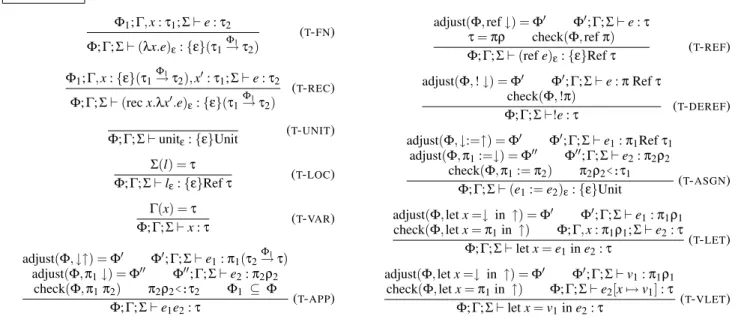
Finally, the rules employ the adjust and check functions to per-form static privilege checking. The adjust function is consulted in order to produce the appropriate privilege set to use when type-checking each subexpression of the given expression. The check function is consulted in order to decide whether an expression that
Φ;Γ;Σ`e:τ
Φ1;Γ,x:τ1;Σ`e:τ2 Φ;Γ;Σ`(λx.e)ε:{ε}(τ1Φ→1τ2)
(T-FN)
Φ1;Γ,x:{ε}(τ1→Φ1τ2),x0:τ1;Σ`e:τ2 Φ;Γ;Σ`(recx.λx0.e)ε:{ε}(τ1
Φ1
→τ2)
(T-REC)
Φ;Γ;Σ`unitε:{ε}Unit
(T-UNIT)
Σ(l) =τ Φ;Γ;Σ`lε:{ε}Refτ
(T-LOC)
Γ(x) =τ
Φ;Γ;Σ`x:τ (T-VAR)
adjust(Φ,↓↑) =Φ0 Φ0;Γ;Σ`e1:π1(τ2 Φ1
→τ)
adjust(Φ,π1↓) =Φ00 Φ00;Γ;Σ`e2:π2ρ2 check(Φ,π1π2) π2ρ2<:τ2 Φ1 ⊆ Φ
Φ;Γ;Σ`e1e2:τ (T-APP)
adjust(Φ,ref↓) =Φ0 Φ0;Γ;Σ`e:τ τ=πρ check(Φ,refπ) Φ;Γ;Σ`(refe)ε:{ε}Refτ
(T-REF) adjust(Φ,!↓) =Φ0 Φ0;Γ;Σ`e:πRefτ
check(Φ,!π)
Φ;Γ;Σ`!e:τ (T-DEREF)
adjust(Φ,↓:=↑) =Φ0 Φ0;Γ;Σ`e1:π1Refτ1 adjust(Φ,π1:=↓) =Φ00 Φ00;Γ;Σ`e2:π2ρ2
check(Φ,π1:=π2) π2ρ2<:τ1 Φ;Γ;Σ`(e1:=e2)ε:{ε}Unit
(T-ASGN) adjust(Φ,letx=↓ in ↑) =Φ0 Φ0;Γ;Σ`e1:π1ρ1 check(Φ,letx=π1in ↑) Φ;Γ,x:π1ρ1;Σ`e2:τ
Φ;Γ;Σ`letx=e1ine2:τ (T-LET)
adjust(Φ,letx=↓ in ↑) =Φ0 Φ0;Γ;Σ`v1:π1ρ1 check(Φ,letx=π1in ↑) Φ;Γ;Σ`e2[x7→v1]:τ
Φ;Γ;Σ`letx=v1ine2:τ (T-VLET)
Figure 5. Generic type-and-effect checking.
will dynamically evaluate to a redex has the appropriate privileges to be reduced.
For example, consider the ruleT-ASGN for typechecking ex-pressions of the forme1:=e2. The rule invokes the adjust function to produce the privilege setΦ0to use when typecheckinge1. The adjust function is invoked again, this time passing as context the statically determined tagsetπ1fore1, to produce the privilege set Φ00for typecheckinge2. The adjust function for a particular disci-pline could simply makeΦ0=Φ00=Φ, thereby requiringe1ande2 to be well typed under the current set of privileges. However, our rule soundly allows many other effect disciplines to be enforced. For instance, the following adjust function, used in conjunction with the check function at the end of Section 3.1, serves to enforce a particular canonical form on programs, whereby the subexpressions in an assignment expression are required to be pure: adjust(Φ,A) =
/
0 if A=↓:=↑ or A=π:=↓ Φ otherwise
Finally, theT-ASGNrule passesπ1along withe2’s statically de-termined tagsetπ2 to the check function in order to ensure that the effect discipline for assignments is being obeyed. The premise check(Φ,π1:=π2)is shorthand for the requirement that this call to the check function returns true.
The ruleT-FNfor typechecking lambdas “guesses” an argument typeτ1 and privilege setΦ1for use in typechecking the function body, and similarly for the ruleT-REC. Our tag system is a variant of existing approaches to user-defined type qualifiers, so we expect tag inference to follow from the work on qualifier inference (Ørbæk and Palsberg 1997; Foster et al. 2006). Privilege inference poses more of a challenge, particularly in the presence of arbitrary black-box check and adjust functions. In this paper we have chosen to keep the check and adjust functions fully general, in order to explore the expressiveness and soundness limits of our approach. It may be possible to adapt existing algorithms for effect inference (e.g., (Talpin and Jouvelot 1992)) by restricting the form of the check and adjust functions.
The ruleT-APPperforms privilege checking in a manner anal-ogous to the other rules, and it additionally ensures that the
privi-τ1<:τ2
π1 ⊆ π2 π1Unit<:π2Unit
(ST-UNIT)
π1 ⊆ π2 τ1<:τ2 τ2<:τ1 π1(Ref τ1)<:π2(Ref τ2)
(ST-REF)
π1 ⊆ π2 Φ1 ⊆ Φ2 τ2<:τ1 τ01<:τ02
π1(τ1 Φ1
→τ01)<:π2(τ2 Φ2
→τ02)
(ST-FN)
Figure 6. The subtyping judgment.
legesΦ1required by the function being invoked are a subset of the current set of privilegesΦ.
For increased expressiveness, our type system includes a form of subtyping for tagged types. For example, the ruleT-APPonly requires the type of the actual argument expression to be a sub-type of the formal argument sub-type. The subtyping rules are shown in Figure 6. A type’s tagset is required to be a subset of any super-type’s tagset. This makes sense since a tagset represents the set of all possible tags of the associated expression’s run-time value, so a smaller tagset denotes a stronger property than a larger tagset. As usual for soundness, nontrivial subtyping is not allowed underneath a Ref type and function argument types are contravariant. Finally, a function type’s privilege set must be a subset of any supertype’s privilege set, since a function that requires fewer privileges can be safely used where one requiring more privileges is expected.
Our type system also includes a form of let-polymorphism for tagged types. As others have done (e.g., (Talpin and Jouvelot 1992)), we express polymorphism formally through substitution rather than through explicit quantification over types. The ruleT -VLETin Figure 5 expresses this form of polymorphism. As usual,
adjust(Φ,letscopeπ1in ↓) =Φ0 Φ0;Γ;Σ`e:τ τ=π2ρ2 check(Φ,letscopeπ1inπ2)
Φ;Γ;Σ`letscopeπ1ine:τ
Figure 7. The typing rule for letscope.
for soundness in the presence of references we only treat values polymorphically, so the rule is specialized to that situation. As an example of polymorphism, consider our memory effects checker and a function that takes a reference cell as an argument and possi-bly dereferences it. With polymorphism, this function can be called multiple times with differently tagged reference cells, as long as the appropriatereadprivileges are held at each call site.
4.
Examples
This section illustrates the expressiveness of our approach. We first extend our core language with a generic scoping mechanism in order to facilitate the presentation of examples and then show how several effect systems from the literature can be expressed as instantiations of our generic system.
4.1 A Generic Scoping Expression
For some effect systems there is a construct in the language where it is natural to adjust privileges, such astryfor an exception checker. But others, like our memory checker, do not have such an expres-sion. In these cases, we can use function annotations to control privileges. For instance, by annotating a function with the empty privilege set in our memory checker, we prevent the body of the function from accessing memory. However, we may want to have more fine-grained control. To achieve this we introduce a new ex-pression form calledletscope. The expression(letscopeπine) dy-namically behaves likeeand, like all expressions in our language, has associated check and adjust contexts. Thus we can define cases for the adjust function that grant or revoke privileges while type-checking the body of the letscope. The typing rule for letscope is shown in Figure 7.
Consider again our memory checker with read, write and alloc privileges. Assuming that we begin with an initial set containing all privileges, we can use letscope to require purity in certain code segments:
adjust(Φ,A) =
(
/
0 if A=letscopeπin ↓ Φ otherwise
Using the tagset π provided to the letscope we can allow more fine-grained control and require that a code segment be pure only with respect to locations with particular tags:
adjust(Φ,A) =
Φ− {write(ε)|ε∈π} − {read(ε)|ε∈π} − {alloc}
if A=letscopeπin ↓ Φ otherwise
It may be useful to have different “kinds” of letscopes for dif-ferent purposes. Our formalism has only one letscope expression, but different kinds can be encoded through the tagsetπprovided in the expression. For example, we could modify the above rule to only revoke privileges whenπcontains a distinguishedpuretag:
adjust(Φ,A) =
Φ− {write(ε)|ε∈π} − {read(ε)|ε∈π} − {alloc}
if A=letscopeπin ↓ andpure∈π Φ otherwise
We could then augment the above function to revoke only writeandalloc privileges when a distinguishedreadonlytag is present inπ. In this way, we can use the letscope expression to perform many different privilege operations within a program. Throughout this section, we use a syntactic sugar for this idiom and allow letscope expressions to be subscripted with a tag that we call aletscope kind. These kinds can be used within check and adjust functions. For example, we can rewrite the above effect discipline using our syntactic sugar as follows:
adjust(Φ,A) =
Φ− {write(ε)|ε∈π} − {read(ε)|ε∈π} − {alloc} if A=letscopepureπin ↓
Φ otherwise 4.2 Type Qualifiers
Our notion of tags is sufficient to express typical idioms involving type qualifiers. For example, a program could use tagsuntainted and tainted to respectively tag data that can and cannot be trusted (Ørbæk and Palsberg 1997; Shankar et al. 2001). Our type system ensures that if a function’s formal parameter is declared to have type{untainted}ρ, thentainteddata will never flow there. The CQUALsystem for type qualifiers in C (Foster et al. 2006) allows users to specify a partial order on qualifiers, which induces a subtyping relation on qualified types. For example, a CQUALuser would declareuntainted≤taintedin order to allowuntainted data to flow wherevertainteddata is expected. While our type system does not support such a relationship between tags, our use of tagsets and the associated subtyping relation on tagged types ac-complishes the same thing. In our type system bothuntainted and tainted data can flow to a place where a value of type
{untainted,tainted}ρis expected.
Finally, our check function can interact with tags to provide more expressiveness for type qualifiers, even in the absence of privileges. For example, consider a tagreadonlythat is meant to annotate memory locations that cannot be updated after initializa-tion. The following check function enforces this behavior:
check(Φ,C) =
(
readonly6∈π if C=π:=π0 true otherwise
4.3 Memory Effects
Consider the check function at the end of Section 3.1 which imple-ments standard tracking of memory effects. Given this definition for check, our type system will require each function’s type to be annotated with a set of privileges representing the memory effects that may occur during its execution. These privileges are expres-sive enough to represent the four “effect classes” in the original effect system of Gifford and Lucassen (1986): a function requiring the empty set of privileges corresponds to their PURE effect class; a function requiring neitherreadnorwrite(but possiblyalloc) privileges corresponds to their FUNCTION effect class; a function requiring nowriteprivileges corresponds to their OBSERVER ef-fect class; and a function requiring arbitrary privileges corresponds to their PROCEDURE effect class.
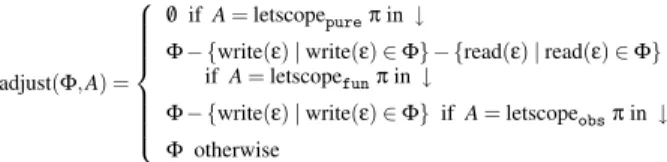
The letscope construct can also be used to enforce these dis-ciplines at a finer granularity than a function. One approach is to allow all memory operations by default, by including thealloc privilege and thereadandwriteprivileges for all tags in the ini-tial privilege set. Memory effects can then be restricted through-out the program by using different kinds of letscopes. The adjust function shown in Figure 8 implements this discipline. It includes three letscope kinds to mark code that falls into the different ef-fect classes. There is no letscope kind corresponding to the PRO-CEDURE effect class since our initial privilege set makes this the default.
adjust(Φ,A) =
/
0if A=letscopepureπin↓
Φ− {write(ε)|write(ε)∈Φ} − {read(ε)|read(ε)∈Φ}
ifA=letscopefunπin↓
Φ− {write(ε)|write(ε)∈Φ}ifA=letscopeobsπin↓
Φ otherwise
Figure 8. An adjust function for a memory checker whose initial privilege set allows everything.
check(Φ,C) =
(p∈π⇒P∈Φ)∧(u∈π⇒U∈Φ) ifC=!π
(p∈π⇒P∈Φ)∧(u∈π⇒U∈Φ) ifC=π:=π0 true otherwise
adjust(Φ,A) =
{P}ifA=async ↓ {U}ifA=unprotected↓ Φ otherwise
Figure 9. Implementing the AME calculus effect system.
As a concrete example, suppose a programmer decides to mem-oize the results of a certain function in order to improve perfor-mance. For the memoization to be safe, the function must be pure. Therefore, the programmer could create a wrapper function to per-form the memoization whose call to the original function is en-closed in a letscopepure. Our type system would then ensure that
this call can be typechecked without any memory privileges. 4.4 Strong Atomicity for Transactional Memory
Our approach naturally extends to richer languages than our simple formalism. To illustrate this, we show that an effect system defined by others for their AME calculus (Abadi et al. 2008), a lambda cal-culus augmented with mutable references and constructs for auto-matic mutual exclusion (Isard and Birrell 2007), is supported by our model. The relevant language extensions are(asynce), which exe-cuteseasynchronously as a transaction, and(unprotectede), which executeseasynchronously outside of a transaction. The latter form is necessary to support side effects like I/O as well as interaction with legacy code.
The authors discuss the problem of “weak atomicity” (Martin et al. 2006), whereby implementations of software transactional memory (STM) do not prevent conflicts between transactional and non-transactional code. The resulting semantics can cause unex-pected and counterintuitive behavior, but implementing STM to di-rectly support “strong atomicity” is difficult. To address the prob-lem, the authors show how an effect system can be used to ensure that transactional and non-transactional code never read or write the same memory locations, thereby recovering strong atomicity even when the STM is implemented in the weakly atomic style.
The effect system for the AME calculus uses effectsPand U to respectively distinguish between protected and unprotected con-texts. The type for references is similarly augmented with a tag (p oru) indicating whether the reference can be manipulated in pro-tected or unpropro-tected contexts. The effect discipline then ensures that a protected (unprotected) reference is only manipulated in a protected (unprotected) context. This effect system can be easily expressed in a generic effect system for the AME calculus created by following the approach we outlined in Section 2. Figure 9 shows check and adjust functions that enforce the discipline.
4.5 Application-Specific Effects
Our type system is also expressive enough to capture useful kinds of application-specific effects. As an example, we consider some is-sues in a user-level threads library. Such a library typically provides
wrapped versions of all system calls that potentially cause a process to block, such as thereadandwritefile operations. Clients of the thread library should always invoke the wrapped versions of these system calls, so that the library may schedule another thread while the caller awaits a response. Our type-and-effect system can be used to check that blocking system calls are never directly invoked.
To do so, we assume that each blocking system call is annotated with the tagblocks. We then define a privilegemayblock, along with the following check and adjust functions:
check(Φ,C) =
(
blocks∈π⇒mayblock∈Φ if C=π π0 true otherwise
adjust(Φ,A) =
(
Φ∪ {mayblock} if A=letscopeblkπin ↓ Φ otherwise
The check function above requires the mayblock privilege to be held whenever a function potentially tagged with blocks is invoked, while the adjust function uses letscopeblk to grant
the mayblock privilege. Now letscopeblk can be employed in
the implementation of the library’s wrapper functions, allowing them to directly invoke the blocking system calls. The intent is that client functions should never use letscopeblk.1 Therefore, if
start threadis the library function that takes a client function and invokes it in a new thread, then givingstart thread’s formal parameter the typeUnit→0/ Unitwill ensure that client functions do not directly invoke blocking system calls.
To continue the example, suppose that this user-level threads library is cooperatively scheduled: client code is not preempted but instead explicitly yields control to the scheduler, either by calling one of the wrapper functions described above or by calling a specialyieldfunction provided by the library. Others have used an effect system to track which functions might yield control to the scheduler, since yields represent points at which the code must be properly synchronized with other threads (Fischer et al. 2007; Isard and Birrell 2007).
To define this effect system in our theory, we assume that the wrapper functions and theyieldfunction are annotated with the tagyields, and as above we define a privilegemayyield. Assum-ing that we check programs under an initial privilege set containAssum-ing mayyield, the following check and adjust function cases imple-ment the desired effect discipline:
check(Φ,C) =
(
yields∈π⇒mayyield∈Φ if C=π π0
true otherwise
adjust(Φ,A) =
(
Φ− {mayyield} if A=letscopeatomicπin ↓
Φ otherwise
The check function above requires the caller of a function that po-tentially yields to hold themayyieldprivilege. The letscopeatomic
can then be placed around code blocks that must be executed atom-ically, in order to ensure that the execution of these code blocks does not yield to the scheduler.
It is also possible to express finer-grained versions of the above effect discipline in our type system. For example, rather than tag-ging all wrapper functions andyieldwith the same tag, each func-tion could have its own tag. Themayyieldprivilege could then be augmented to be parameterized by a tag. In that way, the effect sys-tem would track not only which functions potentially yield but also
howthey yield.
1If our language had a module system, it would be natural to allow users to limit the visibility of a letscope kind to a particular module.
There are many other application-specific properties that could be tracked and controlled using our type-and-effect system in a manner similar to the examples shown above. For instance, the Linux kernel deallocates some data and functions after the initial-ization phase, and this code is tagged with the qualifier init (Fos-ter et al. 2006). It would be straightforward to introduce a privi-legemayinitalong with a check function definition to track func-tions that may manipulate initdata or call initfunctions. A letscope could then be used to revoke themayinitprivilege af-ter the initialization phase, ensuring that the kernel will not type-check if later phases attempt to touch init data or functions. As a final example, the Enterprise JavaBeans component platform for Java imposes several requirements on “bean” classes written by clients (DeMichiel 2004). One of these requirements is that beans do not spawn threads. Similar to the system calls example above, an effect system could be used to track functions that potentially spawn threads.
5.
Dynamic Semantics
As mentioned earlier, our dynamic semantics is instrumented to perform privilege checking via the same check and adjust functions provided for static type-and-effect checking. As usual, dynamic checking is more precise than its static counterpart. For example, the standard check function for memory effects (shown at the end of Section 3.1) will be used dynamically to check that the appropriatereadprivilege is held for the actual memory location being dereferenced.
The operational semantics of our language is defined in Fig-ure 10. As usual, a storeµis a finite mapping from memory loca-tions to values. The small-step operational semantics is specified by a judgment of the formΦ`Dhe,µi −→ he0,µ0i, which says that,
for a particular discipline
D
, the pair of expressioneand storeµtakes one step of evaluation to a new paire0andµ0in the context of privilegesΦ. The rules make use of a small abuse of notation:
vεrepresents an arbitrary value whose associated tag isε. As in our rules for the type system, we omit the discipline subscripts in Figure 10 for readability.
As usual in a small-step semantics, there are two kinds of rules:
congruencerules (whose names begin withS-), which simply take a step of evaluation in some subexpression; andcomputationrules (whose names begin with E-), which perform a reduction. The adjust and check functions exactly parallel this distinction. The adjust function is consulted in each congruence rule, to determine the set of privileges to use when evaluating the subexpression. The check function is consulted in each computation rule, to determine whether the reduction is allowed under the current set of privileges. Because each value has exactly one tag, the tagset arguments to the check and adjust contexts are always singleton sets, unlike in the static semantics.
Our instrumented dynamic semantics allows us to define the standard notion of type soundness, which is the subject of the next section. It would be unnecessary for an implementation to actually perform dynamic tagging or privilege checking on well-typed programs.
6.
Type Soundness
In our setting, the standard type soundness theorem for effects re-quires that well-typed programs do not fail any dynamic privilege checks. This is a basic well-formedness condition that should be true of any sound effect discipline. However, since the user-defined check and adjust functions are unrestricted, it is not possible to prove type soundness once and for all. In particular, there exist dis-ciplines
D
defined by functions checkDand adjustDthat would al-low a program to typecheck but fail a privilege check dynamically.Therefore, type soundness must be proven separately for each ef-fect discipline.
We have architected a modular approach to type soundness. Just as our language’s static and dynamic semantics are parameterized by a small amount of discipline-specific information, so is our lan-guage’s type soundness proof. The bulk of the proof is independent of the adjust and check functions and is provable once. Proving type soundness for a particular effect discipline merely requires proving four relatively simple lemmas which ensure natural forms of mono-tonicity for the adjust and check functions.
This section describes our approach to proving type soundness. First, we illustrate how an effect discipline could violate our infor-mal notion type soundness. Next, we describe our modular proof ar-chitecture, focusing on the four lemmas that must be proven about a particular effect discipline. Finally, we formally present the type soundness result for our generic framework.
6.1 An Unsound Privilege Discipline
Type soundness does not hold in general for our language, because of the presence of arbitrary check and adjust functions. For exam-ple, consider the following cases of the check and adjust functions for a discipline
U
related to memory writes:checkU(Φ,C) =
(
∀ε∈π.write(ε)∈Φ if C=π:=π0 true otherwise
adjustU(Φ,A) =
(
{write(ε)|ε∈π} if A=π:=↓ Φ otherwise
The check function above is standard for tracking memory writes. The adjust function above only allows the right-hand side of an as-signment to update memory tagged with one of the possible tags of the left-hand location.
Consider an assignment of the forme1:=e2. With the above ad-just functione2will be statically typechecked under the privileges {write(ε)|ε∈π}, whereπis the top-level tagset in the type ofe1. However, this adjust function will causee2to be dynamically eval-uated under just the privilegewrite(ε), whereεis the single tag of the resulting value ofe1. Ifπcontains some other tagε0, then the
check function above will statically allowe2 to write to memory tagged withε0, even though dynamically this check will fail.
The fact that not all effect disciplines lead to sound type sys-tems motivates our approach to proving type soundness, which is discussed next.
6.2 Modular Proof Architecture
We have devised a novel proof architecture for ensuring type soundness of instantiations of our generic system. The architecture has a small discipline-dependent portion, which consists of only four monotonicity lemmas about the check and adjust functions. The rest of the type soundness proof is completely independent of the check and adjust functions and can be proven once and for all. As we discuss in the next section, we have validated this proof architecture by formalizing our language, its type system, and its type soundness proof in the Twelf proof assistant (Pfenning and Sch¨urmann 1999). Twelf verifies our type soundness proof as com-plete modulo the proofs of the four lemmas discussed below. 6.2.1 Privilege Monotonicity
The first two lemmas require a form of monotonicity of the check and adjust functions with respect to privilege sets. The lemmas en-sure that the more privileges that are held, the more an expression is allowed to do. Intuitively, this property is necessary for sound-ness since a sound static typechecker underapproximates the set of privileges that will be held dynamically for the evaluation of
Φ` he,µi −→ he0,µ0i
adjust(Φ,↓↑) =Φ0 Φ0` he1,µi −→ he01,µ0i Φ` he1e2,µi −→ he01e2,µ0i
(S-APP1) adjust(Φ,{ε} ↓) =Φ0 Φ0` he2,µi −→ he02,µ0i
Φ` hvεe2,µi −→ hvεe02,µ0i
(S-APP2) check(Φ,{ε} {ε0})
Φ` h(λx.e)εvε0,µi −→ he[x7→vε0],µi
(E-APP) check(Φ,{ε} {ε0})
Φ` h(recx.λx0.e)εvε0,µi −→ he[x7→(recx.λx0.e)ε,x07→vε0],µi (E-APP2) adjust(Φ,ref↓) =Φ0 Φ0` he,µi −→ he0,µ0i
Φ` h(refe)ε,µi −→ h(refe0)ε,µ0i
(S-REF) check(Φ,ref{ε}) l∈/domain(µ)
Φ` h(refvε)ε0,µi −→ hlε0,µ[l7→vε]i
(E-REF) adjust(Φ,!↓) =Φ0 Φ0` he,µi −→ he0,µ0i
Φ` h!e,µi −→ h!e0,µ0i (S-DEREF)
check(Φ,!{ε}) µ(l) =v Φ` h!lε,µi −→ hv,µi
(E-DEREF)
adjust(Φ,↓:=↑) =Φ0 Φ0` he1,µi −→ he01,µ0i Φ` h(e1:=e2)ε,µi −→ h(e01:=e2)ε,µ0i
(S-ASGN1) adjust(Φ,{ε}:=↓) =Φ0 Φ0` he,µi −→ he0,µ0i
Φ` h(vε:=e)ε0,µi −→ h(vε:=e0)ε0,µ0i
(S-ASGN2) check(Φ,{ε}:={ε0})
Φ` h(lε:=vε0)ε00,µi −→ hunitε00,µ[l:=vε0]i
(E-ASGN) adjust(Φ,letx=↓ in ↑) =Φ0 Φ0` he1,µi −→ he01,µ0i
Φ` hletx=e1ine2,µi −→ hletx=e01ine2,µ0i (S-LET) check(Φ,letx={ε}in ↑)
Φ` hletx=vεine2,µi −→ he2[x7→vε],µi (E-LET) adjust(Φ,letscopeπin ↓) =Φ0 Φ0` he,µi −→ he0,µ0i
Φ` hletscopeπine,µi −→ hletscopeπine0,µ0i
(S-LETSCOPE) check(Φ,letscopeπin{ε})
Φ` hletscopeπinvε,µi −→ hvε,µi
(E-LETSCOPE)
Figure 10. Generic operational semantics.
LEMMA6.1. IfΦ1 ⊆ Φ2and check(Φ1,C), then check(Φ2,C).
LEMMA6.2. IfΦ1 ⊆ Φ2, then adjust(Φ1,A) ⊆ adjust(Φ2,A).
Figure 11. Lemmas for privilege monotonicity.
some subexpression. The two lemmas are described formally in Figure 11.
The lemmas naturally support many desirable programming dis-ciplines for type-and-effect systems, including all of the exam-ple check and adjust functions shown in this paper. Consider the mayyieldexample shown at the end of Section 4. The first lemma in Figure 11 holds for the given check function because an ele-ment of a set is also an eleele-ment of any superset. It is easy to check that the second lemma holds for the letscopeatomicadjust function
case, which revokes themayyieldprivilege. Finally, the lemma also safely allows the adjust function that grantsmayblockwithin letscopeblk.
Intuitively the two lemmas in Figure 11 disallow check and adjust functions that depend on “negative” information aboutΦ.
For example, a check function cannot require the absence of a particular privilege fromΦ. However, in some cases it is possible to obtain the desired behavior by replacing a “negative” privilege
pwith a dual privilegep, which is granted (revoked) whereverp
would have been revoked (granted) and whose presence is required whereverp’s absence would have been required. Further, some uses of negative information do satisfy the two lemmas. For example, it is perfectly sound for an adjust function to revoke a particular privilege only in the absence of another privilege.
6.2.2 Tag Monotonicity
The other two lemmas require a form of monotonicity of the adjust and check functions with respect to tagsets. The lemmas ensure that the smaller the tagsets are in the adjust and check contexts, the
LEMMA6.3. IfC2 v C1and check(Φ,C1), then check(Φ,C2).
LEMMA6.4. IfA2 v A1, then adjust(Φ,A1) ⊆ adjust(Φ,A2).
Figure 12. Lemmas for tag monotonicity.
more an expression is allowed to do. Intuitively, this is necessary for soundness since the static typechecker overapproximates the possible tags of an expression’s run-time values.
The lemmas for tag monotonicity are defined in Figure 12. The lemmas rely on partial orders on the check and adjust contexts, de-notedv. These relations are simply the⊆partial order on tagsets lifted in the obvious way to check and adjust contexts; they are for-mally defined in Figure 13. The tag monotonicity lemmas naturally support many desirable programming disciplines, including all of our examples (except the unsound discipline from Section 6.1). For example, the check function formayyieldin Section 4 satisfies the first lemma because asπgets smaller the check gets weaker. The check function forreadonlyfrom that section similarly satisfies that lemma.
Consider the adjustUfunction for our unsound effect discipline in Section 6.1. This function does not satisfy Lemma 6.4: asπ
gets smaller, the function grantsfewerprivileges rather thanmore
privileges.
6.3 Type Soundness
We can now express type soundness for our framework in the traditional “progress and preservation” style (Wright and Felleisen 1994). We first define the notion of a monotonic discipline: DEFINITION6.1. (Monotonic Discipline) We say that
D
ismonotonicif checkD satisfies Lemmas 6.1 and 6.3 and adjustD satisfies Lemmas 6.2 and 6.4.
C1 vC2
π1 ⊆ π3 π2 ⊆π4 π1π2 vπ3π4
π1 ⊆π2 refπ1 vrefπ2
π1 ⊆π2 !π1 v!π2
π1 ⊆π3 π2 ⊆ π4 π1:=π2 vπ3:=π4
π1 ⊆π2
letx=π1in↑ v letx=π2in↑
π1 ⊆π2
letscopeπinπ1 vletscopeπinπ2
A1v A2
↓↑ v ↓↑
π1 ⊆ π2 π1↓ vπ2↓
ref↓ vref↓
!↓ v!↓
↓:=↑ v ↓:=↑
π1 ⊆ π2 π1:=↓ v π2:=↓
letx=↓ in↑ v letx=↓in↑
letscopeπin↓ v letscopeπin ↓
Figure 13. Partial order on check and adjust contexts.
DEFINITION6.2. (Well-Typed Store) We say that Γ,Σ`D µ if domain(µ) = domain(Σ) and ∀l∈domain(µ) we have 0/;Γ;Σ`D µ(l):Σ(l).
This definition is standard (Pierce 2002), except for the privilege set used in the typechecking judgment. The typechecking of values never depends on privileges, so it is sufficient to use an empty set of privileges in the definition.
Now we can state the progress and preservation theorems, which are also standard (we use•to denote the empty type en-vironment):
THEOREM6.1. (Progress) For any monotonic discipline
D
, ifΦ;•;Σ`D e:τ, then either e is a value or for all µ such that
•,Σ`Dµ, there existe0andµ0such thatΦ`Dhe,µi −→ he0,µ0i. THEOREM6.2. (Preservation) For any monotonic discipline
D
, ifΦ;Γ;Σ`De:τandΦ`D he,µi −→ he0,µ0iandΓ,Σ`Dµ, then there existΣ0andτ0such thatΦ;Γ;Σ0`De0:τ0, whereτ0<:τand
Γ,Σ0`Dµ0.
7.
Implementation in Twelf
To validate our work, we have implemented an interpreter and typechecker for our language in the Twelf proof assistant (Pfen-ning and Sch¨urmann 1999). We have also implemented a me-chanically checked type soundness proof for this implementation following the architecture described in the previous section. Fi-nally, we have implemented all of the example effect disciplines described in Section 4 except the one that relies on special lan-guage features for transactions. We have used these example dis-ciplines to typecheck and execute some small programs and have provided mechanically checked implementations of the four mono-tonicity lemmas required to prove soundness for each discipline. Our Twelf implementation and examples are available athttp: //www.cs.ucla.edu/∼todd/research/effects.tar.gz. 7.1 Base Semantics
First we implemented the traditional static and dynamic seman-tics and type soundness proof for our lambda calculus. We did so by modifying an existing Twelf implementation and type sound-ness proof for a simple language with mutable references called Fun (Simmons 2005). We replaced Fun’s top-level function def-initions with first-class (possibly recursive) lambdas, and we in-troduced let polymorphism as described earlier. We also inherited from Fun a slightly richer language than we presented in our for-malism. For example, the language of our Twelf implementation additionally supports 32-bit integers and if-then-else expressions. 7.2 Tag and Privilege Checking
Next we augmented the static and dynamic semantics with tags and tag checking. While our formalism ensures that each value will have exactly one tag, our Twelf implementation allows a value
to be tagged multiple times. We then instrumented our static and dynamic semantics with privilege checking, parameterized on the black-box adjust and check functions. For ease of maintenance we implemented static tag and privilege checking as its own pass that follows the existing typechecking pass. Similarly, we implemented dynamic privilege checking as an additional check that occurs after the program takes each ordinary small step.
In order for multiple effect disciplines to easily coexist, each declared privilege class is associated with aprivilege kind. For example,read,write, andallocprivilege classes might belong to the privilege kindmemcheck, while themayblockprivilege might belong to the privilege kinduserThreads. Each privilege kind has its own associated check and adjust functions, and the static and dynamic privilege checking judgments are parameterized by the privilege kind.
The check and adjust functions are represented in Twelf as judg-ment forms (using thejudgments as typesprinciple (Harper et al. 1993)). A particular effect discipline is specified as a collection of inference rules for these judgments, which are implemented in Twelf in a logic programming style. Each rule pattern matches on a particular check or adjust context, similar to our informal examples in this paper.
We have also implemented a form of the letscope expression as described in Section 4.1. The version in our Twelf implementation has two extra parameters: a privilege kind and an integer. The first parameter allows check and adjust functions to provide different behaviors for letscope based on the privilege kind. The second parameter plays the role of the informalletscope kindswe have used in examples, allowing an effect discipline to easily support multiple behaviors for letscope within a privilege kind.
7.3 Modular Type Soundness Proof
Finally, we implemented our proof architecture for type soundness in Twelf. In particular, we have a mechanically checked implemen-tation of the discipline-independent portion of the type soundness proof. This portion is parameterized by the four monotonicity lem-mas described earlier. Twelf’s typechecker and totality checker ver-ify the correctness and completeness of our Progress and Preserva-tion theorems, subject to the proofs of those four lemmas. There-fore, our proof architecture is correct: the four lemmas are sufficient to ensure type soundness for any effect discipline expressible in our theory.
The lemmas are defined as judgment forms in the typical Twelf style, as described above for the check and adjust functions. The lemmas are proven for a particular privilege kind by defining a set of proof cases, typically one (or more) per inference rule defining the check and adjust functions for that privilege kind.
8.
Related Work
Many program analyses and programming disciplines have been formulated as type-and-effect systems, some of which have been
incorporated into languages (e.g., FX (Gifford et al. 1992)). The in-troduction discusses several examples, including tracking of mem-ory effects, checked exceptions, and locking disciplines for con-current programs. While these systems hard-code a particular kind of effects and an associated discipline for controlling those effects, our effect system is parameterized by both the set of effects and the associated discipline.
The CQUALsystem has a generic typechecker and type infer-encer for user-defined type qualifiers in C that is parameterized by a programmer-defined set of qualifiers and associated partial or-der (Foster et al. 2006). The Clarity system additionally allows pro-grammers to provide explicit type rules for qualifiers (Chin et al. 2005, 2006). The tags in our generic effect system are essentially equivalent to CQUAL-style qualifiers. By themselves, type quali-fiers are not expressive enough to encode computational effects: they refer to thevalueof an expression rather than itsevaluation.
CQUALallows programmers to declare some qualifiers aseffect qualifiers. The type system then tracks the effect of each expres-sion, which is a single effect qualifier that is the least upper bound of the effect qualifiers of all subexpressions. The authors used ef-fect qualifiers to track proper initialization in the Linux kernel (Fos-ter et al. 2006). Our theory is more expressive than CQUAL’s ef-fect qualifiers in several ways. First, our notion of efef-fects is more general, with privileges dependent on tags. For example, it is not obvious how to encode the standard discipline for read(ε) and write(ε)effects in CQUAL. Second, our effect discipline is param-eterized by the check and adjust functions that instrument the static semantics in a uniform manner, while CQUALemploys a fixed ap-proach for tracking effects except for a few special cases exposed to programmers for configuration. Finally, we provide a formal-ized and mechanically checked proof architecture for ensuring type soundness in the presence of arbitrary check and adjust functions.
The capability calculus (Walker et al. 2000) supports a region-based memory management discipline whereby region lifetimes need not be lexically scoped. The associated type system tracks a set of static region capabilities, which indicate both which regions are live and which regions areuniqueand can therefore be safely freed. Our use of privileges as a dual to effects is directly inspired by the capability calculus. We plan to explore ways to incorporate a form of uniqueness in privileges in order to remove our lexical scoping restriction.
The Vault language (DeLine and Fahndrich 2001) generalizes the ideas in the capability calculus to support tracking of user-defined computational effects, and similar functionality can be achieved in the flow-sensitive extension of CQUAL(Foster et al. 2002). Mandelbaum et al. (2003) provide a formal account of a Vault-like type system. These systems support flow-sensitive track-ing of effects, which is not possible in our type system. On the other hand, we provide a general approach for specifying arbitrary type-and-effect disciplines on any syntactic context in a language, while effect disciplines in these systems are expressible only through pre-and postconditions on functions.
Others have investigated the type-theoretic foundations of effect systems. Wadler and Thiemann (2003) show how memory effects are naturally captured by a state monad (Moggi 1989) whose type additionally maintains a set of effects, and Filinski (1999) shows how new effects can be introduced in a language as monads that are defined in terms of lower-level effects. Nanevski has pursued the use of modal operators as a logical foundation for effect systems. For example, he shows how the operator2of modal necessity and 3of modal possibility can be used to respectively track read and write effects (Nanevski 2003). He also illustrates how2provides a logical interpretation of effect consumption and uses this idea to define a type system for exception handling (Nanevski 2005).
These works are more foundational than our work, showing how to encode effects in terms of existing notions like monads and modal-logic type constructors. In these formalisms, each particular effect discipline is encoded separately through specialized typing rules. Our work, on the other hand, uses a standard style of adding effects to a type system, but identifies a general template for cre-ating an effect system in this style that achieves a generic form of soundness. It would be interesting in future work to understand how our results translate to the monadic and modal settings.
9.
Conclusion and Future Work
We have presented a generic type-and-effect system. To our knowl-edge, ours is the first type-and-effect system that is parameterized by both the set of effects to be tracked and the discipline to be stat-ically enforced on these effects. Our notions of check and adjust contexts, derived from the existing notions of redexes and eval-uation contexts, provide a generic way of instrumenting any lan-guage’s type system to support static checking of effect disciplines. Further, we have architected a parameterized type soundness proof for our type-and-effect system which requires only four monotonic-ity lemmas to be proven about a discipline’s check and adjust func-tions. We have instantiated the approach for a lambda calculus with references and implemented the language, type-and-effect system, and type soundness proof in the Twelf proof assistant.
The generic effect system presented in this paper could be ex-tended in a number of ways to increase expressiveness. As men-tioned earlier, we could employ more sophisticated forms of tag-ging. It might also be useful to consider employing a data structure other than a set to maintain privileges. For example, a sequence of privileges could be useful for disciplines that care about the or-der in which privileges are acquired. Translating our ideas to the context of the capability calculus (Walker et al. 2000) would pro-vide a form of flow sensitivity for our effect disciplines. Finally, we plan to explore ways to incorporate proofs of extensional no-tions of soundness. One possible approach is to first prove standard type soundness using our strategy and then to prove a relationship between the instrumented and uninstrumented dynamic semantics. Our ultimate goal is to use our approach for formalizing a generic effect system as the foundation for a practical framework for enforcing programmer-definable effect disciplines in a full-fledged language like ML or Java. While we have focused on making the check and adjust functions as expressive as possible while retaining type soundness, it may be useful in practice to impose additional structure. For example, restricting the form of the check and adjust functions could simplify privilege inference or ensure privilege and tag monotonicity without requiring proof.
10.
Acknowledgments
This material is based upon work supported by the National Science Foundation under Grant Nos. CCF-0427202 and CCF-0545850. Special thanks to Jeff Foster for shepherding the paper, pointers to example effect systems, and helpful comments on an earlier draft. Thanks also to Jens Palsberg for feedback on this paper and to David Walker for discussions that motivated this research direction.
References
Martin Abadi, Cormac Flanagan, and Stephen N. Freund. Types for safe locking: Static race detection for java. ACM Trans. Program. Lang. Syst., 28(2):207–255, 2006.
Mart´ın Abadi, Andrew Birrell, Tim Harris, and Michael Isard. Se-mantics of transactional memory and automatic mutual exclu-sion. In POPL ’08: Proceedings of the 35th Annual ACM