Wireless mesh networks: a survey
Ian F. Akyildiz
a, Xudong Wang
b,*, Weilin Wang
b aBroadband and Wireless Networking (BWN) Lab, School of Electrical and Computer Engineering, Georgia Institute of Technology, Atlanta, GA 30332, USA
b
Kiyon, Inc., 4225 Executive Square, Suite 290, La Jolla, CA 92037, USA
Received 1June 2004; received in revised form 1November 2004; accepted 20 December 2004 Available online 1January 2005
Abstract
Wireless mesh networks (WMNs) consist of mesh routers and mesh clients, where mesh routers have minimal mobi-lity and form the backbone of WMNs. They provide network access for both mesh and conventional clients. The inte-gration of WMNs with other networks such as the Internet, cellular, IEEE 802.11, IEEE 802.15, IEEE 802.16, sensor networks, etc., can be accomplished through the gateway and bridging functions in the mesh routers. Mesh clients can be either stationary or mobile, and can form a client mesh network among themselves and with mesh routers. WMNs are anticipated to resolve the limitations and to significantly improve the performance of ad hoc networks, wireless local area networks (WLANs), wireless personal area networks (WPANs), and wireless metropolitan area networks (WMANs). They are undergoing rapid progress and inspiring numerous deployments. WMNs will deliver wireless ser-vices for a large variety of applications in personal, local, campus, and metropolitan areas. Despite recent advances in wireless mesh networking, many research challenges remain in all protocol layers. This paper presents a detailed study on recent advances and open research issues in WMNs. System architectures and applications of WMNs are described, followed by discussing the critical factors influencing protocol design. Theoretical network capacity and the state-of-the-art protocols for WMNs are explored with an objective to point out a number of open research issues. Finally, test-beds, industrial practice, and current standard activities related to WMNs are highlighted.
2004 Elsevier B.V. All rights reserved.
Keywords:Wireless mesh networks; Ad hoc networks; Wireless sensor networks; Medium access control; Routing protocol; Transport protocol; Scalability; Security; Power management and control; Timing synchronization
1389-1286/$ - see front matter 2004 Elsevier B.V. All rights reserved. doi:10.1016/j.comnet.2004.12.001
*
Corresponding author. Tel.: +1425 442 5039.
E-mail addresses:[email protected](I.F. Akyildiz),[email protected](X. Wang).
1. Introduction
As various wireless networks evolve into the next generation to provide better services, a key technology, wireless mesh networks (WMNs), has emerged recently. In WMNs, nodes are com-prised of mesh routers and mesh clients. Each node operates not only as a host but also as a rou-ter, forwarding packets on behalf of other nodes that may not be within direct wireless transmission range of their destinations. A WMN is dynami-cally self-organized and self-configured, with the nodes in the network automatically establishing and maintaining mesh connectivity among them-selves (creating, in effect, an ad hoc network). This feature brings many advantages to WMNs such as low up-front cost, easy network maintenance, robustness, and reliable service coverage.
Conventional nodes (e.g., desktops, laptops, PDAs, PocketPCs, phones, etc.) equipped with wireless network interface cards (NICs) can con-nect directly to wireless mesh routers. Customers without wireless NICs can access WMNs by con-necting to wireless mesh routers through, for example, Ethernet. Thus, WMNs will greatly help the users to be always-on-line anywhere anytime. Moreover, the gateway/bridge functionalities in mesh routers enable the integration of WMNs with various existing wireless networks such as cellular, wireless sensor, wireless-fidelity (Wi-Fi)
[136], worldwide inter-operability for microwave
access (WiMAX) [137], WiMedia [138] networks.
Consequently, through an integrated WMN, the users of existing network can be provided with otherwise impossible services of these networks.
WMN is a promising wireless technology for
numerous applications[98], e.g., broadband home
networking, community and neighborhood net-works, enterprise networking, building automa-tion, etc. It is gaining significant attention as a possible way for cash strapped Internet service providers (ISPs), carriers, and others to roll out ro-bust and reliable wireless broadband service access in a way that needs minimal up-front investments. With the capability of organization and self-configuration, WMNs can be deployed incremen-tally, one node at a time, as needed. As more nodes
are installed, the reliability and connectivity for the users increase accordingly.
Deploying a WMN is not too difficult, because all the required components are already available in the form of ad hoc network routing protocols, IEEE 802.11 MAC protocol, wired equivalent pri-vacy (WEP) security, etc. Several companies have already realized the potential of this technology and offer wireless mesh networking products. A few testbeds have been established in university re-search labs. However, to make a WMN be all it can be, considerable research efforts are still needed. For example, the available MAC and routing protocols applied to WMNs do not have enough scalability; the throughput drops signifi-cantly as the number of nodes or hops in a WMN increases. Similar problems exist in other networking protocols. Consequently, all existing protocols from the application layer to transport, network MAC, and physical layers need to be en-hanced or re-invented.
Researchers have started to revisit the protocol design of existing wireless networks, especially of IEEE 802.11 networks, ad hoc networks, and wire-less sensor networks, from the perspective of WMNs. Industrial standards groups are also ac-tively working on new specifications for mesh
net-working. For example, IEEE 802.11[64,74], IEEE
802.15 [65,79], and IEEE 802.16 [66,111,135] all
have established sub-working groups to focus on new standards for WMNs.
The remainder of the paper is organized as fol-lows. In Section 2, we present possible system architectures of WMNs. The characteristics of WMNs are summarized in Section 3, where a com-parison between WMNs and ad hoc networks is also conducted. In Section 4, different application scenarios of WMNs are addressed. Critical factors influencing protocol design are emphasized in Sec-tion 5. We discuss fundamental issues such as net-work capacity and optimal node density of WMNs in Section 6. Recent advances in protocol design for WMNs are investigated in Sections 7–15, where protocols on both data and management planes are covered and challenging research issues in all these aspects are discussed. Several testbeds and implementation practice of WMNs are
pre-sented in Section 16. Current status of standard activities in WMNs is highlighted in Section 17. The paper is concluded in Section 18.
2. Network architecture
WMNs consist of two types of nodes: mesh rou-ters and mesh clients. Other than the routing capa-bility for gateway/repeater functions as in a conventional wireless router, a wireless mesh rou-ter contains additional routing functions to sup-port mesh networking. To further improve the flexibility of mesh networking, a mesh router is usually equipped with multiple wireless interfaces built on either the same or different wireless access technologies. Compared with a conventional wire-less router, a wirewire-less mesh router can achieve the same coverage with much lower transmission power through multi-hop communications. Optionally, the medium access control (MAC) protocol in a mesh router is enhanced with better scalability in a multi-hop mesh environment.
In spite of all these differences, mesh and con-ventional wireless routers are usually built based on a similar hardware platform. Mesh routers can be built based on dedicated computer systems (e.g., embedded systems) and look compact, as
shown inFig. 1. They can also be built based on
general-purpose computer systems (e.g., laptop/ desktop PC).
Mesh clients also have necessary functions for mesh networking, and thus, can also work as a router. However, gateway or bridge functions do
not exist in these nodes. In addition, mesh clients usually have only one wireless interface. As a con-sequence, the hardware platform and the software for mesh clients can be much simpler than those for mesh routers. Mesh clients have a higher vari-ety of devices compared to mesh routers. They can be a laptop/desktop PC, pocket PC, PDA, IP phone, RFID reader, BACnet (building automa-tion and control networks) controller, and many
other devices, as shown inFig. 2.
The architecture of WMNs can be classified into three main groups based on the functionality of the nodes:
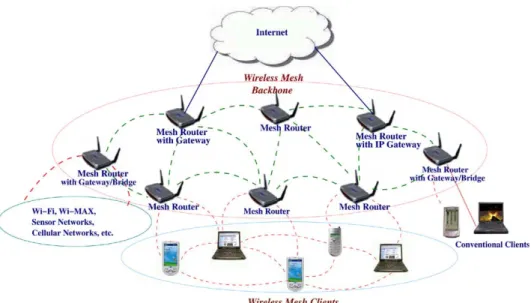
• Infrastructure/Backbone WMNs. The
architec-ture is shown in Fig. 3, where dash and solid
lines indicate wireless and wired links, respec-tively. This type of WMNs includes mesh rou-ters forming an infrastructure for clients that connect to them. The WMN infrastructure/ backbone can be built using various types of radio technologies, in addition to the mostly used IEEE 802.11 technologies. The mesh rou-ters form a mesh of self-configuring, self-healing links among themselves. With gateway func-tionality, mesh routers can be connected to the Internet. This approach, also referred to as
Fig. 1. Examples of mesh routers based on different embedded systems: (a) PowerPC and (b) Advanced Risc Machines (ARM).
Fig. 2. Examples of mesh clients: (a) Laptop, (b) PDA, (c) Wi-Fi IP Phone and (d) Wi-Wi-Fi RFID Reader.
infrastructure meshing, provides backbone for conventional clients and enables integration of WMNs with existing wireless networks, through gateway/bridge functionalities in mesh routers. Conventional clients with Ethernet interface can be connected to mesh routers via Ethernet links. For conventional clients with the same radio technologies as mesh routers, they can directly communicate with mesh routers. If dif-ferent radio technologies are used, clients must communicate with the base stations that have Ethernet connections to mesh routers.
Infrastructure/Backbone WMNs are the most commonly used type. For example, community and neighborhood networks can be built using infrastructure meshing. The mesh routers are placed on the roof of houses in a neighborhood, which serve as access points for users inside the homes and along the roads. Typically, two types of radios are used in the routers, i.e., for backbone communication and for user commu-nication, respectively. The mesh backbone com-munication can be established using long-range
communication techniques including
direc-tional antennas.
• Client WMNs.Client meshingprovides peer-to-peer networks among client devices. In this type of architecture, client nodes constitute the actual network to perform routing and configu-ration functionalities as well as providing end-user applications to customers. Hence, a mesh router is not required for these types of
net-works. The basic architecture is shown in Fig.
4. InClient WMNs, a packet destined to a node in the network hops through multiple nodes to
reach the destination.Client WMNsare usually
formed using one type of radios on devices. Moreover, the requirements on end-user devices
is increased when compared to infrastructure
meshing, since, in Client WMNs, the end-users
Fig. 3. Infrastructure/backbone WMNs.
must perform additional functions such as rout-ing and self-configuration.
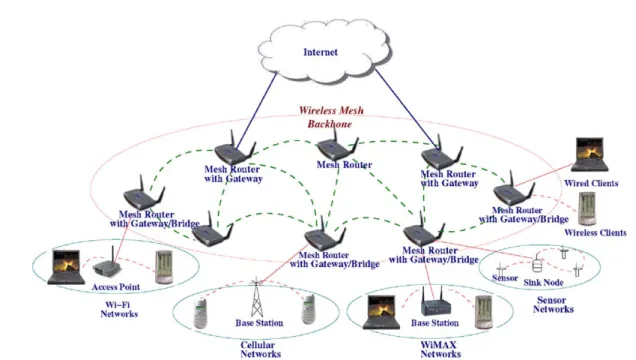
• Hybrid WMNs. This architecture is the
combi-nation of infrastructure and client meshing as
shown inFig. 5. Mesh clients can access the
net-work through mesh routers as well as directly meshing with other mesh clients. While the infrastructure provides connectivity to other networks such as the Internet, Wi-Fi, WiMAX, cellular, and sensor networks; the routing capa-bilities of clients provide improved connectivity and coverage inside the WMN. The hybrid architecture will be the most applicable case in our opinion.
3. Characteristics
The characteristics of WMNs are explained as follows:
• Multi-hop wireless network. An objective to develop WMNs is to extend the coverage range of current wireless networks without sacrificing the channel capacity. Another objective is to provide non-line-of-sight (NLOS) connectivity among the users without direct line-of-sight
(LOS) links. To meet these requirements, the
mesh-style multi-hopping is indispensable [85],
which achieves higher throughput without sac-rificing effective radio range via shorter link dis-tances, less interference between the nodes, and more efficient frequency re-use.
• Support for ad hoc networking, and capability of self-forming, self-healing, and self-organization. WMNs enhance network performance, because of flexible network architecture, easy deploy-ment and configuration, fault tolerance, and mesh connectivity, i.e.,
multipoint-to-multi-point communications [128]. Due to these
fea-tures, WMNs have low upfront investment requirement, and the network can grow gradu-ally as needed.
• Mobility dependence on the type of mesh nodes. Mesh routers usually have minimal mobility, while mesh clients can be stationary or mobile nodes.
• Multiple types of network access. In WMNs, both backhaul access to the Internet and peer-to-peer (P2P) communications are supported
[75]. In addition, the integration of WMNs with
other wireless networks and providing services to end-users of these networks can be accom-plished through WMNs.
• Dependence of power-consumption constraints on the type of mesh nodes. Mesh routers usually do not have strict constraints on power con-sumption. However, mesh clients may require power efficient protocols. As an example, a
mesh-capable sensor[113,114]requires its
com-munication protocols to be power efficient. Thus, the MAC or routing protocols optimized for mesh routers may not be appropriate for mesh clients such as sensors, because power efficiency is the primary concern for wireless
sensor networks[8,9].
• Compatibility and interoperability with existing wireless networks. For example, WMNs built
based on IEEE 802.11 technologies [133,69]
must be compatible with IEEE 802.11 stan-dards in the sense of supporting both mesh-capable and conventional Wi-Fi clients. Such WMNs also need to be inter-operable with other wireless networks such as WiMAX,
Zig-Bee[148], and cellular networks.
Based on their characteristics, WMNs are gen-erally considered as a type of ad-hoc networks due to the lack of wired infrastructure that exists in cellular or Wi-Fi networks through deployment of base stations or access points. While ad hoc net-working techniques are required by WMNs, the additional capabilities necessitate more sophisti-cated algorithms and design principles for the real-ization of WMNs. More specifically, instead of being a type of ad-hoc networking, WMNs aim to diversify the capabilities of ad hoc networks. Consequently, ad hoc networks can actually be
considered as asubsetof WMNs. To illustrate this
point, the differences between WMNs and ad hoc networks are outlined below. In this comparison, the hybrid architecture is considered, since it comprises all the advantages of WMNs.
• Wireless infrastructure/backbone. As discussed before, WMNs consist of a wireless backbone with mesh routers. The wireless backbone pro-vides large coverage, connectivity, and robust-ness in the wireless domain. However, the connectivity in ad hoc networks depends on the individual contributions of end-users which may not be reliable.
• Integration. WMNs support conventional cli-ents that use the same radio technologies as a mesh router. This is accomplished through a host-routing function available in mesh rou-ters. WMNs also enable integration of various existing networks such as Wi-Fi, the Inter-net, cellular and sensor networks through gate-way/bridge functionalities in the mesh routers. Consequently, users in one network are pro-vided with services in other networks, through the use of the wireless infrastructure. The
inte-grated wireless networks through WMNs
resembles the Internet backbone, since the physical location of network nodes becomes less important than the capacity and network topology.
• Dedicated routing and configuration. In ad hoc networks, end-user devices also perform routing and configuration functionalities for all other nodes. However, WMNs contain mesh routers for these functionalities. Hence, the load on end-user devices is significantly decreased, which provides lower energy consumption and high-end application capabilities to possi-bly mobile and energy constrained end-users. Moreover, the end-user requirements are lim-ited which decreases the cost of devices that can be used in WMNs.
• Multiple radios. As discussed before, mesh rou-ters can be equipped with multiple radios to perform routing and access functionalities. This enables separation of two main types of traffic in the wireless domain. While routing and configuration are performed between mesh rou-ters, the access to the network by end users can be carried out on a different radio. This sig-nificantly improves the capacity of the net-work. On the other hand, in ad hoc networks, these functionalities are performed in the same channel, and as a result, the performance decreases.
• Mobility. Since ad hoc networks provide routing using the end-user devices, the net-work topology and connectivity depend on the movement of users. This imposes addi-tional challenges on routing protocols as
well as on network configuration and
4. Application scenarios
Research and development of WMNs is moti-vated by several applications which clearly demon-strate the promising market while at the same time these applications cannot be supported directly by other wireless networks such as cellular networks, ad hoc networks, wireless sensor networks, stan-dard IEEE 802.11, etc. In this section, we discuss these applications.
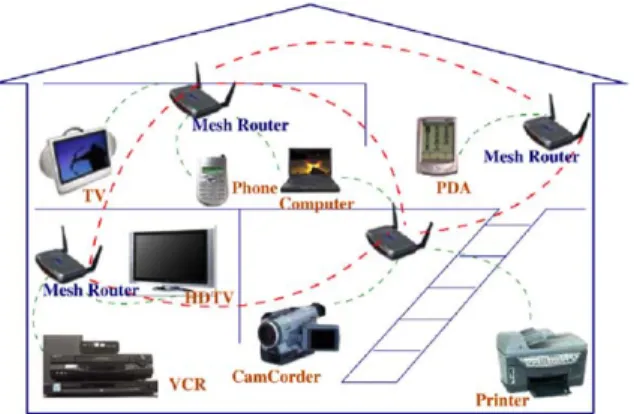
• Broadband home networking. Currently broad-band home networking is realized through IEEE 802.11 WLANs. An obvious problem is the location of the access points. Without a site survey, a home (even a small one) usually has many dead zones without service coverage. Solutions based on site survey are expensive and not practical for home networking, while installation of multiple access points is also expensive and not convenient because of Ether-net wiring from access points to backhaul Ether-
net-work access modem or hub. Moreover,
communications between end nodes under two different access points have to go all the way back to the access hub. This is obviously not an efficient solution, especially for broadband networking. Mesh networking, as shown in
Fig. 6, can resolve all these issues in home
networking.
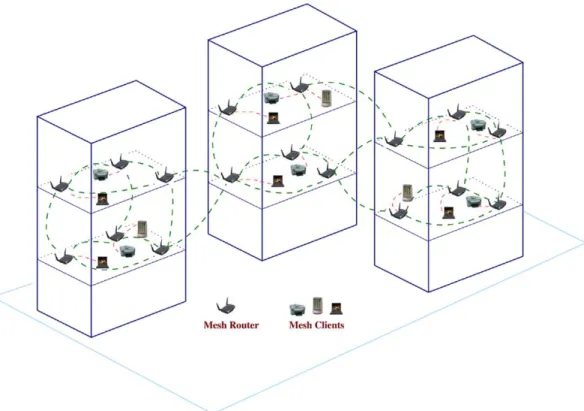
The access points must be replaced by wireless mesh routers with mesh connectivity established
among them. Therefore, the communication be-tween these nodes becomes much more flexible and more robust to network faults and link fail-ures. Dead zones can be eliminated by adding mesh routers, changing locations of mesh rou-ters, or automatically adjusting power levels of mesh routers. Communication within home net-works can be realized through mesh networking without going back to the access hub all the time. Thus, network congestion due to back-haul access can be avoided. In this application, wireless mesh routers have no constraints on power consumptions and mobility. Thus,
proto-cols proposed for mobile ad hoc networks [34]
and wireless sensor networks[8,9]are too
cum-bersome to achieve satisfactory performance in
this application. On the other hand, Wi-FiÕs are
not capable of supporting ad hoc multi-hop net-working. As a consequence, WMNs are well-suited for broadband home networking.
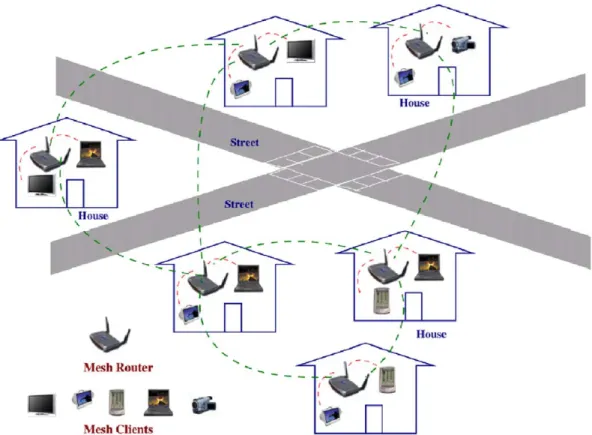
• Community and neighborhood networking. In a community, the common architecture for net-work access is based on cable or DSL connected to the Internet, and the last-hop is wireless by connecting a wireless router to a cable or DSL modem. This type of network access has several drawbacks:
– Even if the information must be shared within a community or neighborhood, all traffic must flow through Internet. This
sig-nificantly reduces network resource
utilization.
– Large percentage of areas in between houses is not covered by wireless services.
– An expensive but high bandwidth gateway between multiple homes or neighborhoods may not be shared and wireless services must be set up individually. As a result, network service costs may increase.
– Only a single path may be available for one home to access the Internet or communicate with neighbors.
WMNs mitigate the above disadvantages
through flexible mesh connectivities between
homes, as shown inFig. 7. WMNs can also
en-able many applications such as distributed file storage, distributed file access, and video streaming.
• Enterprise networking. This can be a small net-work within an office or a medium-size netnet-work for all offices in an entire building, or a large scale network among offices in multiple build-ings. Currently, standard IEEE 802.11 wireless networks are widely used in various offices. However, these wireless networks are still iso-lated islands. Connections among them have to be achieved through wired Ethernet connec-tions, which is the key reason for the high cost of enterprise networks. In addition, adding more backhaul access modems only increases capacity locally, but does not improve robust-ness to link failures, network congestion and other problems of the entire enterprise network. If the access points are replaced by mesh
rou-ters, as shown inFig. 8, Ethernet wires can be
eliminated. Multiple backhaul access modems can be shared by all nodes in the entire network, and thus, improve the robustness and resource
utilization of enterprise networks. WMNs can grow easily as the size of enterprise expands. WMNs for enterprise networking are much more complicated than at home because more nodes and more complicated network topolo-gies are involved. The service model of enter-prise networking can be applied to many other public and commercial service networking sce-narios such as airports, hotels, shopping malls, convention centers, sport centers, etc.
• Metropolitan area networks. WMNs in metro-politan area have several advantages. The phys-ical-layer transmission rate of a node in WMNs is much higher than that in any cellular net-works. For example, an IEEE 802.11g node can transmit at a rate of 54% Mbps. Moreover, the communication between nodes in WMNs does not rely on a wired backbone. Compared to wired networks, e.g., cable or optical net-works, wireless mesh MAN is an economic
alternative to broadband networking, especially
in underdeveloped regions. Wireless mesh
MAN covers a potentially much larger area than home, enterprise, building, or community
networks, as shown Fig. 9. Thus, the
require-ment on the network scalability by wireless mesh MAN is much higher than that by other applications.
• Transportation systems. Instead of limiting IEEE 802.11 or 802.16 access to stations and stops, mesh networking technology can extend access into buses, ferries, and trains. Thus, con-venient passenger information services, remote monitoring of in-vehicle security video, and dri-ver communications can be supported. To enable such mesh networking for a transporta-tion system, two key techniques are needed: the high-speed mobile backhaul from a vehicle (car, bus, or train) to the Internet and mobile mesh networks within the vehicle, as shown in
Fig. 10.
• Building automation. In a building, various elec-trical devices including power, light, elevator, air conditioner, etc., need to be controlled and monitored. Currently this task is accomplished through standard wired networks, which is very expensive due to the complexity in deployment and maintenance of a wired network. Recently Wi-Fi based networks have been adopted to reduce the cost of such networks. However, this effort has not achieved satisfactory performance
yet, because deployment of Wi-FiÕs for this
application is still rather expensive due to wir-ing of Ethernet. If BACnet (buildwir-ing automa-tion and control networks) access points are
replaced by mesh routers, as shown inFig. 11,
the deployment cost will be significantly
reduced. The deployment process is also much simpler due to the mesh connectivity among wireless routers.
• Health and medical systems. In a hospital or medical center, monitoring and diagnosis data
need to be processed and transmitted from one room to another for various purposes. Data transmission is usually broadband, since high resolution medical images and various periodical monitoring information can easily produce a constant and large volume of data. Traditional wired networks can only provide limited network access to certain fixed medical devices. Wi-Fi based networks must rely on the existence of Ethernet connections, which may cause high system cost and complexity but without the abilities to eliminate dead spots. However, these issues do not exist in WMNs.
• Security surveillance systems. As security is turning out to be a very high concern, security surveillance systems become a necessity for enterprise buildings, shopping malls, grocery stores, etc. In order to deploy such systems at locations as needed, WMNs are a much more viable solution than wired networks to connect all devices. Since still images and videos are the major traffic flowing in the network, this appli-cation demands much higher network capacity than other applications.
In addition to the above applications, WMNs
can also be applied to Spontaneous (Emergency/
Fig. 10. WMNs for transportation systems. Fig. 9. WMNs for metropolitan area networks.
Disaster) Networking and P2P Communications. For example, wireless networks for an emergency response team and firefighters do not have in-advance knowledge of where the network should be deployed. By simply placing wireless mesh routers in desired locations, a WMN can be quickly established. For a group of people holding devices with wireless networking capability, e.g., laptops and PDAs, P2P communication anytime anywhere is an efficient solution for information sharing. WMNs are able to meet this demand. These Applications illustrate that WMNs are a superset of ad hoc networks, and thus can accom-plish all functions provided by ad hoc networking.
5. Critical factors influencing network performance
Before a network is designed, deployed, and operated, factors that critically influence its perfor-mance need to be considered. For WMNs, the crit-ical factors are summarized as follows:
• Radio techniques. Driven by the rapid progress of semiconductor, RF technologies, and com-munication theory, wireless radios have under-gone a significant revolution. Currently many approaches have been proposed to increase
capacity and flexibility of wireless systems. Typ-ical examples include directional and smart
antennas [117,124], MIMO systems [139,126],
and multi-radio/multi-channel systems [122,3].
To date, MIMO has become one of the key
technologies for IEEE 802.11n [64], the high
speed extension of Wi-Fi. Multi-radio chipsets and their development platforms are available
on the market[44].
To further improve the performance of a wire-less radio and control by higher layer protocols, more advanced radio technologies such as reconfigurable radios, frequency agile/cognitive
radios [97,89], and even software radios [102]
have been used in wireless communication. Although these radio technologies are still in their infancy, they are expected to be the future platform for wireless networks due to their capability of dynamically controlling the radios. These advanced wireless radio technologies all require a revolutionary design in higher layer protocols, especially MAC and routing proto-cols. For example, when directional antennas are applied to IEEE 802.11 networks, a routing protocol needs to take into account the selec-tion of direcselec-tional antenna sectors. Direcselec-tional antennas can reduce exposed nodes, but they also generate more hidden nodes. Thus, MAC protocols need to be re-designed to resolve this issue. As for MIMO systems, new MAC
proto-cols are also necessary [126]. When software
radios are considered, much more powerful MAC protocols, such as programmable MAC, need to be developed.
• Scalability. Multi-hop communication is com-mon in WMNs. For multi-hop networking, it is well known that communication protocols
suffer from scalability issues [62,72], i.e., when
the size of network increases, the network per-formance degrades significantly. Routing proto-cols may not be able to find a reliable routing path, transport protocols may loose connec-tions, and MAC protocols may experience sig-nificant throughput reduction. As a typical example, current IEEE 802.11 MAC protocol and its derivatives cannot achieve a reasonable throughput as the number of hops increases to 4 or higher (for 802.11b, the TCP throughput
is lower than 1.0 Mbps). The reason for low sca-lability is that the end-to-end reliability sharply drops as the scale of the network increases. In WMNs, due to its ad hoc architecture, the cen-tralized multiple access schemes such as TDMA and CDMA are difficult to implement due to their complexities and a general requirement on timing synchronization for TDMA (and code management for CDMA). When a distrib-uted multi-hop network is considered, accurate timing synchronization within the global
net-work is difficult to achieve [62]. Thus,
distrib-uted multiple access schemes such as CSMA/ CA are more favorable. However, CSMA/CA has very low frequency spatial-reuse efficiency
[2], which significantly limits the scalability
of CSMA/CA-based multi-hop networks. To improve the scalability of WMNs, designing a hybrid multiple access scheme with CSMA/CA and TDMA or CDMA is an interesting and challenging research issue.
• Mesh connectivity. Many advantages of WMNs originate from mesh connectivity which is a crit-ical requirement on protocol design, especially for MAC and routing protocols. Network self-organization and topology control algorithms are generally needed. Topology-aware MAC and routing protocols can significantly improve the performance of WMNs.
• Broadband and QoS. Different from other ad hoc networks, most applications of WMNs are broadband services with various QoS require-ments. Thus, in addition to end-to-end transmis-sion delay and fairness, more performance metrics such as delay jitter, aggregate and per-node throughput, and packet loss ratios, must be considered by communication protocols.
• Compatibility and inter-operability. It is a desired feature for WMNs to support network access for both conventional and mesh clients. Thus, WMNs need to be backward compatible with conventional client nodes; otherwise, the motivation of deploying WMNs will be signifi-cantly compromised. Integration of WMNs with other wireless networks requires certain mesh routers to have the capability of
inter-operation among heterogeneous wireless
networks.
• Security. Without a convincing security solu-tion, WMNs will not be able to succeed due to lack of incentives by customers to subscribe to reliable services. Although many security schemes have been proposed for wireless LANs, they are still not ready for WMNs. For instance, there is no centralized trusted author-ity to distribute a public key in a WMN due to the distributed system architecture. The existing security schemes proposed for ad hoc networks can be adopted for WMNs, but several issues exist:
– Most security solutions for ad hoc networks are still not mature enough to be practically implemented.
– The network architecture of WMNs is differ-ent from a convdiffer-entional ad hoc network, which causes differences in security mecha-nisms.
As a consequence, new security schemes rang-ing from encryption algorithms to security key distribution, secure MAC and routing proto-cols, intrusion detection, and security monitor-ing need to be developed.
• Ease of use. Protocols must be designed to enable the network to be as autonomous as pos-sible, in the sense of power management, self-organization, dynamic topology control, robust to temporary link failure, and fast network-subscription/user-authentication procedure. In addition, network management tools need to be developed to efficiently maintain the opera-tion, monitor the performance, and configure the parameters of WMNs. These tools together with the autonomous mechanisms in protocols will enable rapid deployment of WMNs.
6. Capacity of WMNs
The capacity of WMNs is affected by many factors such as network architecture, network topology, traffic pattern, network node density, number of channels used for each node, trans-mission power level, and node mobility. A clear understanding of the relationship between net-work capacity and the above factors provides
a guideline for protocol development, architec-ture design, deployment and operation of the network.
6.1. Capacity analysis
In the last decade, much research has been car-ried out to study the capacity of ad hoc networks which can be adopted to investigate the capacity of WMNs.
For a stationary multi-hop network, it has been shown that the optimum transmission power level of a node is reached when the node has six
neigh-boring nodes [81]. With this value, an optimum
tradeoff is achieved between the number of hops from source to destination and the channel spa-tial-reuse efficiency. This result is useful for infra-structure WMNs with minimal mobility. When the mobility is a concern as in hybrid WMNs, no theoretical results are reported so far. Some
exper-imental studies have been performed in[16], where
the simulation results of a stationary network
validate the theoretical results of[81].
Analytical lower and upper bounds of network
capacity are given in[54]. From the analytical
re-sults, it follows that the throughput capacity per node reduces significantly when the node density increases. An important implication is derived in
[54] as a guideline to improve the capacity of ad
hoc networks: A node should only communicate
with nearby nodes. To implement this idea, two
major schemes are suggested in[54]:
• Throughput capacity can be increased by
deploying relaying nodes.
• Nodes need to be grouped into clusters.
Thus, communications of a node with another node that is not nearby must be conducted through relaying nodes or clusters. However, these schemes have limitations. In the first scheme, a very large number of relaying nodes are needed in order to increase the throughput by a significant percent. This will definitely increase the overall cost of a network. In the second scheme, clustering nodes in ad hoc networks or WMNs is not a pre-ferred approach, because it is difficult to manage clusters in a distributed system.
Nevertheless, this implication has motivated
other research work such as [83,93], where a
hy-brid network architecture is considered to improve the capacity of ad hoc networks. In the hybrid architecture, nodes only communicate with nearby nodes. If they need to communicate with nodes with many hops away, base stations or access points are used to relay packets via wired net-works. The hybrid architecture can improve capacity of ad hoc networks, however, it may still not be favored by many applications because wired connections between base stations do not ex-ist in many ad hoc networks.
The implication given in [54] can also be
re-flected in [130]. The scheme proposed in[130]
in-creases the network capacity of ad hoc networks by utilizing the node mobility. When a node needs to send packets to another node, it will not send until the destination node is close to the source node. Thus, via the node mobility, a node only communicates with its nearby nodes. This scheme has a limitation: The transmission delay may be-come large and the required buffer for a node may be infinite.
The analytical approach in[54]has significantly
driven the progress in capacity research of ad hoc networks. However, it contains limitations. The networking protocols have not been fully captured by the analysis. For example, power control mech-anisms, commonly used to improve the network capacity, is not considered in the analysis. As an-other example, the characteristics of ad hoc rout-ing protocols have not been totally captured in the analysis. In any routing protocol, the route for packets does not necessary follow the path along the straight-line segment between the source and destination as given in the analysis, because the routing protocol determines a path according to certain metrics such as the number of hop
counts, link quality, etc. [41].
As a result, the applicability of the theoretical results on practical network architectures still re-mains unclear. A close match between the
theoret-ical results in [54]and IEEE 802.11 based ad hoc
networks is reported in [90]. However, this study
relies on the assumption that the traffic pattern in a large ad hoc network tends to be local and thus, nodes usually communicate with nearby
nodes. This assumption is not always valid in a network unless it is intentionally designed so.
Most of the existing analytical approaches are
based on asymptotic analysis [54]. The upper or
lower capacity bounds derived from these ap-proaches do not reveal the exact capacity of an ad hoc network with a given number of nodes, in particular when the number is small. Recently,
an analytical approach is proposed in[75]to study
the exact capacity of WMNs. The analysis is sim-plified by taking advantage of the low mobility feature of WMNs. However, the analytical model
in [75] contains three assumptions that are not
necessarily valid.
• The traffic in all nodes is sent to a single
gate-way which is not the case in WMNs.
• Each node receives an equal share of the
band-width to achieve fairness. However, this
assumption is not valid if the network nodes have different distances between them.
• The unidirectional traffic case is mentioned to
be easily extendable to the bidirectional traffic case. However, the network capacity becomes
totally different if bidirectional traffic is
considered.
• The network architecture considered is actually
still an ad hoc network. Furthermore, only a specific MAC protocol very similar to CSMA/ CA with RTS/CTS is considered. However, CSMA/CA is not the only MAC solution for
mesh networks. For example, the IEEE
802.11e or a TDMA MAC can achieve higher throughput than CSMA/CA, because of the existence of contention free periods (CFP). 6.2. Open research issues
Many research issues still exist in the capacity analysis of WMNs for several reasons:
1. The theoretical results on the capacity of either ad hoc networks or WMNs are still based on some simplified assumptions, as explained before. The derivation of new results by consid-ering critical factors such as transmission power levels, traffic patterns, optimal routing path, etc., is still a challenging research topic.
2. Despite much research progress has been made in network capacity analysis of ad hoc net-works, WMNs have not been fully explored due to the differences between WMNs and ad hoc networks. The research results about net-work capacity and optimum node density of ad hoc networks may not directly be applicable
to WMNs. For example, in [54], the network
architecture in the analysis does not match that of WMNs, because both stationary and mobile ad hoc nodes exist in WMNs.
3. Important techniques of increasing capacity of WMNs have not been considered in the analyt-ical models for ad hoc networks. For example, multi-channels per radio or multi-radios per node will be applied in WMNs. Then, a critical question that arises is: what is the optimum number of channels or radios for each network
node. Although the analytical model in [54]
allows multi-channels in a node, it does not con-tain a scheme to find the optimum number of channels. When other advanced techniques such as directional antennas, multi-input multi-out-put (MIMO) systems, are considered, new ana-lytical models are required.
7. Physical layer
7.1. Advanced physical layer techniques
Physical layer techniques advance fast as RF and circuit design for wireless communications evolve. Most of existing wireless radios are able to support multiple transmission rates by a combi-nation of different modulation and coding rates
[67,68]. With such modes, adaptive error resilience
can be provided through link adaptation
[115,31,52]. It should be noted that under a
fre-quency selective fading environment, a link adap-tation algorithm cannot take signal-to-noise ratio (SNR) or carrier-to-interference ratio (CIR) as a single input from the physical layer, because SNR or CIR alone does not adequately describe
the channel quality[88].
In order to increase the capacity of wireless networks, various high-speed physical techniques have been invented. For example, orthogonal
frequency multiple access (OFDM) has signifi-cantly increased the speed of IEEE 802.11 from 11 Mbps to 54 Mbps. A much higher transmission rate can be achieved through ultra-wide band (UWB) techniques. However, UWB is only appli-cable to short-distance applications such as wire-less personal area networks (WPANs). If a transmission speed as high as that of UWB is de-sired in a wider area network such as WLANs or WMANs, new physical layer techniques are needed.
In order to further increase capacity and miti-gate the impairment by fading, delay-spread, and co-channel interference, multiple-antenna systems have been used for wireless communication
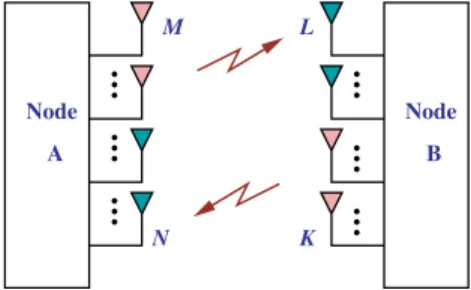
[104,21]. Considering communications between
nodes Aand B in Fig. 12, node Ais assumed to
haveMantennas for transmission andNantennas
for reception, while in nodeBthere areKantennas
for transmission and L antennas for reception.
Different values of M, N, K, L result in various
multiple-antenna systems. If multiple antennas are in the receiver but single channel in the
trans-mitter (i.e., K= 1 , M= 1and either L> 1 or
N> 1), techniques such as antenna diversity and
adaptive/smart antennas can be used for a multi-antenna system. They have been proposed for point-to-multipoint one-hop cellular networks. Antenna diversity is based on the fact that signals received from uncorrelated antennas have inde-pendent fading. Thus, it has high probability that at least one good signal can be received at the re-ceiver. Antenna uncorrelation is usually achieved through space, polarization, or pattern diversity, and the processing technologies for diversity in-clude switch diversity, equal gain, and maximum
ratio combining [104]. When strong interference
is present, diversity processing alone is insufficient to receive signals with high quality. To resolve this issue, adaptive antenna array processing is used to shape the antenna beamform so as to enhance the desired signals while to nullify the interfering sig-nals. The technique for adaptive antenna process-ing is called optimum combinprocess-ing. It assumes that part information of the desired signal can be ac-quired through a training sequence.
Antenna diversity and smart antenna tech-niques are also applicable to WMNs and other ad hoc networks. However, their performance in WMNs or any other ad hoc networks needs more evaluation. Examples of analyzing smart antenna
systems for MANETs are reported in [18,117].
Due to complexity and cost, a fully adaptive smart antenna system is only used in base stations of cel-lular networks. On-going research and develop-ment efforts are still needed to impledevelop-ment fully adaptive smart antenna system in a mobile termi-nal. For WMNs, low-cost is a challenging issue. As a consequence, directional antennas have been actively researched in the area of ad hoc networks. A mechanically or electronically steerable or switched directional antenna system can be tuned to a certain direction. By using directional trans-mission, interference between network nodes can be mitigated and thus, network capacity can be
im-proved[124,118]. Directional antenna can also
im-prove energy efficiency[123]. However, directional
antennas bring challenges to the MAC protocol
design [144,105,82,36].
If multiple antennas are in the transmitter and
single antenna in the receiver, i.e., N= 1 , L= 1
and either K> 1 or M> 1, antenna diversity or
smart antenna cannot be applied unless the chan-nel state information (CSI) is available. However, usually partial information of channel state is available at the transmitter. To achieve diversity under this situation, a commonly used technique
is space–time coding (STC) [12], where signals
transmitted at different antennas in different sym-bol periods are processed with a certain coding technique. The received signals are then combined at the receiver through an appropriate algorithm such as maximum likelihood detection (MLD). STC is a promising technique that achieves second order diversity without bandwidth expansion
..
.
..
.
..
.
..
.
..
.
..
.
Node A M N L K Node B[104]. To date, if CSI is not available, no solution has been developed yet for smart antennas at a
transmitter. Schemes such as[35]still assume that
CSI is perfectly known.
If multiple antennas are in both the transmitter
and the receiver, i.e.,M> 1 ,L> 1 orK> 1 ,N> 1 ,
the multiple-antenna system is an MIMO system, where both diversity and simultaneous transmis-sions exist. Thus, MIMO can potentially increase the system capacity by three times or even more
[94]. Currently MIMO is being adopted into IEEE
802.11n[64]. Depending on where the MIMO
pro-cessing is placed, MIMO systems can be catego-rized into three types: receiver processing only, transmitter processing only, and both transmitter and receiver processing MIMO systems. The pro-cessing techniques can be based on maximum like-lihood detection (MLD), vertical Bell Lab Layered
Space–Time (V-BLAST) [51], singular value
decomposition (SVD)[13], and space–time coding.
So far only few results have been reported on the research of applying STC and MIMO to WMNs as well as other ad hoc networks.
Since multiple channels are usually available in the frequency band of a wireless radio, they can be used to increase the capacity. A single-transceiver radio can use different channels by channel switch-ing on the time axis accordswitch-ing to the needs of higher layer protocols. For a multi-transceiver radio, simultaneous transmissions in different channels can be supported. Multiple transceivers can be easily implemented in a base station of cel-lular networks. However, with the concern of cost and system complexity, a wireless radio with multi-ple transceivers has not become a mature tech-nique yet, although IEEE 802.11 chipsets with
multiple transceivers are already available [44]. In
some situations, the system capacity of a network node can be improved by using multiple radios each with single or multiple channels. Since each radio contains both MAC and physical layers, in order to make a multi-radio network work as a single node, a virtual MAC protocol is usually re-quired to coordinate the communication in all
radios[3].
For a wireless network, the frequency band is a very precious resource. However, many of existing allocated frequency bands (both licensed and
unli-censed) have not been utilized efficiently. Measure-ments by the FCC show that around 70% of
allocated spectrum is not utilized[45,89]. In
addi-tion, the time scale of spectrum occupancy can
vary from milliseconds to hours [45]. Therefore,
abundant spectrum is still available for wireless communication. Furthermore, in a large scale ad hoc network, the complexity is beyond human planning, and thus, conventional static frequency
planning becomes impossible [96]. To achieve
much better spectrum utilization and viable
fre-quency planning, frefre-quency agile[97]or cognitive
radios [89] are being developed to dynamically
capture this unoccupied spectrum. The FCC has recognized the promising future of this technique and pushes to enable it to a full realization. In order to implement cognitive radios, software de-fined radio (SDR) is one of the most convenient
platforms [46] because programmability exists in
all components of a radio such as programmable RF bands, channel access modes, and channel
modulations[102]. SDR is not a mature technique
yet, although testbeds are available now [139].
However, for the long term, SDR will be a key technique for wireless communications. It cannot only realize the cognitive radios, but can also eas-ily implement all other advanced physical tech-niques such as adaptive modulation and coding,
MIMO system [139], controller for smart and
directional antennas, multi-channel radio, and multi-radio systems.
7.2. Open research issues
Open issues in the physical layer are twofold. First, it is necessary to further improve the trans-mission rate and the performance of physical layer techniques. New wideband transmission schemes other than OFDM or UWB are needed in order to achieve higher transmission rate in a larger area network. Multiple-antenna systems have been re-searched for years. However, their complexity and cost are still too high to be widely accepted for WMNs. An example of low-cost directional
antenna implementation is reported in [76].
Fre-quency agile techniques are still in the early phase. Many challenging issues need to be resolved before
Second, to best utilize the advanced features provided by physical layer, higher layer protocols, especially MAC protocols, need to be carefully de-signed. Otherwise, the advantages brought by such physical layer techniques will be significantly com-promised. For directional and smart antennas, many MAC protocols have been proposed for ad
hoc networks [144,105,82,36]. A MAC protocol
for MIMO systems is studied in [126]. However,
for multi-antenna systems, an efficient MAC pro-tocol to achieve significant throughput improve-ment is still needed, as will be discussed in Section 8. Communication protocols for cognitive radios remain an open issue. Significant research efforts are needed to make cognitive-radio based WMNs become practical.
8. MAC layer
MAC protocols for WMNs have the following differences compared to classical counterparts for wireless networks:
• MAC for WMNs is concerned with more than one hop communication. Classical MAC proto-cols are limited to one-hop communication while the routing protocol takes care of multi-hop communication. This assumption makes protocol design easier, since MAC and routing are transparent to each other. However, this method does not work well in WMNs, because data transmission and reception at a node is not only affected by nodes within one hop but within two or more hops away. The hidden-node issue in a multi-hop wireless LAN is such an example.
• MAC is distributed and cooperative and works for multipoint-to-multipoint communication. In WMNs, no centralized controller is available. The MAC function is accomplished in a distrib-uted way, i.e., the MAC protocol must ensure all nodes to cooperate in transmission. In addi-tion, any network node with mesh networking capability is able to communicate all its neigh-boring mesh nodes. Thus,
multipoint-to-multi-point communications can be established
among these nodes.
• Network self-organization is needed for the
MAC. MAC protocol should have the
knowl-edge about network topology which can help better cooperation between neighboring nodes and nodes in multi-hop distances. This can significantly improve the MAC performance in a multi-hop environment. In some circum-stances, network self-organization based on power control can optimize network topology
[91], minimize the interference between
neigh-boring nodes, and thus, improve the network capacity.
• Mobility affects the performance of MAC. Mobility dynamically changes network con-figuration, and thus, may significantly impact the performance of the MAC protocol. In order to be adaptive to mobility or even to
utilize the mobility [130], the network nodes
need to exchange network topology infor-mation.
These differences must be considered in order to design a scalable MAC for WMNs.
The scalability of WMNs can be addressed by the MAC layer in two ways. The first way is to en-hance existing MAC protocols or propose new MAC protocols to increase end-to-end throughput when only single channel is available in a network node. The second way is to allow transmission on multiple channels in each network node. In the fol-lowing, existing single-channel and multi-channel MAC protocols are studied separately. Since IEEE 802.11 is a widely accepted radio technique for WMNs, most of the following discussions are fo-cused on the IEEE 802.11 MAC, i.e., CSMA/CA with RTS/CTS.
8.1. Single-channel MAC
There are three approaches in this case:
• Improving existing MAC protocols. Currently several MAC protocols have been proposed for multi-hop ad hoc networks by enhancing
the CSMA/CA protocol[27,116]. These schemes
usually adjust parameters of CSMA/CA such as contention window size and modify backoff procedures. They may improve throughput for
one-hop communications. However, for multi-hop cases such as in WMNs, these solutions still reach a low end-to-end throughput, because they cannot significantly reduce the probabil-ity of contentions among neighboring nodes. As long as contention occurs frequently, whichever method is taken to modify backoff and contention resolution procedures, the end-to-end throughput will be significantly reduced due to the accumulating effect on the multi-hop path.
• Cross-layer design with advanced physical layer techniques.Two major schemes exist in this cat-egory: MAC based on directional antenna
[82,36] and MAC with power control [112].
The first set of schemes eliminates exposed nodes if antenna beam is assumed to be perfect. However, due to the directional transmission, more hidden nodes are produced in this case. Thus, new solutions must be developed to reduce the number of hidden nodes. Moreover, MAC protocols based on directional antennas also face other difficulties such as cost, system complexity, and practicality of fast steerable directional antennas. The second set of schemes is developed for the purpose of reducing power
consumptions [33,147,131]. These schemes
reduce exposed nodes problem, especially in a dense network, and thus, improve the spectrum
spatial-reuse factor in WMNs [2]. However,
hidden nodes still exist and may become worse because lower transmission power level reduces the possibility of detecting a potential
interfer-ing node[72].
• Proposing innovative MAC protocols. In order to fundamentally resolve the issue of low end-to-end throughput in a multi-hop ad hoc envi-ronment such as WMNs, innovative solutions are necessary. Determined by their poor scala-bility in an ad hoc multi-hop network, random access protocols such as CSMA/CA are not an efficient solution. Thus, revisiting the design of MAC protocols based on TDMA or CDMA
is an important research topic[78,134]. To date,
few TDMA or CDMA MAC protocols have been proposed for WMNs. This is probably because of two factors. One is the complexity and cost of developing a distributed and
coop-erative MAC with TDMA or CDMA. The other is the compatibility of TDMA (or CDMA) MAC with existing MAC protocols. For example, in IEEE 802.16, the original MAC protocol is a centralized TDMA scheme. A distributed TDMA MAC for IEEE 802.16 mesh is still being researched. In WMNs based on IEEE 802.11, how to design a distributed TDMA MAC protocol overlaying CSMA/CA
is an interesting but challenging problem [134].
For distributed TDMA or CDMA MAC proto-cols, network self-organization based on topol-ogy control and/or power control must also be considered.
8.2. Multi-channel MAC
A multi-channel MAC can be implemented on several different hardware platforms, which also impacts the design of the MAC. A multi-channel MAC may belong to one of the following categories:
• Multi-channel single-transceiver MAC. If the cost and compatibility are the concern, one transceiver on a radio is a preferred hardware platform. Since only one transceiver is avail-able, only one channel is active at a time in each network node. However, different nodes may operate on different channels simultaneously in order to improve system capacity. To coordi-nate transmissions between network nodes under this situation, protocols such as the
multi-channel MAC in[122] and the
seed-slot-ted channel hopping (SSCH) scheme [14] are
needed. SSCH is actually a virtual MAC proto-col, since it works on top of IEEE 802.11 MAC and does not need changes in the IEEE 802.11 MAC.
• Multi-channel multi-transceiver MAC. In this scenario, a radio includes multiple parallel RF front-end chips and baseband processing mod-ules to support several simultaneous channels. On top of the physical layer, there is only one MAC layer to coordinate the functions of mul-tiple channels. Engim multi-channel wireless
LAN switching engine[44]belongs to this
protocol for this type of physical layer platform is still an open research topic.
• Multi-radio MAC. In this scenario, a network node has multiple radios each with its own MAC and physical layers. Communications in these radios are totally independent. Thus, a vir-tual MAC protocol such as the multi-radio
unifi-cation protocol (MUP)[3]is required on top of
MAC to coordinate communications in all nels. In fact one radio can have multiple chan-nels. However, for simplicity of design and application, a single channel is used in each radio. To illustrate typical issues existing in multi-channel MAC protocols, here we explain two
pro-tocols in detail: multi-channel MAC (MMAC)
[122] and multi-radio unification protocol (MUP)
[3].
As far as MMAC is concerned, there are three main functions:
• Maintaining data structure of all channels in each
node. Channels of a node are classified into
three types depending on its status of allocation.
• Negotiating channels during ad hoc traffic indica-tion message (ATIM) window. Negotiations are done through a pre-defined channel known to all nodes.
• Selecting a channel. The criterion is to use a channel with the lowest count of source–desti-nation pairs that have selected the channel. Several problems have not been solved in the
MMAC[122].
• It is assumed that RTS/CTS always work in
IEEE 802.11 DCF. In reality, RTS/CTS is an optional function of DCF, and it may cause a high standard.
• Global synchronization in the network is
diffi-cult to achieve in an ad hoc network with a large number of hops and nodes.
• The channel switching time may be much larger
than 224ls [122]. A larger channel switching
time will significantly degrade the performance
of a multi-channel MAC protocol [3].
• Channel selection criterion based on the lowest
number of source–destination pairs for each
channel is not always appropriate. Using pend-ing packets as a metric to select a channel
achieve better performance[122].
• The MMAC eliminates multi-channel hidden
nodes, but it also generates many exposed nodes because of using RTS/CTS and ATIM/ATIM-ACK (for default channel) procedures.
In MUP, there are multiple wireless network interface cards (NICs) on each node. Channels on all NICs are orthogonal and fixed. The major
functions of MUP[3]include:
• Discovering neighbors. After the discovering procedures, neighbors are classified into MUP-enabled and legacy nodes.
• Selecting a NIC based on one-hop round trip time (RTT) measurements. MUP selects the NIC with the shortest RTT between a node and its neighbors.
• Utilizing the selected NIC for a long period. This period is determined by a random process and in the order of 10–20 s.
• Switching channels. After the random time period, all NICs are measured again through one-hop probe messages. If an NIC has a cer-tain amount of quality improvement than the existing NIC, then it is selected for sending packets.
Several issues still need to be investigated further:
• Hidden node issue is not effectively solved. The channel quality measurement is based on one-hop RTT. However, measurements based on shortest RTT do not guarantee that there exists no hidden nodes. For example, suppose nodes
AandCare hidden from each other and node
Bis a neighbor of bothAandC. Then the same
channel can be selected by nodesAandC. The
RTS/CTS mechanism can be applied to reduce the collision probability in this situation, but it causes very high overhead.
• NIC switching mechanism is not justified.MUP allocates a random time period for each selected NIC. Performance of this scheme cannot be guaranteed, because the time of having the best
quality in a NIC is not randomized but related to the wireless channel characteristics and inter-ference from nodes using the same channel.
• Packet re-ordering is needed after NIC
switch-ing. MUP relies on TCP to handle this issue.
However, this will cause low end-to-end
throughput in a multi-hop network like WMNs. In addition, fixed channel assignment on each NIC also limits the flexibility of MUP.
8.3. Open research issues
To the best of our knowledge, the scalability is-sue in multi-hop ad hoc networks has not been fully solved yet. Most of existing MAC protocols based on CSMA/CA solve partial problems of the overall issue, but raise other problems. Thus, how to fundamentally improve the scalability of CSMA/CA is a challenging problem. A distributed
TDMA MAC overlaying CSMA/CA [134]
ad-dressed one possible solution to this problem. For networks based on techniques other than CSMA/CA, both TDMA and CDMA can be ap-plied to WMNs, if a distributed scheme can be developed to locally eliminate the difficulties of implementing TDMA or CDMA in an ad hoc net-work. Many other interesting research problems related to the scalability issue of ad hoc networks still remain to be solved. When advanced tech-niques such as MIMO and cognitive radios are used in the physical layer, novel MAC protocols need to be proposed to utilize the agility provided by the physical layer.
Due to the differences between WMNs and ad hoc networks, a scalable MAC protocol for ad hoc networks may not be effective to WMNs. In WMNs, mesh routers and mesh clients hold signif-icantly different characteristics such as mobility, power constraints, etc. Same distributed solution may not work for both mesh routers and clients. Thus, a MAC protocol for WMNs must consider both scalability and heterogeneity between differ-ent network nodes.
Some mesh routers in WMNs are responsible for integration of various wireless technologies. Thus, advanced bridging functions must be devel-oped in the MAC layer so that different wireless
radios such as IEEE 802.11, 802.16, 802.15, etc., can seamlessly work together. Reconfigurable/soft-ware radios and the related radio resource man-agement schemes may be the ultimate solution to these bridging functions.
Multi-channel MAC protocols for radios with multiple transceivers have not been thoroughly ex-plored, possibly due to the relatively high cost of such radios. However, as the cost goes down, a multi-channel multi-transceiver MAC will be a rather promising solution for WMNs. To really
achieve spectrum efficiency, a multi-channel
MAC protocol must include the single-channel solution that can fundamentally resolve the scala-bility issue of WMNs. Otherwise, the throughput per node per channel will still be very low. How to apply the innovative single-channel solution to a multi-radio or multi-channel system is another research problem.
Most of the existing research efforts in MAC are focused on capacity, throughput, and fairness. However, many applications need to support broadband multimedia communication in WMNs. Thus, the development of MAC protocols with multiple QoS metrics such as delay, packet loss ratios, and delay jitter is an important topic for WMNs.
Another challenge related to MAC is the imple-mentation, because both software and firmware may be involved when a MAC protocol is to be modified. As an example in IEEE 802.11 MAC, although chipset manufacturers have put efforts to pull up more functions in the firmware into the driver level as software, many timing critical functions remain in the firmware. Such a ‘‘thin’’ MAC solution provides little flexibility in modify-ing MAC protocols. To avoid modifymodify-ing firmware, one approach is to design a MAC without cou-pling with firmware. For example, the virtual MAC protocols do not require any modification in firmware or hardware. However, in some cir-cumstances key functions in the firmware need to be modified in order to significantly improve the performance of the MAC protocol. Changing the firmware is a doable but not a viable solution due to its cost and complexity. A solution to this problem is to choose a more flexible MAC proto-col architecture. To our knowledge, there are
sev-eral IEEE 802.11 chipset manufacturers that have eliminated firmware in their MAC implementation architecture. With such an architecture, a true soft
MAC[134] or even a programmable MAC can be
implemented. When software radios become ma-ture enough for commercial use, more flexible and powerful MAC protocols can be easily developed.
9. Network layer
WMNs will be tightly integrated with the Inter-net, and IP has been accepted as a network layer protocol for many wireless networks including WMNs. However, routing protocols for WMNs are different from those in wired networks and cel-lular networks. Therefore, we focus our study on routing protocols in this section.
Since WMNs share common features with ad hoc networks, the routing protocols developed for ad hoc networks can be applied to WMNs. For example, mesh routers of Firetide Networks
[47]are based on topology broadcast based on
re-verse-path forwarding (TBRPF) protocol [108],
Microsoft mesh networks[101]are built based on
dynamic source routing (DSR) [73], and many
other companies[80]are using ad hoc on-demand
distance vector (AODV) routing[109].
Despite the availability of several routing proto-cols for ad hoc networks, the design of routing protocols for WMNs is still an active research area for several reasons. First of all, new performance metrics need to be discovered and utilized to im-prove the performance of routing protocols. In addition, existing routing protocols still have lim-ited scalability. Moreover, the existing routing protocols treat the underlying MAC protocol as a transparent layer. However, the cross-layer inter-action must be considered to improve the perfor-mance of the routing protocols in WMNs. More importantly, the requirements on power efficiency and mobility are much different between WMNs and ad hoc networks. In a WMN, nodes (mesh routers) in the backbone have minimal mobility and no constraint on power consumption, while mesh client nodes usually desire the support of mobility and a power efficient routing protocol.
Such differences imply that the routing protocols designed for ad hoc networks may not be appro-priate for WMNs.
Based on the performance of the existing rout-ing protocols for ad hoc networks and the specific requirements of WMNs, we believe that an opti-mal routing protocol for WMNs must capture the following features:
• Performance metrics. Many existing routing protocols use minimum hop-count as a perfor-mance metric to select the routing path. This has been demonstrated not to be valid in many situations. Suppose a link on the minimum hop-count path between two nodes has bad quality. If the minimum hop count is used as the perfor-mance metric, then the throughput between these two nodes will be very low. To solve this problem, performance metrics related to link quality are needed. If congestion occurs, then the minimum-hop count will not be an accurate performance metric either. Usually Round trip time (RTT) is used as an additional perfor-mance metric. The bottomline is that a routing path must be selected by considering multiple performance metrics.
• Fault tolerance with link failures. One of the objectives to deploy WMNs is to ensure robust-ness in link failures. If a link breaks, the routing protocol should be able to quickly select another path to avoid service disruption.
• Load balancing. One of the objectives of WMNs is to share the network resources among many users. When a part of a WMN experiences con-gestion, new traffic flows should not be routed through that part. Performance metrics such as RTT help to achieve load balancing, but are not always effective, because RTT may be impacted by link quality.
• Scalability. Setting up a routing path in a very large wireless network may take a long time, and the end-to-end delay can become large. Furthermore, even when the path is established, the node states on the path may change. Thus, the scalability of a routing protocol is critical in WMNs.
• Adaptive Support of Both Mesh Routers and Cli-ents.Considering the minimal mobility and no
constraint of power consumption in mesh rou-ters, a much simpler routing protocol can be developed for mesh routers than existing ad hoc routing protocols. However, for mesh cli-ents, the routing protocol must have the full functions of ad hoc routing protocols. Conse-quently, it is necessary to design an efficient routing protocol for WMNs that can adaptively support both mesh routers and mesh clients. In the rest of this section, we discuss various routing protocols applicable to WMNs and emphasize the open research issues.
9.1. Routing protocols with various performance metrics
The impact of performance metrics on a routing
protocol is studied in [41], where the link quality
source routing (LQSR) is proposed on the basis of DSR. LQSR aims to select a routing path according to link quality metrics. Three performance metrics, i.e., the expected
transmis-sion count (ETX) [39], hop RTT, and
per-hop packet pair are implemented separately in LQSR.
The performance of the routing protocol with these three performance metrics is also compared with the method using the minimum hop-count. For stationary nodes in WMNs, ETX achieves the best performance, while the minimum hop-count method outperforms the three link quality metrics when nodes are mobile. The reason is that, as the sender moves, the ETX metric cannot quickly track the change in the link quality. This result illustrates that the link quality metrics used
in[41]are still not enough for WMNs when
mobil-ity is concerned. Better performance metrics need to be developed, and routing protocols integrating multiple performance metrics are necessary for WMNs.
9.2. Multi-radio routing
In WMNs, multi-radio per node may be a pre-ferred architecture, because the capacity can be in-creased without modifying the MAC protocol. A
routing protocol is proposed in[42]for multi-radio
WMNs. A new performance metric, called the weighted cumulative expected transmission time (WCETT) is proposed for the routing protocol. WCETT takes into account both link quality met-ric and the minimum hop-count. It can achieve good tradeoff between delay and throughput be-cause it considers channels with good quality and channel diversity in the same routing protocol.
In WMNs, multi-channel per radio is another alternative to improve the capacity. For this type
of networks, the scheme proposed in [42] is not
applicable because significant differences exist be-tween a multi-channel node and a multi-radio node as explained in Section 8.
9.3. Multi-path routing for load balancing and fault tolerance
The main objective of using multi-path routing is to perform better load balancing and to provide
high fault tolerance [103]. Multiple paths are
se-lected between source and destination. Packets flow in one of these selected paths. When link is broken on a path due to a bad channel quality or mobility, another path in the set of existing paths can be chosen. Thus, without waiting for set-ting up a new rouset-ting path, the end-to-end delay, throughput, and fault tolerance can be improved. However, the improvement depends on the avail-ability of node-disjoint routes between source and destination.
A drawback of multi-path routing is its com-plexity. Whether or not the multi-path routing can be used for WMNs needs to be investigated depending on applications. Another problem is that multi-path routing is infeasible if the shortest path is taken as the routing performance metric. Unless a large number of shortest paths are se-lected, load distribution is almost the same as
sin-gle shortest path routing[50]. Thus, how to design
an effective multi-path routing protocol with appropriate performance metrics is an interesting research topic.
9.4. Hierarchical routing
Numerous hierarchical routing protocols [17,