C55 Doc. 1101-TM059
Progrmng. Ref. Manul~ (DT55) 10/31/79
System Programming Reference Manual
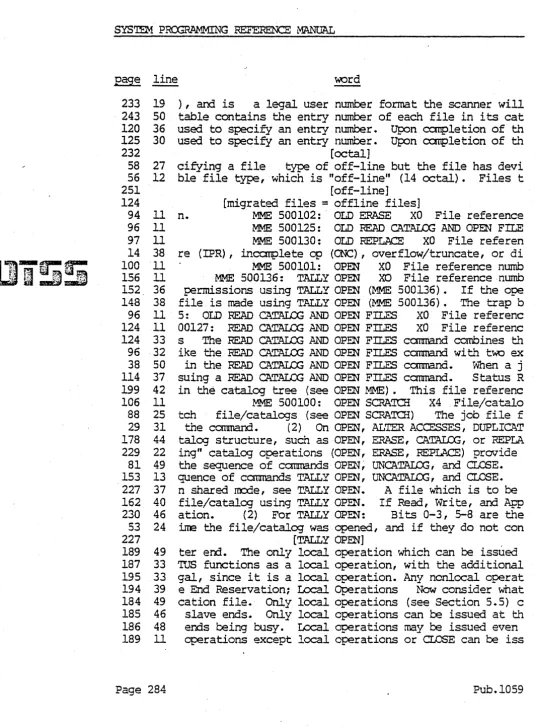
This document contains information necessary for system
title System Programming Reference Manual
authors S. Garland A. Dwyer .
E.
Pet:PerA.
Colvin N. Bourbakipublication number 1059
date 31 OCT 79 (revision 1)
category System Management - Programming
supersedes
DTSS
Programming ReferenceManual,
'IM059 (1 OCT 74)related dccuments ~ Reference Manual, Pub .. 1077
File Access
and
Protection, Pub.l102Description of File System and Job Trees, Pub. 1335
System Managa~t Publications List,
Pub.1350
A FOstage-paid remarks form is included at the end of· this manual for your convenience. Information aOOut publications may be
found in the Publication Price List and Publication Abstracts, of which single copies may
be
obtained free of charge.The named authors ~ld like to thank the many 1 many p:cple who
have au~,ored, prepared, or worked on the various parts of t.~is
manual. Large portions of this manual cane directly fran the superseded edition by S. Garland an::1 A. Dwyer.
SYSTEM PRCGRAMMING REE'ERENCE MANUAL
Contents
Chapter 1 - JobjExecutive Interface •
• • 91.1 Running in Slave Mode • •
10
10
10
10
1.1.1 Base Address Register
1.1.2 Timer Register •
1.1.3 Input and Output (I/O)
1.2
Job
toExecutive • • •
1111
11
12
1.2.1 Leaving Slave Mode • • • • •
1.2.2 Transparent Interrupts •
1.2.3 MME
Faults; Executive
calls1.3 Slave Fault Vector
13
1.3.1
1.3.2
1.3.3
1.3.4
1.3.5
Slave Fault Procedure • • • •
Slave Faults • • . • • • •
Sirrulated Slave Faults •
Special Lccations • • •
Parity Faults; Execute Faults
14
14
15
15
15
1.4
Executive
toJob
16
1.4.1 Traps
16
1.4.2 Special Interrupts. • • • • • •
17
1.4.3
Special Interrupt Stack
171.4.4
Special Interrupt Procedure • • • •
181.4.5 Saved Special Interrupts. •
19
1.4.6 Bouncing Special Interrupts
19
1.4.7 Special Interrupt Pair Format
19
1.4.8
Types of Special Interrupts
20
1.4.9 Simultaneous Traps and Special Interrupts
22
1.4.10 Typical Trap-Handling Code
1.4.11 1.4.12
Ordering of Simultaneous Traps
Traps fran
SqueezedM:Xie
Chapter
2 -Specifications for Executive Commands
2.1
Nontrapping Executive Ccnunands
2.2
Trapping Executive Commands
2.3 Trap Block Format
2.4 SllIIlIIarY
of Status Returns
Chapter
3 -Nontrapping Executive Commands
CLCCK
MTE ENABLE
JOB TIME I.al; PAUSE MEMJRY REOOEST PAUSE
PURE
RtNNING TIME SET TIMER • SClJEEZE
TERMINATE
TIME
OF
DAY •TTh1E S:m:::E BCOrI.OAD
Chapter
4 -Trapping Executive Commands
Page 4
ALTER ACCESSES CATAI.CG
CEAN:;E CATAI.CG ENTRY
CEAN:;E CATAI.CG MAX
reG •
OLD ERASE •
OLD READ CATAI.CG AND OPEN FILES
OLD REPLACE • OPEN
OPEN SCRAroI
GVEm.AY • PASS
PROVIDE DEVICE ADDRESSES
READ
READ CATALCG
READ CATALCG AND OPEN FILES REPLACE •
RECUEST STATUS RESEr STATUS
RW • SCPATal • SET POINrER • TALLY CATAI.CG •
TALLY ERASE TALLY OPEN TAILY REPlACE •
TRUNCATE ONCATALCG • WRITE •
Chapter 5 - Ccmmunication Files
5.1 COPYCcmmands •
5.1.1
.5.1.2
5.1.3
Slave
End copyCcmmands
Master End COPY ·Ccrnmands The "No-Tr aplt Cption •
5. 2 Non-OJPY Ccmmands
5.2.1
5.2.2
5.2.3
5.2.4
5.2.5
5.2.6
5.2.7
RECUEST STAWS· (Master End) RECUEST STATtJS
(Slave
End) DRIVE (~.aster End)DRIVE
(Slave
Em)TRI..u.""'1CATE, SCRA'ICE, and SET FOINrER
(Slave
End Only)PASS and CLCSE • RESEr STATtJS •
5.3 Creation
andDestruction
5.4 Reserving the File
5.5 Busy States
andReset Status
5.5.1 Slave End States • .
5.5.2 Master End States
5.6 Usage Example • • • • • • •
. .
• 182
• • 184
• 186
• • 187
• • 189
191
5.6.1 Creating a Ccmmunication File
• 191
5.6.2 REQUEST STATUS from a Slave
End •192
5.6.3 PASS at a Slave
End . . .192
5.6.4 COPY
Conm3ndwith No-Trap Option • •
• • 193
5.6.5 Aborted
COPY andBreak Drive • • • • •
• 194
5.6.6 Slave End Reservation; Local Operations ... 194
5.6.7 Master
EndDRIVE • • • • • . • • •
•
1965.6.8 Illegal Actions • • • • • • • • • •
196
5.6.9 Destroying the File • • • • • • • •
1975.6.10 Passing Back a CcmmunicationFile
• • 197
Chapter
6-Device Files
. . . .
.
.
.
.
. .
. .
• 1996.1 General Information
andRestrictions
6.2 Device Drives .. • • • • • ••
6.3
6.2.1 Single Action Drives
6.2.2 Drive
withLCd's.
Device Status
Returns ..
.
.
.
199
/
204
• • • 205
• • 207
• • 210
• 211
• 212
• 213
6.3.1
6.3.2
6.3.3
6.3.4
6.3.5
6.3.6
6.3.7
6.3.8
Console
Card Reader
Card.
Punch •Printer
. .
.
.
.
. • • 214
Tat:e • • • • • • •
• • • •
Disk • • • . •
Microprogrammed Peripheral Controller
716 Front
EndProcessor
6. 4 S
imula ted
Status Returns6.5 Special Programming Considerations
Page 6
• 215
217
219
• 220
221
· 222
SYS'IEM PRCGRAMMING REEERENCE MANUAL
6.6 Executive Error
Recove~l• • • . • • . • . • • . . 225
Chapter 7 - Shared Files
.
.
.
.
.
.
.
. .
. .
.
.
.
227
Chapter 8 - Tally Operations
8.1
General Parameters
8.2
Scanner Conventions •
8.3 Status Returns
Chapter 9 - Catalog
Structure9.1
Introduction
9.2
Definitions • .
9.3 Physical
Organization •
9.3.1 Device
Addresses
(DA'S) 9.3.2catalogs • • • •
9.4
Slave Accessible
I~orrnation9.4.1
catalog
headers • • • 9.4.2 Logical Descriptors9.5 Quotas and Storage Limi tations
9.5.1
catalog quotas •
9.5.2Job
quotas . • •229
• 230
• 231
• • 235
237
237
• • 238
• 240
. • • • • • • 240 • • • • 242
• • 244
244
• 247
• 252
• 252
• • 253
Chapter 1
JobjExecutive Interface
wl1en a slave job is in execution, it has full control of a processor in slave rrode and may perform any legal slave nx:de operations, as described in the "Honeywell 600/6000 Programming Reference Manual II • Whenever a prccessor leaves slave m:::;de, the
Executive gains control.
A slave job may enter the Executive in various ways: it may request service from the Executive, it may execute an instruction that faults, or sane external event (such as a physical I/O
operation completing or timer running out) may cause the Executive to suspend the job. Executive entries that are not caused by a job are invisible to a job; when it resumes
execution, nei ther its merr.ory nor its environment will be
changed.
The Executive conveys information to a slave job by the following means:
faults
traps
interrupts
indicating that the job e..xecuted an instruction ~,at faulted
indicating that asynchronous operations have completed
usually indicating that another slave job wishes to carmunicate wi th this job
This sketchy description covers the entire interface be~Heen the Executive and a slave job, wi th the exceptiqn of special
SYS'lEM PRCGRAMMING REEERENCE MANUAL
do with system startup). We now consider this interface in more detail.
1.1 Running in Slave MOde
A job actually running (executing instructions) is not affected
by. the Executive I except
as
noted here.1.1.1 Base Address Register
The base address register (BAR) limits
memory
references by the slave job. The base p:>rtion of the register is set according to the location of the job in main rnenory, and may be reset by the Executive at any tim: that the job is interrupted (is notactually executing instructions). The length p:>rtion is set according to the length of the job, and changes only when the job issues a MEMJRY _ REQUEST call (on a MME faul t,
as
descri1:edbelow) •
1.1.2 Timer Register
The timer register is set according to the needs of the
Executive, and may change any tine the job is interrupted. The slave job &,ould not t.~erefore dep:nd on the setting of the timer register.
1.1.3 Input and Output (I/O)
An I/O activity requested by the jcb may proceed concurrently with its execution. (I/O is requested with Executive calls, as described eelow.) A slave job should not re-use
an
I/O buffer until it has been notified by the Executive (by means of a trap) that the previously requested I/O has t:e€n canpleted on that Cuffer.1 - JCE/EXEaJrIVE INIERFACE
1.2 Job to Executive
1.2.1 Leaving Slave Mode
The Honeywell 600/6000 hardware provides two general methods for leaving slave mode: I/O interrupts and faults. I/O interrupts cannot be generated by a prccessor in slave nx:de. Certain types of faults can be generated deliberately by a slave job; other
types are due to outside causes. The action taken by the Executive will depend on the type of interrupt or fault, and
FOssiblyon the state of the job's registers "and main meIOOry when the faul t cccurs.
1.2.2 Transparent Interrupts
Certain types of interrupts are normally transparent to a slave job. That is, the job is restarted after the interrupt wi th all its memory and working registers (including the instruction counter or IC) preserved, so that it need not even 1:e aware that the interrupt cccurred. Included in this category' are all
connect faults, timer runcut faults, and startup and shutdown faults. These events are not completely undetectable by the slave jcb, though. Any tim: a job is interrupted, including transparent interrupts, the Executive may take advantage of its opportunity to give a pending trap, slave fault, or special
interrupt (cf. Section 1.4). It may also m:dify the BAR or timer register as previously described.
If it is imperative to the slave job that not even these events cccur, it may prevent all transparent interrupts by the use of the inhibit bit. This hardware feature prevents any of the transparent interrupts fran occurring. care shoold be taken, however, to insure that the inhibit bi t is not used Irore than is absolutely necessary • Excessive use of the inhibi t bi t has the following disadvantages:
(1) If the slave job executes inhibited cede for too long, a lockup fault is generated. This fault may cccur in the middle of the execution of one machine instruction I
SYS'IEM PFCGRAMMING REEERENCE MANUAL
(2) Excessive use of the inhibit bit prevents the Executive from recognizing I/O interrupts as quickly as possible, thus slowing down the rate of I/O activity am reducing the total eff~ciency of the time-sharing system.
1.2.3 MME Faults; Executive Calls'
A slave job may request certain services from the Executive by generating a MME (master mode entry) fault.' The address field of
the instruction causing the fault contains a code for the type of call,. and the job's registers and merrory contain any additional parameters necessary. The specifications for the valid calls are contained in Chapter 2, IISpecifications for ExecutiveCormnandsn
•
Executive calls are of three types: nontrapping, trapping I and
tra~ing with autanatic pause. The action requested by a nontrapping call is performed tefore ~,e slave job regains
control. From the point of view of . the slave job, its action is instantaneous. This action may include modification of the slave job's registers or memory, as described in the specifications. Except for such modifications, a nontrapping call
is
essentially a transparent interrupt.Trapping calls also function as transparent interrupts. However, after a trapping call has been issued and the. slave job has
regained control, the action mayor may not be complete. A trapping call must specify a trap address in X6 at the time of the MME fault. wnen the action is complete, a trap (described in Section 1.4) occurs to that address in the slave job's rnerrory
area.
Trapping calls wi~~ the automatic pause feature share features of trapping and nontrapping calls. The calls are set up much like a trapping calli e.g. a trap address is necessary, but a pause for one interrupt is assumed at the tirr.€ of the' call. This feature may make the call look much like a ncntrapping call. It is considered geed prcgr arnming technique, however, to check to make
sure that the particular trap for the current MME was returned, even after the autanatic pausing type of Executive calls.
1 - JCB!EXECtJI'IVE INrERFACE
If a, jcb is in squeezed m::de, or if the address field of the MME instruction does not specify a valid call, or if the trap address for a trapping call is zero, negative, or out of munds, the MME fault is returned to the slave job as a slave fault (see below) . The upper three bits of the cede for a valid Executive call are always 101 to reduce the chance of an undebugged job accidentally generating and issuing a valid Executive call.
1.3
Slave Fault VectorThe first 40 (octal) words of a slave jobl
s rnerrory form its slave fault vector. This area is divided into two-word fault cells, one for each of the sixteen types of faults described in the , "Honeywell 600/000 Programming Reference Manual". Sane of these
cells are used for special purposes by the Executive, while
others are used for slave faults. The position of the individual cells within the slave fault vector corresponds to ~he hardware-defined locations in the master m::de fault vector. They are·:
Lccaticn Use
o
initial entry poin~special interrupt tally 2 memory fault4 MME fault
6 fault tag fault
10 CRIJ tim:r runcut fault
12 ccmmand fault
14 DRL fault
16 lockup fault
20 special interrupt
22 unused (reserved)
24 illegal procedure fault 26 incomplete op fault
30 unused
32 overflow/truncation fault
34 divide check
SYS'IEM PFCGRAMMING REE'EREl'l:E MANUAL
1.3.1
Slave Fault ProcedureWhen certain faults occur, they are returned to the slave job which generated them as slave faults. To
give
a slave fault, the Executive stores the job's Ie (instruction counter) and IR(indicator register) registers at the time of the fault in the first word of the appropriate fault cell in the slave fault
vector. The job's Ie is reset to point to the secor:d word of the fault cell.
If the first ~rd of the fault cell
was
zero before the IC/IR were stored, then control is transferred to the second word oft.~e fault cell. However, if it was nonzero, the job had a "di~ty
fault vectorff
and is al:orted; that is, it is suspended, and the job which ran it is notified by a trap that the job had a dirty fault vector. The supra job then has the option of continuing or terminating the aborted slave job. This feature is intended to prevent an undebugged job fram looping indefinitely due to a fault in its fault precessing routine.
1.3.2 Slave Faults
w'"henever a memory, fault tag I DRL, lockup, illegal precedure
(IPR) , incomplete cp (OOC), overflow/truncate, or divide check fault occurs, it is returned as a slave fault4 Command faults are normally returned as slave faults. However, if the job in question is highly privileged (enabled) it may use a corrmarrl fault to request an al:::ort of the entire system (see ENABLE MME) • This feature is to allow certaL~ high-level slave jobs to request a system aJ:ort in case they detect a serious error. Camnand faults
are
generatedwhen
a privileged (master mode) instruction is executed in slave rrxXie.~ faults normally indicate Executive calls. However, if the job generating t.~e MME is in squeezed roc:de (entered by the
Executive call SQUEEZE) I if the address field of the instruction
causing the fault does not specify a valid Executive call, or if the trap address specified for a trapping call is zero, negative, or out of tourrls, the MME fault will be returned as a slave
fault.
1 - JCB/EXEaJrIVE lNIERFACE
1.3.3 Simulated Slave Faults
~ software-simulated timers are available to a slave job. A run-time timer is set by the Executive call SET TL~, and a real-time (elapsed time) timer is set by the Executive call CLCCK. Both these calls are nontrapping.
As soon as possible after either of these timers has counted down to zero, the timer is disabled and a slave fault is given. A timer runcut fault is returned if the run-time timer counts to zero, and an execute fault is given if the real-time timer runs out. Either of these simulated faults may cause the job to be
amrted for a dirty fault vector. The s imula ted faults are the only slave faults given in these fault cells; neither the
hardware timer runout nor execute faults are returned as slave faults.
1.3.4 Special Lccations
The shutdown and connect fault cells have special uses in the slave fault vector. 1N:>rd 0 (the first word of the shutdam fault cell) is the ini tial entry FOint to the job. When the job is first run, its Ie is set to zero. Word 1 (the secorrl word of the shutdown fault cell) is the job's special interrupt tally word. The co~nect fault cell is used as the special interrupt cell. Special interrupts are descri1:ed in detail in Section 1.4.
The pari ty fault cell is not currently used, and is reserved for future use. The startup fault cell is not used by the Executive 1
and is available to the slave job, if it wishes to use it .. 1.3.5 Parity Faults; Execute Faults
1.4 Executive to Job
In addition to slave faults, the Executive also communicates with the slave job by using traps and special interrupts.
1.4.1 Traps
A trap occurs whenever the action requested by a trapping
executive call
is
canpleted, or when itis
terminated prematurely by an error or invalid parameter. A trap addressis
specified when the callis
issued. This address is the start of a block of at least four words in the slave job J s merrory. wl'len the trap isready to "spring", the Executive, at its first opportunity, stores two words of status information in the first two words of this block. The job's current IC and
IR
are stored in t.'e third word of the trap block (the return MJrd) , andits
IC is reset to point to the fourth ~rd. (This procedure should be compared wi th the similar procedure used to give a slave fault.) The fourth ~rd shculd contain the 1:eginning ofthe.
slave job's trap proc"essing routine. Bits 9-17 of the first status word always contain a status code indicating whether the operation was completed successfully, and if not, why not. Ot.i1er fields give rrore detailed information. A precise description of the ~~statusfMJrds is given in Section 2.3.
The following sequence of events cccurs when a slave job is trapped upon completion of a trapping command:
(1) Execution of the slave job is suspended;
(2) Two words of status information are stored in the first two words of the trap block pointed to by the slave job IS X6-register when the command was issued;
(3) The Olrrent value of the slave job's instruction
counter
(Ie)
and indicator register(IR)
are stored in the third word of t.~e trap block; and(4) The slave job is restarted at the fourth word of the trap block.
1 - JCB/EXECUl'IVE INTERFACE
A trap block may contain any sequence of instructions starting in the fourth ~rd. This trap routine should end with an RET
instruction whose address field points to the third word of the block in order to resume execution of the code interrupted by the trap.
It is possible for the time between the issuance of a command and
the resulting trap to vary considerably. Sane traps may occur irmnediately and m:>re than one trap may occur at once. A prcgram which exi
ts
frem each trap routine by a RET instruction will encounter all traps in·the order in which they cccurred; it will also encounter all traps before encountering any specialinterrupt which cccurred at the same time as the traps. Note, however, that ccmnands are not necessarily trapped in the same order in which they were issued.
1.4.2 Special Interrupts
A special interrupt is used by the Executi v~ to notify a job of
some
event o~,er than the completion of a trapping Executive call. A job will receive special interrupts only if its special interrupt tally ~rd (~rd one) is not zero. If the word is zero, the job is not accepting specials. In this case, any special interrupts which would be given to the job are either discarded or l:ounced to a job higher in the job tree, depending on the origin of the special interrupt (see Section 1.4.6).1.4.3 Special Interrupt Stack
If a job is accepting specials, the special interrupt tally word (word l) contains a tally p::>inter to the job I
s
special interruptstack. The tally word is typically generated by using the ~
pseudo-operation TALLYD, as in:
SPTAL:TALLYD S~..CK,NlJMEER,2 SPECIAL INrERRUPT TALLY
which will fit in the stack, and the "2ft refers to the length of a special interrupt pair. The last field need not be set, but most programmers find it convenient to do so.
1.4.4 Special Interrupt Procedure
At its first opportunity after a special interrupt is generated (caused), the Executive will do the following:
(1) If the job is not accepting Sl=€Cials (the special interrupt tally ~rd is zero), the special is discarded or J1oounced" , an::l the procedure is canplete. A special interrupt on a slave end of a canmunications file can be "oounced" to a higher slave end which is accepting special interrupts.
(2) Otherwise, any p:n::1ing roadblocks on the job are released (see the description of the PAUSE call in c.'apter 3).
(3) If the tally field (bits 18-29) of the special interrupt tally ~rd is zero, indicating ~~at the special interrupt stack is full, the special interrupt is "saved" (see below) ,
and
the procedure terminates.(4) Otherwise, if the address field (bits 0-17) of the special interrupt tally ~rd points out of bourrls (outside the job's rnem.::>ry) , the special is discarded, and the prccedure ems. (5)
Two
words of special interrupt data (special interrupt pair)are stored in the special interrupt stack. The address field of the tally ~rd is incrertented by two, and the tally field is decremented by one.
(6) If v.ord 20 (the first ~rd of the slave connect fault cell) is zero, a slave connect fault is simulated. If word 20 is nonzero, no fault takes place. No dirty fault vector aborts are generated. This feature can
be
used to prevent a slave job from receiving a special interrupt (connect fault) while it is executing its special interrupt service routine, if the slave job dces not clear word 20 until the erd of its special handling routine.1 - JOB!EXEa1I'IVE INTERFACE
1.4.5
Saved Special InterruptsIf the jcb I s special interrupt stack is full (the tally field of
the tally word is zero) in step 3 above, the special interrupt pair will be saved by the Executive ar:d given to the job as scan as the tally field becomes nonzero. The order of the special
interrupts is preserved when each pair is saved. However, once a special interrupt pair has been saved, the special interrupt cannot be oounced. If the job stops accepting special interrupts
(clears the special interrupt tally word to zero) l:efore making' ream in the special interrupt stack, all saved special pairs will
Ce discarded.
1.4.6
Bouncing Special InterruptsOnly special interrupts which are generated by a DRIVE ccrnmand at the master eoo of a camnunication file are l::ounced. The methcd by which the Executive determines which job will recsi ve the SI=€Cial interrupt is covered in detail in Section 5.2.
1.4.7
Special Interrupt Pair FormatThe ~ data words which are placed by the Executive in the special interrupt stack have ~,e following format:
o
13 14
17 18
35TYPE
DATA
FRN - Depending on the type of the special interrupt, this field
may contain a file reference number.
Onspecials generated
by a DRIVE on a communication file, this field contains the
FRNof the em of the ccrnrnunication file held by the job
receiving the special.
Onpassed file and returned file
specials (types
PF and RF),the
Fmof the file passed . or
returned is given here.
Onfile closed specials (type
FCLO)
Ithe FRN of the former communication file end is given
here.
DATA -
The use of this field depends on the type of the special
interrupt. If the special
was
generated by a DRIVE or
CLOSEon a communication file, the lower half of the DATA field
always contains the drive function data (fran the lower half
of the issuing job
IsA-register). Other uses of the
DATAfield are listed below.
1.4.8
~reesof Special Interrupts
~
Mnemonic Use
o
1 RCF
2
3
BRK
Page 20
Set rrode -
used tonotify the master end
job that a slave
endjcb issued a set rrcde
drive (see DRIVE-slave
endin Section
5.2).
The lo.--"'€r half
of DATAcontains
~'emcde.
Read communication file - used
tonotify a
slave end job
thatthe master eoo job
-wishes the slave to issue a
READ. Byconvention
thelower half of
DATAcontains
the length
toread.
(See DRIVE-rnaster
end, Section
5.2.)Slave issued reset - notifies the master
end job that a slave end job issued a
RESET S"rATOSon a
COPY towhich the master
em job had rot yet respJooed.
(See
RESET STATUS,Section
5.2.)Break - notifies a slave end job that G,e
master end
jobhas
issued a break drive.
(See DRIVE-master end, Section
5.2.)4 5 7
10
11
12
PF
RF FCLOITA.
D1 - JCB/EXECUl'IVE Th""TERFACE
Passed File - notifies the job that a file has been passed to i t ~7ia the PASS
cannand. This special interrupt is not caused by the implici t PASS ccrnrrand in the
RON ccrnnand. If DATA is nonzero, the passed file special is due to a "passback" fran an :irran:diate infra-job, and the lower half of DATA contains the FPN of the job file from which the file was passed. Returned file - notifies the job that a file which it passed with the return bit set has rt:JW been returned to it. The
10\a;er half of DATA contains the FRN of the job file to which t.~e file eeing returned
was passed.
File closed - notifies t.~e job that a
ccmnunication file of which it held an em has been destroyed because a CLOSE
was
issued at another er..d. DATA contains the contents of the A-register of ~~e job requesting the close at the time of the close
MME.
Reserved for future use.
Illegal trap address - notifies a job that the Executive attempted to give it a trap, but discovered that the trap address
was
outside the job's rnemJry. The lower half
of rATA contains the illegal trap address. This condi tion can ar ise if Il1E:Irory
containing the trap block is released
with
a MEMORY ~ ccmrand l:efore the trap cccurs.Reserved for future use.
SYS'IEM POCGRAMMING REE'EREl.'rn MANUAL
13
R14
w
15
PS16
T17
SP
Slave issued read - notifies the master
end job that a read-type command was
issued at a slave end. DATA contains the
requested length.
(See slave end COPY
commands, Section 5.1.)
Slave issued
wri te - noti'fies
~,emaster
end
jcbthat a write-type command was
issued at a slave errl. DATA contains the
requested length.
(See Slave end
COpycommands, Section 5.1.)
Slave issued request status - notifies
~~emaster
endjob that a
REQUESTSTATUS was
issued at a slave em.
DATA.contains the
requested length of the status block.
Slave issued truncate - potifies the
master end, job that a
TRIJ"NCATEor
SCRATCHcommand was issued at a slave end.
DATAcontains the requested truncation length
(zero for
SCRATCH).(See
TRL~TE-slaveend only
ISection
5.2.)Slave issued set pointer - notifies the
master end job of a SET POINTER ccrnmand
issued at a slave end. DATA contains the
requested pointer setting. This special
is automatically given to a master end job
when a
copy beor fram a slave end
specifies a starting location pointer (see
copy tt!r1E) •
1.4.9 Simultaneous Traps and Special Interrupts
It is possible for more than one trap, special interrupt, or
slave fault
to begiven to a job each tiIre that job is
inter-rupted. In this case, the traps are linked, with the
Ie
in the
return
~rdof one trap fXJinting to the next trap. It is thus
important that a job
beprogrammed so as always 'to return from
its traps, special interrupts, and slave faults
byissuing a RET
instruction to the appropriate return word. This ensures that if
nore than one trap
1or if a trap
anda
specialinterrupt cccur
sim.ll taneously,
bothwill
beserviced
bythe slave jeb. Even if
1 - JCB;EXECUrIVE INTERFACE
the programmer believes
~~esituation cannot occur, it is still a
goodpractice to return from all traps through the return word.
It typically simplifies program design
andincreases readability
to do so.
1.4.10 Typical Trap-Handling Code (Non-Multiprogrammed)
The following sequence of instructions is a typical way for a
nonmultiprogrammed slave
jobto handle a trapping Executive call ..
It illustrates the use of the return
word.-CHECK: SPRONG: TFAP: EAX6 STZ MME INHIB SZN TNZ
LDXS
MME INHIB TFA LDXO ANXO (MlXO TNZ BSS BSS RET TRAP TPAP+2 (type) SAVE,ON TPAP+2 SPRUNG 1,DU PAUSE RES'IDRE CHECK TRAP=D777,DU
GCOD,IXJ ERROR 2 1*-1
PJint to trap blcck
clear return word as flag
issue trapping Executive call
inhibi t pause routine
check return
~rdif not zero, trap has sprung
load pause count
wait for one trap or interrupt
reset inhibit bit
tonormal
cheek flag again
pick up status word
1mask to status field
check for expected status
go analyze error
remainder of program
~NO
status
w~rdsreturn
wurdreturn immediately from trap
This routine always waits after issuing an Executive call. Note
that the trap routine returns immediately through the return
~rd,
and the main routine checks the status words. The return
~rd
is also used as a flag, since the Executive will not put the
IC/IR into this word until it springs the trap. If Executive
calls are issued
inmany places in a program, it is usually
SYS'IEM PRCGRAMMING REE'EREl\K:E MANUAL
1.4.11 Ordering of Simultaneous Traps
The Executive will link simultaneous traps
andspecials in such a
way that a job which returns through the appropriate return words
(as
alljobs normally should) will encounter first all traps
andsimulated slave faults in the order in which they actually
occurred, then the connect fault (special interrupt) if any,
andthen any slave fault other than simulated slave faults. The job
will thus process all traps before specials. The return word in
a slave fault cell
will always point to the location where the
fault actually occurred.
1.4.12 Traps from Squeezed MOde
When a job running in squeezed rrcde (see
SQUEEZE, MME 500007in
Chapter
3)receives a trap, special interrupt, or slave fault, it
is unsqueezed. The trap or interrupt takes place normally,
excepttL,at the saved IC/IR is relative to the squeezed
BAR,and
has bi t
35(the squeeze bi
t)set on to indicate this fact. Note
that the above sample trap-handling routine cannot
beused by a
job
which expects to be trappedfran squeezed
m::x:1e,since
the RETinstruction .will not "resqueeze" the job.
Chapter 2
Specifications for Executive Ccmmands
The specifications for Executive commands are divided into three sections:
a brief summary of the parameters for
and
the status returns from each ccrnmand;o detailed
specifications
for the nontrapping ccrnmands;o detailed specifications for the trapping camrnands.
As descril:ed in Section 1.2, a slave job issues an Executive carmand by executing a MME (master rrcde entry) instruction with an address field specifying a legitimate ccrnmand; execution of a
MME instruction whose address field does not specirz a legitimate canrnand will result in a MME fault., (A jcb receives a ",!ME fault
by
having the current value of its IC/IR stored in location 4 of its job me.'OC>ry and then having its IC reset to location 5.)There is one exception to this rule: if the address field of the MME instruction is exactly 100 (octal) greater than a ~lalid
trapping MME nt.m1ber I this is equivalent to issuing that MME
followed immediately by a
PAUSE MME
wi~~ a pause count of one. Such MME I S are called 200 series, or pausing MME I s. The contentsof the slave job I S registers ufOn execution of a MME instruction specify parameters relevant to the ccmrand.
Except in the case of a SQ:JEEZE or a ~ cararand, a slave
job will regain control at the location following a MME instruction unless a fault, trap, or special interrupt was
SYS'IEM P:ocGRAMMING RE]iERE:Ol'X:E MANUAL
In the case of trapping commands, the Executive may not have completed processing the command; instead, execution of the corrrnand and of the slave job may continue in parallel, with the slave job being trapped upon ccmp1etion of the command.
Numbers occurring in the specifications of this section can be of tYtO types: octal and decimal. In general, numbers which can occur as the contents of a register are
in
ectal; thus,addresses, status returns, or special interrupt numbers are in octal. Numbers which do notcccur as the contents of a register are in decimal; for example, bit numbers
and
fractions ofmilliseconds are given in decimal.
~
_~.!.! __ t10!l~~"~I!~Hi_~!~~~~!.~c!_ Co 111111 !!!!1:!•
}-J COIllIIICl'ld I1HE '1.0 Xl '1.2 Xl
0 XII )(5 '1.6
'/.', A Q Return
lJ1
1.O
Terminate 50nOOt) Acce!J3
Set Timer SOOOot Time A = old
Running TltRC 500002 bin. A
Time of nay 50000] ASCII AQ
Oale 5000011 ASCII AQ
Puu!le 500005 II
Hellwl~y Ilcque:Jt 500006 llound X5::0 if ok
S'I'ICCZC 50U001 Ie/lUI nAn Ueg:J'
T 1me Slllet! Bootload 5QOO H) bin. A
Pm"e 500011 Fil HI X'/::O if ok
Job Tillie 500012 hi n . A
l. 0 III! PaU3C 500013 U
C loclc 500011i Time A :: old
Unu3cd 500015
lJllu!Jcd 500016
C
,';'-.~'" ;I.,;:~,.~-.r¥G:~.,
m;~al
b'
L'(L.,
.1.~"0 ,2 . ~ ___ ![~~P_!.')lLJ~~£~t:.~~_~01ll1~~~1:! Ul
~
;
(l)
Command HHE XO X t X2 X3 ' X'I X5 X6 X1 A/Q
N
00
500100 Access Pref Trap' .. at HAX
Open Scratch
Open 500101 I'll Cal Hamel Pass· Access Trap' H Slave trap 1. D.
Old [raBe 500102 I'll Cat Hame' Pass' Trap' Slave trap 1. D.
Catalog 50010] fR Cat UaUle l FR I)as!}· Access' Datel Trap'
Uncatalog 'j00 1011 I'll Trap·
Close 50010'j FR Trap· Com file special
Ove"lay 500106 I'll Fl as btts Trap· neg'
Truncate 50010'1 fU Trap' length
~
Scratch 500110 FU Trapl
Change Catalog Entry 5001 11 fll Uame' Pas::}' Access· Oate" Trap·
Era!lc 500112 I'll Cat tj;uIle • Zero fa!}3" Trap ma3k Zero Trap' N Slave trap 1.1>.
Set Po inter 500111 fll Trap' Po1nter
IlHad Catalog 500 I 11, Fll Cat HI' H2' Trap' UI
Ileclucst Statu!} 500115 fU H2· 'TI'ap" N'
Replace 500' 16 Fit Cat Hamel fit Pass· Trap masle Zero Trapl N Slave trap l.ll.
~
Execute 500111 I'll Sur Typo L 1m i Ls l.lsl· Trap' neg' Timel Acc
lIun 500120 FU S<}J' Type l.lmits list' Trap' neg l Timel Acc
~
Continuu 500121 fR Job llrnlts Trap· Time
Pass 500122 I'll Job H:3g1 I'll Access Pref Trap· HI
Alter Accesses 50012] fll Aocess Trap'
Change Catalog HAX 500121, I'll Cat It'ap' Cat HAX
Old Reud Cat & Open 500125 Fil Cat H II H211 Aoce:}s Cod Date Trap' U' Slave tral) I. o.
Provide DAs 500126 FR H21 Trap' U·
Head Catalog & Open 500127 I'll H 11 Ze,"o ti21 Access Date' Trap· N' Slave trap 1. D.
Old Replal:e 5001]0 FU Cat Uamel fR Pa.3s1 Trap' Slave trap I. D.
Copy 5UU1Jl fnl H
,I
fll2 H21 flag bits Trap' U'Drive 5001J2 FU Flag bits T .. ap· function
Head 500t13 I'll H2· Flag h1ts Trap' NI
\Jr'l ta 50011" H 1· FII 1'1 ag bits T.'ap· U'
lle:Jet Status 5001]5 Fn flag bits Trap'
Tally Opeu 5001]6 I'll Cat Tally' Zero FIl Alt Cat Access last Name' Trap· Zero Slave trap I. D.
Tally E.'ase 50013'1 . Fn Cat Tally· Zel"o r:n Alt Cat Trap mask last Namel Trap' Zero Slave trap 1.0.
Tally lleplace 500t'I0 fll Cat Ta 11 y. f"U Fit Alt Cat Trap lOask last Name' Trap· ZtH'O Slave trap I. l) •
·u
Tally Cat.alog 5001'11 fll Cilt Ta 11 Vi Fil fll All Cal Auce3s' last NLimel Trap· natel§.
Log Iluplicate 5001112 5001'1"1 FIf Zero HP lCI'o Zero Ztll'O le,'o Z~ro flag hit:} Acoes!l Zcr'o Ze.'o Trap· l,'ap· Zer'o NJI•
~
0
U1
•
lndleate~ pOillter to \-10,'<1 containing pa.' amete,'2 - SPECIFICATICNS FOR EXEOJI'IVE (X'tylMANLS
2.3
Trap Block Format
o
8 9 17 18 3SStatus
~rd1
Status
~rd 2Return
~rd(Access)
Status
(File ReferenceNumber)
(Length
or
Counts)Ie
IRTrap Routine
Access
(bi
ts 0-8of status word
1)(1) On
access error (status
100),gives
theaccess bit
needed
for successful completion
ofthe
ccmmand.(2) On OPEN, ALTER ACCESSES, DUPLICATE, and REPLACE,
gives the access
wi~~the
file is open or could
have
teenopened.
(3) On RUN, EXEaJI'E and CCNrINtJE,
gives termination
access of infra
job.(4) On DRIVE
with
ocw'
s, givesrecord
countresidue.
(5)Zero in all other cases.
Status (bits 9-17
of
statusword 1)
. rA.ajor
status (see individual trapping EXecutive
camnard2.4 Summary of Status Returns
ALTER ACCESSES
o
Successful
1Partial success
2
File closed
$i2=
Length of file
o
Successful
1
Illegal trap protection
2Duplica te entry
incatalcg
3
File not
ascratch file
4
File preference too low
13
Illegal usage or dates
o
Successful
1
Illegal trap protection
2
Duplicate entry
incatalcg
3File
r~tfound
4
Protection violation
6
Bad tree
name7
Fetch error
12Format error
13
Illegal usage
anddates
14
File preference too low
SW2=
Substatus/character
count andposition {if status is
12}o
Successful
1
File not cataloged
2 DL~licate
file
namefourd in catalog
3
Illegal trap bi
ts13
Illegal usage
anddates
2 - SPECIFICATIONS FOR EXEC!.1rIVE ~
o
Successful
1
Rejected: specified MAX is less
thancurrent
MIX:,CLCSE
o
Successful
6
Communication file
busyCOPY/READ/WRITE/READ CATALCG/REQUEST STATUS/READ CATALCG Al'ID OPEN
o
All words transferred
1
Source file exhausted
2
Destination file exhausted
3 Command
inappropriate for state of ccrnmunication file
4
Source file pointer out- of
bounds5
Destination file pointer out of bounds
6Communication file
busy7
Master end of communication file not accepting special
interrupts
14
State vector full
(REll..D CATALCG AND OPENonly)
SW~=Number of words transferred - number requested
DRIVE
o
Successful
1
Not all data transferred
2
Destination file exhausted
3
Command inappropriate for state of communication file
6Communication file
bUS1·7
Other end of cornrnunication file not accepting special
interrupts
10 Bad CCW
(Drive
Type 24only)
LCG
o
Successful
1
Rejected: log already outstanding
2
No log buffer available
3 Escape
sequence error
OPEN~RASE/REPLACE/rALLY
OPEN/l'ALLY
ERASE!rALLY REPLACEo
Successful
1
Partial success
2
Lockout
3
File
notfound
4
Protection violation
5
Fail
6
Bad tree name
7 Fetch
error
10Off-line file
11
Rejected: specially cataloged files (device files) 'cannot
berenoved fran catalcgs (ERASE
arrlREPLACE only)
12
Format
error (TALLYMMEfs)
S'W2=' Length
of file or catalog
~!AX(zero on
ERASE)or
substatus/character count
andposition
(if status
is
12on TALLY Mo1Es)
OVERLAY
1
Rejected: operation outstar.ding
2
Rejected: file teo long
,
PASS
o
Successful: message, if any, was read
2 Message not readSW2= Number of words
read -number of words in message
2 - SPECIFICATIONS FOR EXECU"TIVE CG1MANI:S
RESET srAWS
o
Successful
1
Reset status already
inprogress
6
Communication file
busy7
Master end of communication file not accepting special
interrupts
o
Jobterminated
1 CRU
limit exhausted
2 Jobat:orted
5
Error in
runlist
6
Swap error;
jobterminated
SW2= CRDs
constnned
by jcbTRIJNCATE/SET POINTER/SCRATCH
o
Successful
1
Length
teolong or f:Ointer
outof l:our:ds
6Communication file
busy7
Master
endof ccrnmunication file not accepting special
interrupts
SW2=
Length of file - length requested
(ifstatus
is 1on
TRUNCATE)o
Successful
Chapter 3
Nontrapping Executive Ccmmands
This chapter contains detailed specifications for all nontrapping
commands
(in alphabetical order; for a list sorted
bynumber, see
Section
2.1).CIcek • •
Date
Enable
Job Time
Long Pause
Memory Request
Pause • • . •
Pure • . • • .
Running
TiTre S~t. Timer •Squeeze . • • .
Terminate • • •
Timeof
Day • •Time
Since
Bcoticad •MME 500014
MME 500004 MME 500017
~lME 500012 MME 500013
MME
500006MME 500005
MME 500011
MME 500002 MME 500001
MME
500007 MME 5000003 - NCNI'RAPPnK; EXEct7I'IVE CQ.1MANDS
MME 500014: CLOCK
A Tim:
The CLOCK ccmrnand enables
a
job to receivean
execute fault (real-time timer runout fault) after a specified amount of real time has elapsed. If no CLOCK canmand is issued, or if a CLOCKconmand with an argument of zero is issued, then no real tim: timer runout fault will cccur. A CLOCK canmand with a nonzero argument sets a real-time timer for the issuing job; ~'is timer decrements continually, and a real time timer runout fault occurs when it reaches zero (if the issuing job happens to be
road-blocked at this time it will be unroadblocked to receive the fault). After a real ti.rre timer runout fault has occurred, the real-time timer is disabled, and no further such fault will occur until a new CLOCK canmand is issued.
Tirre is a 36-bi t integer which is decremented 64 times per millisecond, thus accurate to the nearest 15.625 microseconds.
Since it is r:cssible for a job to be swapp:d out of rne.rrory when its real-time timer reaches zero, the Executive cannot guarantee that a job will be restarted as scan as its real-time timer runs out. It can guarantee only that the job will receive an execute .fault the first time it regains control ,after its real-tL~ timer
runs out.
A job receives an execute fault by having its current Ie and IR stored in location 36 of its job rne.rnory and then having its Ie reset to 37.
w11en a CLOCK carmand is issued, the old value of the job J S
real-t~~ timer is returned to the A-register.
Note: A CLOCK canrrand with a zero argument will not prevent an execute fault from cccurring if a previously set CLOCK has already run dcwn.
SYS'IEM PRCGRAMMING REF. ~.NUAL DATE
MME 500004: DATE
No argtnnents
ENABlE 3 - NONrRAPP:m:; EXECUTIVE CCM-1A..1\lDS
~ 500017: ENABLE
A Desired setting for job type bits rrasked by Q (bi ts 0-8)
Q Mask for job type bits to set or reset (bits 0-8)
The job type of a running job consists of tv;o 9-bit quantities: the perrrdssions allowed for the job and the permissions for which the job is currently enabled.. These permissions are as follows:
Bit Function
o
Monitor permission (affects scheduling only)1 Core Residence permission
2 Large State Vector permission (permits a state vector with nore
than
64 files)3 Special Catalcg· pennission (allows a job to specify infinite catalog MAXes, and to estimate the number of entries when creating a catalog)
4
Load-Dump permission (allows preallocaticn of scratch files)5 Priori ty Scheduling (PW)
6
Crash
(allows slav~ job to abort system)7 leg (allows job to do MME reG)
In
additionthe load-dump
permission suppresses quota checks involving catalcg MAXes, enables the PIDlIDE DEVICE ADDRESSEScarmand, ar.d provides device addresses in the ~.D CATALCG AND
OPEN FILES canmand ..
When a jcb is run, bits 0-8 of index register X3 on the PJJN
comnand are ANDed with the job type bits allowed to the issuing job to form the permissions allcwed to the infra job. The only permissions which are enabled on the run are Large State Vector
SYS'IEM P~.MMING REF. Mn.NUAL
permission, Priority Scheduling, Crash, and Leg; all other permissions must be enabled by the ENABLE ccmrand.
ENABLE
When an ENABLE canrnand is issued, only those permissions
JCB TIME 3 - NONTFAPP:m; EXECUrIVE CCM-1ANDS
MME 500012: JOB TIME
No argt.nnents
The total running tine (CRU's) for the issuing job is loaded right-justified in the A-register; running times for jobs running
below the issuing job are not included in the total. The running tim: is in timer units of 1/64 milliCRIJ. (See also ~'NING
TIME. )
SYS'IEM PRCGRAMMING REF. ~..NUAL r.ax; PAUSE
~ 500013: LONG PAUSE
xs
Number of trapsLC't-X3 PAUSE is identical in effect to PAUSE. LONG PAUSE should be used in place of PAUSE when the issuing job does not expect to
be
. restarted while residing in main m:rrory. For example, it shouldMEMORY REQUEST 3 - NCNTFAPP:rn:; EXECUTIVE CClwMl.NDS
r+!E 500006: MEMORY REQUEST
XS Upper tremory limit
MEMORY REQUEST causes the BAR for the issuing job to be extended or compressed so as to allow a
maximum
valid address of N-l, where N is the least nonzero multiple of 1K (1024 words) greater . t.~an or equal to the specified upper meIlX)ry limit. The new BARwill be in effect when the job regains control. Memory obtained will be zeroed out; memory released is lost.
If the command is successful, then XS will be zero on return. If the requested memory is not available, t.'1en the amJunt that is available will
be
returned inXS
and another MEMORY REQUEST canbe issued to obtain this amount. If a job has previously issued a PURE cannand, then any MEMJRY REQUEST which would release memory containing pure procedure will
be
rejected, and the least amount of memory for which a memory requestwill
succeedwill be
returnedin
Xs.
If the job's Ie is no longer wi ~,in the range of the new BAR after memory is released, then
a
ma~ry fault willoccur.
The axrount of rneIIOry that can be requested by a job is lirni ted by the Olrrent system lirni t on rnaxim..nn rnerrory length and by the memory limit imposed by the supra job in X4 of the RUN or CCNI'INUE ccmnand which ini tia
tea
the job.SYS'IEM PRCGRAMMING REF. MANUAL PAUSE
MME 500005: PAUSE
X5 Number of traps
PAUSE causes the issuing job to be roadblocked until N traps, one
special
interrupt, or one real-time timer runout fault hasoccurred. If an N greater than the number of outstanding
trawing executive connnands is specified, then an N equal to the number of outstanding trapping executive commands will be
PURE 3 - N:NTRAPPING EXECtJrIVE C~
MME 500011: PURE
XO File reference number of source file for pure procedure
XJ Points to length N
A segment of job rnerrory is said to contain "pure procedure" if no location in that segment is ever altered during -the execution of the job. The PURE comnand indicates that the issuing job
consists of pure procedure from word 100 to word
N-l
ifX7
is nonzero ,or that the issuing job contains no pure procedure if y;]is zero. This PURE facility is designed to avoid the necessity of swapping and restoring
common
packages of code.Any
error in the parameters for ~~e PUREcommand
will causethe
carrnand to be rejected and X7 to be nonzero on return. Thelength N must be a multiple of 100 and must be less than or equal to l:oth the current length of the issuing job and the length of the source file specified in XO. The file specified in XO must be q::en wi~~ Read
permission.-If a
PURE
carrnand with a nonzero value inX7
is successful, then a zero will be returned in X7. On subsequent swaps of the job, words 100 to N-l will not be swapped, but will be restored fran the source file specified inXo.
This file will remain busy as long as thePURE
command is in effect.If a job does not issue a PURE ccmmand, it will be assumed to contain ro pure procedure. A job which is running with pure procedure can at any fOint declare itself impure by issuing a
PUBE cannand wi th XJ zero or by issuing a RESET STATUS on the source file for the pure procedure. Ei ther of these two actions will cause subsequent swaps to occur normally
and
will allow access to the source file for pure procedure.Copies to and fran the pure region of a job file will be al:orted if they occur TNhen that job file is swapped out of main rnerrory.
SYSTEM PRCGRAMMING REF. MANUAL RUNNING TIME
~ 500002: RUNNING T~
No arguments
SET TIMER 3 - NCNI'PAPP:m3 EXECGTIVE CCMMANDS
MME 500001: SET TIMER
A Tirre
The SEI' TIMER command enables a job to receive a timer runout fault after a specified amount of precessing. This timer decrements only when ~,e job is actively running or doing
I/O,
and a tim:r runout fault occur s when this timer reaches zero or beccm:s negative. If no SET TIMER caTnlEI1d is issued, or if a SET TIMER carmand wi th an argument of zero is issued, then no timer
runout fault will occur. A SET TIMER command with a nonzero argument
sets
a timer forthe
issuing job. Aftera
timer runout fault has cccurred, the timer is disabled, and no further timer runout fault will occur until a new SET TIMER command is issued.When a SET TIMER canmand is issued, the old value of t..~e job IS
tirner is· returned in the A-register.
When a SET TlMER camnand is issued, the old value of t..i1e job t s
t~~r is returned
in
the A-register.A
job receives a timer runcut faultby
having its currentIe
andIR
stored
in locationlO of its job memory and then having itsIC
reset
to li.SQUEEZE
MME 500007: SQUEEZE
X4
Points to IC/IRX5 BAR
X7
Points to registersThe SQUEEZE command enables a slave job to simulate a master mode prcgram by setting a pseudo base address register. SQUEEZE
causes the BAR for the issuing job to be changed to resemble the BAR specified in XS, where the format of the BAR in XS is as it
~uld
t:e
if the slave job were l:eing executed in master m::de. For example, to squeeze a job so that address 2000 becanesa
andthe upper memory limit is 6000 (i.e. 6000 above the base of 2000), ~~e BAR in X5 would be 002006.
After the BAR has been changed, the registers are loaded by an
LREG
instruction from the location pointed toby X7,
and aRET
instruction is executed through the' specified IC/IR. If a fault, trap, or special interrupt occurs while tl1e job is in thesqueezed m:de, the BAR is unsqueezed and the fault, trap, or
special
interrupt takes place no~ally with bit 35 of the saved IC/IR in the trap or fault cell set to 1.. Thus a. squeezed job can r:ever call the Executive since all MME faults will Cereturned to the unsqueezed job. All Inem:)ry outside of the squeezed BAR is retained and beccrnes available again after the
BAR is unsqueezed.
3 - NCNrRAPPnx; EXECUrIVE Ca.t1ANDS
Mt1E 5 00000 : TEFMINA'IE
X4
Termination access
~TE
causes the termination of the issuing job
andall jobs
running l:elow it. All files open for the job are closed
and,if
the return bit is set in their access, returned to the supra job.
If
the supra job is accepting specials, then a special interrupt
type
5(returned file) is generated for each returned file. Upon
termination, a job's remaining scratch and catalog word
allotments are added
tothe corresponding allotments for the
supra job.
On
a roonal pro:;rarn, the termination access specified in X4
is
returned in bits
0-8of status word
1in the trap for
theRUN
or
CCNTINUE
corrmand which ini tiated the job.
Ona trap pro:;rarn
protecting a catalcged file, the access in
X4 will t:e t.~eaccess
permi tted
for
tJ.'eopened file.
.
SYSrrEM PRCGRAMMING REF. MANUAL TL~ OF DAY
~ 500003: TrnE OF DAY
No arguments
The ASCII tim: of day in the stamard format
· TIME SINCE EO::1rLOAD 3 - NONTRAPPm:; EXECOI'IVE CCM-1ANDS
lvf.1E 500 010 : TIME S:m:::E BcortOAD
No arguments
The
timesince system boatload is loaded tight-justified into the
A..;.register in timer· uni ts of 1/64 millisecond. This time is not affected bythe
operator I s entering,the.
time of day.Chapter 4
Trapping Executive Commands
This chapter contains detailed specifications for all trapping commands (in alphabetical order; for a list sorted by
number,
see Section 2.2) •Alter Accesses
catalog • • • • • • • • c.'1ange catalcg Entry • • Change catalog Max
Close ••
Continue • • • • Copy • •
Drive •• Duplicate • Erase ••
E!xecute • • • • • • • • •
~
....
Old Erase •
Old Read catalog ar:d Open Files • • Old Replace • •
OE=en · · · · • • • ·
Op:n Scratch
OVerlay • • • • • • • Pass •• • •
Provide Device Addresses • • • • Read • • • • • • • • • • •
Read Catalog • • • • • • •
Read catalcg and Open Files •
Replace • • • • • • • • • Request S ta tus • • • • Reset Status
~
...
Scratch • • • Set Pointer • • Tally catalog •
MME 500123 r-!ME 500103
MME 500111 MME 500124
MME 500105 MME 500121
MME 500131 MME 500132 MME 500143
MME 500112 MME 500117 MME 500142 MME 500102 MME 500125
MME
500130MME 500101 MME 500100
MME
500106M-1E 500122
MME
500126MME 500133
MME 500114
MME 500127
MME 500116
MME 500115 MME 500135
MME 500120
MME 500110
Tally Erase .. .. ..
Tally Open ....
Tally Replace .. ..
Truncate
Uncatalcg ...
write .. • .. .. .. ..
Page 52
MME 500137
MME 500136 MME 500140 MME 500107 MME 500104 MME 500134