International Journal Advances in Social Science and Humanities
Available Online at: www.ijassh.com
RESEARCH ARTICLE
What’s Expected of Men in Turkish Culture: Perceptions of Male
University Students
Oznur Bayar*,
Ozlem Hascan AVCI, Muharrem KOC,
Dept. of Educational Sciences,Hacettepe University, Sosyal Bilimler Enstitu, Egitim Bilimleri Bolumu Beytepe.
*Corresponding Author: Oznur Bayar
Abstract
The aim of this study is to examine the opinion of male university students in Turkey about the expectations that are presented from society as men. For this purpose, firstly focus group interviews were conducted with 10 students and some questions were asked to identify how they are considering being men in Turkey. And then as an instrument of the study a questionnaire was designed by researchers, including socio-demographic characteristics and one open-ended question considering the answers given in these interviews. The study group was composed of 206 participants that were selected with the using convenience sampling and snowball sampling. The data gained from participants were analyzed use of content analyzes. In the analyzing process, data is arranged and coded by researchers and themed on the basis of codes and categories that have been identified in themes and then distributions are displayed by frequencies and percentages. Then data were interpreted. According to the results, three themes explain society’s expectations from men: fulfilling various responsibilities about life (282; %44, 69), fulfilling social responsibilities (245; %38, 83) and having essential personal qualities (104; %16, 48). The findings were discussed in the light of the literature and some suggestions were presented.
Keywords:
Gender, masculinity, Male gender role. IntroductionGender is one of the main parts of one’s life experiences [1]. Gender as a term refers to the social and cultural aspects attributed to the biological distinction between men and women. According to Dokmen [2] gender roles represent the traditionally accepted roles related to women and men. Gender is learned, contrary to biological traits. In other words, even though a person had born male or female, she/he learns to become a man or a woman through socialization.
In society, there is implication about gender or stereotypes which were used to differentiate treat girls and boys. By age five, most children have learned how to be boys or girls: to play with trucks or dolls; to wear blue or pink; to strike out or to cry [3]. This forced stereotypic behaviors in childhood, have some permanent effects on one’s life. Concepts of masculinity provide beliefs about how men ought to behave. Young boys in their early ages, reward by their parents and
teachers for conforming to gender-role standards. Playmates congratulate their peers for performing like men. Mentors, teachers or other grown-ups pat them on the back for their ‘masculine’ achievements [4].
traits are universal. Harris [4] explained such, in any country; men were tended to share similar cultural histories, as a result of that they may have received similar notions about how to be like as men. These common understandings of masculinity can evaluate as a result of dominant cultural norms.
Harris [4] emphasized that each man constructs his own identity in relation to specific gender notions in his culture. These notions are embedded within messages with specific configurations that spell out specialized patterns of conduct. To learn this gender role is not enough to acquiesce to routines immediately necessary for its outward performance. A young boy must be initiated into the various cognitive and affective norms appropriate to that role. Each role socially defined the knowledge and a repertoire of acceptable and unacceptable behaviors [4].
The male gender role is social that is a product of social forces with specific forms of masculinity being idealized to the extent that they serve to support social order [8]. According to Douglas [9], too many boys are growing up in a culture that pressures them to suppress their fundamental humanity. In many cultures, challenging the precepts of masculinity is virtually unspeakable.
Turkey has been seen as geographically, historically and culturally bridge between East and West. Historically, this land has been host to many cultures -e.g., Hittite, Greek, Roman, Byzantine, Seljuk, and Ottoman- [10]. This mix shows itself in social values, too. Traditional Turkish culture idealizes masculinity, equating it with activity, power, courage, and competence; it denigrates femininity, equating it with passivity, weakness, cowardice, and inadequacy [11].
Nowadays, one can say that there are many expectations of men. Douglas [9] argued that boys confront deeply conflicting messages about their identities. Rhode [12] argued that according to most research whatever their biological predispositions; children receive strong cultural messages about sex-appropriate traits, tasks, and behaviors. These messages are not intentional, but they often have unconscious, subtle, or indirect signals. For reverse damaging effects of this message, adults have to be become more
aware of their role in the gender socialization process.
One of the most generalized belief about gender is that ‘Gender effects no one but women'. But studies prove that women are not always the losers and men are not always the winners in gender systems. Generalizing these ideas about men and women, risks overlooking gender-specific inequities and vulnerabilities, for example, the power that elite older women exert over younger or poorer women or the influence that elders might have over young men [13] Connell [14] emphasized that patriarchy and gender practices affect the men as well – although not equally – and that it constantly reproduces itself.
Studies of men appear to be a new area which starts to rise with the idea of ‘gender must focus on both sex- male and female-’. Men studies can best be understood as a broad interdisciplinary field of study that provides, in whatever discipline it surfaces, a critical examination of how our concepts of masculinity are influenced by and influence society.
Beginning in the mid-1970s and into the 1980s, some academic departments at colleges and universities began to offer courses focused on men and masculinities. The term “masculinity” came to be pluralized, acknowledging the broad range of ways males are and can be “masculine.” [8]. Masculinity is a combination of social practices and cultural representations associated with being a man. The plural ‘masculinities’ is also expressing the ways of being a man and cultural representations of/about men vary, both historically and culturally, between societies and between different groupings of men within any one society [15].
from society as men were examined. Firstly socio-demographic information was gained from undergraduate and grad school students and then one open-ended question was asked to participants. The question was: ‘What’s expected of men in Turkey?’
Method
Participants of the Study
Participants of this study were selected using convenience sampling and snowball sampling. Firstly, focused group interviews conducted with 10 students by one of the researchers and some questions were asked to identify how they are considering being men in Turkey. And then as an instrument of the study, a questionnaire was prepared by researchers considering answers given at these interviews, including one open-ended question and questions relating to demographic characteristics.
Also, online form was prepared. Total 206 male students were conducted in this study and 53 (25, 73%) of the students who participated in the study, were between ages of ’18-20’, 62 (30, 09%) of them were between ages of ’21-23’, 55 (26, 70%) of them were between ages of ’24-26’, 22 (10, 69%) of them were between the ages of ‘27-29’ and 14 (6, 79%) of them were between the ages of ‘30 and higher’.
As for education level, 152 (73, 79%) of the participants were under-graduate students and 54 (26, 21%) of them were grad school students.
As for the marital status, 111 (53, 88%) of them were reported being single at the time of the research, 71 (34, 46%) of them were romantically involved while 24 (11, 66%) of them were married.
Thus, at the time of the research 134 (65, 05%) participants stated that they were not
currently working at a job. In spite of this, 72 (34, 95%) participants were working.
Collecting data
Data was obtained through a questionnaire which was composed of two sections: the fırst section contained demographic characteristics and the second section contained one open-ended question. The open-ended question administered to a group of students in order to determine what they think/feel as an expectation from a society which was ‘What are the expectations from you as a man in society? This question reveals ‘vision and belief’ of people [16]. Data collection was carried out by researchers in the classroom and different place on campus and also collected online by using Google Forms.
Analyzing Data
In the study collected data were analyzed using content analysis method. Answers to one open-ended question and demographic characteristics read by each researcher, the aspects of content were investigated. The content analyzing process involves four steps.
1- Coding, 2- Defining themes, 3- Organizing codes and themes and 4- Interpreting those data [17]. One of the researchers created initial codes and organized them while all of the researchers were becoming familiar with the data. After that, other two researchers reviewed the codes and themes separately. And then all of the researchers organized codes and themes together. Quotations were reviewed to determine whether they are fitting identified themes or not. The names and themes were finalized and were interpreted lastly.
Findings
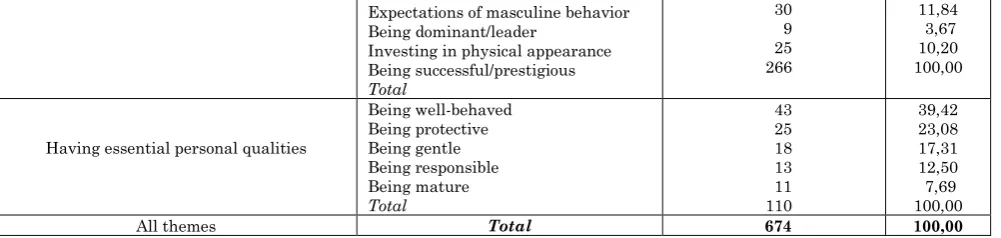
Table1: Expectations from men as described by male university students
Theme Categories f %
Fulfilling various responsibilities about life
Marriage and family Economic status Job/working
Compulsory military service Education
Total
117 79 70 17 15 298
31,01 29,95 24,11 5,32 4,61 100,00
Fulfilling social expectations
Conformity Being strong
Being emotionally strong Being socially strong Being physically strong Being sexually strong
62 21 21 19 10 5 64
Expectations of masculine behavior Being dominant/leader
Investing in physical appearance Being successful/prestigious
Total
30 9 25 266
11,84 3,67 10,20 100,00
Having essential personal qualities
Being well-behaved Being protective Being gentle Being responsible Being mature
Total
43 25 18 13 11 110
39,42 23,08 17,31 12,50 7,69 100,00
All themes Total 674 100,00
Based on Table 1, three interrelated, overarching themes were identified through analysis procedure: Fulfilling various responsibilities about life (298; 44, 20%), Fulfilling social expectations (266; 39, 50%) and having essential personal qualities (110; 16, 30%).
Fulfilling Various Responsibilities about Life
In this study, this theme surfaced initially when participants were asked to express the expectations of society from them. This theme outlines a range of expectations that are perceived as being directed at men considering their gender.
Participants stated that they are having massive responsibilities in following subjects as men: marriage and family (117; 39, 01%), economic status (79; 29, 95%), job/working (70; 24, 11%), compulsory military service (17; 4, 61%) and education (15; 5, 32). This category contains expressions like: ‘Getting married with children’, ‘it’s a men’s job to provide family’s needs.’, ‘having a secure job to provide for your home’, ‘firstly I must finish my school’, ‘I have to join the army and have my military service’.
According to the results, participants ranged expectations like marriage and family, economic expectations, having a job/working, responsibilities about education and compulsory military service in order. In other words, they were not stated randomly. Participants emphasized that in their following expressions, ‘Job+ military service+ marriage’, ‘Study, get married, have a family’, ‘1.job, 2.marriage, 3.child, 4.money, 5.house’, ‘First, you have to get a job, then you have to get married’, ‘First military service and job’. These statements display that participants not only having various responsibilities to make society’s expectations come true, but also they are
feeling pressured to make these expectations come true in a specific order.
Historically, work has often stood as the most fundamental foundation of masculine identity, particularly in relation to modernity [18]. According to Olavarria [19], one of the most important elements in men’s lives is the idea of owing themselves to work. Because working comes with being responsible, meritorious, and capable, attributes that characterize manhood in its full adult phase.
Working at a job gives men autonomy and allows them to form a family, become breadwinners, fulfill their duties towards the family, such as protect the family, and be the household head and authority. Men feel enormous pressure about this subject, especially those who have precarious jobs and few resources. Overall, if men experience the loss of a job and unemployment as a profound degradation which causes a crisis in self-esteem that engulfs their lives. [19].
Similarly to this research, Selek [20] emphasizes, if a man wants to be accepted by society in Turkey, traditionally he has to get past this 4 basic stage: 1. Circumcision, 2. Military service, 3. Job seeking, 4. Marriage.
Interestingly, in this research, participants did not claim circumcision as an expectation from society -except for 3 participants; that’s why circumcision could not be a category because of the minority of statements-.
2012 [23] Yavuz et al., 2012 [24] Barutçu, [25]. One of the possible causes of this result may be circumcision has seen as a religious requirement in Turkey’s culture. In other words, participants may have seen this requirement coming from God, not society. And also, it is realized that participants emphasized society’s present and future expectations, not past one’s. According to Şahin et al., [21] average age for circumcision is seven in Turkey. Thus, all of the participants have past their time of this expectation.
Fulfilling Social Expectations
Society’s demands were reported often by participants as an expectation in this theme. Conformity described by participants such as: ‘Showing appropriate behavior in society’, ‘having a decent life’
Participants articulated the importance of being strong in society. Some of the participants claimed this as ‘men have to be strong’, ‘you have to be strong’. Students’ different statements categorized as being emotionally, socially, physically and sexually strong.
Statements like, ‘Not even in your most painful situation you can show it to the other people’, ‘Men have to be active, outgoing, socially strong’, ‘Men have to appear physically strong’ and ‘Sexually strong’ (like pre-ejaculation) are gathered in this theme. Zeybekoğlu [26] claims that, in Turkey, men always have to be successful; financially, emotionally and sexually strong; has the authority and always gets to be on the winning side. When examining the findings of this research and different researches, it can be seen displaying such behavior constantly, puts pressure on men.
Many boys in their early years, they learn that they have to be strong, they must hide their feelings, and that conflict is resolved by physical violence and sometimes even that boys are superior to girls. [27] This socialization can lead boys and men to feel justified in subordinating women and girls. This notion continues in their adult life.
As mentioned previously, gender roles represent feminine and masculine behaviors expected by society. In the process of a boy becoming a man, a person may experience difficulty because of these gender roles and
as a result of gender roles, gender stereotypes. A stereotype is a method which works through classifying individual people into a group category [15]. Stereo types are very hard to change, and the process of stereotyping, with its emphasis on set looks and comportment forms a mental picture that cuts deep [28]. Therefore, gender stereotypes often create an artificial gap between men and women.
Participants reported that they have to possess traits such as, ‘Being masculine’, ‘Masculinity’, ‘Being a man’. Within this framework, ‘expectations of masculine behavior’ category revealed. Additionally, this category has subcategories such as, being dominant/leader which has statements like: ‘Not being at equal distance from a woman’, ‘being in the position allowing woman’, ‘Men say the last word’. And ‘investing in physical appearance’ subcategory revealed which has statements like: ‘Being handsome’, ‘Being muscular, well built’.
Finally ‘being successful/prestigious category’ has expressions like ‘having economic ambition and success in life-based on career concerns’.
In most cultures, men and boys are, socialized to be competitive, aggressive and dominant. In society, political and economic powers are valued and rewarded. Physically and financially powerful men are desired by women, and envied by other men. Men are also, socialized to be sexually promiscuous. Amongst themselves, men often brag about their sexual prowess [27].
‘Having that physical appearance desired by that shallow society’.
O’ Beaglaoich et al. [29]’s research differ from this research as well. Researchers found a norm ‘not caring’, defined by Irish boy as ‘do not care about anything or what people think of them’. In this research, participants initially indicated otherwise, such as: ‘you have to take care of everyone’, ‘We have to be sensitive to the community'.
This dissimilarity can be explained considering the different cultural properties of samples. The Turkish community is a collectivist culture [30] and the community members are expected to care about the others firstly, not themselves. Nevertheless, even though samples have age a difference, two samples show a very similar distribution about the expectation of masculine beheavier in the context of gender stereotypes and that is an important finding.
‘Being successful/prestigious’ theme contain expressions such: ‘Men have to be competitive, determined and successful’.
Having Essential Personal Qualities
Participants indicated that Turkish masculinity necessitated possessing some personal qualities. Students wrote ‘men should be …’ sentences by using few adjectives. On this basis, this theme named ‘Having essential personal qualities’. This theme has five categories distributes like, being well-behaved, being protective, being gentle, being responsible and being mature.
Personal qualities expected of men seem to contain extremely high expectations. ‘Idealized male model’ was created. Not all young men can be able to comply with this ideal man. Young males’ self-doubts about their masculine norms negatively impact their self-esteem. They may feel the pressure to live up to the societal construct of masculine [27].
According to the findings, men have to be well-behaved, protective, gentle, responsible and mature. This means, in participants’ point of view, people who have these qualifications characterize as men/masculine. In these categories, students used statements like: ‘Men expected to be understanding, devoted, honest, and loyal, gentle, sensitive, anti-violence’. This findings show, society is not expecting men to be all masculine, they
expected them to show some qualifications seem to be feminine according to Bem [31] like, understanding, tender, sensitivity, gentleness, loyalty. In the context of gender, people who have both feminine and masculine qualifications are androgyny [31]. In this study, gender roles expected of participants seem to be an emphasis of androgyny.
At the same time, different parts of society may have different types of expectations. In this study, university students were chosen as a sample that’s why expectations that they are getting from their close environment such their families’, friends’, lecturers’ may differentiate than the rest of the society’s. In a community, male students may have conflicting emotions between being ‘tough like men' and being ‘gentle and sensitive' because of society's sayings about ‘being men'.
In the current study, different statements identified that are contradictory to social norms. There are statements contradictory statements about social norms were identified. Such as, ‘being more equalitarian', ‘being libertarian', ‘being a feminist. In fact, an existence of males who says these statements as society’s expectations from them, in a sort of way shows, there is a part of people who appreciate going against social norms. And that finding is highly hopeful for gender studies University students’ questioning about gender roles instead of accepting them without questioning, may show that studies about gender may be successful in society.
Conclusion and Suggestion
In this study, expectations of young male university students' opinions in Turkey about the expectations that are presented from society as men were examined. As a result, students stated that society has expectations about fulfilling various responsibilities about life, fulfilling social expectations and having essential personal qualities.
about ‘difficulties about gender roles’. Men are affected by gender expectations as well. Current study shows, gender have to be considered as a problem not only for women but also for men. For this reason, it needs to be understood that patriarchal system and patriarchy conservation efforts actually and firstly pressures men.
This study is a qualitative study conducted with content analysis, which gives in-depth information and also the participants of the study were a small group of males residing Turkey’s capital city Ankara. To reach larger samples, relevant measuring instruments may adapt or developed in Turkish culture.
Therefore quantitative studies may conduct.Psycho-educational programs should be developed and conducted about male gender roles awareness. The realization of this matter should be evaluated and therefore revised if needed.
This is the first qualitative research about male gender role expectations among Turkish young men. It is recommended that more qualitative studies should be conducted with male young adults residing in other countries to determine whether they have the same expectations from society or not. Thus, cross-cultural studies can be conducted about male gender role expectations and gender roles.
References
1. Kimmel M (2008) Guy land: The perilous world where boys become men. NY: Harper Collins.
2. Dökmen ZY (2000) Toplumsalcinsiyet:
Sosyalpsikolojikaçıklamalar. İstanbul: Remzi Publishing.
3. UNESCO (1997).Integrating girl child issues into population education. Retrieved April http://unesdoc.unesco.org/images/0011/001102/110 280eo.pdf.
4. Harris A (2005) Gender as soft assembly. Hillsdale, NJ: The Analytic Press.
5. Yavuz Ş (2014)
İktidarolmasürecindeerkeklerinerkeklikleimtihan i, MilliFolklörDergisi, 26:104 110-127.
6. Basow SA (1992) Gender: Stereotypes and roles (3rd Ed.). Pacific Grove, CA: Brooks/Cole.
7. Basow SA (1984) Cultural variations in sex typing. Sex Roles, 10, 577–585.
8. Bank BJ (2007) Gender and education: An encyclopedia. USA: Praeger Publishers.
9. Douglas S (2000) Masculinity is dangerous. In L.K. Egendorf (Eds.) Male female roles, opposing viewpoints. (pp.124-128). California: Green haven Press, Inc.
10. Sunar D, Fişek GO (2005) Contemporary Turkish family. In U. Gielen& J. Roopnarine(Eds.), Families in global perspective (pp. 169-183). Allyn & Bacon/Pearson.
11. Gürbüz E (1985) A measurement of sex-trait stereotypes. Unpublished master’s thesis, Boğaziçi University, Istanbul, Turkey.
12. Rhode DL (2000) Culture Establishes Gender Roles. In L.K. Egendorf (Eds), Male Female Roles, Opposing Viewpoints ( 21-25). California: Green haven Press, Inc.
13. Cornwall A (2000) Missing men? Reflections of men, masculinities and gender in GAD. IDS Bulletin, 31(2), 18-27.
14. Connell RW (1998) Gender and Power Society, the Person and Sexual Politics. Stanford University Press.
15. Pilcher J, Whelehan I (2004) Fifty Key Concepts in Gender Studies. London: Sage Publications. 16. Heppner PP, Wampold BE, Kivlighan DM Jr
(2015) Research design in counseling: Research, statistics, & program evaluation. (4th Ed.). USA: Thomson Brooks/ Cole.
17. Yıldırım A Şimşek H (2006)
Sosyalbilimlerdenitelaraştırmayöntemleri. Ankara: SeçkinYayınları.
18. Edwards T (2006) Cultures of Masculinity. London: Routledge.
19. Olavarria J (2006) Men’s Gender Relations, Identity, and Work-Family Balance in LatinAmerica. In I, Bannon & M, Correia(Eds), Men’s Issues in Development: The otherHalf of Gender (29-42). World Bank Publications.
20. Selek P (2011) Sürünesürüneerkekolmak, (5.Ed.), İstanbul: İletişim.
21. Şahin F, Beyazova U, Aktürk A (2003) Attitudes and practices regarding circumcision in Turkey. Child Care Health Development, 29(4): 275-280. 22. Sancar S (2009) Erkeklik: İmkansıziktidarailede,
piyasada, sokaktaerkekler. İstanbul: Metis.
23. Taşıtman A (2012)
Kutsalerkekliğininşasındabirdurak:
Sünnetritüeli. In N. G.Toksoy (Eds.). Bellekizleri: Kurgudankuramagörüntüler (109-129).İstanbul: Kalkedon Yayınları.
24. Yavuz M, Demir T, Doğangün B (2012) Sünnetinçocukruhsağlığıüzerineetkisi:
Gözdengeçirmeçalışması, TürkPsikiyatriDergisi, 23(1): 63-70.
25. Barutçu A (2015)
“Ucundanazıcık”laatılansağlamtemel:
Türkiye’desünnetritüelive erkeklikilişkisi. A Journal of Identity and Culture, 3, 129-155.
26. Zeybekoğlu Ö (2010)
27. Women’s Commission for Refugee Women and Children (2005). Masculinities: Male roles and male involvement in the promotion of gender equality: A resource packet. D.Buscher (Eds.). New York: Women’s Commission for Refugee
Women and Children. Retrieved
http://www.unicef.org/emergencies/files/male_role s.pdf.
28. Mosse GL (1998) the Image of Man: The Creation of Modern Masculinity. Oxford University Press. 29. O’ Beaglaoich, C Morrison, TG Nielsen, E J Ryan
TA (2015) Experiences of gender role conflict as described by Irish boys, Psychology of Men & Masculinities, 16(3): 312-325.
30. Kagitcibasi C (1997) Individualism and collectivism. In J. F. Berry,M. H. Segall, &C. Kagitcibasi (Eds.), Handbook of cross-cultural psychology 3, 1-49. London: Allyn & Bacon. 31. Bem SL (1974) the measurement of psychological