Summer & Autumn 2016, Volume 13,Number2
Comparing the Effect of Teaching Aids, Review Session, and
Practical Session on Learning Anatomy
Mohammad Mohsen Taghavi1, Reza Vazirinejad2, Khalil Komlakh3, Ahmad Shabanizadeh4, Zahra Taghipour4, Hamid Reza Jafari-Naveh4, Akram Mollahoseini4, Mahdi Shareiati Kohbanani1*
1. Department of Anatomy and Social Determinants of Health Research Center, Rafsanjan University of Medical Sciences, Rafsanjan, Iran. 2. Department of Social Medicine and Social Determinants of Health Research Center, Rafsanjan University of Medical Sciences, Rafsanjan, Iran. 3. Department of Neurosurgery, School of Medicine, Rafsanjan University of Medical Sciences, Rafsanjan, Iran.
4. Department of Anatomy, School of Medicine, Rafsanjan University of Medical Sciences, Rafsanjan, Iran.
* Corresponding Author:
Mahdi Shareiati Kohbanani, PhD
Address: Department of Anatomy, School of Medicine, Rafsanjan of University of Medical Sciences, Rafsanjan, Iran. Tel: +98 (913) 1935168
E-mail: [email protected]
A B S T R A C T
Article info:Received: 25 Dec. 2015
Accepted: 01 Jan. 2016
Available Online: 01 Jul. 2016
Key Words:
Anatomy, Learning, Teaching
Dr. Mahdi Shariati Kohbanani is an assistant professor of anatomy department in Rafsanjan University Of Medical Sciences and teaching anatomy and histology course for medical and paramedical students. His interest focus is on histology and human molecular biology.
Introduction: We compared the effect of the teaching aids and review sessions on learning anatomy subjects by the medical students of Rafsanjan University of Medical Sciences.
Methods: In this study, during each semester, practical anatomy courses were presented by using different teaching aids such as, cadaver, bones, and training videos to the students. For
all studied groups, at the end of each semester and a few days before the final exam, the regular
review sessions were held by course lecturers. Then, student’s viewpoints about the effect of both teaching aids and review sessions on their learning process were investigated, using the
study checklist. Finally, the mean final scores of students who participated in the review session
were compared with those who did not.
Results: The mean scores of anatomy practice exam (range 1-20) of students who did not participate in review sessions were significantly lower than the student who did participate in these sessions. Among the medical and dental students, a significant difference was reported with regard to the
effectiveness of teaching aids and review sessions on learning process. Viewpoint of senior students in comparison to junior students were more positive about practical courses and review sessions. Overall, students’ viewpoints about the effect of both teaching aids and review sessions on their
learning process were positive and there was no significant difference between them with regard to their gender or field of study. However, medical and dental students believed that using teaching
aids such as bones and models was very effective in their learning process of head and neck course.
These opinions were significantly different between students of these two courses compare to students in the other courses (for models: P=0.022, for bones: P=0.007).
Conclusion: Practical anatomy and review sessions play an important role in the learning process
of different subjects. Therefore, we suggest that practical courses and review sessions be held with greater emphasis and for a longer time.
Citation: Taghavi MM, Vazirinejad R, Komlakh Kh, Shabanizadeh A, Taghipour Z, Jafarinaveh HR, et al. Comparing the Effect of Teaching Aids,
the issues that faculty members are current
-ly concerned about and it is more evident in basic sciences of medicine and dentistry. Medical students come to wrongly believe
(or at least, the senior and graduate students induced them) that the basic sciences are only a bunch of
theo-retical knowledge, which have no practical value on their
future profession, in other words, are useless. Thus,
find-ing new ways to boost student’s motivation, and improve the current learning methods would help with student’s learning. Some reports indicate that medical students face
with various problems such as financial problems, depres-sion, and lack of motivation in learning scientific courses.
Furthermore, many medical students have a negative at
-titude toward basic sciences such as anatomy and assume that these courses despite their high volume do not apply to clinical practice [1,2]. Because the quantity of educa
-tional programs in basic sciences seems to be satisfactory, the emphasis must be put on their quality [3].
Other studies show that whenever these lessons are pre
-sented with teaching aids and practical methods, they will become more attractive to students and their learning mo
-tives will increase [2]. It is reported that if anatomy top -ics and physical examination skills were taught together,
the learning outcome would be the best [4]. With regard to these issues, it is recommended that new methods be used in teaching the medical students to promote their motivations [2, 5]. Apparently, medical students learn easier anatomy topics in practical sessions and with us -ing teach-ing aids. The find-ings of other studies suggest that students’ satisfaction with interactive and task-based
teaching methods may result in their deeper learning compared to the conventional unidirectional methods [6].
Experts in education emphasize that class lessons should
be held in such a way that students be the core and active member of learning process. In this regard, it is necessary to encourage students in different ways. Resorting to tra
-ditional methods such as giving lectures, do not provide the main goal of education i.e. learning [1,2,7].
At the end of each semester, a review session is pre
-sented and medical students review all contents of re
-lated anatomical course. Some students believe that the review session is more useful than other sessions of the
course. Some are satisfied with the number and quality
of educational aids and some are not. Finally, some stu -dents express that the number and quality of training aids
in some courses such as head and neck are enough and in others not. The present study aimed to evaluate and
on learning. In addition, the students’ viewpoint about practical and review sessions were asked.
2. Materials and Methods
This descriptive study was conducted on midwifery, ra
-diology, dental, and medical students of Rafsanjan Uni
-versity of Medical Sciences. Given that the students’ viewpoints are different in each course, students in radiol
-ogy, midwifery, dental, and medical courses were selected from paramedical, nursing, dental, and medicine schools, respectively. Filling out the checklists was done in dif -ferent ways. For example, the authors of study filled out
the checklists at different times. A number of checklists were given to a few interested and trusted students. Then,
in a proper time and place, they were asked to fill out the checklists. At the hospitals, the clinical colleague filled out
the checklists by interview with senior students. Moreover, because participation in the review sessions were volun -tary, after the final practice exam, the mean scores of stu-dents were calculated in two following groups: first group
included students who participated in review sessions and second group included students who did not. After col -lecting all checklists, the extracted data were analyzed by SPSS. The results are presented with chart and mean val-ues. The significance level was considered at P<0.05.
3. Results
The results showed that different students had a posi
-tive view about the anatomy practical courses, especially about the review sessions held at the end of the semester
and before the anatomy exam. The majority of them (re-gardless of their field of study) believed that these
ses-sions played a major role in their learning. So that, out of 360 students who had completed the checklists, the opin -ion of 341, 319, and 343 students were good or excellent
about anatomy practice sessions, review sessions hold in dissecting room, and anatomy museum, respectively.
This matter was regardless of the study field or gender of the students. There was a significant difference between
the students’ opinions about bones and moulages with re
-gard to their effect on learning in head and neck teaching
courses (P=0.022 for moulages and P=0.007 for bones).
Summer & Autumn 2016, Volume 13,Number2
of the students were satisfied with the number of cadav-ers. The significant difference was observed between four groups with regard to the number of moulages (P=0.001).
The viewpoint of male and female students about ques
-tions of study was similar. The mean scores of junior and senior medical students with regard to the effectiveness of anatomy and review sessions were 3 and 3.3, respectively
(P=0.007)(Figure 1). The mean scores for dental junior Figure 1. Bar diagram presenting mean scores of junior and senior medical and dental students with respect to anatomy and review sessions.
Significant difference between mean scores of junior and senior dental students (P=0.042). Significant difference between mean scores of junior and senior dental students (P=0.007).
Extern Medicine Students
Intern Medicine Students
Extern Dental Students
Intern Dental Students
Scores of Students (1-4)
Students Groups
4.5 4
3.5 3 2.5
2 1.5
1 0.5
0
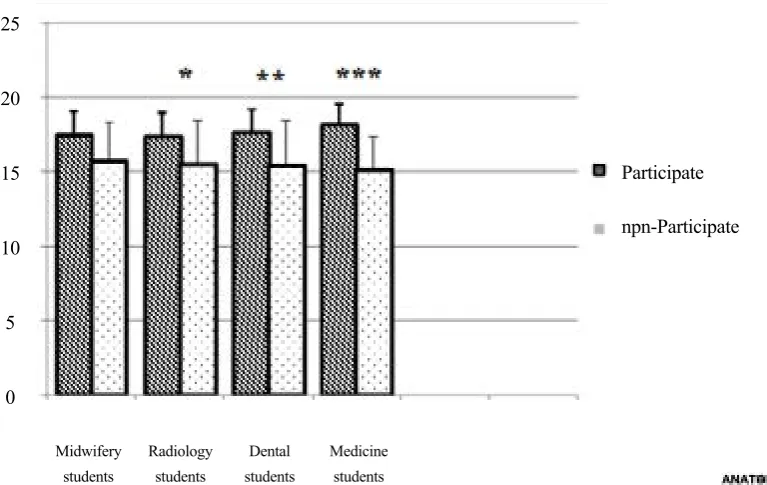
Figure 2. Bar diagram of the mean scores of anatomy practice exam of four groups of students who participated in review ses-sions and who did not.
*Significant difference between the mean scores of students (P≤0.05). * Significant difference between the mean scores of students (P≤0.01). * Significant difference between the mean scores of students (P≤0.001).
Participate
Midwifery students
Radiology students
Dental students
Medicine students
npn-Participate
25
20
15
10
5
The mean scores of anatomy practice exam (range 1-20) of midwifery, radiology, dental, and medical
stu-dents who did not participate in review sessions were
significantly lower than the mean scores of students who
participated in the mentioned sessions. For medical stu
-dents, there was more difference in comparison to other
3 fields (P<0.0001) and less differences were seen be-tween midwifery and radiology students (P=0.0113 for midwifery and P=0.0117 for radiology) (Figure 2).
4. Discussion
Generally, the quality of education should be reviewed continuously. This review could be done from different aspects such as teaching method or the curriculum. At one time teaching method or curriculum could be satis
-factory, but in another time and for various reasons such
as new findings and information, changing condition of
society and failure to achieve the educational goals, they must be reviewed. For these reasons, the teaching meth
-ods should be evaluated from time to time.
With regard to anatomy, students will become famil
-iar with basic terms of medical vocabulary [8]. Some students believe that anatomy is about lifeless bones and dissecting a cadaver [8]. In anatomy, students must learn a wide range of knowledge, which most of it will be forgotten after some time. Medical students in differ -ent fields, at the beginning of their studies face a large volume of complex and difficult anatomical terms. Anat-omy like other basic courses is taught in the first three
se-mesters, so its learning is very hard, because students are
not familiar with difficult Latin terms yet. In high school,
students become familiar with a few of these terms in
Persian [7] and some of them may be wrong.
In recent decades, education of anatomy has changed.
This change is due to two facts: first, different ways of
learning among new generation of students, and second,
the major advances in the field of teaching aids such as us-ing three-dimensional anatomical plastination. With regard
to this new situation, it is not possible to hold the anatomi
-cal teaching sessions by using the traditional methods. In fact, teaching anatomy and other basic science courses with lecture method must be held in such a way that the students understand the relationships between the content, medical profession, and their application in clinical practice.
In anatomy education, besides using traditional lecture method, other new methods should be used to make students
could not understand the anatomical structure and their ap
-plication in live and healthy people, learning anatomy is in vain [7]. Inability of students to memorize all subjects, their low motivation to learn basic science courses, and their fail -ure to use learned clinical teachings (including performing physical examination), all represent shortcomings in
tradi-tional method of teaching i.e. lecture style [10].
Acquiring a deep knowledge of anatomy depends on the correct way to teach these lessons. One of the most
important factors in this context is practical assignments
which involve the students. If students understand the basic sciences such as anatomy, they will be able to re -late this information to clinical findings and patients’
di-agnosis and treatment [11]. Previous studies have shown
that theoretical and practical teaching of anatomy topics together with using anatomical teaching aids and various radiological images, lead to better understanding of anat -omy, lasting learning, encouraging students toward
self-directed learning, and understanding the role of anatomy in the interpretation of preclinical items [11, 12].
According to some studies on depression, lack of moti
-vation, and negative attitude in our students towards study
-ing medicine, most students like to learn clinical skills in
the early years of university. Students express that
learn-ing clinical skills increases their motivation and pleasure of studying medicine [11-16]. Results of the present study show that senior medical students have a more positive view toward practical sessions, because of the following reasons: they have faced with the sick and occupational therapy and they believe that visual learning is more ef -ficient than auditory learning. If students see anatomy
top-ics on the moulages and cadavers, later on and in the face of patients, they will not have any problems with regard to anatomy issues. Senior medical students believe that
practical sessions stay longer in the mind and in their next study periods, such as pre-internship period, there will be
no need to refer to these contents, again.
Present study showed that medical students (especially senior students) are interested in practical teaching
meth-ods, so in providing educational aids should attend more, especially in head and neck courses.
Acknowledgements
We sincerely grateful thanks of Rafsanjan University
Summer & Autumn 2016, Volume 13,Number2
Conflicts of Interests
The authors declared no conflict of interest.
References
[1] Michel MC, Bischoff A, Heringdorf DZ, Neumann D, Jakobs K. Problem-vs. Lecture-based pharmacology teaching in a German medical school. Naunyn-Schmiedeberg's. Ar -chives of Pharmacology. 2002; 366(1):64-68. doi: 10.1007/ s00210-002-0570-x
[2] Mehdizadeh M, Haghir H, Joghtai MT, Shayan SH. [Edu-cational needs and practical skills of master anatomy stu-dents considering the needs of the community (Persian)]. Iranian Journal of Medical Education. 2004; 4(2):85-93.
[3] Shariati M, Jafarinaveh H, Bakhshi H. [The role of anatomy course in achieving clinical objectives: The viewpoints of Rafsanjan Medical University students in clinical settings (Persian)]. Iranian Journal of Medical Education. 2005; 5(2): 176-80.
[4] Adibi I, Hasani N, Sadre Arhami S, Ashourioun V, Mona -jemi AR. [Teaching integrated course of physical examina-tion and trunk anatomy to second year medical students (Persian)]. Iranian Journal of Medical Education. 2006; 6(1):7-13.
[5] Forrester-Paton C, Forrester-Paton J, Gordon AL, Mitchell HK, Bracewell N, Mjojo J, et al. Undergraduate teaching in geriatric medicine: mapping the British Geriatrics Society undergraduate curriculum to Tomorrow’s Doctors 2009. Age & Ageing. 2014; 43(3):436-439. doi: 10.1093/ageing/ afu024
[6] Mirzaei M, Azizian F. [Assessment of interactive and Task-Based Learning (TBL) methods compared to the conven -tional method of undergraduate teaching (Persian)]. Jour -nal of Medical Education & Development. 2012; 7(1):10-17.
[7] Reidenberg JS, Laitman JT. The new face of gross anato -my. Anatomical Record. 2002; 269(2):81-88. doi: 10.1002/ ar.10076
[8] Azer SA, Eizenberg N. Do we need dissection in an integrat -ed problem-bas-ed learning m-edical course? Perceptions of first-and second-year students. Surgical & Radiologic Anatomy. 2007; 29(2):173-80. doi: 10.1007/s00276-007-0180-x
[9] Lempp HK. Perceptions of dissection by students in one medical school: beyond learning about anatomy. A quali -tative study. Medical Education. 2005; 39(3):318-25. doi: 10.1111/j.1365-2929.2005.02095.x
[10] Miller SA, Perrotti W, Silverthorn DU, Dalley AF, Rarey
KE. From college to clinic: reasoning over memorization is key for understanding anatomy. Anatomical Record. 2002; 269(2):69-80. doi: 10.1002/ar.10071
[11] Lachman N, Pawlina W. Integrating professionalism in
early medical education: the theory and application of re
-flective practice in the anatomy curriculum. Clinical Anat -omy. 2006; 19(5):456-60. doi: 10.1002/ca.20344
[12] Cho MJ, Hwang YI. Students’ perception of anatomy
edu-cation at a Korean medical college with respect to time and contents. Anatomy & Cell Biology. 2013; 46(2):157-62. doi: 10.5115/acb.2013.46.2.157
[13] Mitchell R, Batty L. Undergraduate perspectives on the
teaching and learning of anatomy. ANZ Journal of Surgery. 2009; 79(3):118-21. doi: 10.1111/j.1445-2197.2008.04826.x
[14] Lam TP, Irwin M, Chow LW, Chan P. Early introduction
of clinical skills teaching in a medical curriculum-factors affecting students’ learning. Medical Education. 2002; 36(3):233-40. doi: 10.1046/j.1365-2923.2002.01142.x
[15] Tavares MA, Silva MC. Evaluation of the Clinical Anatomy
Program in the Medical School of Porto by two cohorts of students. Clinical Anatomy. 2002; 15(1):56-61. doi: 10.1002/ ca.1093
[16] Allen SS, Roberts K. An integrated structure-function mod