ISSN-L: 2501 - 1235 Available on-line at: www.oapub.org/edu
doi: 10.5281/zenodo.1455997 Volume 4 │ Issue 12 │ 2018
THE RELATIONSHIP BETWEEN PERFORMANCE OF
NEUROMUSCULAR JUNCTION AND SOCIAL SKILLS
(CO-OPERATION, INTERACTION, INDEPENDENCE)
OF PRESCHOOLERS
Zaragkas Charilaos K.1i,
Chatzivasiloglou Anastasia2,
Giotsa Artemis3,
Sarris Dimitrios4
1,4Assistant Professor, E.C.E.D.U. of Ioannina, Greece 2Kindergartener, Primary Education of Thessaloniki, Greece 3Associate Professor, E.C.E.D.U. of Ioannina, Greece
Abstract:
This study investigated the relationship between neuromuscular junction and the social skills of cooperation, interaction and independence, after these variables had been detected and assessed in early childhood children. The sample consisted of 72 preschoolers (40 boys, 32 girls) aged 48 to 78 months. In order to assess whether or not there were kinetic difficulties in the neuromuscular juxtaposition of preschoolers, an array of eight motor tests was used (M-ABC Test, Henderson & Sugden, 1992). The Preschool and Kindergarten Behavior Scales (Merrell, 1994) was used to assess social skills. The results showed that the majority of children performed below the values of the risk zones, while 8.00% of the sample was found in the high-risk zone. No differences were found regarding gender and age regarding the onset of motor problems. Regarding social skills, it was found that most preschoolers had sufficient skills of cooperation, interaction and independence, while few were those with a shortage of these skills. In addition, the results showed a relationship between performance in MABC Test and social skills, but this was not statistically significant. The results of this research are consistent with other similar surveys, but they also contradict some others. Therefore, it is necessary to further investigate the issue due to the small sample of the survey.
Keywords: developmental disturbance of kinetic coordination, social skills, collaboration, interaction, independence, pre-school age
1. Introduction
Neuromuscular junction refers to the coordinational function of the central nervous system, namely, in the determination and coordination of actions (neural, muscular) to
achieve a desired resultii. According to this function, the perceptual mechanism is
activated so that specific stimuli are perceived which are required for further responses, such as the visual and acoustic motor coordination (e.g., achieves a goal with the ball, responds in a motor – dancing way appropriately to the sounds that are heard, can take off his blouse in a reasonable time). The perceptual mechanism is activated to control the functioning of competing muscles so as to support each other in relation to the purpose of deliberate behavior instead of preventing or prohibiting it. The process may be inherent or acquired and can be activated consciously but also unconsciously.
Junction is an element of fitness associated with performance. It is the ability to empower special motor systems with a variety of sensory οrgans for effective movement (Gallahue 2002). The harmonious co-ordination of the synchronization, the rhythm and the sequence of the elements of the individual’s movement is important for the articulated movement. Various parts of the body can be involved, such as an eye-foot fitting in the kicking of a ball or the climbing of the ladder. Eye-to-hand assembly is evident in fine kinetic activities such as the placement of beads in a rope, copying clay constructions, or rough motor activities such as snapping or batting of objects (Gallahue 2002).
There are many children who, without knowing that they have pathological causes, and although they meet the conditions for joining the activities of a formal school or kindergarten, fail to acquire or improve basic motor skills. This situation evolves and leads these children into a vicious circle (Zimmer, 2007) to avoiding motor activities with already existing motor problems becoming even more serious and prominent.
Motor clumsiness or motor coordination disorder is the lack of definition and coordination of basic motor skills and actions to achieve the intended motor outcome (Smith, Zelaznik, 2004). Children with motor clumsiness are usually spotted in preschool age when they cannot perform simple motor skills with precision even though they do not show any obvious neurological deficits or other pathological motor or sensory disorder (Stelios Mantoudis, 2017). Children with movement difficulties (Developmental Disturbance of Co-ordination) are considered to be those children whose overall mobility score in the Movement Assessment Battery for Children (MABC) is lower than the 5th position compared to the age-specific norms.
The clumsy child in preschool age is characterized by the difficulty of acquiring and successfully practicing motor skills that require precision, speed and neuromuscular junction. This difficulty is not limited to specific skills, which could be attributed to inexperience and ignorance but it is manifested in his/her free play,
everyday activities and self-service. The preschooler's clumsiness is not always apparent to parents who often attribute their motor failures to their young age and inexperience. The clumsy preschooler’s difficulty in performing a variety of motor activities is evident from the first year of their school life. Concise clumsiness in preschool children may be a precursor to low academic performance and the emergence of psychological and developmental problems (Iversen, Knivsberg, Nodland, Ellertsen, 2006).
Skinner and Piek (2001) concluded that the group of adolescents with motor clumsiness had lower self-worthiness and higher levels of anxiety. Teenagers perceived themselves as less capable, with poorer social support and lower self-worth than younger children, and their anxiety was significantly higher than younger participants. Cummins, Piek and Dyck (2005) conclude that children's motor skills were an important predictor of their social behavior.
2. Literature review
Research results in school-age children have shown that these children who have difficulties in neuromuscular junction or motor coordination have been associated with withdrawal and isolation (Smyth & Anderson, 2000; Poulsen, Ziviani, Cuskelly & Smith, 2007; Jarus, Lourie-Gelberg, Engel-Yeger & Bart, 2011), difficulties in focusing attention (Chen, Tseng, Huc & Cermak, 2009), with behavior problems, emotional problems, depression, hyperactivity, lack of appropriate social skills, difficulty in conducting relationships with peers, reduced verbal intelligence, poor social communication (Schoemaker & Kalverboer, 1994, Dewey, 1994), stress, physical discomfort (Lingam, Jongmans, Ellis, Hunt, Golding & Emond, 2012, Sylvestre, Nadeau, Charron, Larose & Lepage, Kaplan, Crawford & amp; Wilson, 2002).
The bibliographic review of Chen and Cohn (2003) showed that children with coordination problems run the risk of limited social participation in family social activities, neighborhood leisure activities, and physical and social activities at school. In addition, the poor self-perception and self-esteem of children with coordination problems can reduce their motivation to participate in activities. A similar survey (Kanioglou, Tsorbatzoudis & Barkoukis, 2005) in the Greek school for school age children showed that children with severe coordination difficulties showed higher scores in all four categories of divergent behavior (hyperactivity, lack of attention, stress and behavioral disorders ).
has also been the subject of studies, although surveys are comparatively fewer especially in Greece.
In particular, surveys indicate that there is a significant degree of coexistence of difficulties in motor coordination of emotional and behavioral problems, as well as an important relationship between attention focusing problems and maneuvering difficulties (Iversen, Knivsberg, Ellertsen, Nødland & Bade Larsend, 2006; Piek, Bradbury, Elsley & Tate, 2008). The combination of these difficulties (motor and social behavior) makes children particularly vulnerable to exclusion and isolation (vicious circle, Zimmer, 2007). Thus, motor coordination problems can easily increase the already significant risk of social exclusion.
Other studies (Bart, Jarus, Erez & Rosenberg, 2011; Liberman, Ratzon & Bart, 2013) concluded that children with mobility problems are less independent, mainly in terms of education, and less satisfied with their participation in play, social interactions and education, compared to children without mobility difficulties.
Bar-Haim and Bart (2006) concluded that children with poor motor skills exhibit a lower social gaming frequency and a higher incidence of social contraction than children with normal or high motor skills. Correspondingly, children with low motor skills demonstrate a higher frequency of solitary play than children with high motor skills.
In the Kennedy-Behr, Rodger and Mickan (2011) research on motor and social play for children of pre-school age, it was found that children with a likelihood of coordination disorder are engaged in games that are appropriate for younger age groups and have deficits in space management and material than children without coordination difficulties. It was also found that these children had more negative feelings and were more involved in aggressive incidents - either as offenders or as victims - and were more observers than active players.
Similarly, the same researchers (Kennedy-Behr, Rodger, Mickan, 2013a), investigating the relationship between participation in the game and the well-being of preschool children with or without coordination problems, found that the developmental age of the game varies considerably between the two groups. They also found that children with coordination problems are less involved in group games - and when they are divided into indoor and outdoor space, they are less involved in outdoor ones - they are more often involved in aggressive incidents (most occurring outside) and show more often negative face grimaces when involved in a negative interaction.
In conclusion, children with mobility difficulties encounter various psychosocial problems such as difficulties in conducting relationships with peers and social participation difficulties in activities that require movement, all of which causes low self-esteem, increased anxiety and tendency to isolate and withdraw.
The purpose of this paper is to study the motor coordination (neuromuscular junction) and the social behavior of pre-school children, as well as the relationship between these two variables, especially if the poor performance of motor coordination also exhibits low estimates of social skills or good performance of motor coordination also shows high estimates of preschooler's social skills.
3. Methodology of research
3.1 Sample
The sample in the present study consisted of seventy-two children (N = 72), 40 boys and 32 girls, attending kindergarten in the prefecture of Thessaloniki.
Table 1: The sample characteristics (frequencies and percentages)
for gender and age (N = 72, 100%)
Characteristics f %
Gender
Boys 40 55,6
Girls 32 44,4
Total 72 100
Age
48 to 54 months – 4 - years- old 4 5,6
55 to 66 months – 5 - years- old 27 37,5
67 to 78 months – 6 - years- old 41 56,9
Total 72 100
3.1 Measuring tools
A. Measuring tool for the Developmental Disturbance of Kinetic Coordination (Movement Assessment Battery for Children, Henderson & Sugden, 1992).
The Kinetic Movement Assessment Battery for Children (MABC, Henderson & Sugden, 1992) was used to evaluate the motor performance of children. This test has been used in a number of previous surveys (Coleman, Piek & Livesey, 2001; Junaid & Fellowes, 2006; Giagazoglou, Kabitsis, Kokaridas, Zaragas, Katartzi & Kabitsis, Zaragas 2009; Welsvelde, Peersman, Lenoir, Smits Engelsman & Henderson, 2008, Chow, Henderson & Barnett, 2001, Livesey, Coleman & Piek, 2007; Kourtessis, Tsougou, Maheridou, Tsigilis, Psalti & Kioumourtzoglou, 2008). This motor test is based on norms and is aimed at children from 4 to 12 years of age. It includes three modules: a) hand skills (manipulative skill); b) ball skills (object manipulation); and c) balance (dynamic and static). In total, it consists of 32 exercises, divided into four categories (eight exercises in each category) depending on the age of the children. Category 1 is used for children aged 4 - 6 years. For the purposes of this survey, Category 1 exercises were used to assess the motor performance of preschool children (4-6 years).
manipulation, and the scores of the dynamic and static equilibrium exercises are summed up and give the score of balance. In the end, the scores of the eight exercises are summed up and give the total score. This total score can vary from 0 (for children without any kinetic difficulty) to 40 (for children with very severe kinetic difficulties). A child with a general motor score of less than 10 is not a problem. A child with a general kinetic score greater than 10 has some difficulties. A child with a general motor score of more than 14 shows severe motor problems. The test is designed to differentiate children from the motor performance and the differentiation thresholds are the 15th and 5th lowest percentage. Thus, a child whose kinetic performance drops below the 15th position, compared to the norms set for his age, is in a marginal state with some motor problems. If its motor performance drops below the lowest 5th position, it has serious motor problems.
B. Social Measurement Tool for Preschool Children (Preschool and Kindergarten Behavior Scales, Merrell, 1994).
The Preschool and Kindergarten Behavior Scales (PKBS, Merrell, 1994) were used to assess the social skills of children. This Scale is a behavioral observation tool used to evaluate social skills and problem behaviors in preschool children (3-6 years) and is complemented by parents or teachers. It is a standard tool developed specifically for use in the assessment of young children in a variety of environments and with a variety of behavioral information. This tool includes two separate Scales (categories): A) Social Skills (34 items) and B) Behavioral Problems (42 items).
The Scale of Social Skills in the present study appeared to be reliable and shows very good internal consistency as Cronbach reliability index was found to be 0.879. This particular tool for assessing social skills was also used in Greece, in a recent survey of Iosephides (2015), where the scale also showed very good internal consistency as Cronbach reliability index was 0.96.
3.2 Statistical analysis
Frequency tables and corresponding percentages were constructed and the principles of descriptive statistics (average, standard deviation, maximum and minimum) were applied to all survey variables.
an internal consistency, that is, questions tend to measure the same thing (Social Independence).
The questionnaire partition reliability was applied, which refers to the correlation between measurements based on the first half of the questions for all the Social Co-operation questions and measurements based on the second half. For Social Collaboration, the reliability of splitting the 12 questions is .881 (Guttman Split-Half Coefficient), which shows that the scale is very reliable. The same process was carried out for the credibility of the partition of the 11 questions of Social Interaction and the 11 questions of Social Independence, where 868 and .740 respectively were found, indicating that the scales are very reliable.
Inter - rater reliability is given by the Kappa coefficient, and is based on a measurement of the agreement between the estimates of two different estimators (researchers - nursery teachers). The Kappa coefficient for the agreement of the estimates of the two researchers is 0.94 for motor clumsiness, and 0.91 for social skills, which shows agreement of a very high level among the estimators.
In order to control the hypothesis between the relationship of neuromuscular junction performance and social skills (co-operation, interaction and independence), a regression analysis was performed which reveals the predictability of one variable on the other, i.e if the poor performance of the neuromuscular junction (motor skill) provides low prices for social skills.
4. Results
4.1 Results on the performance of the Neuromuscular M-ABC Test
Table 2: Frequencies and corresponding percentages of the sample score of children (N = 72, 100.00%) in the total of eight MABC Test kits
Score f % Score f %
2,00 1 1,4 10,00 8 11,1
3,50 1 1,4 10,50 1 1,4
4,00 1 1,4 11,00 3 4,2
4,50 1 1,4 11,50 2 2,8
5,00 1 1,4 12,00 2 2,8
5,50 4 5,6 12,50 3 4,2
6,00 4 5,6 13,00 2 2,8
6,50 1 1,4 13,50 5 6,9
7,00 2 2,8 16,50 1 1,4
7,50 1 1,4 18,00 3 4,2
8,00 3 4,2 26,00 1 1,4
8,50 5 6,9 26,50 1 1,4
9,00 7 9,7
Total 72 100,0
9,50 8 11,1
Regarding children with motor problems, 11 boys and 7 girls were found in the risk group, with 15.3% and 9.7% respectively in the whole sample (30% of the 5-year-old boys and 28.5% 5-year old girls, 27.7% 6-year-old boys and 21.7% 6-year-old girls). These children, with an appropriate intervention program, can improve their motor skills. However, children with severe motor difficulties were also found, which suggests the existence of DDMJ. In the group of motor clumsiness, the same percentage of 4.2% was found in the whole sample (3 boys and 3 girls, namely 10% of the 5-year-old boys and 14.25% of the 5-year-5-year-olds, and 5.5% of 5-year-old boys and 8.6% of 6-year-old girls). Overall, in terms of age, 11.1% of 5-year-6-year-olds and 7.3% of 6-year-6-year-olds showed DDMJ (Developmental Disorder of Neuromuscular Junction). All the above are summarized in the following table (3).
Table 3: Summary table of frequencies and corresponding rates for the number of
children experiencing motor difficulties
Age
Team Risk Kinetic Clumsiness
Boys Girls Boys Girls
F % F % F % F %
4-years-old
5-years-old 6 30 2 28,5 2 10 1 14,25
6-years-old 5 27,7 5 21,7 1 5,5 2 8,6
Total 11 27,5
(15,3) 7
21,9
(9,7) 3
7,5
(4,2) 3
9,4 (4,2)
co-operation, social interaction and social independence are presented in the following frequency table.
Table 4: Frequency table for the four functional levels of social skills for the three sub-scales
(A1, A2, A3), sex and age group (N = 72, 100%)
Functional Level
High Functioning Average Moderate Deficit Significant Deficit
Age Boys Girls Boys Girls Boys Girls Boys Girls
A1
Coope
ra
ti
on
4-years
old 1 1 2
5-years
old 4 2 12 3 4 2
6-years
old 3 6 10 16 4 1 1
A2
In
te
ra
ct
ion
4-years
old 1 2 1
5-years
old 5 1 8 3 5 3 2
6-years
old 3 1 8 12 7 10
A3
In
d
ep
en
d
en
ce 4-years old 1 2 1
5-years
old 4 1 9 1 5 4 2 1
6-years
old 3 5 7 9 8 8 1
Table 5: Frequency distribution and relevant percentages for each operating level and the three sub-scales (A1, A2, A3) regarding the total of children (N = 72, 100%)
Functional Level
A1 - Social Cooperation
A2 - Social Interaction
A3 - Social Independence
F % F % F %
High Functional 16 22,23 10 13,89 13 18,05
Average 42 58,34 32 44,45 29 40,28
Moderate Deficit 13 18,05 28 38,89 25 34,73
Significant Deficit 1 1,38 2 2,77 5 6,94
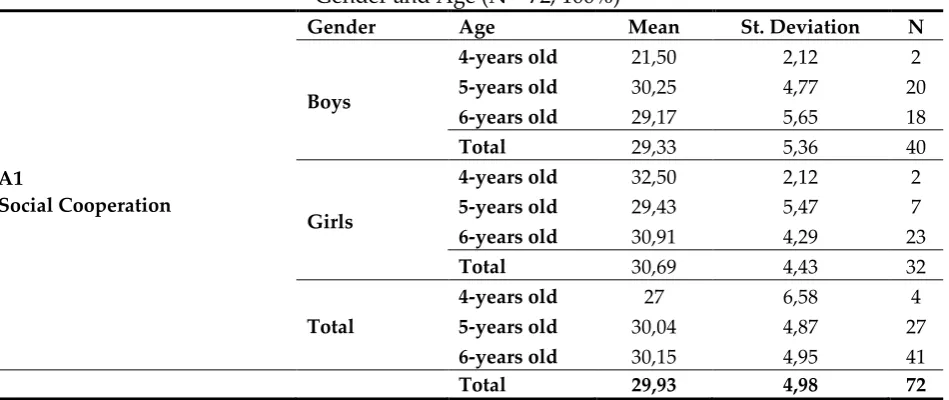
In summary, taking into account both sex and age variables (Table 6), girls and three age groups experienced adequate social co-operation skills, with an average score of 32.50 for 4 years, 29.43 for 5 years and 30.91 for 6 years. As for boys, there was little differentiation, as older boys (5yrs and 6years) showed adequate social coaching skills with an average score of 30,25 and 29,17 respectively, while the younger boys (4yrs) showed a modest deficit with an average term score 21.50. Thus, from Table (6) it appears that 4-year-old boys showed low performance in the skill of Social Co-operation compared to girls, while older boys and girls (5years and 6years) showed similar performances ranging within the operating level average.
Table 6: Summary Table of Descriptive Statistics on (A1) Social Co-operation, Based on
Gender and Age (N = 72, 100%)
Α1
Social Cooperation
Gender Age Mean St. Deviation N
Boys
4-years old 21,50 2,12 2
5-years old 30,25 4,77 20
6-years old 29,17 5,65 18
Total 29,33 5,36 40
Girls
4-years old 32,50 2,12 2
5-years old 29,43 5,47 7
6-years old 30,91 4,29 23
Total 30,69 4,43 32
Total
4-years old 27 6,58 4
5-years old 30,04 4,87 27
6-years old 30,15 4,95 41
Total 29,93 4,98 72
low Social Interaction skills, while older boys and girls showed similar performances ranging within the operating average level.
Table 7: Summary Table of Descriptive Statistics on (A2) Social Interaction, based on
Gender and Age (N = 72, 100%)
Α2
Social Interaction
Gender Age Mean St. Deviation N
Boys
4-years old 14 1,41 2
5-years old 24,30 5,89 20
6-years old 24,22 4,71 18
Total 23,75 5,63 40
Girls
4-years old 19 ,41 2
5-years old 24,43 5,15 7
6-years old 24,04 5,08 23
Total 23,81 5,01 32
Total
4-years old 16,50 3,1 4
5-years old 24,33 5,61 27
6-years old 24,12 4,84 41
Total 23,78 5,33 72
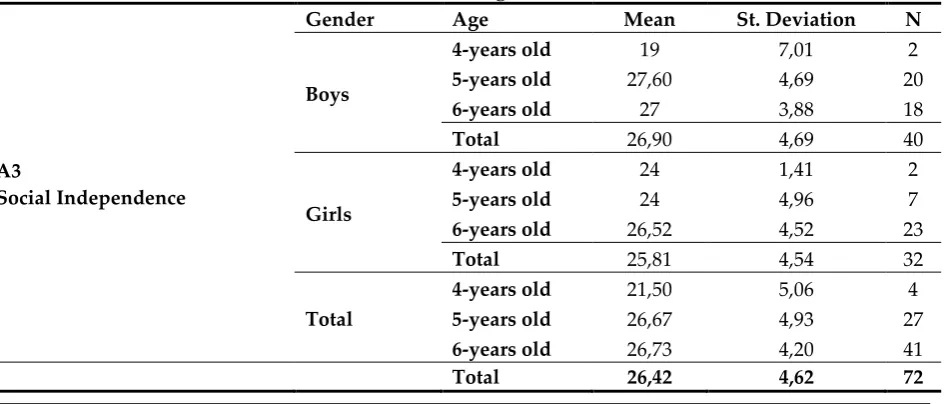
Finally, considering both sex and age variables in relation to the ability of Social Independence (Table 22), again, the older boys (5 years and 6 years) showed adequate social independence skills, with an average score of 27.60 and 27.00 respectively, while younger boys (4-year-olds) showed a moderate deficit with an average score of 19.00. For girls, there was little variation, as 4-year and 6-year-old girls showed adequate Social Independence skills with an average score of 24.00 and 26.52 respectively, while 5-year-old girls showed a moderate deficit with an average score of 24.00. Thus, from Table (8), 4-year-old boys appear to have lower Social Independence skills as opposed to girls, 5-year-old boys scored better than girls, while in the 6-year age group there was no difference between the two sexes as they showed similar performance.
Table 8: Summary Table of Descriptive Statistics Regarding (A3) Social Independence,
Based on Gender and Age (N = 72, 100%)
Α3
Social Independence
Gender Age Mean St. Deviation N
Boys
4-years old 19 7,01 2
5-years old 27,60 4,69 20
6-years old 27 3,88 18
Total 26,90 4,69 40
Girls
4-years old 24 1,41 2
5-years old 24 4,96 7
6-years old 26,52 4,52 23
Total 25,81 4,54 32
Total
4-years old 21,50 5,06 4
5-years old 26,67 4,93 27
6-years old 26,73 4,20 41
4.3 Results on the relationship of performance to the M-ABC Test and all three social skills
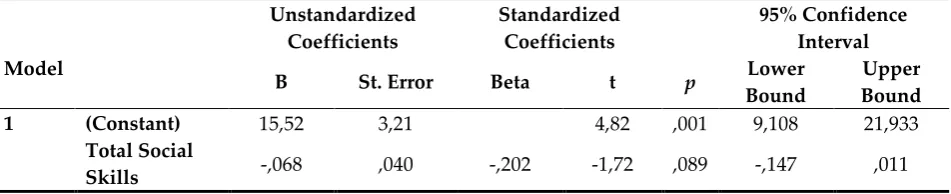
The dispersion chart between performance in MABC Test and the set of social skills shows a negative linear relationship between the two variables. The equation is y = 15,52 + (- 0,07x) where x is the overall performance in all three social skills of cooperation, interaction and independence and y performance in the MABC Test. The confidence interval of 95% for the regression line slope is -, 147 to, 011 (Table 9), as this interval contains the value 0, the slope does not differ significantly (beta = , 202, t = -1.725, p = 089) from the horizontal line.
The fact that a negative relationship was found between these two variables shows that the lower the motor score in the M-ABC Test (showing the performance of the neuromuscular junction), the higher the score of all social skills. From the graphical representation of dispersion (Figure 1) we observe that most children who achieved a low motor score (10 and below) showed adequate social skills, achieving a total score of 68 and above. In other words, it was apparent that the motor skillful children showed high levels of social skills. However, few children were found who, while having achieved a low motor score, ie exhibited motor skills, showed a lack of social skills, achieving a total score of 67 and below.
In addition, we notice that children who achieved a mobility score of 11 to 15, those who joined the risk group, had adequate social skills. Instead, children who achieved a high motor score of 16 and above and joined the group of motor skills, showed a lack of social skills. The greatest successes in social skills are associated with the lowest scores in the M-ABC Test.
Table 9: Results of linear regression regarding the performance M-ABC Test and
the total of Social Skills (Ν = 72, 100%)
Unstandardized Coefficients
Standardized Coefficients
95% Confidence Interval Model
B St. Error Beta t p Lower
Bound
Upper Bound
1 (Constant) 15,52 3,21 4,82 ,001 9,108 21,933
Total Social
Skills -,068 ,040 -,202 -1,72 ,089 -,147 ,011
Graphic depiction 1: dispersion between the performance in M-ABC Test and the total of social skills (Ν = 72, 100%)
5. Conclusions, discussion, proposals
The majority of preschoolers appeared from the results, that they did not experience visual motor coordination problems. Specifically, in the present study the percentage of children experiencing severe motor coordination disorders was 8.00% (ie 6 children in the sample as a whole). In Greece, research has shown that the rate of motor clumsiness ranges from 0.9% to 15% (Tougou, 2007, Kourtessis, Tsougou, Maheridou, Tsigilis, Psalti, Kioumourtzoglou, 2008; Zaragas, 2009; Karabatzaki, 2002; Giagazoglou, Kabitsis, Kokaridas, Zaragas, Katartzi, Kabitsis, 2011; Arabatzis, 2015). In the international bibliography this percentage is close to 5% (Waelvelde, Peersman, Lenoir, Smits Engelsman, Henderson, 2008; Lingam, Jongmans, Ellis, Hunt, Golding, Emond, Missiuna, Gaines, Kaplan, Crawford, Wilson, 2002, Dewey, Wilson, 2001, Gillberg, Kadesjo, 2003, Sutton Hamilton 2002, Gubbay, 1975), while according to the American Psychiatric Society (APS, 1994, 2000) the percentage of motor clumsiness for children of the USA ranges from 5% to 10%.
boy. This result contradicts the previous bibliography, but it is in accordance with Zaragas (2009) study, where six-year-old girls showed a double percentage of motor clumsiness compared to boys. A possible explanation for this result is the fact that this motor deficit may have existed at an earlier age and over time, coupled with a lack of motor experience and interest and inadequate exercise, to keep their motor skills poor by affecting in this way the percentages of motor clumsiness of these six-year-old girls. Finally, from the results of the present study it appeared that none of the four-year-olds had DVMC, which can be explained by the fact that the sample of four-year-olds was not adequate to produce safe conclusions as they were only four children.
As far as the social skills of preschoolers are concerned, the results of this survey showed that the majority of children showed adequate skills in Social Co-operation, Social Interaction and Social Independence. This result is in line with the research by Denham, Blair, DeMulder, Levitas, Sawyer, Auerbach-Major & Queenan (2003) that pre-school children display adequate social skills despite their young age making them cooperative, likeable to peers and adults rather than isolated, and in addition, adequate social skills are also a predictive factor for future social well-being at an older age. It has been found that knowledge of emotions has a beneficial effect on social relations with peers, which provokes their positive relationship with social skills, especially for self-promotion and cooperative behavior. Thus, accurate recognition and interpretation of the facial expressions of others helps children decide how they will interact positively with others and provide guidance for interpersonal transactions, which shows that the knowledge of sentiments sets the foundation for positive social behavior (Izard, Fine, Schultz, Mostow, Ackerman, Youngstrom, 2001). Another fact that is associated with important social skills is that of positive parenting. The proper upbringing and especially the greater involvement of the mother in family routines were found to correlate with cooperative behaviors of children, self-control behaviors and generally greater social skills, while family conflicts were found to be associated with behavioral problems (Koblinsky, Kuvalanka, Randolph, 2006). Consequently, good knowledge of emotions and positive parenting can be a possible explanation of the concrete outcome of this research.
of the trend of the sample in question, where it is a small and heterogeneous sample (gender and age).
This research attempted to approach the phenomenon of the Developmental Disorder of Kinetic Coordination and the level of social skills of preschool children, as well as the existence of a relationship between these two variables. As the results showed, there were children who experienced severe motoring difficulties but also low levels of social skills, namely social co-operation, social interaction and social independence. This leads to the need to realize how important and critical the knowledge of the impact of motor and social deficits and timely detection is aimed at improving these skills. In addition, there appeared to be little negative relation between the total performance in the array of eight M-ABC Test kinetic tests and the overall performance of the social skills of cooperation, interaction and independence, but which is marginal statistically significant which means that levels of high functionality in social skills are associated with lower scores in the M-ABC Test.
References
American Psychiatric Association (1994). Diagnostic and statistical manual of mental
disorders. (4th ed.). Washington, DC: Author.
American Psychiatric Association (2000). Diagnostic and statistical manual of mental
disorders. (4th ed., text revision). Washington, DC: Author.
Arampatzi, M. (2015). Evaluation of the developmental disorder of motoric coordination of
elementary school pupils by educators through the Movement Assessment Battery for Children-2 observation list. Unpublished postgraduate dissertation. D.E.P.S.S. of Serres – Aristotle University of Thessaloniki.
Bar-Haim, Y., Bart, O. (2006) Motor function and social participation in kindergarten
children. Social Development, 15(2): 296 – 310.
Bart, O., Jarus, T., Erez, Y., & Rosenberg, L. (2011). How do young children with DCD
participate and enjoy daily activities? Research in Developmental Disabilities, 32(4):
1317–1322.
Cairney, J., Hay, J.A., Veldhuizen, S., Missiuna, C., Faught, B.E. (2010). Developmental coordination disorder, sex, and activity deficit over time: a longitudinal analysis of participation trajectories in children with and without coordination
difficulties. Developmental Medicine & Child Neurology, 52(3): e67 – e72. Done
accessed on 18/06/2018 https://www.ncbi.nlm.nih.gov/pubmed/20015253
Chen, H.F., Cohn, E.S. (2003). Social Participation for Children with Developmental Coordination Disorder: Conceptual, Evaluation and Intervention Considerations. Physical & Occupational Therapy in Pediatrics, 23(4): 61 – 78.
Chen, Y.W., Tseng, M.H., Huc, F.C., Cermak, S.A. (2009). Psychosocial adjustment and attention in children with developmental coordination disorder using different
Cherng, R.J., Hsu, Y.W., Chen, Y.J., Chen, J.Y. (2007). Standing balance of children with
developmental coordination disorder under altered sensory conditions. Human
Movement Science, 26(6): 913 – 926.
Chow, S.M.K., Henderson, S.E., Barnett A.L. (2001). The Movement Assessment Battery for Children: A Comparison of 4-Year-Old to 6-Year- Old Children from Hong
Kong and the United States. The American Journal of Occupational Therapy, 55(1): 55 – 61.
Coleman, R., Piek, J.P., Livesey, D.J. (2001). A longitudinal study of motor ability and kinaesthetic acuity in young children at risk of developmental coordination
disorder. Human Movement Science, 20(1-2): 95 – 110.
Cummins, A., Piek, J.P., Dyck, M.J. (2005). Motor coordination, empathy, and social
behaviour in school-aged children. Developmental Medicine & Child Neurology,
47(7): 437–442.
Denham, S.A., Blair, K.A., DeMulder, E., Levitas, J., Sawyer, K., Auerbach-Major, S., Queenan, P. (2003). Preschool Emotional Competence: Pathway to Social
Competence? Child Development, 74 (1): 238 – 256.
Dewey, D., Kaplan, B.J., Crawford, S.G., Wilson, B.N. (2002). Developmental Coordination Disorder: Associated problems in attention, Learning, and
psychosocial adjustment. Human Movement Science, 21(5-6): 905 – 918.
Dewey, D., Wilson, B.N. (2001). Developmental Coordination Disorder: What is it? Physical & Occupational Therapy in Pediatrics (The Haworth Press, Inc.), 20(2-3): 5 – 27.
Gallahue, D. (2002). Developmental Physical Education for Today’s Children. (Editing.: Ch.,
Evagelinou & Α. Papa), Thessaloniki, University Studio Press.
Giagazoglou, P., Kabitsis, N., Kokaridas, D., Zaragas, C., Katartzi, E., Kabitsis, C. (2011). The movement assessment battery in Greek preschoolers: The impact of age,
gender, birth order, and physical activity on motor outcome. Research in
Developmental Disabilities, 32(6): 2577 – 2582.
Gillberg, C., Kadesjo, B. (2003). Why bother about clumsiness? The implications of
having developmental coordination disorder (DCD). Neural Plasticity, 10(1-2):59 –
68.
Gubbay, S.S. (1975) The clumsy child. London: W. B. Saunders.
Haibach-Beach, P., Reid, G. & Doug Collier, D. (2018). Motor learning and Development.
2nd Edition, Custody: Ch., Zaragkas, Athens, Ed.: Pedio.
Henderson, S.E, & Sugden, D.A. (1992). Movement Assessment Battery for Children.
London UK: The Psychological Corporation, Harcourt Brace Jovanovich.
Iosefidis, A. (2015). Assessment of social skills of preschool children: Investigation of differences in the gender of the child and the socio-economic background of the
family. Teacher's Science Step. Teachers' Federation of Greece, Institute of
Pedagogical Research - Studies. Issue 20, pp. 43-59.
Iversen S., Knivsberg A., B., Nødland M., & Ellertsen, B. (2006). Motor coordination difficulties in 6-year-old children with severe behavioural and emotional
Iversen, S., Knivsberg, A.M., Ellertsen, B., Nødland, M., Bade Larsend, T. (2006). Motor coordination difficulties in 5–6-year-old children with severe behavioural and
emotional problems. Emotional and Behavioural Difficulties, 11 (3): 169 – 185.
Izard, C., Fine, S., Schultz, D., Mostow, A., Ackerman., Youngstrom, E. (2001). Emotion Knowledge as a Predictor of Social Behavior and Academic Competence in
Children at Risk. Psychological Science, 12(1): 18 – 23.
Jarus, Τ., Lourie-Gelberg, Y., Engel-Yeger, B., Bart, O. (2011). Participation patterns of
school-aged children with and without DCD. Research in Developmental
Disabilities, 32(4): 1323 – 1331.
Junaid, Κ.Α., Fellowes, S. (2006). Gender Differences in the Attainment of Motor Skills
on the Movement Assessment Battery for Children. Physical & Occupational
Therapy in Pediatrics, 26(1/2): 5 – 11.
Kanioglou, A., Tsorbatzoudis, H., Barkoukis, V., (2005). Socialization and behavioral problems of elementary school pupils with developmental coordination
disorder. Perceptual and Motor Skills, 101(1): 163 – 173.
Karabatzaki, Z., (2002). Early Detection and Identification of Developmental Disorder of
Psychomotor Coordination in children aged 4-8 years. Doctoral thesis. University of Ioannina.
Kennedy-Behr, A., Rodger, S., Michan, S. (2013a). A comparison of the play skills of preschool children with and without Developmental Coordination Disorder. OTJR: Occupation, Participation and Health (Thorofare N J), 33(4): 198 – 208.
Kennedy-Behr, A., Rodger, S., Mickan, S. (2011). Physical and social play of preschool
children with and without coordination difficulties: preliminary findings. British
Journal of Occupational Therapy, 74(7): 348 – 354.
Koblinsky, S.A., Kuvalanka, K.A., Randolph, S.M. (2006). Social skills and behavior problems of Urban, African American preschoolers: Role of parenting practices,
family conflict and maternal depression. American Journal of Orthopsychiatry,
76(4): 554 – 563.
Kourtessis, T., Tsigilis, N., Maheridou, M., Ellinoudis, T., Kiparissis, M., Kioumoutzoglou, E. (2008). The influence of a short intervention program on early childhood and physical education teachers’ ability to identify children with
developmental coordination disorders. Journal of Early Childhood Teacher
Education, 2(4): 276 – 286.
Kourtessis, T., Tzetzis, G., Kioumourtzoglou, E., Mavromatis, G. (2001). The effects of an
intensive recreational program on children with movement difficulties. New
Zealand Journal of Disability Studies, 9, 120 – 139.
Liberman, L., Ratzon, N., Bart, O. (2013). The profile of performance skills and emotional factors in the context of participation among young children with
Developmental Coordination Disorder. Research in Developmental Disabilities,
Lingam, R., Jongmans, M.J., Ellis, M., Hunt, L.P., Golding, J., Emond, A. (2012). Mental Health Difficulties in Children With Developmental Coordination Disorder. Pediatrics, 129(4): e882 – e891.
Liveris Kantere, A. (2006). Coexistence of kinetic skill and learning difficulties in the Greek
school environment - A first approach. Unpublished postgraduate dissertation. TEFFA Komotini, Democritus University of Thrace & University of Thessaly.
Livesey, D., Coleman, R., Piek, J. (2007). Performance on the Movement Assessment
Battery for Children by Australian 3- to 5-year-old children. Child: care, health and
development, 33(6): 713 – 719.
Merrell, K.W. (1994). Preschool and Kindergarten Behavior Scales. Test Manual. Clinical
Psychology Publishing Company, Inc., Brandon, Vermont
Missiuna, C., Gaines, R., Soucie, H., McLean, J. (2006). Parental questions about
developmental coordination disorder: A synopsis of Current evidence. Pediatric
Child Health, 11(8): 507 – 512.
Pedagogical Psychological Encyclopedia Dictionary (1990). Coordination, Athens, ed.:
Greek Letters, vol. 8, p. 4598.
Piek, J.P., Bradbury, G.S., Elsley, S.C., Tate, L. (2008). Motor Coordination and Social–
Emotional Behaviour in Preschool-aged Children. International Journal of
Disability, Development and Education, 55(2): 143 – 151.
Poulsen, A.A., Ziviani, J.M., Cuskelly, M., Smith, R. (2007). Boys with developmental
coordination disorder: Loneliness and team sports participation. American Journal
of Occupational Therapy, 61(4): 451 – 462.
Schoemaker, S.M., Kalverboer, A.F. (1994). Social and Affective Problems of Children
Who Are Clumsy: How Early Do "they Begin? Adapted Physical Activity Quarterly,
11, 130 – 140.
Skinner, R.A., Piek, J.P. (2001). Psychosocial implications of poor motor coordination in
children and adolescents. Human Movement Science, 20, 73 – 94.
Smith A, Zelaznik HN. Development of functional synergies for speech motor
coordination in childhood and adolescence. Dev Psychobiologie., 45(1):22-33.
Smyth, M.M., Anderson, H.I. (2000). Coping with clumsiness in school playground:
Social and physical play in children with coordination impairments. British
Journal of Developmental Psychology, 18, 389 – 413.
Sutton Hamilton, S. (2002). Evaluation of Clumsiness in Children. American Academy of
Family Physicians, 66(8): 1435 – 1440.
Sylvestre, A., Nadeau, L., Charron, L., Larose, N., Lepage, C. (2013). Social participation by children with developmental coordination disorder compared to their peers. Disability and Rehabilitation, 35(21): 1814 – 1820.
Tsougou, E. (2007). Detection of kinetic coordination kinetic disorders in pre-school children.
Unpublished postgraduate dissertation. TEFFA Komotini, Democritus University of
Thrace & University of Thessaly.
Differences Between 4- and 5-Year-Old Children from Flanders and the United
States. Pediatric Physical Therapy, 20(1): 30 – 38.
Zaragkas, C. (2012). Investigation of the relationship between the degree of motor
learning and social action through group activities in kindergarten. Scientific
Yearbook of the Pedagogical Department of Kindergarten, University of Ioannina, 5, 5 – 30.
Zaragkas, Ch. (2009). Developmental disorder of neuromuscular juxtaposition in preschool
children. Unpublished postgraduate dissertation in Kinesiology. D.E.P.S.S. of Serres – Aristotle University of Thessaloniki.
Zimmer, R. (2007). Kinetic Handbook. From theory to practice. Sci. ed.: A., Kampas. Athens:
Creative Commons licensing terms