Parenting and English Language Learning at
Iranian Grade One Senior High Schools: A
Theoretical and Empirical Approach
Ebrahim Khodadady Ferdowsi University of Mashhad, Iran
Bahareh Hadizadeh
Ferdowsi University of Mashhad, International Branch, Mashhad, Iran
Abstract—This study aimed to explore whether the Parenting Authority Questionnaire (PAQ) relates significantly to the English language achievement of grade one senior high school (G1SHS) students in Mashhad, Iran. To this end, the PAQ designed by Buri (1991) was translated into Persian and administered to three hundred and nineteen students in two versions dealing with their fathers and mothers’ parenting separately. Inspired by the microstructural approach of schema theory, the PAQ was treated as a measure of parenting domain while its three sections were adopted as its authoritarian, authoritative and permissive genera. The students’ performance on the PAQ and its three sections were correlated with their scores obtained on the final English examination (FEE) held nationally at the end of grade three junior high schools. The results showed that not only the parenting domain but also its authoritarian, authoritative and permissive genera correlate significantly with English achievement at different degrees and in opposite directions. The findings are discussed and suggestions are made for future research.
Index Terms—parenting authority questionnaire, schema theory, English language achievement
I. INTRODUCTION
By referring to Darling and Steinberg (1993) and Darling (1999), Bibi et al. (2013) proved to be among those who approach parenting as “a complex activity” (p. 91). Surprisingly, few researchers, if any, have attempted to define parenting from either theoretical or empirical perspective. Most scholars have, however, followed Baumrind (1991) and focused on “parenting style” as a construct to capture normal variations in parents’ attempts to control and socialize their children (e.g., Chan & Koo, 2011; Cramer, 2002; Ellis, 2007). Similarly, no researcher has endeavored to explain how the so-called complex activity of parenting treated as a superordinate concept by the majority can be subsumed under various styles assumed to be its subordinates!
Parenting styles have also been defined as characteristics of the parent that are stable over time and context (Holden & Miller, 1999; Smetana, 1994) and constitute the emotional context for specific parenting practices (Darling & Steinberg, 1993). Furthermore the styles have been discussed as typologies characterized by the parent’s level of sensitivity to and expectations for their child’s behavior (Baumrind, 1971) as well as “trait variables, as opposed to state variables” (Grusec & Goodnow, 1994 cited in Coplan, et al., 2002, p. 3).
The concept of parenting assumed a more nebulous status when Coplan, et al. (2002) differentiated parenting styles from “parental belief systems (e.g., Dix, 1993; Hastings & Coplan, 1999; Mills & Rubin, 1990; Sigel, McGillicuddy-DeLisi, & Goodnow, 1992), … and affective component of parenting (e.g., Bugental, 1992; Eisenberg, Cumberland, & Spinrad, 1998)” [pp. 1-2]. The present researchers believe the confusion faced in defining parenting stems from the fact that most research projects, if not all, have adopted a macrostructural approach towards its operationalization, i.e., defining parenting in a single statement (see Khodadady, 2013).
Buri (1991), for example, equated parenting with parental authority and followed Baumrind (1973) who ignored parenting and focused on its three distinct and unrelated prototypes, i.e., authoritarianism, authoritativeness and permissiveness, instead. Based on Baumrind’s (1966) descriptions of the prototypes he did, however, develop and validate his 30-statement Parental Authority Questionnaire (PAQ). Although Buri does not acknowledge himself, the PAQ does address a construct, i.e., parenting, which accommodates its constituting styles as a superordinate concept.
permissive genera at higher levels. And finally, genera come together to generate the domain of parenting measured by the PAQ.
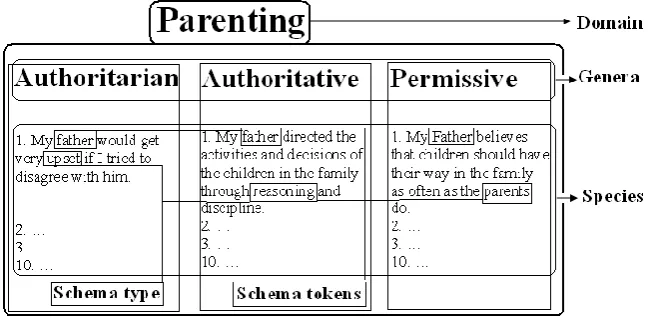
Figure 5.1 presents the schema tokens, types and statements forming the three prototypes of “parenting” as measured by PAQ. As can be seen, there is no connection among authoritarian, authoritative and permissive prototypes because Buri (1991) treated them as three distinct parenting styles or macro structures. Similarly, there is no connection between "the prototypes of parenting" and “parenting” itself as a superordinate concept encompassing the prototypes. However, when the PAQ is analyzed by employing the microstructural approach of schema theory, it shows that the statements comprising the prototypes do share a fairly large number of schemata with each other. The schema type “father”, for example, appears in the three genera as shown in the figure. (The exact number of common and distinct schemata will be presented shortly in the discussions section.)
Figure 1. Schema tokens, types and species forming parenting prototypes
Based on the microstructural approach of schema theory parenting is treated as a cognitive domain as Khodadady, Aryanjam, and Ghazanfari (2015), Khodadady and Bagheri (2014), Khodadady and Dastgahian (2015a, 2015b), Khodadady and Fard (2014), Khodadady and Gholamian (2014), Khodadady and Mokhtary (2014) and Khodadady and Moosavi (2014) did with English language policy, Islamic religious orientations, Syria Unrest, motivations underlying English language learning and personality, respectively. According to these scholars, the main construct measured by any psychological measure such as PAQ, i.e., parenting, is a cognitive domain whose constituting schemata, species and genera relate to each other in a hierarchical system. Within this system, the schemata represent the main and basic concepts by use of which the broader concepts of species, genera and domain are expressed and measured.
The present study is designed to investigate whether the parenting construct underlying the development of the PAQ stands the microstructural analysis of schema theory as other questionnaires such as English Language Policy Inventory (Khodadady et al., 2015) and Islamic Religious Orientation Scale (Khodadady & Bagheri, 2014) do. It also attempts to find out whether the parenting domain relates significantly to grade one senior high school (G1SHS) students’ English language achievement measured by final English language examination held nationally at the end of grade three junior high schools.
II. METHODOLOGY A. Participants
Three hundred and nineteen female grade one senior high schools (G1SHS) students took part in this study voluntarily. (Three participants were, however, removed from the study because they had not filled out the PAQ.) They had registered as full time students at Hatami, Parvin Etesami and Noor G1SHSs in educational district four in Mashhad, Iran. They were 15 years of age and spoke Persian (n = 306, 95.9%), Kurdish (n = 4, 1.3%) and Turkish (n = 3, 0.9%) as their mother language.
B. Instruments
Three instruments were employed in this study: a Biodata Questionnaire, Parent Authority Questionnaire and the English scores the G1SHS students had obtained on their Final English Examination held at grade three junior high schools.
1. Biodata Questionnaire
In order to obtain the required demographic information a biodata questionnaire containing one short-answer question and four multiple choice items was developed in this study. They dealt with the participants’ age, educational background, gender, family structure and mother language.
2. Parent Authority Questionnaire
and attitudes at home. G1SHS students participating in this study were required to completely disagree, disagree, almost disagree, agree and completely agree with each statement. The values of 1, 2, 3, 4, and 5 were assigned to these choices, respectively. The statements (Ss) deal with Authoritarian (10Ss), Authoritative (10Ss) and Permissive (10Ss) styles. Statement two of the PAQ which describes an Authoritarian father, for example, reads, "even if his children do not agree with him my father feels that it is for our own good if we are forced to conform to what he thinks is right". Buri does not provide his readers with alpha coefficient related to the PAQ. He did, however, report .75, .85, and .82 for mothers’ permissiveness, authoritarianism, and authoritativeness, respectively. He also reported .74, .87 and .85 for fathers’ permissiveness, authoritarianism, and authoritativeness, respectively.
3. English Language Achievement Scores
For determining the participants’ English language achievement and exploring its relationship with the cognitive domain of parenting their scores on the written Final English Examination (FEE) held at grade three junior high schools (G3JHSs) was obtained from their G1SHSs. The FEE is designed by a team of experienced English teachers and is held nationally at the end of school year. It is a criterion or content-based achievement examination developed on the textbook English book 3 (Birjandi & Soheili, 2009). The cut-off score of 10 out of 20 is adopted to admit students to G1SHSs.
The FEE consisted of 18 sections and 57 items for which 90 minutes were allotted to be completed. The items involved restoring the deleted letters of three words having pictorial stimuli (section 1), restoring the middle letters of some words appearing in two sentences (section 2), matching the answers with the questions provided (section 3), filling incomplete sentences with scrambled phrases (section 4), finding specific phonemes in words (section 5), restoring the missing words of some sentences (section 6), collocations (section 7), filling the blanks with given words (section 8), filling a crossword (section 9), multiple choice items dealing with grammar (section 10), filling the blanks with structural words (section 11) finding erroneous parts of sentences (section 12), changing statements to questions (section 13), ordering scrambled words into sentences (section 14), giving a complete answer to an open-ended question (section 15), matching drawings with written statements (section 16), choosing the best choice to complete a sentence (section 17), and answering questions based on a reading passage (section 18)
C. Procedures
Following Khodadady and Hadizadeh’s (2013) suggestion, Buri’s (1995) PAQ was translated into Persian by employing schema theory (Khodadady, 2008; Khodadady & Lagzian, 2013; Seif & Khodadady, 2003). (The interested readers can contact the corresponding author to obtain a copy of the Persian PAQ.) It requires providing the best equivalents for target words by focusing on their semantic features as they relate to each other within the context of the statements they constitute. Esfandiyari’s (1995) translation of the PAQ is widely used in Iran. It was not, however, employed in this study because he took the liberty to change whatever words he felt necessary to develop a localized questionnaire. The first English statement describing permissive mothers, for example, reads, “While I was growing up my father/mother felt that in a well-run home the children should have their way in the family as often as the parents do.” He translated the statement as VALEDEEN BAYAD BEH BACHEHAYE KHOD EJZAZEH DAHAND TA HAR ANCHEH RA KEH MIKHAHAND ANJAM DAHAND (Parents should allow their children to do whatever they want.)
Similar to Esfandiyari (1995), however, the first introductory part, i.e., while I was growing up, was not included in the translation of the statements of which it had formed a part because the participants of this study were not university students as Buri’s (1991) were. (In other words, the participants of this study were still parented by their fathers and mothers.) In addition to omitting this part, Esfandiyari, nonetheless, dropped the schema “felt” altogether and thus rendered the statement a fact. According to Onions (1973), the schema “felt” has eight senses among which “to believe on grounds not distinctly perceived; to have a conviction of” (p. 736) was chosen as the best equivalent for being translated into Persian.
Following Khodadady (1999) the redundant phrase “in a well-run home” was also not translated into Persian because it introduces some extra and irrelevant concepts into the answering process which bears little, if any, on the parenting styles of the G1SHS students’ fathers and mothers. One implication of the phrase is that a mother may, for example, believe that “in a well-run home” or “ideal” family, mothers should let their children do whatever they like. However, since their own home is not well-run, it does not apply to them! In other words, children can have their own way in the families which are not well-run.
In addition to dropping the schema “felt” from translation, Esfandiyari (1995) translated “should” as BAYAD (must). In the present study, it was, however, translated as “MIBAYESTI” to reflect the advisability of action. He also added the verb schemata “EJAZEH DADAN” and “ANAJM DADAN” for which no English equivalents can be found in Buri’s (1991) statement, i.e., the children should have their way in the family as often as the parents do. In other words, in Esfandiyari’s translation there is no schema suggesting parents have their own way in the family. The statement above was therefore translated as MADARAM BAR IN BAVAR AST KE FAZANDAN MESSLE VALEDIN MIBAYESTI HAR CHIZI KE MIKHAHAND BEDAST BIYAVARAND. The same procedure was followed in translating the remaining 29 statements.
contacted in Mashhad to obtain their official approval. After scrutinizing the questionnaires, they introduced the first researcher to several schools in their fourth educational district with an official letter. She immediately visited several schools in person and talked to their principles. Three of them finally agreed to have their students participate in the study provided the researcher supplied them with the results.
To collect the data as fast and as conveniently as possible, the first researcher of this study talked to the councilors of three schools to secure their support. Fortunately, they showed great interest in the project because of their personal experiences with the parents and the necessity of providing them with some educational programs. They agreed to assign each student a code so that they could enter their FEE scores on the completed and coded questionnaires to secure their anonymity. Appreciating the help, the researcher attended classes in person and talked to the students who ultimately agreed to fill out the PAQ. All the data were collected at the end the first quarter of the school year in 2014. D. Data Analysis
For determining the types of schemata employed in the development of PAQ, Khodadady (2013) and Khodadady and Lagzian (2013) were followed and its 30 statements were parsed and their constituting schemata were analyzed and assigned to semantic, syntactic and parasyntactic schema species, genera and domains. For quantifying the parenting style of parents Khodadady and Hadizadeh (2013) were followed and the responses on statements dealing with authoritarian, authoritative and permissive parents were added up and averaged. The highest mean obtained on any of three styles for each of the participants’ responses was adopted as an indicator of her parents’ style at home. If the same mean score was obtained on two styles, it was assigned to the style which had fewer followers. To make the presentation of the data and their description simpler, the two points "disagree completely” and “disagree” were collapsed to form the single point “disagree” as were “agree” and “agree completely” to form another single point. Following Buri (1989), Cronbach’s (1951) alpha reliability coefficient was estimated to determine the reliability level of the PAQ as a whole. The same formula was followed to estimate the reliability level of the authoritarian, authoritative and permissive sections of the PAQ. And finally, the PAQ and its three sections were correlated with the scores obtained on the FEE to explore the relationship between parenting and English achievement. All statistical analyses were run via the IBM SPSS Statistics 20 to address the following hypotheses.
H1. There is no significant relationship between fathers’ parenting domain and their G1SHS children’s English achievement.
H2. There are no significant relationships between fathers’ parenting genera and their G1SHS children’s English achievement.
H3. There is no significant relationship between mothers’ parenting domain and their G1SHS children’s English achievement.
H4. There are no significant relationships between mothers’ parenting genera and their G1SHS children’s English achievement.
III. RESULTS
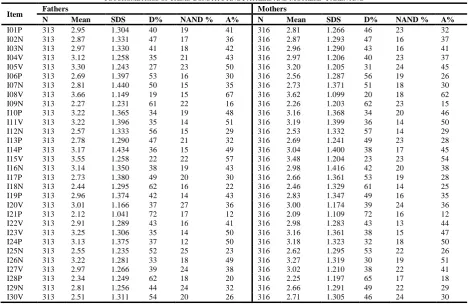
TABLE 1
PSYCHOMETRICS OF ITEMS CONSTITUTING FATHERS AND MOTHERS’PARENTING
Item Fathers Mothers
N Mean SDS D% NAND % A% N Mean SDS D% NAND % A%
I01P 313 2.95 1.304 40 19 41 316 2.81 1.266 46 23 32 I02N 313 2.87 1.331 47 17 36 316 2.87 1.293 47 16 37 I03N 313 2.97 1.330 41 18 42 316 2.96 1.290 43 16 41 I04V 313 3.12 1.258 35 21 43 316 2.97 1.206 40 23 37 I05V 313 3.30 1.243 27 23 50 316 3.20 1.205 31 24 45 I06P 313 2.69 1.397 53 16 30 316 2.56 1.287 56 19 26 I07N 313 2.81 1.440 50 15 35 316 2.73 1.371 51 18 30 I08V 313 3.66 1.149 19 15 67 316 3.62 1.099 20 18 62 I09N 313 2.27 1.231 61 22 16 316 2.26 1.203 62 23 15 I10P 313 3.22 1.365 34 19 48 316 3.16 1.368 34 20 46 I11V 313 3.22 1.396 35 14 51 316 3.19 1.399 36 14 50 I12N 313 2.57 1.333 56 15 29 316 2.53 1.332 57 14 29 I13P 313 2.78 1.290 47 21 32 316 2.69 1.241 49 23 28 I14P 313 3.17 1.434 36 15 49 316 3.04 1.400 38 17 45 I15V 313 3.55 1.258 22 22 57 316 3.48 1.204 23 23 54 I16N 313 3.14 1.350 38 19 43 316 2.98 1.416 42 20 38 I17P 313 2.73 1.380 49 20 30 316 2.66 1.361 53 19 28 I18N 313 2.44 1.295 62 16 22 316 2.46 1.329 61 14 25 I19P 313 2.96 1.374 42 14 43 316 2.83 1.347 49 16 35 I20V 313 3.01 1.166 37 27 36 316 3.00 1.174 39 24 36 I21P 313 2.12 1.041 72 17 12 316 2.09 1.109 72 16 12 I22V 313 2.91 1.289 43 16 41 316 2.98 1.283 43 13 44 I23V 313 3.25 1.306 35 14 50 316 3.16 1.361 38 15 47 I24P 313 3.13 1.375 37 12 50 316 3.18 1.323 32 18 50 I25N 313 2.55 1.235 52 25 23 316 2.62 1.295 53 22 26 I26N 313 3.22 1.281 33 18 49 316 3.27 1.319 30 19 51 I27V 313 2.97 1.266 39 24 38 316 3.02 1.210 38 22 41 I28P 313 2.34 1.249 62 18 20 316 2.25 1.197 65 17 18 I29N 313 2.81 1.256 44 24 32 316 2.66 1.291 49 22 29 I30V 313 2.51 1.311 54 20 26 316 2.71 1.305 46 24 30
Note: A: agree, D: disagree, NAND: neither agree nor disagree, N: authoritarian, P: permissive, V: authoritative,
Table 2 presents the descriptive statistics and reliability estimates of the PAQ and its three sections measuring the parenting domain and its genera. As can be seen, among the three styles, the number of fathers and mothers determined to be authoritative by G1SHS students, i.e., 153 and 160, has proved to be more than the authoritarian, i.e., 90 and 84, and permissive ones, i.e., 70 and 72, respectively. The three genera for both fathers and mothers are all highly reliable in that they are in .80s. The PAQ itself has a relatively low alpha coefficient for fathers, i.e., .51, which is slightly higher than that of mothers, .45. The low reliability of the PAQ is, however, acceptable because Khodadady and Namaghi (2013) administered 36-item Reading the Mind in the Eyes Test developed by Baron-Cohen et al. (2001) to 181 undergraduate university students and reported an alpha of .54.
TABLE 2
DESCRIPTIVE STATISTICS AND RELIABILITY ESTIMATES OF FATHERS AND MOTHERS’PARENTING DOMAINS AND GENERA AS DETERMINED BY THEIR
G1SHSDAUGHTERS
Parents Genera and Domain N Mean SD Skewness Kurtosis Alpha
Fathers
Authoritarian 90 28.00 8.976 .354 -.687 .865 Authoritative 153 32.18 8.849 -.004 -1.001 .879
Permissive 70 27.89 8.418 .334 -.602 .833
Parenting 313 87.24 9.989 .436 -.225 .508
Mothers
Authoritarian 84 27.16 9.366 .395 -.738 .882 Authoritative 160 31.94 8.773 .111 -.870 .882
Permissive 72 27.30 8.264 .393 -.677 .834
Parenting 316 85.95 9.372 .469 .088 .451
TABLE 3
CORRELATION BETWEEN FEE AND PAQDETERMINING FATHERS’PARENTING DOMAIN AND ITS GENERA
Test and Domain FEE Domain Authoritarian Authoritative Permissive
FEE 1 .122* .127* .424** -.417**
Domain .122* 1 .357** .496** .342**
Authoritarian .127* .357** 1 -.225** -.380**
Authoritative .424** .496** -.225** 1 -.180**
Permissive -.417** .342** -.380** -.180** 1
* Correlation is significant at the 0.05 level (2-tailed) ** Correlation is significant at the 0.01 level (2-tailed)
Table 4 presents the correlations between G1SHS students’ scores on the FEE and their performance on the PAQ determining their mothers’ parenting domain and its three genera. As can be seen, the PAQ correlates significantly with the FEE (r = .122, p<.05) and thus rejects the third hypothesis that there is no significant relationship between mothers’ parenting domain and their G1SHS children’s English achievement. Furthermore, the three authoritarian, authoritative and permissive sections of the PAQ correlate significantly with the FEE (r = .127, p<.05; .424, p<.01; and -.417, p<.01, respectively), and thus reject the fourth hypothesis that there are no significant relationships between mothers’ parenting genera and their G1SHS children’s English achievement.
TABLE 4
CORRELATION BETWEEN FEE AND PAQDETERMINING MOTHERS’PARENTING DOMAIN AND ITS GENERA
Test and Domain FEE Domain Authoritarian Authoritative Permissive
FEE 1 .128* .124* .438** -.462**
Domain .128* 1 .331** .521** .232**
Authoritarian .124* .331** 1 -.253** -.471**
Authoritative .438** .521** -.253** 1 -.183**
Permissive -.462** .232** -.471** -.183** 1
* Correlation is significant at the 0.05 level (2-tailed) ** Correlation is significant at the 0.01 level (2-tailed)
IV. DISCUSSIONS AND CONCLUSION
The findings of this study establish the PAQ as a measure of parenting which relates significantly to G1SHS students’ English language achievement. They show that regardless of the authoritarian, authoritative and permissive genera of parenting styles, fathers and mothers explain 1.5 and 1.6 percent of variance in their female children’s learning of English in the schools where the present project was conducted. Since no studies have, to the best knowledge of present researchers, explored the relationship of G1SHS students’ English achievement with other variables in Iran, no comparisons could be made here to find out what position parents' styles occupy in relation to other variables such as social capitals.
Finding a significant relationship between parenting and English achievement is, therefore, unique to this study because no study has approached the PAQ as a measure of parenting per se in Iran. The finding owes to the microstructural approach of schema theory which defines language in relation to the role each schema plays in representing and understanding a specific concept at a basic level of cognition and its application with other schemata at broader levels such as species, genera and domains. To accomplish the task, the PAQ was explored at two levels in this study, i.e., linguistically and cognitively.
TABLE 5
SCHEMA TOKENS AND TYPES COMPRISING DOMAINS OF LANGUAGE USED IN PAQ
Domain Genera Schema
tokens
Schema tokens%
Distinct Schema types
Common Schema types
Total schema types
Semantic
Adjectives 20 3.0 14 0 14
Adverbs 10 1.5 7 1 8
Nouns 140 21.3 33 7 40
Verbs 115 17.5 61 4 65
Total 285 43.4 115 12 127
Syntactic
Conjunctions 43 6.6 4 2 6
Determiners 83 12.7 9 2 11
Prepositions 57 8.7 7 5 12
Pronouns 106 16.2 11 8 19
Syntactic verbs 28 4.3 7 2 9
Total 317 48.3 38 19 57
Parasyntactic
Abbreviations 3 .5 2 0 2
Para-adverbs 23 3.5 8 2 10
Particles 28 4.3 1 0 1
Total 54 8.2 11 2 13
Total 656 100.0 164 33 197
The contribution of microstructural approach to understanding “parenting” becomes more vivid when it is approached from a cognitive perspective as well. As illustrated in Figure 2, one hundred ninety seven schema types combine with each other in various tokens to produce 30 species whose contribution to authoritarian, authoritative and permissive genera have been determined by specialists in various related fields. Future research must show whether the species assigned to the three genera load on the same factors if the participants’ evaluation of the species are subjected to factor analysis. The findings of this study, however, show that the genera established by authorities do also share a number of concepts with each other without which their relevance to a single domain called “parenting” could not be discerned. These common schemata help children accept their fathers and mothers as their parents even if they differ from each other in certain schemata, species and genera.
Figure 2. Schema tokens, types, species and genera forming parenting domain
Sixteen noun schema types comprise the ten species constituting the authoritarian genus addressed by the PAQ, i.e. “authority”, “behaviors”, “boss”, “children”, “decisions”, “expectations”, “family”, “father”, “force”, “parents”, “problems”, “questions”, “respect”, “society”, “thought”, and “ways”. A comparison of these schemata with those employed by Baumrind (1966) shows that Buri (1991) avoided the application of some key concepts such as “conduct” and “standard” comprising the phrasal schema of “a set standard of conduct”. These differences can be utilized to revise the PAQ and explore the effect of revision on variables of interest in future studies.
The authoritative genus of parenting domain consists of 239 and 94 schema tokens and types, respectively. Fathers and mothers’ authoritative genus relates to G1SHS students’ English achievement, i.e., r = .424 and .438, p<.01, respectively, indicating that authoritative genus is more related to the achievement than the authoritarian genus does. These findings show that while 18 and 19 percent of G1SHS students’ English achievement is explained by their authoritative fathers and mothers’ parenting it drops to only one percent when it is related to teacher effectiveness as measured by the English Language Teachers’ Attribute Scale (ELTAS) at G3SHSs. Khodadady, Fakhrabadi, and Azar, (2012) administered the ELTAS to 1328 G3SHS students and correlated it with their self-reported English achievement scores and reported the correlation coefficient of .111 (p. <.01), indicating that authoritative fathers and mothers’ role in their children’s achievement is far stronger than their English teachers’.
As the third style of parenting, the permissive genus consists of 200 and 99 schema tokens and types, respectively. In sharp contrast to authoritative genus, fathers and mothers’ permissive genus relates strongly but negatively to G1SHS students’ English achievement, i.e., r = -.417 and -.462, p<.01, respectively, indicating that the more permissive the parents are in their parenting the less their daughters achieve in their English course at school. Based on these findings it is suggested that in addition to studying significant differences in the mean scores in variables such as achievement, the relationship of parenting and its genera with these variables be explored. Khodadady and Hadizadeh (2013), for example, showed that the mean scores of preschoolers brought up by authoritative and permissive parents did not differ significantly from each other on S-Tests measuring their children’s first language acquisition, implying that the two genera are the same. The findings of this study do, however, show that authoritative parenting must be adopted if parents wish to make a difference in their G1SHS students’ English achievement.
REFERENCES
[1] Baron-Cohen, S., Wheelwright, S., Hill, J., Raste, Y., & Plumb, I. (2001). The “Reading the Mind in the Eyes” test revised version: A study with normal adults, and adults with Asperger syndrome or high-functioning autism. Journal of Child Psychology and Psychiatry, 42, 241-251.
[2] Baumrind, D. (1966). Effects of authoritative parental control on child behavior. Child Development, 37, 887-907. [3] Baumrind, D. (1971). Current patterns of parental authority. Dev. Psychol. 4, 1–103.
[4] Baumrind, D. (1978). Parental disciplinary patterns and social competence in children. Youth and Society, 9, 239–276.
[5] Baumrind, D. (1991). Parenting styles and adolescent development. In J. Brooks-Gunn, R. Lerner, & A. C. Petersen (Eds.), The encyclopedia of adolescence (pp.746- 758). New York: Garland.
[6] Bibi, F., Chaudhry, A. G., Awan, E. A., & Tariq, B. (2013). Contribution of parenting style in life domain of children. IOSR Journal Of Humanities And Social Science (IOSR-JHSS), 12(2), 91-95.
[7] Birjandi, P., & Soheili, A. (2009). English book 3. Tehran: Ketabhaye Darsie Iran Publication.
[8] Bugental, D. B. (1992). Affective and cognitive processes within threat-oriented family systems. In I. Sigel, A. McGillicuddy-DeLisi, & J. Goodnow (Eds.), Parental belief systems: The psychological consequences for children (2nd ed., pp. 219–248). Hillsdale, NJ: Lawrence Erlbaum Associates, Inc.
[9] Buri, J. R. (1991). Parental authority questionnaire. Journal of Personality Assessment, 57(1), 110-119.
[10] Chan, T. W., Koo, A. (2011). Parenting style and youth outcomes in the UK. European Sociological Review, 27(3), 385–399. [11] Coplan, R. J., Hastings, P. D., Lagacé-Séguin, D. G., & Moulton, C. E. (2002). Authoritative and Authoritarian Mothers’
Parenting Goals, Attributions, and Emotions across Different Childrearing Contexts. Parenting: Science and Practice, 2(1), 1– 26.
[12] Cramer, K. E. (2002). The influences of parenting styles on children’s classroom motivation. Unpublished MA thesis, Louisiana State University.
[13] Cronbach, L. J. (1951). Coefficient alpha and the internal structure of tests. Psychometrika, 16, 297-334.
[14] Darling, N. (1999). Parenting style and its correlates. Clearinghouse on Elementary and Early Childhood Education. Retrieved March 23, 2013 from http: //ecap. crc. illinois. edu/ eecearchive/digests/1999/darlin99.pdf [4].
[15] Darling, N., & Steinberg, L. (1993). Parenting style as context: An integrative model. Psychological Bulletin, 13(3), 487-496. [16] Dix, T. (1993). Attributing dispositions to children: An interactional analysis of attribution in socialization. Personality and
Social Psychology Bulletin, 19, 633–643.
[17] Eisenberg, N., Cumberland, A., & Spinrad, T. L. (1998). Parental socialization of emotion. Psychological Inquiry, 9, 241–273. [18] Ellis, R. M. (2007). Relationship between parenting styles and children’s motivation style: The development of learned
helplessness (unpublished master’s thesis). Wichita State University, United Sates of America.
[19] Esfandiyari, G. R. (1995). Comparing the parenting styles of mothers whose children suffer from behavioral disorder with those of normal children's mothers and the effect of mothers' education on behavior disorders. Unpublished MA thesis, Tehran Psychiatric Institute.
[20] Grusec, J., & Goodnow, J. (1994). Impact of parental discipline methods on the child’s internalization values: A reconceptualization of current points of view. Developmental Psychology, 30, 4–19.
[21] Hastings, P., & Coplan, R. (1999). Conceptual and empirical links between children’s social spheres: Relating maternal beliefs and preschoolers’ behaviors with peers. New Directions for Child and Adolescent Development, 86, 43–59.
[22] Holden, G.W., & Miller, P. C. (1999). Enduring and different: Ameta-analysis of the similarity in parents’ child rearing.
Psychological Bulletin, 125, 223–254.
[23] Khodadady, E. (2008). Schema-based textual analysis of domain-controlled authentic texts. Iranian Journal of Language Studies (IJLS), 2(4), 431-448.
[26] Khodadady, E., & Bagheri, N. (2014). Development and validation of an Islamic religious orientation scale with pilgrims of Imam Reza shrine. Journal of Arts and Humanities, 3(8), 37-50.
[27] Khodadady, E., & Dastgahian, B. S. (2015a). Schema-based English achievement and teacher effectiveness. Theory and Practice in Language Studies, 5(5), xxx-xxx.
[28] Khodadady, E., & Dastgahian, B. S. (2015b). Teacher effectiveness, educational grade and English achievement. Theory and Practice in Language Studies, 5(8), xxx-xxx.
[29] Khodadady, E., & Fard, H. K. (2014). Ideology in the BBC and Press TV’s coverage of Syria unrest: A schema-based approach. Review of Journalism and Mass Communication, 2(1), 47-67.
[30] Khodadady, E., & Gholamian, M. (2014). Motivations underlying blind students’ English language learning: A theoretical and factorial analysis. International Journal of Applied Psychology, 4(5), 169-180.
[31] Khodadady, E., & Hadizadeh, B. (2013). Parenting styles and their relationships with pre-school children’s first language proficiency. American Journal of Scientific Research, 93, 97-107.
[32] Khodadady, E., & Hadizadeh, B. (2013). Parenting styles and their relationships with pre-school children’s first language proficiency. American Journal of Scientific Research, 93, 97-107.
[33] Khodadady, E., & Lagzian, M. (2013). Textual analysis of an English dentistry textbook and its Persian translation: A schema-based approach. Journal of Studies in Social Sciences, 2(1), 81-104.
[34] Khodadady, E., & Mokhtary, M. (2014). Does personality measured by NEO-FFI consist of five dimensions? International Journal of Humanities and Social Science (IJHSS), 4(9/1), 288-301.
[35] Khodadady, E., & Moosavi, E. G. (2015). Spiritual intelligence and English language learning at a specific grade in secondary education. Theory and Practice in Language Studies, 5(9), xxx-xxx.
[36] Khodadady, E., & Namaghi, I. M. (2013). Social intelligence and language proficiency: Are they related? European Journal of Scientific Research, 102(1), 7-14.
[37] Khodadady, E., Aryanjam, L. & Ghazanfari, M. (2015). English language policy and teacher effectiveness at grade three senior high schools. Journal of Language Teaching and Research, 6(3), xxx-xxx.
[38] Khodadady, E., Fakhrabadi, G. Z., & Azar, K. H. (2012). Designing and validating a comprehensive scale of English Language Teachers' Attributes and establishing its relationship with achievement. American Journal of Scientific Research, 82, 113-125. [39] King, D. B. (2008). Rethinking claims of spiritual intelligence: A definition, model, and measure(Unpublished master’s thesis,
Trent University, Canada, Ontario.
[40] Mills, R., & Rubin, K. H. (1990). Parental beliefs about problematic social behavior in early childhood. Child Development, 61, 138–151.
[41] Mokhtary, M. (2014). Validating the revised NEO Five-Factor Inventory of personality with grade three high school students and exploring its relationship with their English achievement (Unpublished master's thesis). Ferdowsi University of Mashhad, Iran.
[42] Moosavi, E. G. (2014). Validating a spiritual intelligence scale translated into Persian and exploring its relationship with grade three senior high school students’ English achievement (Unpublished master's thesis). Ferdowsi University of Mashhad, Iran. [43] Seif, S. & Khodadady, E., (2003) Schema-based cloze multiple choice item tests: measures of translation ability. Universite de
Tabriz, Revue de la Faculte des Letters et Sciences Humaines, Langue, 187(46), 73-99.
[44] Sigel, I., McGillicuddy-DeLisi, A., & Goodnow, J. (1992). Parental belief systems: The psychological consequences for children (2nd ed.). Hillsdale, NJ: Lawrence Erlbaum Associates, Inc.
[45] Smetana, J. G. (1995). Parenting styles and conceptions of parental authority during adolescence. Child Development, 66, 299– 316.
Ebrahim Khodadady obtained his PhD in Applied Linguistics from the University of Western Australia. He holds TESL Ontario and Canadian Language Benchmarks Placement Test (CLPBPT) certificates and has taught English as a first, second and foreign language to high school and university students in Australia, Canada and Iran.
He is currently an academic member of Ferdowsi University of Mashhad, Iran. He was invited as a VIP by Brock University in Canada in 2004 and served as the Associate Director of Assessment Center at George Brown College in Toronto for almost a year. His published books are Multiple-Choice Items in Testing: Practice and Theory (Tehran, Rahnama, 1999), Reading Media Texts: Iran-America Relations (Sanandaj, Kurdistan University, 1999), English Language Proficiency Course: First Steps (Sanandaj, Kurdistan University, 2001) and Research Principles and Methods and Statistics in Applied Linguistics (Mashhad, Hamsayeh Aftab, 2013). His main research interests are Psychometrics, Psycholinguistics, Sociolinguistics.