107
DIATOMS FROM A PEAT BOG ON THE PEŠTER PLATEAU (SOUTHWESTERN SERBIA):
NEW RECORDS FOR DIATOM FLORA OF SERBIA
Danijela Vidaković*, Jelena Krizmanić, Sanja Šovran and Mirko Cvijan
University of Belgrade, Faculty of Biology, Institute of Botany and Botanical Garden “Jevremovac”, Belgrade, Serbia
*Corresponding author: [email protected]
Received: May 12, 2015; Revised: June 10, 2015; Accepted: July 7, 2015; Published online: November 27, 2015
Abstract: The distribution of diatoms was studied in three types of diatom communities (epiphytes, benthos and plankton) of a peat bog on the Pešter plateau. The observed diatom flora inhabited all investigated communities, comprising in total 250 taxa in 53 genera. Among them, 45 taxa were new records for the Serbian diatom flora. Identified taxa belonged to dif-ferent groups of algae, however alkaliphile diatoms were dominant. New ecological data for Encyonopsis minuta, Pinnularia isostauron and P. marchica are presented here. All the diatoms were documented by light micrographs, and brief notes on their morphology, distribution and ecology are provided.
Key words:diatoms; new records; peat bog; Pešter plateau
INTRODUCTION
Among aquatic ecosystems, peat bogs are a very spe-cific environment, possessing unique ecological prop-erties and remarkably high diversity of diatom flora. In Serbia, they are not as numerous as in northern and western Europe. In addition, they are gradually dis-appearing due to anthropogenic and climatic factors (Buczko and Wojtal, 2005; Kulikovskiy et al., 2010; Šovran et al., 2013). These factors mutually affect the composition of the total algal flora, including diatom flora, which is a permanent component of the biota in peat bogs (Kulikovskiy, 2008).
The main purpose of the study was to record the floristic characteristics of the diatom assemblages of the peat bog on the Pešter plateau due to its unique-ness not only in Serbia but in Europe as well. There are relatively little literature data about the morphology, distribution and ecology of diatoms from the peat bog on the Pešter plateau (Krizmanić, 2009; Vidaković et al., 2013).
Description of the study area
The Pešter plateau is located in southwestern Serbia and lies at an altitude of 1150-1492 m a.s.l. With an area of around 50 km², Pešter is the largest plateau in Serbia, and the highest on the Balkan Peninsula. Four rivers (Uvac, Vapa, Jablanica and Grabovica) flow through the plateau. The peat bog from the Pešter plateau is one of the last large preserved peat bogs in Serbia. It has a somewhat acid reaction, with a fair amount of organic matter, but with humic acids pre-dominating (Tešić et al., 1960).
MATERIALS AND METHODS
through the open water. All samples were fixed with formaldehyde to a final concentration of about 4% shortly after sampling.
Water temperature and transparency were meas-ured in situ at all localities. Water samples for chemical analysis were collected using a Ruttner sampler (depth 0.5 m). The samples were stored in plastic containers at 4oC for transfer to the laboratory for further analyses.
The analysis of physicochemical parameters of water (pH, conductivity, Ca2+ concentrations) was performed
at the Institute of Public Health of Serbia “Dr Milan Jovanović Batut”, by standard analytical methods.
In laboratory algological samples were treated us-ing standard methods to obtain permanent slides of diatoms (Krammer and Lange-Bertalot, 1986). Light microscope observations and micrographs were made using a Zeiss AxioImagerM.1 microscope with DIC optics and AxioVision 4.8 software.
RESULTS AND DISCUSSION Physical and chemical parameters
The results of the physical and chemical parameters of water are summarized in Table 1. The peat bog on the Pešter plateau differed in physicochemical parameters from peat bogs such as the sphagnum bogs of the Volga Upland (Kulikovskii, 2008), Nur bog in northern Mon-golia (Kulikovskii et al., 2010) or peat bogs in the
Mari-time Alps Nature Park (Falasco and Bona, 2011). The pH was significantly lower in the sphagnum bogs of the Volga Upland (4.4-5.1) and in Nur bog (5.5-5.6), but in the Maritime Alps Nature Park the pH was similar to our values (6.17-6.68). The conductivity range was much higher than in other peat bogs, sphagnum bogs of the Volga Upland (27.3-54 µS cm-1), peat bogs in the
Maritime Alps Nature Park (17-26 µS cm-1).
Diatom communities
The Pešter plateau peat bog was characterized by high diversity of diatoms. A total of 250 taxa belonging to 53 genera were determined in the studied samples. The most abundant genera were Pinnularia (23 taxa),
Gomphonema (22), Nitzschia (22) and Navicula (17). Among them, 45 taxa were new records to the Serbian diatom flora (Table 2). Recent studies of Kulikovskiy et al. (2010) have shown that the total number of spe-cies identified in peat bog microhabitats exceeds 200-300 species. Some of the most species-rich genera in peat bogs are Amphora, Aulacoseira, Cymbopleura,
Encyonema, Eunotia, Fragilaria, Gomphonema, Luti-cola, Navicula, Neidium, Nitzschia, Pinnularia, Psam-mothidium and Stauroneis. This observation is based on results from peat bogs in Hungary (Buczkó and Wojtal, 2005), southern Poland (Wojtal et al., 1999), Volga Upland (Kulikovskiy, 2008) and the Nur bog in northern Mongolia (Kulikovskiy et al., 2010).
Descriptions of the new taxa, which occurred more than once in the samples, are presented below.
Adlafia bryophila (Petersen) Moser (1998: 89)
(Moser et al., 1998) (pl. 2, Fig. 23, Table 2)
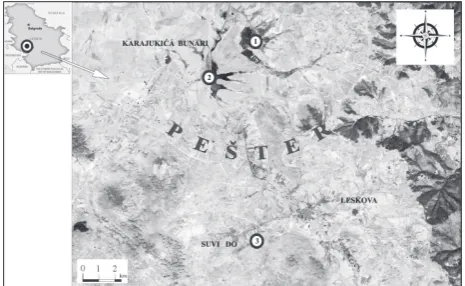
Fig. 1. Map of the Pešter plateau with investigated localities: 1 − Excavation of peat, 2 − Jezero, 3 − Suvi Do.
Table 1. Ranges of physical and chemical parameters at peat bog localities of the Pešter plateau.
Locality Excavation of peat (1) Jezero (2) Suvi Do (3) Parameters Ranges of the parameter values
Temperature [oC] 13-21 13-22 14-20
Transparency [mm] / 200-500 / pH 6.5-7.1 7.1-7.2 7.1-7.3 Conductivity [μS cm-1] 59-78 30-250 300-350
Valve length 14.4-18.67 µm, width 2.97-3.8 µm; striae 27-33 per 10 µm. At our sampling sites the pH varied from 6.5-7.3, conductivity from 77-350 µS cm-1
and the Ca2+ concentrations varied from 2.8-69 mg
L-1. It is probably cosmopolitan, locally frequent on
intermittently wet bryophytes, periodically drying up aerophytic habitats (Lange-Bertalot, 2001; Buc-zkó and Wojtal, 2005). Occurring in various waters, except those of higher saprobity levels of more than β-mesosaprobic, predominantly under oligosaprobic conditions (Lange-Bertalot, 2001).
Amphora alpestris Levkov (2009: 34; 283; pl. 51,
Figs 1-14; pl. 168, Figs 1-4; pl. 169, Figs 1-4) (Lev-kov, 2009) (pl.1, Figs11-12, Table 2)
Valve length 26.66-5.79 µm, width 16.3-22.35 µm; dorsal striae 14-16, ventral striae 13-15 per 10 µm. In the material studied, pH varied from 6.5-7.3, conduc-tivity from 77-350 µS cm-1 and the Ca2+ concentrations
varied from 2.8-69 mg L-1. According to Levkov (2009),
it is widespread in Europe in oligotrophic up to dys-trophic, slightly acidic peat bogs, streams and springs.
Brachysira neglectissima Lange-Bertalot (2004:
128; pl. 53, Figs 1-13; pl. 54, Figs 1-6) (Werum and Lange-Bertalot, 2004) (pl.2, Fig.29, Table 2)
Valve length 16.53-19.9 µm, width 4.12-4.86 µm; striae 34-36 per 10 µm Recorded from samples with pH values ranging from 7.1-7.3, conductivity from 78-350 µS cm-1 and Ca2+ concentrations from 18-69 mg L-1.
Re-corded from oligotrophic lakes together with B. neoexi-lis. Details about its distribution are missing, some habi-tats such as eutrophic lakes are doubtful (Hofmann et al., 2013; Werum and Lange-Bertalot, 2004).
Brachysira neoexilis Lange-Bertalot (1994: 51;
pl. 5, Figs 1-35; pl. 6: Figs 1-6, pl. 17: Figs 7-11: pl. 32: Figs 27-30, pl. 46, Figs 19-27) (Lange-Bertalot and Moser, 1994) (pl.2, Figs 27-28, Table 2)
Valve length 13.7-26.99 µm, width 3.98-5.54 µm; striae 29-36 per 10 µm. At the sampling sites pH was 6.5, conductivity varied from 59-77 µS cm-1 and Ca2+
concentrations from 2.8-4.4 mg L-1. According to
Hof-mann et al. (2013) it is known from oligotrophic and mesotrophic water with low nutrient content.
Brachysira procera Lange-Bertalot and Moser
(1994: 55; pl. 7: Figs 8-26, pl. 9: Figs 4-6, pl. 32: Figs 21-26) (Lange-Bertalot and Moser, 1994) (pl.2, Fig.26, Table 2)
Valve length 22.53-30.4 µm, width 4.59-5.62 µm; striae 32 per 10 µm. Recorded from samples with pH values from 6.5 to 7.1, conductivity from 77-78 µS cm-1 and Ca2+ concentrations from 2.8-18 mg L-1.
Ac-cording to Hofmann et al. (2013), it occurs in oligo-trophic, slightly acid water with low nutrient content.
Caloneis fontinalis (Grunow) Cleve-Euler (1932:
130) (Cleve-Euler, 1932) (pl.1, Fig.28, Table 2) Valve length 12.75-16.95 µm, width 3.46-4.76 µm; striae 23-25 per 10 µm. In the material studied, pH was 7.3, conductivity 350 µS cm-1 and the Ca2+
concen-tration was 69 mg L-1. Widespread species recorded
in calcium rich, mesotrophic and eutrophic waters (springs and running waters) of low saprobity with a medium or high ion content (Lange-Bertalot and Metzeltin, 1996; Solak and Wojtal, 2005; Hofmann et al., 2013)
Caloneis tenuis (Gregory) Krammer (1985: 17)
(Krammer and Lange-Bertalot, 1985) (pl.1, Figs 25-26, Table 2)
Valve length 19.32-29.9 µm, width 4.43-5.94 µm; striae 19-23 per 10 µm. Recorded from samples with pH values from 6.5-7.3, conductivity from 77-350 µS cm-1 and Ca2+ concentrations from 2.8-69 mg L-1.
Ac-cording to Van Dam et al. (1994), mainly occurring in mesotrophic waters or on wet and moist or tem-porarily dry places, with very small concentrations of organically bound nitrogen, at pH values of about 7. Widespread in the Nordic-alpine region, especially in standing, occasionally very slowly flowing, oligosapro-bic water with a low to medium ion content (Hofmann et al., 2013).
Chamaepinnularia hassiaca (Krasske)
Canto-nati and Lange-Bertalot (2009: 228) (CantoCanto-nati and Lange-Bertalot, 2009) (pl.2, Figs 34-35, Table 2)
values were from 6.5 to 7.1, conductivity from 77-78 µS cm-1 and Ca2+ concentrations varied from 2.8-18
mg L-1. It is known from streams with silicate surface
(Hofmann et al., 2013).
Diploneis krammeri Lange-Bertalot and
Rei-chardt (2000: 652; pl. 4: Figs 1-10, 12; pl. 5: Figs
1-5; pl. 6: Figs 1-5) (Lange-Bertalot and Reichardt, 2000) (pl.2, Fig.17, Table 2)
Valve length 32.49-39.51 µm, width 15.97-19 µm; striae 13-14 per 10 µm; areolae 13-15 per 10 µm; cen-tral area 4.32-5.29 µm. At our sampling, sites pH was from 7.1-7.3, conductivity varied from 78-350 µS cm-1 Plate 1 (Figs 1-28). LM micrographs. Figs 1-2Pinnularia macilenta; Fig. 3.P.
reichardtii; Fig. 4P. isostauron; Fig. 5.P. nodosa; Fig. 6.P. submicrostauron; Fig.
7.P. microstauron var. angusta; Figs 8-10.P. marchica; Figs 11-12.Amphora
alpestris; Fig. 13.Cymbopleura subaequalis var. truncata; Fig. 14.C. subaequalis
var. alpestris; Fig. 15.C. oblongata; Fig. 16.C. lata var. truncata; Fig. 17.
Gom-phonema lateripunctatum; Figs 18-19 G. hebridense; Figs 20-22 G. utae; Fig. 23 G.
occultum; Fig. 24.G. innocens; Figs 25-26.Caloneis tenuis; Fig. 27.C. aerophila;
Table 2. Checklist of the 45 new observed taxa for Serbian diatom flora from the peat bog at Pešter plateau.
Taxon Plate Figure Diatom communities
Adlafia bryophila (Petersen) Moser 2 23 B, EP
Amphora alpestrisLevkov 1 11-12 B, EP, P
Brachysira neglectissimaLange-Bertalot 2 29 B, P
Brachysira neoexilis Lange-Bertalot 2 27-28 B, EP, P
Brachysira proceraLange-Bertalot and Moser 2 26 B, EP, P
*Caloneis aerophilaBock 1 27 B
Caloneis fontinalis(Grunow) Cleve-Euler 1 28 B, EP
Caloneis tenuis(Gregory) Krammer 1 25-26 B, EP
Chamaepinnularia hassiaca(Krasske) Cantonati & Lange-Bertalot 2 34-35 B, EP
*Cymbopleura lata var. truncata Krammer 1 16 P
*Cymbopleura oblongataKrammer 1 15 B
*Cymbopleura subaequalis var. alpestrisKrammer 1 14 B
*Cymbopleura subaequalis var. truncataKrammer 1 13 B
*Diploneis fontanellaLange-Bertalot 2 18 B
Diploneis krammeriLange-Bertalot & Reichardt 2 17 B, EP
Diploneis petersenii Hustedt 2 19-20 B, EP
Diploneis separandaLange-Bertalot 2 21 B, EP
Encyonema neogracileKrammer 2 15-16 B, EP, P
Encyonema perminutumKrammer 2 13-14 B
*Encyonema persilesiacumKrammer 2 12 B
Encyonopsis microcephala var. robusta(Hustedt) Krammer 2 30-31 B, EP
Encyonopsis minutaKrammer & Reichardt 2 32-33 B, EP, P
Eunotia meisterioidesLange-Bertalot 2 24-25 B, EP, P
Gomphonema hebridenseGregory 1 18-19 B, EP, P
*Gomphonema innocens Reichardt 1 24 B
*Gomphonema lateripunctatumReichardt & Lange-Bertalot 1 17 EP
*Gomphonema occultumReichardt and Lange-Bertalot 1 23 B
Gomphonema utaeLange-Bertalot and Reichardt 1 20-22 B, P
*Navicula broetziiLange-Bertalot and Reichardt 2 3 EP
Pinnularia isostauron(Ehrenberg) Cleve 1 4 B, P
Pinnularia macilentaEhrenberg 1 1-2 B, P
Pinnularia marchicaIlka Schönfelder 1 8-10 B, EP, P
*Pinnularia microstauron var. angustaKrammer 1 7 B
*Pinnularia nodosa(Ehrenberg) Smith 1 5 B
*Pinnularia reichardtiiKrammer 1 3 B
*Pinnularia submicrostauronSchroeter 1 6 B
*Placoneis navicularis(Ehrenberg) Cox 2 1-2 B
Psammothidium daonenseLange-Bertalot 2 36-39 B
Psammothidium helveticum(Hustedt) Bukhtiuarova & Round 2 40-41 B
*Sellaphora parapupulaLange-Bertalot 2 22 B
*Stauroneis acidoclinatopsisVan de Vijver & Lange-Bertalot 2 4 B
Stauroneis neohyalinaLange-Bertalot 2 7-8 B
Stauroneis reichardtiiLange-Bertalot, Cavacini, Tagliaventi & Alfinito 2 5-6 B, EP, P
Stauroneis separandaLange-Bertalot & Werum 2 9 B, EP
*Staurosirella pinnata var. intercedens (Grunow) Hamilton 2 10-11 EP
and Ca2+ concentrations from 18-69 mg L-1. Recorded
from oligotrophic up to mesotrophic calcareous wa-ters (Hofmann et al., 2013).
Diploneis petersenii Hustedt (1937: 676, Fig.
1068 f-h) (Hustedt, 1927) (pl.2, Figs 19-20, Table 2) Valve length 8.78-20.62 µm, width 5.53-6.15 µm; striae 26-29 per 10 µm. In the material studied pH
value was 7.3, conductivity 350 µS cm-1 and the Ca2+
concentration was 69 mg L-1. Mainly occurring in
oli-gosaprobic and mesotrophic waters with very small concentrations of organically bound nitrogen and at pH values about 7. Especially widespread on wet and moist or temporarily dry places (Van Dam et al., 1994).
Plate 2 (Figs 1-41). LM micrographs. Figs 1-2. Placoneis navicularis; Fig. 3.Navicula broetzii; Fig. 4.Stauroneis acidoclinatopsis; Figs 5-6.S. reichardtii; Figs 7-8.S.
neo-hyalina; Fig. 9.S. separanda; Figs 10-11.Staurosirella pinnata var. intercedens; Fig.
12.Encyonema persilesiacum; Figs 13-14.E. perminutum; Figs 15-16.E. neogracile;
Fig. 17.Diploneis krammeri; Fig. 18.D. fontanella; Figs 19-20.D. petersenii; Fig. 21.
D. separanda; Fig. 22.Sellaphora parapupula; Fig. 23.Adlafia bryophila; Figs 24-25.
Eunotia meisterioides; Fig. 26.Brachysira procera; Figs 27-28.B. neoexilis; Fig. 29.
B. neglectissima; Figs 30-31.Encyonopsis microcephala var. robusta; Figs 32-33.E.
minuta; Figs 34-35.Chamaepinnularia hassiaca; Figs 36-39.Psammothidium
Diploneis separanda Lange-Bertalot (2004: 144; pl. 76: Figs 1-16; pl. 77: Figs 1-5) (Werum and Lange-Bertalot, 2004) (pl.2, Fig.21, Table 2)
Valve length 11.12-34.77 µm, width 5.62-8.86 µm; striae 18-23 per 10 µm. Recorded from samples with pH 7.3, conductivity 350 µS cm-1 and Ca2+
concentra-tion 69 mg L-1. It occurs in calcareous, oligotrophic
water (Hofmann et al., 2013; Werum and Lange-Ber-talot, 2004).
Encyonema neogracile Krammer (1997: 128; pl.
82: Figs 1-13; pl. 83: Figs 1-7; pl. 85: Figs 1-12; pl. 91: Figs 1, 2; pl. 93: Fig. 1; pl. (?) 97: Figs 3, 6) (Kram-mer, 1997) (pl.2, Figs 15-16, Table 2)
Valve length 22.89-37.56 µm, width 5.61-7.34 µm; striae 10-16/10 µm in the middle portion becoming 13-17/10 µm towards the ends. At our sampling sites, pH varied from 6.5-7.3, conductivity from 59-350 µS cm-1 and Ca2+ concentrations from 2.8-69 mg L-1.
Cosmopolitan, occurring in acid to circumneutral, oligotrophic lakes and streams with low ion content. Indicator of good water quality (Krammer, 1997; Hof-mann et al., 2013).
Encyonema perminutum Krammer (1997: 61;
pl. 25: Figs 20-27) (Krammer, 1997) (pl.2, Figs 13-14, Table 2)
Valve length 24.19-31.95 µm, width 6.16-7.35 µm; striae 12-13/10 µm in the middle portion becoming 14/10 µm towards the ends. Found in samples with pH 7.1, conductivity 78 µS cm-1 and Ca2+ concentration 18
mg L-1. Known only from type locality and quite often
at the site (Krammer, 1997).
Encyonopsis microcephala var. robusta (Hustedt)
Krammer (1997: 92; pl. 148: Figs 8, 9) (Krammer, 1997) (pl.2, Figs 30-31, Table 2)
Valve length 15.23-19.59 µm, width 3.56-4.18 µm; striae 20-21 per 10 µm. Recorded from samples with pH 7.3, conductivity 350 µS cm-1 and Ca2+
concentra-tion 69 mg L-1. Cosmopolitan, from boreal to tropical
zone and always often in suitable habitats. In northern Europe occurring in oligotrophic, acid waters with low electrolyte content. However, in Central Europe
and North America occurring in calcium-rich waters with medium electrolyte content (Krammer, 1997).
Encyonopsis minuta Krammer and Reichardt
(1997: 95; pl. 143: Figs 2, 3; pl. 143a: Figs 1-29; pl. 145: Fig. 15; pl. 149: Figs 17-19; pl. 150: Fig. 23; pl. 151: Figs 1-7; pl. 193: Fig. 5) (Krammer, 1997) (pl.2, Figs 32-33, Table 2)
Valve length 11.88-14.03 µm, width 3.35-3.56 µm; striae 20-24 per 10 µm. Found in samples with pH 7.3, conductivity 350 µS cm-1 and Ca2+ concentration
69 mg L-1. Cosmopolitan, from temperate to boreal
zone and always often in suitable habitats (Krammer, 1997). Ecological characteristics still missing because of lack of differentiation from Cymbella microcephala
complex (Hofmann et al., 2013).
Eunotia meisterioides Lange-Bertalot (2011:
149; pl. 119, Figs 1-26) (Lange-Bertalot et al., 2011) (pl.2, Figs 24-25, Table 2)
Valve length 17.49-20.94 µm, width 2.61-4.21 µm; striae 15-17 per 10 µm. At our sampling sites, pH varied from 6.5-7.1, conductivity from 59-78 µS cm-1 and Ca2+ concentrations varied from 2.8-18 mg
L-1. Widespread in Scandinavia and higher mountains.
According to Lange-Bertalot (2011), it occurs in acid-ic, electrolyte-poor, oligotrophic waters.
Gomphonema hebridense Gregory (1854: 99; pl.
4, Fig. 19) (Gregory, 1854) (pl.1, Figs 18-19, Table 2) Valve length 29.47-50.85 µm, width 5.4-7.12 µm; striae 14-16 per 10 µm. In the material studied, pH varied from 6.5-7.3, conductivity from 77-350 µS cm-1
and Ca2+ concentrations varied from 2.8-69 mg L-1.
According to Hofmann et al. (2013), reported from oligotrophic, circumneutral lakes and rivers of moun-tain zones with low electrolyte content.
Gomphonema utae Lange-Bertalot and
Rei-chardt (1999: 27; pl. 28, Figs 1-37; pl. 29, Figs 1-7) (Reichardt, 1999) (pl.1, Figs 20-22, Table 2)
Ca2+ concentrations from 4.4-69 mg L-1. Generally,
spe-cies widespread in waters with low electrolyte content; also can be found in wet soil (Hofmann et al., 2013). Known from peat bogs around Valasco River, Italy (Falasco and Bona, 2011), Baryczka stream, Poland (Noga et al., 2013) and in Germany (Reichardt, 1999).
Pinnularia isostauron (Ehrenberg) Cleve (1895:
93) (Cleve, 1895) (pl.1, Fig.4, Table 2)
Valve length 55.27-69.62 µm, width 9.72-10.8 µm; striae 9-10 per 10 µm. In the material studied, pH var-ied from 6.5-7.1, conductivity from 77-78 µS cm-1 and
Ca concentrations from 2.8-18 mg L-1. Widespread in
arctic, subarctic and nordic areas, commonly isolated. Occurring in oligotrophic to dystrophic waters with very low electrolyte content; pH of 6 and less (Kram-mer, 2000).
Pinnularia macilenta Ehrenberg (1843: 421; pl.
2/1: Fig. 23 (Ehrenberg, 1843) (pl.1, Figs 1-2, Table 2) Valve length 79.25-117.45 µm, width 11.2-14.7 µm; striae 8-10 per 10 µm. At our sampling sites, pH varied from 6.5-7.3, conductivity from 59-350 µS cm-1 and Ca2+ concentrations varied from 2.8-69 mg
L-1. Cosmopolitan, records from the tropics and the
temperate zone, abundant in places (Krammer, 2000).
Pinnularia marchica Ilka Schönfelder (2000: 80;
218; pl. 12, Figs 11-17; pl. 90, Figs 4, 5) (Krammer, 2000) (pl.1, Figs 8-10, Table 2)
Valve length 24.08-32.39 µm, width 5.4-6.37 µm; striae 13-15 per 10 µm. Recorded from samples with pH values from 6.5-7.1, conductivity 59-78 µS cm-1
and Ca2+ concentrations 2.8-18 mg L-1. It prefers
eu-trophic, alkaline waters with moderate electrolyte con-tent (Hofmann et al., 2013). At the type locality not rare, pH values between 7.5-8.8, conductivity about 800 µS cm-1 (Krammer, 2000).
Psammothidium daonense Lange-Bertalot
(1999: 280) (Lange-Bertalot, 1999) (pl.2, Figs 36-39, Table 2)
Valve length 9.18-12.08 µm, width 4.99-5.41 µm; striae 27-32 per 10 µm. In the material studied, pH was 7.1, conductivity varied from 59-78 µS cm-1 and
Ca2+ concentrations varied from 4.4-18 mg L-1.
Ac-cording to Hofmann et al. (2013), it occurs in oligo-trophic up to dysoligo-trophic, circumneutral waters with low electrolyte content.
Psammothidium helveticum (Hustedt)
Bukhti-yarova and Round (1996: 3) (Bukhtiuarova and Round, 1996) (pl.2, Figs 40-41, Table 2)
Valve length 16.52-17.92 µm, width 5.83-6.59 µm; striae 20-23 per 10 µm. Found in samples with pH 7.1, conductivity 78 µS cm-1 and Ca2+ concentration
18 mg L-1. Occurs in slightly acid to circumneutral
rivers with low electrolyte content on silicate surfaces (Hofmann et al., 2013).
Stauroneis neohyalina Lange-Bertalot (1996:
188; pl. 35, Figs 7-10) (Lange-Bertalot and Metzel-tin, 1996) (pl.2, Figs 7-8, Table 2)
Valve length 36.32-37.67 µm, width 6.59-7.34 µm. Recorded from samples with pH values from 6.5-7.1, conductivity 77-78 µS cm-1 and Ca2+ concentrations
2.8-18 mg L-1. Widely distributed in small humic-rich
lakes and wetlands with pH values between 6.2-7.6 and with low electrolyte content (Lange-Bertalot and Metzeltin, 1996).
Stauroneis reichardtii Lange-Bertalot, Cavacini,
Tagliaventi and Alfinito (2003: 142; pl. 36; pl. 37: Figs 1-14; pl. 61: Figs 6, 7) (Lange-Bertalot et al., 2003) (pl.2, Figs 5-6, Table 2)
Valve length 46.21-55.28 µm, width 8.64-11.12 µm; striae 19-20 per 10 µm; puncta in the striae 22 per 10 µm. In the material studied, pH varied from 6.5-7.3, conductivity from77-350 µS cm-1 and Ca2+
concentrations from 2.8-69 mg L-1. Prefers
stand-ing waterbodies (small pools and large lakes) with pH values between 6.1-8.1, low nutrient content and conductivity ranging from almost 0 µS cm-1 to 280 µS
cm-1 (Van de Vijver et al., 2004).
Stauroneis separanda Lange-Bertalot and
Werum (2004: 180; pl. 46, Figs 1-12) (Werum and Lange-Bertalot, 2004) (pl.2, Fig.9, Table 2)
Ca2+ concentrations from 2.8-69 mg L-1. It is
wide-ly distributed in chalk-rich springs of Europe with moderate electrolyte content (Hofmann et al., 2013; Werum and Lange-Bertalot, 2004).
The flora of diatoms from the peat bog on the Pešter plateau is formed of acidobiontic, acidophiles, neutrophiles, alkaliphiles, alkalibiontic, indifferents, aerophilic and widely distributed taxa. It is based on the ecological characteristics of taxa according to Le-cointe et al. (1993) and Van Dam et al. (1994). Among them, alkaliphile diatoms were dominant. The large development of alkaliphilic species is evidently related to an insufficient study of acidic habitats, including peat bogs (Kulikovskiy, 2008).
The ecological characteristics of the new observed taxa presented in this text, are matched with literature data, with several exceptions. This is a contribution to the knowledge of ecological data for Encyonopsis minuta, because of the lack of differentiation within the Cymbella microcephala complex (Hofmann et al., 2013). In our samples, Pinnularia isostauron was ob-served at higher pH values than recorded in the litera-ture (pH of 6 and less), while P. marchica was recorded at lower pH values and at lower conductivity values than suggested by literature data (pH from 7.5-8.8 and conductivity about 800 µS cm-1) (Krammer, 2000).
Species composition and distribution in the Pešter plateau peat bog, according to Lecointe et al. (1993) and Van Dam et al. (1994), indicate the dystrophic, oligotrophic up to mesotrophic environment of the peat mound. On the whole, the flora is formed by cosmopolitan species with a large involvement of taxa from alpine and subalpine areas.
Acknowledgments: Financial support was provided by the Min-istry of Education, Science and Technological Development of the Republic of Serbia (Projects No. TR 037009).
Authors’ contributions: All authors have contributed to the fieldwork, elaboration of the data, the writing process and the discussion of the results. The authors have no conflict of interest.
REFERENCES
Buczkó, K. and A. Wojtal (2005). Moss inhabiting siliceous algae
from Hungarian peat bogs. Stud. Bot. Hun.36, 21-42.
Bukhtiyarova, L. and F.E. Round (1996). Revision of the genus
Achnanthes sensu lato section Marginulatae Bukh. sect.
nov. of Achnanthidium Kütz. Diatom Res.11(1), 1-30.
Cantonati, M. and H. Lange-Bertalot (2009). On the
ultrastruc-ture of Chamaepinnularia schauppiana Lange-Bertalot & Metzeltin (Naviculaceae s.l.). Diatom Res.24(1), 225-231.
Cleve-Euler, A. (1932). Die Kieselalgen des Tåkernsees in
Schwe-den. K. Svenska Vet. Akad. Handl. 11(2), 1-254.
Cleve, P.T. (1895). Synopsis of the naviculoid diatoms. Part 2. K.
Svenska Vet. Akad. Handl.27(3), 1-219.
Ehrenberg, C.G. (1843). Verbreitung und Einfluss des
mikrosko-pischen Lebens in Süd-und Nord-Amerika. Abh. Königl.
Akad. Wiss. Berlin.1841, 291-466.
Falasco, E. and F. Bona (2011). Diatom community biodiversity in an Alpine protected area: a study in the Maritime Alps Natural Park. J. Limnol. 70(2), 157-167.
Gregory, W. (1854). Notice of the new forms and varieties of
known forms occurring in the diatomaceous earth of Mull; with remarks on the classification of the Diatomaceae. Q.
J. Microsc. Sci. 2, 90-100.
Hofmann, G., Werum, M. and H. Lange-Bertalot (2013).
Dia-tomeen im Süßwasser - Benthos von Mitteleuropa. Bestim-mungsflora Kieselalgen für die ökologische Praxis, 1-908. Koeltz ScientificBooks, Königstein.
Hustedt, F. (1927). Kryptogamen-Flora von Deutschland,
Öster-reich und der Schweiz Band VII Die Kieselalgen. Akad-emische, Leipzig.
Krammer, K. (1997). Die cymbelloiden Diatomeen. Eine
Mon-ographie der weltweit bekannten Taxa. Teil 2: Encyonema
part., Encyonopsis und Cymbellopsis, In: Bibliotheca
Dia-tomologica, 37 (Eds. H. Lange-Bertalot and P. Kociolek),
1-469. J. Cramer, Berlin-Stuttgart.
Krammer, K. (2000). The genus Pinnularia, In: Diatoms of Europe,
1 (Ed. H. Lange-Bertalot), 1-703. ARG Gantner Verlag K.G., Rugell.
Krammer, K. and H. Lange-Bertalot (1985). Naviculaceae, In:
Bib-liotheca Diatomologia, 9 (Ed. H. Lange-Bertalot), 1-230. J.
Cramer, Berlin Stuttgart.
Krammer, K. and H. Lange-Bertalot (1986). Bacillariophyceae. 1.
Teil: Naviculaceae, In: Süßwasserflora von Mitteleuropa,2/1 (Eds. H. Ettl, J. Gerloff, H. Heynig, and D. Mollenhauer), 1-876. G. Fischer Verlag, Jena.
Krizmanić, J. (2009). Floristic, taxonomical and ecological
investi-gations of siliceous algae (Bacillariophyceae, Bacillariophy-cideae, Bacillariophyta) in Serbia. University of Belgrade, Faculty of Biology, Serbia.
Kulikovskii, M.S. (2008). The species composition and
Kulikovskiy, M.S., Lange-Bertalot, H., Witkowski, A., Dorofeyuk, N.I. and S.I. Genkal (2010). Diatom assemblages from Sphagnum bogs of the World, In: Bibliotheca
Diatomo-logica, 55 (Eds. H. Lange-Bertalot and P. Kociolek), 1-326.
J. Cramer, Stuttgart.
Lange-Bertalot, H. (1999). Neue Kombinationen von Taxa aus
Achnanthes Bory (sensu lato), In: Iconographia
Diatomo-logica. Annotated Diatom Micrographs.
Phytogeography-Diversity-Taxonomy, 6 (Ed. H. Lange-Bertalot), 270-283 (In
corrected printing pp. 276-289). Koeltz Scientific Books, Königstein.
Lange-Bertalot, H. (2001). Navicula sensu stricto. 10 genera
sepa-rated from Navicula sensu lato. Frustulia, In: Diatoms of
Europe,2 (Ed. H. Lange-Bertalot), 1-526. A.R.G. Gantner
Verlag. K.G., Ruggell.
Lange-Bertalot, H. and G. Moser (1994). Brachysira.
Monogra-phie der Gattung, In: Bibliotheca Diatomologica, 29 (Ed. H. Lange-Bertalot). 1-212. J. Cramer, Stuttgart.
Lange-Bertalot, H. and D. Metzeltin (1996). Indicators of
Oligotro-phy. 800 Taxa representative of three ecologically distinct lake types, carbonate buffered-oligodystrophic-weakly buffered soft water, In: Iconographia Diatomologica.
Anno-tated Diatom Monograph, Ecology, Diversity, Taxonomy, 2
(Ed. H. Lange-Bertalot), 1-390. Koeltz Scientific Books, Königstein.
Lange-Bertalot, H. and E. Reichrdt (2000). Diploneis ovalis sensu
stricto und Diploneis krammeri nov. spec. Revision des aktuellen Konzepts von Diploneis ovalis (Hilse) Cleve, In:
Iconographia Diatomologica. Annotated Diatom Micrographs.
Phytogeography-Diversity-taxonomy, 9 (Ed. H.
Lange-Berta-lot), 650-669. Koeltz Scientific Books, Königstein.
Lange-Bertalot, H.,Cavacini, P.,Tagliaventi, N. and S. Alfinito
(2003). Diatoms of Sardinia: Rare and 76 new species in rock pools and other ephemeral waters, In: Iconographia Diatomologica. Annotated Diatom Micrographs.
Biogeogra-phy-Ecology-Taxonomy,12 (Ed. H. Lange-Bertalot), 1-438.
A.R.G. Gantner Verlag K.G, Ruggell.
Lange-Bertalot, H.,Bak, M. and A. Witkowski (2011). Eunotia
and some related genera, In: Diatoms of Europe, 6 (Ed. H. Lange-Bertalot), 1-747. Gantner Verlag K.G, Ruggell.
Lecointe, C., Coste, M. and J. Prygiel (1993). “Omnidia”: software
for taxonomy, calculation of diatom indices and inventories management. Hydrobiologia. 269/270, 509-513.
Levkov, Z. (2009). Amphora sensu lato,In: Diatoms of Europe,
5 (Ed. H. Lange-Bertalot), 1-916. A.R.G. Gantner Verlag K.G, Ruggell.
Moser, G., Lange-Bertalot, H. and D. Metzeltin (1998). Insel der
Endemiten Geobotanisches Phänomen Neukaledonien, In:
Bibliotheca Diatomologica, 38 (Eds. H. Lange-Bertalot and
P. Kociolek), 1-464. Gebrüder Borntraeger Verlag, Berlin.
Noga, T., Stanek-Tarkowska, J., Kochman, N., Peszek, Ł., Pajączek,
A. and K. Woźniak (2013). Application of diatoms to assess
the quality of the waters of the Baryczka stream, left-side tributary of the River San. J. Ecol. Eng.14(3), 8-23.
Reichardt, E. (1999). Zur Revision der Gattung Gomphonema. Die
Arten um G. affine/insigne, G. angustatum/micropus, G.
acuminatum sowie gomphonemoide Diatomeen aus dem
Oberoligozän in Böhmen, In: Iconographia Diatomologica, 8 (Ed. H. Lange-Bertalot), 1-203. Koeltz Scientific Books, Königstein.
Solak C.N. and A. Wojtal (2005). Diatoms in springs and streams
of Türkmen Mt. (Sakarya River Basin) common in Turkish inland waters. Polish Bot. J.57(2), 375-425.
Šovran, S., Jovanović, V., Krizmanić, J. and M. Cvijan (2013).
Desmid flora from four peat bogs in Serbia. Arch. Biol. Sci.
65(2), 721-732.
Tešić, Ž., Bogdanović, M., Todorović, M. and S. Stojanović (1960).
The quality of some Yugoslav peats as organic fertilizers.
Agrohemija. 5, 3-20.
Van Dam, H., Mertens, A. and J.Sinkeldau (1994). A coded
check-list and ecological indicator values of freshwater diatoms from The Netherlands. Neth. J. Aqut. Ecol. 28, 117-133.
Van de Vijver, B., Beyens, L. and H. Lange-Bertalot (2004). The
genus Stauroneis in Arctic and Antarctic Regions, In: Bib-liotheca Diatomologica, 50 (Eds. H. Lange-Bertalot and P. Kociolek), 1-312. J. Cramer, Berlin-Stuttgart.
Vidaković, D., Krizmanić, J., Šovran, S. and M. Cvijan (2013).
Epiphytic diatoms from genus Navicula (Suvi Do, Pešter plateau, Serbia), In: 42nd Annual Conference of the Serbian
Water Pollution Control Society “Water 2013”, Conference Proceeding, 65-72. Perućac.
Werum, M. and H. Lange-Bertalot (2004). Diatoms in springs
from Central Europe and elsewhere under the influence of hydrogeology and anthropogenic impacts, In: Iconographia Diatomologica. Annotated Diatom Micrographs.
Ecology-Hydrology-Taxonomy, 13 (Ed. H. Lange-Bertalot), 3-417.
A.R.G. Gantner Verlag K.G, Ruggell.
Wojtal, A., Witkowski, A. and D. Metzeltin (1999). The diatom
flora of the “Bor na Czerwonem” raised peat-bog in the Nowy Targ Basin (Southern Poland). Fragm. Flor. Geobot.