SEPARATION AND QUANTIFICATION OF STRUCTURALLY
SIMILAR IMPURITIES BY HPLC METHOD OF
VORTIOXETINE HYDROBROMIDE- AN ANTIDEPRESSANT
DRUG
Shashikant B. Landge,
[a]Sunil B. Dahale,
[a]Sachin J. Devadhe,
[a]Dattatray G. Deshmukh,
[a]Pavankumar V. Solanki,
[a]Sanjay A. Jadhav,
[a]László Kótai,
[b]Saroj R. Bembalkar,
[c]* and
Rajendra P. Pawar
[c]*
Keywords: Vortioxetine; positional isomers; isomeric impurities; HPLC method; normal phase
A new, specific, and robust normal phase liquid chromatographic (NP-LC) method for the determination of structurally similar impurities (isomers) of Vortioxetine hydrobromide has been developed and validated. An excellent chromatographic resolution between the structurally similar impurities (isomers) and Vortioxetine hydrobromide was achieved on Chiralpak-ADH (250 x 4.6 mm ID), 5 µ column. The mobile phase used of n-hexane, ethanol, diethylamine, and trifluoroacetic acid in the ratio (75:25:0.05:0.05, v/v/v/v) and the flow rate was maintained at 1.0 mLmin-1. UV detection was carried out at 235 nm. The resolution between all positional isomers and Vortioxetine hydrobromide was found not less than 2. An effect of column oven temperature on the resolution was also studied and found to be ≥ 2.0. Three structurally similar impurities (Isomer-1, Isomer-2, and Isomer-3) have been detected in the test sample of Vortioxetine hydrobromide by advanced NP-LC method. Further, these isomeric impurities were characterized by mass spectrometry, 1H NMR and FT-IR spectral data. The developed method was validated as per ICH guidelines and found to be specific, robust, and selective. The developed NP-LC method was successfully applied to the analysis of drug substance and drug product samples of Vortioxetine hydrobromide.
*Corresponding author
E-mail: [email protected], [email protected]
[a] Research and Development Center, Megafine Pharma (P) Ltd,
Nashik, India
[b] Research Centre for Natural Sciences, Budapest, Hungary [c] Department of Chemistry, Deogiri College, Station Road,
Aurangabad-431005, Maharashtra, India
INTRODUCTION
Vortioxetine is an antidepressant drug used to treat depressive disorders (depression). A major depressive disorder is a severe and disabling condition that is often accompanied by cognitive dysfunction.1 This dysfunction in depression may include impairments in attention, memory, executive function, and processing speed. Acute serotonin (5HT) depletion impairs memory and mood in vulnerable patients. The depressive disorder has traditionally been treated with tricyclic antidepressants, monoamine oxidase inhibitors, selective serotonin and norepinephrine uptake inhibitors. Vortioxetine falls under a class of typical antidepressants known as serotonin modulators and stimulators.
This drug is sold under the trade names Trintellix and Brintellix. It is made by the pharmaceutical companies Lundbeck and Takeda. Vortioxetine given orally once daily, to start with an initial dose of 5 mg or 10 mg and can be extended to a maximum of 20 mg, depending on the situation of the case under the fed condition or fasting conditions.2
There are lots of regulatory challenges to address the regulatory queries on control and carryover by organic impurities in drug substance or drug product. These impurities are sometime genotoxic, hence the proper study of these impurities by the suitably developed analytical method is critical in drug development in today's scenario. These improved continuously with the use of new reagents, catalyst and intermediates, etc., or with changes in synthesis routes. Therefore, the control of organic or inorganic impurities in the manufacturing stages of API and its starting material plays an essential role during the process development. We have observed three isomeric impurities viz., Isomer-1, Isomer-2, and Isomer-3 in the Vortioxetine hydrobromide drug substance sample (Figure 1).
2,3- Vortioxetine 2,4- Vortioxetine 2,5- Vortioxetine (Isomer-1) (Drug Substance) (Isomer-2)
2,6- Vortioxetine (Isomer-3)
Figure 1. Structure of Vortioxetine and its isomeric impurities (Isomer-1, Isomer-2, and Isomer-3).
S N N H
N S N H
S N N H
During the literature search, there were several bio-analytical methods3-7 reported for the determination of Vortioxetine and its metabolite in blood plasma. Few other pieces of literature were also available on the quantitative determination of Vortioxetine and its impurities in biological and formulation samples.8-11 However, these papers have not provided the details on the analysis of structurally similar impurities (Isomers) of Vortioxetine hydrobromide. It is mandatory that, to meet the regulatory requirement, the impurity profile study of drug substances and drug products has to be carried out using a suitable and validated analytical method in the final drug substance and drug product.12,13 Further, during the review of pharmacopeial monographs, Vortioxetine hydrobromide was not found in them.
Best of our knowledge, there were no methods reported for the determination of structurally similar impurities of Vortioxetine in drug substance and drug product by using the HPLC technique. The core objective of this research work was to develop a specific and robust NP-LC method for the determination of structurally similar impurities of Vortioxetine and its analytical method validation. The identified isomeric impurities required for method development and method validation were received from Megafine Pharma R&D center, process development laboratory. IR, mass spectra and NMR methods were used to characterize the impurities. The developed method was found to be specific, selective, and robust for the determination of isomeric impurities of Vortioxetine hydrobromide. The developed method was successfully validated according to the USP<1225> Validation of Compendial Procedures and ICH Q2 (R1) guidelines.14, 15
EXPERIMENTAL
The common reagents like diethylamine and trifluoroacetic acid AR grade were procured from Merck (India). HPLC grade n-hexane and ethanol were procured from Qualigen fine chemicals, Mumbai, India. The samples of Vortioxetin hydrobromide and its three isomers (Isomer-1, Isomer-2, and Isomer-3) were received from the synthetic laboratory of Megafine Pharma (P) Ltd., Nashik, India.
HPLC (Agilent 1200, Agilent Technologies, Germany) equipped with an ultraviolet (UV) detector was used for method development and method validation. The n-hexane, ethanol, diethylamine, and trifluoroacetic acid was used in the ratio of 75:25:0.05:0.05 (v/v). The analysis was carried out under isocratic mode. The flow rate and injection volumes were fixed at 1.0 mL min-1 and 10 µl, respectively and the autosampler temperature was kept at 10 °C. The data were acquired at 235 nm for 45 min and processed by using Chromeleon Software Ver. 6.8.
Preparation of analytical solutions
Individual stock solutions of each impurity and Vortioxetin hydrobromide reference standard at a concentration of 200 µg mL-1 were prepared in the mobile phase and further diluted adequately to study the validation parameters to get the 2.0 µg mL-1 concentrations of Vortioxetine and its impurities, respectively, as the standard solution, shown in Electronic Supplementary Material
Figure 1b. The reference standard of Vortioxetine hydrobromide (2000 µg mL-1) spiked with all impurities at a specification level (0.10% w/w) was used as a system suitability solution (SST) as shown in Electronic Supplementary Material Figure 1c.
The test sample solution having a concentration of 2000 µg mL-1 was prepared for the determination of isomeric impurities of Vortioxetine hydrobromide. The mobile phase was used as a diluent for the preparation of all analytical solutions. The specification limits used for validation studies of Isomeric impurities (Isomer-1, Isomer-2, and Isomer-3) was 0.10 % w/w. Formulation sample was prepared by powdering the tablets of Vortioxetine hydrobromide contains 40 mg of the active ingredient in the diluent in a 20 mL flask and ultrasonicated for ca. 15min. Finally, this solution was filtered through the Merck Nylon syringe filter having pore size 0.45 µm. The clear liquid was collected and used for the determination of related substances in the pharmaceutical dosage forms.
Chromatographic procedure
The blank (diluent), resolution mixture, six replicate injections of standard solution, and test sample solution were separately injected and chromatographed. The relative standard deviation (RSD) of NMT 5.0 % from six replicate injections of standard solution for Vortioxetine and its Isomers, Isomer-1, Isomer-2, Isomer-3 were used to verify the system suitability criteria of the method. The resolution NLT2.0 between Vortioxetine and its three isomers was set as system suitability criteria in resolution mixture.
Identification of Impurities
Vortioxetine hydrobromide crude samples were analyzed for the identification of isomeric impurities by the proposed method. Three isomeric impurities were detected in the crude sample of Vortioxetine. The m/z of detected peaks was determined by LCMS technique. The observed m/z values confirmed the possible structures of isomeric impurities (Figure 1). The impurities (Isomer-1, Isomer-2, and Isomer-3) were synthesized and co-injected with the Vortioxetine hydrobromide test samples to confirm its retention times. The representative chromatogram of spiked test preparation is shown in Electronic Supplementary Material Figure 2b. These identified impurities found to be carryover impurities from the starting material of Vortioxetine hydrobromide. It is bound to come as carryover in Vortioxetine hydrobromide by the reaction of such impurities with another key starting material.
Bruker AV400 (400 MHz) spectrometer was used to record the 1H NMR spectra by using deuterated chloroform as a solvent and tetramethylsilane (TMS) as an internal standard.
LCMS-2020 mass spectrometer (Shimadzu) equipped with a quadrupole mass analyzer was used to record the mass spectra. Spectra were acquired from m/z 100 to 1000 at scan speed 3750 μ/sec with event time 0.2 sec. Ions were detected in electron spray ionization with positive ion mode.
RESULTS AND DISCUSSION
Development of analytical method
The objective of analytical method development was to separate Vortioxetine hydrobromide and its three isomeric impurities (Isomer-1, Isomer-2, and Isomer-3) in short run time with excellent resolution and good peak shape. The resolution between isomeric impurities was critical during the method development and hence selection of proper stationary phase played a significant role during the method development. Initial method development trials were conducted on different stationary phases like Chiralpak-ODH, Chiralpak-ADH, Chiralpak-IA, Chiralpak-IB, and Chiralpak-I Columns along with the optimization of other chromatographic conditions like detection wavelength, type and the quantity of organic solvent and modifier, the composition of the mobile phase, thermostat, and column oven temperature.16
Analytical trials were carried out at isocratic condition by using Chiralpak-IA column [(250 x 4.6 mm) 5µm] and a mixture of n-hexane, ethanol, and diethylamine in the different ratios (e.g., 70:30:0.05, v/v/v). The various trials taken by changing the ratio of ethanol were found not suitable to separate the Vortioxetine and its three isomers. The peak of Vortioxetine was found co-eluted with its isomeric impurities. To increase the resolution between Vortioxetine and its isomers, the stationary phase of chiral columns was screened (e.g., Chiralpak-ODH, Chiralpak-ADH, Chiralpak-IA, Chiralpak-IB, and Chiralpak-IC). Due to this change, the resolution between Vortioxetine and its three isomers was increased but not to the satisfactory level. Few additional trials were conducted on the Chiralpak-ADH column by using the other modifier, i.e., trifluoroacetic acid. Finally, the change in the column with a
combination of modifiers, diethylamine and trifluoroacetic acid has given good separation between the Vortioxetine and its isomers.
The system suitability criterion was evaluated at every time during the different trial runs of method development to ensure the strength of the developed method. The isocratic mode was preferred than the gradient mode to achieve a stable baseline due to normal phase chromatography. Finally, satisfactory resolution and good peak shape of analyte were observed on Chiralpak-ADH, (250 x 4.6mm ID), 5µ column at flow rate 1.0 mL min-1, λ 235nm, column oven temperature 35°C, injection thermostat 10°C. The mobile phase consists of n-hexane, ethanol, diethylamine, and trifluoroacetic acid in the ratio (75:25:0.05:0.05,v/v/v/v). It was observed that Vortioxetine and its three isomers, Isomer-1, Isomer-2, and Isomer-3, are well separated under the optimized conditions with a resolution greater than 2.0 (Figure 2).
Figure 2. Typical NP-LC chromatograms of the Vortioxetine test sample spiked with isomeric impurities (Isomer-1, Isomer-2, and Isomer-3).
Table 1. Results of a validation study for isomeric impurities of Vortioxetine.
Compound Related substances results, in %
Isomer-1 Isomer-2 Isomer-3 Vortioxetine
Precision: %RSD
Method precision (n=6) 1.08 1.95 3.71 -
Limit of detection (LOD)
LOD (% w.r.t. test) 0.008 0.008 0.008 0.008
Limit of quantitation (LOQ)
LOQ (% w.r.t. test) 0.025 0.025 0.025 0.025
Linearity: For related substances LOQ to 500 % of specification level
The correlation coefficient (r) 1.00000 1.00000 0.99997 0.99998
Slope 32671.77 26431.51 27210.24 36785.80
Intercept 733.46 -365.57 -276.50 1600.94
Accuracy; Mean Recovery ( %RSD): LOQ to 150 % of specification level
LOQ 97.01 (2.34) 103.91 (2.80) 109.93 (2.56) -
50 % 104.97(0.98) 106.39 (1.21) 111.78 (1.48) -
100 % 105.15(1.48) 104.93 (1.97) 106.11 (1.68) -
150 % 102.21(0.82) 104.08 (1.26) 106.18 (0.98) -
The observed resolution indicates that the excellent capability of the developed method to resolve the closely eluted peaks. This optimized method was validated as per ICHQ2 (R1) guidelines. The representative chromatograms are provided below in the Electronic Supplementary Information Figures 1 and 2 or in Figure 2.
Analytical method validation
Specificity
Specificity is an ability of the method to measure the analyte response in the presence of its potential impurities. The uniqueness of the developed NP-HPLC method was determined in the presence of its isomeric impurities (Isomer-1, 2, and 3). The test sample of Vortioxetine was spiked with its isomeric impurities at specification level and injected along with its every isomeric standard to confirm the retention time of spiked isomeric impurities; similar to each isomeric standard.
Precision
The system precision for Vortioxetine and its isomer was verified by injecting six replicate injections of the standard solution. % RSD of Vortioxetine and its isomers peak areas were evaluated and found to be < 5.0 %. The test samples of Vortioxetine hydrobromide were prepared by spiking the Isomeric impurities viz., Isomer-1, 2 and 3 at the specification level. The % RSD (n = 6) for each isomer was evaluated and found to be between 1.08-3.71 %. The results are depicted in Table 1.
Linearity
The linearity of peak areas versus different concentrations was evaluated for Vortioxetine and its three isomers using six levels ranging from LOQ to 500 % (LOQ, 50, 100, 200 and 500 %) concerning the specification level of impurities. The linear regression data for all the components were tested and the correlation coefficient for each component found to be more than 0.999. The results are depicted in Table 1.
Limits of detection and quantitation (LOD and LOQ)
Several approaches for determination of the quantitation limit are reported in ICH Q2 (R1), depending on the procedure (non-instrumental or instrumental). Based on the visual evaluation, the quantitation limit has been determined by the analysis of samples with known concentrations of analyte (isomeric impurities) and establishing the minimum level at which the analyte can be quantified with acceptable accuracy and precision. 25 % of specification (i.e., 0.025 %) concentration was selected to determine the LOQ of the method. Further, the LOQ was verified by giving the six replicate injection of LOQ concentration. The observed % RSD of LOQ precision was < 10.0 %. 1/3 concentration of LOQ was established as a LOD. The results are depicted in Table 1.
Recovery
Vortioxetine hydrobromide test sample solutions were spiked with its three isomers at four different concentration levels, LOQ, 50, 100, and 150 % at the specified limit in triplicate. These spiked sample solutions were analyzed to determine the recovery of the analytical method. The recovery of all three isomers was found to be in-between the predefined acceptance criterion, 80.0-120.0 %. The results are depicted in Table 1.
Mobile phase stability
The Vortioxetine test sample was analyzed after 24 h and 48 h by using the same mobile phase. Vortioxetine test sample spiked with isomeric impurities at specification level was used to evaluate the mobile phase stability of the method. The content of each isomeric impurity was evaluated and compared with the results of method precision. The study indicated that there is no effect on the determination of isomeric impurities even after 48 h. Therefore the mobile phase found to be stable up to 48 h.
Stability of analytical solution
The sample solutions of Vortioxetine hydrobromide spiked with isomeric impurities were prepared and analyzed immediately after 24 and 48 h to determine the stability of the analytical solution. The sample cooler temperature was maintained at about 8 °C. The results of these studies indicated that the sample solution is stable at 8 °C for 48 h.
Robustness
To evaluate the robustness of the developed method, the chromatographic conditions were deliberately altered, and the resolution between closely eluting peak pair of isomeric impurities and Vortoxetine was evaluated. The flow rate of the mobile phase was 1.0 mL min-1. To study the effect of flow rate on the resolution, it was altered by 0.1 units, i.e., from 0.9 to 1.1 mL min-1. The effect of column temperature on the resolution was studied at 27 and 33 °C instead of 30°. The effect of change in % of ethanol on the resolution was also studies at -1 % (24 %) and +1 % (26 %) instead of 25 %. All the other mobile phase components were held constant, as described above. In all the varied chromatographic conditions (flow rate, column temperature and % ethanol), the tailing factor of Vortioxetine was found <2.0 and the resolution between isomeric impurities (themselves) and with Vortioxetine peak found >2.0. This robustness study demonstrates that the developed analytical method is robust.
Application of the method
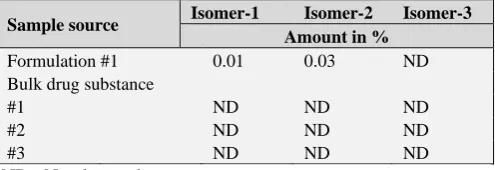
Table 2. Results (%) of tablet analysis and bulk drug sample analysis
Sample source Isomer-1 Isomer-2 Isomer-3 Amount in %
Formulation #1 0.01 0.03 ND
Bulk drug substance
#1 ND ND ND
#2 ND ND ND
#3 ND ND ND
ND= Not detected
CONCLUSION
A new, specific and robust NP-LC method has been developed that separates the isomeric impurities of Vortioxetine hydrobromide with excellent peak shape and resolution. The developed method was further validated to ensure compliance per ICH Q2(R1) guideline. This method was applied for testing of Vortioxetine drug substance and drug product samples.
ACKNOWLEDGMENTS
The authors wish to thanks the management of Megafine Pharma (P) Ltd. for giving support to this work. We would also like to thank colleagues in the division of Research and Development of Megafine Pharma (P) Ltd for their cooperation to carry out this work.
REFERENCES
1Pehrson, A. L., Leiser, S. C., Gulinello, M., Dale E., Li, Y.,
Waller, J. A., Sanchez, C., Treatment of Cognitive Dysfunction in Major Depressive Disorder—a Review of the Preclinical Evidence for Efficacy of Selective Serotonin Reuptake Inhibitors, Serotonin-norepinephrine Reuptake inhibitors and the Multimodal-acting Antidepressant Vortioxetine, Eur. J. Pharmacol., 2015, 753, 19-31.
https://doi.org/10.1016/j.ejphar.2014.07.044.
2Brignone, M., Diamond, F., Painchault, C., Takyar, S., Efficacy
and tolerability of switching therapy to Vortioxetine versus other antidepressants in patients with major depressive disorder, Curr. Med. Res. Opin., 2016, 32, 351–366.
https://doi.org/10.1185/03007995.2015.1128404.
3Gu, E. M., Huang, C., Liang, B., Yuan. L., Lan. T., Hu, G., Zhou, H., An UPLC–MS/MS method for the quantitation of Vortioxetine in rat plasma: Application to a pharmacokinetic study, J. Chromy. B: Anal. Technol. Biomed. Life Sci., 2015, 997, 70-74. https://doi.org/10.1016/j.jchromb.2015.05.010.
4Wróblewski, K., Petruczyni, A., Buszewski, B., Szultka-Mlynska,
M., Juchnowicz, H., Waksmundzka-Hajnos, M., Determination of Vortioxetine in Human Serum and Saliva Samples by HPLC–DAD and HPLC–MS, Acta Chrom., 2017, 29(3), 325–344. https://doi.org/10.1556/1326.2017.29.3.02.
5Velamakanni, S. R., Padala, V., Polagani, S. R., Boya J., A Novel
LC-MS/MS Method for Quantification of Vortioxetine in Human Plasma and its Application to Pharmacokinetic Studies, J. Global Trends Pharm. Sci., 2017, 8(4), 4584-4597.
https://www.jgtps.com/admin/uploads/OfaWNG.pdf.
6Qin, M., Qiao, H., Yuan, Y., Shao, Q., A quantitative
LC-MS/MS Method for Simultaneous Determination of Deuvortioxetine, Vortioxetine and their Carboxylic acid Metabolite in Rat Plasma, and its Application to a Toxic kinetic Study, Anal. Methods, 2018, 9, 1023-1031.
https://doi.org/10.1039/C7AY02642K
7Correa, D., Mennickent, S., Godoy, R., Vergara,
C., Determination of Vortioxetine and its Degradation
Product in Bulk and Tablets, by LC‐DAD and MS/MS
methods, Biomed. Chromy., 2018, 32(11).
https://doi.org/10.1002/bmc.4340
8Dousa, M., Doubsky, J., Srbek, J., Utilization of Photochemically
Induced Fluorescence Detection for HPLC Determination of Genotoxic Impurities in the Vortioxetine Manufacturing Process, J. Chrom. Sci., 2016, 54(9), 1625–1630.
https://doi.org/10.1093/chromsci/bmw116
9Douša, M.,Klvaňa, R.,Doubský, J.,Srbek, J.,Richter, J., Exner, M., Gibala, P., HILIC–MS Determination of Genotoxic Impurity of 2-Chloro-N-(2-Chloroethyl)Ethanamine in the Vortioxetine Manufacturing Process, J. Chrom. Sci., 2016, 54(2), 119–124.
https://doi.org/10.1093/chromsci/bmv107
10Dong, S., Yan, Z., Yang, H., A Sensitive Precolumn
Derivatization Method for Determination of Piperazine in Vortioxetine Hydrobromide Using a C8 Column and High-Performance Liquid Chromatography-Mass Spectrometry, Anal. Sci., 2016, 32, 1333-1338.
https://doi.org/10.2116/analsci.32.1333
11Li, J., Song, S., Zhang, H., Zhao J., Determination of Related
Substances in Vortioxetine Hydrobromide Tablets by HPLC, Chin. J. Pharmaceut., 2017, 48(09), 1359- 1364.
https://doi.org/10.16522/j.cnki.cjph.2017.09.020
12Impurities in New Drug Substances, Int. Conf. Harmonization
(ICH), Methodology Q3A (R2).
https://www.fda.gov/media/112426/download
13Good Manufacturing Practice Guide for Active Pharmaceutical
Ingredients, Int. Conf. Harmonization (ICH), Methodology Q7A. https://apic.cefic.org/pub/5GMPDev9911.PDF
14The United States Pharmacopeia, Validation of Compendial
Methods, USP 39, NF34, Section < 1225 >.
https://www.gmp-compliance.org/gmp-news/revised-usp- chapter-1225-validation-of-compendial-methods-approved
15Validation of Analytical Procedure, Int. Conf. Harmonization
(ICH), Methodology Q2 (R1).
http://www.gmp-compliance.org/guidemgr/files/Q2(R1).PDF
16Snyder, L. R., Kirkland, J. J., Glajch, J. L., Practical LC Method
Development,1997.
https://doi.org/10.1002/9781118592014