R E S E A R C H
Open Access
An efficient and traceable KP-ABS scheme
with untrusted attribute authority in cloud
computing
Hanshu Hong and Zhixin Sun
*Abstract
ABE has been widely applied for secure data protection in cloud computing. In ABE, user’s private keys are generated by attribute authority, thus, attribute authority has the ultimate privileges in the system and can impersonate any users to forge valid signatures. Once the attribute authority become dishonest or be invaded in cloud systems, the system’s security will be at risk. To better solve the problem mentioned above, in this paper, we propose a key-policy attribute based signature scheme with untrusted authority and traceability (KP-ABS-UT). In our scheme, the signer’s private key is composed by two components: one part is distributed by attribute authority and the other part is chosen privately by the signer’s self. Thus attribute authority cannot forge any signatures which should be signed by legal users. Besides, our scheme introduces an entity“tracer”, which can trace the identity of signer when necessary. By security analysis and efficiency comparison, we prove our KP-ABS-UT scheme meets the requirements of unforgeability as well as lower computation cost.
Keywords:Access structure, Untrusted authority, Traceability
Introduction
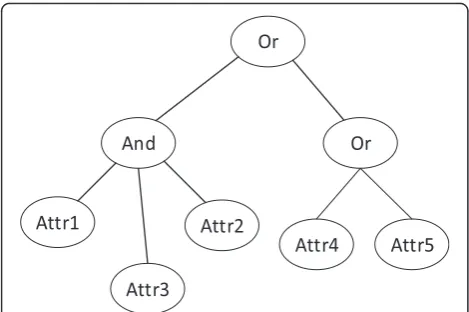
With the various information resources increasing rap-idly in the cloud, users are faced with urgent problems like how to make data sharing among resources effi-ciently and securely. On this occasion, Sahai proposed a new cryptographic primitive named “ABE” (attribute based encryption) [1]. In ABE mechanism [1–4], a user’s identity is described by several attributes rather than a single string. A data receiver is capable of getting access to the data when the attributes he possesses match with the structure made by the data owner. KP-ABE [2, 3] is a typical class of ABE.As is shown in Fig. 1, a user’s pri-vate key corresponds to an access tree structure. Each leaf node stands for the attribute a user owns; the non-leaf node describes the access policy of these attributes. The ciphertext corresponds to an attribute set such as {Attr1, Attr4}. Due to its capability of providing flexible access control for data sharing between users, KP-ABE
is gradually becoming an effective tool for secure data sharing in complex networks.
After the proposal of ABE, ABS (attribute based signa-ture) has been developed as a primitive to solve the data authentication problem in attribute based cryptosystem. ABS was originally proposed by Maji et al. in [5]. In ABS mechanism [6–9], a user is capable of signing a message using the private key component of the attribute set he owns. A receiver validates the signature by utilizing sys-tem public parameters. The signature can be verified to an attribute set or access structure which the signer pos-sesses. Since the advent of the notion, many ABS schemes have been proposed. However, most of the existing ABS schemes have one thing in common, that is the attribute authority has the ultimate privileges in the whole system. In order to keep the whole system run-ning safely, attribute authority must be honest and highly protected. In the open network systems, attribute authority are vulnerable to external as well as internal threat. Once being invaded, it can impersonate any users to forge legal signatures, which will threaten the whole security of the system. What’s more, anonymity is an important feature of common attribute based signature * Correspondence:[email protected]
Key Lab of Broadband Wireless Communication and Sensor Network Technology, Ministry Education, Nanjing University of Posts and Telecommunications, Nanjing, China
mechanism. However, some malicious users may take advantage of this feature to release illegal information without taking responsibility.
To better solve the problems discussed above, in this paper, we construct a KP-ABS-UT (key-policy attribute based signature with untrusted authority and traceabil-ity) scheme, which has the following merits: (1) the sig-nature is unforgeable, even attribute authority cannot impersonate any users to forge legal signatures; (2) the overall computation cost of the whole process of signing and verifying is reduced sharply; (3) the signer’s identity can be traced by the system administer if necessary.
The rest sections are arranged as follows:
In section 2, we give the literature review and funda-mental mathematical preliminaries and notions. The se-curity model and detailed algorithms of our KP-ABS-UT scheme are constructed in section 3 and section 4. Section 5 gives the security proof and performance comparison of our scheme. At last, the conclusion of this paper and pros-pects on future directions are made in section 6.
Related works and preliminaries Related works
The notion of ABS was first proposed by Maji in [5]. Since then, many ABS schemes have been proposed by researchers worldwide. Existing literatures of ABS can be classified to three types in terms of the data access structure :(1)ABS using threshold structure [10–12]; (2) ABS using LSSS access structure [13–15];(3) ABS using access tree [16], which has been illustrated in Fig. 1. Be-sides access structure, different ABS schemes have dif-ferent advantages and performances. A. Escala et al. in [13] proposed a user-revocable attribute based signature. If a user drops some of the attributes, his signing privil-ege can be exactly withdrawn. Their scheme also achieves adaptively security in the standard model. S. Shahandashti et al. in [10] construct a threshold ABS and applied it to credential systems. Their scheme
enables a signature holder to prove possession of signa-tures by revealing only the relevant attributes of the signer, hence providing signer attribute privacy for the signature holder. S. Kumar et.al in [11] proposed an ABS which is equipped with multiple threshold access structure. Their scheme is efficient as well as stretch-able. Tatsuaki et al. in [16] proposed a decentralized multi-authority ABS. In their scheme, due to the introdu-cing of multiple authorities, thus no central CA is needed. However, this also brings about other problems such as parameter synchronization, time synchronization, etc. Be-sides, the efficiency of their scheme can be further im-proved. S.L Ding et al. proposed a traceable ABS in [14], which allows PKG and the issuing authority join together to trace the identity of a malicious signer. However, since the trace algorithm needs frequent participation of PKG, it may be exposed to more internal and external security risks. Li et al. in [15] proposed a novel ABS with hidden attribute property. In their scheme, anonymous user revo-cation is achieved. Liu et al. in [17] proposed an attribute based multisignature scheme, which allows a number of users to participate to authenticate a message with only one signature. Their scheme is shown to be secure and is more appropriate to be applied for wireless communica-tions. Chen et al. in [9] proposed a new paradigm named “Outsourced ABS”. The computation load in their scheme is reduced sharply by delegating most of the computation work to a semi-trusted server, thus this will relieve the ter-minal devices from heavy computation burden. The high efficiency and security level makes their scheme an excel-lent method for providing data authentication in cloud computing. Xu et al. in [18] propose an ABS scheme with dynamic user revocation. Their scheme has superior per-formance with regard to scalability, which is able to be applied to massive data storage environments.
The above schemes have laid solid foundations for filling the gap between theoretical proposal and practical appli-cation of ABS. However, in the above schemes, the attri-bute authority has the ultimate privilege in the system. Even worse, it can forge as any legal users and generates a valid signature. Once the attribute authority become dis-honest, the system will be exposed to potential risks. Although ABS with multiple attribute authorities has been proposed in [16], if these attribute authorities collude with each other to obtain a user’s private key, a legal signature can still be successfully forged. Thus, it is of significance to cut down the privilege of the attribute authority in ABS systems.
Bilinear pairings
Denote G1and G2to be cyclic groups of prime orderq.
Let g be a generator of G1. A bilinear pairing ê:G1×
Bilinearity: Fora,b∈Zq,ê(ga,gb) =ê(g,g)ab.
Non-degeneracy: There existsP,Q∈G1which satisfy
ê(g,g)≠1.
Computability: The value ofê(u,v) can be calculated for anyu,v∈G1.
Hardness assumption
Decision Bilinear Diffie-Hellman problem:
Picks random numbers a;b;c;z∈Zq,assuming that the value of (g,ga,gb,gc,z) are given, no probabilistic polynomial-time algorithm can distinguish the tuples (A= ga,B=gb,C=gc,ê(g,g)abc) and (A=ga,B=gb,C=gc,ê(g, g)z) with a non-negligible probability.
Lagrange Interpolation function
For a polynomial p(x) inZqof orderd−1 and a set Sin
Zq with the size |S| =d is computed by p xð Þ ¼ X
i∈Sp ið Þ
Y
j∈S;j≠i
x−j i−j.
Our model and assumptions Formal model of our scheme
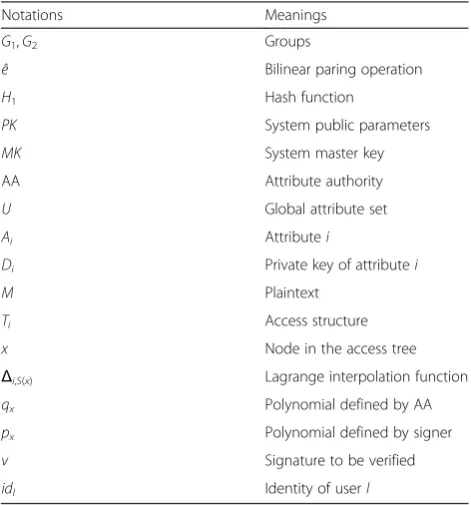
In order to clearly describe our KP-ABS-UT, we define some notations listed in Table 1.
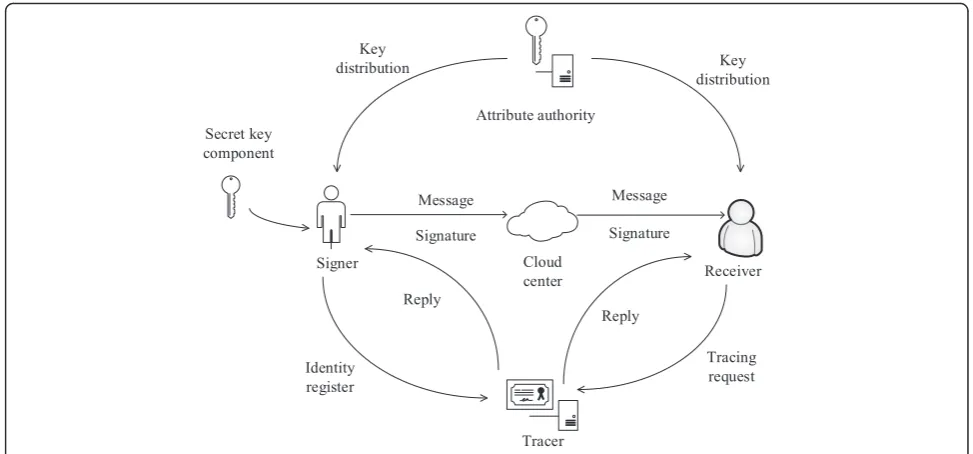
The model of our system is shown in Fig. 2. Our model consists of 4 entities: “AA” (Attribute authority), “tracer”, “signer” and “receiver”. AA provides system’s public parameters, generates part of user’s private key and distributes them to users. After receiving the
original key generated by AA, signer re-generates his own private key by adding a secret component. Then signer signs the plaintext using the private key generated by himself and uploads the signature to cloud center. Cloud center provides secure data storage and responses the access request made by data receiver. Receiver veri-fies if the signature is a valid one. Tracer is responsible for revealing the signer’s identity when necessary.
Formulized definitions of algorithms in KP-ABS-UT:
Setup{1λ}→{PK,MK}:This algorithm is operated by AA. Take in a security parameter, it generatesPKand MK. PKis shared by users whileMKis kept private by AA.
Private key generation PKf ;MK;Tk;sg→ Di;Tk;idl
: The private key generation algorithm is an interaction between AA and a user with an access structureTk. On
inputPK,MK,Tk, AA firstly returnsDi;Tk to be the initial attribute private key forTk. Then each signer
embeds a secret component intoDi;Tk to re-generate his own private keyDi;Tk;idl.Signer sends certain information referring to the secret component to tracer. Tracer assigns a unique identity number to the signer and stores the relationship of each signer with his identity.
Sign Di;Tk;idl;PK;M;σidl
→f gv : This algorithm is run by a signer which the systems public parameterPK, a plaintextM, signer’s private keyDi;Tk;idl and a mathematical constantσidl which can reveal signer’s identity as input. Then the algorithm outputs a signaturevfor the plaintextM.
Verify{PK,v,M}→{θ}: This algorithm is run by the receiver. On inputPKand the plaintextMwith the signature, it outputs a valueθ. Ifθ= 1 then the signature is a valid one, ifθ= 0 then the signature is invalid.
Trace{MK,v}→{idl}: This algorithm is run by the
tracer. On input the signaturev,the tracer can pinpoint the exact identity of a signer.
The essential unforgeability of our KP-ABS-UT
Definition 1
Our KP-ABS-UT has the existential unforgeability if no
Adversaryhas non-negligible advantage in the following
game played by aChallengerand anAdversary.
Setup:Challenger runs Setup procedure to obtain the
system parameters and sendsPKtoAdversary.
Sign queries: Adversary chooses an access control
structure Ti,a plaintext M. Challenger calculates the at-tribute private key Di;Tk;idl and runs the Sign procedure to calculate the signature v¼Sign PK;M;Di;Tk;idl
.After then,Challengersends the signaturevtoAdversary.
Challenge:Adversarychooses a plaintextM*,a challen-ging access structureTc, and calculates the signaturev*. Table 1Notations and their corresponding meanings
Notations Meanings
G1,G2 Groups
ê Bilinear paring operation
H1 Hash function
PK System public parameters
MK System master key
AA Attribute authority
U Global attribute set
Ai Attributei
Di Private key of attributei
M Plaintext
Ti Access structure
x Node in the access tree
Δi,S(x) Lagrange interpolation function
qx Polynomial defined by AA
px Polynomial defined by signer
v Signature to be verified
Challenger verifies the signature by running the pro-cedureVerify(PK,v*) and outputs a valueθ.
Adversary wins if the output of Verify algorithm is
valid.
Denote Adv(A) = |Pr[θ= 1]| to be advantage of Adversary.
Our construction to KP-ABS-UT scheme Concrete algorithms:
Setup: Let G1 and G2 be two cyclic groups of prime
orderp, whilegis the generator ofG1. Letê:G1×G1→
G2be a bilinear paring. DefineH1: {0, 1}*→Zp.AA picks
ti∈Zp for each Ai in the system. Besides, AA picks an-other secret number y∈Zp and calculatesê(g,g)y.Set MK to be {ti,y} whilePKto befG1;G2;p;g;H1;^e gð ;gÞy;gtig.
Private key generation: AA randomly chooses a
poly-nomialqxfor each nodexin the access tree and sets the degreedxofqxto be one less than the threshold valuekx of that node (dx=kx−1). For any other node (except root node) in the access tree, letqx(0) =qparentindex(x(x)). For the
root node AA sets qroot(0) =y. To avoid the signature forgery which can be made by AA, the signer also chooses a polynomial px likewise and picks a secret number s. For the root node AA sets qroot(0) =y while the signer sets proot(0) =s. Once the polynomials have been decided, the private key is of each leaf node x in
the access tree can be denoted by Di;Tk;idl¼
gqx
0 ð Þ:pxð Þ0
ti ;i∈Tk
n o
. Signer sends the value of gs to tracer.
For each signer, tracer chooses a global unique identifier idl∈Zp to describe his identity (Without loss of general-ity, the signer’s identity is denoted byidl). Tracer calcu-lates σidl ¼ g
s
ð Þidl and sends σ
idl back to the signer. Meanwhile, it stores a list recording the relationship be-tween singer’s unique identifier andσidl.
Sign: For a plaintext M, the signer picks a random numberr∈Zpand calculates:
C0¼^e gð ;gÞyrs;C1¼^e gð ;gÞys
C2¼ Di;Tk;idl
H1ðMjjσidlÞ s
þr
n o
¼ g
qxð Þ0 :pxð Þ0 ti 0 B @
1 C A
H1ðMjjσidlÞ s
þr 8
> > < > > :
9 > > = > > ;
ð1Þ
The signature can be denoted by v¼ C1;C2;C3;M;σidl;g
s;H
1ðMjjσidlÞ
s
f g. The signer sendsv
to the receiver.
Verify: After receiving the signature v= {C1,C2,C3,M,
σid,gs,H1(M||σid)s} from the signer, receiver firstly calcu-lates:ê(H1(M||σid)s,g) =ê(H1(M||σid),gs).
If the equation is set up, then calculates VerityNode x;PK;v
ð Þ ¼^e gti;C
2
ð Þ.
If x is a leaf node, then the calculation process is as follows:
VerityNode xð;PK;vÞ
¼
^
e gð ti;C2Þ ¼^e gti; g
qxð Þ0:pxð Þ0
ti 0 B @ 1 C A
H1ðMjjσidlÞ s þr 0 B B @ 1 C C A
¼^e gti;g
qxð Þ0:pxð Þ0
ti 0 B @ 1 C A
H1ðMjjσidlÞ s
þr
¼e g^ pxð Þ0;gqxð Þ0H1ðMjjσidlÞ s
⋅^e gr:pxð Þ0;gqxð Þ0
⊥;otherwise
8 > > > > > > > > > > > > > > > > > < > > > > > > > > > > > > > > > > > :
ð2Þ
All the value calculated from VerityNode(x,PK,v) will be stored as Fz. For any Fz≠0, the algorithm calculates
Froot (the value of root node) using Lagrange
interpolation method.
Ifxis a non-leaf node,zis the child node ofx,then the value ofVerityNode(x,PK,v) is calculated as follows:
Leti=index(z),Sx, = {index(z) :z∈Sx}
Fx¼
Y
z∈Sx FzΔi;Sx0ð Þ0
¼Y
z∈Sx ^
e gpzð Þ0Δi;Sx0ð Þ0;gqzð Þ0 Δi;Sx0ð Þ0
H1ðMjjσidlÞ
s þr
¼Y
z∈Sx ^
e gpparentð Þzðindex zð ÞÞ
Δi;Sx0ð Þ0
;
gqparentð Þz index zð Þ ð Þ Δi;Sx0ð Þ0
ÞH1ðMjjσidlÞ
sþ
r
¼Y
z∈Sx
^e gpxð ÞiΔi;Sx0ð Þ0; gqxð Þi Δi;sx0ð Þ0
H1ðMjjσidlÞ
s þr
¼e g^ pxð Þ0;gqxð Þ0H1ðMjjσidlÞ s
⋅^e g r:pxð Þ0;gqxð Þ0 ð3Þ
Then, the algorithm calculates Froot (the value of root node) by recursive function.
Finally, the algorithm verifies if:
Froot¼C1H1ðMjjσidlÞ
s
⋅C0 ð4Þ
If the equation is set up, then the signature is a legal one and the signer’s attributes satisfies the claimed structure.
Trace: The tracer searches the list recording the rela-tionship between idl−σidl, then the identity of the signer can be pinpointed.
Security proof and performance evaluation Correctness proof
To calculate the value of Froot, it is essential to obtain the value of leaf nodes which satisfy the access structure.
Since the value of VerityNode xð ;PK;vÞ ¼^e
gpxð Þ0;gqxð Þ0
H1ðMjjσidlÞ
s þr
; whether x is a leaf node or
non-leaf node, consequently, the value of root nodeFroot can be calculated by:
Froot¼^e gprootð Þ0;gqrootð Þ0
H1ðMjjσidlÞ
s þr
prootð Þ ¼0 s;qrootð Þ ¼0 y ð5Þ
Consequently, if the signature is valid then the equation is set up:
Froot ¼^e gð s;gyÞH1ðMjjσidlÞ
s þr
¼ð^e gð ;gÞysÞH1ðMjjσidlÞ s
þr
¼C0⋅C1H1ðMjjσidlÞ
s
ð6Þ
Unforgeability
Theorem 1
If our scheme can be broken by anAdversarythen it can be constructed that a simulator with a non- negligible advantage solves the DBDH problem successfully.
Proof
In the challenge game, if an Adversary can break our scheme with advantageε, then a simulator be constructed to solve the DBDH problem with an advantage of2ε.
The construction process of the simulator is as follows:
Phase 1Setup:
Challengersets the parameters as follows: Defines a global attribute setU= {1, 2,…n}.
Denotesidlto be the unique identifier ofAdversary. DefinesG1andG2be two cyclic groups of prime order
p. The generator ofG1is denoted byg.
Defines a bilinear paringê:G1×G1→G2.
Picksμ∈{0, 1},a,b,c,z∈Zp.
A;B;C;Z
ð Þ ¼ga;gb;gc;^e gð ;gÞabc
if μ¼0
A;B;C;Z
ð Þ ¼ga;gb;gc;^e gð ;gÞz
if μ¼1
(
ðLetÞ
The aim of simulator is to output a valueμ* as a guess ofμ.
The simulator runs Adversary as sub-program and plays the role ofChallenger.
Adversarydefines attribute setγ.
Simulator randomly chooses ri,βi∈Zp and sets PK to
beY ¼^e g a;gb¼^e gð ;gÞab;T i¼ g
ri; if i∈γ gbβi;if i∉γ
Phase 2Queries:
Private key generation queries:When Adversaryasks a
Private key generation query for access structure Tk,
Chooses two polynomialqx,pxfor each nodexin the ac-cess structureTkand sets the degreedxofqx,pxto be one less than the threshold valuekxof that node (dx=kx−1). Besides, simulator sets qroot(0) =y,proot(0) =s. For any other node (except root node) in the access tree, let qx(0) =qparentindex(x(x)). Then simulator calculates the private
key and sends Di;Tk;idl back to Adversary.The format of Di;Tk;idl is as follows:
Di;Tk;idl¼ g
qxð Þ0 pxð Þ0
ti ¼g
qxð Þ0 pxð Þ0
ri ;if att xð Þ∈γ
g
qxð Þ0 pxð Þ0
ti ¼g
qxð Þ0 pxð Þ0
bβi ;if att xð Þ∉γ
8 > > > < > > > :
Signqueries: WhenAdversaryasks aSignquery for ac-cess structure Tk and a plaintextM, simulator responds as follows:
Firstly, simulator calculates the private keyDi;Tk;σidl. Obtaining the private key of access structure Tk by running
Randomly chooses r∈Zp , let σidl¼ g
s
ð Þidl , then calculates:
C0¼^e gð ;gÞabrs;C1¼^e gð ;gÞabs; C2
¼ Di;Tk;idl
H1ðMjjσidlÞ s
þr
n o
ð7Þ
Then signer outputs v¼ C1;C2;C3;M;σσidl;g
s;H
1 Mjjσσidl s
n o
and sends it toAdversary.
It can be seen that the simulator is consistent with our scheme.
Phase 3:Challenge:
Adversary outputs a new signature vl with a
challen-ging access structureTland plaintextM.
Adversarycannot makeSignqueries aboutTland vlis
not gained by a previousSignquery.
Adversary forges the signature as the following
process:
Chooses a polynomial plx.Sets plroot(0) =sl. Picks rl∈ Zp, returnsgsl to simulator.
Simulator chooses sends σσidl ¼ð Þgsl id back to Adversary.
Adversaryforges the private keyDi;Tl;σidl
of the access
structureTl.
Di;Tl;σidl
¼ g
qxð Þ0plxð Þ0
ti ¼g
qxð Þ0plxð Þ0
ri ;if att xð Þ∈γ
g
qxð Þ0plxð Þ0
ti ¼g
qxð Þ0plxð Þ0
bβi ;if att xð Þ∉γ 8 > > > > > < > > > > > :
ð8Þ
Adversarycalculatesvl¼ C0;C1;C2;M;gsl;σσidl;H1 Mjjσσidl sl
n o
:
C0¼^e gð ;gÞabsl;C1¼^e gð ;gÞab:rlsl
C2¼ Di;Tl;σidl
rlþH1ðMjjσidlÞsl
¼
g
qxð Þ0 plxð Þ0 ri 0 B @ 1 C A
rlþH1ðMjjσidlÞsl
;if att xð Þ∈γ
g
qxð Þ0 plxð Þ0 bβi
0 B @ 1 C A
rlþH1ðMjjσidlÞsl
;if att xð Þ∉γ
8 > > > > > > > > > > < > > > > > > > > > > :
ð9Þ
Verify:
Simulator firstly calculates VerityNode xð ;PK;vlÞ ¼^e
gri;C
2
ð Þ.
VerityNode xð ;PK;vlÞ
¼
(
^e gri; g
qxð Þ0 plxð Þ0
ri 0 B @ 1 C A
rlþH1ðMjjσidlÞsl
0 B B @ 1 C C A;
if att xð Þ∈γ
^
e gbβi; g
qxð Þ0 plxð Þ0 bβi 0 B @ 1 C A
rlþH1ðMjjσidlÞsl
0 B B B @ 1 C C C A;
if att xð Þ∉γ
¼^e g pl xð Þ0;gqxð Þ0rlþH1ðMjjσidlÞ sl
ð10Þ
By recalling the recursive function, the value of root nodeFrootcan be calculated by:
Froot¼^e g pl rootð Þ0;gqrootð Þ0rlþH1ðMjjσidlÞ sl
¼^e g sl;gqrootð Þ0rlþH1ðMjjσidlÞ sl
¼ ^e gð ;gÞslqrootð Þ0
rlþH1ðMjjσidlÞsl
ð11Þ
According to the setting inSetupphase, letsl=c,rlþH1
Mjjσidl
ð Þsl ¼f;then
Froot¼ ^e gð ;gÞsl⋅qroot ð Þ0
rlþH1ðMjjσidlÞsl
¼ ^e gð ;gÞabc
f
;if μ¼0 ^
e gð ;gÞz
ð Þf;
if μ¼1
8 < :
ð12Þ
Then we will discuss the advantage of simulator in breaking the DBDH assumption.
When μ= 0, Adversary forges the signature
this incident is12þε. WhenAdversarysuccessfully forges the signature, simulator guessesu* = 0 and simulator has a 1
2þε probability of making the correct guess of u*.
The probability of simulator making the correct judg-ment can be denoted by:
Pr uð ¼ujμ¼0Þ ¼1
2þε ð13Þ
Whenμ= 1, Adversary fails to forge the signature. The result of output is rejected symbol⊥. Under this condition simulator guessesμ* randomly. The probability of simulator making the correct judgment can be denoted by:
Pr uð ¼ujμ¼1Þ ¼1
2 ð14Þ
As is mentioned above, the advantage of simulator is:
1
2Pr u
¼ujμ¼0
ð Þ þ1
2Pr u
¼ujμ¼1
ð Þ−1
2 ¼1
2 1
2þε
þ1
2
1
2−
1 2 ¼ε
2
ð15Þ
Unforgeability with untrusted authorities and traceability In attribute based signature mechanism, users’attribute private keys are generated and distributed by AA. Under this circumstance, AA is capable of forging any signa-tures without being detected. To keep the whole system running safely, AA must be honest and highly protected from being invaded. However, in the complex network systems, there are variety risks which may result in the fault of AA. Consequently, for the sake of safety, AA’s rights in the system should be reduced to some extent. In our KP-ABS-UT, the private key used for signature is generated by joint efforts of both AA and user, so it is computational infeasible for AA to forge any signatures which should be signed by legal users. Besides, since dif-ferent users randomly choose difdif-ferent secret numbers to embed into their initial private keys distributed from AA, it is computational infeasible for a user to personate any other users to forge a legal signature in the system.
Anonymity is another important feature of common attribute based signature mechanism. However, some mali-cious users may take advantage of this feature to send out illegal information without taking responsibility. To prevent such incidents happening, in our KP-ABS-UT scheme, the signer’s identity can be revealed with the introducing of “tracer”. When data receivers receive illegal information from a malicious signer, they can send the signature v to tracer. Since tracer has stored σidl ¼ g
s
ð Þidl with user’s identity, the signer’s identity can be located by searching
the idl−σidl list. Then tracer calculates σidl −idl¼
gs ð Þidl
−idl
¼gs. Sincesis the secret number used in the Signalgorithm andgshas been sent to tracer, a signer can-not deny the message he signed before.
Efficiency and comparison analysis
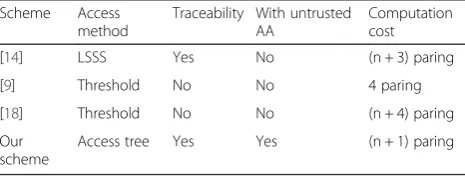
In our KP-ABS-UT scheme, assume“n”to be the amount of attributes which a signer owns. The Sign algorithm needs (n + 3) times of exponential operation and 1 hash operation. The computation ofSignalgorithm is low since it does not need any paring operation. The Verify algo-rithm needs (n + 1) times of paring operation and 1 hash operation. Since the computation cost of paring operation is much more than any other operation, in this paper, we mainly compare the number of paring operation with other ABS schemes [9, 14, 18] with respect to efficiency. The efficiency and performance comparison results are listed below in Table 2.
From the result we can see that the computation cost is lower in our KP-ABS-UT since the number of bilinear paring operation is reduced. Thus our plan has a higher efficiency. Besides, our KP-ABS-UT uses access tree as control structure, each signer’s private key corresponds a certain structure. It is computational infeasible for differ-ent users to collude their private keys with each other to forge a legal signature. With the introducing of user’s se-cret key component and the entity“tracer”, the signature cannot be forged by AA and can be traced to identity if a malicious user releases information illegally. The overall comparison shows our KP-ABS-UT is of better perform-ance and is more appropriate for secure data verification in open network systems such as cloud computing, etc.
Conclusion
In this paper, we propose a KP-ABS with untrusted au-thorities and traceability, which is also of high efficiency. In our scheme, the signer’s private key is composed by two components: one part is distributed by attribute au-thority and the other part is chosen privately by the signer’s self. The signature cannot be forged by any other users including attribute authority. What’s more, the identity of signer can be traced. Our scheme is proved to be secure and of better performance with respect to efficiency.
Table 2Efficiency and performance comparison
Scheme Access method
Traceability With untrusted AA
Computation cost
[14] LSSS Yes No (n + 3) paring
[9] Threshold No No 4 paring
[18] Threshold No No (n + 4) paring
Our scheme
Our future work should focus on the attribute revoca-tion and key refreshing in our KP-ABS scheme. Once key exposure happens, although the system can trace the traitor, however, user’s private keys still need to be refreshed for the safe of privacy. Consequently, research on the attribute based refreshing mechanisms should be taken into our future research direction. Besides, out-sourcing ABS [9] with untrusted attribute authorities also merits attention.
Competing interests
The authors declare that they have no competing financial interests.
Authors’contribution
Dr Hanshu Hong: Participated in the design of scheme and drafted the manuscript. Dr Zhixin Sun: Participated in the performance analysis of the proposed KP-ABS-UT. All authors read and approved the final manuscript.
Acknowledgement
This research is supported by the National Natural Science Foundation of China (60973140, 61170276, 61373135).
Received: 17 November 2015 Accepted: 6 March 2016
References
1. Sahai, A, Waters,“Fuzzy identity-based encryption”. Proc. Int. Conf. EUROCRYPT 2005, pp. 457-473, Aarhus, Denmark: Springer; 2005. http://link. springer.com/chapter/10.1007%2F11426639_27
2. V. Goyal, O. Pandey, A. Sahai and B. Waters,“Attribute Based Encryption for Fine-Grained Access Control of Encrypted Data”, In ACM conference on Computer and Communications Security, pp. 89-98. 2006.
3. Attrapadung N, Libert B, De Panafieu E. Expressive key-policy attribute-based encryption with constant-size ciphertexts, Public Key
Cryptography—PKC 2011, vol. 6571 of LNCS. Taormina, Italy: Springer, pp. 90-108, 2011.
4. Bethencourt J, Sahai A, Waters B (2007) Ciphertext-Policy Attribute Based Encryption. Proceedings of the 2007 IEEE Symposium on Security and Privacy, Washington DC, pp 321–334
5. H. K. Maji, M. Prabhakaran, and M. Rosulek,“Attribute-based signatures: Achieving attribute-privacy and collusion-resistance,”IACR Cryptology ePrint Archive, pp. 328–351, 2008.
6. B. Z. J. S. Dan Cao, Xiaofeng Wang and Q. Hu,“Mediated attribute based signature scheme supporting key revocation,”in Proceedings of the 8th International Conference on Information Science and Digital Content Technology. Jeju Island, Korea: IEEE; 2012; 277–282.
7. S.Q. Guo and Y.P. Zeng,“Attribute-based signature scheme”, In International Conference on Information Security and Assurance, pp.509-511, 2008. 8. H. K. Maji, M. Prabhakaran, and M. Rosulek,“Attribute-based signatures”, in
CT-RSA, 2011, pp. 376–392, 2011.
9. Chen X, Li J, Huang X (2014) Secure Outsourced Attribute-Based Signatures”. IEEE Transactions on Parallel and Distributed Systems 25(12):3285–3294 10. S. Shahandashti and R. Safavi-Naini,“Threshold attribute-based signatures
and their application to anonymous credential systems,”Progress in Cryptology–AFRICACRYPT 2009, pp. 198–216, 2009.
11. Kumar S, Agrawal S, Balaraman S, Rangan C (2011) Attribute Based Signatures for Bounded Multi-level Threshold Circuits. Public Key Infrastructures, Services and Applications (EuroPKI 2010), Berlin Heidelberg, pp 141–154
12. J. Herranz, F. Laguillaumie, B. Libert,“Short attribute based signatures for threshold predicates”, Topics in Cryptology–CT-RSA 2012, pp. 51–67, 2012. 13. A. Escala, J. Herranz, and P. Morillo,“Revocable attribute-based signatures with
adaptive security in the standard model,”in AFRICACRYPT, pp. 224–241, 2011. 14. S.L Ding, Y. Zhao,“Efficient Traceable Attribute-Based Signature”, in IEEE
13th International Conference on Trust, Security and Privacy in Computing and Communications, pp 582-589, 2014.
15. Li J, Kim K (2010) Hidden attribute-based signatures without anonymity revocation. Inform Sci 180(9):1681–1689
16. Okamoto, T., Takashima, K,“Decentralized attribute-based signatures”, Public Key Cryptography-PKC. Nara, Japan: 2013; 125–142.
17. X. Liu, J. Ma, Q. Li, J. Xiong, and F. Huang,“Attribute based multi-signature scheme in the standard model,”in Proceedings of the 9th International Conference on Computational Intelligence and Security (CIS’13). Sichuan Province, China: IEEE; 2013; 738–742.
18. Zhiqian Xu, Keith M. Martin,“Anonymous User Revocation for Using Attribute-Based Signature in Cloud Computing”. 6th International Conference on Cloud Computing Technology and Science. Singapore: IEEE; 2014; 358-365.
19. Boneh D, Franklin M (2001) Identity-Based encryption from the weil pairing. In: Advances in Cryptology-CRYPTO 2001. Springer-Verlag, LNCS 2139, Berlin, Heidelberg, pp 213–229
Submit your manuscript to a
journal and benefi t from:
7Convenient online submission
7Rigorous peer review
7Immediate publication on acceptance
7Open access: articles freely available online
7High visibility within the fi eld
7Retaining the copyright to your article