Available online throug
ISSN 2229 – 5046
UNSTEADY MAGNETOHYDRODYNAMIC
FREE CONVECTIVE RADIATING VISCOUS DISSIPATIVE FLUID
FLOW ALONG A SEMI INFINITE VERTICAL POROUS PLATE WITH HEAT SOURCE
MAMTA THAKUR*
Department of Mathematics,
Chaitanya Bharathi Institute of Technology, Gandipet, Hyderabad, Telangana State, India.
(Received On: 24-07-17; Revised & Accepted On: 08-09-17)
ABSTRACT
A
n unsteady hydromagnetic flow of free convective radiating, viscous dissipative fluid along a semi infinite vertical plate embedded in a porous medium with heat source has been investigated. The fluid is considered to be a gray, absorbing emitting but non – scattering medium and the Rosseland approximation is used to describe the radiative heat flux in the energy equation. The dimensionless governing coupled, non – linear boundary layer partial differential equations are solved by an efficient finite element method. The effects of flow parameters like, thermal Grashof number, solutal Grashof number, Hartmann number, Permeability parameter, thermal radiation parameter, Prandtl number, Schmidt number, Heat source parameter and Eckert number on the velocity, temperature and concentration are illustrated graphically. The forms of the wall shear stress, Nusselt number and Sherwood number are derived and the results are shown through graphical representations. This present problem finds applications in magnetic pumps, controlled fusion research, crystal growing, MHD Couples and Bearings, Plasma Jets, Chemical Synthesis, etc.Keywords: MHD, Thermal radiation, Free convection, Porous medium, Viscous dissipation, Heat source and Finite
element method.
1. INTRODUCTION
The influence of magnetic field on electrically conducting viscous incompressible fluid is of importance in many applications such as extrusion of plastics in the manufacture of rayon and nylon, the purification of crude oil, and the textile industry, etc. In many process industries the cooling of threads or sheets of some polymer materials is important in the production line. The rate of the cooling can be controlled effectively to achieve final products of desired characteristics by drawing threads, etc., in the presence of an electrically conducting fluid subjected to magnetic field. The study of magnetohydrodynamic (MHD) plays an important role in agriculture, engineering and petroleum industries. The MHD has also its own practical applications. For instance, it may be used to deal with problems such as the cooling of nuclear reactors by liquid sodium and induction flow meter, which depends on the potential difference in the fluid in the direction perpendicular to the motion and to the magnetic field.
The problem of free convection under the influence of the magnetic field has attracted the interest of many researchers in view of its applications in geophysics and astrophysics. The problem under consideration has important applications in the study of geophysical formulations, in the explorations and thermal recovery of oil, and in the underground nuclear waste storage sites. The unsteady natural convection flow past a semi – infinite vertical plate was first solved by Hellums and Churchill [1], using an explicit finite difference method. Because the explicit finite difference scheme has its own deficiencies, a more efficient implicit finite difference scheme has been used by Soundalgekar and Ganesan [2]. A numerical solution of transient free convection flow with mass transfer on a vertical plate by employing an implicit method was obtained by Soundalgekar and Ganesan [3]. Takhar et al. [4] studied the transient free convection past a semi – infinite vertical plate with variable surface temperature using an implicit finite difference scheme of Crank Nicolson type. Soundalgekar et al. [5] analyzed the problem of free convection effects on Stokes problem for a vertical plate under the action of transversely applied magnetic field. Sacheti et al. [6] obtained an exact solution for the unsteady MHD free convection flow on an impulsively started vertical plate with constant heat flux. Shanker and Kishan [7] discussed the effect of mass transfer on the MHD flow past an impulsively started vertical plate with
Corresponding Author: Mamta Thakur*
variable temperature or constant heat flux. Elbashbeshy [8] studied the heat and mass transfer along a vertical plate under the combined buoyancy effects of thermal and species diffusion, in the presence of the magnetic field. Ganesan and Palani [9] obtained a numerical solution of the unsteady MHD flow past a semi – infinite isothermal vertical plate using the finite difference method. The effects of thermal radiation and heat source on an unsteady magneto -hydrodynamic free convection flow past an infinite vertical plate in a porous medium in presence of thermal diffusion and diffusion thermo investigated by Srinivasa Raju et al. [10]. Das et al. [11] investigated the hydromagnetic convective flow past a vertical porous plate through a porous medium with suction and heat source.
Radiation effects on free convection flow have become very important due to its applications in space technology, processes having high temperature, and design of pertinent equipments. Moreover, heat transfer with thermal radiation on convective flows is very important due its significant role in the surface heat transfer. Recent developments in gas cooled nuclear reactors, nuclear power plants, gas turbines, space vehicles, and hypersonic flights have attracted research in this field. The unsteady convective flow in a moving plate with thermal radiation were examined by Cogley et al. [12] and Mansour [13].The combined effects of radiation and buoyancy force past a vertical plate were analyzed by Hossain and Takhar [14]. Hossain et al. [15] analyzed the influence of thermal radiation on convective flows over a porous vertical plate. Seddeek [16] explained the importance of thermal radiation and variable viscosity on unsteady forced convection with an align magnetic field. Muthucumaraswamy and Senthil [17] studied the effects of thermal radiation on heat and mass transfer over a moving vertical plate. Pal [18] investigated convective heat and mass transfer in stagnation – point flow towards a stretching sheet with thermal radiation. Aydin and Kaya [19] justified the effects of thermal radiation on mixed convection flow over a permeable vertical plate with magnetic field. Mohamed [20] studied unsteady MHD flow over a vertical moving porous plate with heat generation and Soret effect. Chauhan and Rastogi [21] analyzed the effects of thermal radiation, porosity and suction on unsteady convective hydromagnetic vertical rotating channel. Ibrahim and Makinde [22] investigated radiation effect on chemically reaction MHD boundary layer flow of heat and mass transfer past a porous vertical flat plate. Pal and Mondal [23] studied the effects of thermal radiation on MHD Darcy Forchheimer convective flow pasta stretching sheet in a porous medium. Palani and Kim [24] analyzed the effect of thermal radiation on convection flow past a vertical cone with surface heat flux. Recently, Mahmoud and Waheed [25] examined thermal radiation on flow over an infinite flat plate with slip velocity.
The viscous dissipation effects are important in geophysical flows and also in certain industrial operations and are usually characterized by the Eckert number. In the literature, extensive research work is available to examine the effect of natural convection on flow past a plate. Gebhart [26] has shown the importance of viscous dissipative heat in free convection flow in the case of isothermal and constant heat flux at the plate. Gebhart and Mollendorf [27] have considered the effects of viscous dissipation for external natural convection flow over a surface. Soundalgekar [28] has analyzed viscous dissipative heat on the two – dimensional unsteady free convective flow past an infinite vertical porous plate when the temperature oscillates in time and there is constant suction at the plate. Maharajan and Gebhart [29] have reported the influence of viscous dissipation effects in natural convective flows, showing that the heat transfer rates are reduced by an increase in the dissipation parameter. Israel Cookey et al. [30] have investigated the influence of viscous dissipation and radiation on an unsteady MHD free convection flow past an infinite heated vertical plate in a porous medium with time dependent suction. Suneetha et al. [31] have analyzed the effects of viscous dissipation and thermal radiation on hydromagnetic free convective flow past an impulsively started vertical plate. Suneetha et al. [32] have studied the effects of thermal radiation on the natural convective heat and mass transfer of a viscous incompressible gray absorbing emitting fluid flowing past an impulsively started moving vertical plate with viscous dissipation. Ahmed and Batin [33] have obtained an analytical model of MHD mixed convective radiating fluid with viscous dissipative heat. Babu et al. [34] have studied the radiation and chemical reaction effects on an unsteady MHD convective flow past a vertical moving porous plate embedded in a porous medium with viscous dissipation. Kishore et al. [35] have analyzed the effects of thermal radiation and viscous dissipation on MHD heat and mass diffusion flow past an oscillating vertical plate embedded in a porous medium with variable surface conditions.
2. MATHEMATICAL FORMULATION
Consider the unsteady free convective mass transfer flow of a radiating, viscous incompressible electrically conducting fluid past an infinite vertical porous plate in presence of constant suction and heat source and transverse magnetic field. We made the following assumptions.
1. Let the
x
′
−
axis be taken in vertically upward direction along the plate andy
′
−
axis normal to it.2. The wall is maintained at constant temperature
(
T
w′
)
and concentration(
C
w′
)
higher than the ambient temperature(
T
∞′
)
and concentration(
C
∞′
)
respectively.3. A uniform magnetic field of magnitude
B
o is applied normal to the plate. The transverse applied magnetic field and magnetic Reynold’s number are assumed to be very small, so that the induced magnetic field is negligible.4. The homogeneous chemical reaction is of first order with rate constant
K
between the diffusing species and the fluid is neglected.5. It is assumed that there is no applied voltage which implies the absence of an electric field.
6. The fluid has constant kinematic viscosity and constant thermal conductivity and the Boussinesq’s approximation have been adopted for the flow.
Within the above framework, the equations which govern the flow under the usual Boussinesq’s approximation are as follows
Continuity Equation:
o
v
v
y
v
=
⇒
′
=
−
′
′
∂
′
∂
0
(Constant) (1)Momentum Equation:
(
)
(
)
u
K
v
u
B
y
u
C
C
g
T
T
g
y
u
v
t
u
o′
′
−
′
−
′
∂
′
∂
+
′
−
′
+
′
−
′
=
′
∂
′
∂
′
+
′
∂
′
∂
∞ ∞ρ
σ
ν
β
β
* 2 2 2(2) Energy Equation:
(
)
y
q
T
T
S
y
u
C
y
T
C
y
T
v
t
T
r pp
∂
′
∂
−
′
−
′
′
+
′
∂
′
∂
+
′
∂
′
∂
=
′
∂
′
∂
′
+
′
∂
′
∂
∞ 2 2 2ν
ρ
κ
(3) Concentration Equation: 2 2y
C
D
y
C
v
t
C
′
∂
′
∂
=
′
∂
′
∂
′
+
′
∂
′
∂
(4)The boundary conditions of the problem are:
(
)
(
)
∞
→
′
′
→
′
′
→
′
→
′
=
′
′
−
′
+
′
=
′
′
−
′
+
′
=
′
′
−
=
′
=
′
>
′
′
=
′
=
′
=
′
=
′
≤
′
∞ ∞ ′ ′ ∞ ′ ′ ∞y
as
C
C
T
T
u
y
at
e
C
C
C
C
e
T
T
T
T
v
v
u
t
y
all
for
C
T
v
u
t
t i w w t i w w o,
,
0
0
,
,
,
0
:
0
0
,
0
,
0
,
0
:
0
ω ωε
ε
(5)The radiative heat flux term is simplified by making use of the Rosseland approximation [36] as
y
T
k
q
r′
∂
′
∂
−
=
* 43
4
σ
(6)
Here
σ
is Stefan – Boltzmann constant andk
* is the mean absorption coefficient. It is assumed that the temperature differences within the flow are sufficiently small so thatT
′
4can be expressed as a linear function of T′
after using Taylor’s series to expandT
′
4about the free stream temperatureT
h′
and neglecting higher – order terms. This results in the following approximation:4 3
4
3
4
T
hT
T
hUsing equations (6) and (7) in the last term of equation (3), we obtain: 2 2 * 3
3
16
y
T
k
T
y
q
r h′
∂
′
∂
′
−
=
∂
∂
σ
(8)Introducing (8) in the equation (3), the energy equation becomes:
(
)
* 3 2 22 2 2
3
16
y
T
k
T
T
T
S
y
u
c
v
y
T
c
y
T
v
t
T
h pp
∂
′
′
∂
′
+
′
−
′
′
+
′
∂
′
∂
+
′
∂
′
∂
=
′
∂
′
∂
′
+
′
∂
′
∂
∞σ
ρ
κ
(9)Introducing the following non – dimensional variables and parameters,
(
)
(
)
(
)
′
′
=
′
=
′
−
′
′
=
′
′
−
′
=
′
′
−
′
=
=
′
−
′
′
−
′
=
′
−
′
′
−
′
=
=
′
′
=
′
=
′
′
=
′
′
=
′
′
=
′
′
=
∞ ∞ ∞ ∞ ∞ ∞ ∞ 2 3 * 2 3 * 3 2 2 2 2 2 24
,
4
,
,
,
,
Pr
,
,
,
,
,
,
,
4
,
4
,
o h w p o o w o w w w o p o o o o o ov
S
S
T
k
R
T
T
C
v
Ec
v
C
C
g
Gc
v
T
T
g
Gr
v
C
C
C
C
C
T
T
T
T
D
Sc
v
K
K
v
v
B
M
v
u
u
v
v
v
v
t
t
v
v
y
y
ν
σ
κ
ν
β
β
ν
κ
θ
ν
ν
ρ
σ
ω
ω
(10)where
g
,
ρ
,
σ
,
ν
,
β
,
β
*,
ω
,
κ
,
θ
,
T
w',
T
∞',
C
,
C
w',
C
∞',
C
p,
D
,
Pr,
Sc
,
Gr
,
Gc
,
S
,
K
p,
Ec
andM
are respectively the acceleration due to gravity, density, electrical conductivity, coefficient of kinematic viscosity, volumetric coefficient of expansion for heat transfer, volumetric coefficient of expansion for mass transfer, angular frequency, thermal diffusivity, temperature, temperature at the plate, temperature at infinity, concentration, concentration at the plate, concentration at infinity, specific heat at constant pressure, molecular mass diffusivity, Prandtl number, Schmidt number, Grashof number for heat transfer, Grashof number for mass transfer, heat source parameter, permeability parameter, Eckert number and Hartmann number.Substituting (10) in equations (2), (4) and (9), we get:
( ) ( )
u
K
M
y
u
C
Gc
Gr
y
u
t
u
p
+
−
∂
∂
+
+
=
∂
∂
−
∂
∂
1
4
1
2 2θ
(11)2 2 2
)
(
4
1
3
4
1
Pr
1
4
1
∂
∂
+
+
∂
∂
+
=
∂
∂
−
∂
∂
y
u
Ec
S
y
R
y
t
θ
θ
θ
θ
(12) 2 21
4
1
y
C
Sc
y
C
t
C
∂
∂
=
∂
∂
−
∂
∂
(13)The corresponding boundary conditions are:
∞
→
→
→
→
=
+
=
+
=
=
y
as
C
u
y
at
e
C
e
u
i t i t0
,
0
,
0
0
1
,
1
,
0
θ
ε
ε
θ
ω ω(14)
The skin – friction, Nusselt number and Sherwood number are important physical parameters for this type of boundary layer flow. The skin – friction at the plate, which in the non – dimensional form is given by
0 =
∂
∂
=
′
′
=
y o wy
u
v
ν
ρ
τ
τ
(15)The rate of heat transfer coefficient, which in the non – dimensional form in terms of the Nusselt number is given by ∞ = ′
′
−
′
′
∂
′
∂
−
=
T
T
y
T
x
Nu
w y 0 0 1Re
= −
∂
∂
−
=
⇒
y xy
The rate of mass transfer coefficient, which in the non – dimensional form in terms of the Sherwood number, is given by
∞ = ′
′
−
′
′
∂
′
∂
−
=
C
C
y
C
x
Sh
w y 0 0 1Re
= −
∂
∂
−
=
⇒
y xy
C
Sh
(17)Where
ν
x
v
o′
=
Re
is the local Reynolds number.The mathematical formulation of the problem is now completed. Equations (11), (12) & (13) present a coupled nonlinear system of partial differential equations and are to be solved by using initial and boundary conditions (14). However, exact solutions are difficult, whenever possible. Hence, these equations are solved by the Finite element method.
3. METHOD OF SOLUTION
By applying Galerkin finite element method for equation (11) over the element
( )
e
,(
y
j≤
y
≤
y
k)
is:0
4
4
4
( )) ( ) ( 2 ) ( 2
=
+
−
∂
∂
+
∂
∂
−
∂
∂
∫
Au
P
dy
y
u
t
u
y
u
N
k j y y e e e e T (18)Where A =
p
K
M
+
1
,P
=
4
(
Gr
)
θ
+
4
(
Gc
)
C
Integrating the first term in equation (18) by parts one obtains
dy
P
Au
y
u
t
u
N
y
u
y
N
y
u
N
k j k j y y e e e T e e T e y y e T e∫
−
+
∂
∂
−
∂
∂
+
∂
∂
∂
∂
−
∂
∂
( ) ) ( ) ( ) ( ) ( ) ( ) ( ) (4
4
4
4
= 0 (19)Neglecting the first term in equation (19), one gets:
0
4
4
4
( )) ( ) ( ) ( ) ( ) (
=
−
+
∂
∂
−
∂
∂
+
∂
∂
∂
∂
∫
Au
P
dy
y
u
t
u
N
y
u
y
N
k j y y e e e T e e T eLet
u
(e)=
N
(e)φ
(e) be the linear piecewise approximation solution over the element( )
e
(y
j≤
y
≤
y
k), where[
]
[
]
Tk j e k j e
u
u
N
N
N
( )=
,
φ
( )=
andj k j k j k k j
y
y
y
y
N
y
y
y
y
N
−
−
=
−
−
=
,
are the basis functions. Oneobtains:
dy
u
u
N
N
N
N
N
N
N
N
dy
u
u
N
N
N
N
N
N
N
N
dy
u
u
N
N
N
N
N
N
N
N
k j k j k j y y k j k k k j k j j j y y k j k k k j k j j j y y k j k k k j k j j j∫
∫
∫
−
+
• • ' ' ' ' ' ' ' ' ' ' ' '4
4
dy
u
u
N
N
N
N
N
N
N
N
A
k j y y k j k k k j k j j j∫
+
4
dy
N
N
P
k j y y k j∫
=
Simplifying we get
2 ( )
( )
1
1
2
1
1
1
2
1
1
4
1
4
4
1
1
6
1
2
2
1
1
6
1
2
2
1
j
j j j
e e
k k k
k
u
u
u
A
u
P
l
u
u
u
Where prime and dot denotes differentiation w. r. t
y
and time t respectively. Assembling the element equations fortwo consecutive elements
y
i−1≤
y
≤
y
iandy
i≤
y
≤
y
i+1following is obtained:
=
+
−
−
−
−
+
−
−
−
−
+ − + − + • • − • + −1
2
1
2
2
1
0
1
4
1
0
1
2
6
4
1
1
0
1
0
1
0
1
1
2
4
2
1
0
1
4
1
0
1
2
6
1
1
1
0
1
2
1
0
1
1
4
1 1 1 1 ) ( 1 1 1 1 ) ( 2P
u
u
u
A
u
u
u
l
u
u
u
u
u
u
l
i i i i i i e i i i i i i e (20)Now put row corresponding to the node
i
to zero, from equation (20) the difference schemes withl
(e)=
h
is:[
]
[
u
u
]
A
[
u
u
u
]
P
h
u
u
u
u
u
u
h
i i i i i i
−
−
i+
i+
i+
i+
i=
+
+
+
−
+
−
+ − + − + • • − • +−1 1 1 1 1 1 1 1
2
4
6
4
2
4
4
6
1
2
4
(21)Applying the trapezoidal rule, following system of equations in Crank – Nicholson method are obtained:
Pk
u
A
u
A
u
A
u
A
u
A
u
A
1 in−+11+
2 in+1+
3 in++11=
4 in−1+
5 in+
6 in+1+
12
(22)Now from equations (12) and (13), following equations are obtained:
Qk
B
B
B
B
B
B
1θ
in−+11+
2θ
in+1+
3θ
in++11=
4θ
in−1+
5θ
in+
6θ
in+1+
12
(23) n i n i n i n i n i n
i
D
C
D
C
D
C
D
C
D
C
C
D
4 1 5 6 11 1 3 1 2 1 1
1 − +
+ + +
+
−
+
+
=
+
+
(24)Where
A
1=
2
+
4
Ak
+
12
rh
−
24
r
,
A
2=
8
+
16
Ak
+
48
r
,
A
3=
2
+
4
Ak
−
12
rh
−
24
r
,
,
24
12
4
2
4
Ak
rh
r
A
=
−
−
+
A
5=
8
−
16
Ak
−
48
r
,
A
6=
2
−
4
Ak
+
12
rh
+
24
r
,
( )
Pr
24
,
(Pr)
12
(Pr)
2
1
rh
S
k
Zr
B
=
+
−
−
B
2=
8
(Pr)
−
4
S
( )
Pr
k
+
48
Zr
,
( )
Pr
24
,
(Pr)
12
(Pr)
2
3
rh
S
k
Zr
B
=
−
−
−
B
4=
2
(Pr)
−
12
rh
(Pr)
+
S
( )
Pr
k
+
24
Zr
,
( )
Pr
48
,
4
(Pr)
8
5
S
k
Zr
B
=
+
+
B
6=
2
(Pr)
+
12
rh
(Pr)
+
S
( )
Pr
k
+
24
Zr
,
,
24
)
(
12
)
(
2
1
Sc
rh
Sc
r
D
=
+
−
D
2=
8
(
Sc
)
+
48
r
,
D
3=
2
(
Sc
)
−
12
rh
(
Sc
)
−
24
r
,
,
24
)
(
12
)
(
2
4
Sc
rh
Sc
r
D
=
−
+
D
5=
8
(
Sc
)
−
48
r
,
,
24
)
(
12
)
(
2
6
Sc
rh
Sc
r
D
=
+
+
P
*=
12
Phk
=
48
hk
(
Gr
)
θ
ij+
48
hk
(
Gc
)
C
ij,
( )
R
Z
y
u
Ec
k
kQ
Q
j i3
4
1
,
(Pr)
12
12
2 *=
+
∂
∂
=
=
Here 2h
k
r
=
andh
,k
are mesh sizes alongy
−
direction and time – direction respectively. Indexi
refers to space andj
refers to the time. In the equations (22), (23) and (24) takingi
=
1
(
1
)
n
and using boundary conditions (14), then the following system of equations are obtained:n
i
B
X
4. RESULTS AND DISCUSSION
The effect of mass transfer on unsteady free convective flow of a radiating, viscous incompressible electrically conducting fluid past an infinite vertical porous plate with constant suction and heat source in presence of a transverse magnetic field has been studied. The governing equations of the flow field are solved by applying Galerkin finite element method and approximate solutions are obtained for velocity field, temperature field, concentration distribution, skin friction and rate of heat and mass transfer. The effects of the pertinent parameters on the flow field are analyzed and discussed with the help of velocity profiles (figures 1 – 6), temperature profiles (figures 7 – 10) and concentration distribution (figure 11). To be more realistic, during numerical calculations we have chosen the values of
Gr
=
5.0,=
Gc
5.0,M
=
1.0,Pr
=
0.71,R
=
1.0,Sc
=
0.60,K
p=
1.0,S
=
0.1,Ec
=
0.002,ε
=
0.2,ω
=
1.0,ω
t
=
π/2.=
Pr
0.71 representing air at20
oC
,Sc
=
0.60 representingH
2O
vapour,Gr
>
0
corresponding to cooling of the plate andS
>
0
representing heat source.4.1. Velocity field
The velocity of the flow field is found to change more or less with the variation of the six parameters. The major factors affecting the velocity of the flow field are Hartmann number
M
, Permeability parameterK
p, Grashof number forheat and mass transfer
(
Gr,
Gc
)
and Heat source parameterS
and Thermal radiation parameter R. The effects of these parameters on the velocity field have been analyzed with the help of figures 1 – 6. The effect of the Hartmann number( )
M
is shown in figure (1). It is observed that the velocity of the fluid decreases with the increase of the magnetic field number values.Figure-1: Velocity profiles against
y
for different values of Hartmann numberM
The decrease in the velocity as the Hartmann number
( )
M
increases is because the presence of a magnetic field in an electrically conducting fluid introduces a force called the Lorentz force, which acts against the flow if the magnetic field is applied in the normal direction, as in the present study. This resistive force slows down the fluid velocity component as shown in figure (1).Figure (2) shows the effect of the permeability of the porous medium parameter
( )
K
p on the velocity distribution. As shown, the velocity is increasing with the increasing dimensionless porous medium parameter. The effect of the dimensionless porous mediumK
p becomes smaller asK
p increase. Physically, this result can be achieved when theholes of the porous medium may be neglected.
Figure-3: Velocity profiles against
y
for different values of thermal Grashof numberGr
Figure-4: Velocity profiles against
y
for different values of solutal Grashof numberGc
The temperature and the species concentration are coupled to the velocity via thermal Grashof number
Gr
and solutal Grashof numberGc
as seen in equation (7). For various values of thermal Grashof number and solutal Grashof number, the velocity profiles u are plotted in figures (3) and (4). The thermal Grashof numberGr
signifies the relative effect of the thermal buoyancy force to the viscous hydrodynamic force in the boundary layer. As expected, it is observed that there is a rise in the velocity due to the enhancement of thermal buoyancy force. Also, asGr
increases, the peak values of the velocity increases rapidly near the porous plate and then decays smoothly to the free stream velocity.Figure-5: Velocity profiles against
y
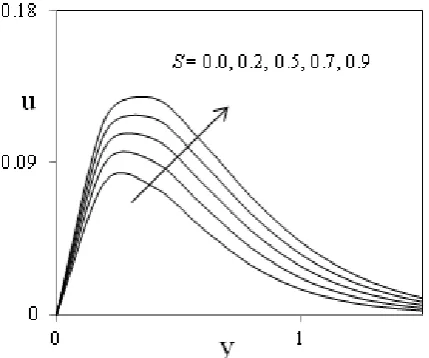
for different values of Heat source parameterS
Figure-6: Velocity profiles against
y
for different values of Thermal radiation parameterR
Figure (5) shows the collective effects of heat source parameter
S
for conducting air (Pr
=
0.71) in the case of cooling plate (Gr
>
0
), i.e., the free convection currents convey heat away from the plate into the boundary layer. With an increase inS
from 0.0 to 0.9, there is a clear increase in the velocity, i.e., the flow is accelerated.When heat is generated, the buoyancy force increases, which accelerate the flow rate and thereby giving, rise to the increase in the velocity profiles. These velocity profiles are closely agreed with existed results of Das et al. [11]. The effect of thermal radiation parameter
R
on velocity profiles in the figure (6). The thermal radiation parameter R defines the relative contribution of conduction heat transfer to thermal radiation transfer. It is obvious that an increase in the radiation parameter results in decreasing the skin friction and rate of heat transfer within the boundary layer.4.2. Temperature field
Figure-7: Temperature profiles against
y
for different values of Prandtl numberPr
The temperature profiles θ are depicted in figures (8) and (9) for different values of Eckert number
Ec
and Heatsource parameter
S
. The fluid temperature attains its maximum value at the plate surface, and decreases gradually to free stream zero value far away from the plate. It is seen that the fluid temperature increases with a rise inEc
. In the present study, we restrict our attention to the positive values ofEc
, which corresponds to plate cooling, i.e., loss of heat from the plate to the fluid. Also, we note that increasingEc
causes an increase in Joule heating as the magnetic field adds energy to the fluid boundary layer due to the work done in dragging the fluid Therefore, the fluid temperature is noticeably enhanced with an increase inS
from 0.0 to 0.9. This increase in the temperature profiles is accompanied by the simultaneous increase in the thermal boundary layer thickness. The effect of thermal radiation parameterR
on temperature profiles in the figure (10). From this figure, it is seen that the temperature decreases as the radiation parameterR
increases. This result qualitatively agrees with expectations, since the effect of radiation is to decrease the rate of energy transport to the fluid, thereby decreasing the temperature of the fluid.Figure-8: Temperature profiles against
y
for different values of Heat source parameterS
Figure-10: Temperature profiles against
y
for different values of Thermal radiation parameterR
4.3. Concentration distribution
The effect of Schmidt number
Sc
on the concentration field is presented in figure (11). Figure (11) shows the concentration field due to variation in Schmidt numberSc
for the gasses Hydrogen, Helium, Water – vapour, Oxygen and Ammonia. It is observed that concentration field is steadily for Hydrogen and falls rapidly for Oxygen and Ammonia in comparison to Water – vapour. Thus Hydrogen can be used for maintaining effective concentration field and Water – vapour can be used for maintaining normal concentration field.Figure-11: Concentration profiles against
y
for different values of Schmidt numberSc
4.4. Skin frictionFigure-12: Skin friction profiles against
K
p for different values of Hartmann numberM
Figure-13: Skin friction profiles against
K
p for different values of Heat source parameterS
4.5. Rate of heat and mass transfer
The rate of heat transfer at the wall varies with the variation of Hartmann number
M
, Heat source parameterS
against Prandtl numberPr
are shown in the figures (14) and (15). From figure (14), we observe that a growing heat source parameter increases the magnitude of the rate of heat transfer at the wall. Further, it is observed that from figure (15) that an increase in Hartmann number reduces its value for a given value of Prandtl number due to the magnetic pull of the Lorentz force acting on the flow field. These variations agree with those of Das et al. [11] with a little deviation for all the values ofM
.Figure-15: Rate of heat transfer
Nu
against Prandtl numberPr
for different values of Heat source parameterS
The rate of mass transfer at the wall varies with the variation of Schmidt numberSc
againsty
is shown in the figure (16). From figure (16), we observe that a growing Schmidt number decreases the magnitude of the rate of heat transfer at the wall. In order to ascertain the accuracy of the numerical results, the present results are compared with the existed results of Das et al., [11] for different values ofM
in absence of thermal radiation and viscous dissipation in the figure (17). They are found to be in a good agreement.Figure-16: Rate of mass transfer
Sh
againsty
for different values of Schmidt numberSc
5. CONCLUSIONS
We summarize below the following results of physical interest on the velocity, temperature and the concentration distribution of the flow field and also on the wall shear stress and rate of heat transfer at the wall.
1. A growing Hartmann number retards the velocity of the flow field at all points.
2. The effect of increasing Grashof number for heat and mass transfer or heat source parameter is to accelerate velocity of the flow field at all points.
3. The velocity of the flow field increases with an increase in permeability parameter and heat source parameter. 4. The velocity profiles are reducing with increasing values of thermal radiation parameter.
5. A growing Eckert number or heat source parameter increases temperature of the flow field at all points. 6. The Prandtl number increases the temperature of the flow field at all points.
7. As thermal radiation parameter increases, the temperature profiles are decreases at all flow points.
8. The effect of increasing Schmidt number is to reduce the concentration boundary layer thickness of the flow field at all points.
9. A growing Hartmann number reduces the skin friction at the wall while a growing heat source parameter reverses the effect against the permeability parameter.
10. The effect of increasing heat source parameter is to increase the magnitude of the rate of heat transfer at the wall. On the other hand, a growing Hartmann number reduces its value for a given value of Prandtl number due to the magnetic pull of the Lorentz force acting on the flow field.
11. The effect of increasing Schmidt number is to decrease the magnitude of the rate of mass transfer at the wall. 12. In order to ascertain the accuracy of the numerical results, the present results are compared with the existed
results of Das et al. [11] in absence of thermal radiation and viscous dissipation. They are found to be in a good agreement.
6. REFERENCES
1. Hellums, J. D. and Churchill, S. W., (1962). Transient and steady state, free and natural convection, numerical solutions: part 1. The isothermal, vertical plate, AIChE J., Vol. 8, No. 5, pp. 690 – 692.
2. Soundalgekar, V. M. and Ganesan, P., (1981). Finite difference analysis of transient free convection on an isothermal flat plate, Regional Journal of Energy, Heat and Mass Transfer, Vol. 3, pp. 219 – 224.
3. Soundalgekar, V. M. and Ganesan, P., (1981). Finite difference analysis of transient free convection with mass transfer on an isothermal vertical flat plate, International Journal of Engineering Science, Vol. 19, No. 6, pp. 757 – 770.
4. Takhar, H. S., Ganesan, P., Ekambavanan, K. and Soundalgekar, V. M., (1997). Transient free convection past a semi – infinite vertical plate with variable surface temperature, International Journal of Numerical Methods for Heat and Fluid Flow, Vol. 7, No. 4, pp. 280 – 296.
5. Soundalgekar, V. M., Gupta, S. K. and Aranake, R. N., (1979). Free convection effects on the MHD Stokes problem for a vertical plate, Nuclear Engineering and Design, Vol. 51, No. 3, pp. 403 – 407.
6. Sacheti, N. C., Chandran, P. and Singh, A. K., (1986). An exact solution for unsteady magnetohydrodynamic free convection flow with constant heat flux, International Communications in Heat and Mass Transfer, Vol. 29, pp. 1465 – 1478.
7. Shanker, B. and Kishan, N., (1997). The effects of mass transfer on the MHD flow past an impulsively started infinite vertical plate with variable temperature or constant heat flux, Journal of Energy, Heat and Mass Transfer, Vol. 19, pp. 273 – 278.
8. Elbashbeshy, E. M. A., (1997). Heat and mass transfer along a vertical plate with variable surface tension and concentration in the presence of magnetic field, International Journal of Engineering Science, Vol. 34, No. 5, pp. 515 – 522.
9. Ganesan, P. and Palani, G., (2004). Numerical solution of unsteady MHD flow past a semi – Infinite isothermal vertical plate, Proceedings of the Sixth ISHMT/ASME Heat and Mass Transfer Conference and Seventeenth National Heat and Mass Transfer Conference, Kalpakkam, India, pp. 184 – 187.
10. Srinivasa Raju, R., Sudhakar, K. and Rangamma, M., (2013). The effects of thermal radiation and heat source on an unsteady MHD free convection flow past an infinite vertical plate with thermal diffusion and diffusion thermo, Journal of Institutions of Engineers (India): Series C, Vol. 94, pp. 175 – 186. 11. Das S. S., Tripathy, U. K. and Das, J. K., (2010). Hydromagnetic convective flow past a vertical porous plate
through a porous medium with suction and heat source. International Journal of Energy and Environment, Vol. 1, No. 3, pp. 467 – 478.
12. Cogley, A. C., Vincenti, W. C. and Gilles, S. E., (1968). Differential approximation for radiation transfer in a non – gray gas near equilibrium, American Institute of Aeronautics and Astronautics Journal, Vol. 6, pp. 551 – 555.
13. Mansour, M. A., (1990).Radiative and free convection effects on the oscillatory flow past a vertical plate, Astrophysics and Space Science, Vol. 166, No. 2, pp. 269 – 275.
15. Hossain, M. A., Alim, M. A. and Rees, D. A. S., (1999). The effect of radiation on free convection from a porous vertical plate, International Journal of Heat and Mass Transfer, Vol. 42, No. 1, pp. 181 – 191.
16. Seddeek, M. A., (2002). Effects of radiation and variable viscosity on a MHD free convection flow past a semi – infinite flat plate with an aligned magnetic field in the case of unsteady flow, International Journal of Heat and Mass Transfer, Vol. 45, No. 4, pp. 931 – 935.
17. Muthucumaraswamy, R. and Senthil, G. K., (2004).The effect of heat and mass transfer on moving vertical plate in the presence of thermal radiation, Journal of Theoretical And Applied Mechanics, Vol. 31, No. 1, pp. 35 – 46.
18. Pal, D., (2009). Heat and mass transfer in stagnation – point flowtowards a stretching surface in the presence of buoyancy force and thermal radiation, Meccanica, Vol. 44, No. 2, pp. 145 – 158.
19. Aydin, O. and Kaya, A., (2008). Radiation effect on MHD mixed convection flow about a permeable vertical plate, Heat and Mass Transfer, Vol. 45, No. 2, pp. 239 – 246.
20. Mohamed, R. A., (2009). Double – diffusive convection radiation interaction on unsteady MHD flow over a vertical moving porous plate with heat generation and Soret effects, Applied Mathematical Sciences, Vol. 3, No. 13–16, pp. 629 – 651.
21. Chauhan, D. S. and Rastogi, P., (2010). Radiation effects on natural convection MHD flow in a rotating vertical porous channel partially filled with a porous medium, Applied Mathematical Sciences, Vol. 4, No. 13 – 16, pp. 643 – 655.
22. Ibrahim, S. Y. and Makinde, O. D., (2011). Radiation effect on chemically reacting Magnetohydrodynamics (MHD) boundary layer flow of heat and mass transfer through a porous vertical flat plate, International Journal of Physical Sciences, Vol. 6, No. 6, pp. 1508 – 1516.
23. Pal, D. and Mondal, H., (2011). The influence of thermal radiation on hydromagnetic Darcy – forchheimer mixed convection flow past a stretching sheet embedded in a porous medium, Meccanica, Vol. 46, No. 4, pp. 739 – 753.
24. Palani, G. and Kim, K. Y., (2012). Influence of magnetic field and thermal radiation by natural convection past vertical cone subjected to variable surface heat flux, Applied Mathematics and Mechanics (English Edition), Vol. 33, pp. 605 – 620.
25. Mahmoud, M. A. A. and Waheed, S. A., (2012). Variable fluid properties and thermal radiation effects on flow and heat transfer in micropolar fluid film past moving permeable infinite flat plate with slip velocity, Applied Mathematics and Mechanics (English Edition), Vol. 33, pp. 663 – 678.
26. Gebhart, B., (1962). Effect of viscous dissipation in natural convection, J. Fluid Mech., Vol. 14, No. 2, pp. 225 – 232.
27. Gebhart, B. and Mollendraf, J., (1969). Viscous dissipation in external natural convection flows, J. Fluid. Mech., Vol. 38, pp. 97 – 107.
28. Soundalgekar, V.M., (1972). Viscous dissipation effects on unsteady free convective flow past an infinite vertical porous plate with constant suction, Int. J. Heat Mass Transfer, Vol. 15, No. 6, pp. 1253 – 1261. 29. Maharajan, R.L. and Gebhart, B.B., (1989). Influence of viscous heating dissipation effects in natural
convective flows, Int. J. Heat Mass Transfer, Vol. 32, No. 7, pp. 1380 – 1382.
30. Israel – Cookey, C., Ogulu, A. and Omubo – Pepple, V. B., (2003). Influence of viscous dissipation on unsteady MHD free convection flow past an infinite heated vertical plate in porous medium with time – dependent suction, Int. J. Heat mass Transfer, Vol. 46, pp. 2305 – 2311.
31. Suneetha, S., Bhaskar Reddy, N. and Ramachandra Prasad, V., (2008). Effects of viscous dissipation and thermal radiation on hydromagnetic free convection flow past an impulsively started vertical plate, J. Naval Archit. Marine Eng., Vol. 2.
32. Suneetha, S., Bhaskar Reddy, N. and Ramachandra Prasad, V., (2009). Effects of thermal radiation on the natural convective heat and mass transfer of a viscous incompressible gray absorbing emitting fluid flowing past an impulsively started moving vertical plate with viscous dissipation, Thermal Sci., Vol. 13, No. 2, pp. 71 – 81.
33. Ahmed, S. and Batin, A., (2010). Analytical model of MHD mixed convective radiating fluid with viscous dissipative heat, Int. J. Engg. Sci. Tech., Vol. 2, No. 9, pp. 4902 – 4911.
34. Sudheer Babu, M., Satya Narayana, P. V., Sankar Reddy, T. and Uma Maheswara Reddy, D., (2011). Radiation and chemical reaction effects on an unsteady MHD convection flow past a vertical moving porous plate embedded in a porous medium with viscous dissipation, Advances in Applied Science Research, Vol. 2, No. 5, pp. 226 – 239.
35. Kishore, P. M., Rajesh, V. and Vijaya Kumar Verma, S., (2012). The effects of thermal radiation and viscous dissipation on MHD heat and mass diffusion flow past an oscillating vertical plate embedded in a porous medium with variable surface conditions, Theoret. Appl. Mech., Vol. 39, No. 2.
36. Brewster, M. Q., Thermal radiative transfer & properties, John Wiley & Sons (1992).
Source of support: Nil, Conflict of interest: None Declared.