KINETICS AND THERMODYNAMICS OF THE CORROSION OF
MILD STEEL IN THE PRESENCE OF EUPHOBIA TIRUCALLI
GUMS
Habibat Faith Chahul
[a]*Elijah Maji
[a]and Rufus Shaato
[a]Keywords:Euphobia tirucalli, adsorption isotherm, activation energy, corrosion inhibition
Understanding the mechanism of corrosion of steel in acidic environments along with the accompanying quest for corrosion inhibitors that are nontoxic to the environment is of significant industrial concern. This work sets to investigate the corrosion of mild steel in 1.0 M solution of HCl in the presence of Euphobia tirucalli gums (ET) using weight loss and linear polarization measurements. The study was carried out within the inhibitor concentration range of 0.2-1.0 g L-1 and at the temperature range of 303 - 333 K. From the results obtained, it was observed that ET gums inhibited the dissolution of mild steel in the acid medium. Thermodynamic parameters obtained from the studies revealed the corrosion inhibition process to be spontaneous, exothermic and physisorptive. The adsorption of ET gums on the steel surface aligned well with the Langmuir, Freundlich and Temkin isotherm models. Linear polarization results revealed that ET functioned as a mixed-type inhibitor by inhibiting both the cathodic and anodic reactions on the mild steel surface.
Corresponding Author*
E-Mail: [email protected]
[a] Department of Chemistry, FederalUniversity of Agriculture, P.M.B.2373 Makurdi, Nigeria.
Introduction
Corrosion is the process through which metals/alloy deteriorates. The presence of moisture, acids, bases, salts, aggressive metal polishes and electrolytes generally would lead to the deterioration of most metals/alloys. According to Ahmad and Roberge,1,2 the tendency of a metal/alloy to
corrode to a large extent is a function of the type of metal/alloy and the aqueous medium.
Mild steel is known for its widespread industrial applications due to its structural and mechanical properties. It is, however, susceptible to corrosion when it gets in contact with electrolytes resulting in a relatively short life span.1,2 Corrosion of steel structures and pipes result in
significant losses of products in industries, environmental pollution and ecological disasters which have attracted much attention and investigations.3,4
A substance is said to be a corrosion inhibitor when on its addition to a corrosive environment, it either slows down or prevents corrosion. These substances can function by adsorbing both physically and chemically at the metal/solution interface thereby serving as a barrier between the metal and the corrosive species in the environment.5-7
Peter et al. and Ramyan et al.,7,8 described corrosion
inhibitors as usually possess heteroatoms such as oxygen, nitrogen and sulfur that have hydrocarbon parts that are typically attached to or part of a polar group, an aromatic ring or a conjugated system.
Many inorganic and organic compounds have been used and are still being employed in mitigating corrosion of metals and alloys. However, most of these compounds are expensive coupled with the fact that they pose health and
environmental challenges hence the quest for cheap and environmentally friendly inhibitors as substitutes.5,7,8
Plant gums have been reported as good corrosion inhibitors against the dissolution of steel in acidic environments.9-14 Umoren has investigated the inhibitive
effects of plant gum exudates from Raphiahookeri (RH) against the corrosion of mild steel in H2SO4and Ebenso.9
The results obtained revealed that RH acted as a suitable corrosion inhibitor for the corrosion of mild steel in sulphuric acid medium. Abdallah10 investigated the potential
of Guar gum (GG) as a corrosion inhibitor for carbon steel in 1.0 MH2SO4 solution using weight loss and Tafel
polarization techniques. The results showed that GG inhibited the corrosion of carbon steel in the acid medium and acted as a mixed type inhibitor. In other studies, other gums such as Gum arabic (GA), Albizia zygia (AZ), Anogessus leiocarpus(Al) and Ficus platphylla (FP) have also been reported to be good corrosion inhibitors.11-14
The results of phytochemical and pharmacological studies carried out by Prabha et al., and Prashant and Shital on
Euphobia tirucalli (ET) gum exudates showed that the gum exudates contain triterpenes, diterpene esters, steroids, alkaloids, flavonoids, tannins, phenols, anthraquinones and cardiac glycosides15,16 which are sources of heteroatoms.
This study sets to investigate the kinetics and thermodynamics of the dissolution of mild steel in 1.0 M solution of HCl in the absence and presence of
Euphobiatirucalli gums using weight loss and linear polarization measurements.
Experimentals
Mild steel coupons of dimension 3x2 cm2 and percentage
Purification of Euphobia tirucalli gum.
The procedure adopted for the purification of gum has been reported elsewhere by Femi et. al., and other researchers.17,18 The gums were oven dried at 40 °C for two
hours after which they were pulverized with a blender and hydrated in chloroform water of double strength for five days with intermittent stirring such that all the gums particles dissolve completely. A 75 μm sieve was used to strain the hydrated gums to obtain a pure slurry which was allowed to sediment. Absolute ethanol was used to precipitate the gum sediment from the slurry which was later filtered and defatted using diethyl ether. The precipitate was dried again by placing it in an oven at the temperature of 40 °C for 48 hours, after which the dried flakes were pulverized using a blender. The pulverized gums were kept in a dry and air tight container. Inhibitor test solutions (0.2, 0.4, 0.6, 0.8 and 1.0 g L-1concentrations)19 were prepared by
dissolving appropriate quantities (0.05 g - 0.25 g) of the gum exudates in 250 mL of 1.0 M HCl solution.
Weight loss measurement
Mild steel coupons were cleaned, weighed and immersed in 250 mL test solutions in the absence and presence of ET gum exudates (0.2, 0.4, 0.6, 0.8and 1.0g L-1) as reported in
previous studies.19,20 They were removed at specified time
intervals, washed in water, cleaned with ethanol, dried with acetone and reweighed. The average loss in weight was taken as the difference between the initial and final weights of the mild steel (in duplicates).
The corrosion rate of mild steel as a function of time was investigated by carrying out the experiment for 24 – 168 hours. This was done in the absence and presence of ET exudates. Temperature studies were done in a similar manner for three hours with the water bath maintained at 303- 333 K.
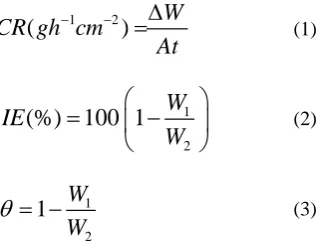
By carrying out the necessary substitutions in equations 1 to 3, weight loss data were used to evaluate the weight loss (g h-1), corrosion rate (g h-1 cm-2), inhibition efficiency (% IE) and the degree of surface coverage (θ).
(1)
(2)
(3)
where ΔW = W2 - W1 is the weight loss of mild steel after time, t, W1 and W2 are the weight loss (g) of mild steel with and without the inhibitor, respectively, θ is the extent of surface coverage of the inhibitor, A is the area of the metal coupon (in cm2) and t is the immersion period (in hours).6
Linear polarization measurements
The coupons of 3 x 2 cm2 dimension were sealed with
epoxy resin in such a way that only 1 cm2 was left exposed.
A three-electrode system consisting of mild steel as working electrode, platinum (Pt) as an auxiliary electrode and saturated calomel electrode (SCE) as a reference electrode was used. Linear polarization studies were carried out using Metrohm Autolab AUT50280 in the potential range of -1500 to -1500 mV with a scan rate of 0.012 V s-1 at room
temperature.
The linear Tafel segments of the anodic and cathodic curves were extrapolated to corrosion potential to obtain the corrosion current densities (Icorr). The % IE was obtained from the equation below:
(4)
where Icorr(blank) is the corrosion current density of MS in the free acid solution andIcorr(inh) is the corrosion current density of MS in the inhibited acid solution.7
Optical microscopy
The morphologies of the surface of the polished mild steel coupons before immersion in the test solutions and after immersion in the test solutions were investigated using a metallurgical microscope (Tsview digital metallurgical microscope, model: Tucsen 0923502).
Results and discussion
The corrosion rate of mild steel and inhibition efficiency of ET gums
Figure 1 showed the rate of corrosion of mild steel in the free acid and inhibited 1.0 M HCl solution as a function of immersion time. It can be observed from the plot in Figure 1 that the rate of corrosion of the steel decreased with immersion time and as the concentrations of ET gums increased.
Figure 2 illustrates the trend of inhibition efficiency (%
IE) of various concentrations of ET gums with immersion time. Inhibition efficiency of the gums increased as the concentrations of ET gums increased with % IE > 98 up to the immersion time of 96 h before decreasing.
This trend may be due to the desorption of the constituents of ET gums from the surface of the steel over a prolonged exposure resulting in the inhibition efficiency been lowered as observed in the plots.
Olasehinde et al., and Momoh-Yahaya et al.20,21 in
previous studies reported the decrease in inhibition efficiency of Nicotiana tabacum extracts and adenine 1 2
(
)
W
CR gh cm
At
− −
=
∆
( )
%
IE
100
I
corrI
I
−
=
blnk corr(inh)corr(blnk)
1
2
(%) 100 1
W
IE
W
=
−
1
2
1
W
W
molecules in acidic environments at more extended immersion periods.
Figure 1. The corrosion rate of mild steel as a function of time in the absence and presence of ET gums
In both studies, the desorption of the constituents of
Nicotiana tabacum extracts and adenine molecules from the surface of the mild steel was attributable to the decrease in inhibition efficiency observed.
Figure 2. Inhibition efficiency of ET gums as a function of time (h).
Temperature considerations
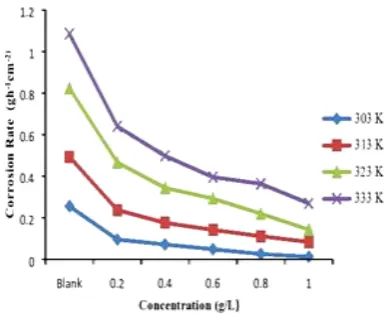
Figure 3 showed the trend in the rate of corrosion of mild steel in uninhibited and inhibited 1.0 M solution of HCl at 303 - 333 K. The plots reveal that the rates of corrosion of mild steel increased generally at higher temperature values both in the free acid solution and in the presence of ET gums. Thermodynamically, the average kinetic energy of reacting species in a system is a function of the temperature. Reacting species become more energetic with a rise in temperature, this explains the increased rates of dissolution and corrosion rates of the mild steel in both the uninhibited and inhibited test solutions at higher temperatures. Other researchers corroborate this observation.20-23However, the
rate of corrosion of mild steel was relatively lower in the inhibited test solutions compared with the uninhibited acid solution. This signifies the inhibitive effect of ET gums on the acid corrosion of mild steel.
The plot of the inhibition efficiency of ET gums as a function of temperature (303-333 K) is presented in Figure 4. The plot shows a decrease in inhibition efficiency of ET gums as the temperature of the system was increased. This could be attributed to the agitation of adsorbed ET gums and consequent desorption of ET gums from the mild steel surface as temperature increased.20-22 The lowering of
inhibition efficiency values with increasing temperature is associated with a physisorptive mechanism of adsorption as reported in other works.20-24
Figure 3. The corrosion rate of mild steel in 1.0 M HCl as a function of the concentration of ET gums at 303-333 K.
Figure 4. Inhibition efficiency of ET gums as a function of concentration at 303- 333 K.
The relationship between the corrosion rate of mild steel in the various test solutions and the temperature was evaluated using the Arrhenius equation (𝑒𝑒𝑒𝑒𝑒𝑒𝑒𝑒𝑒𝑒𝑒𝑒𝑒𝑒𝑒𝑒 5). Taking logarithm of both sides of equation 5, equation 6 is obtained.
(5)
(6)
where CR is the rate of corrosion of the metal, A is the Arrhenius or pre-exponential factor, Ea is the apparent effective activation energy, R is the universal gas constant and T is the absolute temperature of the system (K).
a
log
log
2.303
E
CR
A
RT
=
−
a
exp
/
A plot of log CR versus 1⁄𝑇𝑇 represented on Figure 5 gave a straight line graph with a slope of (-Ea/2.303RT) and an intercept of [log 𝐴𝐴] from which the values of the apparent activation energy (Ea) were evaluated.21,23,24 The values of Ea
are shown in Table 1. It is evident from Table 1 that the value of Ea in the uninhibited system increased on the addition of ET gums as reflected in the values of Ea in the inhibited systems. This behavior is suggestive of a physisorptive kind of adsorption mechanism whereby an increase in temperature leads to the desorption of the adsorbed inhibitor from the steel surface thereby exposing the mild steel surface to the acid solution and leading to arise in the rate of corrosion of the steel as reported bySzauer and Brandt along with other researchers.25,23,24
Enthalpy (Δ𝐻𝐻#) and entropy (Δ𝑆𝑆#) of activation of the
corrosion inhibition were calculated using the Eyring equation;
(7)
where CR is the corrosion rate at temperature T, R is the molar gas constant, n is Avogadro’s constant 6.0225×10²³
and h is the Planck’s constant (6.6261 × 10⁻³⁴ J s). A plot
of log CR⁄𝑇𝑇versus 1/T as shown in Figure 6 is a straigh line graph with a slope of (−Δ𝐻𝐻#⁄2.303𝑅𝑅) and an intercept of
[log(𝑅𝑅⁄𝑒𝑒h) + Δ𝑆𝑆#⁄2.303𝑅𝑅] from which the values of Δ𝐻𝐻# and
Δ𝑆𝑆# were calculated.21,23,24
The results presented in Table 1 show that the enthalpies of activation are all negative which reveals the exothermic nature of the dissolution process of the mild steel. Also, the entropies of activation were all negative for the gums.7
Negative values of Δ 𝑆𝑆#
have been reported by Refat andIshaq25 to represent the association mechanism of the
corrosion process whereby a decrease in disorder takes place ongoing from the reactants to the activated complex. Shukla and Ebenso corroborate this explanation in their findings on the adsorptive behavior and thermodynamic properties of streptomycin in the corrosion of mild steel in1.0 M HCl.23 In
their study, the values of Δ𝑆𝑆# were not only negative but
higher in the inhibited systems.
Figure 5. Arrhenius plot of the temperature –dependence of the corrosion rate of mild steel in 1.0 M HCl in the absence and presence of ET gums.
The values of Δ𝑆𝑆# in this study (Table 1) aligns with the findings of Shukla23 and Refat.25 The entropy of activation, Δ𝑆𝑆# in this present study increased in the presence of ET
gums. This may be as a result of the adsorption of ET gums on the surface of the steel thereby slowing the discharge of hydrogen ions on the surface of the mild steel and the rate of corrosion of the steel.23-25
Figure 6. Eyring plot of the temperature-dependence of the corrosion rate of mild steel in 1.0 M HCl in the absence and presence of ET gums.
Table 1. Thermodynamic parameters of the corrosion of mild steel in 1.0 M HCl in the presence and absence of ET gums at 303-333 K.
Concentration, g L-1
Ea, kJ mol-1
∆H#, kJ mol-1
∆S#, J mol-1 K
Blank 16.280 -4.509 -132.0
0.2 20.104 -5.569 -113.6 0.4 20.736 -5.774 -108.1 0.6 22.457 -6.220 -66.01 0.8 25.941 -7.185 -75.45 1.0 29.018 -8.037 -68.69
Adsorption isotherms
Surface coverage (Ɵ) values derived from weight loss measurements were adapted into various adsorption isotherms in order to know the adsorption characteristics of ET gums. The Langmuir, Freundlich and Temkin isotherms were found to give good descriptions of the adsorption characteristics of ET gums with all the plots having linear slopes and regression coefficients values R2≥0.9.5,23 The
functionalized and linear forms of the Langmuir, Freundlich and Temkin isotherm models5 are the followings:
Isotherm Functional form Linear form
Langmuir
Freundlich
Temkin
# #
log
log
2.303
2.303
CR
R
S
H
T
nh
R
RT
∆
∆
=
+
−
ads
ads
n
ads ads
ads ads
1 1
0 log log log
(0 1)
exp( ) 2 2.303(log log )
C
k C C
k
k C k n C
n
k C f k C
θ
θ θ
θ
θ αθ
= = +
−
= = −
< <
where C is the concentration of the inhibitor in the bulk electrolyte, Kadsis the adsorption equilibrium constant, Ɵ is
the degree of surface coverage of the inhibitor and ∝is the molecular interaction parameter.20 Table 2 presents the
adsorption parameters evaluated from the plots.
The adsorption equilibrium constant, Kads is related to the standard free energy of adsorption, ∆Gads as showed in equations 8 and 9,
(8)
(9)
where ∆Gads is the standard free energy of adsorption of ET gums on the mild steel surface, R is the universal gas constant, 55.5 is the concentration of water in solution in mol L-1 and K
ads is the equilibrium constant of adsorption.
The values of ∆G0
ads were negative and less than -20 kJ mol -1 for all the three adsorption models.
Figure 7. Langmuir isotherm for the adsorption of ET gums on mild steel surface at 303 K and 333 K respectively.
Figure 8. Freundlich isotherm for the adsorption of ET on mild
This implies that the adsorption of ET gums on the surface of the mild steel coupon is spontaneous and physisorptive.7
The values of ∆G0ads≤-20 kJ mol-1and ∆Gads ≥−40 kJ mol-1
have been reported in studies conducted by Momoh-Yahaya
et al. and Oguzie et al. to signify the mechanisms of physisorption and chemisorption respectively.21,5
Figure 9. Temkin isotherm for the adsorption of ET on mild steel surface at 303 K and 333 K respectively.
Linear polarization
Linear polarization plots for the corrosion of mild steel in the various test solutions are shown in Figure 10 while Table 3 presents all the linear polarization parameters derived from the polarization plots and inhibition efficiency values.
The corrosion current density is a function of the reactivity of a metal in an aqueous environment. The higher the values of Icorr, the higher the dissolution of the metal and vice versa. Addition of ET gums is observed to reduce the anodic and cathodic current densities and the corresponding corrosion current density (Icorr) by shifting the corrosion potential (Ecorr) toward more negative (cathodic) values.
Figure 10. Linear polarisation plots of mild steel in 1.0 M HCl in the absence and presence of ET.
These shifts in the corrosion potential (𝐸𝐸corr) are more
pronounced at higher ET concentrations, and the cathodic inhibiting effect becomes more significant. This implies that the gums functioned as a mixed-type inhibitor, with predominant cathodic effect.
ads
ads ads
log
1.744
2.303
2.303
log(55.5
)
G
K
RT
G
RT
K
∆
= −
−
∆
= −
Table 2. Adsorption parameters of ET gums on mild steel surface in 1.0 M HCl
Temperature, K
Slopes Intercepts R2 α K
ads ΔGads, kJ
mol-1
Langmuir 303 0.904 0.169 0.991 - 5.921 -14.60
333 1.076 0.276 0.990 - 3.376 -14.49
Freundlich 303 0.625 -0.2264 0.977 - 1.684 -11.43
333 1.050 -0.608 0.976 - 4.051 -14.10
Temkin 303 0.324 0.778 0.934 0.324 11.04 -16.17
333 0.292 0.535 0.949 0.292 6.23 -16.18
Table 4. Linear polarisation parameters for the corrosion of mild steel in 1.0 M HCl in the absence and presence of ET.
Conc., g L-1 Ecorr, mV Icorr, μAcm-2 ᵝa,V dec-1 ᵝc, V dec-1 CR, mmyr-1 %IE
Blank -843.79 299.86 0.47551 0.31335 348.44 -
0.2 -513.90 135.76 0.64010 0.54541 157.75 54.73 0.4 -844.30 266.10 0.52436 0.29977 147.12 57.78 0.6 -836.65 22.93 0.35607 0.32226 26.643 92.35 0.8 -1620.4 17.81 0.25595 0.28927 20.692 94.06 1.0 -1315.2 20.31 0.26930 0.23854 23.599 93.23
The values of ba and bc changed as the inhibitor concentration increased, signifying the influence of ET gum exudates on both the dissolution of the mild steel in 1.0 M HCl and the kinetics of hydrogen evolution. This is revealed in similar studies by Oguzie et al. and others.3-5,30
Linear polarization
Linear polarization plots for the corrosion of mild steel in the various test solutions are shown in Figure 10 while Table 3 presents all the linear polarization parameters derived from the polarization plots and inhibition efficiency values.
The corrosion current density is a function of the reactivity of a metal in an aqueous environment. The higher the values of 𝐼𝐼corr, the higher the dissolution of the metal and
vice-versa. Addition of ET gums is observed to reduce the anodic and cathodic current densities and the corresponding corrosion current density (𝐼𝐼corr) by shifting the corrosion potential (𝐸𝐸corr) toward more negative (cathodic) values.
These shifts in the corrosion potential (𝐸𝐸corr) are more pronounced at higher ET concentrations, and the cathodic inhibiting effect becomes more significant. This implies that the gums functioned as a mixed-type inhibitor, with predominant cathodic effect. The values of ba and b𝑐𝑐
changed as the inhibitor concentration increased, signifying the influence of ET gum exudates on both the dissolution of the mild steel in 1.0 M HCl and the kinetics of hydrogen evolution. This is revealed in similar studies by Oguzie et al. and others.3-5,30
Optical microscopy
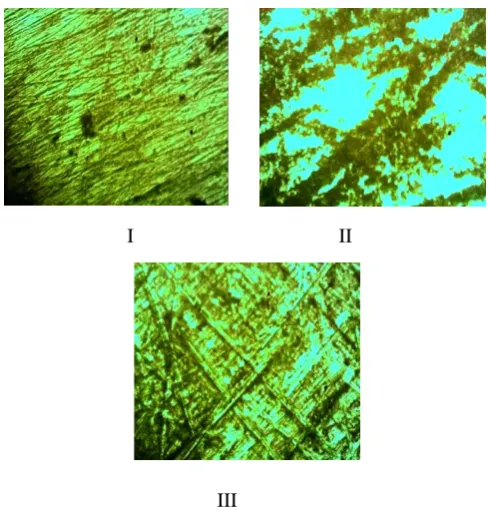
Plates I, II and III show the micrographs of the polished mild steel, the polished steel after immersion in the uninhibited acid solution and the polished steel after
immersion in the inhibited acid solution respectively. Plate II shows a steel surface that is relatively damaged compared to Plates I and III. This is as a result of the rust formed on it after undergoing corrosion in 1.0 M solution of HCl in the absence of the inhibitor. The micrograph of mild steel surface in Plate III shows no pits and cracks except some polishing lines and the presence of an excellent protective film.
This further confirms the adsorption of the constituents of ET gums on the mild steel surface and the inhibitive property of ET gums against the corrosion of mild steel in 1.0 M solution of HCl.
I II
III
Conclusion
The results obtained from this study have shown that
Euphorbia tirucalli gum exudates acted as a useful and efficient inhibitor against the dissolution of mild steel in 1.0 M HCl. Inhibition efficiency of the gums was found to be concentration dependent. However, the inhibition efficiency of the gums decreased with immersion time and rose in temperature. Values of 𝐸𝐸a, Δ𝐻𝐻# and Δ𝐺𝐺ads obtained showed that the adsorption of Euphorbia tirucalli gums exudates on the steel surface was physisorptive, exothermic and spontaneous. Linear polarization measurements showed that
Euphorbia tirucalli gum exudates functioned as a mixed corrosion inhibitor by inhibiting and retarding the rates of both the anodic metal dissolution and cathode hydrogen ion reduction reactions. Optical micrographs confirm the adsorption of Euphorbia tirucalli gum exudates on the surface of the mild steel.
References
1Ahmad, Z., Principles of corrosion engineering and corrosion control.Butterworth-Heinemann: Elsevier Science and Technology Books, 2006.
https://www.elsevier.com/books/principles-ofcorrosion-engineering-and-corrosion-co...
2Roberge, P. R., Handbook of corrosion engineering. New York McGraw-Hill, 2000.
https://www.cntq.gob.ve/cdb/documentos/quimica/197.pdf.
3Okafor, P. C., Liu, X., Zheng, Y. G., Corrosion inhibition of mild steel by ethylaminoimidazoline derivative in CO2-saturated solution, Corros. Sci., 2009, 51(4),761-768. https://doi.org/10.1016/j.corsci.2009.01.017
4Arora, P., Kumar, S., Sharma, M. K., Mathur, S. P., Corrosion Inhibition of Aluminium by Capparis decidua in Acidic Media, E-J.Chem., 2007, 4(4),450-456.
downloads.hindawi.com/journals/jchem/2007/487820.pdf
5Oguzie, E. E., Mejeha, I. M., Nwandu, M. C., Okeoma, K. B., Nnanna, L. A., Chidiebere, M. A., Eze, F. C., Experimental and theoretical assessment of the inhibiting action of Aspilia africana extract on corrosion aluminum alloy AA3003 in hydrochloric acid, J. Mater. Sci., 2012, 47(6), 2559-2572. https://doi.org/10.1007/s10853-011-6079-2
6Ameh, P. O., Eddy, N. O., Gimba, C. E., Physiochemical and rheological studies on some natural polymers and their potentials as corrosion inhibitors. UK: Lambert academic publishing; 2012.
7Peter, A., Obot, I. B., Sharma, S. K. Use of natural gums as green corrosion inhibitors: an overview, Int. J. Ind. Chem., 2015, 6(3),153–164.
https://link.springer.com/article/10.1007/s40090-015-0040-1
8Ramya, K., Mohan, R., Anupama, K. K., Joseph, A., Electrochemical and theoretical studies on the synergistic interaction and corrosion inhibition of alkyl benzimidazoles and thiosemicarbazide pair on mild steel in hydrochloric acid, Mater. Chem. Phys., 2015, 149–150, 632-647.
https://doi.org/10.1016/j.matchemphys.2014.11.020
9Umoren. S. A., Ebenso, E. E., Studies of the anti‐corrosive effect of Raphia hookeri exudate gum‐halide mixtures for aluminum corrosion in acidic medium, Pigment Resin Technol., 2008, 37(3), 173-182.
https://www.emeraldinsight.com/doi/abs/10.1108/036994208 10871020
10Abdallah, M., Guar Gum as Corrosion Inhibitor for Carbon Steelin Sulfuric Acid Solutions, Portugaliae Electrochim. Acta., 2004, 22(2),161-175.
http://www.peacta.org/articles_upload/PEA2222004161.pdf
11Umoren, S. A., Obot, I. B., Ebenso, E. E., Okafor, P. C., Ogbobe, O., Oguzie, E. E., Gum arabic as a potential corrosion inhibitor for aluminum in alkaline medium and its adsorption characteristics, Anti-corros. Methods. Mater., 2006, 5(5),277-82.
https://www.emeraldinsight.com/doi/abs/10.1108/000355906 10692554
12Ameh, P.O., Inhibitory action of Albizia zygia gum on mild steel corrosion in acid medium, Afr. J. Pure Appl. Chem.,2014, 8(2),37–46.https://doi.org/10.5897/AJPAC2014.0549
13Ameh, P. O., Odiongenyi, A. O., Eddy, N. O., Joint Effect of Anogessius Leocarpus Gum (AL Gum) Exudate and Halide Ions on the Corrosion of Mild Steel in 0.1 M HCl, Portugaliae Electrochim. Acta., 2012,
30(4),235-245.
http://www.scielo.mec.pt/scielo.php?pid=S0872-19042012000400001&script=sci_arttext&tlng=en
14Eddy, N. O., Ameh P. O. Ebenso, E. E., Chemical Information from GCMS of Ficus Platyphylla Gum and its Corrosion Inhibition Potential for Mild Steel in 0.1 M HCl, Int. J.Electrochem. Sci., 2012, 7, 5677–5691.
http://www.electrochemsci.org/papers/vol7/7065677.pdf
15Prabha, M. N., Ramesh, C. K., Kuppast, I. J., Mankani, I. J., Studies on anti-inflammatory and analgesic activities of Euphorbia tirucalli L. Latex, Int. J. Chem. Sci., 2008,
6(4),1781-1787. https://www.tsijournals.com/articles/studieson- antiinflammatory-and-analgesic-activitiesof-euphorbia-tirucalli-l-latex.pdf
16Prashant, Y. M., Shital, S. P., Euphorbia tirucalli L.: Review on morphology, medicinal uses, phytochemistry and pharmacological activities, Asian-Pacific J. Tropical Biomed., 2017, 7(7), 603-613.
https://doi.org/10.1016/j.apjtb.2017.06.002
17Femi-Oyewole, M., Musiliu, O., Taiwo, O., Evaluation of the suspending properties of Albiziazygia gum on sulphadimidine suspension, Trop. J. Pharm. Res., 2004, 3(1),279-284.http://www.bioline.org.br/pdf?pr04003
18Jao, A. M., Physicochemical and rheological characterization of some plant gum exudates and their inhibition of the corrosion of aluminum in acidic medium. M.Sc ThesisAhmadu Bello University Zaria, Nigeria,
2014.http://kubanni.abu.edu.ng/jspui/bitstream/123456789/6
736/1/ALIYU%20MOHAMMED%20JA%27O.pdf
19Chahul, H. F., Ndukwe, G. I., Abawua, S. T., Corrosion inhibition studies of mild steel with stem bark extract of maranthes polyandra (Benth.) prance, J. Chem.Soc. Nig.,
2017, 42(1),55-61.
20Olasehinde, E. F., Olusegun, S. J., Adesina, A. S., Omogbehin, S. A., Momoh-Yahaya, H. Inhibitory Action of Nicotiana tabacum Extracts on the Corrosion of Mild Steel in HCl: Adsorption and Thermodynamics Study, Nature and Science,
2012, 10(12),21-34.
http://www.sciencepub.net/nature/ns1101/013_13992ns1101 _83_90.pdf
21Momoh-Yahaya, H., Eddy, N. O., Iyun, J. F., Gimba, C. E., Oguzie, E. E., Experimental Investigation of the Inhibiting Action of Adenine on the Corrosion of Mild Steel in Acidic Environments, J. Mater. Sci. Res., 2013, 2(1),
59-74.http://www.ccsenet.org/journal/index.php/jmsr/article/vie
w/21307
22Singh, A. K., Quraishi, M. A., Piroxicam; A novel corrosion inhibitor for mild steel corrosion in HCl acid solution, J. Mater. Environ. Sci.,2010,
1(2),101-110.
23Shukla, S, S., Eno, E. E., Corrosion Inhibition, Adsorption Behavior and Thermodynamic Properties of Streptomycin on Mild Steel in Hydrochloric Acid Medium, Int. J. Electrochem. Sci., 2011, 6, 3277–3291.
http://www.electrochemsci.org/papers/vol6/6083277.pdf
24Szauer, T., Brandt, A., On the role of fatty acid in adsorption and corrosion inhibition of iron by amine—fatty acid salts in acidic solution, Electrochimica Acta, 1981,26(9),1257-1260.
25Hassan, R. M., Zaafarany, I. A., Kinetics of Corrosion Inhibition of Aluminum in Acidic Media by Water-Soluble Natural Polymeric Pectates as Anionic Polyelectrolyte Inhibitors, Materials, 2013, 6(6),2436-2451.
http://citeseerx.ist.psu.edu/viewdoc/download;jsessionid=36 A5C699B41AB5618365B524408894D8?doi=10.1.1.361.447 7&rep=rep1&type=pdf