from Washington State, U.S.A.
Ben S. Legler1, Markus S. Dillenberger2
1 WTU Herbarium, Burke Museum, Box 355325, University of Washington, Seattle, WA 98195-5325, U.S.A. 2 Department of Botany and Plant Pathology, Oregon State University, 2082 Cordley Hall, Corvallis, OR 97331, U.S.A.
Corresponding author:Ben S. Legler ([email protected])
Academic editor:G.G. del Galdo | Received 6 April 2017 | Accepted 29 May 2017 | Published 15 June 2017
Citation: Legler BS, Dillenberger MS (2017) Two new species of Sabulina (Caryophyllaceae) from Washington State, U.S.A. PhytoKeys 81: 79–102. https://doi.org/10.3897/phytokeys.81.13106
Abstract
Sabulina basaltica and Sabulina sororia (Caryophyllaceae) are described as new species endemic to Wash-ington State, U.S.A. Sabulina basaltica is restricted to high-elevation, basalt rocks in the northeastern Olympic Mountains, and Sabulina sororia to high-elevation, dunite rocks of the Twin Sisters Range in the North Cascade Mountains. Both were previously confused with Sabulina rossii (formerly called Arenaria rossii or Minuartia rossii). Their recognition as distinct species is supported by morphological and molecu-lar characters and disjunct geographic distributions. Both are illustrated, mapped and compared to related species. We also present a molecular phylogeny of Sabulina based on nuclear ITS and plastid trnQ-rps16 DNA with increased sampling of North American taxa. The phylogeny resolves a single clade containing all glabrous, perennial, North American Sabulina taxa including Sabulina rossii and both of the new species.
Keywords
Caryophyllaceae, Arenaria, Minuartia, Sabulina, Washington, Olympic Mountains, Twin Sisters, endemic, new species
Introduction
While preparing a new Flora of the Pacific Northwest (Giblin et al., in press) the status of specimens from the North Cascade and Olympic Mountains in Washington State
formerly called Arenaria rossii R. Br. ex Richardson var. rossii (Hitchcock et al. 1964,
Hitchcock and Cronquist 1973) came into question. Ensuing study of the specimens demonstrated they do not fit any currently described species and are furthermore dis-tinct from each other. On the basis of recent field work, morphological analyses, ge-netic sequencing, and disjunct distributions, they are here described as two new species in order to make names available for use in the new Flora.
Herbarium specimens of the two new species were first collected in 1911 from the Olympic Mountains and in 1939 from the Twin Sisters Range in the North Cascade Mountains, with the most recent collections prior to this study made in 1984 from the Olympic Mountains and in 1968 from the Twin Sisters Range. These specimens, 17 in total, are held by three local herbaria (OLYM, WTU and WWB; acronyms accord-ing to Thiers continuously updated); no duplicates were located through searches of digitized specimens at other herbaria.
These specimens have largely been overlooked in previous studies of Arenaria L. s.
lat. To our knowledge, no floras or literature treat them under any names other than A.
rossii var. rossii or Minuartia rossii (R. Br. ex Richardson) Graebn., with the exception
of a vague reference to M. stricta (Sw.) Hiern. by Wolf et al. (1979). Maguire (1958)
recognized three subspecies of A. rossii with a circumboreal distribution extending
south to the U.S. Rocky Mountains but made no mention of plants from Washington.
Wolf et al. (1979), following a revision of Arenaria by McNeill (1962), treated
Magu-ire’s three subspecies at the rank of species under the segregate genus Minuartia Loefl.,
as M. austromontana S.J. Wolf & Packer, M. elegans (Cham. & Schltdl.) Schischk.,
and M. rossii. In describing M. austromontana, Wolf et al. (1979) examined several
of the herbarium specimens fromWTU, concluding that “reports of this species from
Washington are erroneous,” and vaguely referred the specimens to M. stricta (Sw.)
Hi-ern, a species not otherwise attributed to Washington by any sources. The most recent
comprehensive treatment of Minuartia for North America (Rabeler et al. 2005) does
not account for the Washington specimens and excludes Washington from the
distri-butions of M. austromontana, M. elegans, M. rossii, and M. stricta.
Recent phylogenetic studies (Harbaugh et al. 2010, Greenberg and Donoghue
2011, Dillenberger and Kadereit 2014) clearly demonstrate that Minuartia, as defined
by McNeill (1962) and applied by Rabeler et al. (2005), is highly polyphyletic.
Dil-lenberger and Kadereit (2014) proposed a new generic classification for Minuartia
s. lat. and resurrected the segregate genus Sabulina Rchb., newly circumscribed to
include ca. 65 taxa widely distributed throughout the Northern Hemisphere. Of the
33 North American taxa formerly placed under Minuartia s.l. by Rabeler et al. (2005),
19 now belong to Sabulina, including S. austromontana (S.J. Wolf & Packer) Dillenb.
(2014); assignment of the remaining taxa was inferred by morphology. Morphological
similarities likewise suggest the two new species from Washington belong to Sabulina.
To confirm their placement and to clarify relationships between the new species and
the above taxa, we present an expanded phylogeny of Sabulina.
Methods
A total of 127 herbarium specimens from ALA, KHD, MONTU, OLYM, UBC, V, and WTU for the above taxa were physically examined for morphological characters (see Suppl. material 1). Digital images of additional herbarium specimens accessible online (e.g., CPNWH 2017) from ALA, MONT, MONTU, WWB, and YU were ex-amined for macromorphological characters. Identifications were verified for all speci-mens examined. Comparative measurements given below (e.g., Table 1) were obtained from herbarium specimens and published literature sources (e.g., Rabeler et al. 2005). Geographic distributions of related species were obtained from published literature sources and verifiable herbarium specimens. Field work focused on visiting known locations, with visits to the Olympic Mountains July 15–16 and July 24, 2016, and to the Twin Sisters Range August 6–7, 2016, to collect additional herbarium speci-mens, tissue samples for DNA extraction, and obtain information about distribution, habitat, and plant morphology. Living plants were photographed using a Nikon D800 digital SLR camera with 50 mm macro lens. Measurements for the two new species were obtained from living material and dried specimens, with herbarium specimens examined at 10×–40× magnification using a dissecting microscope with a calibrated, 0.1 mm scale (at 10×) ocular ruler.
For the molecular phylogeny, we used 14 samples of the S. rossii species complex
including three samples in total of the two new species (see Suppl. material 2). Total genomic DNA was extracted using the FastDNA Kit (MP Biomedicals, Santa Ana, CA, U.S.A.) following the manufacturer’s protocol, but adding 40 µl 1% polyvinylpyr-rolidone during cell lysis. PCRs of nuclear internal transcribed spacer (ITS) and
plas-tid spacer trnQ-rps16 were carried out with OneTaq 2x Master Mix (New England
Biolabs, Ipswich, MA, U.S.A.) following the recommendations for reaction mix and PCR cycle program. For ITS, primers ITS4 and 5 (White et al. 1990) were used; for
trnQ-rps16, trnQ(UUG) and rps16x1 (Shaw et al. 2007). Annealing temperature for ITS
Tab
le 1.
M
orphological comparisons of
Sabulina basaltica
,
S. sor
oria
, and other glabr
ous, per
ennial
Sabulina
species in N
or th America. Tax on G ro wth for m Leav es Inflor escence Pedicels
Sepals (at anthesis)
Petals C apsules Seeds Sabulina austr omontana cespitose or
dense mats, 1–3
cm tall
3−10 mm, 1-v
eined flo w ers solitar y 3–15(–20) mm
2–3 mm, narr
owly to br oadly lanceolate, 3-v eined, gr een absent or rudimentar y (rar ely = sepals)
2–3 mm, ca = sepals
0.6–1 mm, br
own,
obscur-ely r
ugose
Sabulina basaltica
cespitose to tightly mat- forming, 0.5–3 cm tall
(0.6−)1−3.5(−4.5) mm, 3-v eined 2–5(–8)-flo w er ed
cymes, with some flo
w
ers solitar
y
1−3.5(−6) mm (1.6−)2.4−2.8(−3.3) mm, lanceolate to narr
owly o vate-lanceolate, 3-v eined, light gr een
(1−)1.2−1.8(−2) × as
long as sepals
1.8–2.4 mm, < or = sepals
0.6–0.8 mm, dar
k reddish-br own to blackish, lightly rugose Sabulina dawsonensis
loosely cespi- tose, 4–30 cm
tall
4−15 mm, 1-veined to
w eakly 3-v eined (2–)7–15-flo w er ed cymes 3–25 mm
2.5–4 mm, o
vate to
br
oadly lanceolate, 3-veined, gr
een to
purplish
0.5–0.8 × as long as
sepals
3.5–4.5 mm, > sepals
0.5–0.6 mm, dar
k
br
own to blackish, lightly r
ugose
Sabulina elegans
loosely cespi- tose, 3–8 cm tall 3−10 mm, 1-v
eined flo w ers solitar y 10–40 mm
2–4 mm, o
vate to
lanceolate, 3-v
eined,
purplish
0.6–1(–1.1) × as
long as sepals (rar
ely
absent)
2–4 mm, ca = sepals
0.6–1 mm, reddish-br own, lightly r ugose Sabulina macr antha
mat-forming to trailing, 2–15
cm tall
5–10 mm, 1-veined to
w eakly 3-v eined 2–5(–8)-flo w er ed
cymes or some flow
ers solitar
y
2–15(–20) mm
3.5–5 mm, o
vate to
lanceolate, 3-v
eined,
gr
een to purplish
0.7–1.8 × as long as
sepals
3–3.8 mm, < sepals
0.7–1.1 mm,
blackish, distinctly
rugose
Sabulina michauxii
loosely cespitose (occ. matted), 8–40 cm tall 8–30 mm, 1–3-v
eined 5–30-flo w er ed 3–60 mm
3–6 mm, o
vate to
lanceolate, 3-v
eined,
gr
een
1.3–2 × as long as sepals, or < sepals in nor
thern plants
3–4 mm, usually < sepals 0.8–0.9 mm, blackish,
pr
ominently r
ugose
Sabulina r
ossii
pulvinate to cespitose, 1–3 cm tall 1–4 mm, 1-v
eined flo w ers solitar y 1–20 mm
1.5–2.5 mm, oblong- ov
ate, 1-v
eined,
purplish
1.2–2 × as long as sepals, or < sepals, or
absent
1.5–2.5 mm, ca = sepals
0.6 mm, br
own, obscur ely r ugose Sabulina sor oria
mat-forming to trailing, 0.5–4
cm tall 1.2−3.5(−5) mm, 1-v eined 2–3-flo w er ed
cymes with some flo
w ers solitar y (1−)2−8(−15) mm (1.4−)1.7−2.5(−3) mm, o vate-lanceolate, 3-v eined, gr een to purplish-tinged
1.3–2(–2.5) × as long as sepals
1.8–2.6 mm,
> or
rar
ely = sepals
0.7–0.8 mm, reddish-black, lightly r
ugose
Sabulina stricta
cespitose or mat- forming, 0.8–12
cm tall
2.5–14 mm, 1-v
eined to w eakly 3-v eined 2–3(–5)-flo w er ed
cymes or some (rarely all) flo
w
ers
solitar
y
1–35 mm
(1.5–)2–3.5 mm, elliptic to o
vate-lanceolate, 3-v
eined,
gr
een to purplish
0.6–1 × as long as sepals, or rudimentar
y to
absent
2.5–3.2 mm, < or = sepals 0.4–0.6 mm, reddish–br
own,
obscur
ely r
seaview v.4.3.0 (Gouy et al. 2010). Maximum likelihood phylogenies were obtained
using RAxML v.8.0.26 (Stamatakis et al. 2008) with the GTR+Γ substitution model
and the fast bootstrap algorithm with automatic halt based on the autoMRE crite-rion. Sequences of ITS and trnQ-rps16 were analysed separately, taxon sampling was
complemented with published sequences from GenBank for Sabulina michauxii and
S. fontinalis, and previously sequenced but unpublished sequences of Sabulina (see
Suppl. material 2).
Results
Morphological comparisons indicate the plants from the Olympic Mountains (
Sab-ulina basaltica in Table 1 and the key) differ from plants from the Twin Sisters Range
(S. sororia) in leaf veination, sepal shape, sepal length, sepal length:width ratio, and
capsule length relative to sepals, with minimal or no overlap between the two species in these characters (Table 1). The plants show additional, though more strongly over-lapping differences in growth form, pedicel length, and stem, leaf, and sepal color. The Olympic Mountains plants and Twin Sisters plants together differ from all other
glabrous, perennial Sabulina taxa in North America by the combination of partially
cymose inflorescences, petals 1.2–2.5 times as long as the sepals, sepals 1.5–2.8(–3.3) mm, capsules 1.8–2.6 mm, and dark reddish-brown to blackish seeds 0.6–0.8 mm.
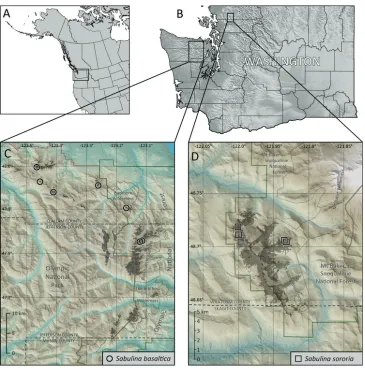
Geographically, the Olympic Mountain plants are separated from the Twin Sisters plants by a distance of ca. 130 air km across the Puget Sound trough (Fig. 6). The
near-est known populations of other glabrous, perennial Sabulina species are in northeast
Oregon (S. austromontana) at a distance of ca. 520 air km and in the Rocky Mountains
of southern Canada (S. austromontana and S. dawsonensis) at a distance of ca. 640 air km.
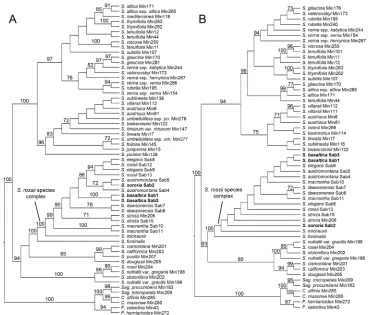
The molecular phylogeny of the ITS data set (Fig. 1A) shows that the S. rossii
spe-cies complex is monophyletic and highly supported (bootstrap support (BS) 100), and
is sister to S. fontinalis (Short & R. Peter) Dillenb. & Kadereit (BS 100). Relationships
among members of the S. rossii species complex were not fully resolved, but S. basaltica
(BS 100), S. dawsonensis (BS 78), S. stricta (BS 71) and S. macrantha (BS 100) are
supported to be monophyletic. Sabulina austromontana is closely related to S. sororia
(BS 72). Sabulina rossii and S. elegans form a monophyletic group (BS 94) without
support for the species within. Sabulina basaltica is part of a polytomy with S.
dawson-ensis and S. stricta and a clade comprising S. rossii, S. elegans, S. austromontana and S.
sororia. The phylogeny of the plastid trnQ-rps16 marker (Fig. 1B) is less resolved, but
the S. rossii species complex is also supported with a BS of 72. Only S. dawsonensis is
Figure 1. Maximum likelihood phylogenies of Sabulina. A Cladogram of the ITS dataset B Cladogram of the trnQ-rps16 dataset. Phylogenies obtained with RAxML, values above branches are bootstrap sup-port values (only ≥ 70 shown) C., Colobanthus; F., Facchinia; S., Sabulina; Sag., Sagina.
Taxonomic treatment
Sabulina basaltica B.S.Legler, sp. nov.
urn:lsid:ipni.org:names:60474719-2
Figs 2A–E, 3
Type. U.S.A. Washington, Clallam Co.: Olympic National Park: along climbers
trail at base of summit block on west side of Mt. Angeles, 1872 m, 47.995079°N,
123.468522°W, 15 Jul 2016, B.S. Legler 14177 (holotype: WTU!; isotype: OLYM!).
Diagnosis. Differs from all other glabrous, perennial Sabulina species in North
Figure 2. Line drawings of Sabulina basaltica and Sabulina sororia. A–E. Sabulina basaltica. A Habit B Dried leaf with 3 veins C Cymose, bracteate inflorescence with two flowers D Capsule with dried, 3-veined sepals (with sepals pushed outwards and withered petals removed to reveal capsule) E Seed F–I Sabulina sororiaF Habit G Dried leaf with 1 vein H Flower I Capsule with dried, 3-veined sepals (withered petals removed).
nearly dioecious. Hypanthium obscure, disc-shaped. Sepals spreading-ascending at anthesis, light green, glabrous, lanceolate to narrowly ovate-lanceolate, (1.6–)2.4–2.8(– 3.3) × 0.7–0.9(–1.1) mm, (2.4–)3–3.2(–3.5) times as long as wide, scarious margins ca. 0.05–0.2 mm wide, base cupped, apex green to maroon, acute to shortly acuminate, outer surface flat to convex, weakly 3-veined at anthesis, becoming distinctly 3-veined
in fruit or when dried. Petals white, spreading, narrowly to broadly oblong or narrowly
obovate, 3.2–5.2 × 1.1–2 mm, (1–)1.2–1.8(–2) times as long as sepals, base gradually tapered to a short, greenish-yellow claw, apex rounded to truncate, entire to weakly
erose or slightly emarginate. Nectaries 5, at base of outer stamens, greenish-yellow,
ca. 0.4 × 0.4 mm, truncate, alternate with the petals. Stamens 10, in 2 series of 5,
either all fertile or all abortive; filaments subulate, whitish-green; anthers orbiculate, pale yellow; fertile stamens with filaments 1.4–2.5 mm and anthers 0.4–0.5 mm;
abortive stamens with filaments 0.2–0.5 mm and anthers 0.1–0.2 mm. Ovary superior;
placentation shortly free-central; ovules usually 12 per ovary. Styles 3, distinct, erect
to ascending; functionally male flowers with styles ca. 0.7 mm and stigmas scarcely developed; functionally female flowers with styles 1–1.7 mm and stigmas linear,
glandular-puberulent adaxially. Capsules light green to greenish-tan (valve margins tan),
on stipe ca. 0.1–0.2 mm, ovoid-conical, 1.8–2.4 × 1–1.5 mm, slightly shorter than or equaling (rarely slightly longer than) and usually enclosed by the appressed sepals and withering-persistent petals, dehiscing in upper half by 3 valves, these becoming
incurved on margins and slightly recurved at tip. Seeds 4–8 per capsule, 0.6–0.8 mm,
dark reddish-brown to reddish-black, obliquely reniform with radicle prolonged into a curved bump, somewhat compressed, with rounded margins, surfaces sculpted with low, rounded, slightly elongate and sinuous bumps at > 10× magnification.
Additional specimens examined.U.S.A. Washington, Clallam Co. Third Peak,
Mt. Angeles, 10 Aug 1911, no collector (OLYM); Mt. Angeles, 5500 ft, 2 Aug 1930,
J.W. Thompson 5481 (WTU); Mt. Angeles, 5500 ft, 10 Jul 1931, G.N. Jones 3202
(WTU); Mt. Angeles, 6800 ft, 17 Jul 1931, J.W. Thompson 7433 (WTU); Mt.
An-geles, 5500 ft, 15 Jul 1933, J.W. Thompson 9458 (WTU); Mt. Angeles, 15 Jul 1933,
H.E. Helmrich 259 (WTU); Mt. Angeles, 12 Jul 1936, M.P. Harthill s.n. (OLYM);
Mt. Angeles, 31 Jul 1966, L.C. Bliss s.n. (WTU); Saddle between Mt. Baldy and Mt.
Tyler, 5600 ft, 23 Jul 1976, N. Buckingham 514 (OLYM); Blue Mountain, northeast
ridge, T28N R5W S1, 5600 ft, 31 Jul 1984, E.L. Tisch 2724 (OLYM); Blue Mountain,
northeast ridge, T28N R5W S1, 5600 ft, 31 Jul 1984, E.L. Tisch 2724 1/2 (OLYM);
Along ridgeline ca. 100 meters southwest of summit of Mt. Angeles, 47.994735°N,
123.467501°W; 1896 m, 15 Jul 2016, B.S. Legler 14178 (WTU); High point at east
end of ridgeline along summit of Mt. Angeles, 47.995365°N, 123.463590°W; 1949 m,
15 Jul 2016, B.S. Legler 14179 (WTU); Southeast rib of Steeple Rock along
Hurri-cane Ridge, 47.961464°N, 123.452969°W; 1657 m, 16 Jul 2016, B.S. Legler 14183
(WTU); South side of summit of Eagle Point, along Hurricane Ridge, 47.938951°N,
123.409042°W; 1893 m, 16 Jul 2016, B.S. Legler 14184 (WTU, OLYM); Jefferson
Co.: Iron Mountain, 6000 ft., 21 Jul 1934, J.W. Thompson 11054 (WTU); Ridge
Figure 3.Sabulina basaltica. A Plant forming a tight mat (Legler 14178) B Excavated plant with taproot (Legler 14184) C Fresh leaves and persisting, 3-veined, dead leaves (Legler 14177) D Dead, persisting, 3-veined leaves (Legler 14178) E–F Cymose inflorescences (Legler 14177, Legler 14175) G Solitary ter-minal flower (Legler 14184) H Sepals and petals, showing shapes and lengths (Legler 14184) I–J Flowers with different combinations of stamen and style lengths (Legler 14177, Legler 14184) K Partially dissected flower showing hypanthium and nectaries (Legler 14183) L Dehisced capsule with seeds (Legler 14183) M Seeds (Legler 14183). Black scale bar is 1 mm.
2658 (OLYM); West face of Buckhorn Mountain just above ridgeline that connects
Buckhorn Mountain to Peak 6988, 47.826286°N, 123.117615°W; 2026 m, 24 Jul
2016, B.S. Legler 14195 (WTU).
Etymology. The epithet basaltica refers to the basalt rock to which this species is
apparently restricted.
Vernacular name. Suitable common names are Olympic sandwort or basalt sandwort.
Distribution and ecology.Sabulina basaltica is known only from subalpine and
alpine peaks along the northeastern rim of the Olympic Mountains in Clallam and Jefferson counties, Washington, U.S.A. (Fig. 6C), at documented elevations of 1650– 2100 meters. It is presently known from seven peaks: Mt. Angeles, Steeple Rock, Eagle Point, Blue Mountain, near Mt. Tyler, Buckhorn Mountain, and Iron Mountain. It is apparently confined to south or southwest facing rock faces composed of ocean floor basalts (mainly pillows and breccia) of the Crescent Formation (Tabor and Cady 1978,
Babcock et al. 1992) on ca. 30–60° slopes (Fig. 5A). Sabulina basaltica occur as
plant cover (Fig. 5B–C). The rock faces are exposed to solar radiation and wind. Snow accumulation is likely minimal due to wind ablation, and meltout likely occurs much earlier than on adjacent slopes. No plants were found on more protected east or north facing slopes, nor on more gentle slopes around the periphery of rock faces, whether vegetated or not.
Directly associated species include Anemone multifida Poir., Antennaria cf. rosea
Greene, Campanula piperi Howell, Carexnardina Fr., Dasiphora fruticosa (L.) Rydb.,
Erigeron compositus Pursh, Penstemon davidsonii Greene var. menziesii (D.D. Keck)
Cronquist, Petrophytum hendersonii (Canby) Rydb., Phlox diffusa Benth., Polemonium
pulcherrimum Hook. subsp. pulcherrimum, Potentilla villosa Pall. ex Pursh, Sabulina
rubella (Wahlenb.) Dillenb. & Kadereit, Salix nivalis Hook., Saxifraga austromontana
Wiegand, Saxifraga cespitosa L., Sedum lanceolatum Torr., Selaginella wallacei Hieron.,
Smelowskia americana Rydb., Trisetum spicatum (L.) K. Richt., and Viola flettii Piper.
Crustose lichens cover most of the rock surfaces. Adjacent conifer species at subalpine
sites include Callitropsis nootkatensis (D. Don) D.P. Little, Abies lasiocarpa (Hook.)
Nutt., Juniperus communis L. var. kelleyi R.P. Adams, and Pinus albicaulis Engelm.
Although oceanic basalts form an extensive belt around the northern, eastern, and southeastern sides of the Olympic Mountains (Tabor and Cady 1978), suitable climatic
conditions for S. basaltica presumably occur only in the northeastern portion of the
mountains within a rain shadow formed by one of the steepest precipitation gradients in North America (Phillips and Donaldson 1972). Average annual precipitation levels for Mt. Angeles and Buckhorn Mountain are estimated at ca. 200 cm (PRISM 2017). For comparison, Mt. Olympus, only 28 km to the southwest of Mt. Angeles, receives an esti-mated 600 cm of precipitation annually and Sequim, 30 km to the northeast, only 41 cm of annual precipitation (PRISM 2017). Furthermore, the growing season is relatively dry, with ca. 12% of total annual precipitation falling during May–September at Mt. Angeles
(PRISM 2017). Based on climate and substrate, areas of suitable habitat for S. basaltica are
prediced to occur in a discontinuous arc extending from the vicinity of Hurricane Ridge in the north to at least the vicinity of Mt. Constance to the southeast, and possibly farther south to The Brothers and adjacent peaks (Fig. 6C). Basalts of the Crescent Formation re-appear on the southern tip of Vancouver Island, British Columbia, just to the north of the Olympic Mountains (Babcock et al. 1992), though at much lower elevations where
previ-ously covered by the Cordilleran ice sheet; we do not expect S. basaltica to occur there.
A pair of specimens from Blue Mountain, Clallam County (E. L. Tisch 2724 and
E. L. Tisch 2724 1/2, OLYM) indicate on the label that plants were collected from
“crevices in (limestone?) rock outcrop,” raising the possibility that S. basaltica is not
confined to basalt. However, Blue Mountain contains outcrops of basalt rocks and a return visit to the site would be needed to determine the actual rock type from which the specimens were collected.
Phenology. Specimens of Sabulina basaltica with flowers were collected from mid
July to mid August, and specimens with fruits from mid July to early August.
Conservation status. Population sizes on Mt. Angeles, Steeple Rock, and Eagle
documented with herbarium specimens (CPNWH 2017), and the lack of information precludes range-wide estimates of the total number of populations and plants. Assign-ment of a formal conservation status may require additional field work to gauge rarity. All known populations and nearly all areas of potentially suitable habitat are protected within Olympic National Park and adjacent wilderness areas. The known populations are located on steep rock slopes away from trails and roads. Therefore, direct anthro-pogenic impacts are assumed to be minimal. Grazing pressure and disturbance from
introduced mountain goats (Oreamnos americanus Blainville, 1816) pose an increasing
impact to high elevation plant communities in the Olympic Mountains (Houston et al. 1994, Jenkins et al. 2012), and goats were observed in the vicinity of populations
of S. basaltica on Mt. Angeles during the visit in 2016; however, no evidence of direct
grazing or damage to S. basaltica was detected.
Sabulina sororia B.S.Legler, sp. nov.
urn:lsid:ipni.org:names:60474720-2
Figs 2F–I, 4
Type. U.S.A. Washington, Whatcom Co.: Mt. Baker-Snoqualmie National Forest, on
west side of ridge along Sisters Divide 0.45 air km southeast of outlet of Lake
Wise-man, Twin Sisters Range, 1414 m, 48.707131°N, 121.934086°W, 6 Aug 2016, B.S.
Legler 14263 (holotype: WTU!; isotypes: MICH!, MO!, NY!, UBC!).
Diagnosis. Differs from all other glabrous, perennial Sabulina species in North
America by the combination of 1-veined dried leaves, flowers partly in 2–3-flowered cymes, sepals mostly < 2.5 mm long, petals conspicuously longer than the sepals, cap-sules 1.8–2.6 mm long and mostly > sepals, and reddish-black seeds 0.6–0.8 mm long.
Description.Plants perennial, forming loose to dense mats 2–20 cm in diameter,
glabrous throughout. Taproot slender to slightly thickened, 1–3 mm diameter near
summit. Stems numerous, radially spreading from the taproot, prolifically branching;
older stems decumbent to ascending, 1–10 cm, brown to tan; new shoots arising from axillary fascicles on previous year’s stems, ascending to erect, 1–4 cm, internodes of
flowering shoots 0.3–2(–3) times as long as leaves, deep green or purplish. Leaves
Figure 4.Sabulina sororia. A Plant forming a loose mat (Legler 14263) B Excavated plant with loosely sprawling stems (Legler 14268) C Fresh leaves and persisting, 1-veined, dead leaves (Legler 14263) D Ex-cavated plant (Legler 14263) E–F Cymose inflorescences (Legler 14263) G Dried, 1-veined leaves (Legler 14263) H Dead leaves with only midvein persisting (Legler 14263) I Ovate-lanceolate, purple-tinged sepals (Legler 14263) J Sepals and petals, showing shapes and relative lengths (Legler 14263) K–L Flowers with different combinations of stamen and style lengths (Legler 14263) M Dried flower with dehisced capsule longer than sepals (Legler 14263) N Seeds (Legler 14263). Black scale bars are 1 mm.
older stems, with only the midvein visible and persisting (no lateral veins). Inflorescences
terminal, 2–3-flowered, open cymes, usually mixed with solitary terminal flowers; bracts 0.7–1.6 mm, lanceolate to ovate-lanceolate, incurved, green or maroon with scarious margins, rounded abaxially, flat to concave adaxially, apex obtuse to bluntly
acute. Pedicels (1–)2–8(–15) mm, glabrous. Flowers perfect or functionally male
or functionally female, most plants functionally monoecious to nearly dioecious.
Hypanthium obscure, disc-shaped. Sepals spreading-ascending at anthesis, deep green,
often lightly maroon-tinged, glabrous, broadly ovate to ovate-lanceolate, (1.4–)1.7– 2.5(–3) × 0.6–1.1(–1.3) mm, 1.5–2.5(–3.5) times as long as wide, scarious margins ca. 0.05–0.15 mm wide, base cupped, apex green to maroon, acute, outer surface convex, smooth to very weakly 3-veined at anthesis, becoming 3-veined in fruit or when dried.
Petals white, spreading, broadly oblong to obovate, 3.2–4(–5.2) × 1.2–2(–2.6) mm,
1.3–2(–2.5) times as long as sepals, base gradually tapered to a short, greenish-yellow
claw, apex rounded to weakly truncate. Nectaries 5, at base of outer stamens,
developed; functionally female flowers with styles 1.1–2.1 mm and stigmas linear,
glandular-puberulent adaxially. Capsules light green to greenish-tan (valve margins
tan), on stipe ca. 0.1–0.2 mm, ovoid-conical, 1.8–2.6 × 1.1–1.8 mm slightly longer than (rarely slightly shorter than) and mostly enclosed by the appressed sepals and withering-persistent petals, dehiscing in upper half by 3 valves, these becoming
incurved on margins and slightly recurved at tip. Seeds apparently 8 per capsule, 0.7–
0.8 mm, reddish-black, obliquely reniform with radicle prolonged into a curved bump, somewhat compressed, surfaces sculpted with low bumps at > 10× magnification.
Additional specimens examined. U.S.A. Washington, Whatcom Co.: Twin
Sis-ters Range, 11 Aug 1939, W.C. Muenscher 10281 (WTU); Twin Sisters Range, 12 Aug
1939, W.C. Muenscher 10306 (WTU); Head of Orsina Creek, at west base of Twin
Sis-ters Mountain, 4900 ft, T37N R6E S11, 12 Jul 1961, A.R. Kruckeberg 5225 (WTU);
Northwest slope of Twin Sisters, ca. 6200 ft, 28 Jul 1968, R.J. Taylor 2158 (WWB);
Crest of ridge along Sisters Divide 0.7 air km southeast of outlet of Lake Wiseman,
Twin Sisters Range, 48.704998°N, 121.931408°W; 1508 m, 7 Aug 2016, B.S. Legler
14268 (ID, US, WTU).
Etymology. The epithet sororia is from the Latin word sororis, sister, in reference
to the Twin Sisters Range.
Vernacular name. Twin Sisters sandwort.
Distribution and ecology.Sabulina sororia is known only from the Twin Sisters
Range on the western flank of the Cascade Mountains in Whatcom County, Wash-ington, U.S.A. (Fig. 6D). The Twin Sisters Range consists of a large body of relatively unaltered dunite rock aproximately 16 km long by 6.5 km wide (Tabor et al. 2003) oriented in a northwest to southeast direction, with a maximum elevation of 2135 meters and sustained ridgeline elevations above 1500 meters. The dunite rock likely formed in the earth’s mantle and was subsequently uplifted along a series of nearly vertical thrust faults (Ragan 1963); it is a dense, crystalline, ultramafic rock composed mostly of olivine with lesser amounts of chromite and pyroxenite, rich in magnesium, iron, chromium and nickel (Ragan 1963, Onyeagocha 1978). The rock weathers to a distinctive light reddish-brown color with a coarse-grained surface. Ultramafic rocks display a pronounced effect on the overlying vegetation (Kruckeberg 2002, and refer-ences therein), and the Twin Sisters dunite is no exception with its depressed treeline and sparse vegetation cover above treeline.
Sabulina sororia is apparently restricted to rocky or gravelly, sparsely vegetated,
sub-alpine and sub-alpine slopes. Documented elevations range from 1490 to 1890 meters. Habitat information from older herbarium specimens is sparse, indicating only a
“west-facing alpine ridgeline” (Grable 5023), “moist, gravelly, serpentine soil on an alpine
fell-fields and talus, with krummholz lodgepole pine and subalpine fir in snow-melt
basin” (Kruckeberg 5225). At the two sites visited by B. Legler in August 2016, S. sororia
was observed growing most frequently in mesic, coarse, gravelly and rocky soil derived from dunite on erosional surfaces with slopes ranging from flat to ca. 30° (Fig. 5D–F). A few plants were found in exposed crevices of stable dunite rock outcrops along a narrow ridgeline with slopes of ca. 45–60°. The species apparently avoids areas with late-lying
snow. Sabulina sororia occurs as scattered individuals, forming a minor component of
the sparse, low vegetation cover. Total vegetation cover of all plant species at these two sites is estimated at 5–20%. Average precipitation for the higher elevations of the Twin Sisters Range is estimated at ca. 180–190 cm per year, with about 30% of the total pre-cipitation falling during May–September (PRISM 2017).
Directly associated species consist of scattered tufts or mats of Carex spectabilis
Dewey, Cassiope mertensiana (Bong.) G. Don, Cerastium arvense L. subsp. strictum
Gaudin, Cryptogramma acrostichoides R. Br., Danthoniaintermedia Vasey, Erigeron
au-reus Greene, Polystichum lemmonii Underw., Sabulina rubella (Wahlenb.) Dillenb. &
Kadereit, Saxifraga cespitosa L., Sibbaldia procumbens L., Silene acaulis (L.) Jacq., and
Smelowskia ovalis Rydb. Trees and taller shrubs are absent from these sites, though
Figure 6. Distribution of Sabulina basaltica and S. sororia. A–B Reference maps of western North America and Washington State, indicating locations of inset maps C Known locations for Sabulina basal-tica (open black circles) within the northeastern Olympic Mountains; gray shading indicates the predicted extent of potential habitat based on exposures of oceanic basalt rocks at subalpine to alpine elevations D Known locations for Sabulina sororia (open black squares) within the Twin Sisters Range; gray shad-ing indicates the predicted extent of potential habitat based on exposures of dunite rock away from large snowfields at subalpine to alpine elevations.
adjacent ridgelines and slopes hold patches of Abies lasiocarpa (Hook.) Nutt.,
Callitrop-sis nootkatenCallitrop-sis (D. Don) D.P. Little, Pinus contorta Douglas ex Loudon var. latifolia
Engelm., Tsuga mertensiana (Bong.) Carrière, Juniperus communis L. var. kelleyi R.P.
Adams, and Phyllodoce empetriformis (Sm.) D. Don. Crustose lichens are sparse, and
bryophytes nearly absent.
exposed at slightly lower elevation (Tabor et al. 2003). An examination of aerial
im-agery suggests marginally suitable habitat for Sabulina sororia may occur in these areas,
though no surveys have been conducted to determine its presence. It seems unlikely
that S. sororia will be found elsewhere in the Cascades Mountains or over non-dunite
rocks; however, small, subalpine exposures of ultramaphic rocks in Skagit and Sno-homish counties may warrant investigation.
Phenology. Specimens indicate the flowering period for Sabulina sororia extends
from mid July to mid August, and fruiting period from early to mid August. The full ranges of flowering and fruiting periods likely vary based on timing of snowmelt and site exposure.
Conservation status. Although apparently restricted to the Twin Sisters Range,
Sabulina sororia may occur in suitable microsites throughout the upper elevations of
the range within an extent of occurrence estimated at ca. 16 km2. The total number
of plants cannot be estimated due to inadequate sampling across the range, possibly preventing assignment of a formal conservation status at this time. The Twin Sisters Range lies almost fully within the Mt. Baker-Snoqualmie National Forest, and the en-tire northeastern slope of the range lies within the Mt. Baker Wilderness. No roads or trails penetrate the range, resource extraction is absent from the higher elevations, and very few people visit each year due to difficulty of access. Direct anthropogenic impacts are therefore assumed to be very minimal.
Discussion
Sabulina basaltica and S. sororia can be reliably distinguished from each other
mor-phologically (Table 1, and see key), with the differences comparable to those used to
distinguish among other members of the S. rossii species complex (e.g., leaf length and
veination, sepal length and shape, petal length relative to sepals, capsule length, and seed size and color), suggesting they are appropriately recognized at the same taxo-nomic rank of species. Their recognition as two distinct species is further supported by the absence of plants with intermediate morphology that could not be unambigu-ously assigned, their disjunct geographic distributions relative to each other (Fig. 6)
and all other glabrous, perennial Sabulina species, and their unique ecological niches.
Attempts to re-circumscribe any of the previously published Sabulina taxa to
accom-modate S. basaltica or S. sororia would be impractical.
The results of the molecular phylogenetic analyses (Fig. 1) also support the
exist-ence of two independent taxa in Washington. Sabulina sororia is part of a group of four
closely species (S. rossii, S. elegans, S. austromontana and S. sororia), while S. basaltica
is outside of this group (Fig. 1A). In the ITS phylogeny (Fig. 1A), all species are either supported as monophyletic, or the samples are in a polytomy with samples of one or
more other species of the S. rossii species complex. The two samples of S. basaltica are
not closely related to other sequenced samples of the complex, but are supported as
architecture and petal length are labile within the S. rossii species complex. An
analo-gous situation is found within the European genus Facchinia Rchb., recently split out
of Minuartia s. lat. by Dillenberger and Kadereit (2014). In that study, F. cherlerioides
(Sieber) Dillenb. & Kadereit and F. grignensis (Rchb.) Dillenb. & Kadereit were
un-expectedly resolved as sister species by ITS sequence data, yet they differ substantially from each other in morphology (Dillenberger and Kadereit 2015).
Sabulina basaltica and S. sororia resemble, and might be confused with, S.
mac-rantha and forms of S. stricta found in the southern Rocky Mountains and California,
based on shared characters of cymose inflorescences and a similar low growth form
with relatively short pedicels. Both of the new species differ from S. macrantha by their
shorter leaves, shorter sepals, shorter capsules, and smaller seeds with less rugose
sur-faces, and from S. stricta in their markedly longer petals, shorter capsules, and larger,
dark reddish-brown to blackish seeds. Sabulina basaltica further differs from S.
macran-tha and S. stricta in its strongly 3-veined leaves.
Hitchcock et al. (1964) treated both Sabulina basaltica and S. sororia as Arenaria
rossii var. rossii (= S. rossii). This questionable application of name may reflect
Hitch-cock’s preference for conservative, or broad, species concepts (Hitchcock et al. 1955).
Sabulina rossii is distinguished from both of the new species and all other glabrous,
perennial Sabulina species in North America by the presence of vegetative propagules
formed from tight, readily dislodged axillary or terminal leaf fascicles (in other species
the fascicles remain firmly attached). The main stem leaves of S. rossii are also typically
spreading (vs. ascending) and strongly fleshy with a fleshy sheath, usually giving them
the appearance of being connate-perfoliate. The sepals of S. rossii are 1-veined, while
both S. basaltica and S. sororia have 3-veined sepals, and flowers in S. rossii are strictly
solitary (vs. partially cymose). Sabulina rossii is restricted to the high arctic, mostly in
areas near the Arctic Ocean and adjacent connected waterbodies.
Sabulina rubella (Wahlenb.) Dillenb. & Kadereit, a normally stipitate-glandular
species which also occurs in the Cascade and Olympic mountains, very rarely produces glabrous individuals (Rabeler et al. 2005) with a low, tufted growth form and short
pedicels (B. Legler, pers. obs.). These plants may be separated from S. basaltica and
S. sororia by their larger capsules (4–4.5 mm), smaller (0.4–0.5 mm), reddish-brown
seeds, broadly ovate to elliptic petals abruptly narrowed to the clawed base, and acute
to subulate leaf tips. The authors know of no such glabrous plants of S. rubella from
Washington State.
The close relationship between Sabulina fontinalis and the S. rossii species complex
(Fig. 1) has been noted in other studies (Greenberg and Donoghue 2011, Dillenberger
and Kadereit 2014). Here we exclude S. fontinalis from the S. rossii species complex due
4 mm wide; flowers mostly 4-merous) which has led previous authors to place S.
fon-tinalis variously under Sagina L., Spergula L., or Stellaria L. (e.g., Rabeler et al. 2005).
Several of the characters commonly used to distinguish among glabrous, perennial
Sabulina taxa in North America warrant further clarification. Leaf veins are usually not
visible in fresh material, but upon drying or decaying show a single prominent mid-vein and, in some species, a faint to prominent pair of lateral mid-veins. The inflorescence may consist solely of solitary, terminal flowers not subtended by bracts, or partly to
fully of 2–many-flowered, bracteate cymes. However, in several species, including S.
basaltica and S. sororia, one must sometimes use care to look for the 2–several-flowered
cymes mixed among the often more numerous solitary flowers. The bracts of cymose inflorescences can usually be distinguished from vegetative leaves by their shorter, pro-portionately broader shape and thin, scarious margins. Petal length must be used with caution on dried specimens and it should be noted that published descriptions (Magu-ire 1958, Wolf et al. 1979, Rabeler et al. 2005) appear to under-represent the range of
petal lengths for S. elegans, S. michauxii, and S. rossii (Table 1).
The following key includes all glabrous, perennial species of Sabulina in North
America. Leaf veins should be observed on dried or dead, persisting leaves. Leaf length is for main stem leaves, not axillary fascicles. Sepal veins are often weakly visible on living plants, but become clearly defined on dried specimens. Sepal length is taken at anthesis, as sepals often elongate slightly in fruit. Petal length is for fresh material, and petals may shrink relative to the sepals upon drying; this can be mitigated by carefully arranging and pressing individual flowers between tissue paper.
1 Plants reproducing vegetatively by means of tight, readily dislodged, axillary
or terminal fascicles of leaves; primary stem leaves mostly widely spreading, strongly fleshy and ± connate-perfoliate, often purple-tinged, 1-veined, 1–4 mm; flowers often absent; sepals 1.5–2.5 mm, oblong-ovate, weakly 1-veined, purplish; petals 1.2–2 times as long as sepals, or sometimes < sepals or absent; high arctic of eastern Siberia to North America, Greenland, and Spitzbergen ...
...Sabulina rossii
– Plants not reproducing by means of readily dislodged vegetative propagules;
leaves mostly ascending to appressed, with a scarious to herbaceous sheath,
1- or 3-veined; flowers nearly always produced; sepals and petals various ....2
2 Petals mostly 1.2–2(–2.5) times as long as the sepals; flowers partly in
2–8(–30)-flowered, terminal cymes (often also some flowers solitary and
ter-minal, rarely all flowers solitary and terminal) ...3
– Petals 0.5–1(–1.1) times as long as the sepals, or rudimentary to absent;
flow-ers partly in 2–5(–8)-flowered, terminal cymes, or flowflow-ers all solitary and
terminal ...6
3 Sepals 3–6 mm; main stem leaves 5–30 mm; shoots of current year’s growth
2–40 cm; seeds 0.8–1.1 mm, blackish ...4
– Sepals 1.4–2.8(–3.3) mm; main stem leaves 0.6–4(–4.5) mm; shoots of
cur-rent year’s growth 0.5–4 cm; seeds 0.6–0.8 mm, dark reddish-brown to
procumbent to ascending, 2–15 cm; leaves 5–10 mm, tips rounded; pet-als 0.7–1.8 × as long as seppet-als; Rocky Mountains from Wyoming to New
Mexico, west to Nevada ...Sabulina macrantha
5 Leaves 3-veined; sepals (1.6–)2.4–2.8(–3.3) mm, lanceolate to narrowly
ovate-lanceolate, (2.4–)3–3.2(–3.5) times as long as wide; mature capsules mostly slightly < sepals; pedicels 1–3.5(–6) mm; plants usually forming dense, tight mats or cushions; crevices of exposed basalt summits; Olympic
Mountains, Washington ...Sabulina basaltica
– Leaves 1-veined; sepals (1.4–)1.7–2.5(–3) mm, ovate to ovate-lanceolate,
mostly 1.5–2.5 times as long as wide; mature capsules mostly > sepals; pedi-cels (1–)2–8(–15) mm; plants mat-forming or trailing; bare dunite rock and
gravel; Twin Sisters Range, Washington ...Sabulina sororia
6 Flowers all solitary and terminal at stem tips, not subtended by bracts
(upper-most stem leaves not distinct from those below); leaves 1-veined ...7
– Flowers partly in 2–15-flowered, bracteate, terminal cymes (often also some
flowers solitary and terminal, very rarely all flowers solitary and terminal); bracts generally with thin, scarious margins, often smaller and broader than
the stem leaves; leaves 1-veined or weakly 3-veined ...8
7 Sepals light green, linear-lanceolate to narrowly lanceolate; petals absent
or rudimentary (rarely nearly equaling sepals); pedicels 3–15(–20) mm; plants tightly cespitose; Rocky Mountains of southern Canada and northern
U.S.A. ...Sabulina austromontana
– Sepals purplish, lanceolate to ovate-lanceolate; petals usually present
(occa-sionally absent), 0.6–1(–1.1) times as long as sepals; pedicels 10–40 mm; plants loosely tufted to cespitose; eastern Siberia, Alaska, and northwest
Can-ada to Rocky Mountains of central CanCan-ada...Sabulina elegans
8 Seeds 0.7–1.1 mm, blackish, prominently rugose at 10 × magnification;
se-pals 3–6 mm at anthesis; southeast Canada and eastern U.S.A., or U.S.A.
Rocky Mountains ...see couplet 4
– Seeds 0.4–0.6 mm, reddish-brown to blackish, obscurely rugose at 10 ×
mag-nification; sepals (1.5–)2–4 mm at anthesis...9
9 Inflorescences (2–)7–15-flowered; capsules 3.5–4.5 mm, equaling or longer
than sepals; seeds dark brown to blackish; sepals ovate to lanceolate; stems ascending to erect, 4–30 cm; Alaska and much of Canada, south to
north-central U.S.A. ...Sabulina dawsonensis
- Inflorescences 1–3(–5)-flowered; capsules 2.5–3.2 mm, equaling or shorter
than sepals; seeds reddish-brown to brown; sepals elliptic-ovate to ovate-lan-ceolate; stems decumbent to erect, 0.8–12 cm; circumboreal in arctic regions,
Sabulina basaltica joins seven other vascular plant taxa endemic to higher
eleva-tions of the northeastern and eastern poreleva-tions of the Olympic Mountains: Astragalus
australis (L.) Lam. var. cottonii (M.E. Jones) S.L. Welsh, Campanula piperi, Erigeron
flettii G.N. Jones, Petrophytum hendersonii, Senecio neowebsteri S.F. Blake, Synthyris
lanuginosa (Piper) Pennell & J.W. Thomp., and Viola flettii. These are all concentrated
on relatively dry, subalpine to alpine rock faces, scree slopes and tundra-like mead-ows and co-occur with several plant taxa widely disjunct from the Rocky Mountains,
such as Astragalus microcystis A. Gray, Carex obtusata Lilj., and Oxytropis borealis DC.
var. viscida (Nutt.) S.L. Welsh. In general, the vascular plant flora of the Olympic
Mountains shows relatively high levels of endemism and floristic similarities to both the Rocky Mountains and coastal and boreal regions of British Columbia and Alaska (Houston et al. 1994, Buckingham et al. 1995). The mountains are disconnected from other high-elevation ranges by encircling lowlands and saltwater.
To explain these patterns it is widely proposed that the northeastern Olympic Mountains acted as a refugium during Pleistocene glacial advances (Buckingham et al. 1995, Houston et al. 1994, Peterson et al. 1997, Gavin et al. 2013). The Cordil-leran ice sheet reached a maximum depth of ca. 1000 meters in the lowlands along the northern and eastern sides of the mountains ca. 17,000 yr B.P. (Porter and Swanson 1998), leaving ridgelines well above the ice, while alpine glaciers were concurrently limited by relatively arid regional conditions (Thackray 2001) and had furthermore began retreating from their maximum extent ca. 20,000 yr B.P. (Booth 1987, Thack-ray 2001). The asynchronous timing of alpine and continental ice undoubtedly led to persistently ice-free areas at high elevations. These areas lie in the rainshadow cast by the bulk of the mountains to the west and remained relatively arid throughout the last glacial maximum and up through the present day (Gavin et al. 2013), potentially pro-viding long-term habitat stability for taxa adapted to dry alpine conditions. As noted by Gavin et al. (2013) and Houston et al. (1994), it is probably no coincidence that the endemic plant taxa in the northeastern Olympics are mostly restricted to the very
ridgelines that remained ice-free and relatively dry. Sabulina basaltica, likewise adapted
to these habitats, may have persisted here through multiple glacial cycles. The lack of a
clear close relationship between S. basaltica and any other single member of the S. rossii
species complex (Fig 1A) provides further evidence of long-term isolation, suggesting
S. basaltica is a paleoendemic.
In contrast, the Twin Sisters Range, where Sabulina sororia is endemic, exhibits
remained above the ice sheet (Ragan 1962), creating a potential refugium. We suspect
that S. sororia, able to grow on exposed, rocky ridgelines and slopes, may have found
suitable habitat within this small refugium to persist in-situ through the last glacial
maximum. Alternatively, S. sororia may be a neoendemic that colonized and
differenti-ated following the most recent retreat of the ice sheet, as suggested by its close
relation-ship to S. austromontana (Fig 1A). Phylogeographic methods may provide means of
testing these scenarios.
Acknowledgements
We acknowledge curators and staff at the following herbaria for providing loans or physical access to their collections: ALA, KHD, MONTU, OLYM, OSC, UBC, V,
and WTU. Patrick Sweeney provided access to a digital image of W.J. Cody 24237 (YU
057124), allowing correction of a misidentified sample in Greenberg and Donoghue (2010). We are grateful to Janet Coles and Roger Hoffman at Olympic National Park
for providing a permit (OLYM-2016-SCI-0050) to collect Sabulina specimens in the
Park. We thank Peggy Hudson for first bringing to our attention the discrepancies that led to recognition of the Washington plants as undescribed species, and Rich Rabeler for offering helpful discussions and ideas early in the investigation. We acknowledge Rich Rabeler and Ron Hartman for reviewing the manuscript and providing helpful comments. Photographs were taken by B. Legler. The line drawings were skillfully prepared by Soojeong (Crystal) Shin at WTU.
References
Babcock RS, Burmester RF, Engebretson DC, Warnock A, Clark KP (1992) A rifted margin ori-gin for the Crescent Basalts and related rocks in the northern Coast Range volcanic province, Washington and British Columbia: Journal of Geophysical Research 92: 6799–6821. https:// doi.org/10.1029/91JB02926
Booth DB (1987) Timing and processes of deglaciation along the southern margin of the Cor-dilleran ice sheet. In: Ruddiman WF, Wright Jr HE (Eds) North America and adjacent oceans during the last deglaciation. The Geology of North America, Vol. K-3. Geological Society of America, Boulder, Colorado, 71–90. https://doi.org/10.1130/dnag-gna-k3.71 Buckingham NM, Schreiner EG, Kaye TN, Burger JE, Tisch EL (1995) Flora of the Olympic
CPNWH (2017) Consortium of Pacific Northwest Herbaria Specimen Database. http://www. pnwherbaria.org [accessed January 2017]
Dillenberger MS, Kadereit JW (2014) Maximum polyphyly: Multiple origins and delimitation with plesiomorphic characters require a new circumscription of Minuartia (Caryophyl-laceae). Taxon 63: 64–88. https://doi.org/10.12705/631.5
Dillenberger MS, Kadereit JW (2015) A revision of Facchinia (Minuartia s.l., Caryo-phyllaceae). Edinburgh Journal of Botany 72(3): 353–389. https://doi.org/10.1017/ S0960428615000153
Edgar RC (2004) MUSCLE: multiple sequence alignment with high accuracy and high through-put. Nucleic Acids Research 32(5): 1792–1797. https://doi.org/10.1093/nar/gkh340 Gavin DG, Fisher DM, Herring EM, White A, Brubaker LB (2013) Paleoenvironmental
Change on the Olympic Peninsula, Washington: Forests and Climate from the Last Gla-ciation to the Present. Final report to Olympic National Park, 109 pp.
Giblin DE, Legler BS, Zika PF, Olmstead RG (in press) Flora of the Pacific Northwest: An Il-lustrated Manual (2nd edin). University of Washington Press, Seattle, Washington.
Gouy M, Guindon S, Gascuel O (2010) SeaView version 4: a multiplatform graphical user interface for sequence alignment and phylogenetic tree building. Molecular Biology and Evolution 27(2): 221–224. https://doi.org/10.1093/molbev/msp259
Greenberg AK, Donoghue, MJ (2011) Molecular systematics and character evolution in Caryo-phyllaceae. Taxon 60: 1637–1652.
Harbaugh DT, Nepokroeff M, Rabeler RK, McNeill J, Zimmer EA, Wagner WL (2010) A new lineage based tribal classification of the family Caryophyllacae. International Journal of Plant Science 171: 185–198. https://doi.org/10.1086/648993
Hitchcock CL, Cronquist A (1973) Flora of the Pacific Northwest, An Illustrated Manual. University of Washington Press, Seattle, 730 pp.
Hitchcock CL, Cronquist A, Ownbey M, Thompson JW (1955) Vascular Plants of the Pacific Northwest. Volume 5: Compositae. University of Washington Press, Seattle, 343 pp. Hitchcock CL, Cronquist A, Ownbey M, Thompson JW (1964) Vascular Plants of the
Pa-cific Northwest. Volume 2: Salicaceae to Saxifragaceae. University of Washington Press, Seattle, 597 pp.
Houston DB, Schreiner EG, and Moorhead BB, editors (1994) Mountain Goats in Olympic National Park: Biology and Management of an Introduced Species. USDI National Park Service Scientific Monograph NPS/NROLYM/NRSM-94/25, Denver, CO, 295 pp. Jenkins K, Happe P, Griffin P, Beirne K, Hoffman R, Baccus B (2012) Mountain goat
abun-dance and population trends in the Olympic Mountains, Washington, 2011. U.S. Geo-logical Survey Open-File Report 2011–1313, 1–22.
Kovanen DJ, Easterbrook DJ (2001) Late Pleistocene, post-Vashon, alpine glaciation of the Nooksack drainage, North Cascades, Washington. Geological Society of America Bulletin 113: 274–288. https://doi.org/10.1130/0016-7606(2001)113<0274:LPPVAG>2.0.CO;2 Kruckeberg AR (1991) The Natural History of Puget Sound Country. University of Washington
Press, Seattle, Washington, 468 pp.
DPAM>2.0.CO;2
Peterson DL, Schreiner EG, Buckingham NM (1997) Gradients, Vegetation and Climate: Spatial and Temporal Dynamics in the Olympic Mountains, U.S.A. Global Ecology and Biogeography Letters 6(1): 7–17. https://doi.org/10.2307/2997523
Phillips EL, Donaldson WR (1972) Washington climate for Clallam, Grays Harbor, Jefferson, Pacific and Wahkiakum Counties. Cooperative Extension Service Publication EM 3708. Washington State University, Pullman, 91 pp.
Porter SC, Swanson TW (1998) Radiocarbon age constraints on rates of advance and retreat of the Puget lobe of the Cordilleran Ice Sheet during the last glaciation. Quaternary Research 50: 205–213. https://doi.org/10.1006/qres.1998.2004
PRISM (2017) PRISM Climate Group, Oregon State University. http://prism.oregonstate.edu [accessed 2 February 2017]
Rabeler RK, Hartman RL, Utech FH (2005) Minuartia. In: Flora of North America Editorial Committee (Eds) Flora of North America North of Mexico, Vol. 5: Magnoliophyta: Caryo-phyllidae, part 2. Oxford University Press, New York, 116–136.
Ragan DM (1962) Glaciation in the Hamilton Quadrangle, northwestern Washington. Geo-logical Society of America Special Paper 73: 60–61.
Ragan DM (1963) Emplacement of the Twin Sisters Dunite. American Journal of Science 261(6): 549–565. https://doi.org/10.2475/ajs.261.6.549
Shaw J, Lickey EB, Schilling EE, Small RL (2007) Comparison of whole chloroplast genome sequence to choose noncoding regions for phylogenetic studies in angiosperms: the tortoi-se and the hare III. American Journal of Botany 94: 275–288. https://doi.org/10.3732/ ajb.94.3.275
Stamatakis A, Hoover P, Rougemont J (2008) A rapid bootstrap algorithm for the RAxML web-servers. Systematic Biology 75: 758–771. https://doi.org/10.1080/10635150802429642 Tabor RW, Cady WM (1978) Geologic map of the Olympic Peninsula, Washington. U.S.
Geological Survey Miscellaneous Investigations Series Map I-994.
Tabor RW, Haugerud RA, Hildreth W, Brown EH (2003) Geologic Map of the Mount Baker 30- by 60-minute quadrangle, Washington. U.S. Geological Survey Investigation Series I-2660.
Thackray GD (2001) Extensive early and middle Wisconsin glaciation on the western Olympic Peninsula, Washington, and the variability of Pacific moisture delivery to the northwestern United States. Quaternary Research 55: 257–270. https://doi.org/10.1006/qres.2001.2220 Thiers B (continuously updated) Index Herbariorum: A global directory of public herbaria and
associated staff. New York Botanical Garden’s Virtual Herbarium. http://sweetgum.nybg. org/science/ih/
(Eds) PCR protocols: A guide to methods and applications. San Diego: Academic Press, 315–322. https://doi.org/10.1016/b978-0-12-372180-8.50042-1
Wolf SJ, Packer JG, Denford KE (1979) The taxonomy of Minuartia rossii (Caryophyllaceae). Canadian Journal of Botany 57(16): 1673–1686. https://doi.org/10.1139/b79-205
Supplementary material 1
Voucher information for herbarium specimens examined Authors: Ben S. Legler, Markus S. Dillenberger
Data type: occurrence
Explanation note: General information and provenance for herbarium vouchers of
Sabulina taxa examined for morphological characters and geographic distribution.
Included are taxon names, general collection locations, collector names and numbers, herbarium acronyms and accession numbers.
Copyright notice: This dataset is made available under the Open Database License (http://opendatacommons.org/licenses/odbl/1.0/). The Open Database License (ODbL) is a license agreement intended to allow users to freely share, modify, and use this Dataset while maintaining this same freedom for others, provided that the original source and author(s) are credited.
Link: https://doi.org/10.3897/phytokeys.81.13106.suppl1
Supplementary material 2
Sample information and GenBank accessions of sequenced specimens Authors: Ben S. Legler, Markus S. Dillenberger
Data type: occurrence
Explanation note: Voucher specimens of Caryophyllaceae taxa sequenced for phyloge-netic analysis. Included are taxon names, sample extraction numbers, general col-lection location, collector names and numbers, herbarium acronyms and accession numbers, and GenBank numbers for ITS and trnQ-rps16 sequences.
Copyright notice: This dataset is made available under the Open Database License (http://opendatacommons.org/licenses/odbl/1.0/). The Open Database License (ODbL) is a license agreement intended to allow users to freely share, modify, and use this Dataset while maintaining this same freedom for others, provided that the original source and author(s) are credited.