SYNTHESIS AND CHARACTERIZATION OF TRANSITION
METAL COMPLEXES WITH AZO LIGAND DERIVED FROM
4-HYDROXY-6-METHYL-2-PYRANONE
Mahmoud Najim Al-Jibouri
[a]Keywords: Azo dyes derived from 4-hydroxy-6-methyl-2-pyranone; transition metal complexes; synthesis.
A series of metal (Cr(III), Fe(III), Mn(II), Co(II), Ni(II), Cu(II) and Zn(II)) complexes with 4-[(Z-(methyl-2-oxo-2H-pyran-3-yl]-1-methyl-2-phenyl-1,2-dihydro-3H-pyrazol-3-one were prepared by azo coupling of diazotised 4-aminoantipyrine with 4-hydroxy-6-methyl-2-pyranone. The free ligand and its metal complexes were fully characterized on the basis of elemental analyses and 1H NMR, FTIR
and UV-Visible spectroscopy. The keto-enol tautomer azo ligand [HL] was a mixture of E and Z isomers as suggested by 1H NMR and
FT-IR spectroscopy. The chelating properties of the new azo ligand were studied towards Cr(III), Fe(III), Co(II), Ni(II), Cu(II) and Zn(II) ions, and the spectral data revealed that the nitrogen and oxygen atoms of –N=N-, C=O and –OH groups participated in bonding with the metal ions. The study of NMR, IR and electronic spectra indicated an octahedral structure for all metal complexes except zinc(II) complex, which has the tetrahedral structure.
Corresponding Authors
E-Mail: [email protected]
[a] Chemistry department, College of Science-Al-Mustansiriya University
Introduction
The study of azo dyes of pyrazoline-2-one and pyran-2-one derivatives has been of much interest in recent years due to their antibacterial, antiviral, anticancer, antifungal, antihelminthes and insecticidal activities.1 In particular, the
tautomerism of pyran-2-one ligands show a dramatic increase in the diversity of biological properties.2-4 For
example, some of these organic derivatives have shown hypoxia-selective cytotoxicity and they could be potentially useful for the treatment of solid tumours. Besides, some derivatives have presented excellent M. tuberculosis growth inhibition values, leading generally the lack of the two – N=N- and –C=O groups to the loss of the antimycobacterial activity.5-6
In an effort to improve bioavailability and pharmacological and toxicological properties of azo dye of 4-aminoantipyrine, many authors focused their research on the synthesis, characterization and biological evaluation of metal complexes of this family of organic compounds.7-9
The spectral and magnetic studies of iron(III) complexes of hydroxyaryl azodyes, derived from antipyrine, prompted Rawther and Nair10 to suggest from the IR data that the OH
groups take part in co-ordination together with –N=N– nitrogen and C=O of pyrazolone ring.10
Antipyrine Schiff base derivatives can serve as antiparasitic agents and their complexes with platinum(II) and cobalt(II) ions have been shown to act as antitumor substance11.This prompted us to synthesize the Schiff base
ligand, Fig. 1, containing the antipyrinyl moiety as well as the delocalized conjugated system followed by its reaction alone or mixed with 2-aminopyridine (2-ampy), 8-hydroxyquinoline (8-HOqu) or oxalic acid (Ox) with some di- and trivalent transition metal halides to gain insight into
the mode of coordination and geometry of the obtained complexes. These studies lead to several complexes with higher pharmacological activity than the free ligands, especially iron complexes bearing anti-Mycobacterium tuberculosis activity.
Metal complexes of azo compounds could be divided into two categories, namely the ones in which the azo group is involved in bonding and the others in which it is not. The former are derived from azo compounds containing donor functions such as OH, NH2, COOH, SH, etc., in a congenial
position so as to form six or five membered chelates.12 In
view of the importance of such azo dye bearing NO donor atoms of pyran-2-one and pyrazoline moieties, we describe here the coordination behaviour of organic ligand derived from azo ligand of 4-hydroxy-6-methyl-pyran-2-one (HL) towards some transition elements (Mn(II), Cr(III), Fe(III), Co(II), Ni(II), Cu(II) (Scheme 1) and Zn(II).
Figure 1. Proposed octahedral structure of Cr(III) and Fe(III) complexes of 4-[(Z-(4-hydroxy-6-methyl-2-oxo-2H-pyran-3-yl]-1-methyl-2-phenyl-1,2-dihydro-3H-pyrazol-3-one (HL) ligand, (if M=Mn, Co, Ni, or Cu(II), there is no Cl in the outer sphere..
N N
O O
H3C
N N O
Ph
CH3
N
N O
O
O CH3
N
O
Ph H3C
M
Cl
M = Cr, Fe N
Experimentals
UV-visible spectra were recorded on a Shimadzu UV-Vis spectrophotometer over 200-800 nm using 10-3 M solutions
of ligands and complexes in methanol, which was used as reference.
IR spectra were recorded on a JASCO FTIR spectrophotometer 4100 in the range 400-4000cm-1.
Elemental analysis was carried out with a CHN Carlo-Erba 1106 elemental analyzer. The %Cl contents were measured via conductometric titrations against standard solution of silver nitrate after dissolving the Zn(II) and Cd(II) complexes in concentrated nitric acid then dilution with 5%v/v methanol.
Magnetic susceptibility values were determined at room temperature on a Merck type instrument which was calibrated using Hg[Co(NCS)4] with Magnet Bruker magnetic susceptibility balance via Faradays method to deduce the magnetic moments of the solid metal complexes. The NMR spectra of free ligand was recorded in DMSO-d6
solvent on Bruker 300MHz spectrometer.
Synthesis of diazonium salt of antipyrine
The reagents and solvents were of analytical grade and used without further purification. 4-Aminoantipyrine (0.01 mole) was diazotised by dissolving it in 1:1 HCl and adding NaNO2 (0.01 mol) solution keeping the temperature at
0-5 °C. This product was dried over anhydrous MgSO4 and
verified for purity (TLC).
Synthesis of HL ligand
4-Aminoantipyrine (1.32 g, 0.01 mole) was diazotised and its diazonium salt was spontaneously added slowly dropwise to a well cooled alkaline solution (pH=8.5) of 4-hydroxy-6-methyl-2-pyranone (1.26 g, 0.01 mole). The mixture was allowed to stand for 1 h. The pale brown product of HL ligand formed was filtered, washed successively with very dilute HCl and water, then recrystallised from boiling ethanol and stored over anhydrous CaCl2 in a desiccator
(yield 80 %, m.p. 120-122 °C) (Scheme 1).
Scheme 1. Synthesis of HL ligand.
Synthesis of metal complexes
To a methanolic solution (10 ml) of HL (1 mmole, 0.345g) a metal salt solution (1 mmole, CrCl3.6H2O, FeCl3.6H2O, MnCl2.4H2O, MCl2.6H2O (M=Co, Ni),
CuCl2.2H2O and ZnCl2) in methanol was added dropwise
under stirring.
The mixture was refluxed on a steam bath for about 2-3 hours. The metal to ligand ratio was kept at 1:2 for all metal ions except for zinc(II) where it was kept at 1:1. The deep colour complexes were filtered, washed with water, methanol and finally dried in an oven. The complexes were recrystallised from CH3CN–EtOH (1:3) mixture and stored over anhydrous CaCl2 in a desiccators. 1H NMR (300 MHz,
DMSO-d6, δ, ppm): 2.4 (S, J=8 Hz, 3H, -CH3-antipyrine), 3.4(s,
3H, CH3-pyranone), 4.5-4.76 (S, 1H, CH=C-antipyrine,), 6.9-7.2 (m, J=12Hz, 5H, Ar-H), 8.4 (d, J=6 Hz, 1H, OH), 8.9 (s, H, H-C=C-pyranone).
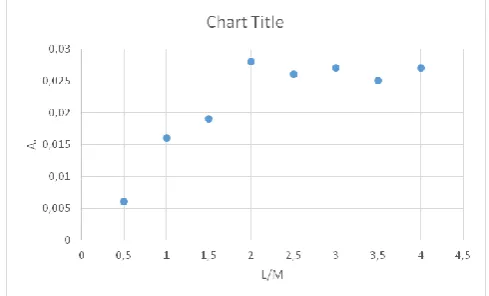
Figure 2. The absorbance-molar ratio relationship in the case of Cu(II)-L1- system (=560 nm)
Results and discussion
The following representative equations illustrate the formation of some of the complexes obtained
2HL+MCl3.6H2O
→
[ML2]Cl, M(III)=Cr and Fe2HL+MCl2.nH2O
→
[ML2], M(II)=Mn, Co, Cu and NiThe synthesis route for the metal complexes is shown in Scheme 1. The complexes are stable solids in air, with varying shades of colouration and their structures were established from their elemental analyses, infrared and electronic and NMR spectra and magnetic moment values.
The results of the elemental analysis are in good agreement with the calculated values of 1:2 metal to ligand except for zinc(II) complexes in which 1:1 ratio was established. The complexes are completely soluble in DMF and DMSO, partially soluble in other polar solvents such as acetonitrile and methanol but are completely insoluble in non polar organic solvents. Low molar conductance values between 27.2 and 38.3 –1 cm2 mol–1 obtained for the
complexes in DMF indicated that they are non-electrolytes and the nature of chlorine to metal bonds can be described as coordinative.13
However, the chromium and iron(III) complexes show molar conductance values in the range 75-85 –1 cm2 mol–1
confirming the electrolytic behavior in 1:1 ratio and support the presence of chloride ions in the outer sphere of the Cr(III) and Fe(III) complexes.14 The analytical data and
other physical properties of the complexes are recorded in Table 1.
OH
O O
H3C N
N CH3
NaNO2
N N
CH3
O
O O
H3C
N N
OH
+
Table 1. Physical properties and elemental analysis of the prepared ligand HL and its metal complexes. Cl% Calc.(found) M% Calc. (found) N% Calc. (found) H% Calc. (found) C% Calc. (found) M.P. °C Colour M.W.
g mol-1 Compound
_
-15.64(15.11) 3.92(3.21) 53.63(52.67) 120-122 Pale brown 358 HL 4.44(4.33) 6.54(6.14) 15.08(15.71) 3.45(3.00) 53.045(52.17) 250-252 Dark green 798[CrL2]Cl
4.42(4.78) 6.98(5.82) 13.94(13.90) 3.30(2.72) 47.22(46.99) 290d Brown 803.5
[FeL2]Cl
- 7.08(6.63) 14.66(14.77) 3.40(3.66) 50.40(49.62) 296d Dark red 766 [MnL2]
- 7.29(6.94) 14.60(14.72) 3.91(3.44) 50.05(49.44) 306d Dark pink 768 [CoL2]
- 7.96(8.87) 14.40(15.11) 3.83(3.11) 49.37(49.00) 307d Orange 770 [NiL2]
- 8.20(8.09) 14.41(14.88) 3.50(2.65) 49.38(45.66) 290d Dark brown 777.6
]CuL
2]7.84(8.33) 13.26 (12.6) 12.31(12.55) 2.80(2.13) 24.69 (24.00) 311d Red 452.5 [ZnLCl] d=decomposition
1H NMR spectra of the free azo ligand
The 1H NMR absorptions of the ligand in DMSO-d
6 is shown in
Figure 3. The proton NMR spectrum of the ligand can be classified into three distinct classes, the methyl (N-CH3), (C=C-H) and hydroxyl (-OH) protons appear as singlet peaks and in the ranges 1.97-2.02, 8.9 ppm and 8.4 ppm respectively. 15-18 The broad singlet
peaks found between 3.6-4.56 ppm are due to protons of –CH3 related to pyran and N-CH3 moiety respectively.However the
multiple peak in the region 6.9-7.22 ppm could be attributed to resonance of aromatic and pyrazoline protons. More ever, the Figure 4 shows the 13C resonance of HL ligand, that records the
absorptions at 155, 131, 121 to 25 ppm that are corresponded to C=O, C=N, C-N-C=C- and CH3 groups respectively. The data
obtained from 13C NMR (Figure 4) with results of 1H NMR
together supports the the expected structure of azo ligand.
Figure 3. 1H NMR spectrum of HL ligand in DMSO-d 6
Figure 4. 13C NMR spectrum of HL ligand in DMSO-d
6
IR spectra
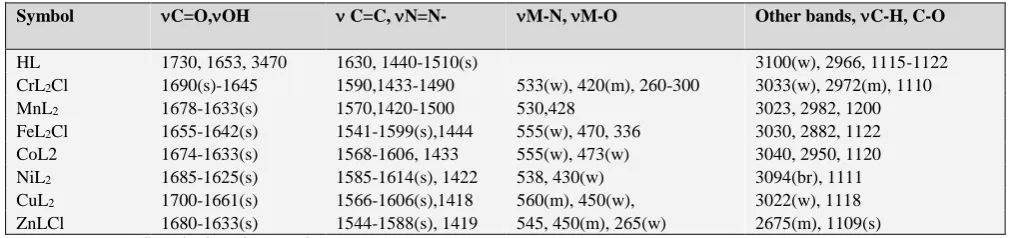
The important IR spectral bands and their assignment are given in Table 2. The free ligand in KBr disc shows broad band at 3470 cm-1 which belongs to OH, thus it confirms the keto-enol
tautomerism of the free azo ligand. The strong absorptions at 1450-1510 cm-1 and 1730-1655 cm-1 are typical for –N=N– and
C=O(pyranone) moieties respectively.19 The band due to C–O–C
stretch of the pyranone ring was observed at 1115-1122 cm-1. In
the IR spectra of the complexes, the band in the region ~ 1700-1625 cm-1 gives a clear indication of chelated C=O group
suggesting involvement of carbonyl oxygen of pyrazolone ring in the coordination with metal ions.
Table 2. FT-IR data of azo ligand and its metal complexes.
Other bands, C-H, C-O M-N, M-O
C=C, N=N-C=O,OH
Symbol
3100(w), 2966, 1115-1122 1630, 1440-1510(s)
1730, 1653, 3470 HL
3033(w), 2972(m), 1110 533(w), 420(m), 260-300
1590,1433-1490 1690(s)-1645
CrL2Cl
3023, 2982, 1200 530,428
1570,1420-1500 1678-1633(s)
MnL2
3030, 2882, 1122 555(w), 470, 336
1541-1599(s),1444 1655-1642(s)
FeL2Cl
3040, 2950, 1120 555(w), 473(w) 1568-1606, 1433 1674-1633(s) CoL2 3094(br), 1111 538, 430(w) 1585-1614(s), 1422 1685-1625(s) NiL2 3022(w), 1118 560(m), 450(w), 1566-1606(s),1418 1700-1661(s) CuL2 2675(m), 1109(s) 545, 450(m), 265(w)
1544-1588(s), 1419 1680-1633(s)
ZnLCl
s=strong, m=medium, br=broad, w=weak
165.462 164.325 161.893 158.029 157.103 156.187 155.961 149.408 149.329 149.205 137.148 136.958 136.259 133.487 123.030 122.899 122.787 122.527 122.423 122.124 122.062 121.996 121.932 121.517 111.341 109.094 107.044 106.208 105.597 102.533 62.662 43.280 40.692 40.356 40.080 39.804 39.527 39.249 38.971 38.691
Current Data Parameters
NAME IVAN−P9
EXPNO 2 PROCNO 53
sample 53
F2 − Acquisition Parameters
Date_ 20130425 Time 16.02 INSTRUM av300
PROBHD 5 mm DUL 13C−1
PULPROG zgpg TD 65536 SOLVENT DMSO NS 164 DS 4 SWH 17985.611 Hz FIDRES 0.274439 Hz AQ 1.8219508 sec RG 1448.2 DW 27.800 usec DE 6.00 usec TE 295.4 K D1 2.00000000 sec d11 0.03000000 sec DELTA 1.89999998 sec MCREST 0.00000000 sec MCWRK 0.01500000 sec ======== CHANNEL f1 ======== NUC1 13C P1 6.40 usec
PL1 −3.00 dB
SFO1 75.4752953 MHz ======== CHANNEL f2 ======== CPDPRG2 waltz16 NUC2 1H PCPD2 80.00 usec
PL2 −3.00 dB
PL12 17.00 dB PL13 16.89 dB SFO2 300.1312005 MHz
200 180 160 140 120 100 80 60 40 20 0 ppm
F2 − Processing parameters
SI 32768 SF 75.4677867 MHz WDW EM SSB 0 LB 0.30 Hz GB 0 PC 1.00
7.447 7.389 7.364 7.327 7.310 7.272 7.244 7.188 7.148 7.120 7.027 6.998 6.971 6.866 6.837 6.735 6.439 6.392 6.324 6.302 6.296 6.200 6.195 6.152 6.117 6.079 6.051 5.999 5.982 5.947 5.641 5.611 5.524 5.388 5.292 5.250 5.050 4.823 4.420 4.409 4.084 3.921 3.877
3.14 1.22 6.13 4.82 0.25 1.43
Current Data Parameters
NAME IVAN−P9
EXPNO 1 PROCNO 53
sample 53 F2 − Acquisition Parameters
Date_ 20130425 Time 16.43 INSTRUM av300
PROBHD 5 mm DUL 13C−1
PULPROG zg TD 65536 SOLVENT DMSO NS 16 DS 2 SWH 8333.333 Hz FIDRES 0.127157 Hz AQ 3.9322100 sec RG 1149.4 DW 60.000 usec DE 6.00 usec TE 294.7 K D1 1.00000000 sec MCREST 0.00000000 sec MCWRK 0.01500000 sec ======== CHANNEL f1 ======== NUC1 1H P1 8.00 usec
PL1 −3.00 dB
SFO1 300.1318509 MHz
F2 − Processing parameters
SI 32768 SF 300.1300000 MHz WDW EM SSB 0 LB 0.30 Hz GB 0 PC 1.00
As well as, the downshift in –N=N- vibration supports the participation of nitrogen atom in -position in bonding with the metal ions. The weak to medium bands at 560-530 and 420-477 cm-1 were due to vibrational modes of M-N and M-O bands,
respectively. 20-21
Electronic spectra and magnetic moments of metal complexes
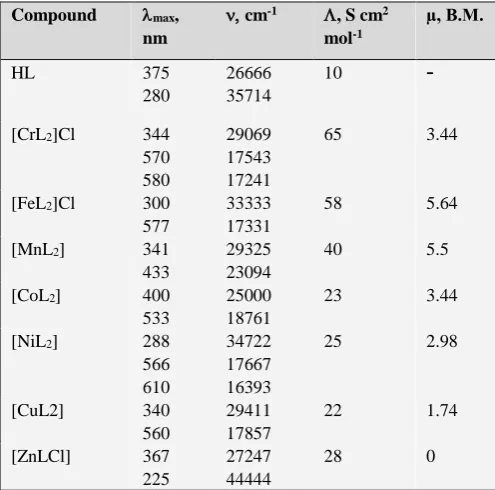
The free azo ligand solution in methanol displays two distinct peaks at 280 and 375 nm that are characterized of –N=N-, C=O and other chromophore groups.22 The magnetic moment value of
Cr(III) complex was 3.44 B.M suggested an octahedral geometry.22-23 The conspicuous electronic spectral bands were at
470-580 nm due to 4A
2g(F) →4T1g(F) and 4A2g(F) →4T2g(F)
transitions, respectively, that remarkably gave additional support to octahedral geometry of the Cr(III) complex. The brown solution of iron(III) complex in DMF showed spectral bands which were overlapped with CT bands. The bands observed at 577 nm could very well be due to 6A
1g →4T1g transition. The magnetic moment
value of 5.64 B.M indicated the octahedral geometry. 23The
spectrum of Ni(II) complex was characteristic of an octahedral geometry with prominent bands at 380 nm (3A
2g →3T1g(P) and
670 nm (3A
2g →3T1g(F)). The magnetic moment of 2.78 B.M. also
suggested an octahedral geometry. The Cu(II) complex was brown in colour due to strong C.T bands tailing off into the blue end of the visible region. The magnetic moment value (1.74 B.M.) lies well within the expected range (1.7-2.2 B.M.). The dark red solution of Zn(II) complex was diamagnetic and the spectral peaks were all similar to those of the ligand as d-d transitions were absent.24 As the same d-d transitions for Cr(III), Fe(III), Mn(II) and
Cu(II) complexes, the cobalt(II) and nickel(II) solutions in DMF exhibit spin-allows transitions in the regions 400-530 and 560-610 nm confirming the 4T
1g→4T2g(F), 4T1g→4A2g(F) and metal to
ligand charge transfer LMCT transitions, respectively, these agree well with the observed values of magnetic moments.25 The red
solution of zinc(II) complex in DMF showed high intensity peaks at 225 and 367 nm due toelectronic transitions of –C=C, C=O, and N=N- chromophores and LMCT, respectively.25
Table 3. Electronic spectra, molar conductance and magnetic moments of the prepared metal complexes
µ, B.M. , S cm2
mol-1 cm-1
max, nm Compound
-
1026666 35714 375
280 HL
3.44 65
29069 17543 17241 344
570 580 [CrL2]Cl
5.64 58
33333 17331 300
577 [FeL2]Cl
5.5 40
29325 23094 341
433 [MnL2]
3.44 23
25000 18761 400
533 [CoL2]
2.98 25
34722 17667 16393 288
566 610 [NiL2]
1.74 22
29411 17857 340
560 [CuL2]
0 28
27247 44444 367
225 [ZnLCl]
λ=molar conductance in DMF solutions at 0.001 M concentration.
Conclusion
A series of novel chromium(III), iron(III), manganese(II), cobalt(II), nickel(II), copper(II) and zinc(II) complexes with a new azo ligand 4-[(Z-(4-hydroxy-6-methyl-2-oxo-2H- pyran-3-yl]-1-methyl-2-phenyl-1,2-dihydro-3H-pyrazol-3-one were synthesized. The free ligand and the isolated solid metal complexes were fully characterized on the basis of C.H.N.M. elemental analyses, 1H and 13C NMR, FTIR and
UV-Visible spectroscopic results. The formula of metal complexes were found to be [ML2]Cln, for theM=Cr, Fe(III)
if n=1 and M=Mn, Co, Ni and Cu(II) for n=0, while the zinc(II) complex has tetrahedral geometry with the formula [ZnLCl]. The infrared spectral data revealed that the new azo compound HL behaves as tridentate Lewis base via the -nitrogen atom of –N=N- group and two oxygen atoms of – deprotonated OH and –C=O of 2-pyranone and pyrazoline moieties, respectively. According to the results obtained from elemental analyses, molar conductivity measurements in DMF solutions and magnetic susceptibility data, the octahedral structures for all metal(II) complexes except the zinc(II), which has tetrahedral structure, were proposed.
References
1Chalaca, M. Z., Figueroa-Villar, J. D., Ellena, J. A. and
Castellano, E. E., Inorg. Chim. Acta, 2002,328, 45.
2Bouchama, A., Bendaâs, A., Chiter, C., Beghidja A. and
Djedouani, A., Acta Cryst., Section E, 2007, 63(9), 1205-1207.
3Khalil, A., Hassan, M. A., Mohamed, M. M., Elsayed, A. M.,
Dyes Pigments, 2005, 66, 241-245.
4Weisberger, A., Wiley R. H., Wiley, P., Eds. The chemistry of
heterocyclic compounds. Pyrazolinones, pyrazolidones and
derivatives, John Wiley, New York. 1964
5Gupta, D. R. and Gupta, R. S., J. Ind. Chem. Soc., 1966, 43(5),
377-379.
6Gupta, D. R. and Ojha, A. C., J. Ind. Chem. Soc., 1970, 47(12),
1207-1208.
7Rawther, S. and Nair, M. R. G., J. Ind. Chem. Soc., 1992, 69,
157-161.
8Hassib, H. B., Abdel Latif, S. A., Spectrochim. Acta, Part A. 2003,
59, 2425-2434.
9Kratzl, K., Fostel H. and Sobczak, R., Monatsh. Chem., 1972,
103(9), 677.
10Makedonski, P. B., Johannes, H. H., Wichem, J., Grahn, W.,
Kowalsky, W., Dyes Pigments, 2004, 16, 109-119.
11Aysha, T., Lycka, A., Lunák, S. Jr., Machalický, O., Elsedik, M.
and Hrdina, R., Dyes Pigments,2013, 98, 547-556.
12Gup, R., Kirkan, B., Spectrochim. Acta, 2005, 62, 1188-1195. 13Geary, W. J., Coord. Chem. Rev., 1971, 7(1), 81-122 .
14 Kruger P. J. and Smith, D. W. Can. J. Chem., 1967, 45(14),
1611-1618.
15Porter, Q. N. and Baldas, J., Mass Spectrometry of Heterocyclic
compounds (Weissberger, A. and Taylor, E. C., eds)
Wiley-Inter Science, John. Wiley and Sons, Inc., USA, 1971.
16Budzikiewicz, H., Djerassi, C. and Williams, D. H., Mass
spectrometry of Organic Compounds, Holden-Day, 1967,
San Francisco.
17Dyer, J. R. Application of absorption spectroscopy of organic
18Batterham, T. J., NMR Spectra of Simple heterocycles (Taylor, E.
C. and Weissberger, A., eds. General Heterocyclic Chemistry
Series, John Wiley and Sons, Inc. New York, USA. 1973.
19Silverstein, R. M., Webster, F. X., Spectrometric Identification of
Organic Compounds, John Wiley and Sons, Inc., New
York,1998.
20Nakamato, K., Infrared and Raman Spectra of Inorganic and
Coordination Compounds, Wiley, New York, 1986.
21Drago, R. S. Physical Methods for Chemists, 2nd. edition,
Saunders Colleges Publishing, New York. 1977.
22Sutton, D., Electronic Spectra of Transition Metal Complexes,
McGraw Hill, , London, 1968.
23 Dutta, R. L. and Syamal, A., Elements of Magnetochemistry,
1992
24Cotton, F. A. and Wilkinson, G., Advanced Inorganic Chemistry,
John Wiley, New York, 1980.
25Seth, S., Aravindakshan, K. K., Spectrochim. Acta Part A Mol.
Biomol. Spectr., 2013,2(1), 415-422.
![Figure 1. Proposed octahedral structure of Cr(III) and Fe(III) complexes of 4-[(Z-(4-hydroxy-6-methyl-2-oxo-2H-pyran-3-yl]-1-methyl-2-phenyl-1,2-dihydro-3H-pyrazol-3-one (HL) ligand, (if M=Mn, Co, Ni, or Cu(II), there is no Cl in the outer sphere.](https://thumb-us.123doks.com/thumbv2/123dok_us/7833356.2089577/1.595.313.554.548.725/figure-proposed-octahedral-structure-complexes-hydroxy-dihydro-pyrazol.webp)