Synthesis of novel pyridines, pyrido[2,3-d]pyrimidines and pyrido[2,3-d]-3,1-oxazines Section A – Research Paper
SYNTHESIS AND SPECTRAL STUDIES OF NOVEL PYRIDINE,
PYRIDO[2,3-d]PYRIMIDINE AND
PYRIDO[2,3-d]-3,1-OXAZINE DERIVATIVES
Mahmoud R. Mahmoud
[a]*, Hamed A. Derbala
[a], Hassan M. F. Madkour
[a],
Mohamed M. Habashy
[a]and Mohamed H. Nassar
[a]Keywords: pyrido[2,3-d]pyrimidines, pyrido[2,3-d]-3,1-oxazines, one carbon donors.
Several novel pyridine, pyrido[2,3-d]pyrimidine and pyrido[2,3-d] 3,1-oxazine derivatives were prepared using the readily obtainable starting material 2-amino-6-aryl-4-(3,4,5-trimethoxyphenyl) pyridine-3-carbonitrile 1a,b via the reaction with one carbon donors such as phenylisothiocyanate, carbon disulphide and formic acid. The IR, 1H-NMR and mass spectra for the new synthesized compounds were discussed.
* Corresponding Authors
E-Mail: [email protected]
[a] Chemistry Department, Faculty of Science, Ain Shams University, Abbassia 11566, Cairo, Egypt
Introduction
Within the framework of our research program1-6
concerning the utility of activated nitriles, we turned our interest to 2-amino-4,6-diaryl pyridine-3-carbonitrile 1 as an example for heterocyclic compounds whose structure represents β-enaminonitrile incorporated with heterocyclic ring.
It has been reported a series of publications reflecting the importance and synthetic applications of aminonitriles bearing various heterocyclic nuclei.7-11 Among those reports,
there has been found different investigation concerning 2-amino-3-cyanofurans12,13 and pyrroles.14 On the other hand,
few reports dealing with similar two bifunctional pyridines were submitted.15
Results and Discussions
The titled compounds 1a, b were successfully prepared by the following two attractive synthetic strategies. First, by the application of the reported one pot methodology used for the preparation of 2-aminopyridine-3-carbonitriles.16 Thus a
mixture of equimolar amounts of 3,4,5-trimethoxy-benzaldehyde, acetophenone (2-acetylnaphthalene), malononitrile and ammonium acetate in absolute ethanol was heated under reflux for 2 hrs. Second, by refluxing the arylidenmalononitrile, namely, 3,4,5-trimethoxy-benzylidenemalononitrile with the coreactant ketone and ammonium acetate on molar ratios in absolute ethanol. The reaction readily proceeded to afford in each case an excellent yield of pyridine derivatives 1a, b. (Scheme 1)
The structure of the products obtained was inferred from microanalytical and spectral data. Thus, the IR spectra of both compound showed two sharp absorption frequencies at 3496 and 3372 cm-1 standing for the –NH group absorption,
in addition to the vibrational frequency at 2207 cm-1
indicating the presence of nitrile functionality.
Furthermore, the 1H-NMR spectrum of compound 1a in
DMSO-d6 exhibited signals from low to high field which
were in agreement with the concerned structure. The aromatic protons of 6-substituted phenyl moiety displayed two multiplets at δ 8.8-8.40 ppm and 7.48-7.46 ppm integrating to two and three protons, respectively. However, the absorption singlet exhibited at δ 7.3 ppm integrating to one proton refers to the aromatic hydrogen located at C-5. Two magnetically equivalent protons at 2' and 6' positions of trimethoxyphenyl moiety displayed a singlet at δ 6.97 ppm. The amino group protons showed a singlet at δ 6.92 ppm (exch. in D2O).
H
Ar O +
H3C O
Ar' +
CN
CN
EtOH abs. AcONH4
N NH2
CN Ar Ar'
Ar
H CN
CN +
H3C O
Ar' EtOH abs. AcONH4
Ar' a; C6H2(OCH3)3 3,4,5-b; C6H2(OCH3)3
3,4,5-Ar
Ph 2-naphthyl
(1a,b)
Scheme 1
Moreover, the 3,4,5-trimethoxy groups showed two singlets at δ 3.84 and 3.72 ppm, integrating to six and three protons of two magnetically equivalent –OCH3 groups at 3'-
and 5'- positions, while the latter corresponding to that one located at position 4'. Furthermore, structures 1a and 1b
received a satisfactory support from the study of their mass spectra which were in full agreement with their assigned structure (c.f. Exp.).
derivatives.17 Thus, when conducting compound 1a with
triethylorthoacetate and/or compound 1b with triethylorthoformate in refluxing acetic anhydride for 6 hrs. resulted in the formation of 4,6-diethoxymethylene-aminopyridine-3-carbo-nitriles 2a,b in moderate yields. (Scheme 2)
N Ar'
(2)
CN
N Ar
OEt R
N Ar'
CN
NH2 Ar
RC(OEt)3 Ac2O/
(1)
a, Ar = C6H2(OMe)3 3,4,5- , Ar' = Ph b, Ar = C6H2(OMe)3 3,4,5 , Ar' = C10H7
2-NH2NHPh
N Ar'
(3)
N Ar
N NH
NHPh
i) con c. H2
SO4
ii) Ac Cl
PhN CS/ Py.
N Ar'
COOH
N H Ar
(5)
N
Ar' N
Ar
(4)
O
N
NHPh S
S NH
Ph
Ac2O
N
Ar' N
Ar
(6)
O
Me O
a, R = Me; b, R = H R
Scheme 2
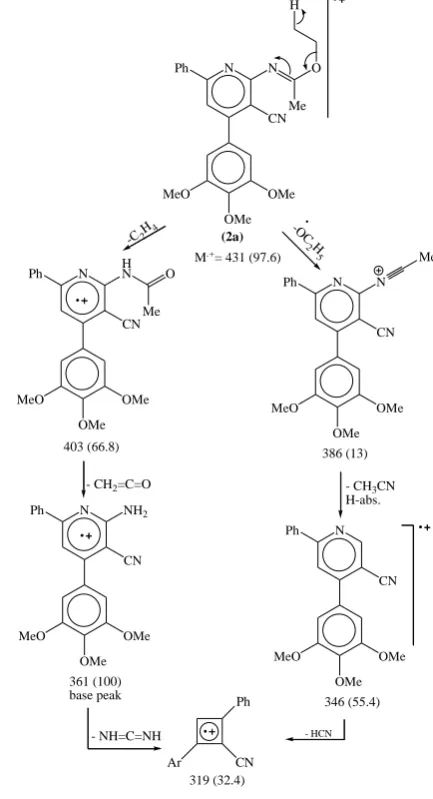
The structure of products 2a,b was inferred from microanalytical and spectral data. Thus, they lacked the coupling absorption bands characteristic to the –NH2 group
and acclaimed only the appearance of absorption frequencies of the nitrile and imino –C=N groups at 2209 cm-1 and 1626 cm-1.
Moreover, the structural features of both compounds 2a,b
received further support by a study of their mass spectra.
Furthermore, the mass spectrum of 2b show a fragmentation pattern which very close to 2a with the correct molecular ion at m/z = 467 (100%) which is the base peak (c.f. Exp.). Because of the presence of two almost similar electrophilic sites, the nitrile and its orthoethoxyisonitrile functionalities, it would be suitable to attempet its condensation with binucleophilic centers reagent e.g., phenylhydrazine. Thus, compounds 2a,b were allowed to react with the latter reagent in refluxing ethanol for two hrs. It was proposed that the reaction proceeded via nucleophilic addition on the ethoxyisonitrile group followed by cyclization on the nitrile functionality to afford 5,7-diaryl-3-phenylamino-4-iminopyrido-[2,3-d](3H)pyrimidine derivatives 3a,b in good yields. (Scheme 2)
N N
CN
Ph O
Me H
MeO OMe
OMe
(2a)
M.+= 431 (97.6)
-C2H4 -OC
2H
5
N HN
CN
Ph O
Me
MeO OMe
OMe
403 (66.8)
N N
CN Ph
MeO
OMe OMe
386 (13)
Me
- CH3CN H-abs.
N
CN Ph
MeO
OMe OMe
346 (55.4) - CH2=C=O
N
CN Ph
MeO
OMe OMe
361 (100) base peak
NH2
- NH=C=NH
Ph
Ar CN
319 (32.4)
- HCN
Figure 1. EI fragmentation pattern of compound 2a
The 1H-NMR spectrum of compound 3a in DMSO-d 6
clearly showed the absorption signals corresponding to each proton type in the assigned structure. Thus, the imino –NH proton displayed a singlet at δ 9.11 ppm integrating to one proton, however, the aromatic proton exhibited three multiplets in the range of δ 8.04-6.6 ppm integrating all thirteen protons, along with the anilino –NH proton appeared as abroad signal at δ 5.034 ppm. The trimethoxy group protons showed their absorption signal as two singlets at δ 4.03 ppm and 3.97 ppm integrating for six and three protons, respectively. In addition the two methyl proton type displayed a singlet at δ 2.30 ppm.
Moreover, the mass fragmentation pattern of compound 3b
presented a satisfactory support which was in full accordance with the proposed structure. It showed the fragment 529 (14.96%) corresponding to the parent peak.
Synthesis of novel pyridines, pyrido[2,3-d]pyrimidines and pyrido[2,3-d]-3,1-oxazines Section A – Research Paper
N Ar'
(3b)
M.+= 529 (14.9) N
N Ar NH
NHPh - PhNH
H- abs. - HCN
N
Ar' N
Ar H N
411 (45.6)
Ar' = C10H7 2-Ar = C6H2(OMe)3
3,4,5-- Ar' - HCN - Ar
N N
N
208 (100) base peak
H N
92 (86.3) 65 (66.1) NHPh
Y
Y - HCN
Figure 2. EI- fragmentation pattern of 3b
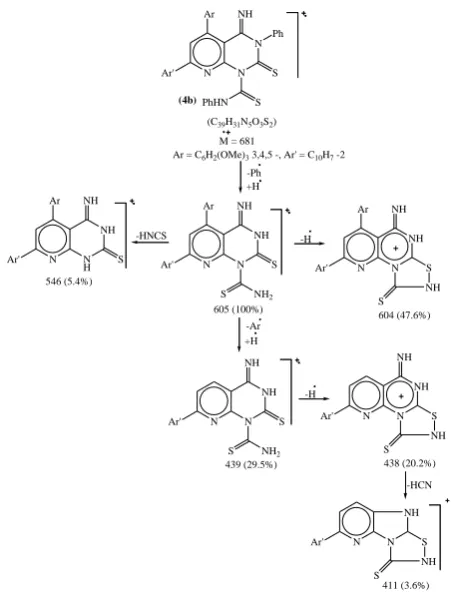
By the study of their mass spectra it has been found that the molecular weight determination indicated the incorporation of two molecules of phenyl isothiocyanate in the formation of reaction product. it was proposed that the reaction involved the formation of 7-aryl-4-imino-3-phenyl- 1-(N-phenythiocarbox-amido)-5-(3,4,5-trimethoxyphenyl)-pyrido[2,3-d] pyrimidin-2-thione 4a,b.
Examination of 1H-NMR spectrum of 4b in DMSO-d 6
revealed two singlets, the former at δ 9.57 ppm integrating for one proton attributable to the exocyclic imino C=NH proton and the latter at δ 8.3 ppm stands for the thiocarboxamide proton absorption. The aromatic protons displayed signals in the range of δ 8.09-6.96 ppm, integrating totally for 20 protons of five aromatic rings existing in the concerned structure. Moreover, the three methoxy group protons lacated at 3', 4' and 5'-positions of the 5-substituted phenyl rings showed two singlets integrating to nine protons at δ 3.81 ppm and 3.78 ppm.The mass spectra of 4a and 4b were completely in accord with the proposed structures (C.F. Fig. 3,4).
Fused oxazinones are among the most important heterocycles which are required as synthons and their wide scope of biological activity.18-25 Thus, the author intented to
synthesize pyrido[2,3-d][3,1]oxazinone derivative 6 via two steps reaction involving hydrolysis of 1b with the aid of concentrated sulphuric acid followed by refluxing in acetyl chloride to give 2-acetamidonicotinic acid derivative 5
which underwent cyclodehydration by treatment with acetic anhydride to afford 2-methyl-7-(2-naphthyl)-5-(3,4,5-trimethoxyphenyl)pyrido[2,3-d][3,1]oxazin-4-one 6 in a moderate yield (Scheme 2).
The structure of the acetamidonicotinic acid derivative 5
was proven by solubility in aqueous sodium carbonate solution and its IR spectrum showed two broad vibrational bands at 3405 cm-1 and 3227 cm-1 attributable to the open
amide –NH group and the carboxyilic functionality existing in H-bonding that causes broadening of their absorption frequencies. Two strong absorption bands appeared at 1705 and 1662 cm-1 referring to the presence of carbonyl
functionalities of both the carboxy and the open amide groups, respectively.
N
Ar' N
Ar
(4a)
N
PhHN S S NH
Ph
(C35H29N5O3S2)
M = 631
Ar = C6H2(OMe)3 3,4,5 -, Ar' = C6H5
-Ph +H
N
Ar' N
Ar
555 (16.8%) NH
NH2
S S NH
-HNCS
N
Ar' N
H Ar
496 (100%) NH
S NH
-H
N
Ar' N
Ar
495 (92.7%) N
S NH
N
Ar' N
N
PhHN S S NH
Ph
464 (21.8%)
-Ph
N
Ar' N
N
NHPh S
S NH
387(9.2%)
-HCN
N
Ar' N
N S
N H S
Ph
360 (10.0%) - Ar
C9H11O3
Figure 3. EI fragmentation pattern of compound 4a
N
Ar' N
Ar
(4b)
N
PhHN S S NH
Ph
(C39H31N5O3S2)
M = 681
Ar = C6H2(OMe)3 3,4,5 -, Ar' = C10H7 -2
-Ph +H
N
Ar' N
Ar
605 (100%) NH
NH2
S S NH
-HNCS N
Ar' N
H Ar
546 (5.4%) NH
S NH
-H N
Ar' N
Ar NH
S NH
NH S 604 (47.6%) +H
-Ar
N
Ar' N
NH
NH2
S S NH
-H N
Ar' N
NH S NH
NH S 438 (20.2%)
-HCN
N
Ar' N S
NH S
NH
411 (3.6%) 439 (29.5%)
Synthesis of novel pyridines, pyrido[2,3-d]pyrimidines and pyrido[2,3-d]-3,1-oxazines Section A – Research Paper
On the other hand, the structure of the product 6 was established from microanalytical and spectral data. Thus, its IR spectrum showed the lack of absorption bands of the amide –NH and acidic –OH groups that refers to their involvement in the cyclization process. The 6μm region reveled a stretching absorption frequency of 6-membered lactone at 1767 cm-1 with the band appearing at 1663 cm-1
which indicated the existence of C=N.
1H-NMR of compound 6 in DMSO-d
6 show from low to
high field signals characteristic for aromatic protons at δ ppm 8.1-7.5 (m, 10H), two singlet at δ 4.0, 3.8 ppm for the three methoxy protons in the ratio 6:3 and singlet at δ 2.3 for the three methyl protons.
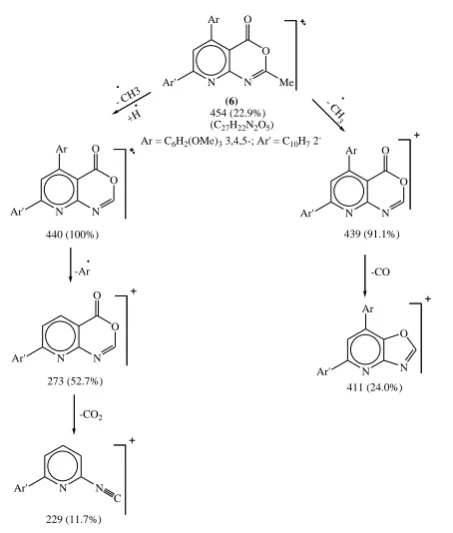
Moreover, a full support of the proposed structure was provided by quantitative investigation of its mass fragmentation pattern (Fig. 5).
N Ar' N Ar 440 (100%) O O N Ar' N Ar (6) O O Me 454 (22.9%) (C27H22N2O5)
Ar = C6H2(OMe)3 3,4,5-; Ar' = C10H7 2
-- CH3 +H -Ar N Ar' N 273 (52.7%) O O -CO2 N Ar' N C 229 (11.7%) - C H 3 N Ar' N Ar 439 (91.1%) O O -CO N Ar' Ar N O 411 (24.0%)
Figure 5. EI fragmentation of compound 6
It has been reported that heterocyclic o-amino carbonitriles including furans, pyrimidines and quinazolines26,27 reacted with carbon disulphide under
different reactions conditions to afford biologically interest fused thiazines and/or pyrimidinedithione. However, when compound 1a was treated with the reagent in ethanolic solution of KOH at refluxing temperature for 6hrs. The reaction fails to give the fused pyridine compound. Instead a semisolid product was separated out (two spots in TLC) and subjected to fractional crystallization, non of these products could be isolated in a pure state. Meanwhile, it was possible to detect in the crude reaction mixture by GC-MS technique two different compounds. The EI fragmentation pattern of one of them is completely in accord with N,N’-bis[4-aryl-3-cyano-6-phenyl pyridine-2-yl]thiourea 7 and the second showed completely different pattern whose highest m/z (relative intensity) peak is recorded at 403 (45.6) which is attributable to the isothiocyanate derivative 8 (Scheme 3). Tentative fragmentation which are in a good compatible with the proposed structures.
N Ar Ph CN NH2 CS2 EtOH Py. -H2S
N Ar Ph CN N H S 2 + N Ar Ph CN N C S (7) (8) N Ar Ph N H NH S S (9) (1a) Scheme 3 N Ar Ph CN N H (7) N H S N Ar Ph NC X Z
[M] = 764 (71.4%)
Z N H Ar Ph CN NH 361 (71.9%) N H Ar CN NH 285 (32.5%) -Ph H. abs. -HCN - CN N H Ar 232 (26.7%) X H. abs. N Ar Ph CN N H NH2
S
420 (67.8%)
- NH3
N Ar Ph CN N C S 403 (100%) base peak -N=C=S - CN N Ar Ph 319 (46.4%) H. abs.
Figure 6. The main fragmentation pattern for 7
Moreover, the highest recorded peak in the mass spectrum of 8 at m/z = 403 (45.6) represent the correct molecular ion peak which upon loss of methyl and cyanide radical afforded the radical cation at m/z = 362(100%) which represent the base peak.(c.f. Exp.).
By repeating the above reaction in pyridine under the same previous reaction conditions resulted in the formation of fused compound 9 whose structure was described as 5-aryl-7-phenylpyrido[2,3-d]pyrimidine-2,4-(1H,3H) dithione (Scheme 3). Now, it is postulated that the utility of pyridine is responsible for the existence of thiocarbamate intermediate 10 which in turn attacks the nitrile group to give the pyrimidine salt of 2-thioxo-1,3-thiazine derivative
11 which undergo rearrangement to the isothiocyanate derivative2812 which underwent cyclization to give pyrido
pyrimidine dithione derivative 9 (Scheme 4).
N Ar Ph CN NH2 CS2 EtOH Py. -H2S
Synthesis of novel pyridines, pyrido[2,3-d]pyrimidines and pyrido[2,3-d]-3,1-oxazines Section A – Research Paper
N Ar
Ph
CN
NH2
(1a)
CS2
N Ar
Ph
(10)
N
H S
S N
HN
N Ar
Ph N S
S HN NH
H N
Ar
Ph N S
SHN NH
N Ar
Ph N C S
S
HN
NH HCl
HN Cl
N Ar
Ph N SH
NH S
N Ar
Ph N
H S
NH S
(9) (11)
(11)
(12)
Scheme 4
The structure 9 was substantiated from the analytical and spectroscopic data. Moreover, its mass fragmentation pattern was in full harmony with the assigned structure. (c.f. Exp.).
Recently, there has been found a number of publications29,30 reported that the formation of fused
pyrimidinones via condensation of variety of substituted 2-aminobenzonitriles and/or 2-aminopyrrolonitriles with formic acid is either an acid catalyzed or time dependent reaction.
We were able in our lab to obtain the intermediate substituted 2-aminopyridine-3-carboxamide derivative 13 by refluxing 1a with formic acid on water bath for 2 hr. in absence of acid catalysis. Whereas, the reaction of 1a with formic acid in the presence of concentrated sulphuric acid as acatalyst, afforded the cyclized product 5-aryl-7-phenylpyrido[2,3-d]pyrimidine-4(3H)one 14 in good yield (Scheme 5).
N Ar
Ar' NH2
CN
(1a)
HCOOH HCOOH
2 hr H
N Ar
Ar' NH2
(13) NH2
O
N Ar
Ar' N
NH O
(14)
Ac2O AcCl
N Ar
Ar' N
H CN
(15)
Me O
N Ar
Ar' N
CN
Me O
Me O (16)
Scheme 5
The structure of pyridopyrimidinone 14 was broven on the basic of microanalytical and spectral data. Thus, their IR spectra revealed abroad band in the 3 µm region standing for stretching vibration of νNH,OH, of the cyclic amide group. In
addition, the 6 µm region exhibited the carbonyl vibrational band at 1680 cm-1 and/or 1659 cm-1 of cyclic 6-membered
lactam ring.
Furthermore, the assigned structure of compound 14
received satisfactory support by the study of its mass fragmentation pattern which showed the correct molecular ion peak at 389 (45.7%).
The 1H-NMR spectra of compound 14 in DMSO-d6
revealed to doublets at δ 8.14 ppm standing for the ring –NH proton. However, the pyridyl H-2 proton displayed a singlet at δ 7.33 ppm along with the phenyl group protons absorption shown as multiplet at δ 7.49 ppm integrating to five protons, a singlet at δ 7.1 ppm integrated for one proton (C6-H). The two protons at m-positions of 5-substituted 3,4,5-trimethoxyphenyl ring exhibited a singlet at δ 6.88 ppm, meanwhile the three methoxy group of the same ring displayed their absorption signals as two singlets at δ 3.84 ppm, and 3.75 ppm integrating for six and three protons located at 3'- and 5'- positions along with those substituted at 4'-position.
One of the historical beneficial roles of the amino group in organic chemistry is its susceptibility to be acylated upon treatment with various number of acylating agents, in easy going reactions. Of these reactions, the concerned compound 1a was treated with acetyl chloride and/or acetic anhydride at the reflux temperature of the reagent. The reaction readily occurred via nucleophilic addition of the amino group on electronically deficient carbonyl carbon atom of the acetyl segment that led finally to the formation of monoacetyl derivative 15 in the first case and the diacetyl derivative 16 in the latter one (Scheme 5). The IR spectrum of 15 displayed ν NH (sharp) at 3347 cm-1, νCN at 2220 cm-1
and νCO(amide) at 1658 cm-1. On the other hand, the latter
product 16 exhibited vibrational coupling bands for a carbonyl groups at 1730 and 1700 cm-1 and show the
absence of absorption bands for NH group.
Moreover, the 1H-NMR spectrum of compound 16 in
CDCl3 displayed a singlet at δ 2.42 ppm integrating to six
protons indicates the presence of two symmetrical acetyl groups.
On the other hand, compound 16 received further support to its structure assignment from the study of its mass spectrum whose fragmentation pattern was in full agreement with the proposed structure.(c.f. Exp.)
Experimental
All melting points were taken on Griffin and Geory melting point apparatus and are uncorrected. IR spectra were recorded on Pye Unicam SP1200 spectrophotometer using KBr Wafer technique. 1H-NMR spectra were determined on
a Varian Gemini 200 MHz, Brucher AC-200 MHz using TMS as internal standard (chemical shifts in δ-scale). EI-MS were measured on a Schimadzu-GC-MS instrument operating at 70 eV. Microanalysis measurements were carried out at Ain Shams University laboratory and satisfactory analytical data (± 0.4) were obtained for all compounds. 1H-NMR spectra and EI-MS were run at Cairo
Condensation of 3,4,5-trimethoxybenzaldehy-de, acetophenone, malononitrile and ammonium acetate; Formation of 2-amino-6-phenyl-4-(3,4,5-trimethoxy-phenyl)pyridine-3-carbonitrile (1a)
A mixture of malononiltrile (0.66 g; 0.01 mol), acetophenone (1.2 g; 0.01 mol), 3,4,5-trimethoxybenzaldehyde (1.96 g; 0.01 mol) and ammonium acetate (1.15 g; 0.015 mol) in dry benzene (50 ml) was heated under reflux using water separator for 4 hrs, cooled and the crude solid was triturated with ethanol. The solid product so formed was collected by filtration, dried and recrystallized from ethanol giving 1a as yellow crystals, 2.8 g (78%), mp 161-163ºC, ir: NH2 3496, 3372, C≡N 2207,
C=N 1630 cm-1. 1H nmr (DMSO-d
6) δ 8.8-7.4 (m, 5Harom.),
7.3 (s, 1H, C5-H), 6.97 (s, 2Harom.), 6.9 (br.s, 2H, NH2,
exchangeable with D2O), 3.84 (s, 6H, 2OMe), 3.72 (s, 3H,
OMe). ms: m/z: 362 (M+1, 100), 347 (43), 319 (24.2), 286 (13.6), 234 (16.2). Anal. Calcd. for C21H19N3O3 (361): C,
69.8; H, 5.26; N, 11.63. Found: C, 69.73; H, 5.42; N, 11.46.
Condensation of 3,4,5-trimethoxybenzaldehy-de, acetylnaph-thalene, malononitrile and ammonium acetate; Formation of 2-amino-6-(2-naphthyl)-4-(3,4,5-trimethoxyphenyl) pyridine-3-carbonitrile (1b)
A mixture of malononiltrile (0.66 g; 0.01 mol), 2-acetylnaphthalene (1.7 g; 0.01 mol), 3,4,5-trimethoxybenzaldehyde (1.96 g; 0.01 mol) and ammonium acetate (1.15 g; 0.015 mol) in dry benzene (50 ml) was heated under reflux using water separator for 4 hrs, cooled and triturated with ethanol. The solid product so formed was collected by filtration, dried and recrystallized from ethanol giving 1b as yellow crystals, 3.5 g (87%), mp 173-175ºC, ir: NH2 3476, 3296 , C≡N 2207, C=N 1642 cm-1. ms: m/z: 412
(M+1, 100), 397 (19), 381 (12), 286 (13.6), 288 (12), 244 (13.3). Anal. Calcd. for C25H21N3O3 (411): C, 72.99; H, 5.1;
N, 10.21. Found: C, 73.09; H, 5.32; N, 10.0.
Reaction of 1a with triethylorthoacetate; Formation of 2-ethoxyethylenamino- 6-phenyl-4-(3,4,5-trimethoxyphenyl)-pyridine-3-carbonitrile (2a)
A mixture of compound 1a (3.61 g; 0.01 mol), triethylorthoacetate (5 ml) in freshly distilled acetic anhydride (5 ml) refluxed for 5 hrs. The solvent was removed under reduced pressure and the resulted solid was triturated with ether and recrystallized from ethanol giving
2a as glassy yellow crystals, 2.28 g (53%), mp 158-160ºC, ir: C≡N 2209 cm-1. ms: m/z: 431 (M+., 97.6), 403 (66.8), 386
(13), 373 (30), 361 (100), 346 (55.4), 319 (32.4). Anal. Calcd. for C25H25N3O4 (431): C, 69.6; H, 5.8; N, 9.74.
Found: C, 69.92; H, 5.66; N, 9.72.
Synthesis of 2-ethoxymethylenamino- 6-(2-naphthyl)-4-(3,4,5-trimethoxy-phenyl) pyridine-3-carbonitrile (2b)
A mixture of compound 1b (4.11 g; 0.01 mol), triethylorthoaformate (10 ml) in acetic anhydride (5 ml) was refluxed for 5 hrs. The solvent was removed under reduced pressure and the resulted solid was triturated with ether and recrystallized from ethanol giving 2b as buff crystals, 2.8 g
(61%), mp 143-145ºC, ir: C≡N 2207 cm-1. ms :m/z: 467
(M+., 100), 340 (M-C
10H7, 22.8), 300 (M-Ar, 70.3), 421
(7.6), 395 (46.2), 167 (32.6), 77 (18.9). Anal. Calcd. for C28H25N3O4 (467): C, 71.94; H, 5.35; N, 8.99. Found: C,
72.08; H, 5.3; N, 8.73.
Reaction of 2 with phenyl hydrazine; Formation of 2-methyl-7- aryl-5-(3,4,5-trimethoxyphenyl)-3-phenylamino-4-imino-pyri-do[2,3-d](3H)pyrimidine (3a) and (3b)
A mixture of compound 2 (0.01 mol) and phenyl hydrazine in ethanol (20 ml) was heated under reflux for 8 hrs. The reaction mixture was left to cool, poured into dilute hydrochloric acid; the solid product so formed was filtered off, dried and recrystallized from methanol giving 3a as light brown crystals, 2.8 g (58%), mp 197 ºC decomp., ir: NH 3383, C=N 1661 cm-1. 1H nmr (DMSO-d
6) δ 9.11 (s,
1H, =NH), 8.04-7.5 (m, 10Harom.), 7.1 (s, 1H, C6-H), 6.66 (s,
2Harom.), 5.03 (br.s, 1H, NH, exchangeable with D2O), 4.03
(s, 6H, 2OMe), 3.9 (s, 3H, OMe), 2.3 (s, 3H, Me). ms: m/z: 493 (M+., 100), 479 (22.8), 402 (70.3), 319 (44.8), 92 (83.6),
65 (33.6). Anal. Calcd. for C29H27N5O3 (493): C, 70.58; H,
5.47; N, 14.19. Found: C, 70.68; H, 5.34; N, 13.89.
3b: crystallized from dioxane to give buff crystals, 2.4 g (46%), mp 206-208ºC, ir: NH 3376, C=N 1652 cm-1. ms:
m/z: 529 (M+., 4.9), 487 (17.8), 411 (45.6), 396 (15.5), 380
(8.1), 351 (14), 224 (12.6), 208 (100), 93 (33.6), 77 (44.1) . Anal. Calcd. for C32H27N5O3 (529): C, 72.58; H, 5.10; N,
13.23. Found: C, 72.73; H, 5.0; N, 13.09.
Reaction of 1a,b with phenyl isothiocyanate; Formation of 7- aryl-4-imino-3-phenyl-1-[N-phenylthiocarboxamido]-5-(3,4,5-trimethoxy phenyl)pyrido[2,3-d]pyrimidine-2-thione (4a,b)
A mixture of compound 1a (3.61 g; 0.01 mol) or 1b (4.1 g; 0.01 mol) and excess phenyl isothiocyanate in pyridine (20 ml) was refluxed for 6 hrs. The reaction mixture was left to cool, acidified with dilute hydrochloric acid; the solid product so formed was filtered off, dried and recrystallized from the proper solvent to give 4a and 4b, respectively.
3,7-Diphenyl-5-(3,4,5-trimethoxyphenyl)-1-[N-phenylthiocar-boxamido]-pyrido[2,3-d]pyrimidine-2-thione (4a)
Recrystallized from benzene as yellow crystals, 5.1 g (92%), mp 280-282ºC, ir: NH 3357, 3376, C=N 1631, C=S 1259 cm-1. 1H nmr (DMSO-d
6) δ : 9.57 (s, 1H, =NH), 8.3 (s,
1H, NH), 8.09-6.96 (m, 15Harom.), 7.2 (s, 1H, C6-H), 6.7 (s,
2Harom.), 3.81 (s, 6H, 2OMe), 3.78 (s, 3H, OMe). ms: m/z:
555 (M-Ph, 16.8), 497 (94.2), 496 (100), 466 (42.2), 387 (9.2), 360 (10). Anal. Calcd. for C35H29N5O3S2 (631): C,
66.56; H, 4.59; N, 11.09; S, 10.14. Found: C, 66.91; H, 4.32; N, 10.88; S, 10.0.
7-(2-Naphthyl)-3-phenyl-5-(3,4,5-trimethoxyphenyl)-1-[N-phe-nylthio-carboxamido]pyrido[2,3-d]pyrimidine-2-thione (4b)
Recystallized from benzene as greenish-yellow crystals, 5.9 g (87%), mp 236-238ºC, ir: NH 3386, 3346, C=N 1644, C=S 1287 cm-1. ms: m/z: 605 (M-Ph, 100), 546 (5.4), 439
Synthesis of novel pyridines, pyrido[2,3-d]pyrimidines and pyrido[2,3-d]-3,1-oxazines Section A – Research Paper
Anal. Calcd. for C39H31N5O3S2 (681): C, 68.72; H, 4.55; N,
10.27; S, 9.39. Found: C, 68.61; H, 4.4; N, 10.0; S, 9.23.
Formation of 2-acetylamino-6-(2-naphthyl)-4-(3,4,5-trimeth-oxyphenyl)pyridine-3-carboxylic acid (5)
A mixture of 1b (4.11 g; 0.01 mol) in concentrated sulphuric acid (5 ml) was heated for 2 hrs, left to cool, neutralized by 5N sodium hydroxide solution and filtered. The clear filtrate was then acidified depositing an orange solid which was filtered off, dried then dissolved in acetyl chloride (5ml), refluxed for only 1 hr, left to cool, and poured into ice water. The separated solid was collected by filtration and dissolved in aqueous solution of sodium bicarbonate, filtered and the alkaline filtrate then acidified with dilute acetic acid. The deposited solid was filtered off, dried and recrystallized from methanol to give 5 as yellow crystals, 2.1 g (46%), mp 214-216ºC, ir: NH 3405, 3227, CO acid 1705, CO amide 1662 cm-1. ms: m/z: 472 (M+., 33.4),
454 (M-H2O, 30.1), 430 (M-CH2=C=O, 27.6), 384 (60.3),
181 (12.8). Anal. Calcd. for C27H24N2O6 (472): C, 68.64; H,
5.08; N, 5.93. Found: C, 68.83; H, 4.8; N, 5.77.
Synthesis of 2-methyl-7-(2-naphthyl)-5-(3,4,5-trimethoxy-phenyl) pyrido [2,3-d]3,1-oxazin-one (6)
A solution of compound 5 (1 g) in freshly distilled acetic anhydride (5 ml) was heated under reflux for one hour, then left to cool and poured into ice water with stirring. The separated solid was collected by filtration, dried and recrystallized from light petroleum ether (b.p. 100-120oC) to
give 6 as orange crystals, 2.08 g (46%), mp 98ºC (decomp.), ir: CO oxazinone 1767, C=N 1663 cm-1. 1H nmr (DMSO-d
6)
δ: 8.1-7.5 (m, 7Harom.), 7.1 (s, 1H, C6-H), 6.7 (s, 2Harom.), 4.0
(s, 6H, 2OMe), 3.8 (s, 3H, OMe), 2.3 (s, 3H, C2-Me).
ms :m/z: 454 (22.9), 440 (M-Me, 100), 410 (12.4), 411 (24.0), 312 (11.9), 273 (52.7), 229 (11.7). Anal. Calcd. for C27H22N2O5 (454): C, 71.36; H, 4.84; N, 6.16. Found: C,
71.61; H, 4.9; N, 5.86.
Reaction of 1a with CS2 / KOH; Formation of N,N-bis[4-aryl-3-cyano-6-phenylpyridin-2-yl]thiourea (7) & isothiocyanate derivative (8)
A mixture of compound 1a (3.61 g; 0.01 mol), carbon disulphide (5 ml) in ethanolic KOH solution (20 ml) was refluxed for 5 hrs. The excess ethanol was evaporated, then reaction mixture was left to cool, acidified with dilute hydrochloric acid giving a semisolid paste which was triturated with ether, recrystallized by DMF to afford a non isolable mixture of two compounds which were identified by GC-MS as 7 and 8.
Reaction of 1a with CS2 / pyridine; Formation of 7-phenyl-5- (3,4,5-trimethoxyphenyl)-1H,3H-pyrido[2,3-d]pyrimidin-2,4-dithione (9)
A mixture of compound 1a (3.61 g; 0.01 mol), carbon disulphide (10 ml) in pyridine (20 ml) was refluxed for 6 hrs. The reaction mixture was left to cool, acidified with dilute hydrochloric acid. The solid product so formed was filtered off, dried and recrystallized from acetic acid giving 9 as buff
crystals, 2.6 g (61%) mp 164-166ºC, ir: NH 3424, 3329, C=S 1241 cm-1. ms :m/z: 437 (M+., 17.6), 422 (M-Me, 100),
406 (M-OMe, 44.2), 363 (36.2), 348 (22.7), 319 (16.1), 182 (80.7). Anal. Calcd. for C22H19N3O3S2 (437): C, 60.41; H,
4.34; N, 9.61; S, 14.64. Found: C, 60.78; H, 4.18; N, 9.37; S, 14.33.
Reaction of 1a with formic acid i) in absence of catalyst; Formation of 2-amino-3-carboxamide-6-phenyl-4-(3,4,5-trimethoxyphenyl)pyridine (13)
A solution of 1a (3.61 g, 0.01 mol) in formic acid (10 ml) was refluxed for 2 hrs, cooled, diluted with cold water. The solid product so formed was then filtered off, washed with water, dried and recrystallized from DMF affording 13
as light brown crystals, 2.1 g (57%), mp 223-225ºC, ir: NH2
3412, 3380, 3240, C=O amide 1659 cm-1. ms: m/z: 379 (M,
78.1), 365 (70), 349 (33.1), 304 (22.8), 291 (20.2). Anal. Calcd. for C21H21N3O4 (379): C, 66.49; H, 5.54; N, 11.08.
Found: C, 66.71; H, 5.32; N, 10.84.
ii) In presence of Conc. H2SO4; Formation of 7-phenyl-5-(3,4,5-trimethoxyphenyl)-3H-pyrido[2,3-d]pyrimidin-4(3H)one (14)
A solution of 1a (3.61 g, 0.01 mol) in formic acid (10 ml) was refluxed in the presence of Conc. H2SO4(1 ml) for 10
hrs. The reaction mixture was then cooled, neutralized by 1N NaOH. The solid product so formed was filtered off, washed with water, dried and recrystallized from DMF affording 14 as brown crystals, 1.59 g (41%); mp 211-213ºC, ir: (br) NH,OH 3271, C=O 1680 cm-1. 1H nmr (CDCl
3) δ:
8.14 (d, 1H, NH), 7.49 (m, 5Harom.), 7.33 (s, 1H, C2-H), 7.1
(s, 1H, C6-H), 6.88 (s, 2Harom.), 3.84 (s, 6H, 2OMe), 3.75 (s,
3H, OMe). ms :m/z: 389 (45.7), 388 (100), 374 (40.6), 357 (18.9), 299 (16). Anal. Calcd. for C22H19N3O4 (389): C,
67.86; H, 4.88; N, 10.79. Found: C, 67.67; H, 5.0; N, 10.66.
Formation of 2-acetylamino-6-phenyl-4-(3,4,5-trimethoxy-phenyl)-pyridin-3-carbonitrile (15)
A mixture of compound 1a (3.61 g, 0.01 mol) and acetyl chloride (10 ml) was heated on a water bath for one hour. The reaction mixture left to cool then poured drop wisely into ice-water with fast stirring. The solid formed was collected by filtration, washed several times with water, dried and recrystallized from chloroform affording 15 as yellow crystals, 3.38 g (84%), mp 218-220ºC, ir: NH 3347, C≡N 2220, CO amide 1658 cm-1. ms :m/z: 403 (100), 361
(90.3), 195 (21.7), 181 (16.2), 91 (30.3). Anal. Calcd. for C23H21N3O4 (403): C, 68.48; H, 5.21; N, 10.42. Found: C,
68.71; H, 5.0; N, 10.37.
Formation of 2-(N,N-diacetylamino)-6-phenyl-4-(3,4,5-trimeth-oxyphenyl)-pyridin-3-carbonitrile (16)
A mixture of compound 1a (3.61 g, 0.01 mol) in freshly distilled acetic anhydride (10 ml) was refluxed for two hours, then left to cool, poured into ice cold water with stirring. The separated solid was filtered off, dried and recrystallized from light petroleum ether (b.p. 80-100oC) to give 16 as
glassy pale brown crystals, 2.51 g (58%), mp 128-130ºC, ir: CO coupling bands 1730, 1700 cm-1. 1H nmr (CDCl
8.10-8.05 (m, 5Harom.),7.01 (s, 1H, C5-H), 6.88 (s, 2Harom.),
3.96 (s, 9H, 3OMe), 2.42 (s, 6H, 2MeCO). ms :m/z: 446 (M+.+1, 70.1), 389 (100), 373 (82.6), 372 (82.5), 346 (22.6).
Anal. Calcd. for C25H23N3O5 (445): C, 67.41; H, 5.16; N,
9.43. Found: C, 67.72; H, 5.0; N, 9.22.
References
1Mahmoud, M. R.; Abou El-magd, W. S. I.; Derbala, H. A.; Hekal, M. H.; Chinese J. Chem., 2011, 29(7), 1446.
2Mahmoud, M. R.; Abou El-magd, W. S. I.; Derbala, H. A.; Hekal, M. H.; J. Chem. Res., 2012, 75.
3Mahmoud, M. R.; Abu El-azm, F. S. M.; Eur. Chem. Bull., 2013,
2(6), 335.
4Mahmoud, M. R.; Abou El-magd, W. S. I.; Abd El-Wahab, S. S.; Soliman, S.A.; J. chem. Res., 2012, 66.
5Mahmoud, M. R.; Madkour, H. M. F.; Habashy, M. M.; El-Shwaf, A. M.; Am. J. Org. Chem., 2012, 2(1), 39.
6Abdel Rahman, R. M.; Seada, M.; Fawzy, M. H.; El-Baz, I.;
Pharmazie1994, 49, 811.
7Abdel Galil, M. F.; Riad, B. Y.; Sherif, S. M.; El-Nagdi, M. H.;
Chem. Lett., 1982, 1123.
8Abdel Galil, M. F.; Sherif, S. M.; El-Nagdi, M. H.; Heterocycles
1986, 24, 2023.
9Soto, J. L.; Perandones, F.; J. Heterocyclic Chem., 1998, 35, 413. 10Soliman, H. A.; Kalafallah, A. K.; Abdel-Zaher, H. M.; J.
Chinese Chem. Soc., 2000, 47(6), 1267 [C.A. 134(19),
266269Y, 2001].
11Nasser, A. H.; Molecules2000, 5, 826.
12Feng, X.; Lancelot, J. C.; Gillard, A. C.; Landelle, H.; Rault, S.;
J. Heterocyclic Chem., 1998, 35, 413.
13Dave, C. G.; Saha, R. D.; J. Heterocyclic Chem., 1998, 35, 1295. 14Mohareb, R. M.; Habashi, A.; Shams, H. Z.;, Fahmy, S. M.; Arch.
Pharm., 1987, 320(7), 599.
15Mona, M. H.; Nadia, S. S.; El-Nagdi, M. H.; Heterocycles1987,
26, 4.
16Álvarez-Pérez, M.; Marco-Contelles, J.;Arkivoc, 2011, (ii), 283. 17Mahmoud, M. R.; Bordany, E. A. A; Hassan, N. F.; Abu
El-Azm, F. S. M., Phosphorus, Sulfur, and Silicon and the
Related Elements, 2007, 182, 2507.
18Mahmoud, M. R.; Bordany, E. A. A.; Hassan, N. F.; Abu El-Azm, F. S. M.; J. Chem. Res., 2007, 541.
19El-Hashash, M. A.; Hassan, M. A. and Sayed, M. A.; Pakistan J.
Sci. Ind. Res., 1977, 20(6), 336.
20El-Hashash, M. A.; Kaddah, M. A.; El-Kady, M.; Amer, M. M.;
Pakistan J. Sci. Ind. Res., 1982, 25(4), 104.
21Mitsuhashi, H.; Nonaka, T.; Hamamura, I.; Kishimoto, T.; Muratani, E.; Fujii, K.; Pharmacol. J., 1999, 126, 1147. 22Neumann, U.; Schechter, N.; Gütschow, M.; Bioorg. Med. Chem.,
2001, 9, 947.
23Mohamed, M. M.; El-Hashash, M. A.; El-Gendy, A. M.; Hamed, M. M.; Ind. J. Chem., 1982, 21B, 593.
24Krantz, A.; Spencer, R. W.; Tam, T. F.; Liak, T. J.; Copp, I. J.; Thomas, E. M.; Rafferty, S. P.; J. Med. Chem., 1990, 33, 464.
25Fahmy, A. M.; El-Hashash, M. A.; Habishy, M. A.; Nassar, S.; J.
Revue Roumaine de Chimie, 1978, 23, 11.
26Eddy, S.; Nuria, B. C.; Jordi, R.; Enrique, R.; Tetrahedron2002,
58, 2389.
27El-Meligie, S.; El-Ansary, A. K.; Said, M. M.; Hussein, M. M.,
Ind. J. Chem., 2001, 40B, 62.
28Said, S. A.; World J. Chem., 2009, 4(2), 92.
29Roth, G. A.; Tai, J. J.; J. Heterocycl. Chem., 1996, 33(6), 2051.
30Mohamed, M. S.; El-Domany, R. A.; Abd El-Hameed, R. H.;
Acta Pharm., 2009, 59, 145.