POLYMERIZATION REACTION OF STARCH-PHENOL FOR
THE PREPARATION OF LINSEED OIL EPOXY PS-PMMA
COPOLYMER BLEND AND TRANSITION METAL BASED
COORDINATION POLYMER
Nahid Nishat,
[a]*Ashraf Malik
[a]and Akhilesh Kumar
[a]Keywords: use the Keywords style for the list of keywords, separating with a comma each items.
Starch-Phenol based polymer synthesized by the process of polycondensation which further is modified into two different branches. In one case with Linseed Oil Epoxy and PS-PMMA co-polymer by melt blending method for the preparation of biodegradable blend and in another case by transition metals Mn(II), Co(II), Ni(II), Cu(II) and Zn(II) for synthesizing coordination polymer. The type of modified starch used in the composition inherently affects the properties and also play a role in the biodegradability of the developed material. All the synthesized polymeric ligands were characterized by Fourier transform infrared spectroscopy (FT-IR), 1H NMR spectroscopy, 13C
NMR spectroscopy, UV-visible spectra, magnetic moment measurements, thermogravimetric analysis (TGA), Differential Scanning Calorimetry (DSC), Scanning electron microscopy (SEM) and Biodegradation studies. Thermal data revealed that Polymer metal complexes are lesser in thermal strength than blend and that the biodegradation rates of blends and polymer metal complexes are somewhat similar.
Corresponding Authors Tel.: +91-112-682-3254; Fax: +91-112-684-0229
E-Mail: [email protected]
[a] Department of Chemistry, Jamia Millia Islamia New Delhi, 110025, India
INTRODUCTION
Advanced technologies in petrochemical polymers have brought about many benefits to mankind. However it is becoming more and more obvious that the ecosystem is considerably disturbed and damaged as a result of the non-degradability of disposal items.1 Much effort has recently
been made to develop biodegradable materials because of the worldwide environmental and resources problems, resulted from petroleum-derived plastics. The synthesis of polymers or copolymers based on renewable resources has attracted considerable attention from polymer scientists throughout the world because of their potential attributes as substitute for petrochemical derivatives.2-4 Starch, a natural
renewable polysaccharide obtained from a great variety of crops, is one of the promising raw materials for the production of biodegradable plastics. It is a versatile and cheap, and has many uses as thickener, water binder, emulsion stabilizer and gelling agent. Starch based plastics are mainly harvested from wheat, potatoes, rice, and corn. Of these four starches, corn is the most commonly used and is the least expensive starch. Most sales of starch come from the United States, which makes about $1.8 million annually. Being an extremely versatile product, about 20 % of starch is used for non-food items. Starch is used for many non-food items such as making paper, cardboard, textile sizing, and adhesives (“Green Plastics” 2004). Starched plastics have already been processed into eating utensils, plates, cups and other products. Besides the uses of phenol are also manyfold as is in the production of phenolic resins, which are used in
the plywood, construction, automotive, and appliance industries. Phenol is also used in the production of caprolactam and bisphenol A, which are intermediates in the manufacture of nylon and epoxy resins, respectively. Other uses of phenol include as a slimicide, as a disinfectant, and in medicinal products such as ear and nose drops, throat lozenges, and mouthwashes. Phenolic adhesives manifest good adhesion to materials such as wood, leather, rubber, plastics, synthetic fibers, glass, ceramics, cements and metals.5-7 Other important phenolic starting materials are the
alkyl-substituted phenols, hydro- quinone, resorcinol and catechol.8 It is becoming extremely important to find
durable plastic substitutes, especially for short-term packaging and disposable applications.9 A variety of
biomedical applications, has also been in consideration by making use of starch based biodegradable polymers. Starch-based materials have also been projected for incorporation into orthopedic implants10, as a bone replacements11and for
controlled drug delivery.12-13 Polymer blends play an
important role in the technological field since they allowed improvements in material characteristics by combining selected properties of the original polymers.14-15 Most
polymeric blends are multiphase systems and, therefore their properties largely depend on their morphologies.The use of biodegradable packaging is considered a partial solution for solid waste accumulation problems.This part of research work aims at dual mode for making a biodegradable material by synthesizing plastic blend that combines a low cost starch and thermoplastic polystyrene– polymethylmethacrylate, which uses naturally abundant renewable resource based linseed oil epoxy as a compatabilizer and the starch phenol based polymer modified into a transition metal based coordination polymer, which in a course of scientific innovation is characterized by readily available techniques such as FTIR, NMR, Electronic Spectroscopy, TGA, DSC, SEM and CO2 evolution based
EXPERIMENTAL
Materials
Starch, phenol, ethanol MERCK (Mumbai), sodium hydroxide were used without further purification. Oil was extracted from linseed (obtained from local market) through Soxhlet apparatus. Petroleum ether (b.p. 60-80 0C) was used
as a solvent. MMA (350,000) and S (140,000) were procured from Aldrich chemical company USA. Hydrogen peroxide (30 % w/w) sulphuric acid, maleic anhydride, benzoil peroxide, glacial acetic acid. All the chemicals were of analytical grades .Solvents such as acetone, DMF, DMSO and (S.d fine chemicals) methanol were purified by standard procedure before use. Manganese(II) acetate tetrahydrate [Mn(CH3COO)2.4H2O], copper(II) acetate monohydrate
[Cu(CH3COO)2.H2O], nickel(II) acetate tetrahydrate
[Ni(CH3COO)2.4H2O], cobalt(II) acetate tetrahydrate
[Co(CH3COO)2.4H2O] and zinc(II) acetate dihydrate
[Zn(CH3COO)2.2H2O] were used without further
purification. All the microorganisms for biodergradable studies were provided by A.M.U. Agricultural and Microbiology Department, Aligarh.
SYNTHESIS
Synthesis of polymeric resin
Polycondensation polymerization method was adopted for the synthesis of polymeric ligand (Poly-SPhe) by the reaction of phenol and starch in alkaline medium in 2:1 molar ratio (Scheme 1). 250 mL three-necked round-bottomed flask, equipped with a condenser 1.94 g, 0.02 mol of phenol and 1.62 g, 0.01 mol of starch dissolved in a 70 mL distilled water were placed, and then it was stirred with high speed stirrer in a constant temperature water bath at 90
0C for 4 h. A very little amount of sodium hydroxide pellet
was used to pH being stablised at 8. The reaction was monitored by thin layer chromatography (TLC) using ethanol as an eluent. The product of the polymerization reaction was a colorless highly viscous product which was washed with ethanol and acetone several times and then was dried in a vacuum oven under reduced pressure at 60 0C for
15 h. The off white powder of starch based polymer modified by phenol (Poly-SPhe) was obtained in 82 % yield. The synthesized product was found to be soluble in distilled water and DMSO and insoluble in some common organic solvents.
Synthesis of metal complexes
Metal complexes of poly-SPhe were prepared by using molar ratio (1:1) of poly-SPhe and metal salts. (Scheme 1). A typical procedure for the preparation of the Cu(II)-complex is carried out as 2.61 g, 0.01 mol of poly-SPhe was dissolved in a hot DMSO solvent (30 mL) and 1.99 gm, 0.01 mol of Cu(II) salt was also dissolved in hot DMSO (35 mL) separately. Both the solutions were mixed in hot condition under constant stirring. Then the whole reaction mixture was refluxed at 60 0C under constant stirring for 3-4
h. A dark green colored product was obtained which was reprecipitated in distilled water. The product was filtered and washed several times with alcohol, acetone and dried in a vacuum desiccator on calcium chloride, yield 79 %. A series of similar procedure was also adopted for the synthesis of the other metal complexes such as Mn(II), Co(II), Ni(II) and poly-SPhe-Zn(II), and their respective yields were between 79-83 %. All the obtained metal complexes product were found to be soluble in DMSO and insoluble in other common organic solvents and distilled water.
Synthesis of copolymer of PS-PMMA
Synthesis of copolymer was carried outusing the methods reported earlier. Monomers are freed from inhibitor. Styrene 0.01 mol, 20 g and MMA 0.01 mol, 20 g in the ratio (1:1) with benzoyl peroxide 0.50 gm taken in a three necked round bottom flask equipped with a mechanical stirrer, condenser, dropping funnel and thermometer. The temperature of reaction mixture was kept at 50– 60 0C
during the reaction. The reaction time was 45 minutes.16
After completion of reaction, the reaction mixture was washed with solvents in which the synthesized polymer was found to be non-soluble in with, and was finally dried at room temperature in vaccum desiccator over calcium chloride.
Synthesis of linseed oil epoxy
Synthesis of linseed oil epoxy (LOE) was carried out using the methods reported earlier. Linseed oil 40 g (I.V 180) equivalent to 0.2899 mol of unsaturation, 40 mL of benzene, 7.995 mL (0.1326 mol) of glacial acetic acid, and 1 mL of concentrated sulphuric acid diluted to 50% with water were taken in a three necked round bottom flask equipped with a mechanical stirrer, dropping funnel and thermometer. The flask was then immersed in a cold water bath, 48.5 mL, 0.427 mol of hydrogen peroxide was added drop wise with continuous stirring. The temperature of the reaction mixture was kept at 45 0C during the addition of hydrogen
peroxide.The temperature was then raised to 60 0C, which
was maintained till the end of reaction.17
Synthesis of blend
Modified starch, PS-PMMA and linseed oil epoxy blend were prepared by melt method. 25g solution PS and PMMA were mixed with 75 g solution of LOE separately in different reaction vessels under vigorous stirring at room temperature. The solvent was evaporated slowly in a fuming cupboard under exhaust till the product become dry. Different concentration of the two were tried for reaction and finally 2.5 g of modified starch, 7.5 g PS-PMMA -LOE complex with 1 wt.% of a maleic anhydride were mixed with benzoil peroxide (in the range of 0-1 wt %) taken in reaction vessels under vigorous stirring at 80 0C for 1 h, and
it worked out with good results. After the complete homogenegization of the mixture, the blend was prepared and then dried in vacuum oven at 20 0C for 24 h. The phase
Scheme 1. Synthetic route of the polymer metal complex of (SPhe)
Measurements
Perkin-Elmer infrared spectrometer model 621 by using KBr pellets was used to record the functionality of the synthesized polymer in the infrared (IR) regions. The 1
H-NMR spectra were recorded on a JOEL-FX-100 FT H-NMR instrument in dimethylsulfoxide (DMSO) solution and tetramethylsilane (TMS) as an internal standard. The elemental analysis of carbon, hydrogen and nitrogen was carried out on a Perkin-Elmer model-2400 elemental analyzer (CDRI Lucknow). The percentage of metals was determined by complexometric titration against EDTA after decomposing with concentrated nitric acid (HNO3). The
solubility of polymeric ligand and its metal polychelates were checked at room temperature in different solvents. The thermal stability of polymer and its metal polychelates have been evaluated for recording thermograms by TA analyzer 2000 at a heating rate of 20 0C per minute under Nitrogen
atmosphere.. The electronic spectra of the metal complexes were recorded on a Perkin-Elmer Lambda-EZ 201 and magnetic susceptibility measurements were done with vibrating sample magnetometer. The Tg and Tm of the synthesized polymeric resin and its blend have been evaluated by PYRES DIAMOND DSC instrument. The morphological changes have been evaluated by using the instrument JEOL JSM840 SEM. The biodegradable testing were carried out through CO2 evolution method in the
laboratory itself. The solubility of polymeric ligand and its polymer metal complexes were checked at room temperature in different solvents.
RESULTS AND DISCUSSIONS
The polymeric resin (poly-SPhe) was prepared by the polycondensation process in the molar ratio of 1:1 in alkaline medium, according to Scheme 1, and metal complexes were prepared by the reaction of poly-SPhe with metal acetate in 1:1 molar ratio, and the polymer blend were prepared by the reaction of poly-SPhe with PS-PMMA copolymer and Linseed oil epoxy in different molar ratio till compatibilization. All the products were obtained in good yields. The polymeric resin was found to be soluble in distilled water and DMSO while all the metal complexes
were soluble in DMSO only, and insoluble in common organic solvents like methanol, ethanol, THF, DMF, CHCl3,
CCl4 etc. The elemental and spectral analysis provide good
evidence that the compounds are polymeric and these data are also in agreement with the molecular structure given in scheme 1. The results of elemental analysis and yields of the synthesized compounds are given in Table 1.
FT-IR spectra
The FT-IR spectral bands of the important groups with their respective range of frequencies of all the polymeric compounds and their polymer metal complexes are given in Table 2. The IR spectral analysis of poly- SPhe observed the vibrational band for νOH in the region 3412 cm-1. Stretching
frequencies of νC-O and CH2 scissoring appeared at 1081
cm-1, 1458 cm-1 for poly- SPhe respectively. The bands
observed at 2926-2865 cm-1 for CH
2 asymmetric and
symmetric stretching vibrations. The stretching frequencies for aromatic νC=C appeared at 1553 cm-1 in the benzene
ring of phenol. Vibrational band for νC-H bending and νCH2
wagging appeared at 1023 cm-1 and 1157 cm-1 for poly-
SPhe. Polymer metal complexes of poly-SPhe observed a vibrating band of νC-O shifted to the lower frequencies from 1081 cm-1 to 1051 cm-1 and suggested the occurrence
of coordination at oxygen to metal ion and this can be explained by the sharing of electrons from oxygen as dative bond to metal atom, and more supportively by the appearance of (M-O) band at a stretching frequency of 620-613 cm-1. In the polymer metal complexes of poly-SPhe the
loss of a proton from the OH group leads to the shifting of νC-O band by coordination with metal ion. Another band at a stretching frequency of 865 cm-1 appeared in metal
complexes of manganese, cobalt and nickel, which may be assigned to M-H2O. The νO-H also registered lowering in
frequency.18-21
1H-NMR spectra
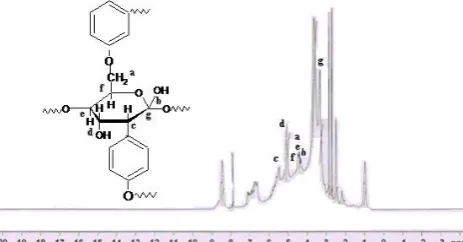
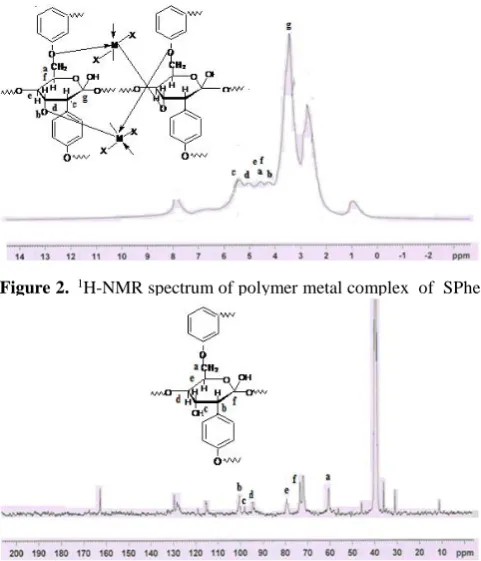
The 1H NMR band ranges of polymeric resin and its metal
complex with Zn(II) are given in Fig 1 and Fig 2. In the spectrum of poly-SPhe a sharp and intense vibration band at 4.389 ppm appeared which may be attributed to CH2–O
protons.22 Vibrational bands at 5.451, 5.090, 4.484, 4.456
and 3.408 ppm is assigned to protons of the pyranose ring of starch for poly-SPhe.24-25 A vibration band of CH-OH was
observed in the polymeric resin at 4.01 ppm. In the spectrum of poly- SPh -Zn(II) complex, the bands for CH2 –O was
shifted, due to coordination by the free electron of oxygen in the group.
Figure 1. 1H-NMR spectrum of polymeric ligand (SPhe) O . H H H OH H OH O O O O n
(CH3COO)2M (CH3COO)2M'
M=Mn(II),Co(II),Ni(II) X= H2O
& M'=Cu(II),Zn(II)
SPhe polymer
M'-SPhe polymer Complex M-SPhe polymer Complex
CH2 O . H H H H OH O O O O CH2 O . H H H H OH O O O O CH2 O . H H H H OH O O O O CH2 O . H H H H OH O O O O CH2 M M
O O O O
Table 1. Elemental analysis and yields of the synthesized polymeric compounds
Compounds Yield, % d.p., °C Elemental analysis
C, % H, % O, % M, % Poly-SPhe
Poly- SPhe -Mn(II)
Poly- SPhe -Co(II)
Poly- SPhe -Ni(II)
Poly- SPhe -Cu(II)
Poly- SPhe -Zn(II)
82
83
81
80
79
79
252
292
294
299
298
296
63.50 63.10 52.34 52.390 49.77 48.770 49.80 48.10 53.65 52.100 53.40 53.700
8.29 8.540 7.26 7.00 7.19 7.110 7.19 7.360 6.97 6.01 6.72 6.200
28.19 27.105 29.73 28.450 26.46 25.97 29.48 27.970 23.82 22.77 23.712 22.880
….. ….. 12.76 12.22 13.56 12.210 13.517 12.108 15.77 15.12 16.15 16.33
In the band of CH-OH, the proton was lost, and that too again for coordination and, so the shifting was occurred. Protons of pyranose ring also observed a slight shifting to lower values of chemical shift.
Figure 2. 1H-NMR spectrum of polymer metal complex of
SPhe-Zn(II)
Figure 3.13C-NMR spectra of polymeric ligand (SPhe)
13C-NMR spectra
The 13C NMR band ranges of polymeric resin of (poly-
SPhe) and its metal complexes with Zn(II) are given in Fig 3 and Fig 4. Singlet peak of vibrational band at 62.90 ppm appeared due to CH2–O carbon of methylene group in poly-
SPhe.23 Pyranose carbons of Starch molecules for
poly-SPhe registered bands in the region 100.28, 96.94, 94.444, 79.06 and 76.51 ppm.23 In case of metal complex of poly-
SPhe bands showed shifting in comparison with the corresponding bands observed in polymeric resin and the band due to carbon of CH2–O group was assigned at 58.16
ppm. This was due to involvment of oxygen atom in coordination which is well supported by M-O bond in IR spectra.
Figure 4.13C-NMR spectra of polymer metal complex of
SPhe-Zn(II)
Pyranose ring carbons also observed a little shifting and were observed at 100.10, 95.17, 93.57,78.112 and 75.75 ppm .
UV Visible Spectra and Magnetic Moment
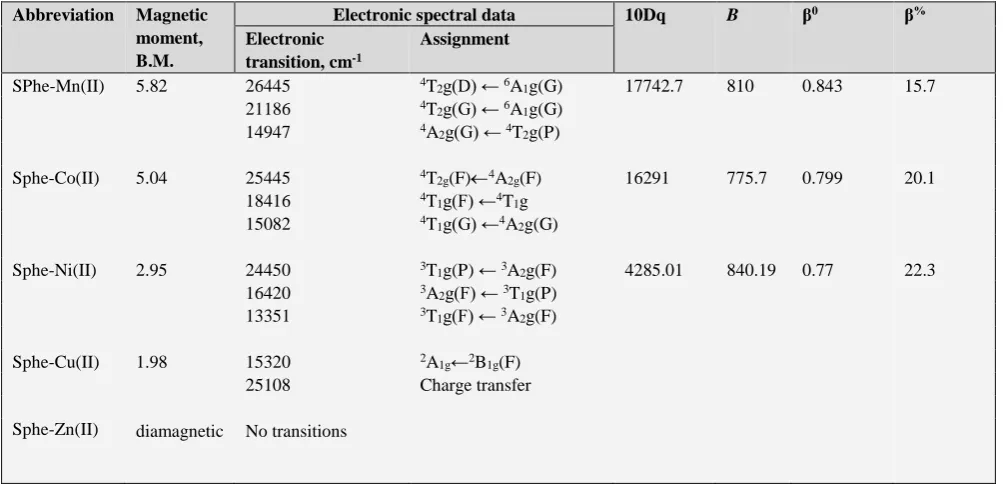
Polymer metal complexes were recorded in DMSO for the electronic spectral observation. Table 3 depicts all the electronic spectral bands and their magnetic moment measurement and other parameters. Polymer metal complex SPhe-Mn(II) in the electronic spectrum exhibited three bands at 14947, 21186, 26455 which may reasonably correspond to 4T
2g(D) ← 6A1g(G) , 4T2g(G) ← 6A1g(G) and 4A
2g(G) ← 4T2g(P) transitions, respectively. Using these
data we can calculate crystal field parameter and the values of 10Dq, B, β0 and β% were found to be 17742.7, 810, 0.843
and 15.7% respectively. The polymer metal complex SPhe-Mn(II) has a magnetic moment value 5.82 BM, which is close to the calculated value of high spin state of the metal ion. An octahedral geometry is proposed for polymer metal complex SPhe -Mn(II) on the basis of μeff value and
Table 2. IR Spectra of polymeric ligand (SPhe) and its polymer metal complexes
Compounds O-H CH bending C=C CH2 asym-sym CH2 wag CH2sci C-O M-O SPhe 3412 1023 1553 2926-2865 1157 1458 1081 - SPheMn(II) 3411 1018 1548 2926-2865 1153 1453 1050 620 SPheCo(II) 3410 1017 1547 2926-2865 1154 1452 1051 618 SPhe-Ni(II) 3409 1016 1552 2926-2865 1152 1457 1053 615 SPheCu(II) 3408 1022 1549 2926-2865 1155 1454 1055 617 SPhe-Zn(II) 3409 1017 1551 2926-2865 1151 1456 1058 613
Table 3. Electronic spectra, magnetic moment and ligand field parameters of polymer metal complexes.
Abbreviation Magnetic moment, B.M.
Electronic spectral data 10Dq B β0 β%
Electronic transition, cm-1
Assignment
SPhe-Mn(II) 5.82 26445 4T
2g(D) ← 6A1g(G) 17742.7 810 0.843 15.7
21186 4T
2g(G) ← 6A1g(G)
14947 4A
2g(G) ← 4T2g(P)
Sphe-Co(II) 5.04 25445 4T
2g(F)4A2g(F) 16291 775.7 0.799 20.1
18416 4T
1g(F) ←4T1g
15082 4T
1g(G) ←4A2g(G)
Sphe-Ni(II) 2.95 24450 3T
1g(P) ← 3A2g(F) 4285.01 840.19 0.77 22.3
16420 3A
2g(F) ← 3T1g(P)
13351 3T
1g(F) ← 3A2g(F)
Sphe-Cu(II) 1.98 15320 2A
1g←2B1g(F)
25108 Charge transfer
Sphe-Zn(II) diamagnetic No transitions
SPhe-Co(II) has a magnetic moment value 5.04 BM. due to four unpaired electrons and showed three bands at 25445, 18416.2, 15082.9 which were assigned to 4T
2g(F)
←4A
2g(F), 4T1g(F) ←4T1g and 4T1g(G) ←4A2g(G) transition
respectively, and suggested octahedral environment around the Co(II) ion. The calculated values of 10Dq, B, β0 and β%
are 16291,775.7, 0.799, 20.1. 24449.8, 16420.3, 13351.1 are the three bands that has been observed for SPhe-Ni(II) which possess a transition 3T
1g(P) ← 3A2g(F), 3A2g(F) ← 3T
1g(P) and 3T1g(F) ← 3A2g(F) respectively. Through these
data the calculated values of 10Dq, B, β0 and β% are found
to be 4285.01, 840.19, 0.77, 22.3% respectively. The observed magnetic moment value for this compound is 2.95 BM and this suggested an octahedral structure. The above discussion very strongly indicates an octahedral geometry around the central metal ion in all polymer metal complexes and the making of octahedral geometry is supported by the occupation of two coordinating sites by H2O out of six. This
series of the study also defines the electronic spectra of the SPhe-Cu (II) ,which exhibits the transition of 2A
1g ← 2B1g
and charge transfer spectra for the bands at 15320 cm-1 and
25108 cm-1 respectively, which indicate square-planar
geometry.26-31 1.98 BM was the magnetic moment value of
SPhe-Cu(II) which accords well with the square planar geometry. Tetrahedral geometry has been shown by the diamagnetic SPhe-Zn(II).
Thermogravimetric analysis
The thermal decomposition of poly-SPhe and its transition metal complexes and its blend is studied by the thermogravimetric method. The thermogravimetric curves of poly-SPhe and its transition metal complexes for a comparative analysis are depicted in Fig 5, and between SPhe and blend is given in Fig 6 and the thermal analytical weight loss % list of data are listed in Table 4.
Table 4. Thermal behaviors of SPhe , Blend and their polymer metal complexes
Compound/Temperature,
0C
Weight Loss(%)
100 150 200 250 300 400 500 600 700
SPhe 4 5 2 8 32 26.5 8.5 1 1
Sphe-Mn(II) 6 4 2 4 2 39 10 14 7
Sphe-Co(II) 4 4 4 6 6 34 9 8 5
Sphe-Ni(II) 6 5 3 2 2 37 11 5 6
Sphe-Cu(II) 3 1 1 5 5 34.5 8 4 3
Sphe-Zn(II) 2 2 5 3 6 36 7 5 9
Blend 1 0.8 7.7 2 16 20.5 11.1 7.5 14.1
The poly-SPhe showed weaker thermal resistance as far as comparison to its metal polymer complex is concerned and started to decompose with weight loss from 4-6 % at 100 °C and this weight loss is mainly absorbed solvent loss and then futher mass loss from 100 °C to the higher temperature was related to the decay of crosslinked polymeric resin.
Figure 6. TGA curve of SPhe, Blend
The decomposition of poly-SPhe was less in the initial stage but above 250 °C wt loss showed a very fast steep downward mass loss. The thermal data indicate that the thermal stability of the poly-SPhe upto 250 °C, and then fast decaying, however its transition metal complexes showed lesser decreases in mass losses and decomposition and reduced mass loss at that particular increasing temperature.
Figure 7. DSC curves of SPhe and it’s Blend
The volatility of the poly-SPhe -metal complexes was reduced because of the formation of coordination bond with the metal. Metal complex started to decompose with weight loss 7-8 % at 100 °C and this loss can be mainly ascribed to attached coordinated water molecule. Although
decomposition rate of polymer metal complexes was very slow up to 300 °C, but above 300 °C weight loss became fast. This result revealed that all the polymer metal complex show better heat resistant characteristics than the poly-SPhe due to the coordination of metal ions and chelation. Blend was slow at its decomposition initially and less mass is reduced as compared to SPhe. The volatility of the blend was reduced because of the formation of physical bonding while in the formation of blend. Polymer blend started to decompose with weight loss 1-2 % at 150 °C and the decomposition rate of blend was very slow upto 250 °C, but while reaching at temperature of 300 °C weight loss became fast. This pattern of data revealed that the blend show better heat resistant characteristics than the polymeric resin due to the enhanced stability, and these results are very well in correlation with the synthesis of blend.
Differential Scanning Calorimetry (DSC)
The DSC measurement has been done to create the comparison between the thermal points of SPhe and Blend and is given in Fig 7. The DSC measurements served to determine the glass transition temperature, Tg and melting behavior. The melting temperature scattered typical range of 290 °C for Starch phenol, and the Tg scattered in the range of 123 °C for starch phenol polymer, this evolution could be ascribed to the interactions between the starch and phenol. The strong H-bond formed between starch and phenol, which decrease starch chain mobility and consequently increased the matrix glass transition. Meanwhile, as compared to the starch phenol polymer, the melting temperature and Tg of the blend is increased. The melting temperature scattered typical range for a blend at 328.73 °C. The Tg scattered in the range of 128.49 °C. This indicate
that the copolymer and linseed oil epoxy affect the thermal stability and glass transition of polymer blends. The single peaks of thermogram show the no phase separation in starch–phenol polymer blend.
Scanning Electron Microscopy (SEM)
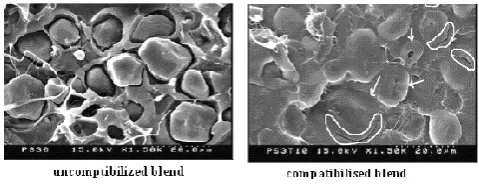
Figure 8 shows an electron micrograph of a blend with and without in the state of being compatibilized for the case of uncompatiblized and compatiblized blend. Clearly distinct phases are visible in the uncompatibilised blend. Where as, a more evenly distributed polymer, results from the compatibilised blend. The increase in homogeneity can be explained through the phobicity of the molecules in the blend. Starch is hydrophilic and PS-PMMA copolymer is hydrophobic, this causes repulsions throughout the uncompatibilised blend that are dramatically diminished by the well-dispersed copolymer addition and compatiblizer. When an uncompatibilised starch/copolymer blend is produced the two phases do not integrate well and stay as two distinct phases in a state of low interfacial adhesion. This causes the blend to be mechanically weak. By using suitable compatiblizer homogenization with greater extent occurred in these copolymer molecules throughout the starch/phenol matrix, a significant improvement in the properties was encountered as a result of this decreased repulsion and hence increased interfacial adhesion. Developing a blend with satisfactory overall physic-mechanical behaviors depends on a proper interfacial tension to generate a small phase size and strong interfacial adhesion to transmit an applied force effectively between the component phases.
BIODEGRADABLE ACTIVITY
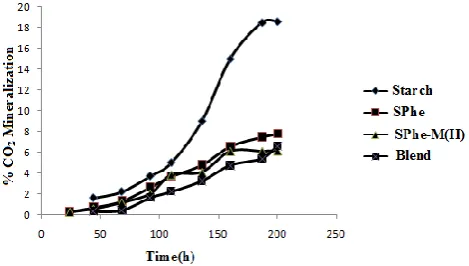
Laboratory respirometeric method as a biotic function (ASTM- D5338-93) that uses compost pile inocula was used to evaluate the biodegradableactivity of SPhe their polymer metal complexes and blend against some selected microorganism32.
Table 5. % CO2 mineralization of starch, SPhe, SPhe-M(II) and
Blend
Time % CO2 mineralization
Starch SPhe SPhe-M(II) Blend
24 0.3 0.25
44 1.6 0.7 0.55 0.35 68 2.2 1.3 1.15 0.45 92 3.7 2.65 2 1.65 110 5 3.7 3.85 2.23 136 9 4.8 4.1 3.25 160 15 6.6 6.1 4.75 187 18.5 7.5 6.1 5.4 200 18.6 7.8 6.15 6.6
All the synthesized polymers show promising biodegradable activity against the given microorganism. Conveniently designed flask has been used for this purpose. Water or soil may be used in the test method but here soil is used. Although in both cases a suitable volume of activated sludge to obtain complete mineralization of the sample in about a month is used. It is recommended to use 10 cm3L-1
for aqueous system but we have used 5 cm3 50 g-1 with cold
medium successfully. The inoculums must be kept aerated until used and it should be used on the same day as collected. Urea and potassium hydrogen phosphate (0.1 and 0.05 % of weight of polymer substrate) are added for the further growth of microbes and for the fortification of the medium. The biodegradation rates of starch, polymeric resin
(SPhe )and polymer metal complexes (SPhe Cu(II), SPhe -Mn(II), SPhe -Ni(II), SPhe -Zn(II), SPhe -Co(II) and Blend are shown in Fig.9.
Figure 9. % CO2 mineralization of starch , SPhe, SPhe-M(II) and
Blend
From these figure and Table, it is clear that polymer metal complexes of poly-SPhe degrade at a slower rate than starch polymer after 200 hrs, and that the biodegradation rates of polymer metal complexes and Blends are comparatively similar, at regular interval of time.
REFERENCES
1Schwach. E., Averous. L., Polym. In., 2004, 54, 2115. 2Glass. J.E., ACS Symp. Ser., 1990, 433, 52.
3Narayan. R., Rowell. R. W., Schultz. T. P., Narayan. R., ACS Symp. Ser., 1992, 476, 1.
4Braun. D., Cherdron. H., Ritter. H., Polymer synthesis: theory and
practice, Berlin: Springer-Verlag, 2001.
5Campbell. J. M., Introduction to Synthetic Polymers, Oxford
Science, Oxford, 1994.
6Knop. A., Pilato. L. A.,
Phenolic Resins,
Springer Verlag, Berlin,1985.
7Feldman. D., Polymeric Building Materials, Elsevier, London,
1989.
8Kirk-Othmer Encyclopedia of Chemical Technology, John Wiley
& Sons, New York, 1985, 628.
9Mori. F., Jpn Kokai Tokkyo Koho, JP 08323949 A2 961210 Hesei,
1996.
10Mendes. S.C., Reis. R. L., Bovell. Y. P., Cunha. A. M., Van
Blitterswijk. C. A., De Bruijn J. D., Biomaterials,2001, 22, 2057.
11Leonor. I. B., Ito. A., Onuma. K., Kanzaki. N., Reis. R. L.,
Biomaterials, 2003, 24,579.
12Duarte. M. G., Brunnel. D., Gil. M. H., Schacht. E., J. Mater. Sci. Mater. Med., 1997, 8, 321.
13Elvira. C., Mano. J. F., San Roman. J., Reis. R. L., Biomaterials,
2002, 23, 1955.
14Scott, G. and Gilead, D., Polym. Degrad. Stab., 2000, 68, 1 . 15Scott, G. and Gilead, D., Degradable polymers principls and
applications, Chapman and Hall: London, UK , 1995,15, 247.
16Resis, R. L., Cunha, A. M., Bevis, M. J., Adv. Polym. Technol.,
1997, 16.
17Sharmim. E., Ashraf. S. M., Ahmad. S., Int. J. Biol. Macromol.,
18Mohamed. G. G., Omar, M., Hindy. A. M., Turk. J. Chem., 2006, 30, 361.
19Bakiler. M., Akyuz. S., Bull. Chem. Technol. Macedonia, 2002, 21, 35.
20Harvest Collier, L., Cho, Y., Korean Polym. J.,1997, 5, 185 . 21Topacli, C., Topacli. A., J. Mol. Struct., 2003, 644, 145 . 22Kumar, H., Tripathi, S. K., Mistry, S. and Bajpai, G., E-J. Chem.,
2009, 6, 1253 .
23Pajua, J., Pehkb, T., Christjansonc, P., Proc. Estonian Acad. Sci.,
2009, 58, 45 .
24Mounika, K., Anupama, B., Pragathi, J. and Gyanakumari, C., J. Sci. Res., 2010, 2, 513 .
25Pasanphan, W., Buettner, G. R., Chirachanchai. S., Carbohydrate Res., 2010, 345, 132.
26Agwara. M. O., Yufanyi, M. D., Foba-Tendo, J. N. , Atamba, M.
A., Derek, T. N., J. Chem. Pharm. Res., 2011, 3, 196.
27Bailey, R. A., Peterson, T. R., Can. J. Chem.,1969, 47, 1681 . 28Chandra, S., Sharma, A. K., Res. Lett. Inorg. Chem., 2009,
Article ID 945670, 4 pages .
29El-Moshaty, F. I., El-Zweay, R. S., El-Ajaily, M. M., Jerboa, A.
M., E-J. Chemistry,2011, 8, 19.
30Prasad, N. R. and Gupta, N., J. Serb. Chem. Soc., 2003, 68, 455. 31Sonmez, M., Turk. J. Chem., 2011, 25, 181.
32Bellia, G., Tosin, M., Floridi, G., Degli-Innocenti, F., Polym.
Degrad. Stab., 1999, 66, 79.