Available online throug
ISSN 2229 – 5046
ROTATION EFFECT ON UNSTEADY MHD FLOW PAST AN IMPULSIVELY STARTED
VERTICAL PLATE WITH VARIABLE TEMPERATURE IN POROUS MEDIUM
U. S. RAJPUT*, MOHAMMAD SHAREEF
Department of Mathematics and Astronomy, University of Lucknow, Lucknow-226007, India.
(Received On: 21-01-16; Revised & Accepted On: 23-02-16)
ABSTRACT
T
his paper investigates the rotation effects on unsteady MHD flow past an impulsively started vertical plate with variable temperature in porous medium. Analytical solutions are found for the governing equations using the Laplace Transform method. A selected set of graphical results illustrating the effects of various parameters involved in the problem are presented and discussed. The numerical values of skin-friction have been tabulated.Keywords: Rotation effects, MHD, Temperature, Porous medium.
1. INTRODUCTION
Magneto-hydrodynamic (MHD) boundary layer with heat transfer from vertical surfaces embedded in porous medium has been the subject of many engineering and geophysical applications such as geothermal reservoirs, thermal insulation, enhanced oil recovery, packed-bed catalytic reactors, cooling of nuclear reactors, power generation system and aero-dynamics, drying of porous solids, groundwater pollution, solar collector, heat exchanger, building heating and cooling underground energy transport etc. Magnetic field is also an important control parameter for heat transfer.
In view of their applications in industry and engineering, the study of uniform fluid flow on bodies of various geometries has been considered by many researchers using different analytical and numerical methods. For instance, Stewartson [1] worked on the impulsive motion of a flat plate in a viscous fluid. Radiation and mass transfer effects on
two-dimensional flow past an impulsively started infinite vertical plate was studied by Prasad et al. [8]. Further Ibrahim
and Makinde [10] considered chemically reacting MHD boundary layer flow of heat and mass transfer over a moving vertical plate with suction. Again they [12] studied the radiation effect on chemically reacting magneto-hydrodynamics
(MHD) boundary layer flow of heat and mass transfer through a porous vertical flat plate. Singh et al. [9] have
analyzed the effect of thermally stratified ambient fluid on MHD convective flow along a moving non-isothermal vertical plate. Effects of mass transfer and free convection on the flow past an impulsively started vertical plate was
studied by Soundalgekar [2]. Further Das et al. [13] considered the model, “An unsteady hydromagnetic flow of a heat
absorbing dusty fluid past a permeable vertical Plate with ramped temperature”. Oscillating plate temperature effects on a flow past an infinite porous plate with constant suction and embedded in a porous medium was considered by Jaiswal
and Soundalgekar [7]. Das et al. [4] analysed the effects of mass transfer on flow past an impulsively started infinite
vertical plate with constant heat flux and chemical reaction. Further the Mass transfer effects on the flow past an
exponentially accelerated vertical plate with constant heat flux was studied by Jha et al. [3]. Radiation and free
convection flow past a moving plate was considered by Raptis and Perdikis [6]. Hossain and Takhar [5] have studied the radiation effects on mixed convection along a vertical plate with uniform surface temperature using finite difference method.
Further Rajput and Kumar [11] considered rotation and radiation effects on MHD flow past an impulsively started vertical plate with variable temperature. This paper investigates the rotation effects on unsteady MHD flow past an impulsively started vertical plate with variable temperature in porous medium. The results are shown with the help of graphs (Figure-1 to Figure-12) and table-1.
Corresponding Author:
U. S. Rajput*
2. MATHEMATICAL ANALYSIS
Consider an unsteady MHD flow of a viscous incompressible electrically conducting fluid past an impulsively started
vertical plate with variable temperature. The fluid and the plate rotate as a rigid body with a uniform angular velocity Ω�
about 𝑧𝑧̅-axis in the presence of an applied uniform magnetic field 𝐵𝐵𝑜𝑜 normal to the plate. The fluid motion is induced
due to the impulsive movement of the plate as well as the free convection due to heating of the plate. Initially, at time
𝑡𝑡̅ ≤ 0, the fluid and the plate are at rest and at a uniform temperature 𝑇𝑇�∞ . At time 𝑡𝑡̅> 0, the plate starts moving with a
velocity 𝑢𝑢𝑜𝑜 in its own plane and the temperature of the plate is raised to 𝑇𝑇�𝜔𝜔. As the plate occupying the plane 𝑧𝑧̅ = 0 is
of infinite extent, all the physical quantities depend only on 𝑧𝑧̅ and 𝑡𝑡̅. As the fluid is electrically conducting whose
magnetic Reynolds number is very small and hence the induced magnetic field produced by the fluid motion is negligible in comparison to the applied one. Under the above assumptions, the governing equations with Boussinesq’s approximation are as follows:
𝜕𝜕𝑢𝑢�
𝜕𝜕𝑡𝑡̅−2Ω�𝑣𝑣̅=𝑔𝑔𝑔𝑔( 𝑇𝑇� − 𝑇𝑇�∞) +𝜈𝜈 𝜕𝜕2𝑢𝑢� 𝜕𝜕𝑧𝑧̅2−
𝜎𝜎𝐵𝐵𝑜𝑜2 𝜌𝜌 𝑢𝑢� −
𝜇𝜇
𝐾𝐾 𝑢𝑢�, (1) 𝜕𝜕𝑣𝑣̅
𝜕𝜕𝑡𝑡̅+ 2Ω�𝑢𝑢�=𝜈𝜈 𝜕𝜕2𝑣𝑣̅ 𝜕𝜕𝑧𝑧̅2−
𝜎𝜎𝐵𝐵𝑜𝑜2 𝜌𝜌 𝑣𝑣̅ −
𝜇𝜇
𝐾𝐾 𝑣𝑣̅, (2) 𝜕𝜕𝑇𝑇�
𝜕𝜕𝑡𝑡̅ =𝛼𝛼 𝜕𝜕2𝑇𝑇�
𝜕𝜕𝑧𝑧̅2. (3)
The boundary conditions taken are as under:
𝑡𝑡̅ ≤0: 𝑢𝑢�= 0, 𝑇𝑇�= 𝑇𝑇�∞ 𝑓𝑓𝑜𝑜𝑓𝑓𝑎𝑎𝑎𝑎𝑎𝑎𝑣𝑣𝑎𝑎𝑎𝑎𝑢𝑢𝑣𝑣𝑣𝑣𝑜𝑜𝑓𝑓𝑧𝑧�,
𝑡𝑡̅> 0: 𝑢𝑢�=𝑢𝑢𝑜𝑜, 𝑇𝑇�= 𝑇𝑇�∞+ ( 𝑇𝑇�𝜔𝜔− 𝑇𝑇�∞)𝑢𝑢𝑜𝑜
2
𝜈𝜈 𝑡𝑡̅ 𝑓𝑓𝑜𝑜𝑓𝑓𝑧𝑧̅= 0, 𝑢𝑢� →0, 𝑇𝑇� → 𝑇𝑇�∞ 𝑎𝑎𝑣𝑣 𝑧𝑧̅ →∞,
� (4)
where the symbols are: 𝑇𝑇� −temperature of the fluid, 𝑇𝑇�∞− temperature of the fluid far away from the plate,𝑇𝑇�𝜔𝜔−
temperature at the wall, 𝐵𝐵𝑜𝑜−exrernal magnetic field,𝑢𝑢� −primary velocity of the fluid,𝑣𝑣̅ −secondary velocity of the
fluid, 𝑢𝑢𝑜𝑜− velocity of the Plate, K −permeability parameter, 𝑧𝑧̅ − spatial coordinate normal to the
plate,𝑡𝑡̅ −time, 𝑔𝑔 −volumetric coefficient of thermal expansion, α−thermal diffusivity, g− acceleration due to gravity,
ρ−density, 𝜐𝜐 −kinematic viscosity, σ−Stefan-Boltzmann constant and Ω� − rotation parameter.
To obtain the equations in dimensionless form, the following non-dimensional quantities are introduced:
𝑢𝑢=𝑢𝑢𝑢𝑢�
𝑜𝑜, 𝑣𝑣= 𝑣𝑣̅
𝑢𝑢𝑜𝑜, 𝑡𝑡= 𝑢𝑢𝑜𝑜2
υ 𝑡𝑡̅,
𝑧𝑧=𝑢𝑢υ𝑜𝑜𝑧𝑧̅, 𝐺𝐺𝑓𝑓=𝑔𝑔𝑔𝑔υ( 𝑇𝑇�𝑢𝑢𝜔𝜔− 𝑇𝑇�∞) 𝑜𝑜3 , Ω=
υ
𝑢𝑢𝑜𝑜2 Ω�, 𝜃𝜃 = ( 𝑇𝑇� − 𝑇𝑇�∞)
( 𝑇𝑇�𝜔𝜔− 𝑇𝑇�∞) , 𝑀𝑀=
σBo2υ
ρ𝑢𝑢𝑜𝑜2, Pr =
υ α,⎭⎪
⎪ ⎬ ⎪ ⎪ ⎫
(5)
where u is dimensionless primary velocity of the fluid, v − dimensionless secondary velocity of the fluid, z
−dimensionless spatial coordinate normal to the plate, 𝜃𝜃 − dimensionless temperature, Pr−Prandtl number,
𝐺𝐺𝑓𝑓−thermal Grashof number t−dimensionless time, Ω− dimensionless rotation parameter and M−magnetic field
parameter. The equations (1), (2), and (3) become:
𝜕𝜕𝑢𝑢
𝜕𝜕𝑡𝑡 −2 Ω𝑣𝑣=𝐺𝐺𝑓𝑓𝜃𝜃+ 𝜕𝜕2𝑢𝑢
𝜕𝜕𝑧𝑧2− �𝑀𝑀+
1
𝐾𝐾� 𝑢𝑢 , (6) 𝜕𝜕𝑣𝑣
𝜕𝜕𝑡𝑡+ 2Ω𝑢𝑢= 𝜕𝜕2𝑣𝑣
𝜕𝜕𝑧𝑧2− �𝑀𝑀+
1
𝐾𝐾� 𝑣𝑣 , (7) 𝜕𝜕𝜃𝜃
𝜕𝜕𝑡𝑡 =
1 Pr
𝜕𝜕2𝜃𝜃
𝜕𝜕𝑧𝑧2. (8)
The corresponding boundary conditions given in equation (4) become:
𝑡𝑡 ≤0: 𝑢𝑢= 0, 𝜃𝜃 = 0 𝑓𝑓𝑜𝑜𝑓𝑓𝑎𝑎𝑎𝑎𝑎𝑎𝑣𝑣𝑎𝑎𝑎𝑎𝑢𝑢𝑣𝑣𝑣𝑣𝑜𝑜𝑓𝑓𝑧𝑧,
𝑡𝑡> 0: 𝑢𝑢= 1, 𝜃𝜃 = 𝑡𝑡 𝑓𝑓𝑜𝑜𝑓𝑓𝑧𝑧= 0,
𝑢𝑢 →0, 𝜃𝜃 → 0 𝑎𝑎𝑣𝑣 𝑧𝑧 →∞. � (9)
To solve above system, take𝑞𝑞 = 𝑢𝑢 + 𝑖𝑖𝑣𝑣. Then using equations (6) and (7), we get,
𝜕𝜕𝑞𝑞
𝜕𝜕𝑡𝑡=𝐺𝐺𝑓𝑓𝜃𝜃+𝜕𝜕
2𝑞𝑞
𝜕𝜕𝑧𝑧2− 𝑚𝑚𝑞𝑞 (10)
The boundary conditions (9) are reduced to:
𝑡𝑡 ≤0: 𝑞𝑞= 0, 𝜃𝜃= 0 𝑓𝑓𝑜𝑜𝑓𝑓𝑎𝑎𝑎𝑎𝑎𝑎𝑣𝑣𝑎𝑎𝑎𝑎𝑢𝑢𝑣𝑣𝑣𝑣𝑜𝑜𝑓𝑓𝑧𝑧,
𝑡𝑡> 0: 𝑞𝑞= 1, 𝜃𝜃= 𝑡𝑡 𝑓𝑓𝑜𝑜𝑓𝑓𝑧𝑧= 0,
𝑞𝑞 →0, 𝜃𝜃 → 0 𝑎𝑎𝑣𝑣 𝑧𝑧 →∞. � (11)
The governing non-dimensional partial differential equations (8) and (10) subject to the above boundary conditions prescribed in equation (11) are solved using the Laplace Transform technique. The solution is as under:
𝑞𝑞(𝑧𝑧,𝑡𝑡) =12𝑣𝑣−√𝑚𝑚𝑧𝑧�1 +𝐸𝐸𝑓𝑓𝑓𝑓 �2𝑡𝑡√𝑚𝑚 – 𝑧𝑧
2√𝑡𝑡 �+𝑣𝑣2√𝑚𝑚𝑧𝑧𝐸𝐸𝑓𝑓𝑓𝑓𝐸𝐸 �
2𝑡𝑡√𝑚𝑚+ 𝑧𝑧
2√𝑡𝑡 ��
+4𝐺𝐺𝑚𝑚𝑓𝑓2
⎣ ⎢ ⎢ ⎢ ⎢ ⎢ ⎢ ⎢ ⎢ ⎢ ⎢ ⎢ ⎢ ⎢ ⎡
2𝑣𝑣−√𝑚𝑚𝑧𝑧𝑚𝑚𝑡𝑡𝑧𝑧
⎝ ⎜
⎛−1− 𝑣𝑣2√𝑚𝑚𝑧𝑧− 𝐸𝐸𝑓𝑓𝑓𝑓 �
2𝑡𝑡√𝑚𝑚 – 𝑧𝑧
2√𝑡𝑡 �
+𝑣𝑣2√𝑚𝑚𝑧𝑧𝐸𝐸𝑓𝑓𝑓𝑓 �2𝑡𝑡√𝑚𝑚+ 𝑧𝑧
2√𝑡𝑡 � ⎠ ⎟ ⎞
+𝑣𝑣−√𝑚𝑚𝑧𝑧𝑧𝑧√𝑚𝑚
⎩ ⎪ ⎨ ⎪
⎧1− 𝑣𝑣2√𝑚𝑚𝑧𝑧+𝐸𝐸𝑓𝑓𝑓𝑓 �2𝑡𝑡√𝑚𝑚 – 𝑧𝑧
2√𝑡𝑡 �
+ 𝑣𝑣2√𝑚𝑚𝑧𝑧𝐸𝐸𝑓𝑓𝑓𝑓 �2𝑡𝑡√𝑚𝑚+ 𝑧𝑧
2√𝑡𝑡 �⎭⎪ ⎬ ⎪ ⎫
+𝑣𝑣−√𝑚𝑚𝑧𝑧𝐴𝐴
1 ⎩ ⎪ ⎨ ⎪ ⎧ ⎝ ⎜
⎛−1− 𝑣𝑣2√𝑚𝑚𝑧𝑧− 𝐸𝐸𝑓𝑓𝑓𝑓 �
2𝑡𝑡√𝑚𝑚 – 𝑧𝑧
2√𝑡𝑡 �
+𝑣𝑣2√𝑚𝑚𝑧𝑧𝐸𝐸𝑓𝑓𝑓𝑓 �2𝑡𝑡√𝑚𝑚+ 𝑧𝑧
2√𝑡𝑡 � ⎠ ⎟ ⎞ + ⎭ ⎪ ⎬ ⎪ ⎫
− 2𝐴𝐴1𝑣𝑣−𝑧𝑧�𝑚𝑚+
𝑚𝑚 𝐴𝐴1+
𝑚𝑚𝑡𝑡 𝐴𝐴1
⎩ ⎨ ⎧
−1− 𝑣𝑣2𝑧𝑧�𝑚𝑚+𝐴𝐴𝑚𝑚1+𝐸𝐸𝑓𝑓𝑓𝑓 ⎝
⎛𝑧𝑧 −2𝑡𝑡�𝑚𝑚+ 𝑚𝑚 𝐴𝐴1
2√𝑡𝑡 ⎠
⎞+𝑣𝑣2𝑧𝑧�𝑚𝑚+𝐴𝐴𝑚𝑚1𝐸𝐸𝑓𝑓𝑓𝑓
⎝
⎛𝑧𝑧+ 2𝑡𝑡�𝑚𝑚+ 𝑚𝑚 𝐴𝐴1 2√𝑡𝑡 ⎠ ⎞ ⎭ ⎬ ⎫ ⎦ ⎥ ⎥ ⎥ ⎥ ⎥ ⎥ ⎥ ⎥ ⎥ ⎥ ⎥ ⎥ ⎥ ⎤
− 𝐺𝐺𝑓𝑓�𝑃𝑃𝑓𝑓
2𝑚𝑚2√𝜋𝜋 ⎣ ⎢ ⎢ ⎡
𝑚𝑚𝑧𝑧 �2𝑣𝑣−𝑧𝑧24𝑃𝑃𝑡𝑡𝑓𝑓√𝑡𝑡+�𝜋𝜋𝑃𝑃𝑓𝑓𝑧𝑧 �−1 +𝐸𝐸𝑓𝑓𝑓𝑓 ��𝑃𝑃𝑓𝑓𝑧𝑧
2√𝑡𝑡 ���+
2𝑚𝑚𝑡𝑡√𝜋𝜋
�𝑃𝑃𝑓𝑓 �−1 +𝐸𝐸𝑓𝑓𝑓𝑓 � �𝑃𝑃𝑓𝑓𝑧𝑧
2√𝑡𝑡��
− 𝐴𝐴1√𝜋𝜋 �𝑃𝑃𝑓𝑓
𝑣𝑣−𝑧𝑧�𝑚𝑚𝑃𝑃𝐴𝐴1𝑓𝑓+ 𝑚𝑚𝑡𝑡 𝐴𝐴1
⎩ ⎨ ⎧
−1− 𝑣𝑣2𝑧𝑧�𝑚𝑚𝑃𝑃𝐴𝐴1𝑓𝑓− 𝐸𝐸𝑓𝑓𝑓𝑓 ⎝
⎛−𝑧𝑧�𝑃𝑃𝑓𝑓+ 2𝑡𝑡�𝑚𝑚𝐴𝐴1
2√𝑡𝑡
⎠ ⎞
+𝑣𝑣2𝑧𝑧�𝑚𝑚𝑃𝑃𝐴𝐴1𝑓𝑓𝐸𝐸𝑓𝑓𝑓𝑓 ⎝
⎛𝑧𝑧�𝑃𝑃𝑓𝑓+ 2𝑡𝑡�𝑚𝑚𝐴𝐴1
2√𝑡𝑡 ⎠
⎞�+2𝐴𝐴1√𝜋𝜋
�𝑃𝑃𝑓𝑓 �−1 +𝐸𝐸𝑓𝑓𝑓𝑓 � �𝑃𝑃𝑓𝑓𝑧𝑧
2√𝑡𝑡�� ⎦ ⎥ ⎥ ⎤
,
𝜃𝜃(𝑧𝑧,𝑡𝑡) =𝑡𝑡 − 𝑡𝑡𝐸𝐸𝑓𝑓𝑓𝑓 ��𝑃𝑃𝑓𝑓𝑧𝑧
2√𝑡𝑡 � −
𝑧𝑧2
2 �−1 +𝐸𝐸𝑓𝑓𝑓𝑓 �
�𝑃𝑃𝑓𝑓𝑧𝑧 2√𝑡𝑡�� 𝑃𝑃𝑓𝑓−
𝑣𝑣−𝑧𝑧 2𝑃𝑃𝑓𝑓 4𝑡𝑡 𝑧𝑧�𝑃𝑃𝑓𝑓𝑡𝑡
√𝜋𝜋 ,
where 𝐴𝐴1=𝑃𝑃𝑓𝑓−1.
3. SKIN FRICTION
The skin-friction components 𝜏𝜏𝑥𝑥 and 𝜏𝜏𝑦𝑦 are obtained as:
𝜏𝜏𝑥𝑥+𝑖𝑖𝜏𝜏𝑦𝑦 =− �𝜕𝜕𝑞𝑞
𝜕𝜕𝑧𝑧�𝑧𝑧=0
= 1
2√𝑚𝑚�1 + Erf�√𝑚𝑚𝑡𝑡�+ Erfc�√𝑚𝑚𝑡𝑡�� − 1
2�−
2𝑣𝑣−𝑚𝑚𝑡𝑡
√𝜋𝜋𝑡𝑡 + 2√𝑚𝑚 Erfc�√𝑚𝑚𝑡𝑡��
− 𝐺𝐺𝑓𝑓
4𝑚𝑚2
⎣ ⎢ ⎢ ⎢ ⎢ ⎢ ⎢ ⎢ ⎢
⎡4𝑚𝑚3�2𝑡𝑡+ 2√𝑚𝑚 Erf�√𝑚𝑚𝑡𝑡�+ 2𝑚𝑚𝑡𝑡 �−2√𝑚𝑚+2𝑣𝑣−𝑚𝑚𝑡𝑡
√𝜋𝜋𝑡𝑡 + 2√𝑚𝑚 Erf�√𝑚𝑚𝑡𝑡��
+4√𝑚𝑚 A1+ 2A1�−2√𝑚𝑚+2𝑣𝑣 −𝑚𝑚𝑡𝑡
√𝜋𝜋𝑡𝑡 + 2√𝑚𝑚 Erf�√𝑚𝑚𝑡𝑡��
−2A1𝑣𝑣 𝑚𝑚𝑡𝑡 A 1�2ⅇ
−𝑡𝑡�𝑚𝑚+𝐴𝐴𝑚𝑚1�
√𝜋𝜋𝑡𝑡 −2�𝑚𝑚+ 𝑚𝑚
𝐴𝐴1+ 2Erf�√𝑡𝑡�𝑚𝑚+ 𝑚𝑚 𝐴𝐴1� �𝑚𝑚+
𝑚𝑚 𝐴𝐴1�
−4ⅇ𝑚𝑚𝑡𝑡𝐴𝐴1�𝑚𝑚+𝑚𝑚 𝐴𝐴1𝐴𝐴1
⎦ ⎥ ⎥ ⎥ ⎥ ⎥ ⎥ ⎥ ⎥ ⎤
+ 𝐺𝐺𝑓𝑓
2𝑚𝑚2√𝜋𝜋 ⎣ ⎢ ⎢ ⎢
⎡ 4𝑚𝑚�𝑃𝑃𝑓𝑓𝑡𝑡+�𝑃𝑃𝑓𝑓2√𝑡𝑡𝐴𝐴1−2�πP𝑓𝑓ⅇ 𝑚𝑚𝑡𝑡 𝐴𝐴1�𝑚𝑚
𝐴𝐴1𝐴𝐴1
−ⅇ𝑚𝑚𝑡𝑡𝐴𝐴1√𝜋𝜋𝐴𝐴1(2ⅇ −𝑚𝑚𝑡𝑡𝐴𝐴1
�𝑃𝑃𝑓𝑓 √𝜋𝜋√𝑡𝑡 −2�
𝑚𝑚
𝐴𝐴1�𝑃𝑃𝑓𝑓+ 2Erf[√𝑡𝑡� 𝑚𝑚 𝐴𝐴1]�
𝑚𝑚 𝐴𝐴1�𝑃𝑃𝑓𝑓)⎦⎥
4. RESULT AND DISCUSSION
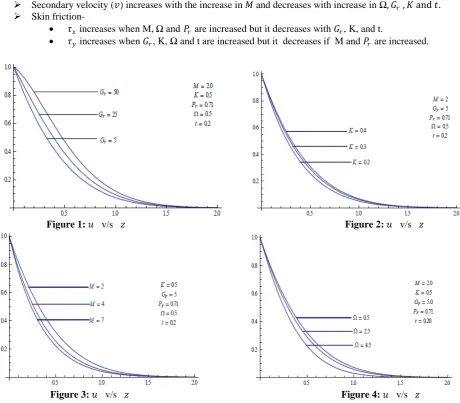
In order to get a physical insight of the problem, a representative set of numerical results is shown graphically in Figures 1–12.Primary velocity profiles are shown in figures - 1 to 5. From figure -1, it is clear that the primary velocity
increases when 𝐺𝐺𝑓𝑓 is increased (keeping other parameters M = 2.0,𝑃𝑃𝑓𝑓= 0.71, 𝐾𝐾= 0.5,Ω= 0.5, t = 0.2 constant). Primary
velocity profile for different values of 𝐾𝐾 is shown in figure - 2 and it shows that primary velocity increases with
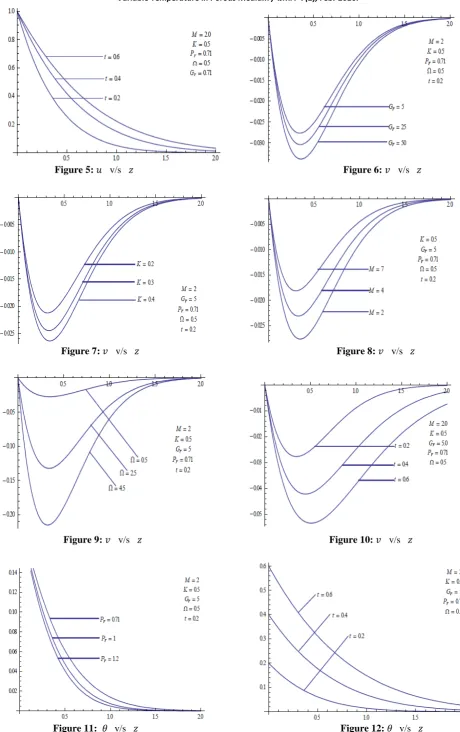
increase in𝐾𝐾. Also primary velocity decreases with increase in M (figure - 3) andΩ (figure - 4). But it increases with t
(figure - 5).
Secondary velocity profiles are shown in figures-6 to 10. Figure - 6 shows that secondary velocity decreases when 𝐺𝐺𝑓𝑓
is increased. Figure -7 shows that it decreases when K is increased. From figure – 8, it is observed that, the secondary
velocity increases when M increases. Figure – 9 and 10 respectively show that it decreases withΩ and t.
Temperature profiles are illustrated in figure – 11 and 12 for different values of 𝑃𝑃𝑓𝑓 and time. In figure 11, it can be seen
that the temperature of the fluid is inversely proportional to the value of Prandtl number 𝑃𝑃𝑓𝑓. Thus, the increase in 𝑃𝑃𝑓𝑓
reduces the temperature in the system. This is due to the fact that there would be a decrease of thermal boundary layer
thickness with the increase of Prandtl number 𝑃𝑃𝑓𝑓. Also thermal boundary layer increases with time (figure - 12).
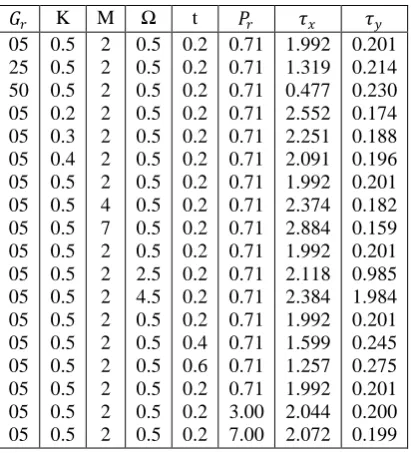
The effects of various parameters on the skin-friction are shown in table - 1. It is found from table - 1, that when the
values of Ω, M and 𝑃𝑃𝑓𝑓 are increased (keeping other parameters fixed), the value of 𝜏𝜏𝑥𝑥 is increased but if values of t, 𝐺𝐺𝑓𝑓
and K are increased, 𝜏𝜏𝑥𝑥 gets decreased. Also it is observed that 𝜏𝜏𝑦𝑦 decreases with M & 𝑃𝑃𝑓𝑓 and it is increased when
t, 𝐺𝐺𝑓𝑓, Ω and K are increased.
5. CONCLUSION
Conclusions of this study are as follows:
Primary velocity (𝑢𝑢) increases with the increase in 𝐺𝐺𝑓𝑓 , 𝐾𝐾 and 𝑡𝑡 and decreases with increase in M and Ω.
Secondary velocity (𝑣𝑣) increases with the increase in𝑀𝑀 and decreases with increase in Ω,𝐺𝐺𝑓𝑓 ,𝐾𝐾 and 𝑡𝑡.
Skin friction-
• 𝜏𝜏𝑥𝑥 increases when M, Ω and 𝑃𝑃𝑓𝑓 are increased but it decreases with 𝐺𝐺𝑓𝑓, K, and t.
• 𝜏𝜏𝑦𝑦 increases when 𝐺𝐺𝑓𝑓, K, Ω and t are increased but it decreases if M and 𝑃𝑃𝑓𝑓 are increased.
Figure 1:𝑢𝑢 v/s 𝑧𝑧 Figure 2:𝑢𝑢 v/s 𝑧𝑧
Figure 5:𝑢𝑢 v/s 𝑧𝑧 Figure 6:𝑣𝑣 v/s 𝑧𝑧
Figure 7:𝑣𝑣 v/s 𝑧𝑧 Figure 8:𝑣𝑣 v/s 𝑧𝑧
Figure 9:𝑣𝑣 v/s 𝑧𝑧 Figure 10:𝑣𝑣 v/s 𝑧𝑧
Table 1: Skin friction for different parameters
𝐺𝐺𝑓𝑓 K M Ω t 𝑃𝑃𝑓𝑓 𝜏𝜏𝑥𝑥 𝜏𝜏𝑦𝑦
05 25 50 05 05 05 05 05 05 05 05 05 05 05 05 05 05 05 0.5 0.5 0.5 0.2 0.3 0.4 0.5 0.5 0.5 0.5 0.5 0.5 0.5 0.5 0.5 0.5 0.5 0.5 2 2 2 2 2 2 2 4 7 2 2 2 2 2 2 2 2 2 0.5 0.5 0.5 0.5 0.5 0.5 0.5 0.5 0.5 0.5 2.5 4.5 0.5 0.5 0.5 0.5 0.5 0.5 0.2 0.2 0.2 0.2 0.2 0.2 0.2 0.2 0.2 0.2 0.2 0.2 0.2 0.4 0.6 0.2 0.2 0.2 0.71 0.71 0.71 0.71 0.71 0.71 0.71 0.71 0.71 0.71 0.71 0.71 0.71 0.71 0.71 0.71 3.00 7.00 1.992 1.319 0.477 2.552 2.251 2.091 1.992 2.374 2.884 1.992 2.118 2.384 1.992 1.599 1.257 1.992 2.044 2.072 0.201 0.214 0.230 0.174 0.188 0.196 0.201 0.182 0.159 0.201 0.985 1.984 0.201 0.245 0.275 0.201 0.200 0.199 6. REFRENSES
1. Stewartson K, On the impulsive motion of a flat plate in a viscous fluid, Quart. J. Mech. Appl. Math. 4 (1951)
182–198.
2. Soundalgekar V M, Effects of mass transfer and free convection on the flow past an impulsively started
vertical plate, ASME J. Appl. Mech. 46 (1979) 757–760.
3. Jha B K, Prasad R and Rai S, Mass transfer effects on the flow past an exponentially accelerated vertical plate
withconstant heat flux, Astro - physics and Space Science, 181(1991), 125-134.
4. Das U N, Deka R K, Soundalgekar V M, Effects of mass transfer on flow past an impulsively started infinite
vertical plate with constant heat flux and chemical reaction, Forschung im Ingenieurwesen – Engineering Research 60 (1994)284–287.
5. Hossain M A and Takhar H S, Radiation effect on mixed convection along a vertical plate with uniform
surface temperature, Heat and Mass Transfer, 31(1996), 243-248.
6. Raptis A and Perdikis C, Radiation and free convection flow past a moving plate, Int. J. of App. Mech. and
Engg.,4(1999), 817-821.
7. Jaiswal B S and Soundalgekar V M, Oscillating plate temperature Effects on a flow past an infinite porous
plate with constant suction and embedded in a porous medium, Heat and Mass Transfer, 37(2001), 125- 131.
8. Prasad V R, Reddy N B and Muthucumaraswamy R, Radiation and mass transfer effects on two- dimensional
flow past an impulsively started infinite vertical plate, Int. J. Thermal Sci., 46(12) (2007), 1251-1258.
9. Singh, Sharma P R and Chamkha A J, Effect of thermally stratified ambient fluid on MHD convective flow
along a moving non-isothermal vertical plate, International Journal of Physical Sciences Vol.5(3), pp. 208-215,March 2010.
10. Ibrahim S Y and Makinde O D, Chemically reacting MHD boundary layer flow of heat and mass transfer over
a moving vertical plate with suction, Scientific Research and Essays Vol. 5(19), pp. 2875-2882,4 October, 2010.
11. Rajput U S and Kumar S, Rotation and radiation effects on MHD flow past an impulsively started vertical
plate with variable temperature, Int. Journal of Math. Analysis, 5(24) (2011), 1155-1163.
12. Ibrahim S Y and Makinde O D, Radiation effect on chemically reacting magnetohydrodynamics (MHD)
boundary layer flow of heat and mass transfer through a porous vertical flat plate, International Journal of the Physical Sciences Vol. 6(6), pp. 1508-1516, 18 March, 2011.
13. Das M, Mahatha B K, Nandkeolyar R, Mandal B K and Saurabh K, Unsteady Hydromagnetic Flow of a Heat
Absorbing Dusty Fluid Past a Permeable Vertical Plate with Ramped Temperature, Journal of Applied Fluid
Mechanics, Vol. 7, No. 3, pp. 485-492, 2014.
Source of support: Nil, Conflict of interest: None Declared