© 2019 by the Serbian Biological Society 215
Periphytic diatoms in the presence of a cyanobacterial bloom: A case study of the Vrutci
Reservoir in Serbia
Ivana S. Trbojević*, Dragana D. Predojević, Gordana V. Subakov Simić and Jelena Ž. Krizmanić
University of Belgrade, Faculty of Biology, Institute of Botany and Botanical Garden “Jevremovac”, Takovska 43, Belgrade, Serbia
*Corresponding author: [email protected]
Received: November 20, 2018; Revised: December 21, 2018; Accepted: January 17, 2019; Published online: January 23, 2019
Abstract: Despite their unique ecology and implications for ecological assessment, diatoms in lentic ecosystems are still insufficiently studied in both scientific research and operational monitoring. In particular, the ecology of periphytic dia-toms relative to the global expansion of cyanobacterial blooms in lakes has not been described at all. This study aims to describe the diversity and dynamics of a periphytic diatom community in the Vrutci Reservoir during Planktothrix rubescens bloom, and to evaluate the adequacy of standard diatom index implementation in lentic ecosystems relative to the diatom index adapted for lakes – the Trophic Diatom Index for Lakes (TDIL). The study was conducted in the Vrutci Reservoir in western Serbia. Periphyton was developed on an artificial glass substrate during the summer of 2015, following a depth gradient of a stratified water column. Diatom diversity and abundance, as well as diatom indices were estimated. Discounting the cyanobacterial bloom, 79 taxa of diatoms were recorded and among them the species Aneumastus stroesei as the first representative of the entire genus Aneumastus ever to be detected in Serbia. Diatom distribution along the depth gradient was clearly associated with shifts in environmental conditions. TDIL showed an advantage over standard diatom indices in terms of stability during experimental period and uniformity along the depth gradient, indicating the necessity for further testing of this index performance in lakes, and consequently local water-quality legislation update.
Keywords:Aneumastus stroesei; diatom diversity; diatom indices; TDIL; Vrutci Reservoir
How to cite this article: Trbojević IS, Predojević DD, Subakov-Simić GV, Krizmanić JŽ. Periphytic diatoms in the presence of a cyanobacterial bloom: A case study of the Vrutci Reservoir in Serbia. Arch Biol Sci. 2019;71(2):215-23.
INTRODUCTION
The importance of periphyton has long been recog-nized in lotic environments, as described in number of detailed studies, whereas in lentic environments phytoplankton research prevailed [1]. The general ratio of publications dealing with periphyton and phyto-plankton in leading hydrobiological journals was 1:20 in the 1990s owing to the opinion that phytoplankton is the leading and dominant primary producer in lakes [2]. The state-of-the-art and accentuated importance of periphyton in primary production, nutrient cycling and food chains in lake ecosystems is evident [3], but even in the second decade of the 20th century, periphyton
studies were outnumbered 10-fold by phytoplankton studies in lakes [4].
Diatoms in a lake’s periphyton are still not a well-known category, although suggestions have been made
that diatoms in a lentic environment have a specific taxonomical composition, diversity and morphology, and that lake-specific aspects of periphyton should be a central point in future research [4,5]. A possible reason for the research deficiency is the lack of an adequate and universal substrate for periphyton development in lakes; the use of artificial substrates is a good alterna-tive when there is no natural (or universal) substrate available for sampling. In Serbia, there are only a few studies dealing with lake periphyton and lake diatom communities [6,7]. The recently updated list of diatoms in Serbia reported findings from several lentic environ-ments [8]. Thus, data on diversity are still scarce, as are reliable data for upgrading the legislative of lake biomonitoring based on the phytobenthos/periphyton to meet the EU Water Framework Directive [9,10].
environ-ments is occurrence of more frequent cyanobacterial blooms. Cyanobacterial blooms cause phytoplankton diversity loss, the most probable reason for this being secondary metabolism products including cyanotoxins [11]. It is well known that Planktothrix rubescens (De Candolle ex Gomont) Anagnostidis & Komárek has a potential to produce hepatotoxic microcystins-LR and -RR, and neurotoxic anatoxin-a, which have different harmful effects on biota [12,13]. It was expected that the cyanobacterial bloom in the Vrutci Reservoir could affect periphyton development and diversity. On the other hand, when Microcystis aeruginosa (Kützing) Kützing was considered [14], it was suggested that diatoms/bacteria predominant in the biofilm express allelopathic control of cyanobacterial blooms. Precise characterization of periphyton developed in the pres-ence of cyanobacterial blooms, when various species causing them are considered, is still lacking. Specifically, diatom diversity and community composition in the presence of cyanobacterial blooms could be of interest considering the previously mentioned study [14] and the bioindication capacity of this group of algae [9].
The first objective of this study was to describe the diversity and dynamics of the periphytic diatom com-munity in a very specific environment in the Vrutci Reservoir in the presence of a cyanobacterial bloom of P. rubescens. The second objective was to compare standard diatom indices relative to the diatom index adapted for lakes (TDIL), with regard to the applicabil-ity and objectivapplicabil-ity in lentic ecosystems, based on the Vrutci Reservoir case study.
MATERIALS AND METHODS
Study site
The Vrutci Reservoir is a freshwater reservoir situ-ated in western Serbia (43°50’34” N, 19°41’36” E). It extends along the Đetinja River Canyon (the reservoir was made by the damming the Đetinja River), lying between two mountains, Tara and Zlatibor. This mul-tipurpose water body was primarily built for water supply and flood protection of the city of Užice. In December 2013, the reservoir was not in use due to a constant P. rubescens bloom [15].
Experimental design
A floating platform was used for carrying artificial substrates – glass slides, for periphyton development. Substrates were incubated at a 1-m depth in epilimnion, at 5.5- and 8-m depths on the top and bottom of the metalimnetic layer, and at 12 m on a hypolimnetic layer. Glass slides were set up for incubation in June 2015, and sampling was done monthly, in July, August, September and October, in a continuously incubated series (CiS). From July onwards, new slides for incuba-tion were introduced each month, and from August, the slides were incubated only for a one-month period in a monthly incubated series (MiS).
Physical and chemical parameters
Water transparency was measured using a Secchi disk. The temperature (T, ºC), conductivity (Cond, µS/cm), total dissolved substances (TDS, g/L), pH, dissolved oxygen (DO, mg/L) and chlorophyll a (Chl a, µg/L) were measured in situ using a YSI 6600 V2 multi-parameter water quality probe. Water samples were taken at the same time as periphyton samples and were further analyzed in the laboratory in the Institute for Development of Water Resources “Jaroslav Černi” in Belgrade, Serbia, where all measurements were done according to standard analytical methods [16]. The measured parameters were total nitrogen (TN, mg/L), total phosphorous (TP, mg/L), dissolved organic carbon (DOC, mg/L) and total organic carbon (TOC, mg/L). Trophic status classification was established according to OECD criteria [17].
Periphyton analyses
water. The suspension was homogenized by a hand blender and separated into subsamples.
Part of the preserved (4% formaldehyde) sub-sample material) was treated by the standard method as described [18], and mounted with Naphrax® to obtain permanent slides for diatom taxonomic identi-fication and quantiidenti-fication. Taxonomic identiidenti-fication was performed according to the standard procedure. Identification of diatom taxa and quantification (rela-tive abundance) was performed by counting at least 400 valves at each permanent slide using a Carl Zeiss AxioImager M1 microscope and a digital camera Axi-oCam MRc5 with AxioVision 4.8 software. Diatom indices were calculated using OMNIDIA 6 software [19], and seven indices were considered for water-quality assessment of the Vrutci Reservoir as follows: Biological Diatom Index (IBD), Pollution Sensitivity Index (IPS), Group Index CEE (CEE), Trophic Diatom Index for Lakes (TDIL), Trophic Diatom Index (TDI), Trophic Index (Rott TI), and Saprobic Index (Rott SI). Water-quality classes were determined [20].
According to the Republic of Serbia legislative, only IPS diatom index is recommended for assessment of the ecological potential of the Vrutci Reservoir (ac-cumulation formed on water body type 4) [10,21]. The values of the IPS diatom index below 9 refer to “very bad”, between 9 and 12 to “bad”, between 12 and 14 to “moderate”, and over 14 to “good” and a maximal ecological potential according to the mentioned leg-islative for the Vrutci Reservoir [10].
Scanning electron microscopy (SEM) with energy dispersive spectroscopy (EDS)
For precise identification of the newly recorded taxon, SEM-EDS was carried out using a JEOL JSM-6610LV SEM (with a W-filament as a beam source), coupled with an X-Max EDS. The samples were covered with gold using a BALTEC-SCD-005 sputter coating device. The results were recorded under high vacuum condi-tions. SEM-EDS and XRPD analyses were performed in the SEMLAB, laboratory at the University of Belgrade, Faculty of Mining and Geology.
Statistical analyses
Principal component analysis (PCA) was performed to summarize the variations in species composition using the data obtained after quantitative analyses of the diatom communities, and was interpreted with the help of environmental variables. Besides certain chemical and physical parameters, the incubation depth, sampling month and incubation series (CiS or MiS) were used as supplementary variables. Statistical analysis was conducted using CANOCO for Windows, ver. 5.0 [22].
RESULTS
The results for parameters that are significant for the trophic status classification of lakes are presented as ranges during the experimental period (Table 1). Each parameter pointed to different levels of trophic status; hypereutrophy could be detected based on the TP, slight eutrophy according to transparency, while phytoplankton primary production in the Vrutci Res-ervoir was characteristic for mesotrophic status. Table 1. Trophic status of the Vrutci Reservoir during the summer of 2015 according to OECD criteria.
TP (mg/m3) Secchi
depth (m) (mg/mChl a 3)
MIN. 80 1.20 2.5
AVERAGE 220 2.89 5.5
MAX 470 3.95 13.05
TROPHIC STATUS
(OECD 1982) Hypertrophic Eutrophic Mesotrophic
In both sample series, 79 taxa (32 genera) of dia-toms were recorded (Supplementary data). The most prominent genera were Cymbella and Nitzschia. Achnan-thidium caledonicum and Pantocsekiella ocellata taxa were dominant, whereas Achnanthidium minutissimum
and Melosira varians were subdominant. Nineteen taxa recorded in the Vrutci Reservoir were found to have a status in the German Red List of diatoms [23,24] (Supplementary data).
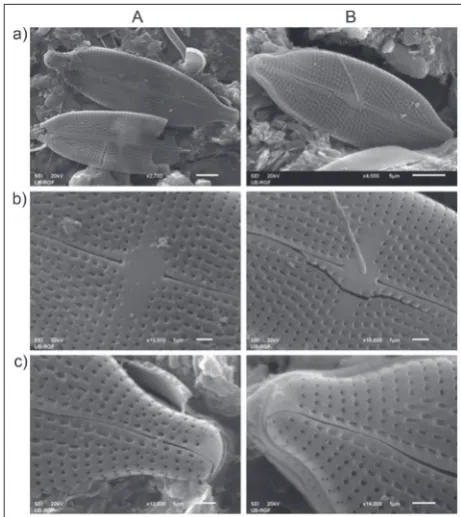
Aneumastus stroesei (Østrup) D. G. Mann (Fig. 1, 2 and 3)
Basionym: Naviculatuscula var. stroesei Østrup Homotypic synonym: Naviculastroesei (Østrup) A. Cleve, Navicula tuscula var. stroesei Østrup
Reference: Lange-Bertalot, H. (2001) (p. 119, figs 1-4; p. 120, figs 1,4: 157)
The main morphological characteristics are fol-lows: valves linear-elliptic to lanceolate, narrowing to rostrate or subrostrate ends. Raphe almost filiform, with slight undulations at both raphe branches. Valve length 27.7-50.5 µm, breadth 11.2-15.3 µm. Axial area narrow and linear. Central area stretches to stauroid fascia, surrounded by 1-3 shorten striae. Striae parallel to slightly radiate, (13) 14-16/10 µm. Areolae visible under LM, 15-18/10 µm. SEM external valve view: typical uniseriate areolae arrangement along the edge of the axial area can be distinguished (Fig. 2). Areolae elongated in the proximal valve area, except in the central area. SEM internal valve view: on the inner side of the valve, a specific areolae morphology is visible, as well as valvocopula (Fig. 3).
PCA was used to assess the relationship between diatom abundance and environmental factors in the Vrutci Reservoir with respect to the time and incuba-tion depth gradient (Fig. 4). The first two PCA axes together explained 35.5% (first 18.8%, and second 16.7%) of the variability of the data set. Incubation depths of 1 m and 5.5 m were positioned at the posi-tive side of the first PCA axis (determined by high pH, conductivity and T values), while depths of 8 m and 12 m were positioned in the negative part of this axis (determined by the highest TDS, TN and
orthophos-phates). As regards the second PCA axes, depths of 5.5 m and 8 m were associated with the positive part, while depths of 1 m and 12 m were associated with the negative part of the axis (determined by the highest transparency and carbon content, TOC and DOC). Three groups of diatoms could be distinguished on Fig. 4, each surrounding one incubation depth, except the deepest (12 m), where the group was not created because of generally low abundance. The group around an incubation depth of 1 m was comprised of the fol-lowing taxa: Achnanthidium caledonicum, A. minutis-simum, Encyonopsis microcephala, E. subminuta and
Fragilaria acus. The group around depth 5.5 m was comprised of Cymbella cymbiformis, C. neocistula,
Fig. 1. Light micrographs (LM) of Aneumastus stroesei, size dimi-nution series, scale bar 10 µm.
Fig. 2. SEM micrographs of two individuals (columns A and B) of A. stroesei from the Vrutci Reservoir – comparative overview;
a – valves, b – central area; c – valve ends.
Amphora lange-bertalotii var. tenuis, A. minutissima, Diploneis elliptica, Gyrosigma attenuatum and Navicula radiosa. Centric diatoms, Lindavia radiosa, Melosira varians and Pantocsekiella ocellata formed a group at the incubation depth of 8 m. Generally, A. caledonicum
wasdominant at 1-m depth, and Pantocsekiella ocellata
was dominant at a depth of 8 m. The PCA ordination diagram shows separation of CiS and MiS along the second PCA axis, indicating that colonization at greater depths was slower and took more than one-month of incubation for the community to become abundant.
According to the results of quantitative analyses of diatoms, OMNIDIA 6 provided values for selected diatom indices, and these are presented in Table 2. The first obvious fact is that the differences between the indices imposed different water-quality classifications that ranged from very good to even bad. When each index (except TDIL) was examined, the decline in water quality could be observed along the depth gradient. Only the TDIL index showed stability and uniformity along the depth gradient and steadily indicated a good water quality of the Vrutci Reservoir. IBD, IPS and Rott SI indices pointed to very good quality in the upper water Fig. 4. Relationship between diatom abundance and
environmen-tal factors in the Vrutci Reservoir (PCA). Diatom abbreviations: Achnanthidium caledonicum (ADCA), Achnanthidium minutis-simum (ADMI), Cymbella cymbiformis (CCYM), Encyonopsis microcephala (ENCM), Encyonopsis subminuta (ESUM), Ulnaria acus (FRAC), Navicula radiosa (NRAD), Pantocsekiella ocellata (POCL), Amphora minutissima (AMNU), Cymbella neocistula (CNCI), Lindavia radiosa (LRAD), Melosira varians (MVAR), Amphora lange-bertalotii var. tenuis (ALGT), Diploneis elliptica (DELL), Gyrosigma attenuatum (GYAT).
Table 2. Selected diatom indices values in the Vrutci reservoir
Series Date Depth (m) IBD IPS TDIL CEE TDI Rott TI Rott SI
CiS
7/2015 1 20 19 14.7 18.2 15.4 15.9 19.7
8/2015 1 19.9 17.1 14.2 15.8 13.8 13.4 19
9/2015 1 20 18 13.9 15.3 15.2 14.5 19.4
10/2015 1 20 18.4 14.4 17.6 15.4 15.1 19.5
7/2015 5.5 15.3 14.3 14.7 13.4 8.3 10.3 17
8/2015 5.5 19.9 16.9 14.8 17.1 15.1 13.8 19.4
9/2015 5.5 19.3 16.1 14.6 16.6 15.4 11.7 17.9
10/2015 5.5 18.2 16.1 13.9 17.6 16 12.5 19.2
8/2015 8 13.9 13.5 14.3 12.9 4 9.2 14
9/2015 8 13.8 13 13.5 12.7 2.1 8.3 12
10/2015 8 14.2 14.4 15.7 14.6 6.5 9.6 15.7
9/2015 12 14.4 12.8 14.5 12.6 2.9 9.4 12.8
10/2015 12 13.8 12.8 13.6 12.5 1.4 8.4 11.8
Mi
S
7/2015 1 20 19 14.7 18.2 15.4 15.9 19.7
8/2015 1 19.3 15.9 14.2 13.9 13.3 12.9 18.9
9/2015 1 19.3 16.6 14.2 15.9 13.7 13.1 18.8
10/2015 1 20 17.6 14.2 17.3 15.5 14.5 19.5
7/2015 5.5 15.3 14.3 14.7 13.4 8.3 10.3 17
8/2015 5.5 16.8 15.1 13.5 13.1 9.8 10.5 17.8
9/2015 5.5 18.8 15.8 14.9 17.2 15 14.3 19
10/2015 5.5 18.7 16.9 13.9 12 12.3 18.8
8/2015 8 13.6 12.2 14.3 10.6 2.3 9.1 12.5
Water quality classes (Prygiel&Coste 2000):
layers. CEE values were variable; Rott TI indicated good to moderate quality, while in TDI, poor water quality was reported at incubation depths of 8 m and 12 m. According to our results for IPS, the Vrutci Reservoir prevalently reflected features of a class II ecological potential (IPS>14), which represents a good ecological potential [10]. No substantial differences in diatom indices were observed between series CiS and MiS.
DISCUSSION
Although the concentration of TP in the Vrutci Res-ervoir during the period of study indicated hypere-utrophy, according to primary phytoplankton pro-duction (approximated by Chl a), this reservoir was mesotrophic [17].
A low diversity in phytoplankton, and also in pe-riphyton as a consequence of the P. rubescens bloom, could be expected [25]. Although the low diversity in periphyton that developed in the presence of P. rubescens was actually detected at a wider scale when non-diatom groups were considered [26], diatom diversity could not be characterized as either low or scarce. As a phenomenon in the Vrutci Reservoir periphyton, we point out that 19 (24%) out of the 79 detected diatom taxa were found to be on the German Red List of diatoms [23,24]. Not having a referent diatom Red List for Serbia, it is appropriate to discuss our results in a wider context, relying on German Red List data. Generally, scarce data on diatoms in lentic environments in Serbia could be one of the reasons why these remarkable results were obtained in the Vrutci Reservoir using artificial substrates, which indicates that diatom diversity in the lakes and reservoirs in Serbia should be explored in detail. On the other hand, this could be debated in the context of low susceptibility (i.e. resistance) of diatoms to the well-known negative effects of cyanobacterial blooms on diversity.
According to the literature, Aneumastus stroesei
is a typical inhabitant of oligo- to mesotrophic lentic chalk-rich ecosystems, where they are not very common and their populations are generally scattered [24,27]. According to the data available in Algaebase [28], A. stroesei has a worldwide distribution. This species has been detected in Europe, Asia, North America, New Zealand and even on Pacific islands. As regards their
distribution in Europe, A. stroesei has been confirmed in diatom flora in Belarus, Britain, France, Germany, Ireland, FYR Macedonia, Netherlands, Poland, Ro-mania, and Switzerland [28]. Literature shows that
A. stroesei was also reported in Albania and Bulgaria [29, 30], neighboring countries of Serbia. Our finding of A. stroesei in the Vrutci Reservoir is a significant contribution to the regional distribution of this species, particularly as A. stroesei populations are declining due to habitat eutrophication [27].
The genus Aneumastus accounts for around 30 species, of which 10 are described in Baikal Lake dia-tom flora [31]. The authors suggested that ancient lakes such as Baikal, Prespa and Ohrid, due to their long history and species flock phenomenon, express a high diversity of rare genera such as Aneumastus
[31]; these lakes served as refugia for species that are nowadays rare or endangered. Although A. stroesei is one of the most frequently found representatives of the
Aneumastus genus, its detection in the Vrutci Reservoir is a valuable contribution to the biogeographic data of Aneumastus spp. in Europe.
Achnanthidium caledonicum, which predominated in the majority of periphyton samples from the Vrutci Reservoir,is characterized as a vulnerable species in the German Red List [23,24], and our data provide a valuable record on the ecology and distribution of this species. A. caledonicum is described as common in cir-cumneutral and slightly alkaline waters with low nutrient concentration [32]. This species is expected in chalk-rich and nutrient-poor lentic ecosystems in mountainous regions, and is an indicator of good ecological quality [24], thus their presence and abundance in the Vrutci Reservoir can be discussed. As the Vrutci Reservoir is situated between two mountains, Tara and Zlatibor, in western Serbia, and is moderately chalk-rich, it seems like a perfect habitat for A. caledonicum. Still, the Vrutci Reservoir’s trophic status as regards phosphorous is higher than expected for the habitat of A. caledonicum
[32,24]. On the other hand, Pantocsekiella ocellata, as the species that shared dominance with A. caledonicum in the Vrutci Reservoir, is a typical oligosaprobic species distributed in oligo- to slightly eutrophic ecosystems [24,33]. When subdominant species are considered,
characteristic of eutrophic ecosystems [33]. Bearing in mind the ecological features of dominant and sub-dominant taxa, it can be anticipated that diatom com-munity structure points to a good ecological potential of the Vrutci Reservoir. This can be discussed in the context of relatively recent eutrophication or even re-oligotrophication of the Vrutci Reservoir. Considering that in our study phytoplankton primary production indicated mesotrophic conditions in the Vrutci Reser-voir, it seems that neither phytoplankton nor periphyton communities reflected eutrophic conditions. Even the
Planktothrix rubescens bloom was confirmed to be symptomatic for oligo-mesotrophic conditions, often linked to re-oligotrophication [26].
After analyzing the relationship between diatom abundance and environmental parameters in the Vrutci Reservoir, we found clear groupings of diatom taxa around parameters defining incubation depths. Also, CiS and MiS were arranged along the depth gradient. CiS were associated with the highest diatom abun-dance at the incubation depth of 5.5 m, and MiS with the incubation depth of 1 m. It is interesting to note that the diatom group formed around an incubation depth of 1 m exclusively consisted of taxa belonging to a low-profile guild [35], characterized by resistance to physical disturbances while being resource-stressed, which makes them decline in thicker biofilms [36]. Around the depth of 5.5 m the majority of taxa also consisted of low-profile representatives, although with increasing proportions (Cymbella spp. and Amphora
spp.); also motile representatives Gyrosigma attenuatum
and Navicula radiosa [35] were present, which points to an environment that was less prone to disturbance (upper metalimnion) and increased biofilm thickness. The diatom group formed around the incubation depth of 8 m consisted of very few centric representatives, with Lindavia radiosa and Pantocsekiella ocellata that belong toa planktonic guild [35,36] typical for biofilms developed in stabile environments lacking disturbances and competitors among periphytic diatoms [37]. The underdeveloped community and low diversity at 8 m depth could be a consequence of a reduced light regime, considering the dense metalimnetic bloom of P. rube-scens. Generally, the highest diversity was detected at a 5.5-m incubation depth, while a decrease in diversity could be observed along a depth gradient, implying that most of the diatoms in periphyton in the Vrutci
Reser-voir were adapted to the moderate light environment [38]. We can conclude that diatom guild distribution along a depth gradient clearly describes environmental conditions in different water-column strata.
IPS point to a slight improvement in water quality in the Vrutci Reservoir since 2012; however, this index appeared to be depth-sensitive in terms of centric taxa prevalence at deeper depths.
CONCLUSION
According to our results we can assume that diatom diversity was not drastically affected by the permanent
P. rubescens bloom in the Vrutci Reservoir. In our study,
Aneumastus stroesei as the entire genus Aneumastus
was detected for the first time in Serbia. Diatom guild distribution and dynamics clearly reflected shifts in environmental conditions along the depth gradient and in the duration of the incubation period. Only a hint of the negative effect of the P. rubescens bloom could be observed as low diversity and abundance in lower metalimnion and hypolimnion, most probably due to a reduced light regime. Our results emphasize the applicability and objectivity of TDIL in water-quality assessment in lentic environments relative to the other selected diatom indices, since only TDIL showed uniformity and stability along the depth gradient and during the experimental period. Nevertheless, further testing of this index in other lakes and reservoirs of various trophic status throughout Serbia should be conducted. The results of this study could be a start-ing point for further consideration of insertstart-ing of the TDIL index in the Serbian legislative for assessing the ecological status/potential of lakes and reservoirs.
Funding: This research was supported by the Ministry of Educa-tion, Science and Technological Development, Republic of Serbia, Project No. OI 176020.
Acknowledgments: The authors would like to thank Mr. Vladimir Maršalkin for technical support.
Author contributions: Ivana Trbojević developed the original concept, provided the draft and edited manuscript. All authors were involved in planning the experiments, in fieldwork, processing of experimental data and the analyses. All authors contributed to the discussion of the results and editing of the manuscript.
Conflict of interest disclosure: There is no conflict of interest.
REFERENCES
1. Goldsborough LG, McDougal RL, North AK. Periphyton in freshwater lakes and wetlands. In: Azim ME, Verdegem
MCJ, van Dam AA, Beberidge MCM, editors. Periphyton: Ecology, Exploitation and Management. Cambridge: CABI Publishing; 2005. p. 71-90.
2. Lowe RL. Periphyton patterns in lakes. In: Stevenson RJ, Bothwell ML, Lowe RL, editors. Algal Ecology: Freshwater Benthic Ecosystems. San Diego: CA, Academic Press; 1996. p. 57-76.
3. Vadeboncoeur Y, Steinman AD. Periphyton function in lake ecosystems. Scientific World Journal. 2002;2:1449-68. 4. Cantonati M, Lowe RL. Lake benthic algae: toward an
understanding of their ecology. Freshw Sci. 2014;33:475-486. 5. Kahlert M, Gottschalk S. Differences in benthic dia-tom assemblages between streams and lakes in Sweden and implications for ecological assessment. Freshw Sci. 2014;33:655-69.
6. Laušević R, Nikitović J. Floristical composition of algae of Borsko Jezero lake (Yugoslavia). Bull Nat Hist Mus. 1993-1994;48:73-81.
7. Cvijan M, Laušević R. Floristical study of algae of Vlasinsko Lake (Yugoslavia). Bull Nat Hist Mus. 1991;46:57-69. 8. Vidaković PD, Jakovljević SO, Predojević DD, Radovanović
MS, Subakov-Simić VG, Lazović MV, Krizmanić ŽJ. An updated list of Serbian diatom flora: new recorded taxa. Arch Biol Sci. 2018;70(2):259-75.
9. European Union. Directive 2000/60/EC of the European Parliament and of the Council of 23 October 2000 estab-lishing a framework for community action in the field of water policy. Offic J Europ Commun Ser. 2000;L327:1-73. 10. Pravilnik o paramatrima ekološkog i hemijskog statusa
površinskih voda i parametrima hemijskog i kvantita-tivnog statusa podzemnih voda. Offic Gazette Rep Serb. 2011;74/11. Serbian.
11. Oberhaus L, Briand JF, Humbert JF. Allelopathic growth inhibition by the toxic bloom-forming
cyanobacte-rium Planktothrix rubescens. FEMS Microbiol Ecol.
2008;66(2):243-9.
12. Fastner J, Neumann U, Wirsing B, Weckesser J, Wiedner C, Nixdorf B, Chorus I. Microcystins (Hepatotoxic Hepta-peptides) in German fresh water bodies. Environ Toxicol. 1999;14(1):13-22.
13. Viaggiu E, Melchiorre S, Volpi F, Di Corcia A, Mancini R, Garibaldi L, Crichigno G, Bruno M. Anatoxin-A toxin in the cyanobacterium Planktothrix rubescens from a fishing pond in Northern Italy. Environ Toxicol. 2004;19(3):191-7. 14. Wu Y, Liu J, Yang L, Chen H, Zhang S, Zhao H, Zhang N.
Allelopathic control of cyanobacterial blooms by periphyton biofilms. Environ Microbiol. 2011;13(3):604-15.
15. Kostić D, Marjanović P, Marjanović M, Blagojević A, Trbojević I, Predojević D, Subakov Simić G, Vulić D, Obradović V, Naunović Z. Drivers of Phytoplankton Blooms in the Vrutci Reservoir During 2014-2015 and Implications for Water Supply and Management. Water Res Manage. 2016;6(3):3-12.
16. APHA. Standard Methods for the Examination of Water and Wastewater 19th Edition. Washington, DC: American Public Health Association. 1995.
18. Taylor JC, de la Rey PA, van Rensburg L. Recommendations for the collection, preparation and enumeration of diatoms from riverine habitats for water quality monitoring in South Africa. Afr J Aquat Sci. 2005;30(1):65-75.
19. Lecointe C, Coste M, Prygiel J. “Omnidia”: software for tax-onomy, calculation of diatom indices and inventories man-agement. Hydrobiologia. 1993;269-270(1):509-13.
20. Prygiel J, Coste M. Guide méthodologique pour la mise en œuvre de l’Indice Biologique Diatomées: NF T 90-354. Agences de l’eau; Cestas: Cemagref; 2000. 134 p. French.. 21. Pravilnik o utvrđivanju vodnih tela površinskih i podzemnih
voda. Offic Gazette Rep Serb. 2010;96/10.
22. Ter Braak CJF, Šmilauer P. Canoco reference manual and user’s guide: software for ordination, version 5.0. Ithaca, USA: Microcomputer Power; 2012.
23. Lange-Bertalot H. Rote Liste der limnischen Kieselalgen (Bacillariophyceae) Deutschlands. Schriftenreihe für Veg-etationskunde. 1996;28:633-77. German.
24. Hofmann G, Werum M, Lange-Bertalot H. Diatomeen im Süßwasser - Benthos von Mitteleuropa. Königstein: Koeltz Scientific Books; 2013. 908 p. German.
25. Jacquet S, Briand JF, Leboulangerm C, Avois-Jacquet C, Oberhaus L, Tassin B, Vinçon-Leite B, Paolini G, Druart JC, Anneville O, Humbert JH. The proliferation of the toxic cyanobacterium Planktothrix rubescens following restoration of the largest natural french lake (Lac du Bourget). Harmful Algae. 2005;4(4):651-72.
26. Trbojević I. Analysis of periphyton developed on artificial sub-strates in the Sava lake and the Vrutci lake. [dissertation]. [Bel-grade]: Faculty of Biology, University of Belgrade. 2018. 276 p. 27. Lange-Bertalot H. Diatoms of Europe. Vol. 2, Navicula Sensu
Stricto, 10 Genera Separated from Navicula Sensu Lato, Frustulia Ruggell: Gantner Verlag; 2001. 526 p. (Diatoms of Europe: Diatoms of the European Inland Waters and Com-parable Habitats; vol. 2).
28. AlgaeBase [Internet]. Galway: National University of Ireland.. 1996 – [cited 2018 March 4]. Available from: http://www.algaebase.org/search/species/detail/?species_ id=33201&sk=0&from=results
29. Isheva T, Ivanov P. Epilithic diatom flora from sub-Mediter-ranean intermittent rivers in Bulgaria during two hydrologi-cal periods. Bot Serb. 2016;40:153-60.
30. Miho A, Çullaj A, Hasko A, Lazo P, Kupe L, Bachofen R, Brandl H, Schanz F, Baraj B. Environmental state of some rivers of Albanian adriatic lowland. Tirana, Albania; 2005. 267 p. Albanian.
31. Glushchenko A, Kulikovskiy M, Okhapkin A, Kociolek JP. Aneumastus laosica sp. nov. and A. genkalii sp. nov. - two new diatom species from Laos (Southeast Asia) with com-ments on the biogeography of the genus. Cryptogam Algol. 2017;38(3):1-17.
32. Wojtal AZ, Ector L, Van de Vijver B, Morales EA, Blanco S, Piatek J, Smieja A. The Achnanthidium minutissimum com-plex (Bacillariophyceae) in southern Poland. Algol Stud. 2011;136-137:211-38.
33. Van Dam H, Mertens A, Sinkeldam J. A coded checklist and ecological indicator values of freshwater diatoms from the Netherlands. Aquat Ecol. 1994;28(1):117-33.
34. Kelly MG, Juggins S, Guthrie R, Pritchard S, Jamieson J, Rippey B, Hirst H, Yallop M. Assessment of ecological status in UK rivers using diatoms. Freshw Biol. 2008;53(2):403-22. 35. Passy SI. Diatom ecological guilds display distinct and pre-dictable behavior along nutrient and disturbance gradients in running waters. Aquat Bot. 2007;86(2):171-8.
36. Rimet F, Bouchez A. Life-forms, cell-sizes and ecological guilds of diatoms in European rivers. Knowl Manag Aquat Ecosyst. 2012;406:01.
37. Rimet F. Diatoms: an ecoregional indicator of nutrients, organic matter and micropollutants pollution. [dissertation]. [Saint-Martin-d’Hères]: Université de Grenoble. 2012. 203 p. 38. Hill WR. Effects of light. In: Stevenson RJ, Bothwell ML,
Lowe RL, editors. Algal Ecology: Freshwater Benthic Eco-systems. San Diego: CA, Academic Press; 1996. p. 121-48. 39. Stenger-Kovács C, Buczko K, Hajnal E, Padisák J. Epiphytic,
littoral diatoms as bioindicators of shallow lake trophic sta-tus: Trophic Diatom Index for Lakes (TDIL) developed in Hungary. Hydrobiologia. 2007;589:141-54.
40. Schaumburg J, Schranz C, Hofmann G, Stelzer D, Schneider S, Schmedtje U. Macrophytes and phytobenthos as indica-tors of ecological status in German lakes – a contribution to the implementation of the Water Framework Directive. Limnologica. 2004;34:302-14.
41. Schaumburg J, Schranz C, Stelzer D, Hofmann G. Action instructions for the ecological evaluation of lakes for imple-mentation of the EU Water Framework Directive: Makro-phytes and Phytobenthos. Augsburg: Bavarian Environment Agency; 2007.
42. Kitner M, Poulícková A. Littoral diatoms as indicators for eutrophication of shallow lakes. Hydrobiologia. 2003;506-509:519-24.
43. Tan X, Zhang Q, Burford MA, Sheldon F, Bunn SE. Benthic Diatom Based Indices for Water Quality Assessment in Two Subtropical Streams. Front Microbiol. 2017;8:601.
44. Bennion H, Sayer C, Tibby J, Carrick H. Diatoms as indica-tors of environmental change in shallow lakes. In: Stoermer EF, Smol JP, editors. The diatoms: applications for the envi-ronmental and earth sciences. 2nd ed. Cambridge: Cam-bridge University Press; 2010. p. 152-73.
45. Denić Lj, Đurković A, Čađo S, Dopuđa Glišić T, Novaković B, Stojanović Z. Assessment of the ecological potential accu-mulation Vrutci based on biological and physico-chemical quality elements. In: A. Đukić, editor.. Conference pro-ceedings of the „Water 2014” 43rd Annual Conference of the Serbian Water Pollution Control Society, June 3-5; Tara, Serbia. Belgrade: Srpsko društvo za zaštitu voda i Institut za vodoprivredu „Jaroslav Černi“; 2014. p. 41-7.
Supplementary Data