Available online throug
ISSN 2229 – 5046
International Journal of Mathematical Archive- 4(12), Dec. – 2013 156
SUPER EDGE TRIMAGIC TOTAL LABELING OF GRAPHS
M. Regees
1and C. Jayasekaran
2*1
Department of Mathematics, Malankara Catholic College, Mariagiri,
Kaliakavilai-629153, Tamilnadu, India.
2
Department of Mathematics, Pioneer Kumaraswamy College,
Nagercoil-629003, Tamilnadu, India.
(Received on: 29-11-13; Revised & Accepted on: 31-12-13)
ABSTRACT
A
n edge magic total labeling of a (p, q) graph is a bijection f: V(G) ∪ E(G) → {1, 2, …, p+q} such that for each edge uv∈E(G), the value of f(u)+f(uv)+f(v) is a constant k. If there exists two constants k1 and k2 such that f(u)+f(uv)+f(v) iseither k1or k2, it is said to be an edge bimagic total labeling. An edge trimagic total labeling of a (p, q) graph is a
bijection f: V(G) ∪ E(G) → {1, 2, …, p+q} such that for each edge uv∈E(G), the value of f(u)+f(uv)+f(v) is either k1or
k2 or k3. In this paper, we prove that the corona graph Cn⨀K2, double ladder Pn×P3, quadrilateral snake Qn and
alternate triangular snake A(TSn) are edge trimagic total and super edge trimagic total.
Keywords: Function, Bijection, Labeling, Magic, Trimagic.
AMS Subject Classification: 05C78.
1. INTRODUCTION
We begin with simple, finite and undirected graph G = (V, E). A graph labeling is an assignment of integers to elements of graph, the vertices or edges or both subject to certain conditions. The concept of graph labeling was introduced by Rosa in 1967. In 1970 Kotzig and Rosa[6] defined, magic labeling of graph G is a bijection f: V∪E→ {1, 2, …, p+q} such that, for each edge uv∈E(G), f(u)+f(uv)+f(v) is a magic constant. In 1996, Ringel and Llado called this labeling as edge magic. In 2001, Wallis introduced this as edge magic total labeling. In 2004, J. Baskar Babujee [1, 2] introduced the edge bimagic labeling of graphs.
In 2013, C. Jayasekaran, M. Regees and C. Davidraj [3] introduced the edge trimagic total labeling of graphs. An edge trimagic total labeling of a (p, q) graph G is a bijection f:V(G)∪E(G)→{1, 2, …, p+q} such that for each edge uv∈E, the value of f(u)+f(uv)+f(v) is equal to any of the distinct constant k1or k2 or k3. A graph G is said to be edge trimagic
total if it admits an edge trimagic total labeling. An edge trimagic total labeling is called super edge trimagic total labeling if G has the additional property that the vertices are labeled with the smallest positive integers.
An alternate triangular snake A(TSn) is obtained from a path u1, u2, …, un by joiningui and ui+1 alternatively to a new
vertex vi. That is every alternate edge of a path is replaced by C3. If G is of order n, the Corona of G with H, G⨀H is
the graph obtained by taking one copy of G and n copies of H and joining the ith vertex of G with an edge to every vertex in the ith copy of H. A Quadrilateral snake Qn is obtained from a path u1, u2,…, un by joiningui, ui+1 to new
vertices vi, wi respectively and joining vi and wi. That is, every edge of a path is replaced by a cycle C4. A ladder Ln is a
graph Pn×P2 with V(Ln) = {ui, vi / 1≤ i ≤ n} and E(Ln) = {uiui+1, vivi+1 / 1≤ i ≤ n–1}∪{ uivi / 1≤ i ≤ n}. A double ladder
Ln is a graph Pn×P3 with V(Ln) = {ui, vi, wi / 1≤ i ≤ n} and E(Ln) = {uiui+1, vivi+1, wiwi+1/ 1≤ i ≤ n–1}∪{uivi, viwi / 1≤ i ≤
n}.
For further references, we use dynamic survey of graph labeling by J. A. Gallian [5]. In [3], we introduced the concept
edge trimagic and super edge trimagic total labeling and proved that, some family and classes of graphs are edge
trimagic total and super edge trimagic total [3, 4, 7]. In this paper, we prove that the corona graph Cn⨀K2, double
ladder Pn×P3, quadrilateral snake Qn and alternate triangular snake A(TSn) are trimagic total and super edge trimagic
total graphs.
M. Regees and C. Jayasekaran / Super Edge Trimagic Total Labeling Of Graphs/ IJMA- 4(12), Dec.-2013.
2. SUPER EDGE TRIMAGIC LABELING OF Cn⊙K2, PnxP3, Qn and A (TSn).
In this section we prove that the corona graph Cn⨀K2, double ladder Pn×P3, quadrilateral snake Qn and alternate
triangular snake A(TSn) are edge trimagic total and super edge trimagic total. And give examples for super edge
trimagic total labeling for each of the above graphs.
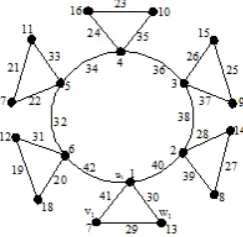
Theorem: 2.1 The graph Cn⨀K2 has an edge trimagic total labeling for positive integer n.
Proof: Let V = {ui, vi, wi / 1≤ i ≤ n} be the vertex set and E = {uivi, uiwi, viwi /1≤ i ≤ n}∪{uiui+1/1≤ i ≤ n–1}∪{unu1} be
the edge set of the graph Cn⨀K2. Then Cn⨀K2 has 3n vertices and 4n edges.
Define a bijection f: V ∪ E →{1, 2, …, 7n} such that
f(ui) = i, 1≤ i ≤ n; f(vi) = n+i, 1≤ i ≤ n; f(wi) = 2n+i, 1≤ i ≤ n;
f(uiui+1) = 7n–2i, 1≤ i ≤ n–1; f(uivi) = 7n–2i+1, 1≤ i ≤ n; f(uiwi) = 5n–2i+2, 1≤ i ≤ n;
f(viwi) = 5n–2i+1, 1≤ i ≤ n and f(unu1) = 7n.
Now we prove the above labeling is an edge trimagic total.
For the edges uiui+1, 1≤ i≤ n–1;
f(ui)+f(uiui+1)+f(ui+1) = i+7n–2i+i+1 = 7n+1 = λ1(say).
For the edges uivi, 1≤ i ≤ n;
f(ui)+f(uivi)+f(vi) = i+7n–2i +1+n+i = 8n+1 = λ2(say).
For the edges uiwi, 1≤ i ≤ n;
f(ui)+f(uiwi)+f(wi) = i+5n–2i +2+2n+i = 7n+2 = λ3(say).
For the edges viwi, 1≤ i ≤ n;
f(vi)+f(viwi)+f(wi) = n+i +5n–2i+1+2n+i = 8n+1 = λ2.
For the edge unu1, f(un)+f(unu1)+f(u1) = n+7n+1 = 8n+1 = λ2.
Hence for each edge uv∈E, f(u)+f(uv)+f(v) yields any one of the trimagic constants λ1 = 7n+1, λ2= 8n+1 and λ3 =
7n+2.
Therefore, the graph Cn⨀K2 admits an edge trimagic total labeling for all positive integer n.
Theorem: 2.2 The graph Cn⨀K2 has a super edge trimagic total labeling.
Proof: We proved that the graph Cn⨀K2 admits an edge trimagic total labeling. The labeling given in the proof of
Theorem 2.1, the vertices get labels 1, 2, …, 3n. Since the graph Cn⨀K2 has 3n vertices and the 3n vertices have labels
1, 2, …, 3n, the graph Cn⨀K2 admits a super edge trimagic total labeling.
© 2013, IJMA. All Rights Reserved 158
Theorem: 2.4 The double ladder Pn×P3 admits an edge trimagic total labeling for odd n.
Proof: Let V = {ui, vi, wi / 1≤ i ≤ n} be the vertex set and E = {uivi, viwi / 1≤ i ≤ n}∪{uiui+1, vivi+1, wiwi+1 /1≤ i ≤ n–1}
be the edge set of Pn×P3. Then the doble ladder Pn×P3 has 3n vertices and 5n–3 edges.
Define a bijection f: V ∪ E →{1, 2, …, 8n–3} such that
f(ui) =�
i+1
2 , 1≤ i ≤ n and i is odd n+i+1
2 , 1≤ i ≤ n and i is even
f(vi) =�
2n+n+i
2 , 1≤ i ≤ n and i is odd
2n+i
2, 1≤ i ≤ n and i is even
f(wi) =�
n+i+1
2 , 1≤ i ≤ n and i is odd
n+n+i+1
2 , 1≤ i ≤ n and i is even
f(uivi) = 6n– i, 1≤ i ≤ n; f(viwi) = 5n– i, 1≤ i ≤ n; f(uiui+1) = 8n–i–2, 1≤ i ≤ n–1;
f(vivi+1) = 4n–i, 1≤ i ≤ n–1 and f(wiwi+1) = 7n–i–1, 1≤ i ≤ n–1.
Now we prove the above labeling is an edge trimagic total.
Consider the edges uivi, 1≤ i≤ n;
For odd i, f(ui)+f(uivi)+f(vi) = i+1
2 +6n–i+2n+
n+i 2 =
17n+1
2 = λ1(say).
For even i, f(ui)+f(uivi)+f(vi) = n+i+1
2 +6n–i+2n+ i 2 =
17n+1 2 = λ1.
Consider the edges viwi, 1≤ i≤ n;
For odd i, f(vi)+f(viwi)+f(wi) = 2n+ n+i
2 +5n–i+n+ i+1
2 = 17n+1
2 = λ1.
For even i, f(vi)+f(viwi)+f(wi) = 2n+i
2+5n–i+n+ n+i+1
2 = 17n+1
2 = λ1.
Consider the edges uiui+1, 1≤ i ≤ n–1;
For odd i, f(ui)+f(uiui+1)+f(ui+1) = i+1
2 +8n–i–2+
n+i+1+1 2 =
17n–1
2 = λ2(say).
For even i, f(ui)+f(uiui+1)+f(ui+1) = n+i+1
2 +8n–i–2+
i+1+1 2 =
17n–1 2 = λ2.
Consider the edges vivi+1, 1≤ i ≤ n–1;
For odd i, f(vi)+f(vivi+1)+f(vi+1) = 2n+ n+i
2 +4n–i+2n+
i+1 2 =
17n+1 2 = λ1.
For even i, f(vi)+f(vivi+1)+f(vi+1) = 2n+ i
2+4n–i+2n+
n+i+1 2 =
17n+1 2 = λ1.
Consider the edges wiwi+1, 1≤ i ≤ n–1;
For odd i, f(wi)+f(wiwi+1)+f(wi+1) = n+ i+1
2 +7n–i–1+n+
n+1+i+1 2 =
19n+1
2 = λ3(say).
For even i, f(wi)+f(wiwi+1)+f(wi+1) = n+ n+i+1
2 +7n–i–1+n+
i+1+1 2 =
M. Regees and C. Jayasekaran / Super Edge Trimagic Total Labeling Of Graphs/ IJMA- 4(12), Dec.-2013.
Hence for each edge uv∈E, f(u)+f(uv)+f(v) yields any one of the constant
λ1 =
17n+1 2 , λ2 =
17n–1
2 and λ3 = 19n+1
2 .
Therefore, the double ladder Pn ×P3 admits an edge trimagic total labeling for odd n.
Theorem: 2.5 The double ladder Pn×P3 has a super edge trimagic total labeling for odd n.
Proof: We proved that the double ladder Pn×P3 admits an edge trimagic total labeling. The labeling given in the proof
of Theorem 2.4, the vertices get labels 1, 2, …, 3n. Since the double ladder Pn×P3 has 3n vertices and the 3n vertices
have labels 1, 2, …, 3n, the double ladder Pn×P3 admits a super edge trimagic total labeling.
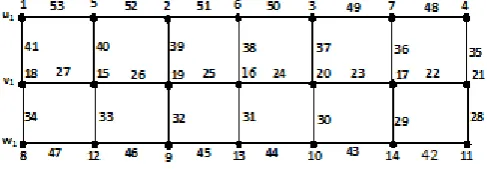
Example: 2.6 A super edge trimagic total labeling of the double ladder P7×P3 is given in figure 2.
Figure 2: P7×P3 with λ1 = 60, λ2 = 59 and λ3 = 67.
Theorem: 2.7 The Quadrilateral Snake Qn admits an edge trimagic total labeling.
Proof: Let V = {ui / 1≤ i ≤ n}∪{vi, wi / 1≤ i ≤ n–1} be the vertex set and E = {uivi, viwi, uiui+1, ui+1wi /1≤ i ≤ n–1}be the
edge set of the Quadrilateral Snake Qn. Then Qn has 3n–2 vertices and 4n– 4 edges.
Define a bijection f: V ∪ E → {1, 2, …, 7n– 6} such that f(ui) = i, 1≤ i ≤ n; f(vi) = n+i, 1≤ i ≤ n–1; f(wi) = 2n+i–1, 1≤ i
≤ n–1; f(uiui+1) = 7n–2i– 4,1≤ i≤ n–1; f(uivi) = 7n–2i–5, 1≤ i ≤ n–1; f(ui+1wi) = 5n–2i–3, 1≤ i≤ n–1 and f(viwi) = 5n–2i–
2, 1≤ i≤ n–1.
Now we prove the above labeling is an edge trimagic total.
For the edges uiui+1, 1≤ i ≤ n–1;
f(ui)+f(uiui+1)+f(ui+1) = i+7n–2i– 4+i+1 = 7n–3 = λ1 (say).
For the edges uivi, 1≤ i ≤ n–1;
f(ui)+f(uivi)+f(vi) = i+7n–2i–5+n+i = 8n–5 = λ2(say).
For the edges ui+1wi, 1≤ i ≤ n–1;
f(ui+1)+f(ui+1wi)+f(wi) = i+1+5n–2i –3+2n+i–1 = 7n–3 = λ1.
For the edges viwi, 1≤ i ≤ n–1;
f(vi)+f(viwi)+f(wi) = n+i +5n–2i–2+2n+i–1 = 8n–3 = λ3(say).
Hence for each edge uv∈E, f(u)+f(uv)+f(v) yields any one of the constants λ1 = 7n–3, λ2 = 8n–5 and λ3 = 8n–3.
Therefore, the Quadrilateral snake Qn admits an edge trimagic total labeling.
Theorem: 2.8 The Quadrilateral snake Qn admits a super edge trimagic total labeling.
Proof: We proved that the Quadrilateral snake Qn has an edge trimagic total labeling. The labeling given in the proof of
Theorem 2.7, the vertices get labels 1, 2, …, 3n–2. Since the Quadrilateral snake Qn has 3nvertices and the 3n–2
vertices have labels 1, 2, …, 3n–2 for all integer n, the Quadrilateral snake Qn admits a super edge trimagic total
© 2013, IJMA. All Rights Reserved 160
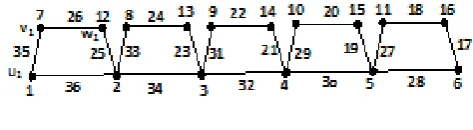
Example: 2.9 A super edge trimagic total labeling ofQuadrilateral snake Q6 is given in figure 3.
Figure 3: Q6with λ1= 39, λ2= 43 and λ3 = 45.
Theorem: 2.10 The Alternate triangular snake A(TSn) admits an edge trimagic total labeling for even n.
Proof: We consider thefollowing two cases.
Case: 1 Triangle starts from u1.
LetV = {ui /1≤ i≤ n}∪{vj /1≤ j≤
n
2} be the vertex set and E = {vju2j–1, vju2j /1≤ j≤ n
2} ∪ {uiui+1 / 1≤ i ≤ n–1} be the edge
set of the alternate triangular snake A(TSn). Since the triangle starts from u1,the alternate triangular snake A(TSn) has
n+n
2 vertices and 2n–1 edges. Define a bijection f: V ∪ E → {1, 2, …, 3n+ n
2– 1} such that
f(ui) =�
i+1
2 , 1≤ i ≤ n and i is odd n+i
2 , 1≤ i ≤ n and i is even ;
f(vj) = n+j, 1≤ j≤
n
2; f(uiui+1) = 3n+ n
2– i, 1≤ i≤ n–1; f(vju2j–1) = 2n+ n
2 – 2j+1, 1≤ j≤ n 2;
f(vju2j) = 2n+
n
2 – 2j+2, 1≤ j≤ n
2.
Now we prove the above labeling is an edge trimagic total.
Consider the edges uiui+1, 1≤ i≤ n–1;
For odd i, f(ui)+f(uiui+1)+f(ui+1) = i+1
2 +3n+ n 2 – i+
n+i+1
2 = 4n+1= λ1(say).
For even i, f(ui)+f(uiui+1)+f(ui+1) = n+i
2 +3n+ n 2– i+
i+1+1
2 = 4n+1 = λ1.
For the edges u2j–1vj, 1≤ j≤
n 2 ;
f�u2j–1�+f(u2j–1vj)+f�vj� = 1+2j–1
2 +2n+
n
2 – 2j+1+ n+j = 7n+2
2 = λ2(say).
For the edges u2jvj, 1≤ j ≤
n 2 ;
f�u2j�+f�u2jvj�+f�vj� = n+2j
2 +2n+ n
2 – 2j+2+n+j = 4n+2 = λ3(say).
Hence for each edge uv∈E, f(u)+f(uv)+f(v) yields any one of the trimagic constants λ1 = 4n+1, λ2 =
7n +2
2 and λ3 =
4n+2. Therefore, the alternate triangular snake graph A(TSn) admits an edge trimagic total labeling when the triangle
starts from u1.
Case: 2 Triangle starts from u2.
LetV = {ui /1≤ i ≤ n}∪{vj / 1≤ j≤
n
2–1} be the vertex set and E = {u2jvj, u2j+1vj /1≤j≤ n
2− 1}∪{uiui+1/1≤i≤n–1} be the
edge set of the alternate triangular snake A(TSn). Since the triangle starts from u2, the alternate triangular snake A(TSn)
has n+n
2 – 1 vertices and 2n–3 edges. Define a bijection f: V∪ E →{1, 2, …, 3n+ n
2– 4} such that
f�uj� =� i+1
2 , 1≤ i ≤ n and i is odd n+i
M. Regees and C. Jayasekaran / Super Edge Trimagic Total Labeling Of Graphs/ IJMA- 4(12), Dec.-2013.
f(vj) = n+j, 1≤ j ≤
n
2− 1; f(uiui+1) = 3n+ n
2 – i–3, 1≤ i≤ n–1;
f(u2j+1vj) = 2n+
n
2 –2j–2, 1≤ j≤ n
2− 1; f(u2jvj) = 2n+ n
2 – 2j–1, 1≤ j ≤ n
2− 1.
Now we prove the above labeling is an edge trimagic total.
Consider the edges uiui+1, 1≤ i ≤ n–1;
For odd i, f(ui)+f(uiui+1)+f(ui+1) = i+1
2 +3n+ n 2 – i–3+
n+i+1
2 = 4n–2 = λ1(say).
For even i, f(ui)+f(uiui+1)+f(ui+1) = n+i
2 +3n+ n 2 – i–3+
i+1+1
2 = 4n–2= λ1.
For the edges u2j+1vj, 1≤ j ≤
n 2 − 1;
f�u2j+1�+f(u2j+1vj)+f�vj� = 1+2j+1
2 +2n+
n
2 – 2j–2+ n+j = 7n–2
2 = λ2(say).
For the edges u2jvj, 1≤ j ≤
n 2 − 1;
f�u2j�+f�u2jvj�+f�vj� = n+2j
2 +2n+ n
2 – 2j–1+n+j = 4n–1 = λ3(say).
Hence for each edge uv∈E, f(u)+f(uv)+f(v) yields any one of the trimagic constants λ1 = 4n–2, λ2 =
7n–2
2 and λ3 = 4n–1.
Therefore, the alternate triangular snake graph A(TSn) admits an edge trimagic total labeling when the triangle starts
from u2.
Hence the theorem follows from case 1 and case 2.
Theorem: 2.11 The Alternate Triangular Snake A(TSn) admits a super edge trimagic total labeling for even n.
Proof: We proved that the Alternate Triangular Snake A(TSn) has an edge trimagic total labeling. The labeling given in
the proof of Theorem 2.10, the vertices get labels 1, 2, …, n+n
2 . Since the Alternate Triangular Snake A(TSn) has n+ n 2
vertices and the vertices have labels 1, 2, …, n+ n
2 for even integer n, the Alternate Triangular Snake A(TSn) admits a
super edge trimagic total labeling for even n.
Example: 2.12 A super edge trimagic total labeling of the Alternate Triangular Snake A(TS10) of the triangle starts
from u1 and triangle starts from u2 are given in figure 4 and figure 5 respectively.
Figure 4: A(TS10) with λ1= 41, λ2= 36 and λ3 = 42.
© 2013, IJMA. All Rights Reserved 162
Theorem: 2.13 The Alternate triangular snake A(TSn) admits an edge trimagic total labeling for odd n.
Proof: We consider the following two cases.
Case: 1 Triangle starts from u1.
LetV = {ui /1≤ i≤ n}∪{vj /1≤ j≤
n–1
2 } be the vertex set and E = {u2j–1vj, u2jvj /1≤ j≤ n–1
2 }∪{uiui+1 / 1≤ i≤ n–1} be the edge
set of the alternate triangular snake A(TSn). Since the triangle starts from u1, the alternate triangular snake A(TSn) has
n+n–1
2 vertices and 2n–2 edges.
Define a bijection f: V ∪ E → {1, 2, …, 3n+n–1
2 – 2} such that
f(ui) =� i+1
2 , 1≤ i ≤ n and i is odd n+i+1
2 , 1≤ i ≤ n and i is even ;
f(vj) = n+j, 1≤ j ≤
n–1
2 ; f(uiui+1) = 3n+ n–1
2 – i–1, 1≤ i≤ n–1;
f(u2j–1vj) = 2n+
n–1
2 – 2j, 1≤ j ≤ n–1
2; f(u2jvj) = 2n+ n–1
2 – 2j+1, 1≤ j ≤ n–1
2.
Now we prove the above labeling is an edge trimagic total.
Consider the edges uiui+1,1≤ i≤ n–1;
For odd i, f(ui)+f(uiui+1)+f(ui+1) = i+1
2 +3n+ n–1
2 – j–1+ n+i+1+1
2 = 4n = λ1(say).
For even i, f(ui)+f(uiui+1)+f(ui+1) = n+i+1
2 +3n+
n–1 2 – i–1+
i+1+1
2 = 4n = λ1.
For the edges u2j –1vj, 1≤ j ≤
n–1 2 ;
f�u2j–1�+f(u2j–1vj)+f�vj� = 2j–1+1
2 +2n+
n–1
2 – 2j+ n+j = 7n–1
2 = λ2(say).
For the edges u2jvj, 1≤ j ≤
n–1 2 ;
f�u2j�+f�u2jvj�+f�vj� = n+2j+1
2 +2n+
n–1
2 –2j+1+n+j = 4n+1 = λ3(say).
Hence for each edge uv∈E, f(u)+f(uv)+f(v) yields any one of the trimagic constants λ1 = 4n, λ2 =
7n– 1
2 and λ3 = 4n+1.
Therefore, the alternate triangular snake graph A(TSn) admits an edge trimagic total labeling when the triangle starts
from u1.
Case: 2 Triangle starts from u2.
LetV = {ui /1≤ i ≤ n}∪{vj/1≤ j≤
n–1
2 } be the vertex set and E = {u2jvj, u2j+1vj /1≤ j≤ n–1
2 }∪{uiui+1 / 1≤ i≤ n–1} be the edge
set of the alternate triangular snake A(TSn).Since the triangle starts from u2, the alternate triangular snake A(TSn) has
n+n–1
2 vertices and 2n–2 edges. Define a bijection f: V ∪ E → {1, 2, …, 3n+ n–1
2 – 2} such that
f(ui) =� i+1
2 , 1≤ i≤ n and i is odd n+i+1
2 , 1≤ i≤ n and i is even ;
f(vj) = n+j, 1≤ j ≤
n–1
2 ; f(ujuj+1) = 3n+ n–1
2– – j–1, 1≤ j≤ n–1;
f(u2jvj) = 2n+
n–1
2 – 2j+1, 1≤ j ≤ n–1
2; f(u2j+1vj) = 2n+ n–1
2 –2j, 1≤ j≤ n–1
M. Regees and C. Jayasekaran / Super Edge Trimagic Total Labeling Of Graphs/ IJMA- 4(12), Dec.-2013.
Now we prove the above labeling is an edge trimagic total.
Consider the edges uiui+1, 1≤ i≤ n–1;
For odd i, f(ui)+f(uiui+1)+f(ui+1) = i+1
2 +3n+ n–1
2 – i–1+ n+i+1+1
2 = 4n = λ1(say).
For even i, f(ui)+f(uiui+1)+f(ui+1) = n+i+1
2 +3n+ n–1
2 – i–1+ i+1+1
2 = 4n = λ1.
For the edges u2j+1vj, 1≤ j ≤
n–1 2 ;
f�u2j+1�+f(u2j+1vj)+f�vj� = 2j+1+1
2 +2n+
n–1
2 – 2j+ n+j = 7n+1
2 = λ2(say).
For the edges u2jvj, 1≤ j ≤
n–1 2 ;
f�u2j�+f�u2jvj�+f�vj� = n+2j+1
2 +2n+
n–1
2 – 2j+1+n+j = 4n+1 = λ3(say).
Hence for each edge uv∈E, f(u)+f(uv)+f(v) yields any one of the trimagic constants λ1 = 4n, λ2 =
7n +1
2 and λ3 = 4n+1.
Therefore, the alternate triangular snake graph A(TSn) admits an edge trimagic total labeling when the triangle starts
from u2.
Hence the theorem follows from case 1 and case 2.
Theorem: 2.14 The Alternate Triangular Snake A(TSn) admits a super edge trimagic total labeling for odd n.
Proof: We proved that the Alternate Triangular Snake A(TSn) has an edge trimagic total labeling. The labeling given in
the proof of Theorem 2.13, the vertices get labels 1, 2, …, n+n–1
2 . Since the Alternate Triangular Snake A(TSn) has
n+n–1
2 vertices and the vertices have labels 1, 2, …, n+ n–1
2 for odd integer n, the Alternate Triangular Snake A(TSn)
admits a super edge trimagic total labeling for odd n.
Example: 2.15 A super edge trimagic total labeling of the Alternate Triangular Snake A(TS9) of the triangle starts from
u1 and triangle starts from u2 are given in figure 6 and figure 7, respectively.
Figure 6: A(TS9) with λ1 = 36, λ2 = 31 and λ3 = 37.
Figure 7: A(TS9) with λ1 = 36, λ2 = 32 and λ3 = 37.
CONCLUSION
In this paper we proved that the corona graph Cn⨀K2, double ladder PnxP3, quadrilateral snake Qn, alternate triangular
snake A(TSn) are edge trimagic total and super edge trimagic total graphs. There may be many interesting trimagic
© 2013, IJMA. All Rights Reserved 164
REFERENCES
[1] J. Baskar Babujee, “On Edge Bimagic Labeling”, Journal of Combinatorics Information & System Sciences, Vol.28-29, Nos. 1-4, pages. 239- 244 (2004).
[2] J. Baskar Babujee, “Bimagic Labeling on Path Graphs” Journal of the Mathematics Education, Vol. 38 (1) PP. 12-16, 2004.
[3] C. Jayasekaran, M. Regees and C. Davidraj, “Edge Trimagic Labeling of Some Graphs”, Accepted for publication, International Journal for Combinatorial Graph theory and applications (2013).
[4] C. Jayasekaran and M. Regees, “Edge Trimagic Total Labeling of Graphs”, International Journal of Mathematical Sciences & Applications, Vol. 3, No.1, pp. 295-320, 2013.
[5] Joseph A. Gallian, “A Dynamic Survey of Graph Labeling”, The Electronic Journal of Combinatorics, 19 (2012), #DS6.
[6] A. Kotzig and A. Rosa, “Magic Valuations of finite graphs”, Canad. Math. Bull., Vol. 13, pages. 415- 416 (1970).
[7] M. Regees and C. Jayasekaran, “More Results on Edge Trimagic Labeling of Graphs”, Accepted for publication in the, International Journal of Mathematical Archive- 4(11), 2013, 247-255.