ISSN 2374-2372 (Print) 2374-2364 (Online) Copyright © The Author(s). All Rights Reserved. Published by American Research Institute for Policy Development DOI: 10.15640/jlis.v3n2a7 URL: http://dx.doi.org/10.15640/jlis.v3n2a7
Awareness and Use of Academic Social Networking Sites by the Academic
Staff at the South Valley Universityin Egypt
Doaa K. El-Berry 1
Abstract
Although there are a number of social networking sites that are widely used by academic and non-academic people mostly for entertainment, the academic social networking sites (ASNSs) specifically target scholars. The ASNSs are the virtual platform where researchers can create a profile and communicate with others sharing similar research interests. The current study attempts to explore the awareness and use of five famous ASNSs; namely ResearchGate, Acedemia.edu, LinkedIn, Mendeley and Scholastica by the South Valley University (SVU)’academic staff. A structured questionnaire was sent to different categories of the SVU academics via email and Facebook. Data analysis revealed that most of the respondents were aware of and using the ASNSs. ResearchGate demonstrated the highest level of awareness and usage followed by LinkedIn, Acedemi.edu, Mendeley and Scholastica, respectively. Further studies are required to explore the use of the SVU academic staff to other ASNSs and the effects of these sites on their professional performance.
Keywords:Academic social Networking Sites, Academic staff, Awareness & usage.
Introduction
The World Wide Web (WWW) or "web" is one of the most useful services provided by the Internet. The web is viewed by using different. The Web 1.0 or read-only web is the first generation of the web and it is a non-interactive static web. Thus, the users of Web 1.0 can only view and read the information. The Web 2.0 or read-write web is the second generation of the Web. It makes the users work in an interactive two-way communication environments. It enables editing and producing information or shrinking views with friends and colleagues, and encourages collaboration (Aghaei. et al., 2012). With the advanced Web 2.0, many Social Networking Sites (SNSs) such as Facebook, Twitter, Orkut and others were introduced and became widely used by general public internet users (Nentwich, 2010).
1 Department of Library and Information Science, Faculty of Arts, South Valley University, 83523
These SNSs allow users to create a personal profile and make personal connections with other users (boyd and Ellison, 2007). Although the SNSs are commonly used for non-scientific purposes and can be used by academic people (Gruzd and Goertzen, 2013, Eke et al., 2014), the nature of SNSs as entertainment networks made them unconfidential for research and development scientific expertise sharing. The academic Social Networking Sites (ASNSs) are websites that seek to harness the social web mostly for academics (Thelwall and Kousha, 2014, Ortega, 2015). These sites are preferred to bring scholars from diverse disciplines together in an academic community. They improve collaborative scientific activity and increase the ability to publicize research output (Thelwall and Kousha, 2013). On the top of these ASNSs are ResearchGate, Acedemic.edu and Mendeley, which attract millions of researchers (Giglia, 2011, Jordan, 2014) and some of non-popular sites such as Mynetresearch.com, Lameresearch.com, Academic.com and Lallslo.com that have less than 500.000 users for each of them (Jordan, 2014).
On general, the ASNSs provide similar features and benefits to their users. These sites allow uploading publication files, follow and being followed by peers. However, some of sites have some specific services not found in others. For example, ResearchGate and Academia.edu connect the users with non-academic SNSs such as Facebook and Twitter. ResearchGate provides a score for evaluating researchers depending upon publication downloads, citation counts, participation in discussion board and a number of views as well as question and answer platform in addition to the service of job searching services (Alheyasat, 2015). Mendeley facilitates uploading document library and allows importing and exporting citations to other similar tools such as EndNote and Zotero (Vasquez. and Bastidas., 2015). LinkedIN was established basically for business purposes, however it is being widely used by academic groups as one of the ASNSs ("ResearchGate", 2015). Scholastica is a new ASNS but no data about this site is currently available. However, it is like other ASNSs mainly is included in the communication of scholars and publication delivery.
The South Valley University (SVU) is a governmental university that covers a large area in the Upper Egypt and distributed in three Governorates (Qena, Luxor, and the Red Sea). According to the short description of the statistical data of university education in Egypt for the year 2013-2014 provided by the Egyptian Supreme Council of Universities (ESCU), the SVU have a total of 1235 academic staff (486 female and 729 male). The academic staff is divided into five position categories; 72 professors, 143 Assistant Professors, 334 lecturers, 336 Assistant Lecturers and 241 Demonstrators.
There is surprisingly little research about use of ASNSs in the Arab University’s academics generally (Elsayed, 2015) and there is no study about the awareness and using of the academic staff at the SVU to these sites specifically. Thus, the current study aimed to investigate the awareness and use of the ASNSs by the SVU staff.
Methodology
This study was carried out by using a web-based online questionnaire created through Google Forum. The survey was designed in a way that participant was not able to send more than one response but can edit his submitted response. Over the period from August 2015 to October 2015, a link to the questionnaire was sent via personal email and Facebook messages to academic staff at the SVU from different age ranges, designations, gender and faculties. The researcher targeted the people mostly shared at the SVU staff member official group on the Facebook
https://www.facebook.com/groups/svu2011/ as well as added the link to this site. In
addition, emails were sent to the staff who are not members at the SVU Facebook group. The research target 400 staff members from the SVU to share the current study. Five reminders were sent to the participants after the initial contact by daily messages through Facebook and by phone calls.
Results and Discussion
1. Demographic characteristics of respondents
Data analysis of the first cluster of the questionnaire summarized the basic information of the respondents shared in the current study (table 1).
Table 1: Demographic characteristics of respondents (n= 90)
The Table-1 shows that the majority of respondents were from the group of “25-34” which means that younger researchers are more likely to join technology including the ASNSs. Men responded more than women in this study as majority of the academics of the SVU are men (http://www.scu.eun.eg/wps/portal). Another limitation was the low representation of demonstrator, and that may due to they have less experiences in research process as this is the first step in the designation positions. Most of the respondents were from the faculties of applied sciences such as Medicine, Nursing, Veterinary Medicine, Science, Agricultures and Engineering. However fewer respondents were from the faculties of social sciences and humanities such as Arts, Education, Archeology, Tourism & Hotels, Fine Arts and Specific Education. A similar result was presented in an another study (Elsayed, 2015).
Demographic characteristics NO. %
Age Range
25-34 4 9.4
35-44 29 32.6
45-45 12 13.5
55-60 4 4.5
Gender Men 79 88.8
Women 10 11.2
Designation
Demonstrator 3 3.4
Lecturer Assistant 28 31.5
Lecturer 32 36.0
Assistant Professor 17 19.1
Professor 9 10.1
Affiliation of last academic degree Egypt 67 75.3
Foreign country 22 24.7
Faculty study type Applied sciences 64 71.9
2- Awareness and use of the academic staff at the SVU to the ASNSs
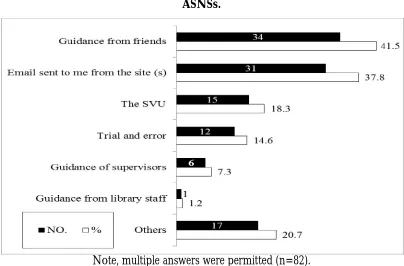
The second cluster began with a question if respondents heard of one or more of the ASNSs (ResearchGate, Acedemi.edu, Mendeley, LinkedIN and Scholastica) . The most of respondents; 82 respondents (92.1%) reported that they having heard of these sites, then they were asked to continue answering the following questions. However, only 7 respondents (7.9%) did not have any idea about these sites, and were asked to submit the survey at this stage. The 82 academic staff who was allowed to answer the following questions indicated that their information about ASNSs came through a variety of sources as shown in Fig. 1.
Figure 1: Source (s) of knowledge of academic staff in the SVU about the ASNSs.
Note, multiple answers were permitted (n=82).
These sources should be considered by the authorities of the SVU to invite and support their academic to use the ASNSs. The respondents were asked to select the ASNS(s) they were aware about. The collected data was analyzed and presented as a number and percentages of respondents and shown in Fig. 2.
Figure 2: Awareness of the SVU academic staff of the ASNS.
Note, multiple answers were permitted (n=82).
About 91.5% of the respondents chosen the ResearchGate to be the most common site they were aware about and followed by LinkedIn (77.5%), Acedemi.com (55.8%), Mendeley (30.1%) and the less popular site was Scholastica (20%). In another study of about 160 universities in Delhi in India, it was found that the most common used ASNSs were as follow ResearchGate (54%), Academia (51%), LinkedIn (39%), and CiteULike (35%) (Madhusudhan, 2012). Also, it was reported that the most frequently used ASNSs among the Arabic academics is the ResearchGate followed by Acedemi.edu and then Mendeley (Elsayed, 2015).
The SVU academic staff were asked to tell about the visiting frequency of the ASNSs. The analyzed data was presented in table 2.
75
49
25
73
17
91.5
59.8
30.5
89.0
20.7 ResearchGate
Acedemia.edu
Mendeley
Scholastica NO
Table 2: Visit frequency of the ASNSs(n=82).
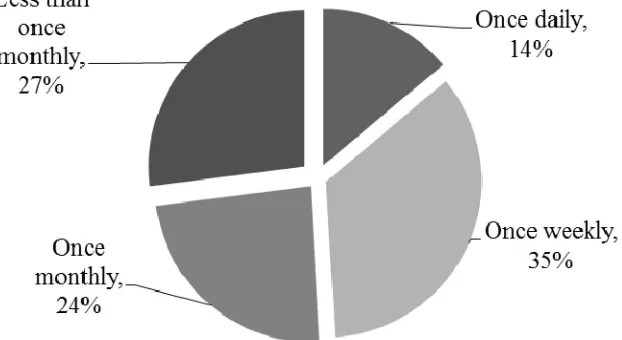
The Table-2 shows that there were variations in the frequency of visiting the studied ASNSs. More than one-third (35%) of the academics at the SVU visited these sited weekly and some of them visited less than once every month (27%) or monthly (24%) and the fewest of them (14%) visited these sites daily (Fig. 3). That indicate the ASNSs became an important part of the scientific life of the SVU academic staff.
Figure 3: Visit frequency to the ASNS (data retrieved from table 2).
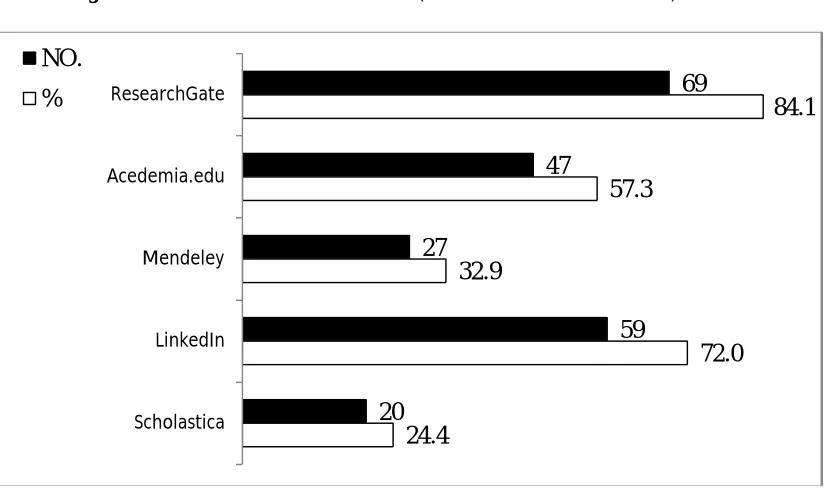
Furthermore, it was clear that the most frequently visited site was ResearchGate (84.1%) followed by LinkedIn (72%), Acedemia.edu (57.3%), Mendeley (27%) and then Scholastica (20%) (Fig. 4). This is in a synchronizing with the results presented above (Fig. 2) about the awareness of the SVU academics to the ASNSs.
Frequency Once daily
Once weekly
Once monthly
Less than once monthly
Total visiting frequently
Not visiting this site
NO. % NO. %
ResearchGate 17 30 16 6 69 84.1 13 15.9
Acedemia.edu 6 15 11 15 47 57.3 35 42.7
Mendeley 2 5 7 13 27 32.9 55 67
LinkedIn 4 21 17 17 59 71.6 23 28
Scholastica 2 7 2 9 20 24.4 62 75.6
Total 31 78 53 60 222 54.1 188 45.9
Figure 4: Preference of the ASNSs (data retrieved from table 2).
The academic staff of the SVU who visited the ASNSs regularly as shown in table 2 responded a question about average time spent during their visit, and their answers were varied as summarized in table 3.
Table 3: Time spent during visits of the ASNSs (n = 82).
Time Less than 1h 1h 1-2h 2-3h More than 3h Total
ResearchGate 48 12 6 1 2 69
Acedemia.edu 33 5 6 1 2 47
Mendeley 24 1 1 0 1 27
LinkedIn 49 5 3 0 2 59
Scholastica 16 2 1 0 1 20
Total 170 25 17 2 8 222
% 76.6 11.3 7.7 0.9 3.6
From table 3, it is clear that more than three-fourth of all respondents reported visiting time to their preferable site for less than 1 h, while the rest one-fourth varies from 1-2 h (11.3%), 2-3h (0.9%) and more than 3h (3.6%). This is an indication of the limited time spend on the ASNSs, as the visitors of these sites usually have specific needs with no time to spend in long communication as in the case of entertainment SNSs. As well as the academics at the SVU are usually occupied with both teaching and research.
69
47
27
59
20
84.1
57.3
32.9
72.0
24.4 ResearchGate
Acedemia.edu
Mendeley
Scholastica NO.
Figure 5: Time spent on the ASNS (n =82).
The respondents answered a question about if they have a profile page on which of the ASNSs and from how long? The data was shown in table 4.
Table 4: Profile page of the staff member of the SVU on the ASNSs (n=82).
The Table-4 demonstrates that the ResearchGate was the first choice for the SVU academic staff as the 81.7% respondents indicated that they had a profile page on this site, followed by LinkedIn (70.7%), Academia (30.5%), Mendeley (28%) and finally Scholastic (18.3%) (Fig. 6).
170
25
17
2 8
76.6
11.3 7.7
0.9 3.6
Less Than 1h 1h 1-2h 2-3h More than 3h
NO.
%
ResearchGate Acedemia.edu Mendeley LinkedIn Scholastica
NO % NO % NO % NO % NO %
Longer than 2
years 25 30.5 18 22.2 4 4.9 22 26.8 3 3.7
1-2 years 15 18.3 9 11.1 5 6.1 17 20.7 0 0.0
3 months-1
year 8 9.8 10 12.3 5 6.1 5 6.1 1 1.2
less than 3
months 19 23.2 6 7.4 9 11.0 14 17.1 11 13.4
I do not have a profile on this site
Again this results confirmed the results in Figs. 2 & 4. As it is a logic that the SVU member staff having a profile on an ASNS to be aware of and visiting it.
Figure 6: Profile page of the SVU academic staff on the ASNSs
(data retrieved from table 4).
In a study about the disciplinary differences of the users of the ASNSs, it was reported that ResearchGate is preferred by the biologists, while Acedemi.edu is used mostly by the social scholar and humanists (Thelwall and Kousha, 2014, Ortega, 2015). In the current study the author did not go in depth to look at the prevalence site for each category of the respondents, however the more respondents shared in this study from academics of the applied sciences than humanities and social science, may be correlated to the increased number of people using the ResearchGate. ResearchGate is an online ASNS targets scientific researchers from all disciplines of science. It was reported more than 3 million users of this site and one-third of them visit the site monthly (Thelwall and Kousha, 2015).
It allows access specific topics and conversations of researchers with similar interests all over the world (Leeder, 2008). Furthermore, it offers the ResearchGate Score “RG Score” for each researcher. The RG Score is a metric that measures the scientific reputation and based on total publications, follower/following downloads and views, and another score is the Total Impact, which depends on the impact factor of the journal of publications they uploaded. Interestingly, the RG present a ranked list of institution according to the RG Score and Impact Score
(https://www.researchgate.net/institutions/worldwide). The SVU ranked 4204 in
this scoring list; with a RG Score of 1,124,95 from 298 members having 670 publications and Impact Score was 1,114.34. To understand the level of the SVU in comparison to the top Egyptian university (Cairo), it worth to know that Cairo University was on the top of the Egyptian University and the second on the African list.
67
25
23
58
15
81.7
30.5
28.0
70.7
18.3% ResearchGate
Acedemia.edu
Mendeley
Scholastica NO.
Cairo university has a RG Score of 20,916,13 from 4943 members and 11464 publications with impact point 19,419.05. The ResearchGate can be used as a scientific indicator to compare researcher, institution and countries (Thelwall and Kousha, 2014). Thus it is very important the SVU authorities to support and encourage their academics to join the ResearchGate and populated their profiles to improve the ranking of the university.
The second on top was the LinkedIN, and that was surprising as this site is mostly supports the business relationship communication and provides few academic-professional services (Skeels and Grudin, 2009). That is likely due to the feature added in 2013, which allow scholars to upload their papers (Thelwall and Kousha, 2014). Among the ASNSs, LinkedIn and researchGate show researcher’s skills, which can be endorsed by other users (Jordan, 2015, Vasquez. and Bastidas., 2015). Acedemi.edu was the third of choice of the respondents. This site provides interesting webometric statistics such as the total number of profile views, total count of paper downloads. (Thelwall and Kousha, 2014). Mendeley was the fourth selected ASNS by the SVU academic staff. This site, is the only ASNS that provides advanced group collaboration tools like a shared library and references (Henning and Reichelt, 2008, Vasquez. and Bastidas., 2015). Finally, the Scholastica was of the lowest site voted by the SVU academics. The future study may exclude this site from any survey provided to the ASNSs as the current study shown most of the academics (81%) at the SVU do not have a profile on this site.
Most of the SVU academic staff had profile on ResearchGate, Acedemi.edu and LinkedIn (30.5%, 22.2, 26.8 respectively) as longer as 2 years ago, while most of those with a profile on Mendeley and Scholastica (11% and 13.4% respectively) owned their profile more recently, as less than 3 months ago.
Figure7: Professional use of the ASNSs (multiple answers were permitted, n=82)
It was reported that the Arab acedemics use the ASNSs with many aims. Most of them use these sites to share publications and communicate with other researchers (Elsayed, 2015). The profile owners responded a question about the professional information they make publicly available online (Fig. 8). All the causes presented were related to either communication or publications.
Figure 8: Online public available information of the SVU academies on the ASNSs (multiple answers were permitted, n =82).
Then the respondents were asked to choose which one of their profile pages on the ASNSs or their institutions site, they were more keeping up to date. About 82.9% chosen those at the ASNSs, while 17.1% voted to their institutional profile page (Fig. 9). That is an indication of the importance of the profile on the ASNSs to the academics at the SVU.
9 15 18 37 20 53 56 39 16 11 26 10 11.0 18.3 22.0 45.1 24.4 64.6 68.3 47.6 19.5 13.4 31.7 12.2
I do not use these sites professionally I signed up out of curiosity I maintain a profile in case someone …
To track metrics relating to interest …
Discovering job opportunities Contacting peers in my field of …
Discovering recommended research …
Following discussion groups Commenting on research that is …
Actively discussing my research Sharing links to my authored content Other
Figure 9: The site more updatable by the respondents (n = 82).
To know more about the way the SVU academic scholar think about the ASNSs, The respondents received a set of questions to indicate their level of agreement with the some items on a scale of strongly agree’/agree’/neutral’/ disagree’/strongly disagree. The distribution of responses as a total and a percentage out of total was summarized in table 5.
Table 5: How the academic staff at the SVU thinks about the ASNSs
Strongly
agree Agree Neural Disagree
Strongly disagree NO. % NO. % NO. % NO. % NO. % “Viewing other researchers' professional profiles on online
networks is a useful way of determining what research I should be reading"
59 72 21 25.6 2 2.4 0 0 0 0 "I feel I should probably do more to promote my research using
online networks" 41 50 34 41.5 7 8.5 0 0 0 0 "I do think having a professional profile on an online network is
very important for a researcher" 51 62.2 29 35.4 2 2.4 0 0 0 0 “I believe it has become a necessary to take advantage of ASNSs
for the dissemination of research and scientific papers and ideas of the academic staff of the SVU”
53 64.6 26 31.7 3 3.7 0 0 0 0 “I think dissemination of research and scientific papers of the SVU
will increase the chances of the spread of this research and facilitate its access to engines, thereby increasing the citation opportunities "
62 75.6 18 22 2 2.4 0 0 0 0 I believe in the importance of integrating the ASNSs in educational
institutions and encourage academic staff to use these sites in the educational process and student courses, projects and others, and guide students to use them in a scientific manner "
52 63.4 24 29.3 6 7.3 0 0 0 0
I believe in the need for introducing new courses concerning the ethics of information in the ASNSs to cover aspects relating to privacy, electronic crimes, intellectual property rights and other "
49 59.8 27 35.4 6 7.3 0 0 0 0 "I see that the expansion in the use of the ASNSs in academic
universities will play an important role in the future in raising the rating of these universities”
From the table it was revealed that all items showed a skew toward agreement (Fig. 10) and that strongly support the view of that the academics of the SVU think positively toward the ASNSs.
Figure 10: Responses to different agreement levels (data retrieved for table 5).
3. Benfits and obstackes of using the ASNSs
Table 6: Benefits and obstacles of suing the ASNSs by the SVU academics.
Note. Multiple answers were available (n= 82).
Table 6 showed that “interaction with expert researchers from around the world” was a common benefit for respondents (96.3%) and the lowest was being informed of researchers quoting from my studies. Some of the respondents selected “other causes” but none of them mentioned to any other benefits. The most common selected obstacles (76.8%) were “many colleagues are not informed about the site” and the lowest choice was “others” and again no mention of any obstacle was added to those in the survey.
4. Suggestions to increase the awareness and using of the ASNSs
Finally in the fourth cluster of the questionnaire, about 97.5% of respondents indicated that it is necessary for the SVU authorities to increase the awareness of their academic staff to the ASNSs and to motivate them to use these sites frequently.
Points B NO. %
en
ef
its
Increase self-esteem and well being 56 68.3
Interaction with expert researchers from around the world 79 96.3
View published researches for researchers of similar discipline or interests 75 91.5
Openness to the world and viewing educational developments 69 84.1
47 57.3
Being informed of researchers quoting from my studies 8 9.8
Easy location of previous studies for the interest of research 64 78.0
View and identify prestigious and certified scientific journals 43 52.4
Offers information about the university's proceeding toward global ranking, and world
classifications for internationally accredited universities 25 30.5
Identify placement or ranking of the researcher among other researchers 32 39.0
Enhance English language competency 31 37.8
View research activities of university 30 36.6
View recommend research articles 36 43.9
Others 46 56.1
O
b
st
ac
le
s
Many colleagues are not informed about the site 63 76.8
Shortage of computers 19 23.2
Weakness of the internet 42 51.2
The site is confined only to English language 16 19.5
Shortage of time 19 23.2
There are other competitive engines to the site 21 25.6
Doubt or fear of incoming messages to be a source of hacking or spreading viruses 37 45.1
Is not adaptable to the needs of my scientific needs 11 13.4
The majority of the respondents think that it is important to increase the awareness and use of the ASNSs and they suggested ways to achieve that. One of the important results of increased the ASNSs use by the SVU academics is the increased visibility and citation of their publications (Jingfeng et al., 2011) and that will certainly has its positive effects on improvement the scholar and institution impact.
The respondents explained that the SVU can encourage their academic staff to increase their awareness and use of the ASNSs through many activities. The most frequent ways of academies at the SVU of finding out about the ASNSs are the invitation to seminars and workshops about the importance of the ASNSs (86.6%), then by sending emails to academic staff including information about these sites (80.5%). Some of them thought that it is better if the information could be included in posters shown to the academic staff in their faculty libraries (61%), or considered as one of the requirements for quality insurance and accreditation of faculties (54.9%), or required for promotion of the academic staff through their scientific committee (40.2%). About 37.8% of the respondents believed that it is important to integrate basic information about these sites in the integrated into the student’s courses especially those in the Department of Library and Information technology. Only 1.2% chosen “other sources’ but did not mention any of these sources. Fig. 11 showed the total counts and percentages for each suggestion.
Figure 11: Suggestions to increase the use and awareness of the SVU staff of ASNSs (multiple answers were permitted), n= 82.
1.2
54.9 40.2 37.8
61.0 80.5
86.6
1
45 33 31
50 66
71
Others Required for quality assurance and
accredation
Required for promotions integeration in the studentt courses Posters in libraries E-mails to the staff members Seminars and training courses
Conclusion
The ASNSs has become a part of most of the scholar’s scientific life. Researchers are accessing the ASNSs with two main aims; communication and collaboration. Through these platforms they can meet the peers in their specific disciplines and upload or download articles, books or other scientific materials. The current study was undertaken with the aim of analyzing the awareness and use of the SVU academics of some ASNSs, ResaerchGate, Acedemia.edu, Mendeley and Scholatics.com.
ResearchGate and LinkedIn appear to be of most particular value to the academic staff of the SVU followed by Acedemi.edu then Mendeley. In contrast they showed a relatively low level of awareness and use of the Scholastica. The awareness and use results were supported with profile having and visiting results presented in this study. It would be interesting to repeat the study using samples from a range of different Arab countries in order to investigate the relation between the scientific achievements of academic of Arab universities and their use of ASNSs. The SVU is to encourage and support the use of their academic staff to the ASNSs to increase its visibility and representation as a tool to increase the academic ranking among other universities in the Arab area.
References
"ResearchGate" (2015). "http//www.researchgate.net."
Aghaei., S., Nematbakhsh., M. A. and Farsani., H. K. (2012). "Evolution of the World Wide Web: from web 1.0 to web 4.0." International Journal of Web & Semantic Technology (IJWesT) 3(1): 1-10.
Alheyasat, O. (2015). "Examination expertise sharing in academic social networks using graphs: The case of researchgate." Contemporary Engineering Sciences 8(1-4): 137-151.
Ben Jabeur, L., Tamine, L. and Boughanem, M. (2010). A social model for Literature Access: Towards a weighted social network of authors. Adaptivity, Personalization and Fusion of Heterogeneous Information: 22-39.
boyd, d. m. and Ellison, N. B. (2007). "Social Network Sites: Definition, History, and Scholarship." Journal of Computer-Mediated Communication 13(1): 210-230.
Eke, H. N., Omekwu, C. O. and Odoh, J. N. (2014). "The use of social networking sites among the undergraduate students of university of Nigeria, Nsukka." Libr. Philos. Pract. Library Philosophy and Practice 2014(1).
Elsayed, A. M. (2015). "The Use of Academic Social Networks Among Arab Researchers: A Survey." Social Science Computer Review.
Giglia, E. (2011). "Academic social networks: it's time to change the way we do research." EUROPEAN JOURNAL OF PHYSICAL AND REHABILITATION MEDICINE
Gruzd, A. and Goertzen, M. (2013). "Wired Academia: Why Social Science Scholars Are Using Social Media." 3332-3341.
Henning, V. and Reichelt, J. (2008). Mendeley – A Last.fm for Research? Fourth IEEE International Conference on eScience: 327-328.
Jingfeng, X., Lynette Myers, R. and Kay Wilhoite, S. (2011). "Multiple open access availability and citation impact." Journal of Information Science 37(1): 19-28.
Jordan, K. (2014). "Academics and their online networks: Exploring the role of academic social networking sites." First Monday 19(11): Retrieved from http://firstmonday.org/ojs/index.php/fm/article/view/4937/4159.
Jordan, K. (2015). Exploring the ResearchGate score as an academic metric: reflections and implications for practice. Quantifying and Analysing Scholarly Communication on the Web (ASCW’15),. Oxford.
Kelly, B. and Delasalle, J. (2013). Can LinkedIn and Academia.edu Enhance Access to Open Repositories? OR2012: the 7th International Conference on Open Repositories. Edinburgh, Scotland.
Leeder, K. (2008). "Social networking with a brain: a critical review of academic sites." Retrieved from. http://www.inthelibrarywiththeleadpipe.org/2008/social-networking-witha- brain-a-critical-review-of-academic-sites/.
Madhusudhan, M. (2012). "Use of social networking sites by research scholars of the University of Delhi: A study." International Information and Library Review 44(2): 100-113.
Nentwich, M. (2010). Web 2.0 and academia Proceedings of the 9th Annual IAS-STS Conference “Critical Issues in Science and Technology Studies”, Graz, Austria. Ortega, J. L. (2015). "Disciplinary differences in the use of academic social networking sites."
Online Information Review Online Information Review 39(4): 520-536.
Skeels, M. M. and Grudin, J. (2009). When Social Networks Cross Boundaries: A Case Study of Workplace Use of Facebook and LinkedIn. the ACM international conference on supporting group work (GROUP), New York, NY: ACM.
Thelwall, M. and Kousha, K. (2013). "Academia.edu: Social network or Academic Network?" Journal of the Association for Information Science and Technology 65(4): 721-731. Thelwall, M. and Kousha, K. (2014). "Academia.edu: Social network or Academic Network?"
ASI Journal of the Association for Information Science and Technology 65(4): 721-731.
Thelwall, M. and Kousha, K. (2014). "ResearchGate: Disseminating, communicating, and measuring Scholarship?" J Assn Inf Sci Tec Journal of the Association for Information Science and Technology 66(5): 876-889.
Thelwall, M. and Kousha, K. (2015). "ResearchGate: Disseminating, communicating, and measuring Scholarship?" Journal of the Association for Information Science and Technology 66(5): 876-889.