International Journal of Advances in Management and Economics Available online at: www.managementjournal.info
RESEARCH ARTICLE
Internationalization of Higher Education
Luisa Karam de Mattos
1*,Leonardo Flach
2,Rafael More
11Department of Management, Federal University of Santa Catarina, Brazil. 2Department of Accounting, Federal University of Santa Catarina, Brazil.
*Corresponding Author: Email:[email protected]
Abstract: The internationalization of higher education is a trend that increased its development in recent years. Educational institutions increased the academic mobility, knowledge exchange, international partnerships for research. This research aims to conduct a systematic review of all articles published about internationalization of higher education in international journals during the period from 2012 to 2017. The research method is quantitative and qualitative. The sample consists of 56 scientific articles. The results show a trend toward increasing production and discussion about the theme, and that the case study method is the most recurrent method. The UK has the biggest number of publications. The five most productive and cite authors about internationalization of higher education are: Hugo Horta (Portugal), Nan Jiang (UK), Victoria Carpenter (United Kingdom), Li Xiaoqing (UK) and Joanne Roberts (UK). Thus, this research highlights the importance of empowering the institutions, faculty and staff, for internationalization, and demonstrates the importance of an international curriculum.
Keywords: Higher education. Higher Education, Internationalization, Systematic review.
Article Received: 20 July 2018 Revised: 13 August 2018 Accepted: 13 August 2018
Introduction
Higher education always had an international dimension. However, in the first decade of this century, the global academic mobility and international educational programs reached a new level of internationalization that has never seen before [1].Most higher education institutions now list internationalization as a priority [2]. There is a prediction that the flow of students who choose to study abroad will increase from two million to seven million and a half, from 2005 to 2020 [3].
The internationalization of higher education institutions is a process produced by a set of policies and practices laid down in national, sector and institutional level. Internationalization integrates an international, intercultural or global dimension into the objectives, functions or products of postsecondary education. Globalization is configured as a continuous effort, denoting evolution of economic flows, technology, knowledge, people, values and ideas without borders. It is a multifaceted phenomenon, which presents opportunities, challenges and risks.
Knight also point out that globalization is changing the world of education. And globalization is changing the world of internationalization. Globalization considers knowledge of the core values, and he, in turn, comes from an efficient higher education. Many developing countries have structured or are restructuring their higher education systems to meet the socio-economic development goals. In Brazil, there are some advances in the development of internationalization of higher education. For example: the adoption of international standards in assessments of the Graduate National System; new government programs empowering international mobility; conferences about international higher education; all federal public universities linked to the Brazilian Association of International Education have sectors responsible for international activities management [4].
Morosini and Nascimento [5] explain that the scientific literature about the subject is still small in the country in comparison to the worldwide scientific production. However, there is a growing production about internationalization in education. With this growing interest in the topic of internationalization, it is important to analyze the international scientific production about Internationalization of Higher Education.
Yuan et al. [6] Explain that, although the internationalization has been an increasingly important phenomenon for higher education sectors, empirical research that investigates the meaning of the movement has been scarce. The previous studies only focus on international activities within universities. These studies highlight the issues of international mobility of students and staff, knowledge transfer, cooperation and competition, forms of educational services, and national policies [7, 8].
In this context, the following research question arises: what is the state of the art of the international scientific production about Internationalization of Higher Education? Thus, this research aims to conduct a systematic review about the scientific production about internationalization of higher education, of all studies presented in international journals indexed in Scopus and Web of Science databases, between the years from 2012 to 2017. In order to search the literature, we applied the following keywords: "Internationalization", "Higher Education". The development of this study is important to relate the state of the art of the literature about the topic, considering the importance of the theme, and the demand of discussions about internationalization of higher education.
There is a growing interest of universities, colleges, higher educational institutions to know which paths have been adopted in the management of internationalization of higher education all over the world. A study summarizing these practical examples and actions in order to support internationalization of higher education can be a great contribution of the practical and theoretical point of view. Finally, this study may provide a general description of the studies conducted on this subject, and can
even provide possibilities to fill knowledge gaps and research opportunities on the topic. Theoretical Background
The systematic review is an important resource of the compilation of practices, results and theories. In the systematic review, a group of articles about the topic are analyzed, applying qualitative and quantitative methods. In the systematic review procedure, the results of all papers are collected, categorized, evaluated and synthesized [9].
The authors have to justify the selection of studies, with explicit criteria for inclusion and exclusion, and assessment of the methodological quality [9, 10]. The systematic review arose in order to clarify controversial research and support only the best quality studies related to an issue. It is a type of research focused on well-defined question, which seeks to identify, select, evaluate and synthesize relevant available evidence [11].
Galvão and Pereira [11] emphasize that the criteria adopted in a systematic review are published, so that other researchers can repeat the procedure and get the same results. The results of a good systematic review are the best level of evidence for decision-making. The selection of the papers should follow specific procedures in order to ensure the quality and credibility of the study. Galvão, Sawada and Trevizan [9] suggest the following steps to build the systematic review: a) preparation of the systematic review question; b) definition of the inclusion criteria; c) choice of the research search strategies; d) check how the research will be critically evaluated; e) carry out the data collection.
strategies in education that impact all policies at national level [13]. International students are also seen by higher education providers as a source of revenue. According to the USA Department of Commerce (2016), international students contributed with more than $ 32 billion to the US economy in 2014 [14]. The importance of these students does not involve only the amounts of money they bring, but also relates to the cultural and social value enriching that contributes to the host country [15].
In this environment, business schools are at the forefront of the internationalization of higher education. In addition to account for a significant portion of international students, they compete also more than other disciplines in international markets, including students, teachers, and research funding [1]. The phenomenon of globalization present challenges for higher education, because it requires that students and the higher education staff face the complexity, interdependence and dynamism of the economy.
Business schools are usually one of the first areas in US colleges and universities to invest in international programming. Many of them have the challenge and responsibility to prepare students for the challenges and realities of the global trade, including intercultural skills [16]. The student mobility is the first step in the process and a large international market to be exploited [16]. The demand for higher education services is increasing all over the world, as nations seek to compete in an economy increasingly based on knowledge [7].
Mc Donnell and Boyle [17] report that in addition to this exchange students, internationalization in higher education can take many forms, including the movement of staff and students to study abroad, international research partnerships, international skills recognition, and international investments. In addition to these most widely known actions, the internationalization of higher education also include these goals: internationalization of the training curriculum; exchange of researchers and teachers; high quality international publications; international joint degree or multiple programs with foreign partners; creation of international quality assurance systems; international ratings
with college and university rankings; international exchange of experiences and best practices. Finally, it should be noted that internationalization can contribute: to international accreditation; to offer an academic international experience and practice; to recruit internationally qualified teachers; to help students to find a good opportunity in the international labor market [18].
With the systematic review of articles, we will see that in a society where the geographical distance is something smaller, universities around the world value and developed internationalization programs. Considering the possible contributions in theoretical and praxis perspective, this study help the development of higher education institutions, presents a summary of possible differentials that internationalization could provide to these institutions.
Method
In order to conduct a literature review of what has been researched on the topic internationalization of higher education, this research is exploratory and descriptive. It is exploratory because we apply a survey about the subject, with reflection and generation of new knowledge. It is also descriptive because we describe the characteristics of publications, the main methods and results. Regarding the aspects of the research problem, this research is characterized as qualitative and quantitative.
The qualitative phase was conducted with an interpretative analysis of the articles, in order to identify the articles to compose the bibliographic portfolio, to interpret and summarize the knowledge. We also applied a quantitative analysis to summarize numerical descriptions of the articles, for example, the number of publications per year.
reviews we carried out a search in Scopus databases, Web of Science and SciELO, using the words "systematic review" (AND) "internationalization" (AND) "higher education". First, we analyzed the abstracts, titles and keywords. No studies were found involving the theme internationalization of higher education. We obtained the articles using the following criteria: the keywords were "Internationalization" and "Higher Education"; only papers published between the years 2012 and 2017; the paper has been published in a scientific journal with high impact; be available in English; it is classified in the database as a complete article.
The result was 60 articles in the database Scopus and 35 articles in the Web of Science database. But 17 articles appeared in both databases. The new amount was 60 of articles in Scopus 60 and 18 in Web of Science. As one of the mandatory items of the survey was to contain the keywords
"Internationalization" or "Higher Education", and to have an alignment to the theme, we removed 09 items from Web of Science, which did not contain these keywords. With the result of 60 database Scopus articles and 09 articles database Web of Science, we found that all 69 articles had adherence to the issue. Then, we downloaded the articles. The articles were read, in order to check the alignment to the theme. Analyzing the articles, we removed 13 items. Thus, the final sample consisted of 56 international articles with strong academic impact.
Data Analysis and Discussion
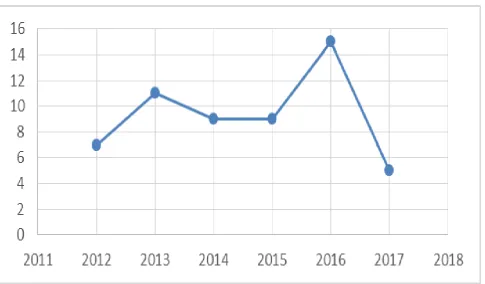
Figure 1 shows the temporal distribution of the identified work. Of the 56 articles of the sample, the year 2016 has 15 publications about internationalization of higher education. The jump of publications in the year 2016 may indicate that there is a growing interest in the research about Internationalization of Higher Education.
Figure 1 - Frequency of publications per year in the period
Regarding the authorship of these articles, we found that they were written by a total of 116 authors. Of this amount, only five researchers have more than one publication: Hugo Horta has three works; Nan Jiang, Victoria Carpenter, Xiaoqing Li and Joanne Roberts, have two works. Interestingly, Jiang and Carpenter published together two works. The same occurs with the partnership of Li and Roberts.
Figure 2: The main methods applied in the studies about internationalization of higher education Source: Authors
The internationalization of higher education is closely linked to globalization theme. We observed in the systematic review that countries around the world consider the internationalization not only a trend, but a reality that is necessary for the institutions in order to remain in the current scenario. It is not only an educational issue, but also an action to promote the quality of teaching and the interest about other cultures. Because this issue is so globalized, we observed that the publication of articles related to the topic
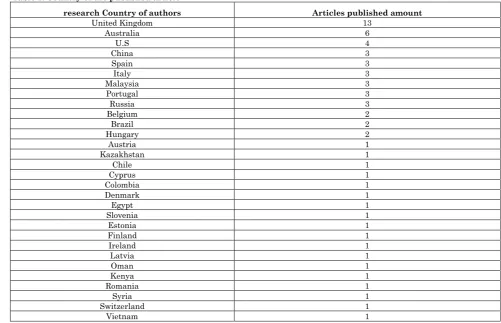
is also well spread around the world. Relating to the previous graph information, the vast majority of the studies apply the qualitative research and more specifically, case studies. There are a diverse number of countries writing about the subject. Each country demonstrates what has being done in the universities about internationalization. Thus, we identified great variability over the country of the universities of the authors. Table 1 presents this information with the countries of the authors.
Table 1: Country of the published article
research Country of authors Articles published amount
United Kingdom 13
Australia 6
U.S 4
China 3
Spain 3
Italy 3
Malaysia 3
Portugal 3
Russia 3
Belgium 2
Brazil 2
Hungary 2
Austria 1
Kazakhstan 1
Chile 1
Cyprus 1
Colombia 1
Denmark 1
Egypt 1
Slovenia 1
Estonia 1
Finland 1
Ireland 1
Latvia 1
Oman 1
Kenya 1
Romania 1
Syria 1
Switzerland 1
We identified that UK has the majority of the recent studies about internationalization of higher education. One of the factors that influence may be the use of English language, which is essential for anyone who wants to publish in well-respected magazines.
Corroborating to this hypothesis, Australia comes in second place and the united States are in third place - all English-speaking countries. Portugal stands out with three publications, with the three works by: Hugo Horta. Interestingly, not only Europe countries and US appear in the table. Latin American countries, such as Brazil and Chile, and also Asian nations, such as Vietnam, Oman and Kazakhstan, show interest in studying ways to internationalize. In this
way, the diversity of countries have produced studies on the internationalization, checking the situation of how the university or students react to this phenomenon, notes the importance that the issue has in the area of University Management. Although each study point out the features found in its environment, in the process of internationalization, we concluded that this is a global policy, and not only local.
This systematic review focused on articles published in journals related to the field of study "Business, Accounting and Management." Within this area, Table 2 shows the main journals that have more published articles about theme Internationalization of Higher Education, in the period from 2012 to 2017.
Table 2: Main journals that published about the internationalization of higher education
Periodic A1 / A2 in the area "Business, Accounting and Management"
Sample quantity of articles published in the period 2012-2017, with the theme Internationalization of Higher Education
International Journal of Educational Management 4
Journal of Teaching in International Business 4
Tertiary Education and Management 4
Technological Forecasting and Social Change 3
Journal of Teaching in Travel and Tourism 2
International Journal of Management in Education 2
International Journal of Intercultural Relations 2
Education and Training 2
Source: Authors.
In the sample of 56 selected articles, 23 are published in one of the journals contained in Table 2. The other articles were also published in high-impact publications, but with only one publication in the period. This study is a systematic review with only recent articles (published from the year 2012). Therefore, it is understandable that many studies still do not have a large number of
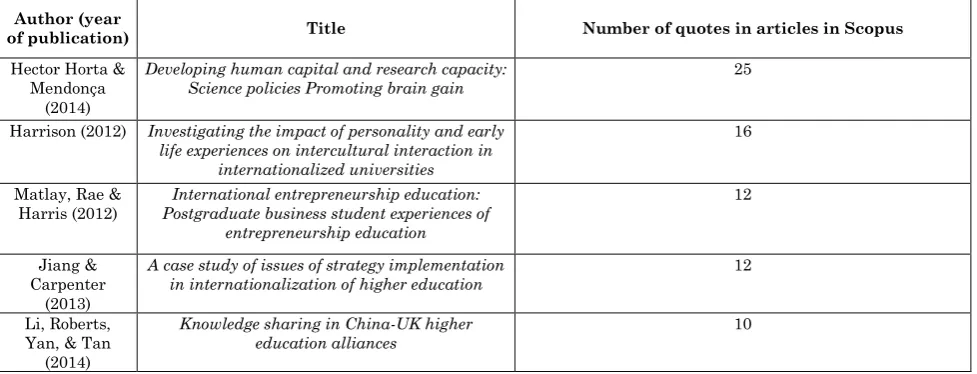
citations. Within the sample, 34 articles have citations in other publications. And one of the ways to measure the impact of scientific research is to check the quality of the journal and the highest number of citations. In this sense, Table 3 shows the number of quotes in articles about internationalization of higher education.
Table 3: Articles more scientific recognition, according to the number of citations Author (year
of publication) Title Number of quotes in articles in Scopus
Hector Horta & Mendonça
(2014)
Developing human capital and research capacity:
Science policies Promoting brain gain 25
Harrison (2012) Investigating the impact of personality and early life experiences on intercultural interaction in
internationalized universities
16
Matlay, Rae &
Harris (2012) Postgraduate business student experiences of International entrepreneurship education: entrepreneurship education
12
Jiang & Carpenter
(2013)
A case study of issues of strategy implementation
in internationalization of higher education 12
Li, Roberts, Yan, & Tan
(2014)
Knowledge sharing in China-UK higher
education alliances 10
Interestingly, five authors have more than one publication: Hugo Horta (Portugal), Nan Jiang (UK), Victoria Carpenter (United Kingdom), Li Xiaoqing (UK) and Joanne Roberts (UK). We conclude that in addition to the scientific recognition and impact of the quotes, these authors have recognition in the area. The objectives of the works are quite different. However, we found some similarities, for example, areas such as the analysis of international students (15 articles), the study of aspects of internationalization (14 articles) and the partnerships between universities (5 items). One of the main items discussed in the papers about internationalization is the experience of the student living abroad.
Not surprisingly, the approach of the academic look was a constant in 15 articles. Among the possible publication gaps about internationalization of higher education, we identified the following issues: the reasons that influence the decision of the student for a university or for a country; studies showing the level of satisfaction of foreign students with the reception from local students; studies about the factors that influence student´s decisions to continue their studies in the country they are visiting; the impact of exchange of experience to strengthen entrepreneurial aspects in students; the quantitative ratio of foreign students; the positive changes of countries and universities that receive more international students.
Specifically considering the gaps regarding the internationalization process, we point out: to research the use of learning to achieve the next higher education internationalization steps; to analyze internationalization efforts; to identify internationalization indicators; scientific conclusions and demonstrations about the importance to the country of having internationalized universities. Many studies point out that internationalization is a process that involves people, not just institutions.
For this reason, 03 works address the capabilities required for an institution to internationalize, what are the skills required, what employees and teachers have to do. Still within the goal of bringing the academic community aspects of internationalization, many of them were case studies. Several studies also depict scenes of
internationalization in emerging nations, studies that bring successful examples in countries already internationalized, like the United States and European countries, following the Treaty of Bologna. Found studies about the internationalization of higher education in emerging countries like Brazil, Cyprus, Mexico, Vietnam, South Africa and Romania. Another area that was fairly addressed in the general objectives of the research was the partnership between universities. This is an item that seems to bring good results, an exchange of cultures, new experiences among the nations, and a reduction in brain drain.
Successful experiences are demonstrated between the UK and Malaysia, between the United States and Portugal. Multicultural exchange prepares more efficiently students for future careers, and generates globalized academic research. Some studies addressed the issue in international teaching. One study addressed the question not only of sending students, but the preparation of Australian teachers to better receive international students. Another study found that an international experience affects (in numbers) the research results and publications.
The studies show also that internationalization is seen as solution to the sustainability of education. Many countries levy charges for foreign students, and do not charge local students. It is also an option to combat inbreeding university, to ensure greater openness to new ideas and thoughts. When researchers, professors, students, live only equal, they tend to think alike. The exchange of experiences and world view that promotes the internationalization also makes the science develops.
resources, support and strategic coordination [19]. Recent studies also suggest that policies for internationalization should not concentrate only a state responsibility. They are deployed and executed by human capital, which should be trained. International partnerships are a personal management issue, because partnerships are conducted by people [20]. There is a need to train professors and staff.
Lapina, Roga and Müürsepp [21] conclude that the quality of the academic staff and their study programs are the most important items to create value for the student. Many studies emphasize the importance of internationalization and highlight the growing need for mobility, international cooperation and research development through partnerships between universities to ensure the education quality. Quality assurance is an essential asset to operate internationally, especially due to the increasing market orientation and entrepreneurial attitude of higher education [22].
The localization, academic reputation and international supervision of an university are key factors that influence how large international employers perceive and evaluate the university as a source of talents [23]. In general, these studies showed that the higher education systems are changing for internationalization. Universities are organizations that need to adapt to the internationalization of higher education guidelines, for student mobility, partnership with international institutions, training the faculty staff. Much remains to be done, but the internationalization of higher education process has already started.
Final Considerations
In this research, we conducted a systematic review about internationalization of higher education, with a focus on papers published
in high impact scientific journals during the period from 2012 to 2017. We found in this research that there is a tendency of using qualitative methods in research involving internationalization of higher education. In studies with approach of the qualitative method, the predominant method was the case study. European countries already have the Bologna Declaration and indicate a growing interest for the international competitiveness of higher education institutions in Europe.
However, it is interesting to note that the theme of internationalization attracts attention worldwide. We found papers from 29 countries in the sample of 56 articles. This may indicate the trend of internationalization of higher education throughout the world. Latin American, African and Asian universities showed the seek in their research, procedures for internationalization. Despite the large number of published articles about internationalization of higher education, we observed that it is a field yet to be explored. It is a broad topic. Some recent works address the reality and expectations of different countries that want to internationalize. A few studies propose how to do the internationalization or how much the internationalization contributes to the quality of education and to the recognition in education rankings.
This paper was the first systematic review about internationalization of higher education. This study helps to fill this gap of knowledge. The search processes were delimited prior to conducting the review. Thus, the research achieved impartial and reproducible results. Finally, for future studies we recommend more studies about the themes that we found in this systematic review [24].
References
1. Rob Dixon, Daniela Slanickova, Philip
Warwick (2013) Business school partnerships for globalization. Journal of Teaching in International Business, 24(3-4):198-213.
2. Knight J (2006) Internationalization of higher
education: New directions, new challenges. IAU Global Survey Report. International Association of Universities, Paris.
3. Altbach P, Reisberg L Rumbley L (2009)
Trends in Global Higher Education: Tracking an Academic Revolution, UNESCO, Paris.
4. Leal F, Cespedes R, Stallivieri L (2016) The
5. Morosini, MC, Nascimento, LM (2017) Internationalization of higher education in Brazil: The recent production of theses and dissertations. Education Review, 33:e155-071.
6. Yuan R, Liu M, Luo M, Yen D (2016)
Reciprocal transfer of brand identity and image associations arising from higher education brand extensions. Journal of Business Research, 69:3069-3076.
7. Li X, Roberts J (2012) The stages approach to
the internationalization of higher education? The entry of UK universities into China. The Service Industries Journal, 32 (7):1011-1038.
8. Robson S (2011) Internationalization: The
transformative book for higher education? Teachers and Teaching: Theory and Practice, 17(6):619-630.
9. Galvao CM, Sawada AT, Trevizan MA (2004)
Systematic review: feature that provides the incorporation of evidence into nursing practice. Latin American Journal of Nursing, 12 (3):549-556.
10. Manes AG, Flach L (2012) Systematic review
of the scientific production on fraud in international accounting journals indexed to ISI and Scopus. Accounting View and Magazine, 23(2):163-189.
11. Galvao TF, Pereira, MG (2014) Systematic
reviews: Steps in its development.
Epidemiology and Health Services, 23(1): 183-184.
12. Nguyen SD, Vickers MH, Ly TMC, Dong TM
(2016) Internationalizing Higher Education (HE) in Vietnam: Insights from Higher Education leaders - an exploratory study. Education, and Training, 58(2): 193-208.
13. Dima Vasilache, MA S (2016) Trends in the
internationalization of European higher education in a perspective convergence. Management & Marketing, 11 (2):449-457.
14. Alfattal E (2017) International students'
college choice is different! International Journal of Educational Management, 31 (7):930-943.
15. Altbach PG, Knight J (2007) The
internationalization of higher education:
motivations and realities. Journal of Studies in International Education, 11 (34):290-305.
16. Begalla R (2013) The Bologna Process and
internationalization for higher education. Journal of Teaching in US International Business, 24(2):65-80.
17. Mc Donnell A, Boyle B (2012) Higher
Education in flight: A new direction for international research assignments. The International Journal of Human Resource Management, 23 (20): 4342-4358.
18. Mourad M, Karanshawy HE (2013) Branding
Islamic studies: exploratory study in the Middle East. Journal of Islamic Marketing, 4 (2): 150-162.
19. Bakar ARA, Talib ANA (2013) A Case Study of
an internationalization process of the private higher education institution in Malaysia. Gadjah Mada Journal of International Business, 15(3):211.
20. Horta H, Patrick MT (2016) Setting up an
international science partnership program: A case study between Portuguese and US
research universities. Technological
Forecasting and Social Change, 113:230-239.
21. Lapina I, Pray R, Müürsepp P (2016) Quality
of higher education: International students'
satisfaction and learning experience.
International Journal of Quality and Service Sciences, 8:263-278.
22. Bernhard A (2012) Quality Assurance in an
International Higher Education area: The summary of the case study and comparative analysis approach. Tertiary Education and Management, 18 (2): 153-169.
23. Ryan J, Silvanto S, Ozkaya HE (2015) The
contextual, theoretical and empirical analysis of the uses of university degrees the symbolic capital in self-initiated expatriation. European
Journal of International Management,
9(5):614-634.
24. Gacel-Avila J (2005) The internationalization