International Journal of Mathematical Archive-9(10), 2018,
27-33Available online throug
ISSN 2229 – 5046
SQUARE REVERSE INDEX AND ITS POLYNOMIAL OF CERTAIN NETWORKS
V. R. KULLI*
Department of Mathematics, Gulbarga University, Gulbarga, 585106, India.
(Received On: 21-08-18; Revised & Accepted On: 04-10-18)
ABSTRACT
W
e propose the square reverse index of a molecular graph. Considering the square reverse index, we define the square reverse polynomial of a molecular graph. In this paper, we determine the square reverse index and its polynomial of certain networks of chemical importance like silicate, chain silicate, hexagonal, oxide and honeycomb networks.Keywords: square reverse index, square reverse polynomial, silicate, hexagonal, oxide, honeycomb networks.
Mathematics Subject Classification: 05C05, 05C07, 05C12, 05C35.
1. INTRODUCTION
A molecular graph is a simple graph such that its vertices correspond to the atoms and the edges to the bonds. In Chemistry, topological indices have found to be useful in chemical documentation, isomer discrimination, structure property relationships, structure activity relationships and pharmaceutical drug design. There has been considerable interest in the general problem of determining topological indices, see [1].
Let G=(V, E) be a finite simple connected graph. The degree dG(v) of a vertex v is the number of vertices adjacent to v.
Let ∆(G) denote the largest of all degrees of G. The reverse vertex degree of a vertex v in G is defined as
cv = ∆(G) – dG(v) + 1. The reverse edge connecting the reverse vertices u and v will be denoted by uv. We refer to [2] for undefined term and notation.
Recently, Kulli [3] proposed the square ve-degree index of a graph, defined as
( )
( )
( )
( )
2
.
ve ve ve
uv E G
Q G d u d v
∈
=
∑
− Motivated by the definition of the square ve-degree index, we introduce the square reverse index as follows:
The square reverse index of a molecular graph G is defined as
( )
(
)
( )
2
.
u v uv E G
QC G c c
∈
=
∑
− (1)Recently, some reverse indices were studied, for example, in [4, 5, 6, 7, 8, 9, 10, 11].
Considering the square reverse index, we introduce the square reverse polynomial of a graph G as
(
)
( )( )
2
, cu cv .
uv E G QC G x x −
∈
=
∑
(2)Recently, some polynomials were studied, for example, in [12, 13, 14, 15, 16, 17, 18, 19, 20, 21, 22].
In this paper, the square reverse index and square reverse polynomial of silicate, chain silicate, hexagonal, oxide and honeycomb networks are determined. Silicates are very important elements of Earth's crust. Sand and several minerals are constituted by silicates. For more information about networks see [23].
Corresponding Author: V. R. Kulli*
2. RESULTS FOR SILICATE NETWORKS
Silicates are obtained by fusing metal oxide or metal carbonates with sand. A silicate network is symbolized by SLn, where n is the number of hexagons between the center and boundary of SLn. A 2-dimensional silicate network is presented in Figure 1.
Figure-1: A 2-dimensional silicate network
Let G be the graph of a silicate network SLn. From Figure 1, it is easy to see that the vertices of SLn are either of degree 3 or 6. Therefore ∆(G) = 6. Clearly we have cu = ∆(G) – dG(u) + 1 = 7 – dG(u). The graph G has 15n2 + 3n vertices and 36n2 edges. In G, by algebraic method, there are three types of edges based on the degree of end vertices of each edge as follows:
E33 = {uv∈E(G) | dG(u) = dG(v) = 3}, |E33| = 6n.
E36 = {uv∈E(G) | dG(u) =3, dG(v) = 6}, |E36| = 18n2 + 6n.
E66 = {uv∈E(G) | dG(u) = dG(v) = 6}, |E66| = 18n2 – 12n. Thus there are three types of reverse edges as given in Tabe 1.
cu, cv\ uv∈E(G) (4, 4) (4, 1) (1, 1) Number of edges 6n 18n2 + 6n 18n2 – 12n
Table-1: Reverse edge partition of SLn
In the following theorem, we compute the square reverse index of SLn.
Theorem 1: The square reverse index of a silicate network SLn is given by
QC(SLn) = 162n2 + 54n.
Proof: From equation (1) and Table 1, we see that
( )
[
]
( )
2
n u v
uv E G
QC SL c c
∈
=
∑
−= (4 – 4) 2 6n + (4 – 1)2 (18n2 + 6n) + (1 – 1)2 (18n2 – 12n) = 162n2 +54n.
In the following theorem, we compute the square reverse polynomial of SLn.
Theorem 2: The square reverse polynomial of a silicate network SLn is given by
QC(SLn, x) = (18n2 + 6n)x9 + (18n2 – 6n)x0.
Proof: From equation (2) and using Table 1, we see that
(
)
[ ]( )
2
, cu cv
n
uv E G QC SL x x −
∈
=
∑
2
2
24 4 2 4 1 2 1 1
6 18 6 18 12
n x n n x n n x
= (18n2+6n)x9 + (18n2 – 6n)x0.
3. RESULTS FOR CHAIN SILICATE NETWORKS
We now consider a family of chain silicate networks. This network is symbolized by CSn and is obtained by arranging
n≥2tetrahedral linearly, see Figure 2.
V. R. Kulli*/ Square Reverse Index and its Polynomial of Certain Networks / IJMA- 9(10), Oct.-2018.
Let G be the graph of a chain silicate network CSn with 3n+1 vertices and 6n edges. From Figure 2, it is easy to see that the vertices of CSn are either of degree 3 or 6. Therefore ∆(G) = 6. Thus cu = ∆(G) – dG(u) + 1 = 7 – dG(u). In G, by algebraic method, there are three types of edges based on the degree of end vertices of each edge as follows:
E33 = {uv∈E(G) | dG(u) = dG(v) = 3}, |E33| = n + 4.
E36 = {uv∈E(G) | dG(u) =3, dG(v) = 6}, |E36| = 4n – 2.
E66 = {uv∈E(G) | dG(u) = dG(v) = 6}, |E66| = n – 2.
Thus there are three types of reverse edges as given in Tabe 2.
cu, cv\ uv∈E(G) (4, 4) (4, 1) (1, 1) Number of edges n + 4 4n – 2 n – 2
Table-2: Reverse edge partition of CSn
In the following theorem, we determine the square reverse index of CSn.
Theorem 3: The square reverse index of a chain silicate network CSn is given by
QC(CSn) = 36n – 18.
Proof: From equation (1) and using Table 2, we see that
(
)
[
]
( )
2
n u v
uv E G
QC CS c c
∈
=
∑
−= (4 – 4)2(n + 4) + (4 – 1)2(4n – 2) + (1 – 1)2 (n – 2) = 36n – 18.
In the following theorem, we compute the square reverse polynomial of CSn.
Theorem 4: The square reverse polynomial of a chain silicate network CSn is given by
QC(CSn, x) = (4n – 2)x9 + (2n + 2)x0.
Proof: From equation (2) and Table 2, we see that
(
)
( )( )
2
, cu cv
n
uv E G QC CS x x −
∈
=
∑
2 2 2
4 4 4 1 1 1
4 4 2 2
n x n x n x
= (4n – 2)x9 + (2n + 2)x0.
4. RESULTS FOR HEXAGONAL NETWORKS
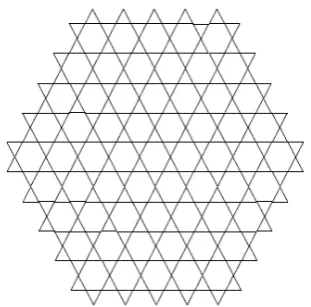
It is known that there exist three regular plane tilings with composition of some kind of regular polygons such as triangular, hexagonal and square. Triangular tiling is used in the construction of hexagonal networks. This network is symbolized by HXn, where n is the number of vertices in each side of hexagon. A hexagonal network of dimension six is shown in Figure 3.
Let G be the graph of a hexagonal network HXn. The graph G has 3n2–3n+1 vertices and 9n2–15n+6 edges. From Figure 3, it is easy to see that the vertices of HXn are either of degree 3, 4 or 6. Therefore ∆(G)=6 and δ(G)=3. Thus cu
= ∆(G) – dG(u) + 1 = 7 – dG(u). In G, by algebraic method, there are five types of edges based on the degree of end vertices of each edge as follows:
E34 = {uv∈E(G) | dG(u) = 3, dG(v) = 4}, |E34| = 12.
E36 = {uv∈E(G) | dG(u) = 3, dG(v) = 6}, |E36| = 6.
E44 = {uv∈E(G) | dG(u) = dG(v) = 4}, |E44| = 6n – 18.
E46 = {uv∈E(G) | dG(u) = 4, dG(v) = 6}, |E46| = 12n – 24.
E66 = {uv∈E(G) | dG(u) = dG(v) = 6}, |E66| = 9n2 – 33n + 30.
Thus there are five types of reverse edges as given in Tabe 3.
cu, cv\ uv∈E(G) (4, 3) (4, 1) (3, 3) (3, 1) (1, 1) Number of edges 12 6 6n – 18 12n – 24 9n2 – 33n + 30
Table-3: Reverse edge partition of HXn
In the following theorem, we determine the square reverse index of HXn.
Theorem 5: The square reverse index of a hexagonal network HXn is
QC(HXn) = 48n – 30.
Proof: From equation (1) and Table 3, we deduce
(
)
[
]
( )
2
n u v
uv E G
QC HX c c
∈
=
∑
−= (4–3) 212+(4–1) 26+(3–3) 2(6n–18) + (3–1) 2(12n – 24)+(1–1) 2(9n2–33n + 30) = 48n – 30.
In the following theorem, we calculate the square reverse polynomial of HXn.
Theorem 6: The square reverse polynomial of a hexagonal network HXn.
QC(HXn, x) = 6x9+(12n – 24)x4 + 12x1 + (9n2 – 27n + 12)x0.
Proof: From equation (2) and Table 3, we see that
(
)
[ ]( )
2
, cucv
n
uv E G QC HX x x −
∈
=
∑
4 32 4 12 3 32 3 12 2 1 12
12 6 6 18 12 24 9 33 30
x x n x n x n n x
= 6x9 + (12n – 24)x4 + 12x1 + (9n2 – 27n + 12)x0.
5. RESULTS FOR OXIDE NETWORKS
The oxide networks are of vital importance in the study of silicate networks. An oxide network of dimension n is denoted by OXn. A 5 -dimensional oxide network is shown in Figure-4.
V. R. Kulli*/ Square Reverse Index and its Polynomial of Certain Networks / IJMA- 9(10), Oct.-2018.
Let G be the graph of an oxide network OXn. From Figure 4, it is easy to see that the vertices of OXn are either of degree 2 or 4. Therefore ∆(G)=4. Thus cu = ∆(G) – dG(u) + 1 = 5 – dG(u). By calculation, we obtain that G has 9n2+3n
vertices and 18n2 edges. In G, by algebraic method, there are two types of edges based on the degree of end vertices of each edge as follows:
E24 = {uv∈E(G) | dG(u) = 2, dG(v) = 4}, |E24| = 12n.
E44 = {uv∈E(G) | dG(u) = dG(v) = 4}, |E44| = 18n2 – 12n.
Thus there are two types of reverse edges as given in Table 4.
cu, cv\ uv∈E(G) (3, 1) (1, 1) Number of edges 12n 18n2 – 12n
Table-4: Reverse edge partition of OXn
In the following theorem, we calculate the square reverse index of OXn.
Theorem 7: The square reverse index of an oxide network OXn is given by
QC(OXn) = 48n.
Proof: From equation (1) and using Table 4, we see that
(
)
[
]
( )
2
n u v
uv E G
QC OX c c
∈
=
∑
−= (3–1)212n + (1–1)2 (18n2 – 12n) = 48n.
In the following theorem, we calculate the square reverse polynomial of OXn.
Theorem 8: The square reverse polynomial of an oxide network OXn is given by
QC(OXn, x) = 12nx4 + (18n2 – 12n)x0.
Proof: From equation (2) and using Table 4, we see that
(
)
[ ]( )
2
, cu cv
n
uv E G QC OX x x −
∈
=
∑
3 12 2 1 12
12 18 12
nx n n x
= 12nx4 + (18n2– 12n)x0.
6. RESULTS FOR HONEYCOMB NETWORKS
Honeycomb networks are useful in Computer Graphics and Chemistry. A honeycomb network of dimension n is denoted by HCn, where n is the number of hexagons between central and boundary hexagon. A 4-dimensional honeycomb network is shown in Figure 5.
Figure-5: A 4-dimensional honeycomb network
Let G be the graph of a honeycomb network HCn. From Figure 5, it is easy to see that the vertices of HCn are either of degree 2 or 3. Thus ∆(G) = 3. Therefore cu = ∆(G) – dG(u) + 1 = 4 – dG(u). By calculation, we obtain that G has 6n2
vertices and 9n2–3n edges. In G, by algebraic method, there are three types of edges based on the degree of end vertices of each edge as follows:
E22 = {uv∈E(G) | dG(u) =dG(v) = 2}, |E22| = 6.
E23 = {uv∈E(G) | dG(u) = 2, dG(v) = 3}, |E23| = 12n – 12.
Thus there are three types of reverse edges as given in Tabe 5.
cu, cv\ uv∈E(G) (2, 2) (2, 1) (1, 1) Number of edges 6 12n – 12 9n2 – 15n + 6
Table-5: Reverse edge partition of HCn
In the following theorem, we derive the square reverse index of HCn.
Theorem 9: The square reverse index of a honeycomb network HCn is
QC(HCn) = 12n – 12.
Proof: From equation (1) and Table 5, we see that
(
)
[
]
( )
2
n u v
uv E G
QC HC c c
∈
=
∑
−= (2 – 2) 2 6 + (2 – 1)2 (12n – 12) + (1 – 1)2 (9n2 – 12n + 6) = 12n – 12.
In the following theorem, we derive the square reverse polynomial of HCn.
Theorem 10: The square reverse polynomial of a honeycomb network HCn is given by
QC(HCn, x) = (12n – 12)x1 + (9n2 – 15n + 12)x0.
Proof: From equation (2) and Table 5, we see that
(
)
[ ]( )
2
, cu cv
n
uv E G QC HC x x −
∈
=
∑
2 22 2 12 2 1 12
6 12 12 9 15 6
x n x n n x
= (12n2– 12)x1 + (9n2– 15n + 12)x0.
REFERENCES
1. I. Gutman and O.E. Polansky, Mathematical Concepts in Organic Chemistry, Springer, Berlin, (1986). 2. V.R.Kulli, College Graph Theory, Vishwa International Publications, Gulbarga, India (2012).
3. V.R.Kulli, On the square ve-degree index and its polynomial of certain oxide networks, Journal of Global Research in Mathematical Archives, (2018).
4. S.Ediz, Maximal graphs of the first reverse Zagreb beta index, TWMS J. App. Eng. Math. accepted for publication.
5. V.R.Kulli, Reverse Zagreb and reverse hyper-Zagreb indices and their polynomials of rhombus silicate networks, Annals of Pure and Applied Mathematics, 16(1) (2018) 47-51, DOI:http://dx.doi.org/ 10.22457/ apam.v16n1a6.
6. V.R. Kulli, On the sum connectivity reverse index of oxide and honeycomb networks, Journal of Computer and Mathematical Sciences, 8(9) (2017) 408-413.
7. V.R. Kulli, Geometric-arithmetic reverse and sum connectivity reverse indices of silicate and hexagonal networks, International Journal of Current Research in Science and Technology, 3(10) (2017) 29-33.
8. V.R. Kulli, On the product connectivity reverse index of silicate and hexagonal networks, International Journal of Mathematics and its Applications, 5(4-B) (2017) 175-179.
9. V.R. Kulli, Atom bond connectivity reverse and product connectivity reverse indices of oxide and honeycomb networks, International Journal of Fuzzy Mathematical Archive, 15(1) (2018) 1-5.
10. V.R. Kulli, Multiplicative connectivity reverse indices of two families of dendrimer nanostars, International Journal of Current Research in Life Sciences, 7(2) (2018) 1102-1108.
11. V.R.Kulli, Computation of F-reverse and modified reverse indices of some nanostructures, Annals of Pure and Applied Mathematics, 18(1) (2018) 37-43.
12. V.R. Kulli, General Zagreb polynomials and F-polynomial of certain nanostructures, International Journal of Mathematical Archive, 8(10) (2017) 103-109.
13. V.R.Kulli, General fifth M-Zagreb indices and fifth M-Zagreb polynomials of PAMAM dendrimers,
International Journal of Fuzzy Mathematical Archive, 13(1) (2017) 99-103.
14. V.R.Kulli, B.Chaluvaraju and H.S.Boregowda, Some degree based connectivity indices of Kulli cycle windmill graphs, South Asian Journal of Mathematics, 6(6) (2016) 263-268.
15. V.R. Kulli, Hyper-Revan indices and their polynomials of silicate networks, International Journal of Current Research in Science and Technology, 4(3) (2018).
16. V.R. Kulli, Revan indices and their polynomials of certain rhombus networks, International Journal of Current Research in Life Sciences, 7(5) (2018) 2110-2116.
V. R. Kulli*/ Square Reverse Index and its Polynomial of Certain Networks / IJMA- 9(10), Oct.-2018.
18. V.R.Kulli, Computing the F-ve-degree index and its polynomial of dominating oxide and regular triangulate oxide networks, International Journal of Fuzzy Mathematical Archive, 16(1) (2018) 1-6.
19. V.R.Kulli, Computing F-reverse index and F-reverse polynomial of certain networks, International Journal of Mathematical Archive, 9(8) (2018) 27-33..
20. V.R.Kulli, On augmented reverse index and its polynomial of certain nanostar dendrimers, International Journal of Engineering Sciences and Research Technology, 7(8) (2018) 237-243.
21. V.R.Kulli, On augmented Revan index and its polynomial of certain families of benzenoid systems,
International Journal of Mathematics and its Applications, (2018).
22. V.R.Kulli, Square Revan index and its polynomial of certain networks, submitted.
23. V.R. Kulli, Computation of some topological indices of certain networks, International Journal of Mathematical Archive, 8(2) (2017) 99-106.
Source of support: Nil, Conflict of interest: None Declared.