Available online throug
ISSN 2229 – 5046RADIATION EFFECTS ON THE PERISTALTIC FLOW
OF A JEFFREY FLUID THROUGH A POROUS MEDIUM IN A CHANNEL
B. RANJITHA
1AND M. V. SUBBA REDDY*
21Research Scholar, Department of Mathematics,
Rayalaseema University, Kurnool-518002, Andhra Pradesh, India.
2Professor, Department of CSE,
Sri Venkatesa Perumal College of Engineering & Technology, Puttur-517583, Andhra Pradesh, India.
(Received On: 07-08-18; Revised & Accepted On: 99-09-18)
ABSTRACT
I
n this paper, the flow of a Jeffrey fluid through a porous medium in a channel with peristalsis has received minute attention. Hence, an attempt is made to study the peristaltic flow of a Jeffrey fluid through a porous medium in a symmetric channel under the assumptions of long wavelength. The expressions for the velocity and pressure gradient are obtained analytically. The effects of various pertinent parameters on the pumping characteristics and temperature field are studied in detail with the aid of graphs.Keywords: Jeffrey fluid; Porous medium; Peristaltic flow; Radiation.
1. INTRODUCTION
The study of the mechanism of peristalsis in both mechanical and physiological situations has recently become the object of scientific research, since the first investigation of Latham [7]. Several theoretical and experimental attempts have been made to understand peristaltic action in different situations. A review of much of the early literature is presented in an article by Jaffrin and Shapiro [5]. A summary of most of the experimental and theoretical investigations reported with details of the geometry, fluid Reynolds number, wavelength parameter wave amplitude parameter and wave shape has been given by Srivastava and Srivastava [14].
Flow through a porous medium has been of considerable interest in recent years particularly among geophysical fluid dynamicists. Examples of natural porous media are beach sand, stand stone, limestone, rye bread, wood, the human lung, bile duct, gall bladder with stones and in small blood vessels. Flow through a porous medium has been studied by a number of workers employing Darcy’s law Scheidegger [13]. Some studies about this point have been made by Varshney [17] and Raptis and Perdikis [11]. The first study of peristaltic flow through a porous medium is presented by Elsehawey et al. [2]. Elsehawey et al. [3] studied peristaltic motion of a generalized Newtonian fluid through a porous medium. Non-linear peristaltic transport through a porous medium in an inclined planar channel has studied by Mekheimer [9] taking the gravity effect on pumping characteristics. Subba Reddy and Nadhamuni Reddy [15] have studied the peristaltic flow of a non-Newtonian fluid through a porous medium in a tube with variable viscosity using Adomian decomposition method.
Heat transfer analysis can be used to obtain information about the properties of tissues. For example, the flow of blood can be evaluated using a dilution technique. In this procedure, heat is either injected or generated locally and the thermal clearance is monitored. With knowledge of initial thermal conditions and the thermal clearance rate, it is possible to estimate blood flow rates. A review of thermal dilution techniques can be found elsewhere Bowman [1]. Understanding of bio-heat transport is important in the beneficial applications of heat and cold for medical treatment. Recent advances in the application of heat (hyperthermia), radiation (laser therapy), and coldness (cryosurgery), as means to destroy undesirable tissues, such as cancer, have stimulated much interest in the study of thermal modeling in tissue. In the case of hyperthermia, it is noted that tissue can be destroyed when heated to 42 – 45o C (Field and Franconi [4]). Vajravelu et al. [16] have studied the peristaltic flow of a Newtonian fluid in a vertical porous annulus
Corresponding Author: M. V. Subba Reddy*2, 2Professor, Department of CSE,
with heat transfer. The effect of heat transfer on the peristaltic flow of a Newtonian fluid in a vertical annulus under the effect of magnetic field was analyzed by Mekheimer and Elmaboud [10]. The influence of wall properties in the MHD peristaltic transport of a Newtonian fluid through a porous medium with heat transfer was studied by Kothandapani and Srinivas [6]. Influence of magnetic field and heat transfer on peristaltic flow of Jeffrey fluid through a porous medium in an asymmetric channel was studied by Vasudev et al. [18]. Mahmoud et al. [8] have investigated the effect of a heat transfer on the peristaltic transport of a Jeffrey fluid through a porous medium with magnetic field. Ravindranath Reddy et al. [12] have investigated influence of heat transfer on peristaltic flow of Jeffrey fluid through a porous medium in an inclined asymmetric channel.
However, the flow of a Jeffrey fluid through a porous medium in a channel with peristalsis has received minute attention. Hence, an attempt is made to study the peristaltic flow of a Jeffrey fluid through a porous medium in a symmetric channel under the assumptions of long wavelength. The expressions for the velocity and pressure gradient are obtained analytically. The effects of various pertinent parameters on the pumping characteristics and temperature field are studied in detail with the support of graphs.
2. MATHEMATICAL FORMULATION
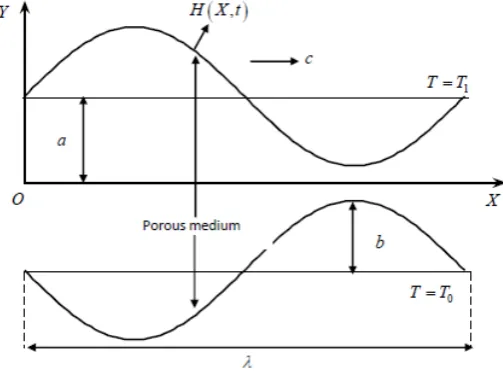
We Consider an incompressible Jeffrey fluid confined in a two-dimensional infinite symmetric channel through porous medium. We employ a rectangular coordinate system with parallel and normal to the channel walls. The symmetry in the channel is induced by assuming the peristaltic wave train on the walls to have different amplitudes and phases due to the variation of channel.
Fig. 1: The Physical Model
The shape of the symmetric channel wall is:
𝐻(𝑋,𝑡) =𝑎+𝑏𝑐𝑜𝑠2𝜋𝜆 (𝑋 − 𝑐𝑡) (2.1)
Here 𝑎 and 𝑏 are the amplitudes of the waves, 𝜆 is the wavelength.
The constitutive equations for an incompressible Jeffrey fluid are:
𝐼0=−𝑝𝐼+𝑆 (2.2)
𝑆=1+𝜆𝜇
1(𝛾̇+ 𝜆2𝛾̈) (2.3)
where 𝐼 and 𝑆 Cauchy stress tensor and extra stress tensor, respectively, 𝑝is the pressure, 𝐼 is the identity tensor, 𝜇is dynamic viscosity, 𝜆1is the ratio of relaxation to retardation times 𝜆2 is the retardation time, 𝛾̇is the shear rate and dots over the quantities indicate differentiation with respect to time.
In laboratory frame, the equations governing two-dimensional motion of an incompressible MHD Jeffrey fluid through a porous medium:
𝜕𝑈
𝜕𝑋+
𝜕𝑉
𝜕𝑌= 0 (2.4) 𝜌 �𝜕𝑈𝜕𝑡+𝑈𝜕𝑈𝜕𝑋+𝑉𝜕𝑈𝜕𝑌�=−𝜕𝑝𝜕𝑋+𝜕𝑋𝜕 (𝑆𝑋𝑋) +𝜕𝑌𝜕 (𝑆𝑋𝑌)− 𝜎𝐻02𝑈 −𝑘𝜇0𝑈 (2.5)
𝜌 �𝜕𝑉𝜕𝑡+𝑈𝜕𝑉𝜕𝑋+𝑉𝜕𝑉𝜕𝑌�=−𝜕𝑃𝜕𝑌+𝜕𝑋𝜕 (𝑆𝑋𝑌) +𝜕𝑌𝜕 (𝑆𝑌𝑌)−𝑘𝜇0𝑉 (2.6)
where 𝑈,𝑉 the velocity components in the laboratory frame are (𝑋, 𝑌) 𝜌 is the density, 𝑝 is the pressure and 𝜎 is the electrical conductivity of the fluid, 𝜁 is a specific heat at constant volume, 𝑇 is the temperature of the fluid, 𝑘 is the thermal conductivity of the fluid, 𝜇 is the kinematic viscosity, 𝑘0 is the permeability of the porous medium, 𝛼 is the coefficient of linear thermal expansion of the fluid and
𝑆𝑋𝑋 =1+𝜆2𝜇
1�1 +𝜆2�𝑈
𝜕
𝜕𝑋+𝑉
𝜕
𝜕𝑌��
𝜕𝑈
𝜕𝑋 (2.8)
𝑆𝑌𝑌=1+𝜆2𝜇1�1 +𝜆2�𝑈𝜕𝑋𝜕 +𝑉𝜕𝑌𝜕��𝜕𝑉𝜕𝑌 (2.9) 𝑆𝑋𝑌=1+𝜆𝜇1�1 +𝜆2�𝑈𝜕𝑋𝜕 +𝑉𝜕𝑌𝜕�� �𝜕𝑈𝜕𝑌−𝜕𝑉𝜕𝑋� (2.10)
We shall carry out this investigation in a coordinate system moving with the wave speed, in which the boundary shape is stationary. The coordinates and velocities in the laboratory frame (𝑋,𝑌), and the wave frame (𝑥,𝑦), are related by:
𝑥=𝑋 − 𝑐𝑡,𝑦=𝑌,𝑢=𝑈 − 𝑐,𝑣=𝑉,𝑝(𝑥) =𝑃(𝑥,𝑡),
where 𝑢,𝑣 the velocity components in the laboratory frame are (𝑋,𝑌), 𝑝 is the pressure and 𝑃 fixed frame references.
Introducing the non-dimensional parameters and variables 𝑥̅=𝑥𝜆 , 𝑦�= 𝑦
𝑎1 , 𝑢�=
𝑢 𝑐 , 𝑣̅=
𝑣 𝑐𝛿 , 𝑆̅=
𝑎1
𝜇𝑐𝑆 , 𝑝̅= 𝑝𝑎12
𝜇𝑐𝜆 , 𝑡̅= 𝑐𝑡
𝜆 , ℎ=
𝐻 𝑎 , 𝛿=𝑎𝜆 , 𝑅𝑒=𝜌𝑎𝑐
𝜇 , 𝜙=
𝑏 𝑎, 𝜃=
𝑇−𝑇0
𝑇1−𝑇0, 𝑃𝑟=
𝜌𝜐𝜁
𝑘 , 𝐸𝑐=
𝑐2 𝜁(𝑇1−𝑇0)
Using non-dimensional variables and parameters in Eqs. (2.4) - (2.6) we get
𝛿𝜕𝑢𝜕𝑥+𝛿𝜕𝑦𝜕𝑣 = 0 (2.11)
𝑅𝑒 𝛿 �𝑢𝜕𝑢𝜕𝑥+𝑣𝜕𝑢𝜕𝑦�=−𝜕𝑝𝜕𝑥+𝛿𝜕𝑆𝑥𝑥
𝜕𝑥 +
𝜕𝑆𝑥𝑦
𝜕𝑦 −
1
𝐷𝑎𝑢 −
1
𝑘𝑢 (2.12) 𝑅𝑒𝛿3�𝑢𝜕𝑣
𝜕𝑥+𝑣
𝜕𝑣
𝜕𝑦�=−
𝜕𝑝
𝜕𝑦+𝛿2 𝜕𝑆
𝑥𝑦
𝜕𝑥 +
𝜕𝑆𝑦𝑦
𝜕𝑦 −
𝛿2
𝑘 𝑣 (2.13)
𝑅𝑒𝛿 �𝑢𝜕𝜃𝜕𝑥+𝑣𝜕𝜃𝜕𝑦�=𝑃𝑟1 �𝛿2𝜕2𝜃
𝜕𝑥2+𝜕2𝜃𝜕𝑦2�+𝐸𝑐 �
4𝛿2�𝜕𝑢
𝜕𝑥�
2
+�𝜕𝑢𝜕𝑦�2
+𝛿4�𝜕𝑣
𝜕𝑥� 2
+ 2𝛿2 𝜕𝑢
𝜕𝑦 𝜕𝑣 𝜕𝑥
�+𝑅2𝜃 (2.14)
where 𝑅2=4𝛼2𝑑2
𝑘 is the radiation parameter, 𝐷𝑎= 𝑘
𝑎2 is the Darcy number, 𝑃𝑟=
𝜌𝜐𝜁
𝑘 is the Prandtl number, 𝐸𝑐=𝜁(𝑇𝑐2
1−𝑇0) is the Eckert number,
𝑆𝑥𝑥=1+𝜆2𝛿1�1 +𝛿𝑐𝜆𝑑12�𝑢𝜕𝑥𝜕 +𝑣𝜕𝑦𝜕��𝜕𝑈𝜕𝑥 𝑆𝑥𝑦=1+𝜆1
1�1 +
𝛿𝑐𝜆2
𝑑1 �
𝜕𝑢 𝜕𝑦 𝜕 𝜕𝑥− 𝜕 𝜕𝑦 𝜕𝑢
𝜕𝑥�� �
𝜕𝑢
𝜕𝑦+𝛿2 𝜕𝑣𝜕𝑥� 𝑆𝑦𝑦=1+𝜆2𝛿
1�1 +
𝛿𝑐𝜆1
𝑑1 �
𝜕𝑢 𝜕𝑦 𝜕 𝜕𝑥− 𝜕𝑢 𝜕𝑥 𝜕 𝜕𝑦��
𝜕2𝑢 𝜕𝑥𝑦
Under lubrication approach (i.e., 𝛿 ≪1and 𝑅𝑒 →0), the Equations (2.12) - (2.14) become:
0 =−𝜕𝑝𝜕𝑥+1+𝜆1
1
𝜕2𝑢
𝜕𝑦2−
1
𝐷𝑎(𝑢+ 1) (2.15)
0 =−𝜕𝑝𝜕𝑦 (2.16)
𝑑2𝜃
𝑑𝑦2+𝑅2𝑃𝑟𝜃=−𝑃𝑟𝐸𝑐 �𝜕𝑢𝜕𝑦�
2
(2.17)
The corresponding boundary conditions are
𝑢=−1 at 𝑦=ℎ (2.18) 𝜕𝑢
𝜕𝑦= 0 at 𝑦= 0 (2.19)
𝜕𝜃
𝜕𝑦= 0 at 𝑦= 0 (2.20)
𝜃= 1 at 𝑦=ℎ (2.21)
From Eq. (2.15) and (2.16), we write Eq. (2.15) as
0 =−𝑑𝑝𝑑𝑥+1+𝜆1
1
𝜕2𝑢
𝜕𝑦2−
1
𝐷𝑎(𝑢+ 1) (2.22)
The volume flux 𝑞 through each cross section in the wave frame is given by
The instantaneous volume flow rate 𝑄(𝑋,𝑡) in the laboratory frame between the centre line and the wall is
𝑄(𝑋,𝑡) =∫ 𝑈𝑑𝑌0𝐻 =∫0ℎ(𝑢+ 1)𝑑𝑦=𝑞+ℎ (2.24)
The average volume flow rate 𝑄� over one wave period �𝑇=𝜆
𝑐� of the peristaltic wave is defined as
𝑄�=1𝑇∫ 𝑄(𝑋,0𝑇 𝑡)𝑑𝑡=𝑞+ 1 (2.25)
3. SOLUTION
Solving Eq. (2.22) subject to the boundary conditions (2.18) and (2.19), we get 𝑢=�1+𝜆1
𝑁2 �
𝜕𝑝
𝜕𝑥�
𝑐𝑜𝑠ℎ𝑁𝑦
𝑐𝑜𝑠ℎ𝑁ℎ−1� −1 (3.1)
where 𝑁=�1+𝜆1
𝐷𝑎.
Using the Eq. (3.1) and solving the Eq. (2.17) subject to the boundary conditions (2.20) and (2.21), we get 𝜃=�1 +𝑃𝑟𝐸 �1+𝜆𝑁 �2�𝜕𝑝𝜕𝑥�22𝑐𝑜𝑠ℎ12𝑁ℎ�𝑐𝑜𝑠ℎ2𝑁ℎ4𝑁2+𝛼
1 2 +𝛼1
1
2�𝑐𝑜𝑠𝛼𝑐𝑜𝑠𝛼11𝑦ℎ�
−𝑃𝑟𝐸 �1+𝜆
𝑁 �
2
�4𝑁21+𝛼12� �𝜕𝑝𝜕𝑥�2 𝑐𝑜𝑠ℎ2𝑁𝑦2𝑐𝑜𝑠ℎ2𝑁ℎ+𝑃𝑟𝐸 �
1+𝜆
𝑁 �
2
�𝜕𝑝𝜕𝑥�2𝛼 1
122𝑐𝑜𝑠ℎ2𝑁ℎ (3.2)
where 𝛼1=𝑖𝑅√𝑃𝑟.
The volume flux 𝑞 through each cross section in the wave frame is given by 𝑞=∫ 𝑢 𝑑𝑦=�1+𝜆𝑁3�
𝜕𝑝
𝜕𝑥[𝑡𝑎𝑛ℎ𝑁ℎ − 𝑁ℎ]− ℎ
ℎ
0 (3.3)
From Eq. (3.3), we have 𝑑𝑝
𝑑𝑥=
(𝑞+ℎ)𝑁3
(1+𝜆1)[𝑡𝑎𝑛ℎ𝑁ℎ−𝑁ℎ] (3.4)
The heat transfer coefficient at the upper wall is defined by 𝑧=𝜕𝜃𝜕𝑦.𝜕ℎ𝜕𝑥�
𝑦=ℎ
=−𝛼1𝑡𝑎𝑛𝛼1ℎ − 𝑝𝑟𝐸( (𝑞+ℎ)2𝑁4
𝑡𝑎𝑛ℎ𝑁ℎ−𝑁ℎ)22𝑐𝑜𝑠ℎ2𝑁ℎ�𝛼1𝑡𝑎𝑛𝛼1ℎ �
𝑐𝑜𝑠ℎ2𝑁ℎ 4𝑁2+𝛼12 +𝛼1
12�+
4𝑠𝑖𝑛ℎ2𝑁ℎ
4𝑁2+𝛼12� (3.5)
4. DISCUSSIONS OF THE RESULT
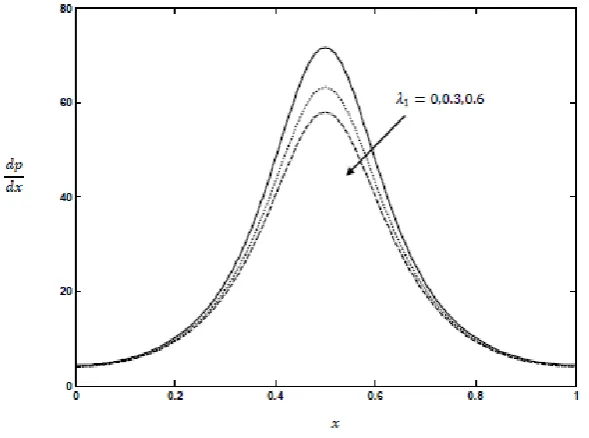
Fig. 2 depicts the variation of axial pressure gradient 𝑑𝑝
𝑑𝑥 with 𝜆1for 𝜙= 0.5 and 𝐷𝑎= 0.1. It is found that, the axial pressure gradient decreases on increasing the material parameter 𝜆1.
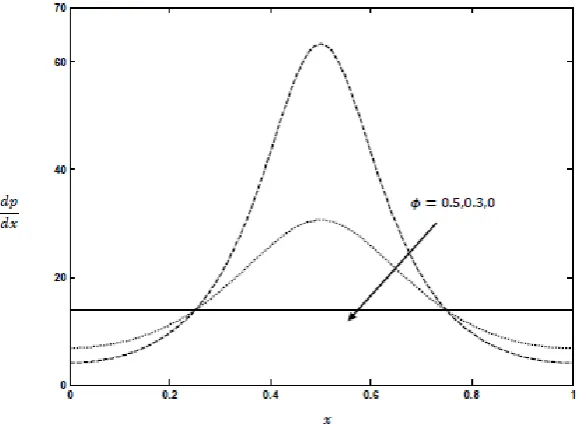
Fig. 3 shows the variation of axial pressure gradient 𝑑𝑝
𝑑𝑥 with 𝐷𝑎 for 𝜙= 0.5 and 𝜆1= 0.3. It is noticed that, the axial pressure gradient decreases with increasing Darcy number 𝐷𝑎.
Fig. 4 illustrates the variation of axial pressure gradient 𝑑𝑝
𝑑𝑥 with 𝜙for 𝜆1= 0.3 and 𝐷𝑎= 0.1. It is noticed that, the axial pressure gradient increases with an increase in amplitude ratio 𝜙.
Fig. 5 depicts the variation of pressure rise Δ𝑝 with 𝑄� for different values of 𝜆1 with 𝜙= 0.5 and 𝐷𝑎= 0.1. It is found that, the time-averaged flow rate 𝑄� decreases in both the pumping (Δ𝑝> 0) and the free-pumping(Δ𝑝= 0) regions with increasing 𝜆1, while it increases in the co-pumping (Δ𝑝< 0) region with increasing 𝜆1.
Fig. 6 illustrates the variation of pressure rise Δ𝑝 with 𝑄� for different values of 𝐷𝑎 with 𝜙= 0.5 and 𝜆1= 0.3. It is observed that, the time-averaged flow rate 𝑄� decreases in the pumping region with increasing 𝐷𝑎, while it increases in both the free-pumping and the co-pumping regions with increasing 𝐷𝑎.
Fig. 7 shows the variation of pressure rise Δ𝑝 with 𝑄� for different values of 𝜙 with 𝜆1= 0.3 and 𝐷𝑎= 0.1. It is noted that, the time-averaged flow rate 𝑄� increases in both the pumping and the free-pumping regionswith increasing 𝜙, while it decreases in the co-pumping region with increasing 𝜙 for chosen Δ𝑝(< 0).
Fig. 9 shows the temperature profiles for different values of 𝐷𝑎 with 𝜙= 0.5,𝜆1= 0.3, 𝑄�=−1, 𝑃𝑟= 0.7,𝐸𝑐= 0.1, 𝑅= 1 and 𝑥= 0.1. It is found that, the temperature 𝜃 increases with increasing Darcy number 𝐷𝑎.
Fig. 10 shows the temperature profiles for different values of 𝜙 with 𝜆1= 0.3,𝐷𝑎= 0.1, 𝑄�=−1, 𝑃𝑟= 0.7,
𝐸𝑐= 0.1, 𝑅= 1 and 𝑥= 0.1. It is found that, the temperature 𝜃 decreases with increasing amplitude ratio 𝜙.
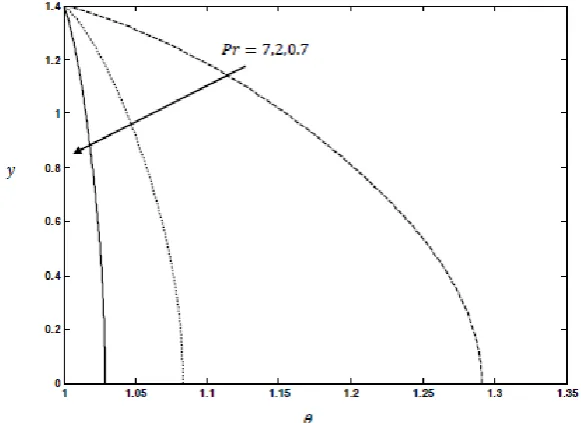
Fig. 11 depicts the temperature profiles for different values of 𝑃𝑟 with 𝜙= 0.5, 𝐷𝑎= 0.1, 𝑄�=−1, 𝜆1= 0.3,
𝐸𝑐= 0.1, 𝑅= 1 and 𝑥= 0.1. It is found that, the temperature 𝜃 increases with increasing Prandtl number 𝑃𝑟.
Fig. 12 illustrates the temperature profiles for different values of 𝐸𝑐 with 𝜙= 0.5,𝐷𝑎= 0.1, 𝑄�=−1,𝜆1= 0.3,
𝑃𝑟= 0.7, 𝑅= 1 and 𝑥= 0.1. It is found that, the temperature 𝜃 increases with increasing Eckert number 𝐸𝑐.
Fig. 13 shows the temperature profiles for different values of 𝑅 with 𝜙= 0.5,𝐷𝑎= 0.1, 𝑄�=−1,𝜆1= 0.3, 𝐸𝑐= 0.1,
𝑃𝑟= 0.7 and 𝑥= 0.1. It is found that, the temperature 𝜃 decreases with increasing 𝛼1.
Table-1shows the heat transfer coefficient 𝑍 at the upper wall 𝑦=ℎ for 𝑥= 0.1 and 𝑄�=−1. It is observed that the heat transfer coefficient 𝑍 increases with increasing 𝜆1,𝑃𝑟,𝜙 and 𝑅, while it decreases with increasing 𝐷𝑎 and 𝐸𝑐.
5. CONCLUSIONS
In this paper, we studied the radiation effects on the peristaltic flow of a Jeffrey fluid through a porous medium in a channel under the assumptions of low Reynolds number and long wavelength approximations. A closed form solutions are obtained for the velocity, temperature and the pressure gradient. It is found that, the axial pressure gradient and the time averaged volume flow rate decreases with increasing 𝜆1 and 𝐷𝑎, while they increases with increasing 𝜙. The temperature increases with increasing the parameters 𝐷𝑎,𝑃𝑟 and 𝐸𝑐, while it decreases with increasing the parameters 𝜆1,𝜙 and 𝑅.
Fig. 2: The variation of axial pressure gradient 𝑑𝑝
Fig. 3: The variation of axial pressure gradient 𝑑𝑝
𝑑𝑥 with 𝐷𝑎 for 𝜙= 0.5 and 𝜆1= 0.3.
Fig. 4: The variation of axial pressure gradient 𝑑𝑝
Fig. 6: The variation of pressure rise Δ𝑝 with 𝑄� for different values of 𝐷𝑎 with 𝜙= 0.5 and 𝜆1= 0.3.
Fig. 7: The variation of pressure rise Δ𝑝 with 𝑄� for different values of 𝜙 with 𝜆1= 0.3 and 𝐷𝑎= 0.1.
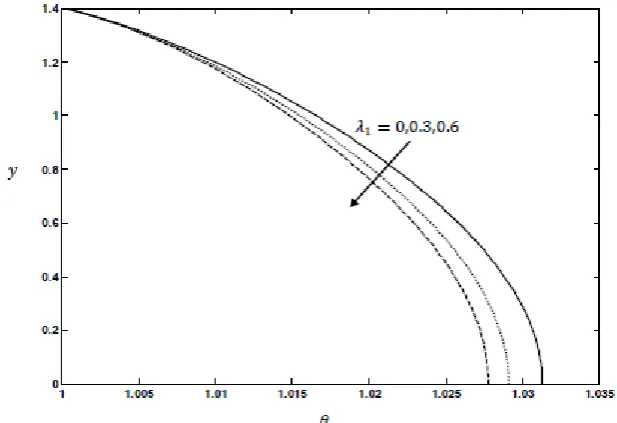
Fig. 8: Temperature profiles for different values of 𝜆1 with 𝜙= 0.5,𝐷𝑎= 0.1,𝑄�=−1, 𝑃𝑟= 0.7, 𝐸𝑐= 0.1, 𝑅= 1
Fig. 9: Temperature profiles for different values of 𝐷𝑎 with 𝜙= 0.5,𝜆1= 0.3,𝑄�=−1, 𝑃𝑟= 0.7,𝐸𝑐= 0.1, 𝑅= 1
and 𝑥= 0.1.
Fig. 10: Temperature profiles for different values of 𝜙 with 𝜆1= 0.3,𝐷𝑎= 0.1,𝑄�=−1, 𝑃𝑟= 0.7,𝐸𝑐= 0.1, 𝑅= 1
and 𝑥= 0.1.
Fig. 12: Temperature profiles for different values of 𝐸𝑐 with 𝜙= 0.5,𝐷𝑎= 0.1,𝑄�=−1, 𝜆1= 0.3, 𝑃𝑟= 0.7, 𝑅= 1
and 𝑥= 0.1.
Fig. 13: Temperature profiles for different values of 𝑅 with 𝜙= 0.5,𝐷𝑎= 0.1,𝑄�=−1,𝜆1= 0.3, 𝐸𝑐= 0.1, 𝑃𝑟= 0.7 and 𝑥= 0.1.
Table-1: The heat transfer coefficient 𝑍 at the upper wall 𝑦=ℎ for 𝑥= 0.1and 𝑄�=−1.
REFERENCES
1. Bowman, H. F. Heat Trans. Med. Biol., 1(1985), 193.
2. EL Shehawey, E.F., Mekheimer, Kh. S., Kaldas, S. F. and AFIFI, N. A. S. Peristaltic transport through a porous medium, J. Biomath., 14 (1999).
3. EL Shehawey, E.F., Sobh, A.M.F. and Elbarbary, E.M.E. Peristaltic motion of a generalized Newtonian fluid through a porous medium, . Phys. Soc. Jpn., 69(2000), 401-407.
4. Field, B and Franconi, C. Physics and Technology of Hyperthermia, Martinus Nijhoff Publishers, Dordrecht, 1987.
5. Jaffrin, M.Y. and Shapiro, A.H. Peristaltic Pumping, Ann. Rev. Fluid Mech., 3(1971), 13-36.
6. Kothandapani, M. and Srinivas, S. On the influence of wall properties in the MHD peristaltic transport with Heat Transfer and porous medium, Phys. A., 372(2008), 4586-4591.
7. Latham, T.W. Fluid motions in peristaltic pump, M.S. Thesis, MIT, Cambridge, Massachussetts, 1966. 8. Mahmoud, S.R., Afifi, N.A.S. and Al-Isede, H.M. Effect of porous medium and magnetic field on peristaltic
transport of a Jeffrey fluid, Int. J. Math. Analysis, 5(2011), 1025-1034.
9. Mekheimer KH.S. Non linear peristaltic transport through a porous medium in an inclined planar channel, J. Porous Media, 6(2003), 190-202.
10. Mekheimer KH.S. and ABD Elmaboud, Y. The influence of heat transfer and magnetic field on peristaltic transport of a Newtonian fluid in a vertical annulus: Application of an endoscope, Physics Letters A, 372(2008), 1657-1665.
11. Raptis, A. and Peridikis, C. Flow of a viscous fluid through a porous medium bounded by vertical surface, Int. J. Engng. Sci., 21(1983). 1327-1330.
12. Ravindranath Reddy, G., Ravi Kumar, S. and Raju, G.S.S. Influence of heat transfer on peristaltic flow of Jeffrey fluid through a porous medium in an inclined asymmetric channel, ARPN Journal of Engineering and Applied Sciences 12(9)(2017), 2962-2971.
13. Scheidegger, A. E. The physics of through porous media, McGraw-Hill, New York, 1963.
14. Srivastava, L.M. and Srivastava, V.P, Peristaltic transport of blood: Casson model II, J.Biomech., 17(1984), 821-829.
15. Subba Reddy, M. V. and Nadhamuni Reddy, C.Peristaltic flow of a non-Newtonian fluid through a porous medium in a tube with variable viscosity using Adomian decomposition method, International Review of Applied Engineering Research, 4(1)(2014), 137-146.
16. Vajravelu, K., Radharishnamacharya, G. and Radhakrishna Murthy, V. Peristaltic flow and heat transfer in a vertical porous annulus, with long wave approximation, Int. J. Non-Linear Mech., 42(2007), 754 – 759. 17. Varshney, C. L. The fluctuating flow of a viscous fluid through a porous medium bounded by a porous and
horizontal surface, Indian. J. Pure and Appl. Math., 10(1979), 1558.
18. Vasudev, C., Rajeswara Rao, U., Subba Reddy, M. V. and Prabhakara Rao, G. Influence of magnetic field and heat transfer on peristaltic flow of Jeffrey fluid through a porous medium in an asymmetric channel, ARPN Journal of Engineering and Applied Sciences, 5(12)(2010), 87-103.
Source of support: Nil, Conflict of interest: None Declared.