Research Article
a
November
2017
Computer Science and Software Engineering
ISSN: 2277-128X (Volume-7, Issue-11)
Design Patterns and Expert System for Online Admission
Systems
Madhuri P. Pant
Asst. Prof., BCA Dept., S.N.D.T. Arts and Commerce College for Women, Pune, S.N.D.T. Women‟s
University, India
Dr. Sachin A. Kadam
Professor in Computer Applications, Bharati Vidyapeeth University, Pune,
Maharashtra, India
Abstract---- After presenting Optimized framework for Online Admission Systems with Reference to Professional Programmes in previous research paper this paper presents Design patterns and Expert System for Online Admission Systems. Framework addressed using design pattern is easier to reuse, maintain, flexible and extensible. Strategy pattern and proxy pattern are used in the system. For requirements collection an expert system is developed which asks few questions regarding the requirements for the system and gives suggestions and approximate budget for the system to be build. Depending on number of students, system suggests three types of online admission systems namely Basic Admission System, Advanced Admission System and Premium Admission System. CLIPS tool is used to develop this expert system.
Keywords---- Online Admission System (OAS), Design patterns, strategy pattern, proxy pattern, class diagram, expert system, CLIPS
I. INTRODUCTION
Technology is integrated into nearly every aspect of education. It also shows its positive impact on student admissions, as admissions play a vital role in any University‟s / Institution‟s running. So Colleges and Universities have begun to rely on Web technology for admissions. [1] Use of Online Admission System is one of them. Online Admission System is defined as a service available and performed using the Internet where computer and other devices are connected with network to perform Admissions. Online Admission System will be useful to transform existing complex admission system into applicant or student-friendly, simpler, efficient, accurate, prompt and transparent system at affordable cost with high quality, greater speed and wider accessibility in a mass personalized manner.[2] Research paper is divided into two sections, in section 1 design patterns will be presented and in another expert system development will be explained.
Let us start with section 1 design patterns. Applications are dependent on framework. Changes to framework‟s design require redefinition of classes, reimplementation and retesting which is very expensive. So framework has to be flexible, extensible and maintainable as possible. Thus framework should accommodate new requirements and changes to existing requirements. Design Patterns are going to help in these situations. Similarly developing time of software is also minimized with the use of pattern, which in turn reduces the cost of development of the software [3]. Researchers work in domain of Online Admissions and already presented optimized framework for OAS in their previous paper. There are no design patterns for online admission systems. This has motivated them to find design patterns for online admissions application. Framework addressed with Design patterns will have all benefits mentioned above. Documentation format given by Erich Gamma, Richard Helm, Ralph Johnson and John Vlissides (collectively known as the "Gang of Four", or GoF for short) in their book “Design Patterns, Elements of Reusable Object-Oriented Software” is used in this research paper[4]. It contains the following sections:
Pattern Name: Design Patterns for Online Admission Systems
Intent: Intent behind finding the design patterns for Online Admission Systems is to provide for any organization an optimized framework to design, develop and maintain Online Admission System.
Motivation: Since last three years researchers are doing their research in domain of Online Admission Systems for Professional Programmes. There are no design patterns for online admission systems so this will be their contribution to research.
Applicability: Different educational organizations conducting admissions say from playgroup to post graduation, even doctoral programmes can use the system for their admissions.
ISSN(E): 2277-128X, ISSN(P): 2277-6451, pp. 86-97
1. Whole population of 46 Organizations except law who conducts Admissions for 8 Professional Programmes like Engineering and Technology, Management (MBA and MCA), Health Sciences, Agriculture, Pharmacy, Education ,Law under State and Deemed Universities in Maharashtra and IIT (Indian Institute of Technology) are considered for study by researchers. Process diagrams for all above organizations are drawn and studied. Different steps used in Online Admission System for above mentioned 46 Organizations„s Professional Programmes and IIT are identified from their process diagrams. For each Professional programme mentioned above generic diagram is drawn which combines all steps used in online Admissions. A Careful study reveals that many steps are common. Data mining technique is applied for steps used in Admission Processes using R data analysis software and its apriori algorithm in arules package which mine frequent steps in processes (using level-wise search for frequent itemsets) to find association rules[7][8].Parameters specified are confidence = 0.8, support = 0.53, target frequent. Researchers found Twelve (12) frequently occurring steps.
2. To verify above frequent admission steps in R, researchers also used WEKA Data Mining tool.
Same above data file is converted to Attribute-Relation File Format (ARFF) file. Using explorer in WEKA, FPGROWTH and APRIORI algorithms are applied. Following table gives Comparison Findings of both algorithms in R and WEKA data mining tool.
Sr.No. Parameter Apriori Fp-growth Remark
1 Working Apriori
1. Generate frequent itemsets of length 1
2. Repeat until no new frequent itemsets are identified
3. Take only itemsets whose support ≥ minsup
Principle : If an itemset is frequent, then all of its subsets must also be frequent
FP-Growth two step approach
1.First builds specialized data structures FP–tree 2.From Fp-tree extracts
frequent itemsets.
2 Working Simple FP-Growth uses more
complicated data structures & mining techniques
3 Speed More time Less time As only 47 rows
data is mined speed has not mattered
4 High
Support
Better Not better Support used is 0.53
so apriori better in R than in WEKA
5 Coding Simple Difficult
7 Implementat
ion in R
12 frequent steps found as restrictions can be applied
8 Implementat
ion in weka
6 frequent steps found 8 frequent steps found
9 Complexity Same Same
Frequent items found in WEKA are less than R. Using FPGROWTH 8 frequent admission steps are found. Using APRIORI 6 frequent Items are found. In R Using APRIORI 12 frequent Items are found. It is observed that admission steps are same.
3. Further evaluation of processes finds that Admission process varies and can be classified under main 5 processes as Admission Process 1, Admission Process 2, Admission Process 3, Admission Process 4 and Admission Process 5 which is used by above mentioned organizations for carrying out Online Admissions. 4. Researchers have proposed Optimized Framework for Online Admission System in their research paper.[5]
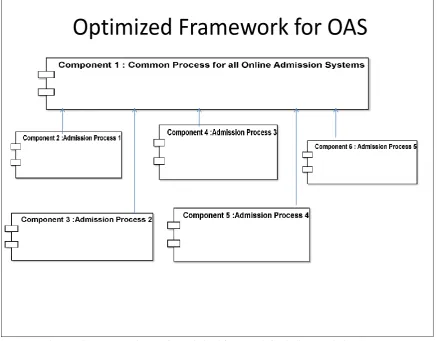
Following Figure 1 component diagram shows the same which consist of
ISSN(E): 2277-128X, ISSN(P): 2277-6451, pp. 86-97
Optimized Framework for OAS
Figure 1 Component Diagram for optimized framework for Online Admission System.
5. Now researchers will consider detailed steps in above components to build the design patterns.
6. First we will consider twelve (12) frequently occurring steps found in R, which are common for admission systems under the study in Component 1 are listed in TABLE I below and tried to find out deign patterns that can be applied. Design principles “Identify the aspects of application that vary and separate them from what stays the same. Take what varies and encapsulate it.” “Program to an interface, not an implementation.” “Favor Composition over Inheritance” [3] are used. Behavioral strategy pattern and structural proxy patterns can be applied.
7. Strategy pattern which defines a family of algorithms, encapsulates each one, and makes them interchangeable. Strategy lets the algorithm vary independently from clients that use it. Thus in five class diagrams figure 2, 3, 5 and 6 below behavioral strategy pattern is used and in figure 4 structural proxy pattern is used.
Table I Sr.No. Step Description
1 S2 Candidate applies online through dynamic website for Entrance Exam or Admissions 2 S4 Apply for online for entrance Exam for admission
3 S9 Gets Help to fill Online form in the form of audio-Video or Screenshots of the Form or Textual information
4 S13 Gets username and password
5 S15 Pay Entrance Exam Fees / Admission Registration Fees
6 S20 Fills Online Application Form For Entrance like Personal Information (Name, Email), Contact Details , Educational Information
7 S21 Uploads Photograph , signature and thumb impression
8 S22 Selects Exam's city , date and schedule online if flexible date and time are provided 9 S25 Receipt of Admit card / Hall Ticket
10 S30 Conduction of Entrance Exam
ISSN(E): 2277-128X, ISSN(P): 2277-6451, pp. 86-97
II. STRUCTURE
While finding out design patterns for Online Admission System we will make some changes in framing the statements which will be easy for designing class diagrams and understanding the working of system.
1) S2: Candidate applies online through dynamic website for Entrance Exam or Admissions. S4: Apply for online for entrance Exam.
Admission processes found by researchers varies and can be classified under main 5 processes as Admission Process 1, Admission Process 2, Admission Process 3, Admission Process 4 and Admission Process 5 all uses dynamic website, in figure III these different admission processes are named as DynamicADP1, DynamicADP2, DynamicADP3, DynamicADP4 and DynamicADP5 respectively. [6] Some organizations follow admission process using static website also. In figure III this admission processes is named as Staticprocess.
For finding design patterns we will combine S2, S4 and all varied admission processes mentioned above and phrase the statement as Applicant applies for admission using website. Website interface has admissionprocess() method which will be implemented by different admission processes found by researchers as shown in figure 2. Thus If any organization wants to vary the process also unintended consequences from code changes will not occur and system will be flexible.
Figure 2 Class Diagram giving Admission Processes in system using Strategy Pattern
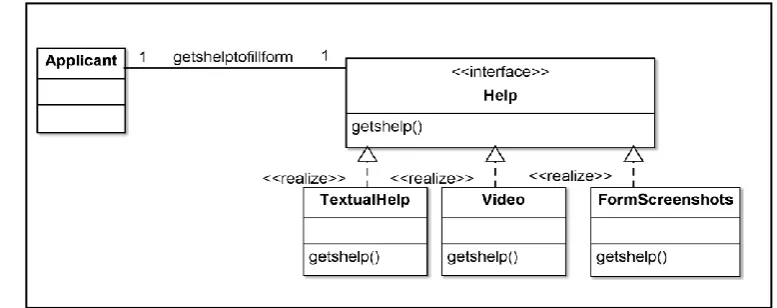
2) S9: Gets Help to fill Online form in the form of Video or Screenshots of the Form or Textual information As shown in design pattern in figure IV Interface Help contains getshelp() method which will be implemented in classes TexualHelp, Video and Form Screenshots using strategy pattern.
Figure 3 Class diagram showing how applicant gets help in system using Strategy Pattern
3) S13: Gets username and password: In Applicant class with method getuserrnamepassword() this statement can be implemented as shown in figure V class diagram.
ISSN(E): 2277-128X, ISSN(P): 2277-6451, pp. 86-97
Figure 4 Class diagram showing applicant pays Admission Registration Fees or Entrance Exam Fees using Net-Banking or Credit-Card or Debit-Card or E-challan or DD or cash using Proxy Pattern.
5) S20: Fills Online Application Form For Entrance like Personal Information (Name, Email) , Contact Details , Educational Information.
S21: Uploads Photograph , signature and thumb impression.
S22: Selects Exam's city, date and schedule online if flexible date and time are provided.
Using Strategy Pattern and Design Principle HAS-A relationship is better than IS-A relationship, thus Favor Composition over Inheritance for above mentioned steps researchers have designed class diagram in figure VI. It shows that one applicant fills one Admission Application or Entrance Exam Form. Researchers have thought that instead of extending the methods fillsinformation(), selects() and uploads() in class Admission_Application _or _Entrance _Exam_Form and using inheritance by applying IS-A relationship, we will use HAS-A relationship because Admission Application form HAS-A information to fill, select and things to upload consisting of family of algorithms and we have used composition of all these which allows flexibility in the system. Thus we have encapsulated family of algorithms into their own set of classes and thus used strategy pattern. Figure VI shows following interfaces
1. Interface InfotoFill consist of classes personalinfo to fill personal information, Contactinfo to fill contact information, Educationinfo to fill educational information, Healthinfo to fill health information all implementing method fillsinformation()
2. Interface selection consist of classes examcity , examdate and examschedule to select city, date and time (schedule ) by an applicant so that he/she can appear for Entrance Exam accordingly. Classes GDschedule and PIschedule will help applicant to choose schedule to appear for Group Discussion and Personal Interview respectively. All classes will implement method selects()
3. Interface Thingstoupload consist of classes photo, signature and thumbimpression which allows applicant to upload their photograph, signature and thumb impression by implementing method uploads().
ISSN(E): 2277-128X, ISSN(P): 2277-6451, pp. 86-97
6) S25: Receipt of Admit card / Hall Ticket S30: Conduction of Entrance Exam.
S35: Display of result or Merit List on website
For above steps while designing class diagram in figure VII we phrased them as 1. Applicant receives HallTicket.
2. Applicant appears for Entrance Exam. 3. Applicant gets Result Merit List on website.
Entrance Exam can be online or offline so for that strategy pattern is used as shown in figure VII where interface EntranceExam has conductsexam() method which will be implemented by classes OnlineExam and OfflineExam respectively.
Figure 6 Class diagram showing applicant appears for Entrance Exam using Strategy Pattern
By combining all above five class diagrams the whole class diagram for Online Admission System using Design patterns will be formed.
Participants: All class diagrams using Strategy Pattern show an interface common to all supported algorithms. Class diagram using Proxy Pattern also shows an interface so that payment can be done using any one of the algorithm.
Collaborations: Proxy forwards requests to appropriate object depending upon kind of proxy i.e. here payment option.
Consequences: Following are benefits and drawbacks of patterns
1. Encapsulating the algorithm or behavior in separate strategy classes allows to vary algorithms independently, makes easier to understand, maintain and extend.
2. Drawback is that number of objects increases. 3. Coding also increases.
Now we will start with section 2. As above section will help to design online admission system, next research work is to develop an expert system for online admission system.
To design an expert system which will collect the admission system requirements, questions are designed by taking the help of above twelve steps mentioned in Table I and admission processes as follows
1. Admission Process1 consists of following steps
1) Along with Entrance Exam Result / Merit list, Counseling Schedule for Admissions is also displayed on website.
2) According to counseling schedule student has to confirm his/her admission. 2. Admission Process2 consists of following steps
1) After Entrance Exam Result Provisional Merit list is displayed on website, students can apply for grievances if any in result or Merit List within specified period.
2) Final Merit List and Counseling Schedule for Admissions is also displayed on website. 3) According to counseling schedule student has to confirm his/her admission.
3. Admission Process3 consists of following steps
1) After Entrance Exam Result Short List for GD(Group Discussion) and or PI (Personal Interview) and or WAT (Writing Ability Test) is displayed on website.
2) After GD(Group Discussion) and or PI (Personal Interview) and or WAT (Writing Ability Test) list of selected candidates and Counseling Schedule is displayed on website.
ISSN(E): 2277-128X, ISSN(P): 2277-6451, pp. 86-97
1) After Entrance Exam Result, Score Cards are available to download from website. 2) Apply again online for centralized admission process.
3) Provisional Merit list is displayed on website.
4) Students can apply for grievances if any in Merit List within specified period. 5) Final Merit List is displayed on website.
6) Option Form filling for different college choices is provided online.
7) According to Merit list and Options given seat allocation is displayed on website. 8) Applicant has to confirm admissions according to seat allocation.
5. Some organizations uses static website for admissions.
III. DESIGN AND DEVELOPMENT OF EXPERT SYSTEM
An Expert System is software that uses expert knowledge to solve complex problem by reasoning about knowledge, represented primarily as if–then rules. Expert system is developed in CLIPS 6.3 [9] which is an expert system tool. CLIPS is designed to facilitate the development of software to model human knowledge or expertise. CLIPS is an acronym for C Language Integrated Production System. In expert system researchers have represented the knowledge in CLIPS using Rules, which are primarily intended for heuristic knowledge based on experience and Deffunctions and generic functions, which are primarily intended for procedural knowledge [8].CLIPS is not primarily designed for number-crunching, so approximate costs are added for each feature added in system using facts. Expert System will be helpful for stakeholders, first for organizations who want an Online Admission System for their Admissions and for third party organizations who want to design and develop Online Admission System. Expert system designed for Online Admissions uses deffunctions and defrules, to ask questions for collecting requirements for admission system and according to input requirements suggest the Online Admission that can used to build actual system and its features, along with approximate cost of each feature. Costing is calculated after discussion with experts who are in business of website developments.
While designing Expert System first point considered is for how many number of students System is to be build? So expert system will ask first question as
Question1: For how many number of student's Admission you want to the build Admission System (less than 100/ more than 100 less than500/more than 2000) Enter choice as 100 or 500 or 2000?
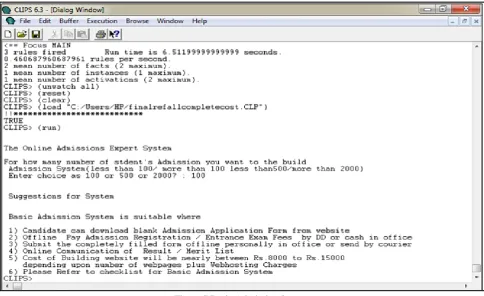
If Admission system is to be designed for less than 100 students Expert system suggest Basic Admission System having static website and Cost of Building website will be nearly between Rs.8000 to Rs.15000 depending upon number of web pages plus Webhosting Charges. Output is as follows Figure 7 shows output in CLIPS window as follows
ISSN(E): 2277-128X, ISSN(P): 2277-6451, pp. 86-97
If Admission system is to be designed for more than 500 but less than 2000 students Expert system suggests Advanced Admission System having dynamic website. As website is dynamic depending on number dynamic web pages cost will vary approximately considering minimum cost as Rs. 20,000 and maximum Rs. 40,000.
As website is dynamic, Admission Form/Entrance Exam Form has to be filled online, so help should be available to the applicants before filling the form which can be provided using
1) Video of form filling process 2) Screenshots of the form to be filled. 3) Textual instructions to fill form. So expert system further asks question as.
Question2: How help to fill Admission Form is to be provided (Using video/screenshotsofform/text) Enter choice as video or screenshots or text?
1. If video is used for helping applicant to fill form Rs. 20000 including third party video player facility will be additional cost. ( variable video size constraints may apply depending on hosting space)
2. If Screenshots of the form to be filled is used for helping applicant to fill form Rs. 5000 to Rs. 8000 will be additional cost.
3. If Textual instructions to fill form are used Rs. 1000 to Rs.2000 will be more than basic price
To pay admission registration fees / Entrance Exam fees, two payment options are to be chosen from given 6 options.
1. Net-Banking 2. Debit-Card 3. Credit-Card 4. E-challan
5. DD
6. Cash
According to choice expert system will give approximate cost to implement each payment mode chosen, for this expert system asks question
Question3: Which payment mode you will opt for (net-banking/debitcard/creditcard/echallan/dd/cash)? Enter choice as : nebanking or debitcard or creditcard or echallan or dd or cash
1. If Net-Banking or Credit-Card or Debit-Card is used for payment additional cost of Rs. 5000 is for linking and processing response and developer is need to purchase payment gateway from third party service provider. Approximate cost of payment gateway ranges from Rs. 10000 to Rs.40000. Plus 1.25 to 4% commission cutting depending upon amount to be paid. Thus total cost vary from 40,000 to 90,000 depending upon payment gateway chosen cost vary depends upon setupcost, annual maintenance charges, plan chosen etc.
2. For E- challan and DD Dynamic forms has to be developed depending on complexity of the form charges range from Rs 2000 to Rs 5000 per dynamic page depending on complexity of contents. So total cost vary from 22000 to 45000.
3. For cash applicant has to contact admission office personally.
Once the two options of payment mode for admission registration fees is chosen expert system asks whether Entrance Exam is compulsory for admissions for that question framed is as follows
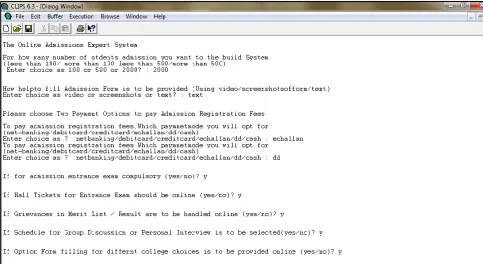
Question4: If for admission entrance exam compulsory (yes/no)? : yes no or y n
If above question is answered as yes then Hall Tickets / Admit cards has to be issued so expert system asks question as follows
Question5: If Hall Tickets for Entrance Exam should be online (yes/no)? yes no or y n
If above question is answered as yes then Hall Tickets / Admit cards will be available online to download from website. This will be suggestion for system to build.
If Entrance Exam is not compulsory then expert system will not ask Hall Ticket question.
ISSN(E): 2277-128X, ISSN(P): 2277-6451, pp. 86-97
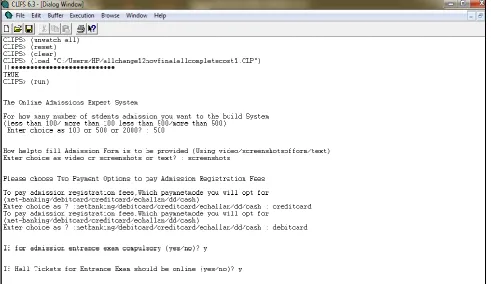
If Hall tickets are to be available online approximate additional cost is Rs. 5000 to 8000. Input and outputs of Expert system are as shown in Figure 8 and Figure 9 respectively.
Figure 8 showing Input for Expert System
Figure 9 showing output of Expert System giving suggestions for Advanced Online Admission System
ISSN(E): 2277-128X, ISSN(P): 2277-6451, pp. 86-97
1) Help Available online using video or screenshots or textual instructions.
2) Two payment options for Payment of Entrance Exam / Admission Registration fees. 3) Whether Entrance Exam is compulsory?
4) Whether Hall Ticket should be available online? In addition to this system adds more features as follows
1) Handling grievances in Result/Merit List for this expert system asks question
Question6: If Grievances in Merit List / Result are to be handled online (yes/no)? yes no or y n
If above question is answered as yes then Admission System will include the process for handling grievances correspondingly design the grievance handling form in admission system.
This covers Admission Process2 as mentioned above.
Per dynamic form cost is Rs.1000 minimum till Rs. 4000 depends on complexity in forms. Considering 4 dynamic forms, this feature will cost additional charge as Rs. 4000 to Rs.16000.
2) Selection of schedule (Date , Time for GD (Group Discussion) and or PI (Personal Interview)) for this expert system asks question
Question7: If Schedule for Group Discussion or Personal Interview is to be selected (yes/no)? Yes no or y n
If above question is answered as yes then Admission System will include the dynamic forms to select date and time for Group Discussion and or Personal Interview corresponding logic and data storage of each candidate‟s schedule. This covers Admission Process3 as mentioned above.
Per dynamic form cost is Rs.1000 minimum till Rs. 4000 depends on complexity in forms, as above feature requires additional data storage and retrieval facility and complexity is also more, cost varies from Rs. 3000 to 6000 additional.
3) Option Form filling for different college choices, for this expert system asks question
Question8: If Option Form filling for different college choices is to be provided online (yes/no)? Yes no or y n
If above question is answered as yes then Admission System will include the dynamic forms depending on number of colleges, last year‟s cut off percentage of colleges, number of options to be filled, choices for different courses etc, according to the requirements of organization who wants to design Online Admission System. This covers Admission Process4 as mentioned above.
Per dynamic form cost is Rs.1000 minimum till Rs. 4000 depends on complexity in forms. Considering maximum 10 dynamic forms cost will vary from 10000 to 40000 as additional cost to implement option form filling process.
Approximate cost for each facility is provided by expert system. According to requirements of Online Admission System cost varies.Input and outputs of Expert system are as shown in Figure 10 and Figure 11 respectively.
ISSN(E): 2277-128X, ISSN(P): 2277-6451, pp. 86-97
Figure 11 showing output of Expert System giving suggestions for Premium Online Admission System
The expert system above gives approximate budget of Online Admission System to be developed. To estimate efforts and to identify size metrics and cost factors of OAS, web application following inputs required are
1) Number of Static Web pages 2) Number of Dynamic Web pages
3) The number of functions and features to be offered by an application. 4) Total number of developers who will help develop the Web application
5) Developers‟ average number of years of experience with the development tools employed 6) The choice of the main programming language used
ISSN(E): 2277-128X, ISSN(P): 2277-6451, pp. 86-97
So Number of person hours required = cost / cost of development per hour = Number of person hours Number of person months = Number of person hours / 120 = Number of person months. Thus according to user‟s requirements cost and size of online admission to be developed can be estimated.
IV. CONCLUSION
In above research paper researchers have proposed a class diagram using Design Patterns and principles for Online Admission System. Proposed Design Patterns for Online Admission Systems contributes to research by helping any organization to develop reusable, extensible and maintainable software for their admissions. The designed expert system has covered all admission processes in designed framework of the researchers for Online Admission System. Expert system for Online Admission Systems contributes to research by collecting the requirements from any organization who wants to design and develop Online Admission system for their admissions. Expert System suggests the Admission System to be used along with approximate costing. Cost and effort estimations can be also calculated. All stakeholders of Online Admission System will be definitely benefited with this expert system.
REFERENCES
[1] 2007 NACAC White Paper by the National Association for College Admission Counseling. Printed in the United States of America. “Technology in the College Admission Process:Impact on Process, Professionals and Institutions.
[2] www.oasis.mkcl.com
[3] Eric Freeman, Elisabeth Freeman, Kathy Sierra, Beth Bates, “Head First Design Patterns” , 2004 Published by O'reilly Media Inc United States of America.
[4] Erich Gamma, Richard Helm, Ralph Johnson and John Vlissides “Design Patterns, Elements of Reusable Object-Oriented Software” 1995, Published by Pearson Education,Inc.
[5] Mrs. Madhuri P. Pant, Dr. Sachin A. Kadam “Optimized Framework for Online Admission Systems with Reference to Professional Programmes” IOSR Journal of Computer Engineering (IOSR-JCE) e-ISSN: 2278-0661,p-ISSN: 2278-8727, Volume 18, Issue 2, Ver. II PP 01-17 www.iosrjournals.org
[6] Mrs. Madhuri P. Pant, Dr. Sachin A. Kadam” Technology Impact on Admission Systems with Reference to Professional Programmes in Maharashtra.” IOSR Journal of Computer Engineering (IOSR-JCE) e-ISSN: 2278-0661,p-ISSN: 2278-8727, Volume 17, Issue 5, Ver. IV (Sep. – Oct. 2015), PP 07-18 www.iosrjournals.org [7] Michael Hahsler, Christian Buchta, Bettina Gruen and Kurt Hornik. “Package „arules‟ Mining Association
Rules and Frequent Itemsets” http://lyle.smu.edu/IDA/arules September 21, 2015
[8] Yanchang Zhao([email protected] www.RDataMining.com R and “Data Mining: Examples and Case Studies” August 7, 2014
[9] Joseph C. Giarratano, Ph.D. CLIPS User‟s Guide Version 6.30
[10] Robert Savely, Chris Culbert “ CLIPS Reference Manual CLIPS Basic Programming Guide Version 6.30” March 17th 2015