733
© 2017 by the Serbian Biological Society How to cite this article: Koç E. Alleviation of Phytophthora capsici-induced oxidatıve stress by foliarly applied proline in Capsicum annuum L. Arch Biol Sci. 2017;69(4):733-42.
Alleviation of
Phytophthora capsici
-induced oxidatıve stress by foliarly applied proline in
Capsicum annuum
L.
Esra Koç
Ankara University, Faculty of Science, Department of Biology, 06100, Ankara, Turkey
E-mail: [email protected]; [email protected]; [email protected]
Received: July 14, 2016; Revised: October 22, 2016; Accepted: December 1, 2016; Published online: December 15, 2016
Abstract: Phytophthora capsici is a highly destructive pathogen of pepper. To examine whether proline modifies the levels of
plant defense compounds produced in response to P. capsici-inducedstress, pepper seedlings were infected with P. capsici-22
in the presence of proline (1 mM, 10 mM) or in its absence. Proline was sprayed on the leaves of CM-334 and Kekova pepper
cultivars prior to inoculation. CM-334 was more resistant to P. capsici-22, while the Kekova cultivar exhibited a sensitive
reaction. P. capsici-22 increased the total phenolic compound and H2O2 levels, as well as phenylalanine ammonia-lyase,
polyphenol oxidase and peroxidase activities in pepper seedlings. The application of exogenous proline further increased the activities of phenylalanine ammonia-lyase, polyphenol oxidase and peroxidase, as well as the total levels of phenolic
compounds and the fresh and dry weights of the plants on the 5th and 7th days post treatment. After proline application, the
highest catalase activity was found in both cultivars on the 5th day of the 10 mM proline + P. capsici application. On all days
of the experiment, the applications caused a decrease in disease severity, necrosis length and H2O2 levels in both cultivars. In
addition, proline decreased the colony growth of P. capsici and the number of zoospores. This finding indicates that enzymes
and total phenolic compound levels protect the pepper seedlings against stress-related damage. Moreover, proline has the
potential to directly scavenge free radicals and promote enzyme activity in pepper seedlings under P. capsici stress. These
results suggest that foliar application of proline is an effective way to improve the stress tolerance of pepper to P. capsici.
Key words: antioxidants; Capsicum annuum; Phytophthora root rot; proline; oxidative stress tolerance
INTRODUCTION
P. capsici is an important oomycete plant pathogen that results in significant losses worldwide. Phytoph-thora root rot caused by P. capsici is one of the most destructive soilborne diseases of pepper (Capsicum annuum L.) production worldwide [1]. P. capsici is detected in many plant species and is known to infect more than 45 cultivated species, including cucurbits, pepper, tomato, eggplant, watermelon, cocoa, pump-kin, squash, snap and lima beans [2-3]. Phytophthora root rot is found on the roots, stems, leaves and fruits of the plant. P. capsici has been reported at locations worldwide, including North and South America, Asia, Africa and Europe [4]. P. capsici results insignificant product loss in the Marmara, Aegean, Mediterranean, Black Sea and southeastern regions of Turkey, which are all areas with significant pepper cultivation [5].
P. capsici was first described on chili pepper in New Mexico [2]. As reported in previous pepper breeding studies, it is unfortunately not possible to obtain a pepper culture resistant to all P. capsici iso-lates. Studies on pepper have also shown that the use of chemicals against pepper root rot is not significant-ly effective [6]. These chemicals also have a negative impact on human health, they pollute the environ-ment, decrease plant quality and increase the cost of the product. Therefore, the use of resistant varieties represents the safest way to grow pepper.
macromolecules from denaturation [8]. Proline can also protect cellular and subcellular membranes from oxidative stress [9]. The regulation of proline metabo-lism in plants under growth-related and abiotic stress conditions has been undertaken, and several reports indicate that the exogenous application of proline can play an important role in enhancing plant tolerance to abiotic stresses. While these studies mostly focused on abiotic stress, there is little information on the effects of exogenous proline application to plants exposed to biotic stress. Reviewing the literature has revealed that there are no studies or data concerning the effect of exogenous proline application to pepper seedlings exposed to P. capsici stress, or of the effect of proline on P. capsici colony growth and numbers of zoospores.
Thus, the aim of this study was to determine to the extent to which exogenous application of proline could change certain physiological parameters, such as phenylalanine ammonia-lyase (PAL), polyphenol oxidase (PPO), peroxidase (POX) and catalase (CAT) activities, the total amounts of phenolic compounds and hydrogen peroxide (H2O2), as well as the fresh and dry weights, disease severity and the length of necro-sis. These parameters are accepted as indicators of dis-ease resistance and of responses to pathogen infection in two pepper cultivars with different sensitivities to P. capsici. In addition, the effect of proline application on
P. capsici colony growth and number of zoospores was investigated. It is expected that the obtained data will stimulate novel approaches to P. capsici control and open the way for similar applications in other species.
MATERIALS AND METHODS Plant material
Criollo de Morelos 334 (CM-334) and Kekova pep-per (Capsicum annuum L.) cultivars were used. The cultivar CM-334 is resistant to the P. capsici pathogen [10]. CM-334 was supplied by the French National Institute for Agriculture Research (INRA) (Montfavet, France). Kekova is a highly productive cultivar that is commercially grown in Turkey, but is susceptible to the disease. The Kekova pepper cultivar was supplied by the Antalya Agricultural Production and Market-ing ConsultMarket-ing Corporation (Antalya, Turkey). After germination, pepper seedlings were sown in a plastic
pot containing a steam-sterilized soil/fertilizer/sand mix (at a ratio of 1/1/1, v/v/v). The plants were grown in a growth chamber under controlled environmental conditions (25±2°C and 16-h light, 8-h dark photope-riods). At the end of two months, the seedlings were collected once they reached the six-leaf stage.
Preparation of Phytophthora capsici Leon.-22 zoospore suspension
P. capsici-22 was obtained from the fungal culture collection of Ankara University, Faculty of Agricul-ture, Ankara, Turkey, and was grown on V8-juiceagar plates at 25ºC in the dark [11]. Zoospores were pro-duced from the mycelia. Zoospore production and spore concentrations were determined as described previously [12-13]. The concentration of 104 zoospores
mL-1 was the desired inoculum concentration and the
optimal zoospore concentration for causing the dis-ease in pepper. This concentration was obtained by diluting with sterile distilled water that had several drops of Tween-20 (to collect spores) per L.
Proline treatment and plant inoculation
back to the growth chamber and incubated for three days at 22±3ºC, 60% humidity and a 14-h light period. The inoculation procedure [13] was carried out 72 h after proline application. A 100 mL zoospore suspen-sion (104 zoospores mL-1) was placed into 250-mL
bea-kers; sterile water served as the control. The seedling bunches (only the roots) were dipped in the solutions inside the beakers for 1 h, and then returned to the glass bottles which were placed in the growth chamber. Hoagland’s solution was renewed at an interval of two days to avoid excessive depletion of any particular ion, and continuously aerated by an air pump throughout the duration of the experiment. Under the same condi-tions, random samples were taken on the 3rd, 5th and
7th days according to the random blocks trial pattern
model. The leaves were separated, frozen in liquid ni-trogen and ground in a pre-chilled mortar, put into nylon bags, labeled and stored at -70ºC until analysis.
Disease severity and necrosis length
The two pepper cultivars’ responses to the P. capsici-22 isolate were examined under controlled conditions. For each measurement, a separate experiment as-sembly was prepared. The two pepper cultivars were exposed to three different treatments: P. capsici alone; 1 mM proline + P. capsici; 10 mM proline + P. capsici. Each treatment was replicated three times, and each replicate had 15 plants (in a glass bottle containing 400 mL of Hoagland solution). The plants were incu-bated for three days at 22±3ºC, 60% humidity and a 14 h light period so that they could acclimatize. The 1 mM and 10 mM proline solutions were sprayed before inoculation. Distilled water was applied to the control groups. The inoculation procedure [13] was carried out 72 h after the application of proline. The disease severity caused by a 104 zoospore mL-1 concentration
on the six leaf pepper cultivars subjected to a pretreat-ment with proline (either 1 mM or 10 mM proline) was determined based on a 0 to 5 scale (0 − no vis-ible disease symptoms; 1 − leaves slightly wilted with brownish lesions beginning to appear on the stems; 2 − stem lesions extending to the cotyledons, defoliated first and second leaves; 3 − stem lesions extending to the second leaves, yellowing or defoliation of some upper leaves; 4 − long, brownish lesions on stems ex-tending up to 10 cm, all leaves except the uppermost leaf defoliated, seedling tissues collapsing and wilted
shoots; 5 − plant dead) [14]. Following the treatment and inoculation, average disease severity and necrosis lengths were determined on the 3rd, 5th and 7th days.
The disease severity index was calculated according to the following formula:
∑ (number of plants x scale value) /total number of plants.
Measurement of fresh and dry weights of leaves
The fresh weights of the leaves of the pepper cultivars were determined using a precision balance (±0.1 g). The dry weight of the leaves was determined by plac-ing the leaves in a dryplac-ing oven set to 60°C until they reached a constant weight, and measuring their dry weights with a precision balance (±0.1 g). The mea-surements were carried out in three repetitions; five seedlings were used in each repetition.
Determination of phenylalanine ammonia-lyase (PAL: EC 4.3.1.5) activity
PAL was extracted from the leaves as described [15]. The supernatant was collected and used as the enzyme extract. The assay mixture was incubated for 1 h at 37°C and the reaction was terminated by adding 0.5 mL of 6 M HCl. The increase in absorbance over a 1-min period was recorded with a spectrophotometer at 290 nm [16]. The calibration curve was constructed using cinnamic acid.
Determination of polyphenol oxidase (PPO: EC 1.10.3.1) activity
PPO was extracted from the leaves, and the increase in absorbance over a 1-min period was recorded with a spectrophotometer at 420 nm [17].
Determination of peroxidase (POX: EC 1.11.1.7) activity
Determination of catalase (CAT: EC 1.11.1.6) activity
CAT was extracted from the leaves, and the enzyme activity was determined using the extinction coeffi-cient (39. 4 mM-1cm-1) of H
2O2 [19].
Analysis of phenolic compounds
Phenolic compounds were extracted by applying 80% methanol in a water bath (80°C) for 15 min, and the extracts were centrifuged for 10 min at 500xg, after which the pellets were re-extracted [20]. The Folin-Ciocalteu method was used to determine the level of phenolic compounds [21]. The phenolic compound content was calculated using gallic acid as a standard, and expressed per g of fresh weight.
Determination of the H2O2 content
Samples were homogenized in 5 mL of 0.1% (w/v) TCA in an ice bath. The homogenate was centrifuged at 12000×g for 15 min, and then 0.5 mL of the super-natant was added to 10 mM of potassium phosphate buffer (pH 7.0), followed by 1 mL of 1M KI. The ab-sorbance of the supernatant was measured at 390 nm. The content of H2O2 was calculated from a standard calibration curve previously made using different con-centrations of H2O2 [22].
Statistical analysis
The normal distribution of the data obtained in the study was checked using the Anderson-Darling test. The variance homogeneity of the subgroups was checked using the Levene test. Variance analysis (ANOVA-factorial design: cultivar×day×treatment) was conducted using a test arrangement in which data analysis was completely random. The trials were ar-ranged to create an experimental design with three repetitions in randomized blocks. A 5% significance level was used in Tukey tests and in the interpretation of the result. All calculations were performed using the Minitab 16 package software. Based on the vari-ance analyses conducted for all the properties, the cultivar×day×treatment triple interactions were found to be statistically significant (p<0.01).
RESULTS
Disease severity index and stem necrosis length
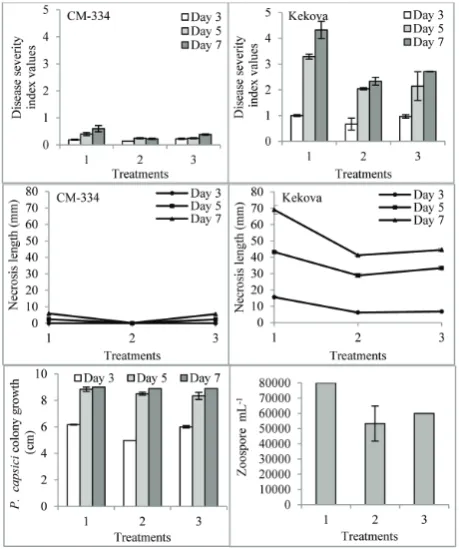
Disease severity was determined according to the in-dex of disease scale values for the 15 seedlings (for each repetition). These were evaluated according to the 0-5 scale and are presented in Fig. 1 for the 3rd, 5th
and 7th days of observation. Based on variance
analy-sis, the cultivar×treatment×day interaction for the disease severity index values and necrosis length of the two pepper cultivars were found to be statistically significant (p<0.01) (Fig. 1).
In the P. capsici-22 isolate, the two pepper cul-tivars were compared in terms of the severity of the infection on the 3rd, 5th and 7th days. Following
infec-tion, the highest level of disease severity and necrosis length were observed in the Kekova cultivar (p<0.05). Compared with the sample exposed to P. capsici alone,
proline application before inoculation decreased the disease severity index and the necrosis length in two pepper seedlings. The difference between them was found to be statistically significant. The 1 mM proline + P. capsici treatment was the most effective treatment in both cultivars (p<0.05) (Fig. 1).
The effect of proline application on the P. cap-sici-22 isolate-treated sampleswas determined, and the P. capsici colonygrowth was measured. The mea-surements were performed by exposing mycelial plugs to two concentrations of proline. To this end, the P. capsici-22 isolate was grown on V8 agar at 25±2ºC in the dark. Mycelium plugs (2 mm in diameter) on the agar from the edge of 10-day-old P. capsici cultures were then placedin the center of Petri plates (9 cm in diameter), filled with sterile medium (V8 agar) con-taining either 1 mM or 10 mM proline. There was no proline in the control group. The Petri dishes were incubated for 7 days at 25±2ºC in the dark. The colony diameter of P. capsici (colony growth)was measured after the 3rd, 5th and 7th days of incubation (Fig. 1). The
obtained results demonstrated that, compared to P. capsici alone, the most effective treatment was with 1 mM proline; this treatment decreased P. capsici growth on the 3rd, 5th and 7th days (p<0.05) (Fig. 1). The effect
of proline on zoospores was also examined. Zoospores
were harvested from the P. capsici plates and incubated with two concentrations of proline in sterile medium (V8 agar) on Petri plates. Zoospore suspensions were then obtained from the Petri plates, including from the 7-day cultivar in order to determine the effect on the number of zoospores. Counting was performed using a hemocytometer [12]. Compared to the sam-ples treated with P. capsici alone, the application of 1 mM and 10 mM proline decreased the number of zoo-spores. The most effective concentration was found to be 1 mM proline (p<0.05) (Fig. 1).
Fresh and dry weights of the leaves of pepper cultivars
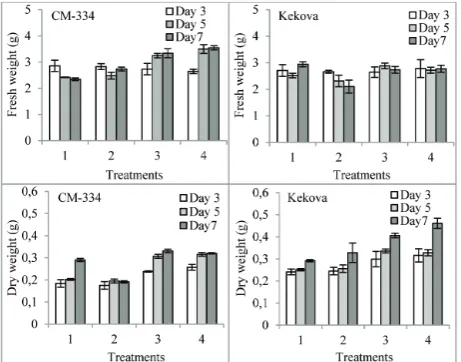
Compared with the control, the fresh weight of P. cap-sici-infected Kekova cultivar leaves decreased during the experiment (p<0.05). When samples treated with 1 mM proline + P. capsici and 10 mM proline + P. cap-sici were compared with the P. capsici-treated sample, it was found that the pretreatment with proline in-creased the fresh and dry weights of the leaves in both pepper cultivars. The difference between the cultivars was found to be statistically significant (p<0.05). The application of 10 mM proline + P. capsici caused the highest increases in the fresh and dry weights of leaves of both cultivars (p<0.05) (Fig. 2).
PAL, PPO, POX and CAT activities in the leaves of pepper cultivars
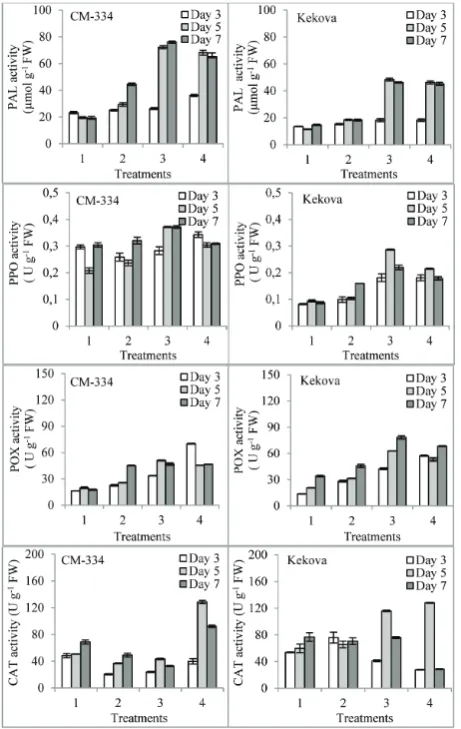
PAL activity in P. capsici-infected leaves increased during the experimental period in the two pepper cultivars (Fig. 3). Compared with the control, the maximum increase in PAL was observed on the 7th
day in the leaves of CM-334 seedlings infected with P. capsici. When the proline + P. capsici treatments were compared with the treatment with P. capsici alone, the pretreatments with proline were found to increase PAL activity in the leaves of the two pepper cultivars. Compared to the treatment with P. capsici alone, the highest enzyme activity was observed in the 1 mM proline + P. capsici-treated samples on the 5th day in
both the CM-334 and Kekova pepper cultivars; the increases in enzyme activities for these two cultivars were 145% and 163%, respectively (p<0.05) (Fig. 3.).
When PPO activity in the two cultivars treated with P. capsici alone was compared on the 3rd, 5th and
Fig. 2. Effect of proline application prior to exposure of pepper seedlings to P. capsici on fresh and dry weights of leaves. All values are the mean of three replications (n = 3). Vertical bars repre-sent standard errors (p<0.05). Type of treatment: 1 – control (no proline, no P. capsici); 2 – samples treated with P. capsici alone;
7th days following infection, the differences in
activi-ties between the cultivars were statistically significant (p<0.05). When proline was applied prior to the in-oculation with P. capsici, PPO activity increased, with the highest increase observed after treatment with 1 mM proline + P. capsici on the 5th day in both the
CM-334 and Kekova pepper cultivars. The increases in the activities were 57.3% and 176.3%, respectively (p<0.05) (Fig. 3).
Compared with the control, the activity of POX increased on the 3rd, 5th and 7th days following
infec-tion of the two pepper cultivars with P. capsici (Fig. 3).
In the leaves of the CM-334 cultivar, maximum POX activity was observed after treatment with 10 mM pro-line + P. capsici as compared to both the control and samples treated with P. capsici alone (p<0.05) (Fig 3). In the Kekova cultivar, the highest POX activity was measured in the 0.1 mM proline + P. capsici-treated sample on the 7th day, and in the 10 mM proline + P.
capsici-treated sample on the 3rd day (p<0.05) (Fig. 3).
Compared with the control, CAT activity in-creased on the 3rd, 5th and 7th days in the Kekova
cul-tivar infected with P. capsici, but not in the CM-334 cultivar. A decrease in CAT activity when compared to the control (p<0.05) was observed on all days in the CM-334 cultivar infected with P. capsici (Fig. 3). In the proline-treated samples, the highest enzyme activity in both pepper cultivars was observed on the 5th day
in the 10 mM proline + P. capsici-treated sample as compared to the sample treated with P. capsici alone. The increase in enzyme activity was 249.3% in the CM-334 cultivar and 95.3% in Kekova cultivar; the difference between the two was significant (p<0.05) (Fig. 3).
Total phenolicsand H2O2 levels in the leaves of pepper cultivars
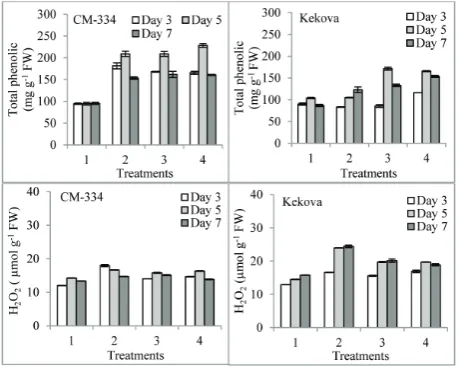
The application of P. capsici alone increased the total phenolic level in the two cultivars on the 3rd, 5th and
7th days when compared with matching controls. The
application of proline prior to inoculation increased PPO activity on the 5th and 7th days in both pepper
cultivars; the difference between them was significant (p<0.05). In theCM-334 cultivar, the highest increase in the level of phenolics was observed on the 5th day in
the 10 mM proline + P. capsici-treated sample in com-parison to both the control and sample treated with P. capsici alone. The increase was 9.3% as compared to the sample treated with P. capsici alone (p<0.05) (Fig. 4). Compared to both the control and samples treated with
P. capsici alone, the maximum level of phenolics was observed in the Kekova cultivar after treatment with 1 mM and 10 mM proline + P. capsici on the 5th day.
Compared with samples treated with P. capsici alone, the increase in phenolic levels were approximately 62.9% and 57.8%, respectively (p<0.05) (Fig. 4.).
Treatment with P. capsici alone increased the H2O2 level in the two pepper cultivars on the 3rd, 5th and 7th
Fig. 3. Effect of proline application prior to exposure of pepper seedlings to P. capsici on PAL, PPO, POX and CAT activities in leaves. All values are the mean of three replications (n = 3). Ver-tical bars represent standard errors (p<0.05). Type of treatment:
days (p<0.05) (Fig. 4). Proline application before in-oculation decreased the level of H2O2 in both pepper cultivars. The difference between the two treatments was found to be statistically significant (p<0.05), with the highest decrease observed in the 1 mM proline +
P. capsici-treated CM-334 and Kekova pepper culti-vars. Compared with samples treated with P. capsici
alone, the levels of decrease in H2O2 in the CM-334 and Kekova pepper cultivars were 9% and 21.3%, re-spectively (p<0.05) (Fig. 4).
DISCUSSION
In this study, the Kekova cultivar presented a sensitive reaction to the pathogen. The disease proceeded so rapidly in the Kekova cultivar that most of the seed-lings were severely damaged by the 7th day; there was
an increase in the disease severity index values and the necrosis lengths. In this study, it was observed that CM-334 was the most resistant to P. capsici-22. In time, the difference between the cultivars increased in terms of resistance. When the effects of the treat-ments were compared on the 3rd, 5th and 7th days in
the two cultivars, pretreatment with proline decreased disease severity and necrosis. These data show that the
treatments were effective against P. capsici, and that they reduce pathogen levels under stress conditions.
Reactive oxygen species (ROS) are produced as normal products of plant cellular metabolism. Despite their destructive activity, they also function as second messengers in cellular signaling pathways, including the development of tolerance to various environmen-tal stresses. Abiotic and biotic stresses lead to excessive production of ROS, causing membrane damage, chlo-rophyll destruction and oxidation of several important metabolites in the cell, and ultimately cell death [23]. The electron transport chain in photosystems I and II (PSI, PSII (respectively) are the main sources of ROS in chloroplasts. ROS can cause a Mehler reac-tion during energy transfer from the chlorophyll in the thylakoid membrane of chloroplasts, and they can initiate lipid peroxidation that leads to a distur-bance in the membrane structure and its functions and adversely affect the transport and maintenance of membrane proteins. In this study, the treatment with 1 and 10 mM proline + P. capsici increased the fresh and dry weights of plant leaves. This can be related to the antioxidant properties of proline that protects pigments against ROS under P. capsici stress, which in turn decreases leaf pigment loss while also increasing photosynthetic efficiency and neutralizing the toxic effects of the fungus. Exogenously applied proline likely plays a role in protecting the photosynthetic apparatus from the adverse effects of P. capsici stress. These assumptions are also supported by data from studies conducted with various stress factors that in-dicated exogenous proline application preserves the photosynthetic mechanism [24,25]. Exogenous pro-line application improved the photosynthetic capacity of salt-stressed olive plants by increasing photosyn-thetic activity and the level of the photochemical ef-ficiency of PSI and PSII [24]. It was observed that leaf photosynthetic pigments were maintained by proline under salt stress [25]. The increase in fresh and dry weights could be associated with proline’s functions, which include the protection of the thylakoid mem-branes of chloroplasts (and hence of photosynthetic processes) against ROS attacks (proline decreases the production of singlet oxygen and reacts with hydroxyl radicals to generate nontoxic hydroxyproline). Proline also enhances general adaptation to negative environ-mental conditions.
Fig. 4. Effect of proline application prior to exposure of pepper seedlings to P. capsici on total phenolic and H2O2 levels in leaves. All values are the mean of three replications (n=3). Vertical bars represent standard errors (p<0.05). Type of treatment: 1 – control (no proline no P. capsici); 2 – samples treated with P. capsici alone;
Pathogen stress-induced excess generation of ROS, as well as the subsequent enhanced levels of defense compounds and the increased activities of many en-zymes during stress, has been reported in many plant species [23]. The present study indicates that the appli-cation of P. capsici alone increased PAL, PPO and POX activities and the total phenolic compound content and H2O2 levels when compared with the control. However, CAT activity responded differently in the two pepper cultivars under pathogen stress. CAT protects plants from oxidative stress-induced damage [26]. In a study investigating oxidative stress in eggplants, it was deter-mined that Ralstonia solanacearum infections caused an increase in total phenolic and H2O2 levels, and in CAT activity [26]. The antioxidant potential of CAT in the tissues of Capsicum annuum is not sufficient for preventing the oxidative damage in some condi-tions. Therefore, if CAT becomes inactive under some stress conditions, the toxic property of H2O2 is pre-vented with the increase in POX activity. These find-ings from previous studies supported the results of the present study. In the present study, a decrease in CAT activity was observed in comparison to the control as a result of the P. capsici infection in CM-334, while on the other hand, POX activity increased in the same cultivar. POX stimulates the formation of compounds such as lignin and suberin, strengthening the cell wall and increasing the production of phytoalexin, thus forming a physical barrier that prevents the spread of the pathogen during the life cycle of the plant.
Proline is known to act as an enzyme protectant during stress conditions [7,27]. Proline can protect cellular and subcellular membranes from oxidative stress by enhancing the activities of various defense enzymes [27-29]. This is because the 3-D structure of proteins is governed by hydrophobic/hydrophil-ic, ionic interactions and interactions between side chains of the constituent amino acids. Proline could interfere with these side chain bonds and induce con-formational changes in enzymes and thus affect their activity [7]. In the present study, the exogenous ap-plication of proline improved the enzyme activities of
P. capsici-stressed pepper plants. When proline was administered before inoculation, it was observed that it caused further increases in PAL, PPO and POX ac-tivities and total phenolic compound levels in both pepper cultivars. The highest CAT and POX activities were observed in both pepper samples exposed to 10
mM proline + P. capsici. CAT and POX activities in-creased in both pepper varieties subjected to P. capsici
stress, and exogenous proline enhanced the activities further, pointing to the H2O2 scavenging role of pro-line. The high activities of enzymes coinciding with the lower accumulation of H2O2 in P. capsici stress induced a significant increase in H2O2 in the two pep-per cultivars. The exogenous application of proline resulted in a reduced H2O2 level and hence in lower oxidative stress in plant cells. This positive effect of proline may be related to its antioxidant property [7].
Some of the important phenolic compounds are derivatives of the phenylpropanoid pathway. PAL is the enzyme at the entry-point of the phenylpropanoid pathway. There are many reports describing changes in PAL and PPO activities which support the notion that PAL and PPO are involved in the synthesis of phenolics. In the present study, pretreatment with proline increased PAL and PPO activities and the level of total phenolics on the 5th day when compared
with P. capsici-treated pepper cultivars. A positive connection was observed between PAL activity and phenolic compounds in the two cultivars. PAL is a key enzyme of phenolic biosynthesis in plants. PPO has antipathogen effects, including general toxicity, which is provided by PPO-generated quinones to pathogens and plant cells that accelerate cell death, alkylation and reduce the bioavailability of cellular proteins to the pathogen, cross-link quinones with proteins or other phenolic compounds, forming a physical barrier to pathogens in the cell wall [30]. Phenolic compounds help to strengthen the cell wall against pathogens, in-hibit fungal growth, and act as free radical scavengers, thereby overcoming oxidative stress [30].
seedling, while the highest POX and CAT activities were found in the 10 mM proline + P. capsici-treated seedlings. The results of this study indicate that the application of 1 and 10 mM proline has a positive ef-fect on pepper under P. capsici stress.
The findings presented here show that proline is a signaling molecule capable of activating PAL, PPO, POX and CAT enzymes, thereby limiting free radical generation and preventing membrane peroxidation and denaturation of biomolecules, resulting in im-proved seedling growth under P. capsici stress. Similar effects have also been observed in several other recent studies [24-33].
The importance of proline in enhancing plant stress tolerance through exogenous application re-ported here is supre-ported by reports describing its beneficial effects in plants under different stress conditions [7,25,34]. In studies conducted during the last decade related to the control of fungal plant diseases, proline application has been suggested as a new strategy for regulating plant stress tolerance. Thus, the exogenous application of proline may be an efficient approach to ameliorate the adverse effects of
P. capsici-induced stress. Nevertheless, the effective-ness of proline applied as a foliar spray depends on the type of cultivars, stress level, age of plant, time of application and concentration. In this study, the dif-ferent defense responses are linked to difdif-ferent geno-types. These findings have provided a clue to the role of proline application in plant defense and show that determining the appropriate concentrations of exog-enously applied proline may be an effective way of protecting pepper plants against P. capsici infection.
Conflict of interest disclosure: There is no conflict of interest.
REFERENCES
1. Kim D, Lee JH, Choi W. Analysis of genes expressed during pepper-Phytophthora capsici interaction using EST Technol-ogy. J Life Sci. 2014;24(11):1187-92.
2. Leonian LH. Stem and fruit blight of peppers caused by Phy-tophthora capsici sp. Nov. Phytopathol. 1922;12:401-8. 3. Kamoun S, Furzer O, Jones JD, Judelson HS, Ali GS, Dalio RJ,
Roy SG. The top 10 oomycete pathogens in molecular plant pathology. Mol Plant Pathol. 2015;16:413-4.
4. Sun WX, Jia YJ, O’Neil NR, Feng BZ, Zhang XG. Genetic diversity in Phytophthora capsici from eastern China. Can J Plant Pathol. 2008;30:414-24.
5. Abak KA, Pitrat M. A study on resistance to root rot dis-ease (Phytophthora capsici Leon.) in peppers. AUAF annual. 1980;933-47.
6. Garcia AC, Arispuro HE, Tellez MAM. Cell metabolism – cell homeostasis and response. In: Paula B, editor. Oligo-glucan elicitor effects during plant oxidative stress. Rijeka, Croatia: Intech; 2012. p. 1-12.
7. Hayat S, Hayat Q, Alyemeni MN, Wani AS, Pichel J, Ahmed A (2012) Role of proline under changing environments. Plant Sign Behav. 2012;7(11):1456-66.
8. Shao H, Chu L, Shao M, Jaleel CA, Hong-mei M. Higher plant antioxidants and redox signaling under environmental stresses. C R Biol. 2008;331:433-41.
9. Ali Q, Anwar F, Ashraf M, Saari N, Perveen R. Ameliorating effects of exogenously applied proline on seed composition, seed oil quality and oil antioxidant activity of maize (Zea mays L.) under drought stress.Int J Mol Sci. 2013;14:818-35. 10. Pochard E, Molat M, Dominquez J. Etude de deux nouvelles
sources de resistance a Phytophthora capsici Leon. Chezle piment: confirmation de l’existence de trois composantes distinctes dans la resistance.Agronomie. 1983;3:333-42. 11. Jones DR, Unwin CH, Ward EWB. Capsidiol induction in
pepper fruit during interactions with Phytophthora capsici and Monilinia fructicola. Phytopathol. 1975;65:1417-9.
12. Jones DR, Graham WG, Ward EWB.Ultrastructural changes
in pepper cells in a compatible interaction with Phytophthora capsici. Phytopathol. 1974;1084-90.
13. Koç E, Üstün AS, İşlek C, Arıcı YK. Defence responses in leaves of resistant and susceptible pepper cultivars infected with different inoculum concentrations of Phytophthora cap-sici Leon. Sci Horticul. 2011;128(4):434-42.
14. Kim YJ, Hwang BK, Park KW. Expression of age-related resis-tance in pepper plants infected with P. capsici. Plant Dis. 1989;73:745-7.
15. Ochoa-Alejo N., Salgado Garcilia R. Phenylalanine ammo-nia-lyase activity and capsaicin-precursor compounds in p-fluorophenylalanine-resistant and sensitive variant cells of chili pepper (Capsicum annuum). Physiol Plant. 1992;85:173-9.
16. Ochoa-Alejo N, Gómez-Peralta JE. Activity of enzymes involved in capsaicin biosynthesis in callus tissue and fruits
of chili pepper (Capsicum annuum L.). J Plant Physiol.
1993;141(2):147-52.
17. Zheng HZ, Cui CL, Zhang YT, Dan W, Yu J, Yong KK. Active changes of lignification-related enzymes in pepper response to Glomus intraradices and/or Phytophthora capsici. J Zheji-ang Univ SCI. 2005;6(8):778-6.
18. Lin CC, Kao CH. Abscisic acid induced changes in cell wall peroxidase activity and hydrogen peroxide level in roots of rice seedlings. Plant Sci. 2001;160(2):323-9.
19. Aebi H. Catalase in vitro. Methods Enzymol. 1984; 105:121-6. 20. Gayosa C, Pomar F, Merino F, Bernal MA. Oxidative
metabo-lism and phenolic compounds in Capsicum annuum L. var.
21. Singleton VL, Orthofer R, Lamuela-Raventos RM. Analysis of total phenols and other oxidation substrates and antioxi-dants by means of Folin–Ciocalteu reagent. Methods Enzy-mol.1999; 299:152-78.
22. Velikova V, Yordanov I, Edreva A. Oxidative stress and some antioxidant systems in acid rain treated bean plants. Protec-tive role of exogenous polyamines. Plant Sci. 2000;151:59-66.
23. Sharma P, Jha AB, Dubey RS, Pesserakli M.Reactive oxygen
species, oxidative damage, and antioxidative defense mecha-nism in plants under stressful conditions. J Bot. 2012;1-26. 24. Ahmed CB, Rouina BB, Sensoy S, Boukhriss M, Abdullah FB.
Exogenous proline effects on photosynthetic performance and antioxidant defense system of young olive tree. J Agric Food Chem. 2010;58(7):4216-22.
25. Rady MM, Taha RS, Mahdi AHA. Proline enhances growth, productivity and anatomy of two varieties of Lupinus termis L. grown under salt stress. S Afr J Bot. 2016;102:221-7. 26. Mandal S, Acharya P, Kar I. Reactive oxygen species
sig-nalling in eggplant in response to Ralstonia solanacearum infection. J Plant Pathol. 2014;96(3):525-34.
27. Sharma P, Dubey RS. Modulation of nitrate reductase activity in rice seedlings under aluminium toxicity and water stress: role of osmolytes as enzyme protectant. J Plant Physiol. 2005; 162:854-64.
28. Islam MM. Exogenous proline and glycinebetaine increase antioxidant enzyme activities and confer tolerance to
cadmium stress in cultured tobacco cells. J Plant Physiol. 2009;166:1587-97.
29. Reddy PS, Jogeswar G, Rasineni GK, Maheswari M, Reddy AR, Varshney RK, Kishor PBV. Proline over-accumulation alleviates salt stress and protects photosynthetic and
anti-oxidant enzyme activities in transgenic sorghum [Sorghum
bicolor (L.) Moench]. Plant Physiol Biochem. 2015;94:104-13. 30. Moschou PN, Wu J, Cona A, Tavladorki P, Angelini R. The
polyamines and their catabolic products are significant play-ers in the turnover of nitrogenous molecules in plants. J Exp Bot. 2012;63(14):5003-15.
31. Kahlaoui B, Hachicha M, Teixeira J, Misle E, Fidalgo F, Hanchi B. Response of two tomato cultivars to field-applied proline and salt stress. J Stress Physiol Biochem. 2013;9(3):357-65. 32. El-Naggar HM. 2012. Phenylalanine ammonia-lyase (PAL)
gene activity in response to proline and tyrosine in rosemary callus culture African J Biotech. 2012;11(1):159-63. 33. Nounjan N, Nghia PT, Theerakulpisut P. Exogenous proline and
trehalose promote recovery of rice seedlings from salt-stress and differentially modulate antioxidant enzymes and expression of related genes. J Plant Physiol. 2012;169(6):596-604.